Mailbag, Social Media

The Mailbag: Contending for the Faith on Social Media

Originally published December 5, 2016

mailbag


I was wondering what your opinion is about using Facebook to correct false doctrine. Mostly what I do is post Scriptures, but every once in a while I may comment on something that is blatantly contrary to the Bible and I try to point to the appropriate Scriptures to show the truth. This mostly happens when a popular preacher or teacher that does not hold to sound doctrine posts something, or when a friend posts something that is clearly unbiblical.

This is such a great question that so many of us (including me!) struggle with. We love our friends and don’t want to see them believing something unbiblical (and spreading it around on social media) and it’s hard to just scroll past the blasphemy false teachers so often post without taking a stand for God’s word.

I readily admit I don’t have a perfect answer for this question. On the one hand, you want to protect your friends from error. On the other hand, there aren’t enough hours in the day to correct every single false teaching out there. And, if you try, people stop listening and you become ignorable background noise. Here are some of the principles I personally try to operate from on my personal (personal friends and family) social media pages. (I try to be consistent, but it doesn’t always work out that way):

  • Do keep in mind that – if it’s a matter of someone simply following a false teacher/ministry, not re-posting – people don’t always follow these accounts because they agree with them. Sometimes it’s to keep an eye on what the false teacher is teaching, to find out more about her doctrine because her materials are being introduced at church, etc. I follow two or three accounts on Twitter for reasons like that.
  • By and large, I don’t follow false teachers/ministries on social media. It just raises my blood pressure too much. So, for the most part, I don’t comment directly on false teachers’ posts because I don’t see them in my feed. If you do decide to comment, be sure you provide ample, in context Scripture passages to support what you’re saying, and comment in a patient, kind tone, not with histrionics, keeping in mind that most of the people who follow that false teacher are baby Christians, Christians who simply aren’t aware they’re being fed false doctrine, or false converts. Be aware that you’re almost certainly not going to change anyone’s mind, that people will verbally eviscerate you, and that the admin of the page will probably block and/or report you.
  • My main way of sharing biblical truth and discernment is to post about it on my own timeline. That way, the information is out there, yet direct confrontation is avoided.
  • When it comes to posting things on your own news feed, make sure you’re posting about good resources and teachers as well as warning about the bad. It’s not enough to get people away from bad teaching. They need somewhere to go for good teaching.
  • I have something of a “Golden Rule” policy about commenting on other people’s posts. I’ve had people comment on my discernment-type posts rebuking me and arguing with me for posting such things, as though they have some sort of right to dictate what I can and can’t post on my own page. That’s not right. People have the right to post what they want to post on their own page, and, while I’m not always perfect at it, I try to remember to respect that fact with others as I would want them to respect it with me. If what the person has posted concerns me for her soul, I will send her a private message. I operate on the assumption that people who claim to be Christians would want to know they’re posting something that’s in conflict with God’s word.
  • If someone’s post or comment makes me biblically angry, I try to remember to wait 24 hours before responding. I’ve found that helps me to calm down and respond more patiently and kindly. I’ve also found that sometimes my anger clouds my understanding of what the person actually meant. I have greater clarity the next day and can respond (or even refrain from responding) more appropriately.
  • There are two passages of Scripture I try to keep in mind when responding to people on social media about false teaching. The first is 2 Timothy 2:24-26. It reminds me of where that person might be coming from and how I am to comport myself:

And the Lord’s servant must not be quarrelsome but kind to everyone, able to teach, patiently enduring evil, correcting his opponents with gentleness. God may perhaps grant them repentance leading to a knowledge of the truth, and they may come to their senses and escape from the snare of the devil, after being captured by him to do his will.

The second is Matthew 7:6:

Do not give dogs what is holy, and do not throw your pearls before pigs, lest they trample them underfoot and turn to attack you.

The Bible is the final word of the holy God of the universe. What He says, goes, whether people believe it or not. It is stake in the ground, unalterable truth that needs no defense from us to pigs and dogs (not that everyone who posts false doctrine is a pig or dog- sometimes they’re just unaware). Sometimes the best response you can give on social media is to patiently lay down simple biblical truth in one comment and walk away, refusing to engage in debate, and trusting God to work on people’s hearts through His word.

  • Above all, pray. Pray for the false teacher/ministry you’re concerned about. Pray for the friend or loved one who’s re-posting false doctrine, that God will open her eyes to the truth. Pray about whether you should approach someone on social media, in which venue (comment, private message, etc.), and for wisdom to use the right words, tone, and Scriptures.

If you have a question about: a well known Christian author/leader, a Bible passage, an aspect of theology, a current issue in Christianity, or how to biblically handle a family, life, or church situation, comment below (I’ll hold all questions in queue {unpublished} for a future edition of The Mailbag) or send me an e-mail or private message. If your question is chosen for publication, your anonymity will be protected.

Discernment, Guest Posts

Guest Post: Lauren Daigle and the Fruit of “Losing her Religion”

If your theology pretty much matches up with mine (as outlined in the “Welcome” and “Statement of Faith” tabs) and you’d like to contribute a guest post, drop me an e-mail at MichelleLesley1@yahoo.com, and let’s chat about it.

Lauren Daigle and the Fruit of “Losing Her Religion”
by Laura M.

“It would be a sad dishonor for a child of God to be the world’s favorite. It is a very bad sign to hear a wicked world clap its hands and shout, “Well done!” to the Christian…Far be it from us to seek a crown of honor where the Lord found a crown of thorns.”  CH Spurgeon

Lauren Daigle is a 28 year old Grammy award winner. In her short career she has won many awards, secular and Christian. She has four number one songs to date and many more at the top of the billboard charts. She has over 1 million Facebook followers, and an abundance of world tour dates that she alone headlines. Her Look Up Child album just reached double platinum. She is wildly popular in the church and on Christian radio stations.

The secular world is now also paying attention. What have they learned? This is an interview with Billboard.com 

“’My home church is right here,’ [Lauren] says, gesturing toward the stage.It’s right here, every night.'”

“Daigle doesn’t preach, onstage or off. In between songs at the show, she told goofy stories — like one about her misadventures in physical therapy — but never mentioned Jesus.” 

That one interview said a lot –no church, means no pastor, no teaching, no growing…no obedience.

Sure, she is fun and cool and trendy and sincere in her desire to use her talents, but is that enough to be labeled a Christian artist? Even she does not want to be described that way, having determined to drop the word “Christian”. Yet, Christians have her at the top of their “worship” playlists.

Should we consider her as purely secular entertainment? Christian words and a great voice filled with sincerity do not make worship acceptable before God.

“When we talk about worship, we’re talking about something very specific, very objective, revelatory, unfolded for us on the pages of Scripture. It is not private, it is not personal in the sense that you define it yourself. It doesn’t rise out of your intuition. It doesn’t rise out of your experience. It doesn’t rise out of your imagination. It isn’t the invention from your own mind of what you want it to be. True worship is simply treating God in the way that God has commanded us to treat Him. That’s what it is.” The Kind of Worship God Desires, John MacArthur

We should have a great concern about the platform and influence that many so called “worship leaders” have in the church today.  Many Christians incorrectly assume that if the words are not heretical and make them “feel” good, it must be acceptable worship. Lauren Daigle is growing in her platform and influence and we should take a discerning look at whether this is a wise choice for Christians. Is the fruit of Lauren’s “Religion” good or bad?

Her Partnerships

Here are just a few, Stephen Furtick and Jesus CultureJoyce Meyer , Hillsong, Bethel Church and here Lauren is leading “worship” at Bethel.

Michelle has already written much about these false teachers and churches.

Her Testimony

Can you tell what is missing? She does not start with Christ.  Does she finish with Him? She was interviewed by the Young Salvationist here (it seems they have removed it since we copied the text). 

The interviewer asked her, “Please share with our readers how you came into a relationship with Jesus Christ?”

When I was 15 years–old I was diagnosed with a debilitating virus. It’s kind of funny how God sets things up, as I was super busy. I was in high school running all over the place and God stopped me – He stopped me in my tracks. I was placed on homebound rest for two years with this illness. It was during that season when I truly began to know God and His character. He gave me hope the entire time; I wasn’t going through this for any reason. This wasn’t just the lot I was handed in life. No, I knew, I could tell, God was setting me up for something and I needed to stay focused.

So, every morning I would get up and read my devotionals and every night before bed. Soon I started making my own devotionals. The Word was filling me up so much and during a season when I was completely alone… During that time, God would give me visions and dreams of the season that I’m walking through now! He affirmed me and who I was in Him. He showed me that my placement had to be with Him and He began to teach me that He was my comforter, He was my portion and He was my foundation. I was baptized when I was a little girl, raised in the church, and a part of a Christian family; but it changed from that to God being my source, my Savior.”

This is typical of many who have their own personal dream and attach God’s name to it. She did not say how she was changed and she did not once mention Christ or sin or the Cross. Did she mention reading the Bible? A Scripture perhaps? No, only visions.

Her website would surely have a larger testimony for us to read. However, I did not find one. The most “spiritual” she got was stating,

“It’s about remembering what it’s like to be a child again and to look up and see the clouds, the sunset, and the stars. It’s about having hope once more. You can always come back to yourself. You can come back to the things you thought were lost. You can always come back to redemption.”

She doesn’t say anything about Christ. Instead she is pointing to childhood memories, the clouds, the sunset, stars. What is the basis of renewed hope? How does one come back to yourself?

In another interview, she says, (of her teen years)

“And I kept having all of these dreams about tours, awards, charts and all of these different stages I’d be on. And I was like, ‘God what is this about? … Then He affirmed me...” 

From fear and uncertainty sprang resistance as Daigle made the personal decision to not pursue Christian music, despite messages from God telling her otherwise. “I told the Lord—yes I told Him, ‘I’m not going to do Christian music! I’ll sing whatever You want me to sing, I’ll do whatever you want me to do in the mainstream world, but I’m not doing Christian music.’”

She took her personal dream of stardom and attributed it to God.  There is much danger in this kind of mystical dream interpretation. It may have come to pass, but God does not affirm pursuit of the praise of men and I cannot say this is anything more than her pursuit of a personal desire.

The Praise of the World and Views on Sin

“The most effective servant of the Gospel of Christ crucified is crucified to the world and its applause.”  Mike Riccardi

Lauren said, “she will not compromise her faith while traveling the world ministering to those outside of the church…She vowed that her testimony would not be destroyed in any way.”

However, this is her response to being criticized for being on the Ellen DeGeneres show. Ellen is an open and proudly lesbian woman.

“I think the second we start drawing lines around which people are able to be approached and which aren’t, we’ve already completely missed the heart of God,” Daigle said during a recent interview with WAY-FM Radio.

Lauren missed the point, this is not about kindness it’s about being foolishly and sinfully drawn to the world and then affirming them because they have affirmed her. Jesus clearly drew lines in Matt 7.

And yet…after being on the Ellen DeGeneres show, she capitulated on her conviction not to compromise.

“Do you feel that homosexuality is a sin?”

After a pause, she responded: “You know I can’t honestly answer on that…I have too many people that I love that, they are homosexual, I don’t know. I actually had a conversation with someone last night about it and I was like ‘I can’t say one way or the other, I’m not God’

Pastor Gabe Hughes responds to this interview in a short video titled, Lauren Daigle doesn’t know if homosexuality is a sin?

And now, not surprisingly, Lauren Daigle Takes Issue with the Label ‘Christian Artist’

“After being in a spotlight of controversy for weeks regarding her stance on homosexuality, well-known Christian artist Lauren Daigle is now saying she doesn’t consider herself a Christian artist, but simply an “artist”….Interestingly enough, the young artist did not mention Jesus or God throughout the interview, sticking to general phrases like “faith,” while placing a large emphasis on the importance of love.”

It is not acceptable to equivocate on sins that Christ died to save us from.  He died for us to be reconciled to the Father, because we are without hope of saving ourselves, not for everyone to “feel” loved.

A 2019 article states,

“She admits the transition from a majority Christian audience to a more secular one has already been a “ride” and hints at the negative comments she’s been receiving from fans and others who are concerned the singer is leaving her Christian roots. Daigle seems unphased by the pushback, though. Risk is the best. Risk is the most beautiful thing,” she says with a smile.” source

And yet 4 years before in 2015, she said, 

God’s not a God of risks. He just says, ‘Trust me,’ because He has it all under control. To us, in our human life, it looks like a risk, but He’s like, ‘No, I’m God. I got this.’” source

This Christian Post article interviews her as well, sharing,

“Daigle went on to share a story about a megachurch pastor which was asked to step down from his ministry and lost his church, after having an affair with his secretary.

Lauren said,

I could see privately that he had some things to reconcile and I just thought about the nature of the church, to push out someone that operated in humanity,” she explained. “It’s so easy to push those people away or to build the white picket fence around our ideologies that create this counterculture that completely denies just the love of Christ, the grace of Christ, the mercy of Christ, and rejects the relationship with Christ.”

Lauren has an unbiblical view of sin, it is not in her testimony, it is not calling homosexuality the abomination that the Bible does, and it sympathizes with the poor pastor who disqualified himself by the most egregious sin against his wife. These are not the words of someone who submits to the authority of Scripture.

The Bible does not mince words (1 Cor 6:11) and neither should anyone who has been washed of the sins we have been so graciously forgiven and desire this to be true of others.

She also provocatively named a song, Losing My Religion and then comments

“This is an age where I am learning, what I believe in. We have a song on there that record called ‘Losing My Religion’ and I think one of the things that I’ve learned and one of the things that I’m embracing is the freedom of taking off the checked boxes, the rules, and all those things that kind of muddy up what faith actually is

Unfortunately, she has muddied her faith and is influencing many who flock to her and find the same muddy waters. This is exactly what we would expect from someone who claims that her church is her “stage”.

She excuses her decision to crossover by pointing to Avril Lavigne, Elvis Presley and Aretha Franklin because they sing a few gospel songs as well. “There’s all these people from back in the day that did this thing as well, where they had both. And I feel like history always repeats itself.” Billboard interview  Not great role models.

Remember, it is OK to be fruit inspectors, not just of false teachers but of everyone, fruit always gives evidence of the source of life. (Matt 7:17-20) We rejoice when we find good fruit and we warn when it is bad.

Lauren is leading worship to the masses she has before her. She seems to love the world, clings to false teachers and obfuscates clear Biblical teaching when given opportunity to proclaim it. As Christians, would it not be better to stop supporting her and so give her the wakeup call she needs rather than the praise and attention she is getting for bad fruit? If she does have a clear testimony of saving faith why is it not front and center for us to see?  

Let’s pray she would get off the stage and into a Biblical church to be taught well how to worship in “spirit and truth.” (John 4:23), and give opportunity for a pastor and church family to care for her soul. (Heb 13:17)


Laura and her husband Scott have been married 25 years and have three children. They live in a suburb of Philadelphia and NYC, where they have recently planted a church. She also writes with a few friends at Where Ordinary Life Meets Divine Truth as a ministry to the local women they are privileged to disciple.


Sin

Throwback Thursday ~ 9 Things that Are Still Sins Whether We Agree or Not

Originally published June 19, 20159 still sins


I do it all the time, Mother, and I’ve decided something-
it’s not a sin.

I heard this line several years ago on a popular sitcom, spoken by an adult daughter to her Christian mother about a behavior the Bible unambiguously calls a sin. I mean, it’s right smack dab in the middle of the Big 10; “thou shalt not” and everything.

It’s one thing to say, “I know it’s a sin, but I don’t care. I’m going to do it anyway,” but how depraved is the world when they think they – in God’s place – are the ones who get to define what sin is? And what’s even worse is that the church has begun to adopt this audacious depravity as well, whether approving of sin by fiat or by simply ignoring God’s word and letting sin slide without rebuke.

When it comes to what’s a sin and what’s not, God made up His mind a long time ago. And He’s not changing it, regardless of what you or I or Joe Politician or Jane Celebrity might think. Maybe we all need a remedial course in hamartiology, so let’s start with the basics. These things are all still sins whether the world and the church agree with God or not:

1. Homosexuality

Let’s just get it out of the way right up front. I don’t care how many celebrity “pastors” and “Christian” authors twist God’s word to say otherwise, or how many people declare themselves to be (unrepentant, practicing) “gay Christians,” or how many homosexuals declare that God made them that way, God’s word is clear: homosexual lust and behavior are sins.

2. Abortion

Abortion is the taking of an innocent human life. We don’t murder people because they’re small or sick or inconvenient or will hinder our sucess. God didn’t say, “You shall not murder, except when…” He said, “You shall not murder.” Period.

3. Extra-Marital (Heterosexual) Sex

Adultery, fornication, whatever form it might take, if you’re not legally married to the person you’re engaging in sexual activity – up to and including actual intercourse – with, you’re sinning.

4. Cohabitation

See #3. And don’t try to whitewash it by saying you’re living together but not sleeping together. A) The Bible says we’re to flee temptation, not move in with it, and B) we’re supposed to avoid every form of evil, even the appearance of it. If you call yourself a Christian and you’re shacking up, you’re living in sin (that’s why they call it “living in sin”). Repent and move out or marry up.

5. Divorce

Yep, still a sin, except in two cases: unfaithfulness or an unsaved spouse leaving a saved spouse. In those two cases the spouse who was wronged is not sinning and is free to marry again.

6. Swearing

The air is saturated with it. Foul language coming from our TVs, music, movies, social media, and the people we’re around all day. But expletives have no place in the vocabulary of a Christian. Is your potty mouth on Saturday the same one you praise God with on Sunday?

7. Taking God’s Name in Vain

It’s gotten to the point where we think so little of casually punctuating our sentences with, “Oh my G-d,”  or using the name of Jesus as an exclamation that pastors are even doing so from the pulpit these days. God’s name is high and holy and should be spoken only reverently and worshipfully. How can we look people in the eye and call them to repentance and faith in a Person whose name we use as a cuss word?

8. Gluttony

We have almost completely amputated gluttony from the spiritual realm by cordoning it off as merely a physical or medical issue. We’ve renamed it “overeating,” but that doesn’t change the fact that it’s a sin. God created good food for us to enjoy, but just as with all the other good gifts He gives us, He expects us to exercise Spirit-enabled self control when we receive it.

9. Female Usurpation

God makes it abundantly clear in His word that women are not to instruct men in the Scriptures or hold authority over them in the church. Women sin when they pastor churches, preach sermons in church, teach men in Sunday School classes, and hold other positions of authority over men in the church. Men, however, bear the primarily responsibility for this when they sin by failing to rebuke usurping women, or when women feel they have no other choice but to take on male responsibilities in the church because men are shirking their own duties before God.


We don’t get to decide what sin is. That’s God’s job. And all of us – whether we’ve committed one of these nine sins or not – are guilty of sinning against Him. That’s the bad news.

But, in Christianity, we never give the bad news without following it up with the good news. And, oh what wonderfully good news it is: forgiveness. Jesus paid for our sin at Calvary so that if we will only turn from it and trust Him, He will forgive us for all nine of these sins and countless others.

If we confess our sins, he is faithful and just to forgive us our sins and to cleanse us from all unrighteousness.
1 John 1:9

1&2 Peter Bible Study

Living Stones: A Study of 1 & 2 Peter ~ Lesson 2

Previous Lessons: 1

Read 1 Peter 1

Questions to Consider

1. Briefly review the housekeeping/helpful hints section and “Introduction to 1 Peter” section from lesson 1 (link above). Pull up the link to the maps for 1 Peter in that lesson, and locate the areas mentioned in verse 1. Who were “the elect exiles of the Dispersion” (1) and why were they dispersed?

2. Is the end of verse 1 the end of Peter’s sentence? (Take note of where sentences begin and end in this book to make sure you’re understanding what Peter is saying in context. Have you noticed he sometimes uses very long sentences?). Read the remainder of the sentence in verse 2, and examine the phrases “according to,” “in,” and “for”. How is each member of the Trinity (2) connected back to “the elect exiles of the Dispersion” (1)? What do the words “foreknowledge,” “sanctification,” and “sprinkling” mean or signify?

3. A word to watch for: imperishable. Peter uses this word three times in this brief letter, two of which are in chapter 1. Identify the verses in chapter 1 containing the word “imperishable”. What is being described as imperishable, and why does Peter emphasize its imperishability? As we work through 1&2 Peter, be on the lookout for the theme of imperishability.

4. Read verses 3-9. Now let’s take a closer look at verses 3-5 (which is all one sentence). What does the phrase “born again” (3) mean, and how does the rest of 3-5 revolve around this phrase? Who has caused us to be born again? (3) How would you use this verse to explain to someone that salvation is all of God? That we do not “decide” to be saved nor play even the smallest part in saving ourselves? What are we born again “to” (3)? “Through” (3)? “To” (4)?

Now focus on 6-9. What does the word “this” in verse 6 refer back to? What does this passage teach us about trials and testing? (6-7) What is the purpose of trials/testing? (7a) What is the goal or anticipated result of trials/testing? (7b)

How do verses 3-9 encourage Christians to “keep our eyes on the prize,” and what is that “prize”? How does this passage explain that our eternity in Heaven is the culmination or “outcome” (9) of our faith, the fulfillment of our salvation (5,9). What circumstances in the life of his audience would cause Peter to keep directing their focus to eternity? How could focusing on your eternity with Christ help you to endure suffering or persecution?

5. Read verses 10-12, and compare the ideas in these verses to Hebrews 1:1-2 and 2 Timothy 3:16. Who are the prophets Peter refers to in verse 10? Explain in your own words the idea this passage conveys. What does “they were serving not themselves but you” (12) mean?

6. Read verses 13-25. In two words, what is the main idea of this passage? (15)

What does it mean to “prepare your mind for action” and “be sober-minded” (13) with regard to being holy and pursuing holiness?

How are we to “be holy”? Make a list of the ways these verses mention: 13-15, 17, 22

Why are we to “be holy”? List the reasons these verses describe: 16, 18-21, 23-25

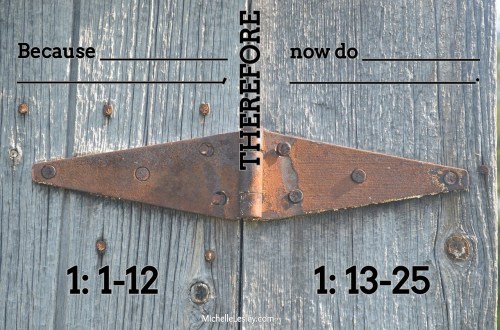
7. Verse 13 starts with the pivot word “therefore,” which means, “Because of all that stuff I just told you, here’s what you need to do.” (“So,” or “So then” at the beginning of a passage mean basically the same thing. Always watch for transitional or pivot words at the beginning of a sentence to help you tie the first part of the passage to the subsequent part of the passage.) The old adage, “Whenever you see the word ‘therefore’ in Scripture, you need to find out what it’s ‘there for’,” is a great little hermeneutical rule of thumb.

Summarize chapter 1 in a “hinge sentence”:


Homework

Think about an area of your life in which you need to “be holy.” Spending more time in prayer? Cleaning up your language? Being patient with other drivers? Write out a plan for pursuing holiness in this area of your life this week (and beyond).

1. List 2-3 specific ways you can “prepare your mind for action” and “be sober-minded” (13) to lay a foundation for holy thoughts, attitudes, and actions.

2. How can you “be holy” in this area? Review verses 13-15, 17, 22, think about how they apply to your situation, and list 2-3 specific holy thoughts, attitudes or actions you can employ.

3. Why should you “be holy” in this area? Review verses 16, 18-21, 23-25, and explain why you should pursue holiness in this area of your life.


Suggested Memory Verse

(Every week of our study, you’ll see a suggested memory verse like the one above. You are welcome to grab the memory verse pic to use as your screensaver or wallpaper on your phone or computer, print it out and stick it somewhere you’ll see it frequently, or use it in any other way you wish to help you memorize the verse.)

Discernment

Discernment IS Love

I’m often accused of being “unloving” for writing in a direct or firm tone against false doctrine and other unbiblical issues in the church.

I received another such accusation recently on one of my older articles, “Nine Reasons Discerning Women Are Leaving Your Church“. I thought I’d share my response to the reader with you, because it seems there’s a misunderstanding among Christian women as to the biblical definition of love. It ain’t always “sugar and spice and everything nice” y’all…

“I don’t think you have a complete understanding of the biblical definition of love. You seem to think that “love” is restricted to always being sweet and nice to people. That’s not biblical.

–Was Jesus being unloving when He cleared the temple? (Matthew 21)
–Was Jesus being unloving when He rebuked the Pharisees? (Matthew 23)
–Was Jesus being unloving when He instructed us to disfellowship unrepentant sinners from the church? (Matthew 18:15-20)
–Was Paul being unloving when he turned Hymenaeus and Alexander over to Satan so they would learn not to blaspheme? (1 Timothy 1:19-20)
–Was Paul being unloving when he anathematized anyone who preaches a false gospel? (Galatians 1:6-9)
–Was Peter being unloving when he described false teachers in 2 Peter 2?
–Was Jude being unloving when he wrote to the brothers warning them about the evils of false teachers instead of writing about the gospel?

Am I being unloving in writing this article? No. Reproof, rebuke, and biblical instruction are all part of godly love. I am demonstrating love for Christ, His Bride, and His Word by pointing out biblical error that needs to be corrected. I am demonstrating love for ignorant pastors and churches by explaining to them why their most spiritually healthy members are leaving. I am demonstrating love for the thousands of doctrinally sound Christians out there who long to attend a healthy church and can’t find one because so many churches are in error in the areas I mentioned. And, I am demonstrating love for you by helping you understand what God’s definition of love is.

Is this article loving? You bet it is.”

Additional Resources:

I Can’t Sit Down, Shut Up, and Play Nice

Discernment: What’s Love Got to Do with It?