Parenting, Throwback Thursday

Throwback Thursday ~ Anything to Get the Kids to Read?

Originally published December 9, 2008.anything to read

This seems to be a new mantra that has sprung up among parents and educators over the last few years. I’ve heard it many times– said with an almost religious fervor –as though a child who doesn’t read is in the same immediate danger as a child who doesn’t eat.

And whenever I hear this statement made with such intensity, I can’t help but think, “Anything to get the kids to read? Really? Anything?” Just how far are we willing to go for the sake of reading?

Most recently I heard this statement made in response to a topic on my local talk radio station. It seems a high school English teacher assigned his class a book to read that contained a significant amount of profanity. Parents complained. The principal intervened and the assignment was terminated. Many who disagreed with the principal’s decision repeated the litany, almost in unison: “Who cares if there’s profanity? The kids were reading.

On another occasion, a Christian father and I were discussing the new movie and book, Twilight. He was planning to allow his “tween-ager” to see the movie in hopes that she would then read the books. He had made this decision, not because he thought the subject matter of the books or movie would be good for her (in fact, he indicated that he had decided to allow her to see it against his better judgment of the content), but because he wanted to do something that would get her to read more.

Now, granted, I haven’t read the book series or seen the movie, so my comment stems only from the several reviews and articles I’ve read about them, but has reading become so important even to Christian parents that they feel the need to OK a book/movie for their children that gives at least the appearance of nominal approval to vampirism?

Don’t get me wrong, I think reading is very important. I’m an avid reader, as are my children who are old enough to read independently. I guess I’m just a little perplexed that in a country with freedom of the press, where we have access to a bountiful supply of good books, both Christian and secular, that don’t contain questionable material, we are getting sucked into the mentality that the only way to get kids to read is to present them with books that contain and normalize profanity, occultism, gratuitous violence and gore, inappropriate and explicit sexuality, and any number of other things that we wouldn’t want them exposed to in real life. Why choose books like that when there are so many other better choices?

There are better ways to turn your kids into readers of good books:

  • Start early- Read to your kids from the time they are infants. Make it a normal, habitual part of life. I used to read to my babies when I was nursing them. I just read aloud from whatever book or magazine I happened to be reading at the moment myself. (That was actually a lot more interesting than reading Green Eggs and Ham or Go Dogs, Go to them a zillion times a day!)
  • Make it part of the daily routine- Just as you set aside time for brushing teeth, naps, daily devotions, homework, etc., set aside time every day to read to your children, or require your older children to spend a certain amount of time reading every day. One thing I have found that works well with my children is to occasionally allow them to stay up fifteen or twenty minutes past their bedtime, but only if they will use that time to read.
  • Make reading something to look forward to– Several years ago, I began a practice of reading my older children a book series every summer. We started with the Little House on the Prairie books, then moved to the Narnia books and others. As we near the end of the school year each May, one of the things I have them do is start looking around the library and the internet for the book series they want us to read that summer. They look forward to this each year. Finding an appropriate author or a topic your children like and having them watch for the latest book to come out is another way to build excitement.
  • Reward reading– Because I love to read so much, it is hard to for me to imagine anyone needing a reward for reading; it’s kind of a reward in itself! Some kids need a little more motivation, though. They might enjoy participating in reading contests such as Pizza Hut’s “Book It” program. Also, check out the programs at your local library. Our library sponsors a reading contest for both kids and adults every summer. It allows the reader to set a goal for the number of books he thinks he can read over the summer and then awards prizes for those who reach their goals. Or, if your kid is dying to see a movie that is based on a certain book, make seeing the movie a reward for reading the book.
  • Set an example– Be a reader yourself. Find an interesting book and curl up on the couch with your kids while they read their books.
  • Limit the electronic pacifiers– This is a good idea even if you’re not especially interested in getting your child to read more. Unlimited time in front of the TV, computer, gaming system, or hand-held video games is hazardous to your child’s intellectual health. Conversely, having your child read in order to earn “screen time” can be a good motivator.

As with everything else, it’s important to abide by Biblical principles when choosing reading materials for ourselves and our children. Reading is important, but not as important as filling our kids’ minds with Godliness.

Finally, brethren, whatever is true, whatever is honorable, whatever is right, whatever is pure, whatever is lovely, whatever is of good repute, if there is any excellence and if anything worthy of praise, dwell on these things. Philippians 4:8

Entertainment, Marriage, Movies, Throwback Thursday

Throwback Thursday ~ “No Greater Love”– Movie Review

Originally published March 21, 2011

I stumbled across this movie at my local library a few days ago, and, boy am I glad I did.

Jeff and Heather were the “lucky ones”.  Best friends from childhood, high school sweethearts, and married by 22, they were inseperable soul mates.

After the birth of her first and only child, Heather Baker (Danielle Bisutti) fell into a deep depression.  Hopelessly lost, she did the unthinkable– she abandoned her husband and her infant son –and vanished.  Jeff Baker (Anthony Tyler Quinn) was forced to raise their son Ethan as a single father.

Ten years after his wife’s disapperance, Jeff is finally ready to move on and is on the verge of marrying his new girlfriend.  His world, however, is dramatically rocked when Heather shockingly reappears in the most unusual place.
(From the “No Greater Love” web site.)

If you liked the movie Fireproof, you’ll almost certainly like No Greater Love.  The acting is much better, and so is the production quality.  Of course, that’s to be expected when a movie is made by a professional studio hiring professional actors rather than by a church using mostly church members as actors.  (That’s certainly not a dig at Sherwood Baptist Church.  They did a fantastic and admirable job with both Fireproof and Facing the Giants –both of which you should see, if you haven’t already –it’s just that professional studios and production companies have the resources and budget to put together a more polished product.)

The storyline of No Greater Love is unique and endearing, but believable.  The only thing I found to be a bit of a stretch was, well, how do I say this without giving too much away?  Let’s just put it like this: It can take a long time and a lot of difficult, painful emotional work for the most Godly among Christians to forgive someone who has wounded them unfathomably.  Generally speaking, one would expect that, for a similarly wounded unsaved person, forgiveness would probably come much more slowly and with even greater difficulty.  But I suppose there are exceptions to the rule.

Theologically, this movie is right on target.  Director, Brad Silverman, says in his commentary on the movie that his goal was to be as theologically correct as possible, and I think he nailed it.  To be honest, one of the reasons I picked up this movie was to see if there were any false doctrine or theology in it, so I was on the lookout for Biblical error.  None to be found as far as I could tell.

Does No Greater Love overtly share the Gospel, spelling it out step by step?  No.  That’s your job and mine, not the job of a movie.  I think, primarily, this is an entertaining movie which reinforces Biblical truth that Christian viewers (should) already know.  But it would also be a great movie to share with unsaved friends as a conversation starter for sharing the Gospel in detail.

For more information on No Greater Love, visit the web site and “like” the Facebook page.

No Greater Love is available for purchase at:
Lionsgate Studios
ChristianBook.com
Amazon.com

Money, Sanctification, Throwback Thursday

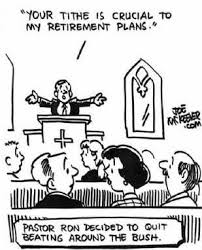
Throwback Thursday ~ To Tithe or Not to Tithe…

Originally published August 22, 2013tithetithe_challenge

…that is the question. But should it be? And is it really as simple as that? Yes. And no. On the “simple answer” side, there are two things to keep in mind:

First, Christians today are not required to keep any of the civil or ceremonial laws of Old Testament Israel. If you disagree, I hope you’ve got a parapet around the perimeter of your roof  and that when you harvest your wheat you’re sure to leave the gleanings on the ground. (Christians are, however, called to obey God’s moral laws –many of which are initially laid down in the Old Testament– not in order to earn or keep our salvation, but because we love our Savior and want to flee as far away from sin as possible.)

If you’re interested in the whys and wherefores of the reasons Christians are not required to keep the law of the tithe, there downloadare a number of great articles out there to help you understand. Check out this one, this one, and this one  for starters.

Second, the words “tithing” and “giving” are not synonymous. The New Testament is rife with admonitions to Christians to give, and examples of Christians giving (many of which went far beyond the amount that would have been required by tithing laws) to meet the needs of the church.

So, tithing- no. Giving- yes.

But there’s another aspect of this question, a bigger picture, that doesn’t fit neatly into a “yes or no” category. It’s the heart of the matter. The matter of our hearts.

There are those who will read the articles I’ve linked to above, and, despite solid biblical teaching on why Christians are not required to keep the law of the tithe, will balk at the idea. I know this because that’s exactly what I did when I was first introduced to this teaching. Most of the churches I’ve attended have taught that tithing is a requirement for Christians. It wasn’t a question of “should we or shouldn’t we,” it was the parsing of “gross or net”. Tithing was just assumed. And when you hear something that goes against what you’ve been taught in church all your life, you just naturally resist it. (As well you should. Many of the “new teachings” and “fresh approaches” you’ll encounter out there are nothing but centuries old heresies with a shiny new coat of paint on them.) But sometimes somthing we’ve been taught in church all our lives is wrong. Once you put your Berean spectacles on and thoroughly examine the Scriptures, do you still bristle at the idea of throwing out the requirement to tithe? Why?

Because it’s easier to write a check on autopilot than to take the time to examine our hearts.

Raise your hand if you remember offering envelopes in Sunday School. When I was a little girl, we filled out an offering envelope every Sunday in Sunday School whether we were giving an offering or not. There were little check boxes on the front of the envelope that said things like “Bible brought,” “Attending worship,” “Bible read daily,” etc. It was the way the teachers counted attendance and organized statistics. 

As fallen creatures, we are bent towards keeping one of those offering envelopes in the back of our minds. “Read my Bible today.” Check. “Prayed.” Check. “Wrote out my tithe check.” Check. And our spiritual lives never go deeper than a check on a checklist.

Remind you of anybody? The Pharisees, perhaps? Ouch.

Time and again, Jesus told them that their relationship with God wasn’t about surface behaviors, but a heart to heart –my heart to God’s heart—communion and intimacy with their Creator and Redeemer.

And I don’t know about you, but my fallen, broken, old nature resists that like the devil. Why? Because it’s messy and dirty. There’s no clear cut, singular, magic “right answer”. It requires a lot of time and effort and trial and error. It can get frustrating and discouraging. It’s inefficient.

tithingIt’s so much easier to just check off a few boxes, be done with it, and be on my way.

But that bent of our hearts is exactly the opposite of what God wants. He doesn’t want to receive our remuneration; He wants to consume our hearts.

“You have heard it said…” Jesus said to the Pharisees, quoting the law, “but I say to you…” it goes much deeper than that.

It’s not enough to keep from murdering somebody. What are the selfish motives in your heart that made you angry with your brother in the first place?

It’s not enough to refrain from the act of adultery. What’s going on in your heart that you’re even looking at that woman?

It’s not enough just to dutifully fulfill the requirement of the law. I want you to have a heart that is so dead to self and alive to Christ that it goes the extra mile joyfully.

Woe to you, scribes and Pharisees, hypocrites! For you tithe mint and dill and cumin, and have neglected the weightier matters of the law: justice and mercy and faithfulness. These you ought to have done, without neglecting the others. You blind guides, straining out a gnat and swallowing a camel!

Woe to you, scribes and Pharisees, hypocrites! For you clean the outside of the cup and the plate, but inside they are full of greed and self-indulgence. You blind Pharisee! First clean the inside of the cup and the plate, that the outside also may be clean.
Matthew 23:23-26

How’s that cup and plate looking? What’s going on in our hearts that we’re not already –simply as a result of being a new creature in Christ—giving of what we have whenever we see a need? It didn’t occur to the early church to quibble over percentages and gross vs. net. Their brothers and sisters were in need, and they dipped into the coffers of the treasure of their heartstheir love for Christ and the brethrenand met those needs.

Maybe we’re just not as acutely aware of the need today. Well get aware, and rejoice in your opportunity to give!

Your pastor and your worship leader and, depending on the dynamics and circumstances of your church, other church staffimages members, need to be able to support their families above the poverty level.

There are people in your church who have lost their jobs, and despite their best efforts, haven’t been able to find new ones. They need your help.

There are pregnant teenagers all over your city who don’t want to abort their babies but don’t see any other options. What can your offering do to help them?

There are people groups all over the globe who have never seen a Bible or heard the name of Jesus. How can we best steward our money to get the gospel to them?

People are dying and spending eternity in hell. Starving to death. Being abused. Living on the streets. Risking their lives to get their hands on a Bible. Trying to put food on the table as they labor to bring you God’s word. The check you put in the offering plate every Sunday can help them.

Forget the percentages and requirements of the law. How can a follower of Christ look upon those needs and ask, “Where’s my calculator?”

Where’s your heart?

Abortion, Forgiveness, Throwback Thursday

Throwback Thursday ~ There Is Forgiveness

Originally published January 22, 201314348483283701

Today is the 40th anniversary of Roe v. Wade, the Supreme Court decision which legalized abortion.

As we look back somberly on the 50 million babies who have died, we mourn for them. We are angered at those in power who have deceived women and men into thinking an abortion carries no more weight than having a tooth extracted or a wart removed. We rail at our leaders to put an end to the legality of this daily mass slaughter. We vote our consciences. We stand our ground.

And we forget.

We forget that after every abortion that takes place, there is a woman

or a man

or both

who need forgiveness.

The Bible says:

…the Lord hates…hands that shed innocent blood,
Proverbs 6:16-17

and

You shall not murder.
Exodus 20:13

Abortion is a grievous sin against God. It is a dreadful thing for a woman to grasp that she has tortured her child to death. Or for a man, who was created to protect the weak, to realize that he has murdered his helpless son or daughter.

But they must sit with that for a moment of time until it fully soaks in.

Because unless we see the horror of our sin for what it truly is, we will never be able to see the beauty of the cross in its fullness.

And, oh, how beautiful it is. For your sin and for mine.

There is forgiveness for abortion.

Lay the body of your child and your broken and contrite heart at the feet of the bloodied and battered Redeemer.

He was wounded for our transgressions,
He was bruised for our iniquities;
The chastisement for our peace was upon Him,
And by His stripes
we
are
healed.

Gospel, Homosexuality, Salvation, Sin, Throwback Thursday

Throwback Thursday ~ Cancer: A Love Story

Originally published April 7, 2013cancer love story

Cancer.

The dreadfulness of the word hung heavy in the air between Jana and her friend Denise.

“The doctor says it’s terminal,” Denise choked, “I’m so confused. I don’t know what to do.”

Jana’s heart broke as she envisioned the difficult emotional road ahead for Denise and watched the tears streaming down her face.

“I’d do anything to take that pain away,” thought Jana. “Anything.

For days after they parted, Jana’s thoughts were consumed with how she could help Denise accept and feel better about her condition. By the weekend, when they met for coffee, Jana was ready.

“Denise,” she began, “I’ve been giving it a lot of thought, and I think I know why you’re so uncomfortable with having cancer.”

“Oh? Why?” asked Denise.

“Well, first of all, you shouldn’t be fighting against the idea of having cancer. It’s a completely natural biological event. In fact, you were probably born genetically predisposed to cancer. It’s part of who you are. Accept it and embrace it as something that makes you unique and wonderful!”

Denise seemed skeptical, but Jana plunged ahead.Girlfriends Enjoy A Conversation

“You’re also worried about what other people will think of you. Maybe they’ll think you’re weak and try to help you with things that you’d rather do for yourself.”

“But maybe I’ll need some help,” Denise suggested quietly.

“Nonsense!” Jana retorted, “Having cancer doesn’t make you different from anybody else. It’s exactly the same as not having cancer. What we need to do is show that to the world. Maybe we should have a rally for cancer equality!”

“Jana, that’s great and all,” Denise whispered somberly, “but I’m going to die. That makes all the stuff you’re talking about seem a lot less important.”

Jana seems like a very loving and kind person, but does the “help” she was offering Denise seem…well…helpful?

What if I told you that during this entire scenario, Jana personally knew a doctor who had a proven cure for Denise’s type of cancer, and was giving it away, yet Jana never told Denise? How loving and kind does Jana seem now?

Now read back through this story and substitute “homosexuality” for “cancer”.

We live in a culture that tells Christians that we are to “love” our homosexual friends and loved ones by embracing homosexuality as good and natural. We even hear people who claim to be Christians saying this. But is this how the Bible defines love? Is this how Jesus loved people?

In this is love, not that we have loved God but that he loved us and sent his Son to be the propitiation for our sins. Beloved, if God so loved us, we also ought to love one another.
1 John 4:10-11

Think back over the encounters Jesus had with people, from the woman at the well, to Zaccheus, to Nicodemus, to the woman caught in adultery, to the rich young ruler, to anybody else Jesus ever interacted with.

Did Jesus ever “love” someone by telling him it was OK to stay in his sin?

No, He didn’t.

Jesus loved sinners by calling them to repentance, forgiveness, and a new life in Christ.

Why? Because it isn’t love to help the slave to embrace his chains. It’s love to set him free.

Christ loved us by going to the cross and becoming the propitiation –satisfying God’s wrath—for our sins. He laid down His life for our freedom.

And, Christian, if God so loved us, we also ought to love one another. We must lay down our opinions, our politics, our ideas of what we’d like the Bible to say, maybe even our actual lives, in order to help people know freedom in Christ. We have the cure for their spiritual cancer—the gospel—and it is not “love” to knowingly misdiagnose them or keep that cure from them.

Greater love has no one than this, that one lay down his life for his friends.
John 15:13

blurry-sky-cross
But as important as it is to rescue the perishing, there’s an even greater issue at stake here for those of us who claim the name of Christ.

For our sin, our Savior endured wrongful conviction, ridicule, mockery, and bullying.

For our sin, our Savior was slapped, punched, spit on, had His beard yanked out, and thorns and brambles mashed into His skull.

For our sin, our Savior had the skin flayed off His back, buttocks, and legs, whipped nearly to death until He was a bloody mess.

For our sin, our Savior, beaten, bloody, and broken of body, hoisted a heavy, splintery cross onto His shoulders and carried it through town and up the hill to His execution.

One nail.

Two nails.

Three nails.

For your sin. For my sin. For our neighbors’ sin.

How dare you, or I, or anyone spit in the face of our bleeding, dying Savior by saying that the sin that put Him on the cross is OK?

How dare we?

How can any of us claim to love Christ while celebrating the nails, the spear, the crown of thorns?

By this we may know that we are in him: whoever says he abides in him ought to walk in the same way in which he walked.
1 John 2:5b-6

Jesus walked the way of leading people to repentance from sin and to the beauty, the freedom of a glorious new life through faith in Himself. Will we, who say we abide in Him, love Jesus and our homosexual neighbor enough to walk in the same way in which He walked?

Mostloving