Sanctification, Sin

Throwback Thursday ~ The Garden of Weedin’

Originally published March 31, 2009

It’s that time again. Spring. Time to survey the damage winter did to the yard and get it back in shape. Sandwiched in between last week’s several days of rain and the multiple days of thunderstorms predicted for this week, were a few beautiful days that were just perfect for tackling the jungle that once was my back yard. Yikes. I could have lost a kid in all that grass.

Much to my dismay, when I got up close and personal with the overgrowth, I discovered that, once again, the army of weeds I spend every spring and summer fighting off had made significant advances into the yard. It also seemed to have secured the perimeter of my fencerow with a tall and nearly impregnable line of defense.

Heaving a sigh, I remembered what one gardener friend told me last year. The best way to fight off weeds is to get the grass really healthy and growing so it will choke out the weeds and reclaim the yard. Sounded reasonable to me. And familiar, too. Where had I heard something similar to that before? The idea tickled my brain as I hauled out the mower.

As I began shoving my trusty mower through that mess, it hit me. Weeds….choking something out. There was something about that in the Bible.

Ever notice how many of Jesus’ parables and illustrations include references to farming, plants, and other aspects of agriculture? The “Lord of the Harvest” gave us wheat and tares, fig trees, mustard seeds, vineyards, and of course, the parable of the sower scattering his seed.

Ah, that’s what it was. The parable of the sower. Remember him? He went out to seed his land, and the seed ended up finding its way not only to the good soil he had prepared, but also to some rocky soil, the roadside, and a patch of thorns (which the New Century Version translates as “weeds”):

Some other seed fell among thorny weeds, which grew and choked the good plants. Matthew 13:7 (NCV)

That’s exactly what was going on in my yard! The grass wasn’t yet strong enough to choke out all the weeds, the weeds were choking out my good crop of grass. They were also making my fencerow look awful, so I finished up the mowing, and, mentally assessing our temperamental edger, decided to clean off the fencerow by hand.

As I began yanking at those pesky plants, God reminded me that we all have weeds in our lives that need to be pulled up. So just what constitutes a “weed” in our spiritual lives? Well, Jesus was kind enough to explain that in Matthew 13:22:

And what is the seed that fell among the thorny weeds? That seed is like the person who hears the teaching but lets worries about this life and the temptation of wealth stop that teaching from growing. So the teaching does not produce fruit in that person’s life. (NCV)

Jesus compares the weeds to two things: “the worries about this life” and “the temptation of wealth”.

“The worries about this life” could cover just about anything. It could be a financial struggle, a wayward child, a difficult marriage, a hostile work environment, or even a painful past that we’re striving to put behind us. Any situation we deal with that looms so large, it blocks out our view of Christ and prevents us from trusting Him to handle it. Anything that takes our eyes off Him, tempts us to focus only on our circumstances, and derails the teaching God is trying to manifest in our lives.

“The temptation of wealth” could also cover a lot of areas in our lives. First Timothy 6:10 tells us that “the love of money is a root of all sorts of evil…”. Evil. In other words, sin.

“A root”. Hmmm…interesting.

Well, I was certainly dealing with plenty of roots. When it comes to weeds, it doesn’t do much good to simply pull the leaves off or snap the stem in half. For some reason, weeds– at least the ones in my yard –seem to take this as a challenge to grow back. You have to pull weeds up by the roots in order to get rid of them.

Likewise, if there is something in our lives which “stops [God’s] teachings from growing” or prevents God’s teachings from producing fruit in our lives (see Matthew 13:22 above) we need to have the Master Gardener root out the instigating problem rather than plucking at its leaves ourselves.

For example, if you’re struggling with being a workaholic, you can break off part of the stem of that problem by cutting back on work a few hours a week, but the root of the problem may be that you have made work an idol in place of God, that you don’t trust Him to provide for your needs, or that you are loving yourself and your work more than your family. If those root problems aren’t dealt with you will likely fail in your efforts to cut back on work, or something else, such as a hobby, may spring up to take the place of those hours you would have spent at work.

As I continued to work, I noticed that some weeds were very easy to pull up and some were quite difficult. The easiest to pull seemed to be the weeds that had taken root in the decaying leaf matter on top of the soil rather than in the soil itself. The difficult ones were the ones that had been growing for a long period of time. Some of their roots were over a foot long. These roots had made their way far from the visible plant and into another part of the yard, which meant they were affecting much more than just the immediate area around the plant itself.

And so it is with our spiritual weeds. The best time to deal with sin or turn a troubling situation over to God is early, before it has a chance to take root, because once it does, it’s going to be much harder to deal with and it’s going to begin to affect more and more areas of our lives.

Dealing with sin or difficult situations pre-emptively is even better. Flee temptation before you have a chance to give in to it. Determine to commit your works to the Lord and acknowledge Him in all your ways, and you will avoid some of the heartbreaking circumstances that might otherwise come your way.

As I struggled with one particularly stubborn weed, I noticed that its roots were intertwined with those of a couple of other totally different weeds. As I pulled at the one I was working on, the others were coming up as well.

When God pulls up those really difficult weeds in our lives, we will often find that He is simultaneously uprooting other sins and situations that have become enmeshed with the primary one. Sometimes when this happens to me, I feels like God is “piling on” and wish He would just work on one thing at a time in my life!

By the time I reached the end of the fencerow, I was sweating, my back was killing me, and I had broken two nails, despite the gardening gloves I was wearing. Pulling weeds is not a day at Disney World. It’s tough work!

But as I stood back and surveyed the results of my efforts, I saw that the fencerow no longer looked trashy. It looked clean and neat. Something any gardener would be pleased with. And, something else had happened that I hadn’t even noticed until that moment. As the roots of those weeds came up, they naturally tilled the soil.

It was moist,

loose,

rich;

the perfect condition for good seed to be sown by the Master Gardener.

Sanctification, Sin

6 Reasons to Recapture Righteous Anger

Do you ever get the sense that anger is a problem in the church these days? It’s more apparent if you’re on social media, but even if you’re not you’ve probably seen Christians acting in anger in your church and Christian groups you belong to. Maybe even among your Christian family and friends.

In the evangelical social construct today’s Christian women have built and immersed themselves in where “being nice” is the highest attribute we can attain to, anger – any anger whatsoever – is usually seen as sin. The antipode of the sweet, effervescent, always-positive, don’t-rock-the-boat church ladies we’re “supposed” to be.

In the evangelical social construct today’s Christian women have built and immersed themselves in where “being nice” is the highest attribute we can attain to, anger – any anger whatsoever – is usually seen as sin.

Time to pick up the biggest rocks we can find and smash that pretty pink stained glass window, ladies.

The problem with anger in the church is not anger itself, but that Christians get angry about the wrong things instead of the right things, and act on that anger – sometimes even anger over the right things – in the wrong way. There are many things Christians should be angry about. Indeed, if Christians got angry about the things we’re supposed to get angry about and acted on that anger in a biblical way, the church would be better – and more Christlike – for it. But what are the right and godly reasons for getting angry and acting on that anger?

If Christians got angry about the things we’re supposed to get angry about and acted on that anger in a biblical way, the church would be better – and more Christlike – for it.

1.
Anger Is an Attribute of God

No character trait God exhibits can ever be considered intrinsically sinful because God is holy and perfect. God displays anger numerous times in the Bible, yet we know God is without sin. Therefore, we know that the emotion of anger itself is not a sin. It can’t be, or that would make God a sinner, and, by definition, not God. God’s anger demonstrates for us that there are times and situations in which anger is holy and good, and that there are godly ways to act on that anger.

God’s anger demonstrates for us that there are times and situations in which anger is holy and good, and that there are godly ways to act on that anger.

2.
Imago Dei

People are made in the image of God. The creation reflects – albeit dimly and sinfully – the Creator. No one has to teach us how to feel anger or love or justice or desire. Those things are just there, hard wired into us from the womb simply because we’re image bearers. Our sin nature is where the train jumps the tracks with those attributes, because sin causes us to apply those attributes to the wrong objects (loving an idol, desiring someone else’s spouse) and to express those attributes in wrong ways (vengeance, abuse).

3.
Multi-Tasking Attributes

God is simultaneously perfect in love, power, wrath, kindness, compassion, anger, justice, mercy, grace, patience, and all His other attributes. When we see Him pouring out His wrath, that doesn’t mean His attributes of love and compassion have disappeared. When God executes judgment, that doesn’t mean He has ceased to be a merciful and patient God. All of God’s attributes are 100% present and potent all of the time. And – though filtered through our sinful flesh – the same is true for Christians. Expressing anger over the right things in a godly way does not cancel out the fact that you’re also loving, kind, patient, peaceful, or joyful. God created us to reflect His nature by simultaneously exhibiting His attributes in a godly way.

God created us to reflect His nature by simultaneously exhibiting His attributes in a godly way.

4.
Symbiotic Anger

How can we know whether we’re getting angry over the right things or the wrong things? It is right and good to be angry over the things that anger God – idolatry, the defaming of His name, false doctrine, sin in the church, people who harm or take advantage of the innocent and vulnerable, dishonesty, cruelty, deception, the failure to do what is right – first and foremost when we see these sins in our own hearts and lives, but also against others who perpetrate these sins. But we may not be angry for sinful reasons such as pride, selfishness, impatience, self-righteousness, inflexibility, greed, hate, bigotry, lust, and personal preferences. What the Bible shows God getting angry about we should be angry about, too.

What the Bible shows God getting angry about we should be angry about, too.

5.
Anger Versus Sadness

A few months ago on social media, I mentioned an incident in which a male member of a certain church sinfully took advantage of several female members of that church. Without exception, every Christian woman (and many of the men) who commented on the incident made the statement (or some variation of it), “That’s so sad.” There are many aspects of a sinful situation over which it’s appropriate to feel sad. It was right to feel sad for this man’s completely innocent wife and children, as well as his victims and the church, who all suffered as a result of his sin. Jesus wept over the effect sin had on His beloved Jerusalem and the rift that sin created between God’s people and Himself. But, interestingly, both Matthew and Luke show us an instance of Jesus’ sorrow over sin immediately preceding or followed by an instance of Jesus’ anger over sin. It’s fine to feel sad for the people who innocently suffer as a result of someone else’s sin. It’s godly to grieve over the general effects and ultimate consequences of sin. But don’t stop there. We should also be angry at sin and at those who blaspheme the name of God and harm others by committing sin. The biblical instances of God being angry over sin and those who perpetrate it far outnumber the instances of God grieving over the effects of sin. Sadness is good, but it shouldn’t replace godly anger toward sin.

Sadness over sin is good, but it shouldn’t replace godly anger toward sin.

6.
Harness the Wild Stallion

Up until now, we’ve mostly been looking at the emotion of anger, but the emotion of anger usually leads to action. The fact that the emotion usually leads to action doesn’t mean the emotion always should lead to action. Sometimes it shouldn’t lead to action at all. Sometimes it shouldn’t lead to action right away. Sometimes it shouldn’t lead to action from you, but from a more appropriate person.

But most of the time, if you’re experiencing righteous anger over the right things, that godly anger should motivate you to take godly action using godly methods. And one of those godly methods is understanding the difference between letting the wild stallion of anger tear madly around the corral and putting a bit and bridle in its mouth to harness and guide all of that energy into plowing a field or pulling a wagon. Venting your anger to a friend might make you feel better temporarily, but it does nothing to fix the problems created by the sin you’re angry about. Harness your anger with the fruit of the Spirit and use that anger as a tool to energize and motivate you to help the victims of sin, call the sinner to repentance, set up a plan to prevent this sin from happening again, and repair the damage done by sin.

How often do you become righteously angry over sin? When you hear a false teacher twist God’s Word, do you blow it off as no big deal? Does it faze you at all when church members refuse to submit to your pastor’s biblical leadership? Do you lend an ear when your best friend verbally eviscerates her godly husband to you?

Ladies, there are things WORTH getting angry about. Righteous anger is not a bad, unloving, or unladylike thing.

Ladies, there are things worth getting angry about. Righteous anger is not a bad, unloving, or unladylike thing. If someone intentionally hurt your child, you would come unglued because you love him so much. What does it say about our love for the Lord when we defend people who mock Him, give the benefit of the doubt to those who defame Him, or yawn apathetically when people rebel against Christ and His Word? When someone blasphemes the name of the holy God of the universe, the Savior who willingly endured the cross for your sin, why wouldn’t you get angry about that? When someone attacks, betrays, or perpetrates evil upon a fellow image bearer – especially if that person is a brother or sister in Christ – you are right to be angry at both the sin and the sinner.

Anger over sin and evil is good and holy. God exhibits anger over sin and evil, and we, as His image bearers, should share His indignation. When Christians are angry over the right things and use that anger to fuel a godly response to sin it makes the church more biblically healthy and grows it to greater Christlikeness.

When Christians are angry over the right things and use that anger to fuel a godly response to sin it makes the church more biblically healthy and grows it to greater Christlikeness.

Sin, Throwback Thursday

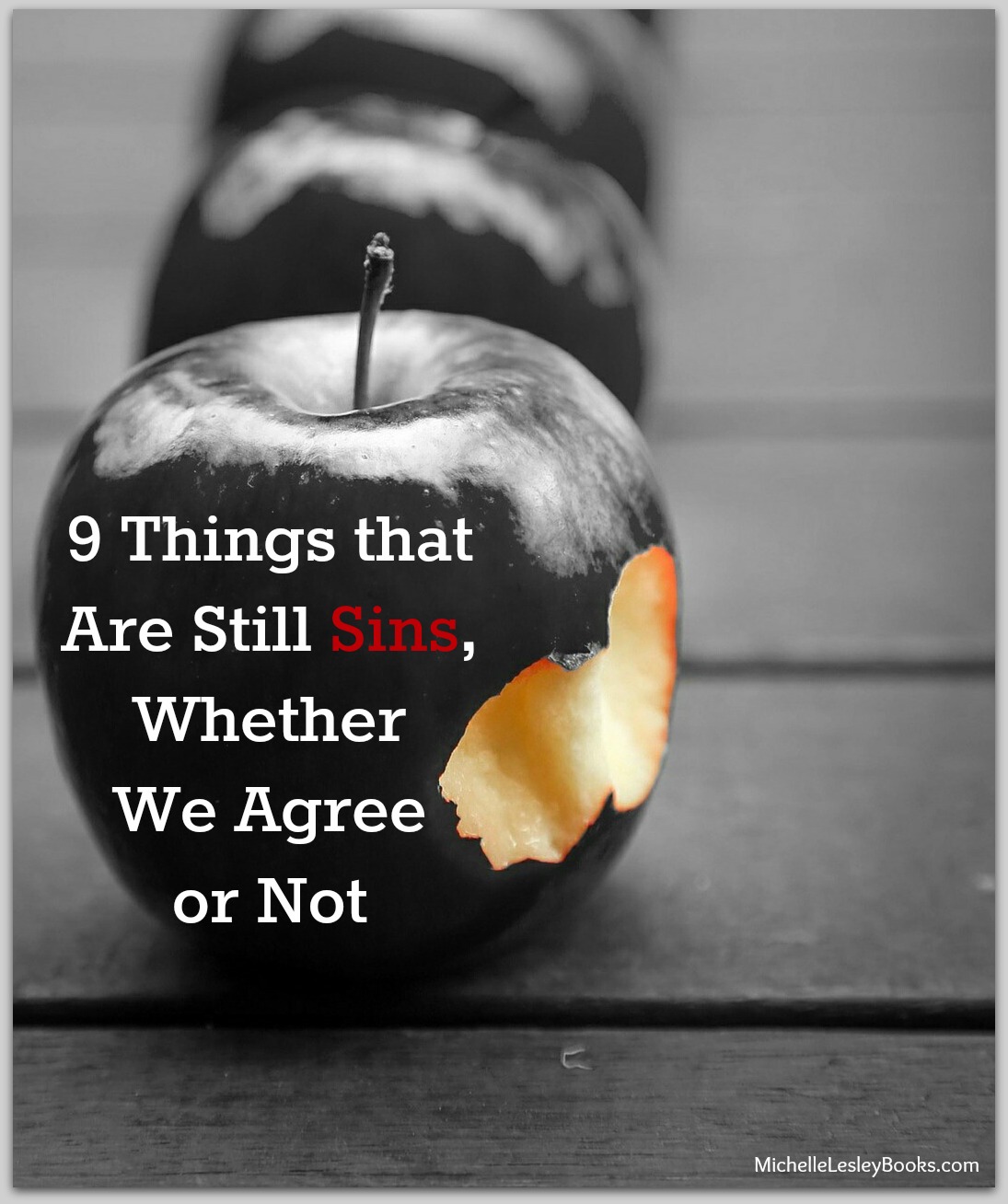
Throwback Thursday ~ 9 Things that Are Still Sins Whether We Agree or Not

Originally published June 19, 20159 still sins


I do it all the time, Mother, and I’ve decided something-
it’s not a sin.

I heard this line several years ago on a popular sitcom, spoken by an adult daughter to her Christian mother about a behavior the Bible unambiguously calls a sin. I mean, it’s right smack dab in the middle of the Big 10; “thou shalt not” and everything.

It’s one thing to say, “I know it’s a sin, but I don’t care. I’m going to do it anyway,” but how depraved is the world when they think they – in God’s place – are the ones who get to define what sin is? And what’s even worse is that the church has begun to adopt this audacious depravity as well, whether approving of sin by fiat or by simply ignoring God’s word and letting sin slide without rebuke.

When it comes to what’s a sin and what’s not, God made up His mind a long time ago. And He’s not changing it, regardless of what you or I or Joe Politician or Jane Celebrity might think. Maybe we all need a remedial course in hamartiology, so let’s start with the basics. These things are all still sins whether the world and the church agree with God or not:

1. Homosexuality

Let’s just get it out of the way right up front. I don’t care how many celebrity “pastors” and “Christian” authors twist God’s word to say otherwise, or how many people declare themselves to be (unrepentant, practicing) “gay Christians,” or how many homosexuals declare that God made them that way, God’s word is clear: homosexual lust and behavior are sins.

2. Abortion

Abortion is the taking of an innocent human life. We don’t murder people because they’re small or sick or inconvenient or will hinder our sucess. God didn’t say, “You shall not murder, except when…” He said, “You shall not murder.” Period.

3. Extra-Marital (Heterosexual) Sex

Adultery, fornication, whatever form it might take, if you’re not legally married to the person you’re engaging in sexual activity – up to and including actual intercourse – with, you’re sinning.

4. Cohabitation

See #3. And don’t try to whitewash it by saying you’re living together but not sleeping together. A) The Bible says we’re to flee temptation, not move in with it, and B) we’re supposed to avoid every form of evil, even the appearance of it. If you call yourself a Christian and you’re shacking up, you’re living in sin (that’s why they call it “living in sin”). Repent and move out or marry up.

5. Divorce

Yep, still a sin, except in two cases: unfaithfulness or an unsaved spouse leaving a saved spouse. In those two cases the spouse who was wronged is not sinning and is free to marry again.

6. Swearing

The air is saturated with it. Foul language coming from our TVs, music, movies, social media, and the people we’re around all day. But expletives have no place in the vocabulary of a Christian. Is your potty mouth on Saturday the same one you praise God with on Sunday?

7. Taking God’s Name in Vain

It’s gotten to the point where we think so little of casually punctuating our sentences with, “Oh my G-d,”  or using the name of Jesus as an exclamation that pastors are even doing so from the pulpit these days. God’s name is high and holy and should be spoken only reverently and worshipfully. How can we look people in the eye and call them to repentance and faith in a Person whose name we use as a cuss word?

8. Gluttony

We have almost completely amputated gluttony from the spiritual realm by cordoning it off as merely a physical or medical issue. We’ve renamed it “overeating,” but that doesn’t change the fact that it’s a sin. God created good food for us to enjoy, but just as with all the other good gifts He gives us, He expects us to exercise Spirit-enabled self control when we receive it.

9. Female Usurpation

God makes it abundantly clear in His word that women are not to instruct men in the Scriptures or hold authority over them in the church. Women sin when they pastor churches, preach sermons in church, teach men in Sunday School classes, and hold other positions of authority over men in the church. Men, however, bear the primarily responsibility for this when they sin by failing to rebuke usurping women, or when women feel they have no other choice but to take on male responsibilities in the church because men are shirking their own duties before God.


We don’t get to decide what sin is. That’s God’s job. And all of us – whether we’ve committed one of these nine sins or not – are guilty of sinning against Him. That’s the bad news.

But, in Christianity, we never give the bad news without following it up with the good news. And, oh what wonderfully good news it is: forgiveness. Jesus paid for our sin at Calvary so that if we will only turn from it and trust Him, He will forgive us for all nine of these sins and countless others.

If we confess our sins, he is faithful and just to forgive us our sins and to cleanse us from all unrighteousness.
1 John 1:9

Gospel, Homosexuality, Salvation, Sin, Throwback Thursday

Throwback Thursday ~ Cancer: A Love Story

Originally published April 7, 2013cancer love story

Cancer.

The dreadfulness of the word hung heavy in the air between Jana and her friend Denise.

“The doctor says it’s terminal,” Denise choked, “I’m so confused. I don’t know what to do.”

Jana’s heart broke as she envisioned the difficult emotional road ahead for Denise and watched the tears streaming down her face.

“I’d do anything to take that pain away,” thought Jana. “Anything.

For days after they parted, Jana’s thoughts were consumed with how she could help Denise accept and feel better about her condition. By the weekend, when they met for coffee, Jana was ready.

“Denise,” she began, “I’ve been giving it a lot of thought, and I think I know why you’re so uncomfortable with having cancer.”

“Oh? Why?” asked Denise.

“Well, first of all, you shouldn’t be fighting against the idea of having cancer. It’s a completely natural biological event. In fact, you were probably born genetically predisposed to cancer. It’s part of who you are. Accept it and embrace it as something that makes you unique and wonderful!”

Denise seemed skeptical, but Jana plunged ahead.Girlfriends Enjoy A Conversation

“You’re also worried about what other people will think of you. Maybe they’ll think you’re weak and try to help you with things that you’d rather do for yourself.”

“But maybe I’ll need some help,” Denise suggested quietly.

“Nonsense!” Jana retorted, “Having cancer doesn’t make you different from anybody else. It’s exactly the same as not having cancer. What we need to do is show that to the world. Maybe we should have a rally for cancer equality!”

“Jana, that’s great and all,” Denise whispered somberly, “but I’m going to die. That makes all the stuff you’re talking about seem a lot less important.”

Jana seems like a very loving and kind person, but does the “help” she was offering Denise seem…well…helpful?

What if I told you that during this entire scenario, Jana personally knew a doctor who had a proven cure for Denise’s type of cancer, and was giving it away, yet Jana never told Denise? How loving and kind does Jana seem now?

Now read back through this story and substitute “homosexuality” for “cancer”.

We live in a culture that tells Christians that we are to “love” our homosexual friends and loved ones by embracing homosexuality as good and natural. We even hear people who claim to be Christians saying this. But is this how the Bible defines love? Is this how Jesus loved people?

In this is love, not that we have loved God but that he loved us and sent his Son to be the propitiation for our sins. Beloved, if God so loved us, we also ought to love one another.
1 John 4:10-11

Think back over the encounters Jesus had with people, from the woman at the well, to Zaccheus, to Nicodemus, to the woman caught in adultery, to the rich young ruler, to anybody else Jesus ever interacted with.

Did Jesus ever “love” someone by telling him it was OK to stay in his sin?

No, He didn’t.

Jesus loved sinners by calling them to repentance, forgiveness, and a new life in Christ.

Why? Because it isn’t love to help the slave to embrace his chains. It’s love to set him free.

Christ loved us by going to the cross and becoming the propitiation –satisfying God’s wrath—for our sins. He laid down His life for our freedom.

And, Christian, if God so loved us, we also ought to love one another. We must lay down our opinions, our politics, our ideas of what we’d like the Bible to say, maybe even our actual lives, in order to help people know freedom in Christ. We have the cure for their spiritual cancer—the gospel—and it is not “love” to knowingly misdiagnose them or keep that cure from them.

Greater love has no one than this, that one lay down his life for his friends.
John 15:13

blurry-sky-cross
But as important as it is to rescue the perishing, there’s an even greater issue at stake here for those of us who claim the name of Christ.

For our sin, our Savior endured wrongful conviction, ridicule, mockery, and bullying.

For our sin, our Savior was slapped, punched, spit on, had His beard yanked out, and thorns and brambles mashed into His skull.

For our sin, our Savior had the skin flayed off His back, buttocks, and legs, whipped nearly to death until He was a bloody mess.

For our sin, our Savior, beaten, bloody, and broken of body, hoisted a heavy, splintery cross onto His shoulders and carried it through town and up the hill to His execution.

One nail.

Two nails.

Three nails.

For your sin. For my sin. For our neighbors’ sin.

How dare you, or I, or anyone spit in the face of our bleeding, dying Savior by saying that the sin that put Him on the cross is OK?

How dare we?

How can any of us claim to love Christ while celebrating the nails, the spear, the crown of thorns?

By this we may know that we are in him: whoever says he abides in him ought to walk in the same way in which he walked.
1 John 2:5b-6

Jesus walked the way of leading people to repentance from sin and to the beauty, the freedom of a glorious new life through faith in Himself. Will we, who say we abide in Him, love Jesus and our homosexual neighbor enough to walk in the same way in which He walked?

Mostloving

Sin

Biblical Resources on Pornography

Pornography is a serious sin, and one that increasingly affects Christian families. Ladies, if you, your husband, or your child are viewing pornography, it’s time to stop, repent, and flee from that sin. If you need help and support, set up an appointment with your pastor for counseling, even if you are the only one who will go. Here are some additional biblical resources which may help:

How to Stop Looking at Porn from When We Understand the Text

When We Understand the Text Q&A on Pornography (23:13 mark) with Gabriel Hughes

Hey, Porn Addict: Stop It by Gabriel Hughes

What Does the Bible Say About Pornography? at Got Questions

Dealing with Private Sins by John MacArthur

Pornography episodes and Resources from Wretched Radio

God Over Porn

Should Christian Couples Watch Pornography Together?

Covenant Eyes: Internet Accountability and Filtering

Biblical Counseling Resources

Support Groups Have No Place in the Church at No Compromise Radio
(Not specifically about pornography, but important points to consider if you’re thinking about a church support group or accountability partner related to pornography usage.)