Church, Sin, Southern Baptist/SBC

Preventative Measures: 6 Steps SBC Churches Can Take to Prevent Sexual Abuse

The state I live in is heavily Catholic and Southern Baptist. For many years, journalists and others have been delving into the gobsmacking number – thousands – of pedophile and sexually abusive Catholic clergy across the globe, and, in recent months, my own local paper has been tackling the issue as it pertains to priests and other Catholic leaders in our area who have been revealed as abusers. So I was kind of prepared for the Southern Baptist Convention to be the next entity to be investigated. My guess is that either Presbyterians or Mormons will be next.

It’s absolutely appropriate that the news media conducted this kind of investigation into the SBC. What’s not appropriate is that SBC leadership appeared not to be ready for it because – at least from my perspective as the average person in the pew – it’s not something the Convention has a history of policingย itself on in any appreciable way. SBC leadership should have been ready and eager to fling the doors wide open and transparently welcome any sort of investigation by the media, demonstrating whatever progress has been made in dealing with perverts in our pulpits. Instead, they seemed to be caught virtually unprepared despite the fact that the signs of the times should have indicated to them that this was coming.

In my opinion, theย Houston Chronicle did an excellent job of exposing the problems with abuse in the SBC in its three-part series of articles, even taking the time to explain the crucial point of church autonomy, which sets SBC churches apart from the governing structure of Catholicism and other organizations, and which has, in many cases enabled abusers to move from church to church undetected. SBC leaders who have explained that they have no authority to force churches to participate in any sort of registry of abusers and the credibly accused are correct (but couldn’t it be voluntary?). SBC leadership, unfortunately, has no such authority over individual churches. Each church has to set its own standards and methods for preventing abuse. So what can individual, autonomous churches do to prevent abuse?

1.
Preach the Gospel

That might sound pretty basic, but it’s one of the basics we desperately need to get back to. We need to be churches who hammer on the gospel – the wretchedness of sin, the supreme holiness of God, the cross, the tomb, the resurrection, grace, mercy, repentance, forgiveness – week in and week out. Not only is that…well…it’s just what any biblical church is supposed to do, but my guess is that the vast majority of the perpetrators in these abuse cases are not actually Christians – despite what they may claim or what office they might hold – they are false converts because a lot of churches they’ve been part of have neglected their duty to preach the gospel.

Too many SBC churches teach an easy – “Just repeat this quick little prayer, and boom, you’re in!” – believism that unrepentant sinners hang their eternal hats on as a “Get out of Hell, Free!” card. They’ve never found themselves filthy and undone before an unfathomably holy God because they’ve never been confronted by that God or that characterization of their sin in the preaching and teaching of their churches. Could some of these perpetrators be genuinely regenerated Christians? It’s possible, but not likely. By and large, true Christians are not out there abusing others – it’s the false converts.

2.
Meaningful Membership

Some churches have done away with formal membership altogether. Everybody’s welcome, come and go whenever you want, if you want, no requirements, no accountability. That’s not biblical, nor is it how the church has handled membership over the course of church history.

Traditionally there have been three main ways to join a SBC church: a newly saved person makes a public profession of his faith to the church body and is baptized into membership, or membership can be transferred from one church to another. You can transfer your membership by promise of letter (your previous church sends a letter to your current church recommending or not recommending that you be accepted for membership) or by statement (when obtaining a letter from a previous church isn’t possible, this is an “honor system” personal testimony that you are a baptized Believer).

Promise of letter in particular is a decent and biblical system that needs to be upheld, adhered to, and taken gravely seriously rather than just waving every Tom, Dick, and Harry through the wide open doors of the church. And in the case of new church members andย new staff members (new staff members have to transfer their membership, too), it could help curb abuse if both the sending and receiving churches would look upon it as far more than a mere formality.

One of the very valid problems the Chronicle articles cite is that sending churches (the churches the abusers came from) did not inform subsequent churches of the problems with the abuser. They silently foisted people theyย knew were dangerous onto unsuspecting congregations. If sending churches would respond honestly to inquiries from receiving churches (the churches the abusers are going to) about their former staff and members, and if receiving churches would ask probing, personal questions rather than sending out perfunctory form letters, that would be a good start to making more headway on preventing abuse.

Furthermore, meaningful membership makes it harder for people to anonymously breeze in to the church, abuse, and slip out before anybody realizes what’s going on. There are sexual abusers out there who find and attend churches with loosey-goosey membership policies for the express purpose of cultivating a pool of victims. They know these churches are blindly and ignorantly trusting, so they show up for a couple of weeks, talk a good game, and promptly volunteer to work in the nursery or with the youth. If your church has a firm membership policy, required membership class, requires members to sign a church covenant, only allows church members (not just anybody who wants to or seems talented) to serve in any office, task, role, or capacity – and only after they have been members for a specified amount of time (ex: must have been a faithful member for at least six months to teach, serve on a committee, etc.), that sort of abuser isn’t going to waste his time or chance being caught by attending your church.

3.
Church Discipline

One of the failings of far too many SBC (and other) churches is sweeping sin under the rug and refusing to biblically exercise church discipline before it’s too late and calamity strikes. Church discipline isn’t just for the “big” sins like a pastor who commits adultery. Church discipline is for all observable, unrepentant, biblically defined sin. If we have verifiable knowledge that a brother or sister in our church is sinning, we have the obligation not to please ourselves by turning a blind eye and avoiding a confrontation, but to lovingly go to that person and plead with her, for her own restoration and reconciliation to Christ, to repent and walk blamelessly. Often (hopefully), that first step in the church discipline process precludes the need for the remaining two.

Churches that consistently, lovingly, and biblically practice church discipline help prevent abuse in four ways:

First of all, nobody wakes up one morning and decides to start sexually abusing others. There are always “smaller” sins leading up to abuse – obscene comments, dirty jokes, leering, pornography, inappropriate touching in public. If we would address those “smaller” sins when we see them happening, we might just prevent the potential abuser from continually hardening his heart by getting away with sin, bring the gospel to bear on his life, and keep him from becoming an abuser in the first place. He might actually get saved, which is one of the goals of church discipline.

Second, if a church cultivates an atmosphere of practicing church discipline, unrepentant abusers aren’t going to hang around long. They don’t want to be caught.

Third, if a church ends up having to go through all the steps of church discipline with an unrepentant potential abuser, the last step – bringing this person before the church to remove him from membership – is public. Church members are made aware of the problems with this person so they can avoid being victimized by him and the procedure of removing the potential abuser from church membership goes into the church records. When he then goes to a new church, that receiving church should inquire of the sending church about him (see “Meaningful Membership” above). The sending church can then provide the record of his removal so the receiving church will be aware of the problems with this person.

Fourth, if we practice church discipline on the “smaller” sins with an unrepentant abuser, he is likely to be removed from membership in the church before he gets to the point of abusing someone.

Another aspect of church discipline is tightening up the rolls and removing members who are dead (no, I’m not kidding), have moved away, have stopped attending, or are no longer members in good standing for other reasons. This may not prevent someone from abusing, but at least if he does abuse, the media won’t be able to report that he’s (still) a member of your church, thus tarnishing your church’s, and possibly God’s, good name.

4.
Take Biblical Requirements for Leadership Seriously

It’s not like the Bible doesn’t tell us what kind of man should be a pastor, elder, or deacon. It’s right there, in black and white,ย twice, in 1 Timothy 3 and Titus 1. And yet there are churches who barely give those requirements a glance in favor of “more important” qualities they want in a pastor: Does he have at least a master’s degree from seminary? Is he a certain age? Does he rub elbows with Christian celebrities? Does he have a track record of successful building programs, fundraising, and attracting lots of new members? Is he charismatic and a dynamic speaker? None of those things are inherently bad unless they take precedence over the biblical qualifications.

But when churches are hiring men as pastors, youth directors, etc., whom they knowย have been in prison for abuse, as theย Chronicle articles cited, we have to think some other factor is more important to those churches than the biblical requirements. Because someone who has been accused, tried, convicted, and imprisoned by worldly courts for sexual abuse is no longer “above reproach” – the very first requirement in both passages (and Titus mentions itย twice for emphasis) – he is not “respectable”, and he is notย “well thought of by outsiders”. The very existence of theย Chronicle’s articles proves that. It boggles the mind that something like this has to be said to professing Christians who are supposedly spiritually mature and biblically knowledgeable enough to be on the pastor search committees for their churches, but people who have criminal records as sex abusers are permanently disqualified from professional ministry because they no longer meet these biblical requirements. (And just as an aside, if your church has a “no hire” policy for men who have ever been divorced for any reason but yet you’ll hire a convicted sexual abuser…well…I’m just at a loss for words at that level of hypocrisy. OK, maybe one word: repent.)

But, “forgiveness for repentant sinners!” I can hear compassionate Christians cry out. Absolutely.ย Absolutely. I have a loved one who was radically and genuinely saved while he was in prison for child molestation. God can and does save sexual abusers, and those forgiven Christians need a church home just like everybody else does. We lovinglyย welcomeย into membership repentant sinners who are transparent with the church about their previous sin and who volunteer to be kept accountable. But we do not put them back into the position of pastor, elder, deacon, etc., first because they are biblically disqualified, and second, because it is not loving to that person nor to the rest of the church to allow him access to facets of church life that would tempt him back into sin. And it is putting God to the test to intentionally put such a person into a tempting situation as some sort of way of “proving” that God has really saved this person. We would not make a convicted embezzler the church treasurer and we should not be putting sexual abusers in positions that would tempt or allow them to abuse again – even volunteer positions. That doesn’t mean we doubt their salvation or the work God has done in their hearts, that means we recognize that Satan is cruel and crafty and we humbly admit that we still succumb to temptations to sin. It’s not holding a grudge or unforgiveness, it’s exercising biblical wisdom.

5.
Stop Being Afraid

When we allow the fear of man to determine our actions instead of the fear of God, we are in grave spiritual error. Peter and the apostles stood up to the authorities who threatened and imprisoned them, insisted on obeying God’s Word, boldly declared, “We must obey God rather than men,” took their licks like men, went away rejoicingย that they had been counted worthy to suffer dishonor for the Name, and kept right on trucking in obedience to God. How far have we fallen when we won’t even address a brother’s sin with him because we’re afraid of confrontation? When we cover up a predator’s behavior and unleash him on others because we’re afraid of a defamation lawsuit? When we must obey men rather than God because we’re more afraid of the earthly consequences than spiritual consequences – because we don’t trust God to take care of us or His church?

Brothers and sisters, this must not be.

Should we act wisely? Of course. Make sure we’re obeying the law and not hurting anyone as far as we’re able? Certainly. Get some legal advice? Absolutely. But when the rubber meets the road of choosing what’s right in God’s eyes versus what’s safe or comfortable in our own eyes, we choose what’s right in God’s eyes every time and we trust Him with the outcome. The God who parts seas, cools furnaces, and raises the dead is powerful enough to handle court cases and the ire of sinful men. Let us say with the Psalms and the Proverbs:

The fear of man lays a snare, but whoever trusts in the Lord is safe.
Proverbs 29:25

…in God I trust; I shall not be afraid. What can man do to me?
Psalm 56:11

The Lord is on my side; I will not fear. What can man do to me?
Psalm 118:6

Trust in the Lord with all your heart, and do not lean on your own understanding. In all your ways acknowledge him, and he will make straight your paths. Be not wise in your own eyes; fear the Lord, and turn away from evil.
Proverbs 3:5-7

6.
Practical Wisdom

Do the practical stuff. God has given us brains, experience, resources, and promises us wisdom. We would be failing to honor Him if we did not make use of all of those blessings in order to protect our churches from predators.

Perform criminal background checks on all staff members and on anyone who works with children, the disabled, or vulnerable adults regardless of how well you know them or how trustworthy you think they are.

Check references on every employee from the pastor to the janitor. Do it thoroughly and diligently, not flippantly.

Put accountability measures in place such as requiring at least two adults be present in children’s and youth activities and classes at all times. No teen or adult – including the pastor, youth pastor or any other staff member – should ever be alone with a child on church property or at church functions.

Hold training sessions for the whole church on your church’s security measures, and how to report suspicious behavior and suspected abuse. Specifically address parents on the issue of trusting other adults in the church. Time after time, we hear that children are victimized because parents have left their child alone with a pastor or other Christian adult assuming that person was trustworthy. Teach them instead to assume that any adult – regardless of his title or position – who seeks to be alone with a child is untrustworthy.

Explore the services of organizations likeย Ministry Safe and others who can help you make your church a safer place. Pick the brains of sister churches who have put precautions in place for helpful suggestions and resources.


In the aftermath of bombshell news of abuse, the most common line of reasoning is, “How can we fix this? What can we do?”. Thoughts turn to practical solutions. That’s not wrong. In fact, it’s very, very right. We should make every effort to put pragmatic safeguards in place. But we can’t focus on the practical and tangible and leave out the spiritual. Because abuse is a spiritual issue way before it’s a safety issue. And if we get the spiritual part of it right from the get go, we drastically reduce the chances that we’ll have to fall back on practical safety measures. An ounce of prevention is worth a pound of cure, and a church striving to uphold the highest Scriptural standards of holiness will find itself fortified with tons of both.

Sanctification, Sin

Throwback Thursday ~ Performing a Sin-ectomy

Originally published November 3, 2008

Have you ever faced an issue of obedience in your walk that seemed so difficult you felt like you’d never get it right? Maybe it’s something most would consider a “biggie”, like pornography, gambling, or alcoholism. Maybe it’s one of those heart issues that nobody sees except you and God, like racism, a critical spirit, pessimism, or bitterness.

Sometimes the sins we would consider to be “big” are, in a way, easier to deal with than the “small” ones. After all, it’s a lot easier to put an adult content filter on your computer than it is to prevent critical thoughts from jumping into your mind. You can take a different route home from work so you don’t even have to drive past your favorite bar, but we take our minds with us everywhere we go (although looking at the behavior of some people these days, you have to wonder!)

I’m working through not one, but two heart issues right now that are both really tough. (I’m not sure if God is piling on or being efficient!) I’m glad, though, that both issues finally came to a head in my spirit and that God is gradually working them out of me to make me more like Him. As I began the battle against these two sins, God sat me down and showed me some things I needed to know and do as I moved forward:

When God reveals sin in our lives, we can’t just ignore it. We must face it and fight it no matter how difficult it seems. If we don’t, the distance between us and God that was created by that sin won’t just remain, it will grow. This is because we’re now committing two sins, the sin itself, and the sin of refusing to deal with it and get it out of our lives.(James 4:17)

Only God can remove sin. We can try, through our own strength, to fix the problem ourselves, and we might even look successful temporarily, but ultimately, without His power, help, and strength, we wil fail. (Romans 7:14-25)

Prayer is absolutely imperative. Because we need God’s strength and power, we’ve got to ask Him for it at least daily, and preferably continuously throughout the day. I have found that if I don’t stay on top of these two obedience issues in my life by praying for God’s help every single day, I start slipping back into my old ways. (Matthew 26:41 )

Commit consciously and completely. Remember the scene in the movie The Karate Kid in which Mr. Miyagi is talking to Daniel about committing to karate? He says something to the effect of, “You do karate “yes”, safe. You do karate “no”, safe. You do karate “guess so”, get squashed, just like grape.” It’s much the same way with issues of obedience, except that the only safe choice is to “do obedience, ‘yes'”. It’s important to make a firm and definitive decision to give ourselves completely to obeying what God has revealed to us, otherwise we’ll be sure to waver when the going gets tough. Sometimes it is helpful to stand in front of the mirror and watch ourselves making a verbal pledge to God to obey, or write out our commitment on a piece of paper. (Psalm 119:57)

Take all the prayer you can get. While we should be discerning with regard to discretion, it’s helpful to enlist others to pray for us. Not only will we have more prayers going up on our behalf, but we will find that being accountable to those who are praying for us helps us stay on track. (Colossians 1:9-10)

Be ready for the enemy’s attack. If there’s one thing Satan hates, it’s a Christian who desires to be obedient to God. We have to realize that when we determine to set our feet on the road to obedience, he will attack. The obedience issue will suddenly become much more difficult; other things will pop up in our lives that have to be dealt with so we’ll feel like putting the obedience issue on the back burner; depression or discouragement may come. Those things are all designed to deter us and keep us in sin, but we have to stand firm and keep moving forward in obedience. (Ephesians 6:12-13)

Get plenty of rest, eat right, and stay healthy. This is war. We can’t fight off the enemy of the flesh when we’re tired and weak. Being in top physical condition when doing spiritual battle helps immensely. (Mark 12:30)

Stumbling here and there is inevitable, but don’t give up! When babies first start to walk, they don’t just get up in the middle of the floor and walk perfectly from that day forward. They take a few steps and fall, then a few more steps and another fall. But, they keep on getting up and trying again. We’re going to mess up when we try to obey, but we can’t give up. We’ve got to keep at it. Eventually we’ll get the hang of it. (Proverbs 24:16, Galatians 6:9)

Be vigilant and always on the alert for opportunities to practice obedience. The main hurdle I’ve been facing with my obedience issues is that I react automatically, quickly, and without thinking, to the stimuli that trigger my disobedience. It’s almost Pavlovian in nature. I literally need God to change my mind and my thoughts. This has prompted me to pray two things: One, that God will help me to stop for a few seconds after a stimulus presents itself so I can think about my response before I give it; two, that every time I enter the presence of the stimuli, God will help me to be focused and alert to opportunities that arise to practice obeying Him. God has answered those prayers, and it has been immensely helpful. Looking for opportunities to obey has now become almost fun, like an Easter egg hunt. It is exciting to find that opportunity and know I’m doing the right thing for a change. (Romans 12:2, II Corinthians 10:5)

Be patient. If the sin we’re battling is entrenched, it’s likely gotten to that point over a long period of time (decades, in my case). It is probably going to take a while to eradicate it and replace it with Godly behavior. Although God sometimes sets us free from things immediately, usually with behavioral and thought issues He has us roll up our sleeves and do the hard work it requires to change. We just have to keep plugging away and remember that even if we only move an inch forward, we’re still moving forward. (Romans 5:3-5, James 1:2-4)

Keep score. Something I’ve found debilitating in the battle against disobedience is that at the end of the day I seem to remember only my failures and none of my successes. This is extremely discouraging and demotivating, so one of the things I have been praying is that God will help me remember what I’ve done right during the day. It has helped me to see my forward progress and reminded me to thank God for His help and give Him the glory for my successes. Additionally, as God has reviewed my successes with me, He has reminded me that He is cheering me on. He is always pleased when we get it right. (I Corinthians 15:56-57)

Eyes on the prize. “His master said to him, ‘Well done, good and faithful slave You were faithful with a few things, I will put you in charge of many things; enter into the joy of your master.'” Matthew 25:21 “Blessed is a man who perseveres under trial; for once he has been approved, he will receive the crown of life which the Lord has promised to those who love Him.” James 1:12 We do what we do for God’s glory and the applause of Heaven.

Hang in there with God. It is worth it!

Sanctification, Sin

Wise to the Ways of the Worldly: 4 Ways Worldliness Sneaks In, and the Scriptures to Slay It

Lately, every time I turn around, I keep bumping up against the same biblical concept. It’s showing up in my personal Bible study time. In Sunday School. In sermons. Even in a revival my husband and I served at this week.

Worldliness, and the need for Christians to be set apart.

What is worldliness? It’s thinking, acting, and “attituding” the way lost people think, act, and attitude. It’s taking everything in through a fleshly filter instead of a biblical one and putting yourself out there through a fleshly filter instead of a biblical one. It’s dealing with the world around you in any way Jesus wouldn’t.

God has called His people to be set apart from the world from day one. (OK, day six, if you want to get all technical about it.) You can’t be more set apart than living at an address God personally designed for you and plopped you down in the middle of.

The whole purpose of the Promised Land, the Law, driving out the pagan nations and destroying them, depending on God to miraculously win wars and conquer the enemy, was for God to set apart a people for Himself. To raise up a nation that the rest of the world could look at and say, “Hey, those Israelite folks are different, and their God is different, too. What’s their one God got that our pantheon doesn’t?”.

Jesus reminded God’s people what it looked like to be different and set apart from the world. So did His disciples. And the New Testament is chock full of passages in which the apostles exhort Christians and the church to be holy and distinct from the world in heart, mind, and behavior.

Why? Because being different, and holy, and counter-cultural is weird, and counter-intuitive, andย attention-grabbing to the world.ย And once we’ve got their attention, we’ve got an opportunity to share the gospel with them.

Yes, sister, God has called you to be a weirdo for Jesus.

And you’re going to have to fight the flesh to do it, because worldliness is insidious and subtle. Just like that sneaky, slimy serpent slithered in to paradise with no alarm bells ringing, we modern day Eves often don’t even notice worldliness has slipped in and tempted us to think and act in ways it has never even occurred to us aren’t godly. Sure, we don’t drink, and we don’t chew, and we don’t go with boys who do. And we don’t rob banks or murder people. But is that all there is to it? Avoiding the big, bad, behavioral no-no’s?

Before Eve ever extended her hand to pluck the fruit off the tree, Satan had already won several skirmishesย with her heart. He had gotten her to doubt God’s character, disbelieve God’s word, and disregard God’s desires in favor of her own. And isn’t he still doing that with us today? Jesus warned us:

The good person out of the good treasure of his heart produces good, and the evil person out of his evil treasure produces evil, for out of the abundance of the heart his mouth speaks. Luke 6:45

As we look at these fourย ways worldliness can tiptoe into our actions unannounced and unnoticed, let’s also think about how our actions are merely the fruit of what’s going on in our hearts.

Whatย are some of those sneaky snakes of worldliness, and how can we mortify those sins and respond in a godly way?

1.
Being quick to take offense

It’s getting to the point where you can hardly carry on a mundane, “Nice weather we’re having,” conversation any more without being accused of racism, gender bias, or having some sort of “privilege”. Even compliments and positive comments are likely to be twisted and heard by the easily offended as insults or condescension.

Think of the way Jesus endured and responded to the verbal abuse and false accusations intentionally and maliciously hurled at Him. Can you imagine Him freaking out at an innocent, offhand remark, someone’s tone of voice, or somebody unintentionally sticking her foot in her mouth?

Neither can I, yet this form of worldliness is probably my biggest area of weakness. It’s just the pride of life, pure and simple. (Well, not pure, I guess.) How dare anyone ruffle my feathers!

And how do I respond? Maybe the same way you do. I get my back up and strike back, fighting fire with fire. I rarely take a moment to step back and think that maybe this person didn’t intend for her tone to sound like that, or maybe to her that word means something different than what it means to me, or maybe she’s just PMS-ing today, or maybe I misheard or misinterpreted what she actually said. I don’t think, “How can I respond in godly love to this person?”. I don’t think at all. I just vomit my fleshly emotions all over her. Instead, I’m to respond in patience, kindness, and love, even if the situation calls for standing firm on Scripture without budging.

The Serpent Slayer:

Do not repay evil for evil or reviling for reviling, but on the contrary, bless, for to this you were called, that you may obtain a blessing. 1 Peter 3:9

Live in harmony with one another. Do not be haughty, but associate with the lowly. Never be wise in your own sight. Repay no one evil for evil, but give thought to do what is honorable in the sight of all. If possible, so far as it depends on you, live peaceably with all. Romans 12:16-18

2.
Being “Tolerant”

The world has been torturing this poor word “tolerant” for at least a few decades now. The definition has morphed from its actual meaning of “peacefully putting up with something that bothers you” to “embracing and celebrating any and every behavior and ideology (except biblical Christianity) as worthy and valid.” You’re not even allowed to think someone else’s worldview or behavior is wrong. You have to think it’s good or you’re a terrible person.

Now, of course, most Christians would not go around blatantly proclaiming that any old religion is just fine or that sexual immorality and perversion are perfectly acceptable or that abortion is a valid health care choice. But what about shying away from sharing the gospel with our Muslim neighbor for fear of appearing to be an Islamophobe? What about attending the homosexual “wedding” of a friend or loved one in order not to offend him and to maintain the relationship? What about failing to stand up for what’s right at work when unethical practices are the industry standard?

The Bible is very clear that following Christ and loyalty to His Word divides people. It divides family members from one another. It divides friends from one another, and it divides God’s people from those whoย claim to be God’s people and from the rest of the world. Jesus came to unite repentant sinners to God, not to unite unrepentant sinners to saved people. We must do what is right and biblical, refusing to participate in sinful and worldly activities, and lovingly, yet firmly, calling sinners to repentance and faith in Christ, even if it costs us family members, friends, our reputations, our churches, or our jobs.

The Serpent Slayer:

โ€œDo not think that I have come to bring peace to the earth. I have not come to bring peace, but a sword. For I have come to set a man against his father, and a daughter against her mother, and a daughter-in-law against her mother-in-law. And a person’s enemies will be those of his own household. Whoever loves father or mother more than me is not worthy of me, and whoever loves son or daughter more than me is not worthy of me. And whoever does not take his cross and follow me is not worthy of me. Whoever finds his life will lose it, and whoever loses his life for my sake will find it.” Matthew 10:34-39

You adulterous people! Do you not know that friendship with the world is enmity with God? Therefore whoever wishes to be a friend of the world makes himself an enemy of God…Submit yourselves therefore to God. James 4:4,7a

3.
Being Flippant or Consumeristic about Church

The world has no reason to think going to church is important. Why would they? They’re lost. And if they do darken the door of a church, it’s not because they love Christ and want to worship Him, it’s ultimately for self-centered reasons. To assuage their guilt, to get Mom or the wife off their back, to feel better about themselves, to satisfy their curiosity.

Gathering to worship God is what genuinely regenerated Christians do. We have a God-givenย cravingย for fellowship with brothers and sisters in Christ and approaching His throne in prayer, praise, and the study of His Word together. Skipping church at the drop of a hat, shopping around for a church with all the slappy happy bells and whistles that makeย you comfortable, demanding that your church cater to your feelings, opinions, and preferences, strolling in with a “what’s in it for me” attitude? Uh uh. Those are worldly, self-centered attitudes, and might even indicate that you’re not saved.

Christians see faithfully attending and serving at church as vital to their relationship with Christ and other Christians. It’s not, “What’s in it for me?” but “How can I serve you?”. It’s not, “What did I get out of the worship service?” but “How can I wholeheartedly throw myself into the worship of Christ?”.

The Serpent Slayer:

And let us consider how to stir up one another to love and good works, not neglecting to meet together, as is the habit of some, but encouraging one another, and all the more as you see the Day drawing near. Hebrews 10:24-25

even as the Son of Man came not to be served butย to serve, andย to give his life as a ransom forย many. Matthew 20:28

So then, as we have opportunity, let us do good to everyone, and especially to those who are of the household of faith. Galatians 6:10

Therefore let us be grateful for receiving a kingdom that cannot be shaken, and thus let us offer to God acceptable worship, with reverence and awe, Hebrews 12:28

4.
Being Defiant

If ever there were a generation of Americans who treated defying authority as the national pastime, this is it. Have you seen all the videos of people pulled over by the police who refuse to comply with their every request, sometimes even turning violent? How about the way wives these days run their marriages and treat their husbands like children? And the way children are allowed to rebel at school and at home? What about the rioting in the streets we’ve seen over the last few years?

The more I study the New Testament, the more passages I find instructing Christians to submit to the authorities in our lives. I’m not sure if I’d call it a major theme of the New Testament, but it sure isn’t a minor one. We’re to submit to the government, governing officials, earthly “masters” (literally if we’re slaves, figuratively – bosses, supervisors, etc. – if we’re not), wives are to submit to our husbands, children are to submit to their parents, and church members are to submit to our pastors and elders. Every human institution.

God’s people are a submitting people. Submitting to the authorities in our lives paints a picture for the watching world that one day every knee will bow in submission to the ultimate authority – God. And because God is our ultimate authority, the only time we disobey the human authorities in our lives is when what they’re asking us to do would cause us to disobey or dishonor God. Otherwise, we humble ourselves and joyfully and graciously submit.

The Serpent Slayer:

Therefore God has highly exalted him and bestowed on him the name that is above every name, so that at the name of Jesus every knee should bow, in heaven and on earth and under the earth, and every tongue confess that Jesus Christ is Lord, to the glory of God the Father. Philippians 2:9-11

Be subject for the Lord’s sake to every human institution. 1 Peter 2:13a

But Peter and the apostles answered, โ€œWe must obey God rather than men.” Acts 5:29


There are so many more ways Satan tempts Christians to act like the world. We put our faith in politicians to fix things rather than in God. We approach the world with a posture of entitlement and demand our rights instead of laying them down to serve others. We lash out in bitterness at those who have hurt us, holding grudges and cutting them out of our lives instead of forgiving as Christ has forgiven us. The list could go on and on.

But however worldliness manifests itself, it all has the same serpentine root in the heart:ย doubting God’s character, disbelieving God’s Word, and disregarding God’s desires. And when our hearts become ambivalent about God, and we push His desires and directives aside, the void that’s left has to be filled with something.

That “something” is the idol of self. I want to do what I want to do and I don’t want anybody standing in my way. This thing, or person, or idea makes me happy and comfortable, and keeping it is more important to me than what God says about it. That’s ultimately what’s going on in our hearts when we think, speak, and act in worldly ways.

out of the abundance of the heart his mouth speaks

Submit to the Scriptures. Be subject to the Savior. Slay the serpent of worldliness.


What are some other forms of worldliness that can sneak into our lives,
and what Scriptures can we use to combat them?

Christian women, Complementarianism, Ministry, Sin

Women Preaching: It’s Not a Secondary Doctrinal Issue

When it comes to Christianity, are the specifics of what people believe important?

I think most of us would answer a resounding “yes” to that question. Of course, the various concepts we believe are important. You can’t just believe anything you like and still be a Christian. There are certain things you must believe in order to become a Christian at all, and there are certain things you will come to believe because you are a genuinely regenerated Christian. But what are those things, and how do we know which is which?

You can’t just believe anything you like and still be a Christian.

Maybe you’ve heard the terms “essential doctrines” or “primary, secondary, and tertiary theological issues” or “first, second, and third tier levels of doctrine”? For years, theologians have been attempting to organize beliefs of the Christian faith – all drawn from the Bible, naturally – into nice neat categories in order to make things a little simpler. As someone who thrives on organization and categories, I’m grateful for their efforts. But if you begin to study this categorization of beliefs, you’ll find that we haven’t reached an across the board consensus yet.

Generally speaking, “essential”, “primary”, or “first tier” doctrines are those which you, biblically, have to believe in order to become a Christian and/or be considered a Christian. For example:

โœข Sin is a thing, and I am a sinner.

โœข God exists and is the supreme authority of the universe.

โœข Jesus was God in human flesh.

โœข Jesus rose bodily from the grave.

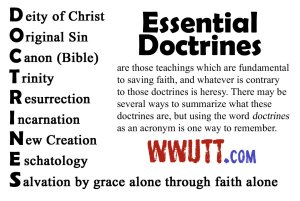
See how this works? If you don’t believe you’re a sinner, you’re not saved. If you don’t believe in the bodily resurrection of Christ, you’re not saved. Here’s how our friend, Pastor Gabriel Hughes, briefly outlines essential doctrines:

(Gabe later tweaked the acrostic a little and added an “S”, which I think is helpful.)

The vast majority of brand new Christians have only the most basic understanding of most of these tenets at the moment of salvation. But it’s not an issue of fully understanding – or else we’d all have to be theologians in order to get saved – it’s an issue of believing. Someone who is genuinely regenerated may not completely understand how the Trinity works (honestly, no one does), but when she’s introduced to the biblical idea of the Trinity, she believes it, learns more about it, and does not reject it.

There is typically agreement among most reputable theologians regarding what constitutes first tier doctrine. Scripture is clear about these things, and several of these issues were settled long ago by the church fathers in assorted church councils (Nicea, Chalcedon, etc.)

Secondary issues are routinely defined as non-salvific but still extremely biblically important, if not quite as biblically clear-cut as primary issues. Doctrines surrounding baptism (credo versus paedo, affusion versus immersion), for example, are usually cited as a secondary issue. A disagreement on a secondary issue doesn’t mean one person is saved and another isn’t, but it normally prevents close partnership in ministry activities involving these issues. For example, my Presbyterian friends and I can join together in pro-life ministry, but we would most likely not plant a church together.

Tertiary issues are non-salvific, less immediately urgent, biblical issues in which the Bible is even less clear-cut and open to wider (yet still biblical) interpretation. These are issues over which Christians can disagree and still maintain close doctrinal fellowship, even in the same church, if they’re in agreement on first and second tier doctrine. Eschatology – the order and timing of events at Jesus’ second coming – is a doctrine that’s often considered third tier. Someone can hold a different eschatological view than mine, yet, for the most part, it shouldn’t affect our ability to worship together, work together, or participate in the ordinances together in the same church.

Some theologians add a fourth category – issues of adiaphora, conscience, or Christian liberty. Usually these are issues of much less importance that the Bible either doesn’t specifically address, or doesn’t give commands about one way or the other. Individual Christians may use biblical principles to inform their consciences and decide for themselves. These would be things like whether or not to take your child trick-or-treating or deciding whether to dress formally or casually for church.

While theologians are largely in agreement about primary doctrines, there is wider spread disagreement on which doctrines are secondary and tertiary (many consider eschatology to be a second tier doctrine, for example) and whether or not there is a need for a category of adiaphora, since such issues are normally not considered to be “doctrinal” issues. In fact, there’s enough space for disagreement that pastors and theologians often wisely refrain from making concrete lists of secondary and tertiary doctrines.

But when we’re talking about the different levels of doctrine, what you won’t find is questions like these: Is murder a first, second, or third tier doctrine? What about gossip? Rape? Adultery? Lying? Gluttony? Pride?

And it’s not because these issues aren’t important or because the Bible doesn’t address them. It’s because they’re in a different category from the other issues: the category of sin. They aren’t doctrines upon which salvation hinges, they aren’t open to interpretation, and the Bible is clear that we are absolutely not to do these things.

The category of doctrine deals with beliefs. The category of sin deals with behavior.

In 2005, Dr. Albert Mohler wrote an excellent article about the different levels of doctrine entitled A Call for Theological Triage and Christian Maturity. He carefully explains the importance of each level of doctrine and what it covers in a plea to keep each level’s urgency in its proper place of significance during discussion, debate, and decision-making.

It was a helpful article to which I always refer people who have questions about tiers of doctrine, and I agree with Dr. Mohler’s thoughts in the article wholeheartedly1 …except on one point:

“In recent years, the issue of women serving as pastors has emerged as another second-order issue.”

Women serving as pastors, women preaching, women teaching men Scripture, and women exercising authority over men in the gathering of the Body is not a secondary issue. Nor is it a primary or tertiary issue. It does not belong in the category of “doctrine” in the same way baptism and eschatology do. It belongs in the category of sin in the same way murder, gossip, and adultery do. Let’s take a look at the reasons for this.

Women serving as pastors, preaching, teaching men Scripture, and exercising authority over men in the gathering of the Body is *not* a secondary issue. Nor is it a primary or tertiary issue. It is a sin.

I do not permit a woman to teach or to exercise authority over a man; rather, she is to remain quiet. 1 Timothy 2:12

(The preponderance of Scripture supports and affirms this concept, so to keep things simple, we’ll use this verse as an exemplar.)

โœข The prohibition in 1 Timothy 2:12 is a clear command against a certain behavior. And when we behave in a way God has prohibited, that is called “sin”. All of the tenets in the three levels of doctrine are affirmative statements regarding beliefs (you must believe in the resurrection of Christ, we believe in baptism by immersion, etc.). None of them are commands, in the negative, against sinful behavior (Thou shalt not murder, I do not permit a woman to teach… etc.)

โœข Secondary and tertiary doctrines can be open – to varying degrees – to biblical interpretation. Every stripe of non-heretical eschatological thought can provide you with chapter and verse passages that can, depending on the angle from which you approach the subject, be biblically plausible and scripturally supported. There is no biblical support for anything God prohibits. No one can cite a properly handled, in context Bible verse in which God says, “It’s OK to commit adultery,” or “Women are allowed to preach.” There can be multiple views on a secondary or tertiary issue that can all be considered biblical, but there can only be one view of sin that is biblical.

โœข Differing beliefs on true secondary and tertiary issues are not sin. My Presbyterian friends have a different view of baptism than I do. That doesn’t mean either of us is sinning. I may think their interpretations of the verses they believe support paedo baptism are incorrect, but they are not breaking any of God’s commands. Differing behavior (again, we see the distinction between doctrinal belief and sinful behavior) on issues of sin is sin. If someone behaves differently from God’s command about lying, she is sinning. If a woman behaves differently from God’s command in 1 Timothy 2:12, she is sinning.

โœข Differing beliefs on secondary and tertiary issues are not born of disobedience and rebellion toward God. Usually, it’s quite the opposite. When someone has studied a theological issue enough to hold a particular position on it, it’s usually because she is striving to please God and to be biblical in her beliefs. Differing behavior on issues of sin is born out of disobedience and rebellion toward God. Someone who steals has already decided in her heart that her desires are better than God’s command. A woman who knowingly holds improper authority over men in her church is doing so because she has already decided to defy God’s clear command against such.

โœข Because different beliefs on secondary and tertiary issues are not born of rebellion and are not sin, they do not require church discipline. Sin does require church discipline. If someone in your church is openly dishonoring her parents, she is sinning and should be subject to church discipline. If a woman is pursuing a career as a pastor, she is sinning and should be subject to church discipline. 

Since the publication of Dr. Mohler’s article (and perhaps as a result of others teaching the same thing) the idea of the violation of 1 Timothy 2:12 being a “secondary doctrine” has spread in a most unhelpful way, leading many Christians to treat the issue in a c’est la vie, “We can just agree to disagree on this,” manner.

No, we cannot.

The idea of the violation of 1 Timothy 2:12 being a “secondary doctrine” has spread in a most unhelpful way, leading many Christians to think “We can just agree to disagree on this.”. No, we cannot.

We would not say, “We can agree to disagree,” on lying or adultery or homosexuality or abortion, and we cannot say it about women preaching, teaching men, or holding unbiblical authority, either. We disciple and teach a sister in Christ who is unaware of what the Bible says on these matters, and if she is committing any of these sins, we begin the process of church discipline. But it would not be loving toward her, or honoring God, to allow her to continue in biblical ignorance or in willful sin.

Furthermore, the violation of 1 Timothy 2:12 brings with it dangers to the church that true secondary and tertiary issues, and even many sins, do not…

The violation of 1 Timothy 2:12 brings with it dangers to the church that true secondary and tertiary issues, and even many sins, do notโ€ฆ

She may not say it with her lips, but when a woman preaches to men in defiance of Scripture, sheโ€™s teaching false doctrine through her behavior. What is the false doctrine sheโ€™s teaching? โ€œI donโ€™t have to obey Godโ€™s Word, and neither do you. If thereโ€™s a part of the Bible you donโ€™t like, youโ€™re free to disregard it.โ€ If your pastor stood up in the pulpit on Sunday morning and said that in words, youโ€™d run him out of town on a rail, and rightly so. Neither should a woman be able to teach that same false doctrine via her actions.

Additionally, I have mentioned several times when dealing with this issue that women preaching to men is highly correlated with women teaching other forms of false doctrine. I have researched scores of women teachers. Every single one of them who unrepentantly teaches men also teaches false doctrine in some other aspect of her theology (usually progressivism, Word of Faith, or New Apostolic Reformation). In other words, if a woman teaches men, you can just about take it to the bank that she also teaches additional false doctrine. False doctrine and heresy are infecting the church – via female preachers – at an alarming rate.

We dare not simply “agree to disagree” on this.

The violation of God’s command that women are not to instruct men in the Scriptures nor hold improper authority over men is a sin like any other. It is not a doctrinal issue in the same sense that other second and third tier doctrines are. If left undisciplined, however, it can lead to first tier doctrinal issues infiltrating a church and eventually destroying it. It is detrimental to the church to label and treat any sin as a secondary doctrinal issue.

Additional Resources

Is Women Preaching a Secondary Issue? on A Word Fitly Spoken

What Are Essentials and Non-Essentials? on A Word Fitly Spoken

Christian Liberty on A Word Fitly Spoken

The importance of Primary and Secondary Doctrines on the Truth Be Known Podcast


1In the years since 2018, when this article was originally written, Dr. Mohler has said, done, and supported various biblically questionable things, leading some to question whether or not he has “gone woke”. While I don’t support his stance on those questionable things, I also don’t believe he has reached the point at which I need to warn against him (although I don’t proactively recommend him, either). To my knowledge, at this time, he is still generally doctrinally sound.

Obedience, Prayer, Sanctification, Sin

When God Answers the “Wrong” Prayer

“Lord, I’m just so frustrated!” I fussed, as I approached the time I had set aside for prayer this morning. Once again, the “I don’t want to” of my flesh was pulling against the “I know I need to” of my spirit like a heavy duty tow truck tugging on a kitten.

So I just ditched it. Well…sort of.

Prayer is pouring out your heart to God, right? Well, I turned on the water cannon. Reverently, of course…but with passion.

I told God how sick I was of this all-too-frequent stumbling block my flesh presented when it was time to pray, especially when I knew from experience that the feeling was fleeting and would go away after I had been praying for a few minutes. I told Him I was tired of a million other things I’d rather be doing, that I needed to do, coming to mind and further crowding out my desire to pray. I told Him I was sorry for all the times I had given in to the flesh and skipped my prayer time. I told Him I wanted Him to make this feeling go away and never come back.

As I poured out my complaint before Him, the Holy Spirit began leading me to examine theย whyย of this whole situation. What was bringing about this pull of the flesh against prayer?

And that’s when it happened. God answered the “wrongยน” prayer.

You see, one of the things I pray every day is that God will reveal to me any sins I’m unaware I’m committing and lead me to repent of and forsake them.

And in that moment,ย that’s the prayer He chose to answer.

Not the prayer for the provision of an item my family needs. Not the prayer for healing of a loved one. Not the prayer that He would save all the lost people on my list.

Not the prayerย I really wanted Him to answer.

God chose to reveal my sin to me.

You know why my flesh so often balks at prayer? Because in the dark, unsanctified recesses of my heart, I’m frustrated with God for not doing what I ask Him to do –ย now. I come to Him day after day, month after month, sometimes year after year, confessing the same sins, asking for the same provisions, and presenting the same requests, andย I don’t see Him doing whatย I want Him to do whenย I want Him to do it.

Never mind that I could list hundreds of my prayers that He actually has answered, many of them in amazing ways. Never mind that Iย know what the Bible says about prayer well enough to teach on it and write articles about it. Never mind that I really do believeย that God will answer my prayers for His glory and my good.

Uh uh. My flesh throws all of that right out the window and wants God to be my cosmic errand boy, delivering the goods on my timetable. I am selfish. I want everything to go my way immediately.

So that was pretty humiliating…but God didn’t stop there. No, there was more.

He opened my eyes to the fact that this sin problem I have relating to Him vertically is basically the same sin problem I have relating to people horizontally.

I yell at people in traffic to get out of my way. I get annoyed with my husband, irritated with my children, and impatient with fellow church members because I want them to do whatย I want, and I want them to do itย now.ย I am selfish. I want everything to go my way immediately.

Oh, wretched man that I am! Who will deliver me from this body of death?ย 

Paul was really onto something there.ย Fortunately, he answers his own question in his very next sentence:

Thanks be to God through Jesus Christ our Lord!
Romans 7:25a

Jesus. Jesus can help me to mortify this sin. And I can obey Him as He does His good work in me. How?

assuming that you have heard about [Jesus] and were taught in him, as the truth is in Jesus, to put off your old self, which belongs to your former manner of life and is corrupt through deceitful desires, and to be renewed in the spirit of your minds, and to put on the new self, created after the likeness of God in true righteousness and holiness.
Ephesians 4:21-24

I stop doing the sin (put off the old self). I remember what God’s Word says about that sin and about the righteousness I’m supposed to do instead (be renewed in mind). I do the righteous thing instead of the sin (put on the new self).

Ephesians 4 goes on to give some examples of what this looks like when dealing with real life sin:

Therefore, having put away falsehood, let each one of you speak the truth with his neighbor, for we are members one of another. Be angry and do not sin; do not let the sun go down on your anger, and give no opportunity to the devil. Let the thief no longer steal, but rather let him labor, doing honest work with his own hands, so that he may have something to share with anyone in need. Let no corrupting talk come out of your mouths, but only such as is good for building up, as fits the occasion, that it may give grace to those who hear. And do not grieve the Holy Spirit of God, by whom you were sealed for the day of redemption. Let all bitterness and wrath and anger and clamor and slander be put away from you, along with all malice. Be kind to one another, tenderhearted, forgiving one another, as God in Christ forgave you.
Ephesians 4:25-32

See how that works?

Stop lying. Remember what God’s Word says about lying and truth. Speak truth instead of lying.

Stop stealing. Remember what God’s Word says about stealing and the godly way to acquire and steward material things. Work an honest job and share with others instead of stealing.

Seems pretty simple and logical, right? It’s pretty clear cut when we’re talking about sinfulย actions. I can keep my mouth shut so lies and corrupting talk don’t come out and choose kind and truthful words to speak instead. I can keep my hands in my pockets or avoid that tempting store so I won’t steal, and get a job and share with others instead. But how in the world do I “put off” a sinfulย attitudeย likeย bitterness, wrath, anger and malice (and in my case, selfishness) when it’s just a feeling that pops up in my heart unbidden?

The world will tell you that you can’t control your feelings. And for the world, that’s true. It’s part of the sin nature of a lost person, the “old self”, to live your life by your feelings, even to be controlled by them. But that’s not the case for someone who has been genuinely born again and is indwelt by the Holy Spirit.

Part of the Fruit of the Spiritย (the evidence that the Spirit is indwelling you) isย self-control. That doesn’t just mean saying no to that second piece of cake. It’s the idea that sin is not our master anymore. We do not have to listen to and be controlled by sin, we can say no to itย because we want to say yes to our new Master – Christ – and be controlled by Him.

Let not sin therefore reign in your mortal body, to make you obey its passions. Do not present your members to sin as instruments for unrighteousness, but present yourselves to God as those who have been brought from death to life, and your members to God as instruments for righteousness. For sin will have no dominion over you, since you are not under law but under grace.
Romans 6:12-14

Notice the wording here. It’s not “do your best” or “try” not to let your old master control you. It’s an authoritative, weighty, no-nonsense command: “Let not sin reign…sin will have no dominion”. God would not command us to do something that we’re incapable of doing, or that the Holy Spirit will not empower us to do. Weย can control and put off sinful thoughts, feelings, and attitudes.

Martin Luther once helpfully said:

“You cannot keep birds from flying over your head, but you can keep them from building a nest in your hair.”

I think about that quote often when it comes to putting off ungodly thoughts that pop into my brain. Here’s how it works:

First, preemptively pray the “wrong” prayer – the one your flesh won’t want God to answer – that He will make you aware of and convict you of sinful thoughts, feelings, and attitudes.

Next, when one of those thoughts rears its ugly head, stop what you’re doing, repent, and kick that rotten vulture right out of your hair. Make a definitive, proactive, Holy Spirit empowered decision of the will that you areย not going to think that way. It helps me to say it out loud: “No. That thought is wrong. The Bible says ____ about that. I amย not going to think that.” You might get some weird looks if you’re in public, but, hey, mortifying sin is worth it, right?

I tend to combine the “put off” (stop it) and “renew your mind” (What does the Bible say?) steps because pulling the Sword out of its sheath is a good way to kill sin. It’s the way Jesus modeled for us.

But how can I “put on” a right thought, feeling, or attitude? I mean, you can’t just conjure up godly feelings, can you? No. But what youย canย do is gather up nest-building materials for that “sweet Heavenly doveยฒ”, the Holy Spirit, so He can shape your thoughts, feelings, and attitudes in a godly way:

Finally, brothers, whatever is true, whatever is honorable, whatever is just, whatever is pure, whatever is lovely, whatever is commendable, if there is any excellence, if there is anything worthy of praise, think about these things. What you have learned and received and heard and seen in meโ€”practice these things, and the God of peace will be with you.
Philippians 4:8-9

There are godly things we canย think about and godly things we canย do (“practice”) that cooperate with the work the Holy Spirit is doing in our hearts.

Instead of thinking about that prayer that God isn’t answering right now, I can think about the prayers Heย has answered. And I canย do something too. I can thank Him for those answered prayers and all of His good attributes in answering prayer.

Instead ofย thinking aboutย how and whenย I want God to do things, I can think about His sovereignty and how good that is for me and everyone else. I can alsoย do something: I can recite Bible verses I’ve memorized about the situation and sing songs of praise to Him.

Instead ofย thinking about how someone else is frustrating me by not doing whatย I want her to do, I canย think about how she is made in the image of God, valuable to Him, and precious in His sight. What can I do? I can stop and pray for her. I can speak a word of encouragement to her. I can bless her with a gift or by serving her.

Thinking and practicing ungodly things feeds and grows your ungodly thoughts, feelings, and attitudes. But thinking and practicing godly things feeds and develops your godly thoughts, feelings, and attitudes.

Back in the Stone Age when dinosaurs roamed the earth and computers were brand new, programmers used to have a saying: “Garbage in, garbage out.” In other words, if you fed faulty commands into the computer, the performance you got out of the computer was going to be faulty, too.

The Christian heart is very much the same. “Godly in, godly out.” If you feed godliness into your heart, godliness will start coming out in your thoughts, words, and actions.

We don’t have to be mastered by sinful thoughts, feelings, and attitudes. Through the power of the Holy Spirit and by putting off the old self, renewing our minds through God’s Word, and putting on the new self by thinking and practicing godly things, we can grow more and more obedient to our Lord and Master, Jesus Christ, in our thoughts, words, and actions.

I don’t know about you, but I’m going to try to remember that the next time God answers the “wrong” prayer.


ยนPlease note that the word “wrong” as it refers to God answering prayer refers toย myย having the wrong attitude or perspective. God is perfect and has never, and will never, do anything wrong.
ยฒFrom the hymnย Sweet, Sweet Spirit by Doris Akers