I’ve been married to a minister of music for over 20 years. My husband has served at many different churches in a variety of capacities: on staff, interim, supply, revivals, conferences, retreats, etc. Over those 20+ years and in those various capacities, I’ve observed a number of things about him, pastors, church musicians, and congregations from a unique vantage point.
Now, with a little help and a lot of input from a few sister minister of music’s wives, it’s true confession time. Time for us to tell all, here in Part 2 of Real Ministers of Music’s Wives of Anychurch, U.S.A.
Turn Your Radio On, and Listen to the Music in The Air The minister of music understands that there are songs we love to sing along with on Christian radio or Spotify that we’d also like to sing in church, and, in a lot of cases, he’d probably like to, too. There are a variety of reasons why the songs we like might not get sung in church:
It’s a solo. Most of the songs we hear on the radio (especially contemporary ones) are written and performed as solos, and don’t work for congregational singing because: the timing is difficult for a large group to follow, there are too many spontaneous riffs and change ups, there are complicated and/or numerous bridges and tags that are difficult for large groups to follow, etc. Not every song works for large group singing.
The lyrics contain faulty or watered down theology. The minister of music’s job is to lead us in worship. We can’t worship if we’re singing something that conflicts with God’s Word or doesn’t focus on Him and His nature, character, and deeds.
The accompanists aren’t comfortable with it. A lot of the songs people want to sing in the worship service can be difficult for pianists and other instrumentalists whose main experience is in other genres of music. While every musician should strive to improve his skills, the minister of music doesn’t want to put his accompanists on the spot if they’re uncomfortable with the technical requirements of the music.
Your minister of music isn’t comfortable with it.If the minister of music is in his 60’s he may not feel he can carry off a top ten CCM song made popular by somebody in his 20’s, especially if he doesn’t have a worship band equal to the one we’re used to hearing on the radio.
There’s no sheet music available. Or it’s not available in the right key or for the right instruments, etc.
It’s “off limits”. Occasionally, and for various reasons, the pastor, elders, or others in leadership over the minister of music will make a decision that a certain song is not to be used in the worship service. Depending on the circumstances, there may not be a diplomatic way to explain this to people who love that song and want to sing it in church.
Play Us a Song, You’re the Piano Woman Just by way of information, not every minister of music’s wife plays the piano. I’m one of them. Sorry. I wish I could.
One Singular Sensation Regardless of how many pop stars got their start by singing in church, the purpose of the worship service is to worship God. There are many wonderful and talented soloists who, in humility and faithfulness, pour their hearts out to God in song at their local churches and do a great job of it. There are also a few divas on their way up the ladder looking for a stepping stone to greatness. Church isn’t American Idol. Find a karaoke bar.
Show a Little Bit of Love and Kindness It’s always encouraging for a minister of music to hear that he did a great job with the choir or that you really worshiped this morning. It’s encouraging when a pastor mounts the platform for his sermon and says thank you, or “I really liked that song,” or refers back to/quotes one of the songs during his sermon. Little things like that go a long way, so offer your minister of music a word of encouragement when you can.
Also, if your church participates in pastor appreciation month (usually the month of October), please don’t forget your minister of music, youth pastor, associate pastor, etc. They all work hard to shepherd you, and it doesn’t feel good to be left out.
War- What is it Good For? The worship wars (contemporary worship music vs. traditional hymns) are alive and well. Sometimes, rather than being a general in that war, our minister of music might just be a casualty of it.
Everybody has particular genres of music that we’re most comfortable with. When a different style comes along, it can be jarring. It can cause angst. It can cause arguments. But when we worship God, our focus is not to be on what makes us happy or comfortable. Often, we get so concerned about whether the worship at church pleases or offends us that we don’t stop to think about whether it pleases or offends God.
But that’s the main concern of the minister of music. Which songs, regardless of style, will be pleasing to the Lord and lead people into truth about Him? While he’s trying to do his best to sort this out week by week, he’s possibly being pulled in a variety of directions by a variety of people over style. How many people will leave the church if we sing more hymns than contemporary songs? How many people will stop giving in the offering if we sing more contemporary songs than hymns? Who’s going to accost me after church and complain? How will the pastor and elders react to this week’s order of service? It can be a lot of pressure and take his focus off of where it needs to be: what will be pleasing to God?
Just as one man’s trash is another man’s treasure, the songs we don’t like might just be someone else’s favorite. What if we looked at singing the songs we don’t particularly like as a way to serve and encourage our brothers and sisters in the congregation who do like those songs?
Why’s Everybody Always Pickin’ on Me? There’s no nice, sweet way to say this, so I’m just gonna throw it out there. Church members can sometimes be mean. I mean, mean. Let me hasten to add that most of the time, most church members are not. The majority of church members are kind, loving, supportive, and definitely appreciated by the pastor and staff. However, the others are definitely out there. I have seen church members treat pastors, ministers of music, and other church staff the way I wouldn’t treat a dog. There’s no excuse for that.
The minister of music isn’t perfect. There may be times when he does something unbiblical or hurtful and at those times, it’s necessary for the appropriate person to talk with him, under the provisos of Matthew 18, about whatever is wrong. But there are other times when people get their feathers ruffled –even though the minister of music hasn’t done anything wrong or unbiblical—simply because their personal preferences haven’t been catered to.
It’s OK to talk with our ministers of music about things, even personal preferences, but let’s do it in an encouraging and helpful way rather than a griping or attacking way. Screaming, threatening, name calling, constant complaints, and nasty anonymous notes and emails are never appropriate, and if that’s what is transpiring, then the problem is not with the minister of music it’s with the person who’s acting that way. If we know that a member of our church is acting that way towards anyone, pastor, staff, or layperson, we must intervene and be a catalyst for making things right.
God calls us to encourage one another and build each other up, so let’s get at it! Let’s try to affirm our ministers of music (and pastors and other staff!) whenever we’re able!
What’s something you can do to be an encouragement to your minister of music?
I’ve been married to a minister of music for over 20 years. My husband has served at many different churches in a variety of capacities: on staff, interim, supply, revivals, conferences, retreats, etc. Over those 20+ years and in those various capacities, I’ve observed a number of things about him, pastors, church musicians, and congregations from a unique vantage point.
Now, with a little help and a lot of input from a few sister minister of music’s wives, it’s true confession time. Time for us to tell all…
Sing, Sing a Song… Singing is often the only opportunity church members have (besides the offering) to take an active role in worship. Let’s all take advantage of it!
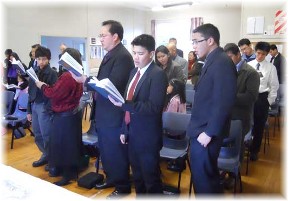
The music portion of the worship service is just that: worship and service, but sometimes we can slip into thinking of it as “filler time” before the “main event” of the sermon. If we’re spending the music time chatting with our friends, checking Facebook on our phones, knitting, or clipping our nails (sadly, yes, I’ve seen all of those happen) aren’t we robbing God and ourselves of the precious few hours per week we set aside for worship? Is it fair to God to spend the time we’re supposed to be worshiping on these kinds of distractions? God commands our worship and God deserves our worship. So, let’s give God our full attention and worship Him!
R-E-S-P-E-C-T – find out what it means to your minister of music. The minister of music doesn’t just roll out of bed on Sunday morning, jump up on the platform, and wave his arms around for thirty minutes. He works hard during the week to plan a worship service that honors God and grows and trains the congregation spiritually. He often does so amid a number of challenges: the varied talents of his accompanists, a hymn request by the pastor or a church member, bugs in the sound system, musicians going out of town, the choir soloist getting the flu. He rehearses with the instrumentalists, the praise team, the choir, and others. When he stands in front of us to lead the music, he deserves the same respect we give the pastor when he preaches or a teacher imparting knowledge or someone at work who’s making a presentation: our attention.
Someone To Watch Over Me Singing in the choir or on the praise team kinda goes hand in hand with being a minister of music’s wife, so we’re often up on the platform near our husbands. I need to tell you a little secret:
We can see you out there.
It is incredibly encouraging to see people who are focused on Christ and engaged with Him as they’re worshiping. It’s obvious they’re communing with their Savior and thinking about Him as they sing. It makes the minister of music feel like he’s been successful in helping them connect with the Lord in worship.
On the other hand, it’s very discouraging to see people with their hands stuffed in their pockets, not singing, or, conversely, mindlessly rattling off lyrics, and with a countenance that says, “I’d rather be at the dentist.” I once saw a televised worship service where the congregation was singing the hymn, “All that Thrills My Soul is Jesus.” It would be difficult to describe just how unthrilled most of them looked. The word “corpses” comes to mind.
Jesus said to love the Lord with all our heart, soul, mind, and strength. When we engage all four of those areas in worship, we’re not just pleasing Him by our obedience, He’s growing us into stronger, more mature Believers. And that’s the best encouragement of all for our minister of music.
Where He Leads Me, I Will Follow We minister of music’s wives are blessed that our husbands have, for the most part, worked under pastors who are supportive and set a great example for their congregations. Pastors, you have an enormous influence on your congregation even when you’re not aware of it. And one area in which you may not be aware that church members are watching and emulating you, even when we’re not aware of it, is during the music portion of the worship service.
Your congregation can see you during the worship time, whether you’re sitting on the stage or in a pew. What you convey with your own behavior about the importance of worship, we will absorb and reflect. If you are engaged and sing heartily to the Lord, we will get the message that you think God is worthy of all of our worship and we will follow suit. If you spend the worship time engaged in other activities, we will get the message that worship time is more like the coming attractions before a movie than a time to join in and commune with the Lord through what we sing.
Additionally, when your congregation is actively engaged in worship, it gets our hearts prepared to soak up the message you have for us in your sermon. So, when you’re worshiping with gusto, you’re not only setting a great example, you’re also getting people right where you want them: ready to drink in God’s word!
Part two of this article is on its way!
What are some things you appreciate about your minister of music or worship leader?
“I desperately want to go to church, but I take care of my elderly mother who has Alzheimer’s. I can’t take her with me, I can’t leave her alone, and I can’t afford someone to sit with her while I’m at church.”
“We’d love to be faithful church members, but our child has a disability that makes him extremely sensitive to the light and sound stimuli in the worship service and he becomes uncomfortable and disruptive. Attending church is rarely an option for us.”
“I’m the sole caretaker of my husband who is a quadriplegic. It takes several hours to get him up, dressed, and ready in the morning. We’ve tried, but there’s no way we can make it to the 9:00 a.m. service of the only doctrinally sound church near us, and no other service times are offered.”
These are just a sampling of the stories I’ve heard from readers recently as I’ve written about the importance of church membership and attendance. The Bible is clear that we’re to be faithful members of a local body of believers. The entire New Testament assumes that Christians need to meet together to worship, pray, encourage and exhort each other, study and hear the preaching of God’s word, celebrate the ordinances of baptism and the Lord’s Supper, and serve one another. “Lone Ranger Christians” don’t exist in the New Testament. Neither do Christians who are perfectly able to attend church, but choose to skip it in favor of sleeping in, kids’ soccer games, birthday parties, frequent travel, shopping, and other non-essential activities. We aren’t to place such a low value on meeting together that we attend church only if it happens to fit into our busy schedules; we arrange our busy schedules around being faithful, active members of a local church. Yes, Scripture insists, it’s that important.
When I was a child, there was still the notion among Christians that you were to attend church unless “Providentially hindered,” meaning that God, in His providence and sovereignty placed you in a situation that made it impossible for you to go to church that day- illness, death, unavoidable imperative travel, an emergency.
What about people who are Providentially hindered from attending church for an extended period because they’re taking care of somebody else who’s Providentially hindered by illness or disability from attending church? How can we help?
But what about people who are Providentially hindered from attending church week after week – maybe for years on end, maybe even for the rest of their lives – because they’re taking care of somebody else who’s Providentially hindered by illness or disability from attending church? How are these precious brothers and sisters who are honoring their parents or laying down their lives for their children not only to obey the Scriptural admonition to meet together, but also to receive the encouragement, edification, and spiritual nourishment they desperately need and want?
It takes two, baby. Both the caretaker and the church itself bear some responsibility here.
The caretaker needs to make sure she’s put in the effort to explore all possibilities of physically attending a doctrinally sound church or meeting of believers before concluding that she can’t. Her first priority is to pray fervently that God will provide a way. God honors the prayers of believers who are looking for ways to be obedient to Him. The caretaker might have to make some sacrifices of time, money, convenience, or preferences, but God can and will make a way.
Most of the caretakers I’ve heard from are praying. They have made the effort. And that’s where the local church comes in.
Local churches often don’t even think about what it’s like to be a caretaker. To long to simply attend church for worship, fellowship, and refreshing of soul, only to realize it’s the impossible dream.
It is to our shame (and I include myself in this obliviousness) that local churches often don’t even think about what it’s like to be a caretaker. To long to simply attend church for worship, fellowship, and refreshing of soul, only to realize it’s the impossible dream. Christian caretakers are often out of sight, and, thus, out of mind, but they are not out of God’s heart, His mindfulness, or His family, and we need to be ministering to them.
Christian caretakers are often out of sight, and, thus, out of mind, but they are not out of God’s heart, His mindfulness, or His family, and we need to be ministering to them.
How? It’s a great question, and I don’t have all the answers because each situation is unique. But guess who can answer that question? God, and the caretakers your church needs to minister to.
Pray:
Does your church have a heart to reach out to caretakers, but isn’t quite sure how to go about it? Pray. Ask God for the wisdom to find caretakers who need to be ministered to and to know how best to meet their needs for fellowship and worship.
Find Them:
Go to your pastor or church secretary and ask for the names of families who are already on your church roll or who are in some way connected to your church, and start with them. Ask friends and family members for names of caretakers your church can minister to. Go to your local agencies, hospitals, organizations, schools, businesses, and other entities that provide services to people with disabilities or chronic illnesses and let them know your church wants to reach out to caretakers.
Ask Them:
Contact caretakers and ask them how your church can meet their needs both inside and outside the church. Caretakers often feel invisible to the church. They need to know Christ loves them- that they matter to Him. We can demonstrate His love by coming alongside them and making a sacrificial effort to help. And, who knows? It might be simpler than you think.
Think Outside the Box:
Put yourself in the caretaker’s shoes. What could be a creative solution to helping her attend church while still tending to her loved one? Just a few ideas…
Sitter rotation– The caretaker in the first scenario of this article could attend worship if just a handful of church members would volunteer to come over to her house and sit with her mother during church on a rotating basis. It wouldn’t even cost anything.
Transportation– Maybe the caretaker’s loved one uses a wheelchair and could attend church with her, but she doesn’t have access to wheelchair accessible transportation on Sundays. Could your church borrow or rent a van and set that up for her?
Special classes– We already provide things like nurseries and children’s church for babies and small children. What about a similar concept for ill or disabled people of any age?
Home church– Perhaps there are a few families with disabled loved ones who would like to meet together for worship in one of their homes. Could the church send a pastor or elder to lead and teach them?
Home groups– Does your church do home groups? Could one of them meet in the caretaker’s home and bring church to her?
Medical needs– Could a caretaker bring her loved one to church if there were medical help available should the need arise? Perhaps a church member who’s a doctor or nurse would agree to be “on call” if needed while the family is at church.
Service times– The caretaker in the third scenario would be helped by the church simply pushing back its service time an hour or so. Could your church adjust its Sunday morning worship time or offer additional services, Bible studies, or small groups on Sunday evenings, on Saturdays, or on a week night?
Accommodations– Could your church make structural changes such as installing wheelchair ramps, elevators, modified seating, or other adjustments to the physical property that would make it possible for the caretaker’s loved one to attend with her? What about turning off the strobe lights and turning down the volume of the sound system for those sensitive to these stimuli? If the caretaker’s main concern is the distraction (noises, etc.) her loved one might create, would it be possible to simply educate the church body about the disability and train them to make loving allowance for these distractions during the worship service?
In home help– Perhaps it would be helpful to the caretaker for a church member to volunteer to come to the caretaker’s home and help get the disabled person ready for church on Sunday mornings while the caretaker gets herself ready.
Professional help– Are there members of your church who are special education teachers, doctors, nurses, home health care aides, contractors? Enlist their help for suggestions on how to make your church accessible to the ill and disabled and how to help caretakers both at home and inside the church.
The spiritual needs of caretakers have been overlooked by the church for far too long. Thanks to technology, transportation, and other modern conveniences God has blessed us with, it has never been easier to reach out to caretakers and meet their needs. Are you looking for a place of service in the church? Maybe you’ve been a caretaker and are all too familiar with ways the church failed to help you? Reaching out to meet the needs of caretakers is a ministry that’s practically tailor made for godly, nurturing women, especially since the majority of caretakers are also women. Could God be calling you to help bridge the gap between caretakers and the church?
Could God be calling you to help bridge the gap between caretakers and the church?
Want more suggestions? Check out how these churches and ministries are assisting caretakers and their loved ones, and if you have a helpful idea or link, or if your church offers a ministry to caretakers, please share it in the comments below. Another reader could be looking for your church, resource, or idea!
Does your church have the resources to “go big” in ministry to families with disabled children both inside and outside the church? Could you partner with Jill’s Houseand import their respite services to your area? Could you replicate their services at a level your church could fund and staff? Check out this amazing ministry. No doubt there’s a need for it in your area.
My former church was a megachurch that had a great special needs kids ministry: A special classroom for children and a classroom for teens who needed more care, pairing a special kiddo with a buddy to go to the regular kids’ program, a once a month respite night.
1) The first step is to welcome the family. Caregivers are tired and can be easily discouraged. If your church only has one service, consider adding another service.
2) Be patient. You may not see them every Sunday; medical emergencies and other stuff happens. They also may not have time to volunteer or attend Bible studies. Someone from the church will have to take the initiative to contact them: a phone call, an email, a postcard are HUGE. Also, having sermons available to stream online may help the caregivers to catch up on missed sermons.
3) Offer a once a month respite night to the whole community. If you can muster the volunteers then for 2 hours a month, you can offer parents (or spouses) the chance to drop off their special kids at your church and give them a much needed break to grocery shop or take a nap. Seriously, this is a huge ministry to parents – especially single parents. Also, I have seen teenage volunteers absolutely flourish by being a buddy to a special needs child. Another great opportunity for teens and adults is to be a buddy to a special needs child for your VBS or AWANA programs as well.
4) Joni and Friends is a Christian organization that ministers to the disabled. In California where I’m from, there are regional offices that offer to host disability ministry workshops to local churches.
5) Realize that at least with special needs children it is not all sunshine and lollipops. There are behavioral, cognitive, and physical challenges. But these kids need to hear about Jesus, and their parents need to feel loved and a part of the wider church body. They need to feel they’re not alone.
When I was sixteen years old, I was convinced God was calling me to be the next Sandi Patty (if you’re under 40, she was the Kari Jobe of my day). I had been singing solos and in church choirs since I was in the second grade. I was taking professional voice lessons and spent my first year of college as a vocal performance major.
Not to toot my own horn here, but, while I’m not the greatest singer in the world, certainly not even in the top 10 percent, I’m also not one of those people you see during the audition rounds of American Idol who makes you want to conduct a nationwide manhunt for every person who ever lied to this poor soul and told her she could sing just so you can beat all of them senseless with a pitch pipe.
But anyway…
I had a modicum of talent, and I wanted to put it to work doing “great things for the Lord.” I wanted God to use me- to put me on a stage every night in front of thousands of people so I could sing to them about Him.
Paragon of adolescent spiritual maturity that I was, it somehow never occurred to me to care what God thought about all this or what He might want to do in my life. If I thought about it at all, I just assumed He was on board with my plans. Like, how could He not be, right?
It somehow never occurred to me to care what God thought about all this or what He might want to do in my life. If I thought about it at all, I just assumed He was on board with my plans. Like, how could He not be, right?
Because even in my day, that was the subtle message that was coming from the pulpit (and Christian media) and landing in the pew: If you really love Jesus and prove it by walking faithfully with Him, He’s going to use you to do some big, fat, awesome thing for Him. You’ll be the next David or Esther or Paul or Mary, and your name will go down in history just like theirs did. You’ll be famous, dahling.
Only I’m not really sure where Christian preachers, authors, and entertainers got this idea, because it sure as heck isn’t in the Bible.
The Bible knows nothing of the idea that we can behave our way into getting God to “use” us in some big way.
The Bible knows nothing of the idea that we can behave our way into getting God to “use” us in some big way. Quite the opposite, in fact. Take a look at some of the “big names” in the Bible and what they were up to when God drafted them.
Noah- just a godly guy trying to survive a sin sick world
Moses- on the lam for murder and hanging out in the desert with a bunch of sheep
Paul- Christian-killer
David- more sheep
Gideon- just trying to feed his family
Peter- gone fishin’
Abraham- even more sheep
Were some of these guys walking faithfully with the Lord? Absolutely. But they were walking faithfully simply because they loved the Lord and desired to please Him, not with the goal of getting God to do some big thing in their lives. In fact, most of them were downright shocked when God showed up and revealed His plans for them.
They were walking faithfully simply because they loved the Lord and desired to please Him, not with the goal of getting God to do some big thing in their lives.
And have you ever noticed that God doesn’t just use “good guys,” or guys who eventually become “good guys”? Ever read the story of Samson? Going strictly by his words and behavior mentioned in Judges 14-16, the dude comes off as a self-centered, slobbering ball of lust with anger management issues. Yet, knowing all about him before he was even born, God said He would use Samson to “…begin to save Israel from the hand of the Philistines.”
And what about Pharaoh? In Exodus 9:16, God says to Pharaoh, “But for this purpose I have raised you up, to show you my power, so that my name may be proclaimed in all the earth.” The plagues…the parting of the Red Sea…I’d say God used Pharoah for His glory in a pretty big way.
God can use anybody He wants for any purpose He wants, and He’s not at the mercy of their behavior in doing so.
God can use anybody He wants for any purpose He wants, and He’s not at the mercy of their behavior in doing so.
What do we mean when we say we want to be “used by God,” anyway? I think what we often have in mind is something awesome, something grandiose. Something that will bring us fame, fortune, and glory. I’ve never heard someone say she wanted God to use her for His glory like God used Job.
Or, for that matter, Jesus.
What do we mean when we say we want to be “used by God,” anyway?
The greatest event in the universe, the one that brought God more glory than any other phenomenon in the history of ever, was also the most excruciating moment of sorrow and suffering eternity has ever known: the crucifixion of Christ for our sin.
When we say we want God to use us, we want the stupendous, not the suffering. The crown, not the cross. Yet it is often in suffering that God is most glorified. So, just whose glory is it we’re seeking, again?
When we say we want God to use us, we want the stupendous, not the suffering. The crown, not the cross. Yet it is often in suffering that God is most glorified.
If you live your life clamoring after God to make you an Esther or a Paul, or a Sandi Patty or a Billy Graham, you are almost certainly going to be disappointed. And not just because there are only a handful of “big name” God-followers out there compared to the nameless millions who have followed Him faithfully in obscurity, but because being used by God in some big, ostentatious way is not what He calls us to clamor after.
When you stand in front of God on the Day of Judgment, He’s not going to say, “Well done. You did some phenomenal things for Me that people are still talking about!” He’s going to say, “Well done, good and faithful servant.”
Faithful servants aren’t out to change the world, they just obey. They go where they’re told to go. They do what they’re told to do. And they do it to honor their masters.
For servants of Christ, most of the time that means getting up every day and doing the same humble tasks over and over for a lifetime: cooking meals, going to work, changing diapers, serving the church, cleaning the house. You know, servant stuff, all done to the glory of God. This is what God calls us to.
God doesn’t call us to seek to be used, He calls us to seek to be faithful.
“So you also, when you have done all that you were commanded, say, ‘We are unworthy servants; we have only done what was our duty’.”
Luke 17:10
The famous people mentioned in this article are mentioned for frame of reference purposes only – because they are recognizable names with large platforms in evangelicalism – not because I’m recommending you follow them. I am aware of the biblical issues with each of them.
Originally published (in another publication) April 9, 2015
When it comes to Christianity, are the specifics of what people believe important?
I think most of us would answer a resounding “yes” to that question. Of course, the various concepts we believe are important. You can’t just believe anything you like and still be a Christian. There are certain things you must believe in order to become a Christian at all, and there are certain things you will come to believe because you are a genuinely regenerated Christian. But what are those things, and how do we know which is which?
You can’t just believe anything you like and still be a Christian.
Maybe you’ve heard the terms “essential doctrines” or “primary, secondary, and tertiary theological issues” or “first, second, and third tier levels of doctrine”? For years, theologians have been attempting to organize beliefs of the Christian faith – all drawn from the Bible, naturally – into nice neat categories in order to make things a little simpler. As someone who thrives on organization and categories, I’m grateful for their efforts. But if you begin to study this categorization of beliefs, you’ll find that we haven’t reached an across the board consensus yet.
Generally speaking, “essential”, “primary”, or “first tier” doctrines are those which you, biblically, have to believe in order to become a Christian and/or be considered a Christian. For example:
✢ Sin is a thing, and I am a sinner.
✢ God exists and is the supreme authority of the universe.
✢ Jesus was God in human flesh.
✢ Jesus rose bodily from the grave.
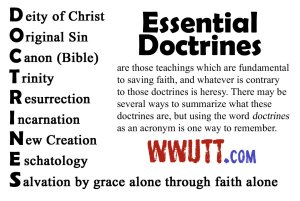
See how this works? If you don’t believe you’re a sinner, you’re not saved. If you don’t believe in the bodily resurrection of Christ, you’re not saved. Here’s how our friend, Pastor Gabriel Hughes, briefly outlines essential doctrines:
(Gabe later tweaked the acrostic a little and added an “S”, which I think is helpful.)
The vast majority of brand new Christians have only the most basic understanding of most of these tenets at the moment of salvation. But it’s not an issue of fully understanding – or else we’d all have to be theologians in order to get saved – it’s an issue of believing. Someone who is genuinely regenerated may not completely understand how the Trinity works (honestly, no one does), but when she’s introduced to the biblical idea of the Trinity, she believes it, learns more about it, and does not reject it.
There is typically agreement among most reputable theologians regarding what constitutes first tier doctrine. Scripture is clear about these things, and several of these issues were settled long ago by the church fathers in assorted church councils (Nicea, Chalcedon, etc.)
Secondary issues are routinely defined as non-salvific but still extremely biblically important, if not quite as biblically clear-cut as primary issues. Doctrines surrounding baptism (credo versus paedo, affusion versus immersion), for example, are usually cited as a secondary issue. A disagreement on a secondary issue doesn’t mean one person is saved and another isn’t, but it normally prevents close partnership in ministry activities involving these issues. For example, my Presbyterian friends and I can join together in pro-life ministry, but we would most likely not plant a church together.
Tertiary issues are non-salvific, less immediately urgent, biblical issues in which the Bible is even less clear-cut and open to wider (yet still biblical) interpretation. These are issues over which Christians can disagree and still maintain close doctrinal fellowship, even in the same church, if they’re in agreement on first and second tier doctrine. Eschatology – the order and timing of events at Jesus’ second coming – is a doctrine that’s often considered third tier. Someone can hold a different eschatological view than mine, yet, for the most part, it shouldn’t affect our ability to worship together, work together, or participate in the ordinances together in the same church.
Some theologians add a fourth category – issues of adiaphora, conscience, or Christian liberty. Usually these are issues of much less importance that the Bible either doesn’t specifically address, or doesn’t give commands about one way or the other. Individual Christians may use biblical principles to inform their consciences and decide for themselves. These would be things like whether or not to take your child trick-or-treating or deciding whether to dress formally or casually for church.
While theologians are largely in agreement about primary doctrines, there is wider spread disagreement on which doctrines are secondary and tertiary (many consider eschatology to be a second tier doctrine, for example) and whether or not there is a need for a category of adiaphora, since such issues are normally not considered to be “doctrinal” issues. In fact, there’s enough space for disagreement that pastors and theologians often wisely refrain from making concrete lists of secondary and tertiary doctrines.
But when we’re talking about the different levels of doctrine, what you won’t find is questions like these: Is murder a first, second, or third tier doctrine? What about gossip? Rape? Adultery? Lying? Gluttony? Pride?
And it’s not because these issues aren’t important or because the Bible doesn’t address them. It’s because they’re in a different category from the other issues: the category of sin. They aren’t doctrines upon which salvation hinges, they aren’t open to interpretation, and the Bible is clear that we are absolutely not to do these things.
The category of doctrine deals with beliefs. The category of sin deals with behavior.
In 2005, Dr. Albert Mohler wrote an excellent article about the different levels of doctrine entitled A Call for Theological Triage and Christian Maturity. He carefully explains the importance of each level of doctrine and what it covers in a plea to keep each level’s urgency in its proper place of significance during discussion, debate, and decision-making.
It was a helpful article to which I always refer people who have questions about tiers of doctrine, and I agree with Dr. Mohler’s thoughts in the article wholeheartedly1 …except on one point:
“In recent years, the issue of women serving as pastors has emerged as another second-order issue.”
Women serving as pastors, women preaching, women teaching men Scripture, and women exercising authority over men in the gathering of the Body is not a secondary issue. Nor is it a primary or tertiary issue. It does not belong in the category of “doctrine” in the same way baptism and eschatology do. It belongs in the category of sin in the same way murder, gossip, and adultery do. Let’s take a look at the reasons for this.
Women serving as pastors, preaching, teaching men Scripture, and exercising authority over men in the gathering of the Body is *not* a secondary issue. Nor is it a primary or tertiary issue. It is a sin.
I do not permit a woman to teach or to exercise authority over a man; rather, she is to remain quiet. 1 Timothy 2:12
(The preponderance of Scripture supports and affirms this concept, so to keep things simple, we’ll use this verse as an exemplar.)
✢ The prohibition in 1 Timothy 2:12 is a clear command against a certain behavior. And when we behave in a way God has prohibited, that is called “sin”. All of the tenets in the three levels of doctrine are affirmative statements regarding beliefs (you must believe in the resurrection of Christ, we believe in baptism by immersion, etc.). None of them are commands, in the negative, against sinful behavior (Thou shalt not murder, I do not permit a woman to teach… etc.)
✢ Secondary and tertiary doctrines can be open – to varying degrees – to biblical interpretation. Every stripe of non-heretical eschatological thought can provide you with chapter and verse passages that can,depending on the angle from which you approach the subject, be biblically plausible and scripturally supported. There is no biblical support for anything God prohibits. No one can cite a properly handled, in context Bible verse in which God says, “It’s OK to commit adultery,” or “Women are allowed to preach.” There can be multiple views on a secondary or tertiary issue that can all be considered biblical, but there can only be one view of sin that is biblical.
✢ Differing beliefs on true secondary and tertiary issues are not sin. My Presbyterian friends have a different view of baptism than I do. That doesn’t mean either of us is sinning. I may think their interpretations of the verses they believe support paedo baptism are incorrect, but they are not breaking any of God’s commands. Differing behavior (again, we see the distinction between doctrinal belief and sinful behavior) on issues of sin is sin. If someone behaves differently from God’s command about lying, she is sinning. If a woman behaves differently from God’s command in 1 Timothy 2:12, she is sinning.
✢ Differing beliefs on secondary and tertiary issues are not born of disobedience and rebellion toward God. Usually, it’s quite the opposite. When someone has studied a theological issue enough to hold a particular position on it, it’s usually because she is striving to please God and to be biblical in her beliefs. Differing behavior on issues of sin is born out of disobedience and rebellion toward God. Someone who steals has already decided in her heart that her desires are better than God’s command. A woman who knowingly holds improper authority over men in her church is doing so because she has already decided to defy God’s clear command against such.
✢ Because different beliefs on secondary and tertiary issues are not born of rebellion and are not sin, they do not require church discipline. Sin does require church discipline. If someone in your church is openly dishonoring her parents, she is sinning and should be subject to church discipline. If a woman is pursuing a career as a pastor, she is sinning and should be subject to church discipline.
Since the publication of Dr. Mohler’s article (and perhaps as a result of others teaching the same thing) the idea of the violation of 1 Timothy 2:12 being a “secondary doctrine” has spread in a most unhelpful way, leading many Christians to treat the issue in a c’est la vie, “We can just agree to disagree on this,” manner.
No, we cannot.
The idea of the violation of 1 Timothy 2:12 being a “secondary doctrine” has spread in a most unhelpful way, leading many Christians to think “We can just agree to disagree on this.”. No, we cannot.
We would not say, “We can agree to disagree,” on lying or adultery or homosexuality or abortion, and we cannot say it about women preaching, teaching men, or holding unbiblical authority, either. We disciple and teach a sister in Christ who is unaware of what the Bible says on these matters, and if she is committing any of these sins, we begin the process of church discipline. But it would not be loving toward her, or honoring God, to allow her to continue in biblical ignorance or in willful sin.
Furthermore, the violation of 1 Timothy 2:12 brings with it dangers to the church that true secondary and tertiary issues, and even many sins, do not…
The violation of 1 Timothy 2:12 brings with it dangers to the church that true secondary and tertiary issues, and even many sins, do not…
She may not say it with her lips, but when a woman preaches to men in defiance of Scripture, she’s teaching false doctrine through her behavior. What is the false doctrine she’s teaching? “I don’t have to obey God’s Word, and neither do you. If there’s a part of the Bible you don’t like, you’re free to disregard it.” If your pastor stood up in the pulpit on Sunday morning and said that in words, you’d run him out of town on a rail, and rightly so. Neither should a woman be able to teach that same false doctrine via her actions.
Additionally, I have mentioned several times when dealing with this issue that women preaching to men is highly correlated with women teaching other forms of false doctrine. I have researched scores of women teachers. Every single one of them who unrepentantly teaches men also teaches false doctrine in some other aspect of her theology (usually progressivism, Word of Faith, or New Apostolic Reformation). In other words, if a woman teaches men, you can just about take it to the bank that she also teaches additional false doctrine. False doctrine and heresy are infecting the church – via female preachers – at an alarming rate.
We dare not simply “agree to disagree” on this.
The violation of God’s command that women are not to instruct men in the Scriptures nor hold improper authority over men is a sin like any other. It is not a doctrinal issue in the same sense that other second and third tier doctrines are. If left undisciplined, however, it can lead to first tier doctrinal issues infiltrating a church and eventually destroying it. It is detrimental to the church to label and treat any sin as a secondary doctrinal issue.
1In the years since 2018, when this article was originally written, Dr. Mohler has said, done, and supported various biblically questionable things, leading some to question whether or not he has “gone woke”. While I don’t support his stance on those questionable things, I also don’t believe he has reached the point at which I need to warn against him (although I don’t proactively recommend him, either). To my knowledge, at this time, he is still generally doctrinally sound.