My pastor says we should come to him individually with concerns instead of talking behind his back, so I have taken a concern of mine to him. Because a pastor can’t be alone with a woman, he had his wife at the first meeting and three members of the board at the second meeting. It then becomes a me vs. them argument with them saying, “Listen to the pastor, he’s always right.” Because he is the pastor and a man, should I not bring my concerns to him, even though he said we should?
Great question. It’s important that pastors and church members communicate clearly about any concerns that arise in the life of a church. In this situation, there are several things to sort out:
1. Any church member, male or female, should talk (kindly, lovingly, and respectfully, of course) to the pastor about any concerns. Your pastor is right to encourage you to bring concerns to him and to discourage gossip and backbiting. (There are some concerns that can be handled at a lower level initially, for example, going directly to a person committing a sin {Matthew 18:15-20}, or concerns that should first be taken to an elder in keeping with any existing church policies regarding this. This is not because of a male/female thing, but to keep the pastor from being overwhelmed. Kind of like the way Jethro told Moses he should get some elders to help him judge the people in Exodus 18.)
2. Your pastor is also right and wise not to meet alone with a woman. It protects him as well as the woman.
3. If the elders are literally saying “the pastor is always right,” that’s problematic. There are some things you’ll need to think about and ask about if that’s what they’re saying. Is it possible you misunderstood what was said or that the elder(s) misspoke? Is this their standard answer to every problem raised by a church member? Does the pastor know they’re saying this, and, if so, does he approve of them saying this or has he corrected them? If he knows this is the elders’ standard answer to people and he approves of it, that is not biblical. Pastors are not infallible dictators. Pastors are to be accountable to the elders; the elders are not to be a rubber stamp for the pastor.
On the other hand, you didn’t indicate what your concern was. Perhaps they were just saying the pastor was biblically right in your particular case. Perhaps you’ve brought a concern to the pastor that was an issue of personal preference instead of a biblical issue, and the pastor is going in a direction that is biblically correct but doesn’t sit well with your preferences. In those kinds of cases, Scripture does say that we’re to submit to our leaders (Hebrews 13:17). Maybe this is what they meant.
It’s great that you want to deal with your concerns in an above board, biblical way. Be prayerful about the situation and ask God to give you wisdom and a godly heart as you seek to work through the problem.
If you have a question about: a well known Christian author/leader, a Bible passage, an aspect of theology, a current issue in Christianity, or how to biblically handle a family, life, or church situation, comment below (I’ll hold all questions in queue {unpublished} for a future edition of The Mailbag) or send me an e-mail or private message. If your question is chosen for publication, your anonymity will be protected.
The Protestant Reformation. Outside of biblically recorded events and the closing of the canon of Scripture, it is arguably the most important event in church history, and one of the most important events in world history as well, yet many Christians today are unaware of this landmark incident in their heritage which birthed the Protestant church.
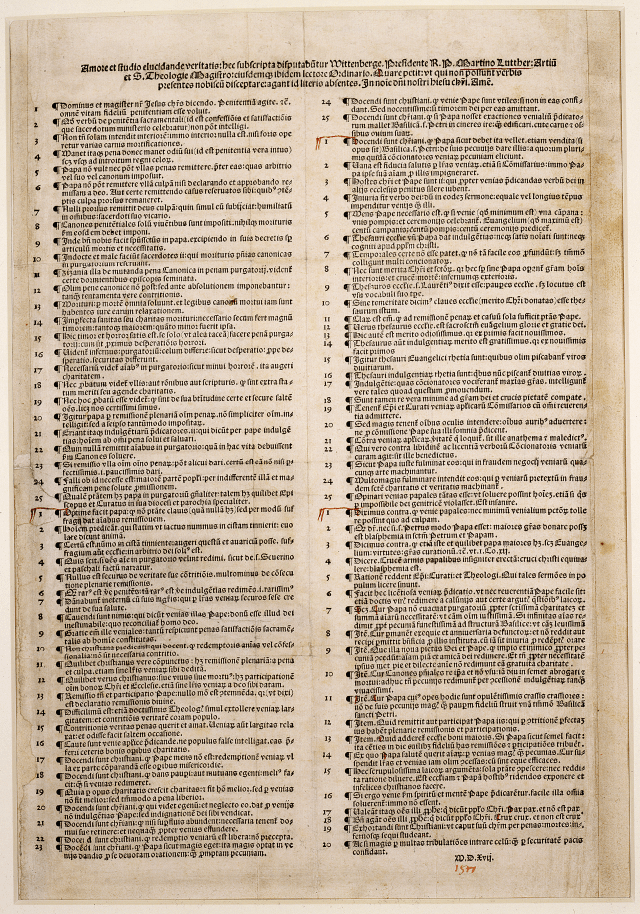
The year was 1517. A monk named Martin Luther gripped his hammer and nailed a list of biblical grievances against the Roman Catholic Church to the door of Castle Church in Wittenberg, Germany, much like we might post a notice to a community bulletin board today. These 95 Theses protested the Catholic Church’s unbiblical policy of selling indulgences, part of an effort to raise funds for the building of St. Peter’s Basilica in Rome. The Catholic Church had created the idea of the Treasury of Merit, sort of a “bank account” of merit deposited by Christ, Mary, the saints, and others as a result of their good works. When church members sinned, they could purchase an indulgence, which was akin to asking the Church to “transfer funds” from the Treasury of Merit to the sinner’s account. The indulgence basically excused the sinner from a certain amount of time in purgatory and/or temporal punishment for that sin.
In addition to protesting the sale of indulgences, Luther’s 95 Theses called the Catholic Church to conform to Scripture by abandoning its unbiblical practices and teachings regarding the doctrines of salvation, religious authority, the nature of the church, and the essence of Christian living.
Luther’s calls for reform spread quickly throughout Europe, inspiring the likes of church fathers Ulrich Zwingli (Zurich), John Calvin (Geneva), and John Knox (Scotland) to join the effort in their own locales. As they worked to address the issues raised in Luther’s document, these men codified what we know today as the “Five Solas of the Reformation,” the basis of Protestant church doctrine. The five solas are:
1. Sola Scriptura– Scripture alone is the basis for all church doctrine, belief, and practice. (2 Timothy 3:16-17)
2. Sola Gratia– Salvation is by grace alone. It is an unmerited gift of God based solely on His goodness, not our own (because we don’t have any). (Ephesians 2:8-9)
3. Sola Fide– Salvation is through faith alone. Faith is a gift bestowed by God. We are saved only by placing that faith in Christ’s finished work on the cross, not by doing good works or by any other attempts to earn salvation. (Ephesians 2:8-9)
4. Solus Christus– Salvation is found in Christ alone. As Acts 4:12 says, “And there is salvation in no one else, for there is no other name under heaven given among men by which we must be saved.”
5. Soli Deo Gloria– God saves man for God’s glory alone, and Believers are to live our lives to glorify Him alone. (Romans 11:36)
One of Luther’s most cherished ideals, from which we still benefit today, was that common people should have access to both the Scriptures and worship services in their own language. Prior to the Reformation, the Bible was only available in Latin. Likewise, all masses and other church services were conducted in Latin. Luther translated the Bible into German, and was later followed by William Tyndale, Myles Coverdale, David Brainerd, and others who translated the Bible into various languages.
On Reformation Day, we commemorate the work, zeal, and sacrifices of Luther and the other reformers. Reformation Day is observed on October 31.
I have a family member, *Fran, who claims to be a Christian, but follows several major false teachers, drinks, habitually lies, is very proud, boastful, and manipulative. She has been shown that these teachers are false but chooses to follow them anyway.
Should I treat her as though she were a sister in Christ by going to her and rebuking her and going through the “disciplinary” steps in hopes of reconciliation? Or should I go about it as if she weren’t a sister in Christ? I have been praying for her and for wisdom for myself to handle this in a God honoring way. (*Name changed)
It’s always difficult to watch a loved one choose sin over Christ and false doctrine over sound doctrine. Praying for Fran and for God’s wisdom and guidance are the first and best step.
You’ve asked about “going through the ‘disciplinary’ steps in hopes of reconciliation.” I believe what you’re referring to here is the process described in Matthew 18:15-17:
If your brother sins against you, go and tell him his fault, between you and him alone. If he listens to you, you have gained your brother.But if he does not listen, take one or two others along with you, that every charge may be established by the evidence of two or three witnesses.If he refuses to listen to them, tell it to the church. And if he refuses to listen even to the church, let him be to you as a Gentile and a tax collector.
This is the basic outline Christ has given us for disciplining sin in the local church. One thing to notice about that last step is that if the person sinning does not listen to the church, the church is to excommunicate (remove, or disfellowship) him from membership and regard him as someone who is lost and in need of the gospel. This brings us to the question of whether Fran is a member of your church or another church. A church obviously can’t excommunicate someone who isn’t a member of that church. This helps us to see that each local body is responsible for disciplining its own members.
If Fran is a member of your church, then, yes, the steps in the Matthew 18 passage should be applied. The wisest course of action, especially if you’ve never done something like this before, is to seek the counsel of your pastor or an elder as to the best way to approach Fran and handle the meeting. Set aside some one on one time to talk to Fran, and be sure you listen to her as well. Part of that one on one meeting is for you– to make sure you are correctly assessing the situation, not, for example, reacting to a rumor you heard, a misunderstanding of an incident, etc. Lovingly and humbly point her to the Scriptures she has transgressed. Pray with her if she is willing.
After that initial meeting, give her some time to consider what you’ve said and to respond to the Holy Spirit’s work in her heart. Check back in with her at a later date and find out if she has repented. If not, prayerfully gather two or three others Fran likes and respects and repeat the process. If she still doesn’t repent, take those two or three people, meet with your pastor or the appropriate elder, and seek his guidance on the next step to take.
You didn’t specify in your e-mail, but it sounded as though Fran is not a member of your church. In this case, you really don’t have any ecclesiological redress (i.e. excommunication) to back you up. What you have is a family member who appears to be a false convert because she is bearing the fruit of someone who is unsaved rather than the fruit of someone who is saved.
I would again encourage you to meet with your pastor, an elder, or a godly, older, spiritually mature woman at your church for counsel as to the best way to proceed. It might be possible to carry out the first two steps of the process simply as an act of love and concern, considering what steps you would take in your personal relationship with Fran if she refuses to repent. First Corinthians 5:9-13 is a good passage to study as you consider this situation:
I wrote to you in my letter not to associate with sexually immoral people—not at all meaning the sexually immoral of this world, or the greedy and swindlers, or idolaters, since then you would need to go out of the world.But now I am writing to you not to associate with anyone who bears the name of brother if he is guilty of sexual immorality or greed, or is an idolater, reviler, drunkard, or swindler—not even to eat with such a one.For what have I to do with judging outsiders? Is it not those inside the church whom you are to judge?God judges those outside. “Purge the evil person from among you.”
This passage is also written to the church body regarding church discipline, but we can glean from it, as well as from the Matthew 18 passage, that there is to be some noticeable degree of separation between Christians and individuals who call themselves Christians yet unrepentantly persist in sin.
As you mentioned, the whole point of lovingly confronting someone you care for about her sin is to – for the good of her own soul – point her back to Christ so that she may first be reconciled with Him through repentance and forgiveness, and then be reconciled with her church family and others. Two good Scriptures to remember and take to heart when we have no other choice but to approach a sinning sister are:
And as you wish that others would do to you, do so to them. Luke 6:31
For with the judgment you pronounce you will be judged, and with the measure you use it will be measured to you. Matthew 7:2
It can be difficult, painful, and embarrassing to hear someone tell you you’re in sin. Put yourself in that sister’s shoes. Treat her as kindly and mercifully as you would want someone to treat you. We never confront another in her sin with the motive of shaming, punishing, seeking revenge, or proving her wrong and ourselves right. That is not the gospel. It is not how Christ treats us when we sin. If she repents when you approach her, forgive and rejoice with her in the good work Christ has done in her heart.
If you have a question about: a well known Christian author/leader, a Bible passage, an aspect of theology, a current issue in Christianity, or how to biblically handle a family, life, or church situation, comment below (I’ll hold all questions in queue {unpublished} for a future edition of The Mailbag) or send me an e-mail or private message. If your question is chosen for publication, your anonymity will be protected.
I am married with two children, and my husband and I had always planned to have as many children as God gave us. I had an emergency cesarean with my first child. During the delivery of my second child, I had signs of uterine rupture and was rushed to the OR. My son was delivered via cesarean as my uterus was tearing open along the incision. I hemorrhaged severely during the surgery and required a blood transfusion.
I asked my doctor what she thought about another pregnancy and she said she thought one more pregnancy would “not be taking an unreasonable amount of risk,” but that every cesarean is higher risk than the one before and most doctors advise against having more than three.
Should I risk getting pregnant again? If I do get pregnant, should I get my tubes tied during the delivery? What does God think of tying tubes? Should I have as many children as God gives us despite the risks?
This is a great question, and one I want to answer very carefully. It would be foolish of me to say, “Yes, have as many children as possible,” because I’m not a doctor and that advice could kill you. It would likewise be foolish to tell you not to get pregnant again because your doctor seems to have indicated that it would probably be OK to do so. This is a decision you and your husband will have to make.
What I can do is hopefully provide you with a few biblical tools you can use to help make that decision.
♦ Pray. God tells us if we lack wisdom to ask Him for it and He’ll give it to us. Pray for your doctors, pray for your husband, and pray for yourself during this decision-making time.
♦ Modern medicine is a blessing of God. Listen to your doctor. Get a second and third opinion if you want. See a specialist. Do some research. Be completely convinced, medically, of whether or not one or more additional pregnancies is wise.
♦ The Bible obviously doesn’t speak to the issue of tubal ligation (having your tubes tied). It neither advocates for nor prohibits non-abortive forms of birth control, especially in cases in which a pregnancy might be medically dangerous. Therefore, this is left to the conscience of Christian couples. Here are some resources that may be helpful:
♦ Count the cost. Are you prepared for the fact that you or your baby could die during the pregnancy or delivery? You have two children and a husband who need you. Are they willing to risk life without you and/or the baby? Conversely, are you prepared to accept being the mother of only two children? If not, why not?
♦ Talk it out with your pastor or some spiritually mature friends if you feel comfortable doing so. Sometimes just hashing everything out verbally can help bring clarity. Pastors and godly friends can provide wise counsel. It’s your pastor’s responsibility to care for your soul and point you to God’s word. Additionally, he may have some helpful resources for you.
♦ This is one of those situations in which submission to your husband can be extremely freeing for you. Ultimately, this is your husband’s decision. The two of you should pray, go over the medical research, and discuss things together, but the final decision rests with your husband. That takes the load of responsibility off your shoulders and places it where it belongs- on him.
Take all of these things into prayerful consideration, make a decision, and trust that when God says He’ll give you wisdom, He will.
If you have a question about: a well known Christian author/leader, a Bible passage, an aspect of theology, a current issue in Christianity, or how to biblically handle a family, life, or church situation, comment below (I’ll hold all questions in queue {unpublished} for a future edition of The Mailbag) or send me an e-mail or private message. If your question is chosen for publication, your anonymity will be protected.
If you are considering commenting or sending me an e-mail objecting to the fact that I warn against false teachers, please click here and read this article first. Your objection is most likely answered here. I won’t be publishing comments or answering emails that are answered by this article.
I get lots of questions about particular authors, pastors, and Bible teachers, and whether or not I recommend them. Some of the best known can be found above at my Popular False Teachers tab. Below are some others I’ve been asked about recently, so I’ve done a quick check (this is brief research, not exhaustive) on each of them.
Generally speaking, in order for me to recommend a teacher, speaker, or author, he or she has to meet three criteria:
a) A female teacher cannot currently and unrepentantly preach to or teach men in violation of 1 Timothy 2:12. A male teacher or pastor cannot allow women to carry out this violation of Scripture in his ministry. The pastor or teacher cannot currently and unrepentantly be living in any other sin (for example, cohabiting with her boyfriend or living as a homosexual).
b) The pastor or teacher cannot currently and unrepentantly be partnering with or frequently appearing with false teachers. This is a violation of Scripture.
c) The pastor or teacher cannot currently and unrepentantly be teaching false doctrine.
I am not very familiar with the women listed below and have not had much of an opportunity to examine their writings or hear them speak, so most of the “quick checking” I did involved items a and b (although in order to partner with false teachers (b) it is reasonable to assume their doctrine is acceptable to the false teacher and that they are not teaching anything that would conflict with the false teacher’s doctrine).
Just to be clear, “not recommended” is a spectrum. On one end of this spectrum are people like Nancy Leigh DeMoss Wolgemuth and Kay Arthur. These are people I would not label as false teachers because their doctrine is generally sound, but because of some red flags I’m seeing with them, you won’t find me proactively endorsing them or suggesting them as a good resource, either. There are better people you could be listening to. On the other end of the spectrum are people like Joyce Meyer and Rachel Held Evans- complete heretics whose teachings, if believed, might lead you to an eternity in Hell. Most of the teachers I review fall somewhere in the middle of this spectrum (leaning toward the latter).
Rachel Held Evans– Not recommended. There are so many ways Rachel deviates from orthodox, biblical Christianity, It would be impossible to describe all of them, even briefly. Rachel denies the Bible’s inerrancy as well as its authority. She rejects the Bible’s teaching that a conscious knowledge of and faith in Christ is necessary for salvation (inclusivism). She supports homosexual “marriage” as well as the idea of calling practicing, unrepentant homosexuals Christians and including them in church membership. She mercilessly twists and misuses Scripture to the extent that it would be comical for its ridiculousness were it not so blasphemous. (Denny Burk has an excellent article that covers all of these issues in more detail.) Rachel believes in evolution. Rachel has, at best, mixed feelings about abortion, supporting the funding of Planned Parenthood and decrying “abstinence only” teaching in sex ed classes. Rachel is a staunch feminist, egalitarian, and promoter of “gender equality” in the church. Pick a biblical issue or doctrine. Rachel is almost certain to be on the unbiblical side of it.
Heather demonstrates extremely poor hermeneutics and lacks a basic understanding of Christ’s atonement in salvation. In this video , she not only teaches that you can lose your salvation by failing to forgive others, she also refers to examining Scripture in context as a way of “squirming out of” obedience to the Bible. In this article on how to study the Bible, Heather suggests praying in tongues, using music by some of her favorite artists, including Jesus Culture, Kari Jobe, and Hillsong, and using study materials such as the Joyce Meyer Everyday Living Bible, the Dakes Study Bible (embraced by Kenneth Copeland and Benny Hinn), The Power of Speaking God’s Word by Joyce Meyer, and Beth Moore materials. In the same article, she makes this odd statement in reference to Jesus being her “husband” (she misunderstands and takes several verses out of context to explain this relationship):
“When I was single, I would dress up, make reservations and take my bible & have a date night! I would go to the movies with Jesus! I would cook him dinner, brownies AND we’d watch a movie at home alone. We’d go grocery shopping together. At nighttime, I would talk to Him about what I should wear the next day (sometimes, we would disagree lol) I would ask Him how He wants me to wear my hair.”
She also talks about having “a relationship with God the Holy Spirit through Jesus Christ,” demonstrating her lack of understanding of the role of the Holy Spirit.
Continuing in the same article, Heather indicates that she believes in and receives extra-biblical revelation and that she relies on her feelings rather than God’s word:
“I started to obey Christ..whenever He told me to do something. You hear God’s voice through your inner ear and some would call it your ‘gut’, conscience or ‘just something told you that you should have done that.’ I always CHECK my peace. If something comes up–I immediately tune into the Holy Spirit and I can tell if He is tugging my heart one way or another. I LISTEN to that peace. A great checker is if you’re in an unhealthy relationship & God is telling you to leave it–you won’t have any peace about the person.”
Heather’s blog is rife with recommendations for and references to Joyce Meyer and T.D. Jakes, she is an admirer of Sarah Jakes Roberts, and Heather and her husband Cornelius have preached at T.D. Jakes’ organization The Potter’s House. You can listen to a critique of one of her “sermons” here.
Nancy (Leigh) DeMoss Wolgemuth– Not recommended. There are many good things about Nancy and her ministry, Revive Our Hearts. Nancy’s teaching is generally doctrinally sound, andI would not label her a false teacher. I’ve personally done one of Nancy’s studies and didn’t find any theological problems with it.
I commend Nancy for stating on her Revive Our Hearts web site that ROH supports the Danvers Statement on biblical manhood and womanhood. Unfortunately, Nancy also believes it is appropriate for women to speak to mixed groups as long as they’re doing so “under the headship of male spiritual authority” and the woman is not in “a position of ongoing responsibility for the spiritual direction of men” (Scripture doesn’t make either of these exceptions).
ROH recommends multiple studies by both Beth Moore and Priscilla Shirer on their resource page and ROH has printed articles by Nancy and others positively referencing both Moore and Shirer (who was a featured speaker at ROH’s True Woman conference in 2012), as well as Lysa TerKeurst/Proverbs 31. There was also concern in 2012 over Nancy’s/ROH’s/True Woman’s use and endorsement of “circle maker” praying. Finally, ROH is an outreach of Life Action Ministries which subscribes to Keswick theology (source, source, source).
I truly regret that I’m unable to give a wholehearted endorsement to any of these women. I’m sure they’re all perfectly nice people who, in their own hearts, have only the best of intentions, but Christian leaders and teachers have a grave responsibility to Christ and to their listeners to teach sound doctrine and walk in obedience to Scripture. Please understand that this is not a personal attack on any of these women, only answers to readers’ questions about whether or not I recommend them and their materials.
If you have a question about: a well-known Christian author/leader, a Bible passage, an aspect of theology, a current issue in Christianity, or how to biblically handle a family, life, or church situation, comment below (I’ll hold all questions in queue {unpublished} for a future edition of The Mailbag) or send me an e-mail or private message. If your question is chosen for publication, your anonymity will be protected.