
Mailbag

The Mailbag: Is lust a sin for women, too?

In the past, I’ve had lots of trouble wondering about my desire and tendency to look at, and get excited by, physically attractive men, especially men who reveal a lot of themselves in underwear modeling and soft-core porn. I think this is a sin, but I’m not sure.

I’ve gotten mixed reactions when I’ve mentioned this to people. There are some who say that, yes, this is the sin of lust. Yet there are others who have told me that women cannot possibly struggle with lust, only men do. I once dealt with one particular man who was very dogmatic that God created men and women to be tempted differently, and that lust is not a temptation women deal with, so he dismissed my struggles with this subject.

When I tried to search Scripture, using Matthew 5:28, it would also seem that this is a male-only sin. So is it OK for me to keep looking at male models, including underwear modeling and soft-core porn?

This is an awesome question for three reasons. First, you’re concerned about whether or not you’re sinning with the aim of mortifying this behavior if it is a sin. Second, you’re not relying on your own feelings, opinions, or experiences to determine whether or not this is a sin, you’re turning to Scripture to find out. Those are both very encouraging things. They demonstrate that the Holy Spirit is working in your heart to sanctify you and make you more like Christ. Third, it gives us an opportunity to take a look at the Scriptures in more depth and give an example of handling God’s Word correctly and in context for everyone reading this article. So, thank you for asking!

The short answer to your question is, yes, lust is sinful for the women who experience it just as much as it is for the men who experience it. But I don’t want you to just take my word for it, so let’s look at why.

The Scripture you’ve cited, Matthew 5:28, is definitely one of the passages that addresses this issue. It says:

But I say to you that everyone who looks at a woman with lustful intent has already committed adultery with her in his heart.

I suspect this verse might be the reason the man you spoke with said that lust is a male-only sin, because this particular verse speaks to men lusting after women. However, to make a blanket statement that because God created men and women differently, lust is never a temptation for women is foolhardy and shows a lack of biblical knowledge and understanding as well as a denial of reality.

Let’s address reality first. It is true that God created men in such a way that they are more likely to be sexually stimulated by what they see than women are. However, that does not mean that no woman anywhere has ever experienced lust. God also created men in such a way that men are usually taller and stronger than women and women are usually more emotionally expressive than men. But we can look around us and see that some women are taller or stronger than some men, and some men are more emotionally expressive than some women.

Furthermore, while you really can’t do anything about how tall you are (and, to some extent, how strong you are), lust is something that can be introduced to women and encouraged in women by culture. A hundred years ago, it would have been unthinkable to see advertisements featuring nearly naked men, or strip clubs with male dancers, or pornography aimed at women, so readily available and with so little shame attached. And at that time there were probably far fewer women who struggled with the sin of lust.

These days, it’s right there on your phone or computer or TV or at the bachelorette party for your friend. Lust, lewd behavior, and lurid talk by women are actually encouraged by the feminist movement. (If men are going to objectify women with lust and porn, we’re going to objectify them right back. Really? This is equality? The right to sink to the same depth of degradation as the scuzziest of men? No thanks.) Watch any sitcom or drama on TV. You’ll see it soon enough. And, of course, there’s money to be made by making women into consumers of porn and other sexual material, so the businesses that peddle these things encourage women to lust as well. All of which means that today, just a hundred years later, far more women are struggling with the sin of lust.

So we can see that the reality is that lust is a temptation experienced by some women, even though men are more prone to it.

But is lust a sin for women if Matthew 5:28 is speaking in terms of men lusting? Yes. There are a couple of different reasons for this, one cultural, and one biblical.

Let’s go cultural first to understand more clearly why this particular verse is addressed to men rather than men and women. We start off with the knowledge that men are much more likely to experience lust than women. Then we take the culture of the time into account.

Jesus spoke these words in a patriarchal society. In His culture, there were no women in positions of authority and power. Men ran the political system, the religious system, and men were the heads of their households. (By the way, despite what our culture today would say, this wasn’t a bad thing in and of itself. In fact, most of this was perfectly biblical.) Normally, women were not educated, and they depended on men – first their fathers, then their husbands, and finally, their grown sons – to take care of them their entire lives.

So when Jesus was teaching to the crowds as with the Sermon on the Mount (which Matthew 5 is part of) the cultural understanding was that He was primarily teaching the men, and any women and children they brought with them were basically along for the ride. Indeed, many would have thought the women incapable of understanding teaching (since they were intellectually inferior to men) or unworthy of receiving teaching (because God had created them as “lesser” than men).

The Jewish understanding that Jesus was primarily teaching the men would have been similar. Rabbis didn’t teach women, they taught men. Any intentional biblical instruction women received would have been from their fathers or husbands at home. We can see further evidence of this cultural and Jewish understanding in several different Scriptures. A few examples:

At the feeding of the five thousand, the feeding of the four thousand, and some other New Testament “crowd scenes”, the crowd is numbered by the number of men present.

Both the woman at the well herself and the disciples “marveled” that Jesus was speaking with a woman.

Due to Martha’s cultural and Jewish understanding of women’s roles, Jesus had to explain to her that it was OK – even good – for Mary to sit at His feet and learn.

At Pentecost, Luke refers to the “multitude” as “devout men“, and Peter addresses this crowd as “men of Judea“, “men of Israel“, and “brothers“.

So, in Jesus’ secular and Jewish cultural context, He was understandably speaking to the men present. (And what was He telling these men who lived in a world that taught them that women were inferior to men, and that men could regard and treat women any way they wanted to? Jesus elevates the status of women by telling the men they’ve got to respect women even in their hearts. They’ve got to respect their wives by not committing adultery with other women in their hearts, and they’ve got to respect those other women by not using them as objects of sexual gratification in their hearts.) It would have been an unnecessary distraction from His message to address the women directly, and it would certainly have been viewed as inappropriate, maybe even perverted, for Jesus to have suggested that women lusted after men.

So Jesus’ culture, and the fact that lust is largely a sin committed by men, required Him to address this remark to men. But those two things do not have any bearing on the intrinsic sinfulness of lust itself, and they do not mean that this instruction applies only to men. In the section of Matthew 5 preceding the section on lust, Jesus deals with the sin of being angry with your “brother”. Does this mean anger is only sinful if you’re angry with a man instead of a woman? The section of Matthew 5 immediately following the section on lust says men may not divorce their wives except for unfaithfulness. Does this mean women are free to divorce their husbands for any reason? Of course not.

But it’s important to remember that Matthew 5:28 is not the only passage of Scripture that deals with lust. Let’s look at some others.

These passages describe lust as female attribute:

a wild donkey used to the wilderness, in her heat sniffing the wind! Who can restrain her lust?
Jeremiah 2:24a

Oholah played the whore while she was mine, and she lusted after her lovers…everyone after whom she lusted…the Assyrians, after whom she lusted…Her sister Oholibah saw this, and she became more corrupt than her sister in her lust and in her whoring, which was worse than that of her sister. She lusted after the Assyrians…all of them desirable young men.
Ezekiel 23:5a,7b,11,12a,c,

Ezekiel even describes Oholibah viewing pictures of men lustfully. Doesn’t it sound like a woman viewing pornography?:

But she carried her whoring further. She saw men portrayed on the wall, the images of the Chaldeans portrayed in vermilion, wearing belts on their waists, with flowing turbans on their heads, all of them having the appearance of officers, a likeness of Babylonians whose native land was Chaldea. When she saw them, she lusted after them and sent messengers to them in Chaldea.
Ezekiel 23:14-16

In the Jeremiah passage, the lusting woman represents Israel. In Ezekiel, Oholah represents Samaria, and Oholibah represents Jerusalem. So these are not individual women lusting, rather, God is using the illustration of a woman lusting after her “lovers” to describe the unspeakable abomination of Israel’s idolatry. He was using the severest language He could to disgust His people over their sin and move them to repent and turn back to Him. God could have chosen any sin – male lust, robbery, murder, etc. – to represent how horrific their idolatry was to Him, but what did He choose? Female lust. Let that sink in.

Romans 1:18-32 clearly refers to the sins of both men and women, with verse 24 stating:

Therefore God gave them up in the lusts of their hearts to impurity, to the dishonoring of their bodies among themselves,

These passages speak of lust in neutral, rather than male or female, terms:

and especially those who indulge in the lust of defiling passion
2 Peter 2:10a

For all that is in the world, the lust of the flesh and the lust of the eyes and the boastful pride of life, is not from the Father, but is from the world.
1 John 2:16

Lust is a form of coveting – the greedy yearning to have something that God has not given to you or has given to someone else, and that is certainly not limited to men. Also notice in these passages that you can covet a person, and that coveting is often linked to sensuality or sexual immorality.

You shall not covet your neighbor’s house; you shall not covet your neighbor’s wife, or his male servant, or his female servant, or his ox, or his donkey, or anything that is your neighbor’s.
Exodus 20:17

coveting, wickedness, deceit, sensuality, envy, slander, pride, foolishness. All these evil things come from within, and they defile a person.
Mark 7:22-23

But sexual immorality and all impurity or covetousness must not even be named among you, as is proper among saints…For you may be sure of this, that everyone who is sexually immoral or impure, or who is covetous (that is, an idolater), has no inheritance in the kingdom of Christ and God.
Ephesians 5:3,5

Put to death therefore what is earthly in you: sexual immorality, impurity, passion, evil desire, and covetousness, which is idolatry.
Colossians 3:5

Finally, lusting after another person – adulterous coveting – is not loving your neighbor:

For the commandments, โ€œYou shall not commit adultery, You shall not murder, You shall not steal, You shall not covet,โ€ and any other commandment, are summed up in this word: โ€œYou shall love your neighbor as yourself.โ€
Romans 13:9

When you look at another person with lust, you are loving yourself. You are thinking selfishly about how that person could gratify your base desires, make you feel good, serve you. That is the antithesis of everything Jesus taught and stood for. Our Master, the One we follow and strive to be like, said:

For even the Son of Man came not to be served but to serve, and to give his life as a ransom for many.
Mark 10:45

Jesus came to die on a cruel rugged cross to pay for the sins of the flesh. He would never have thought of using another person to gratify His own selfish desires. How could we?

Is lust a sin for women too? Absolutely. Stop it. Repent. Receive the merciful grace and forgiveness Christ offers.

Additional Resources:

Just Stop It: Instructions on how to repent at The Cripplegate

Hey, Porn Addict: Stop It by Gabriel Hughes

How do you stop looking at porn? at When We Understand the Text

God Over Porn

Every Womanโ€™s Silent Struggle: Fighting Lust with Sisters in Christ by Marian Jacobs


If you have a question about: a Bible passage, an aspect of theology, a current issue in Christianity, or how to biblically handle a family, life, or church situation, comment below (Iโ€™ll hold all questions in queue {unpublished} for a future edition of The Mailbag) or send me an e-mail or private message. If your question is chosen for publication, your anonymity will be protected.


Bible Study, Mailbag

The Mailbag: How can I get started studying the Bible itself?


Where would you recommend someone start if they really wanted to read the Bible for themselves?

I love this question so much. I wish more women were asking this question.

If you’ve hung around the blog for practically any amount of time, you’ve probably heard me say that next to “Is ______ a false teacher?”, the question I’m most often asked is, “Can you recommend a good women’s Bible study?“. I give the same answer to that question every time: no.

First of all, it’s easier to find a needle in a haystack than a doctrinally sound study at a Christian retailer. But, second, why would you rob yourself of the joy of holding the actual words of God in your hands and studying them for yourself? I can’t bring myself to recommend something that would be less – less joy, less growth in Christ, less depth, less knowledge of the Word – than the best. I recommend that you study God’s Word itself, not the gleanings from somebody else’s study of God’s Word.

When I first received this question, I wasn’t sure whether the reader wanted to know which book of the Bible she should start with or which method to use, so I’ll cover both.

๐Ÿ“–ย Fear not. Let’s take just one step backwards from this reader’s question for a moment. Sadly, some women have never been introduced to the idea that they can study the Bible for themselves, without using a pre-packaged (I call them “canned”) study (book, workbook, DVD, etc.). If this Mailbag article is the first time you’ve ever heard of such a thing, and you’re intrigued but apprehensive, don’t be afraid to give it a try. Until some time around the latter part of the 20th century, when people wanted to study the Bible, they just picked up the Bible itself and started studying. And it worked. People – usually withย far less education than you have – grew in their faith to godly maturity just fine. There’s no reason you can’t do that, too.

๐Ÿ“–ย Go into it with the right mindset.ย Bible study is a skill just like anything else. You’re not going to be perfect at it the first time you try, just like you didn’t ride a bicycle perfectly the first time you tried. You may try a method of studying that just isn’t a fit for you. You might choose a book of the Bible that’s not as suited for beginners as another book might be. That’s OK. There’s going to be some trial and error. Stick with it and don’t give up.

๐Ÿ“–ย Commitย I always encourage women to commit to putting aside all of the workbooks and devotionals for a year. It takes a while to get out of the habit of relying on somebody else to do the heavy lifting for you and into the habit of diligently digging in to God’s Word for yourself. If you have a little hiccup in your studying, don’t quit and go back to the canned studies, assuming you can’t handle studying God’s Word on your own. Yes, youย can. Just pick yourself up, dust yourself off, and start again.

๐Ÿ“–ย “Training wheels” If you need a little help getting started, choose one of the studies I’ve written at the “Bible Studies” tab at the top of this page. My studies are designed to train you to study the Bible for yourself. You’ll learn about context, cross-references, culture, the storyline of redemption from Old Testament to New, the kinds of questions you should be asking of the text, and more. They are “teach a woman to fish” studies rather than “give a woman a fish” studies. I fully expect that you will be able to bait your own hook in no time.

๐Ÿ“–ย Structure If structure and schedules and plans are your jam, you might want to choose a Bible reading plan. It’s become my New Year’s Day tradition to publish an annual round up of super Bible reading plans. You can find this year’s list of plans at theย Bible Studiesย tab at the top of this page.ย There are plans that range in length from seven days to indefinite. Some will take you through a biblical topic, others through one or two books, others through the whole Bible. If you’re a beginner, I would recommend starting with one of the shorter ones (90 days or less) to get your feet wet. And, when you’re ready to read through the whole Bible (which you really need to do at some point), I highly recommend the chronological plan.

๐Ÿ“–ย Freestyle If you’re more of a “set your own schedule” kind of person, just choose a book of the Bible – maybe one you’ve had your eye on – start at the beginning, and read a bit each day until you reach the end of the book. Then choose another book and start again. Not really familiar with the layout of the Bible? Try choosing one of the shorter (less than 20 chapters) books if this is your first try and you’re taking a shot in the dark. Enjoy reading stories? You might want to start with Genesis or one of the gospels (Matthew, Mark, Luke or John). Looking for instruction instead? Try one of the epistles (basically anything between Acts and Revelation). You will probably want to save the longer and more complicated books (ex: the major and minor prophets, Revelation, Leviticus) for when you get a bit more experience with studying Scripture. As you get more confident in studying the Bible, make it your goal to study through every book at least once.ย 

๐Ÿ“–ย How to?ย There are a variety of methods and techniques you can learn for studying the Bible, and whatever method enables you to rightly handle God’s Word and works best for you is fine. I like to keep things simple. Before I start studying, I spend some time in prayer. I confess my sins, ask God to speak to me through His Word, and ask Him to help me correctly understand, obey, and apply His Word. After that, I have a spiral notebook and a pen, and I simply take notes on the text. (If you want to see the kinds of things I write down when I take notes, read through the questions in one of the studies I’ve written at the “Bible Studies” tab. I write those studies the same way I take notes during my personal study time.) As a beginner you may wish to simply read the text and build up to taking notes as you become more comfortable with reading.

๐Ÿ“–ย Get some help. You don’t have to do this all by yourself. Maybe your husband, a godly friend, one of the older ladies at church, or your pastor could offer you some pointers on studying your Bible or help you out with any questions you might encounter along the way. Never be afraid to ask for help. That’s what brothers and sisters in Christ are for.

I’ve also got a number of resources onย how to study the Bible under the “Bible Studies” tab at the top of this page. Click on the link and scroll through, or you might wish to start with one of these.

Youโ€™re Not as Dumb as You Think You Are: Five Reasons to Put Down that Devotional and Pick Up the Actual Bible

Nine Helps for Starting and Sticking to Daily Bibleย Study

10 Bookmarkable Biblical Resources for Christian Women

10 Simple Steps to Plain Vanilla Bible Study

Rightly Dividing: 12 Doโ€™s and Donโ€™ts for Effective Bible Study

Bible Book Backgrounds: Why You Need Them and Where to Findย Them

As a newly doctrinally sound Christian, should I stopย journaling?

(More details on taking notes on the text of Scripture.)


If you have a question about: a Bible passage, an aspect of theology, a current issue in Christianity, or how to biblically handle a family, life, or church situation, comment below (Iโ€™ll hold all questions in queue {unpublished} for a future edition ofย The Mailbag) or send me anย e-mail or private message. If your question is chosen for publication, your anonymity will be protected.
Mailbag

The Mailbag: Potpourri (Sexual abuse, Feminism, Serpent seed doctrine…)

Welcome to another โ€œpotpourriโ€ edition ofย The Mailbag, where I give short(er) answers to several questions rather than a long answer to one question. I also like to take the opportunity in these potpourri editions to let new readers know about my comments/e-mail/messages policy. Iโ€™m not able to respond individually to most e-mails and messages, so here are someย helpful hintsย for getting your questions answered more quickly.ย Remember, the search bar can be a helpful tool!


Can you please suggest an iPhone app Radio station that plays biblically sound worship, praise and messages?

A reader asked this question via Facebook recently. I mostly listen to podcasts, and though I’m aware of a few good sermon apps, I wasn’t familiar with any apps that provide both sermons and music. I asked my Facebook readers for some help and got lots of great answers. You can check out their suggestionsย hereย (even if you’re not on Facebook). I’m not personally familiar with all of these sites and apps, so use good discernment and make sure everything they’re teaching lines up with Scripture.


Do you have advice on Christian women and feminism? I have friends who are reading Jesus Feminist. The title makes me cringe.

Secular feminism is not something I handle a whole lot here on the blog, although I have touched on it in these articles:

Toxic (Evangelical) Femininity

Feminist Infiltration and the Emasculation of Christianย Men

6 Reasons Godly Women are Stronger Thanย Feminazis


I would recommend that you head over to Sheologians. Summer and Joy have done several very good podcast episodes and articles on the history of feminism and its current influence on society and the church. I cannot remember whether they coveredย Jesus Feminist or not, so you may want to make use of the “contact us” link at the top of their site and ask. (Tell them I said hi!)


My husband and I are having sexual problems that stem from the fact that I was molested as a child. What should I do?

I have intentionally left out the specific details of this particular reader’s question, first, in order to protect her identity, second, because I have no doubt that many readers have this same general question, and third, because, being a stranger on the internet, I am not the person who can best help anyone in this situation, so I can only give a very general answer anyway.

I grieve with those of you who have had this terrible sin perpetrated against you. I hope the person who abused you was caught and prosecuted to the fullest extent of the law. It is also my prayer that God has taken what was meant for evil against you and used it for good in your life by drawing you to Himself, teaching you to depend on Him, and deepening your walk with Him.

As I mentioned, although I’m humbled and honored that readers sometimes reach out to me for help with staggering griefs and difficulties, I would be doing you a disservice if I tried to help you via e-mail or a blog article with complicated personal problems that require ongoing counseling from someone you have (or can develop) a face-to-face relationship with.

Generally speaking, it’s important that youย understand that, as a child, the abuse was not your fault, regardless of how you responded to it at the time. A physiological response (orgasm) to the abuse does not mean you enjoyed being violated, wanted it to happen, or were “asking for it”. Neither does having kept it a secret, being friendly with the abuser, “allowing” the abuse to continue in order to receive gifts from the abuser, etc. You were a victim.

It’s important that yourย husband understand that the sexual difficulties you are experiencing are no reflection on him. Sex is a very personal thing, and he may be incorrectly assuming that your aversion to sex is an aversion to his performance or to him, personally. He will also need to come to grips with the fact that there’s no quick, cut-and dried, three or five or fifteen step plan to “fixing” this. It will be a growth process for both of you.

Assuming you’re in a doctrinally sound church, I would urge you and your husband in the strongest possible terms to set up an appointment with your pastor for counseling. Shepherding your souls through life’s difficulties is part of his biblical job description, and if he went to a decent seminary, he was trained in marital counseling.

If you absolutely don’t think you could look your pastor in the eye during the sermon every week after discussing such personal matters, ask him for a referral to a certified biblical counselor (not a “Christian counselor” – biblical counseling, formerly called nouthetic counseling, is different) who can help you and your husband heal by learning and walking out in your marriage the Scriptures that apply to your situation. If your pastor isn’t familiar with biblical counseling, find a referral through theย Association of Certified Biblical Counselors, the counselor search linksย here, or contact a nearby (doctrinally sound) seminary or Christian university and ask if you can speak to someone in their school of biblical counseling.

I know it seems like it will be painful and embarrassing to discuss this situation with a third party, but don’t let it continue to fester. It will destroy your marriage. Getting biblical help will set you and your husband free.


What are your thoughts on a woman teaching an introductory class in biblical Greek to adults (men and women) at church?

Not knowing the context and spiritual climate of your church and assuming the class is taught in the same way other academic foreign language classes are taught – alphabet, vocabulary, grammar, etc. – I don’t see any more problem with it than if she were teaching French or Swahili or Chinese.

The biblical prohibition against women teaching men has to do with women instructing men in theย content of the Bible, not the language the Bible was originally written in. Greek is just a language like any other. It is not holy or special just because that’s the language the majority of the New Testament was penned in. (Actually, the opposite is true. Greek was the most widely spoken language of the time, so God used it to get His Word out to the largest number of people.)

Even if the teacher has the class translate portions of Scripture or uses a word or phrase from a Bible verse to illustrate the meaning of a word – assuming she doesn’t veer off into preaching on that verse – she is still teaching aย language, not giving Bible instruction to men in the way prohibited by Scripture.

As I said, I don’t know the context and spiritual climate of your church so there could be other factors along those lines that need to be taken into consideration as to whether or not it’s wise for a woman to teach this class, but strictly speaking as to whether or not it’s a violation of Scripture, no.


Do you have any teachings on the implications of the serpent seed doctrine?

No, I’ve never written about it because, until I was asked this question, I’d never heard of it.

I did a brief search, and I would say that the implications are racism, false doctrine, and poor hermeneutics. Apparently, the gist of this teaching is that when the serpent tempted Eve in the Garden of Eden, a sexual encounter took place between the two, leading to the conception of Cain. Therefore, everyone who is descended from Cain was conceived from the “serpent’s seed” and is of the devil.

This is a concoction of an evil imagination and has no basis in Scripture whatsoever. In fact, Genesis 4:1 clearly tells us who Cain’s father was. Even Cain’s name tells us Godย caused Eve to conceive him:

Now Adam knew Eve his wife, and she conceived and bore Cain, saying, โ€œI have gotten a man with the help of the Lord.โ€

I mean, that’s pretty much a mic drop moment with regard to this ridiculous “doctrine”.

Here are a couple of good resources explaining more:

What is the Serpent Seed doctrine?

The serpent seed and the Kenites


If you have a question about: a Bible passage, an aspect of theology, a current issue in Christianity, or how to biblically handle a family, life, or church situation, comment below (Iโ€™ll hold all questions in queue {unpublished} for a future edition ofย The Mailbag) or send me anย e-mail or private message. If your question is chosen for publication, your anonymity will be protected.

Mailbag

The Mailbag: Should Christian women cover up while breastfeeding?

To my dear brothers in Christ –
This is an opportune time to remind you that this blog is written to, and for, Christian women. Though you are always welcome to “eavesdrop” here, please be advised that this article contains reverent and biblical, yet open, references to female anatomy and sexuality. If that would cause you to stumble in any way, please do not read this article.


It seems like I’m constantly seeing stories in the news and on social media in which breastfeeding women angrily freak out about being asked to cover themselves while nursing their babies. How should Christian women approach this issue? Maybe these women are right to protest? It’s just feeding a baby in the natural way, after all, isn’t it?

Whenever Christians approach an issue like this (or any other), the first thing we need to ask ourselves is, “Who am I?” not “What doย I want to do?”. For Christians the answer has to start with, “I am a bondservant of the Lord Jesus Christ. I am here to represent Him and do what He wants me to do, not what I want to do.”

So, how would Christ want a Christian nursing mother to act and to represent Him in this situation?

Christ wants us to be kind and be at peace with others.
There are hills to die on, such as biblical truth, the gospel, and protecting the lives of others. Personal preferences and habits are not one of those hills.

Then Jesus told his disciples, โ€œIf anyone would come after me, let him deny himself and take up his cross and follow me.
Matthew 16:24

If possible, so far as it depends on you, live peaceably with all.
Romans 12:18

But I say to you, Do not resist the one who is evil. But if anyone slaps you on the right cheek, turn to him the other also. And if anyone would sue you and take your tunic, let him have your cloak as well. And if anyone forces you to go one mile, go with him two miles.
Matthew 5:39-41

Do nothing from selfish ambition or conceit, but in humility count others more significant than yourselves. Let each of you look not only to his own interests, but also to the interests of others.
Philippians 2:3-4

We’re to be gracious and hospitable to others, even putting ourselves out, if necessary, to be kind to them. I have nursed four babies. It is not that big of a deal to throw a burp rag or small blanket over your shoulder and the baby. As an imitator of Christ, why would Iย not do this small thing as an act of love toward someone who’s uncomfortable enough to ask me to do so? Why would I ever act with hostility or speak unkindly to this person who’s asking me to cover? Does that kind of attitude represent Christ well?

Christ wants us to be set apart from the world.
If the world is acting a certain way, it’s a pretty good bet that Christians should be acting the opposite way.

Therefore go out from their midst, and be separate from them, says the Lord,
2 Corinthians 6:17a

For the grace of God has appeared, bringing salvation for all people, training us to renounce ungodliness and worldly passions, and to live self-controlled, upright, and godly lives in the present age,
Titus 2:11-12

I’ve seen some of the articles and social media posts from women (whom I can only assume by their words and actions are unsaved) who really do “angrily freak out” when asked to cover. If Christian women act the same way the world acts, how is that a testimony to Christ? Does that kind of behavior represent Christ well?

Christ wants us to share the gospel.
One of the reasons Christ wants us to be kind and peaceable to others and set apart from the world is because acting that way grabs the attention of lost people. Godly attitudes and behavior are a rare light shining in the darkness of our world. It is so joltingly unexpected that lost people will often ask in incredulity why we’ve acted that way. And that is our open door to explain why and share the gospel.

but in your hearts regard Christ the Lord as holy, ready at any time to give a defense to anyone who asks you for a reason for the hope that is in you.
1 Peter 3:15 (CSB)

Nevertheless, we have not made use of this right, but we endure anything rather than put an obstacle in the way of the gospel of Christ.
1 Corinthians 9:12b

Christians are people who put aside our personal rights and endure without offense the slings and arrows hurled at us by the lost in order to reach them with the gospel. If someone asks you to cover and you go off on her, is that going to open a door for you to share the gospel with her? Do you think she would even listen to you after your angry tirade?

Christ wants us to be honest.
In the stories I’ve read about the covering issue, the most common argument I’ve seen for refusing to cover is, “It’s natural! I’m just feeding my baby!”.

Come on. Let’s get real. And biblical.

First, there are plenty of “natural” bodily functions we don’t perform in public for the world to see. We don’t have sex in public. We don’t relieve ourselves or attend to feminine hygiene needs in public. We don’t change clothes in public. We don’t bathe in public. Most of us even avoid burping and passing gas in public. “It’s natural!” isn’t even aย logicalย (never mind biblical)ย argument for doing something in public. Performing any and all bodily functions in public without shame is what animals do, not people made in the image of God.

Next, feeding a baby with your breast isn’t the same thing as feeding a baby with a bottle or from a spoon. Don’t believe me? When was the last time you saw an article about a woman who was offended by someone asking her to cover up a Dr. Brown’s or a jar of strained peas? Never, that’s when. No reasonable human being is buying the argument that, visually, breast equals bottle, so let’s stop trying to make that happen. The two are different, and that’s OK.

One of the differences is that while bottles and spoons have only one function – transporting food to mouth – breasts are multi-taskers, much like our tongues. We use our tongues for eating, but we also use them for talking. We use our breasts for feeding babies, but they are also a component of our sexuality. And that’s not a bad thing, nor are men wrong or bad for considering breasts to be sexual. That’s the way God created women and men.

rejoice in the wife of your youth…Let her breasts fill you at all times with delight;
Proverbs 5:18b,19b

Your two breasts are like two fawns, twins of a gazelle…Your stature is like a palm tree, and your breasts are like its clusters. I say I will climb the palm tree and lay hold of its fruit. Oh may your breasts be like clusters of the vine,
Song of Solomon 7:3,7-8a

They played the whore in Egypt; they played the whore in their youth; there their breasts were pressed and their virgin bosoms handled.
Ezekiel 23:3

Your breasts don’t look any different when you’re feeding a baby than they do when they’re functioning sexually. Whether you intend for them to be sexual or not,ย breasts are breasts regardless of context.ย As constant components of sexuality, in order to maintain biblical modesty and avoid being a stumbling block to others, your breasts are for reserved for two sets of eyesย only: your husband’s eyes and the eyes of the child you’re currently nursing.ย And preciselyย becauseย of that, God instructs us to keep the girls under wraps.

And the Lord God made for Adam and for his wife garments of skins and clothed them.
Genesis 3:21

When she carried on her whoring so openly and flaunted her nakedness, I turned in disgust from her, as I had turned in disgust from her sister.
Ezekiel 23:18

I counsel you to buy from me gold refined by fire, so that you may be rich, and white garments so that you may clothe yourself and the shame of your nakedness may not be seen,
Revelation 3:18a

and our unpresentable [body] parts are treated with greater modesty, which our more presentable parts do not require.
1 Corinthians 12:23b-24a

likewise also that women should adorn themselves in respectable apparel, with modesty and self-control,
1 Timothy 2:9a

Outside of the one flesh relationship of marriage, the Bible equates nakedness with shame and clothing and modesty with honor. Does flaunting the nakedness of private body parts more closely align with what the Bible calls shameful or what the Bible calls honorable?

Breastfeeding your baby is a good thing. Biblical modesty is also a good thing. Fortunately, the two are easily compatible. Nursing your baby in public? Don’t put others in the awkward position of having to ask. Cover up.


If you have a question about: a Bible passage, an aspect of theology, a current issue in Christianity, or how to biblically handle a family, life, or church situation, comment below (Iโ€™ll hold all questions in queue {unpublished} for a future edition ofย The Mailbag) or send me anย e-mail or private message. If your question is chosen for publication, your anonymity will be protected.

Mailbag

The Mailbag: Potpourri (Heretical church music, Mistranslating 1 Tim. 2:12, Books for women…)

Welcome to another โ€œpotpourriโ€ edition ofย The Mailbag, where I give short(er) answers to several questions rather than a long answer to one question. I also like to take the opportunity in these potpourri editions to let new readers know about my comments/e-mail/messages policy. Iโ€™m not able to respond individually to most e-mails and messages, so here are someย helpful hintsย for getting your questions answered more quickly.ย Remember, the search bar can be a helpful tool!


I need guidance in approaching the worship director of the church I started attending 6 months ago (haven’t joined yet) due to his frequent use of Bethel/Jesus Culture/Hillsong/Elevation Church music. I stand there in silence most of the worship time because I just donโ€™t feel comfortable singing those songs. I donโ€™t want to meet with him and be that person who is critical and legalistic but I feel convicted that someone needs to. Should I go talk to the pastor first (we have somewhat of a relationship since Iโ€™ve met with him a couple times and agree with his theology)?

It’s awesome that you are discerning enough to know that music from these heretical and New Apostolic Reformation organizations shouldn’t be used by any church. I encourage you to keep having those “powers of discernment trained by constant practice” of distinguishing good from evil (Hebrews 5:14).

I also want to encourage you that inquiring about the theology of a church or its music – especially as someone who is deciding whether or not to join that church – is not being “critical and legalistic”. That is what scoffersย say about discernment issues, but it is not theย biblicalย way of viewing “contending for the faith”. Do not allow ungodly people with their unbiblical personal opinions to deter you or even make you feel bad for doing what is right and good and godly.

I agree with you that someone needs to address the issue of the music. It is possible that’s why God put you into this church at this time – to pray for the church, the minister of music, and the pastor about this, and to lovingly explain the issues.

Since I’m not personally involved in the situation, I can’t offer any advice as to whether to approach the minister of music or the pastor first. I would suggest you pray and ask God to give you the wisdom to know which one of them to speak to first, and trust Him to direct your paths. You might want to consider which of these men you feel will be more receptive to what you have to say. If you go to the minister of music first and he brushes you off, I would encourage you to go to the pastor next. I think both of their responses will help you decide whether or not you want to join this church.

Here are some resources that may help:

The Mailbag: How should I approach my church leaders about a false teacher theyโ€™reย introducing?

Hillsongโ€™s Theology of Music andย Worship

The Mailbag: Should Christians listen to โ€œRecklessย Loveโ€?

Popular False Teachers (further information on Hillsong, Bethel, Jesus Culture, Steven Furtick)


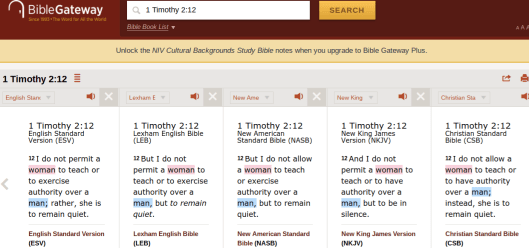
A popular Christian apologist I follow says that the prohibition against women preaching, teaching Scripture to men, and holding authority over men in the church in 1 Timothy 2:12 is translated incorrectly.

I do not permit a woman to teach or to exercise authority over a man; rather, she is to remain quiet.

He says it should not be translated as “woman” and “man” “but as “wife” and “husband”, and that he believes Bible translators mainly translate it as man woman due to tradition (i.e. men have historically been the pastors and teachers in the church).

This is why linguists – professional experts in the biblical languages – are hired to translate Scripture, not apologists.

Bible translators (of reliable translations) are true to the text, not church tradition or personal convictions. Furthermore, when translators are working on the text, it is not a lone individual who writes down what he thinks the Greek words say and that’s the Bible you end up reading. There are teams of translators, linguists, editors, and even computer experts who work on the text. They check, and double check, each other’s work. So even if one translatorย was translating according to tradition or opinion, it would be caught by others and not allowed to slip through the cracks.

All of the most reliable English translations translate the words as “man” and “woman”, not “husband” and “wife”.

And just for kicks, I checked this verse in about a dozen of the less reliable translations, and every single one of them translates it “man” and “woman”. Even versions that got other parts of verse 12 incorrect still use “man” and “woman.” For goodness sake, evenย The Messageย andย The Passion “Translation” possibly the two worst English versions of the Bible (They’re not even translations.ย The Message is a paraphrase, written by someone who endorsed the heresy-laden bookย The Shack and has made statements affirming homosexuality. Andย Passion is the new New Apostolic Reformation version of the Bible, based, supposedly, on new revelation directly from God.) both say “man” and “woman”. And the NAR is totally OK with female preachers, so you know they’re not using “man” and “woman” due to tradition.

So we’ve got one apologist who’s of the opinion that it should be “husband” and “wife” against scads of translators who are experts in their fieldsย andย whack job NAR “translators” who approve of female pastors, who all use “man” and “woman”. You would thinkย someone out of all of those people would have translated it “husband” and “wife” if that was the correct translation. It’s telling that even “translators” who push the egalitarian agenda won’t go so far as to change it to “husband” and “wife”.ย I think the apologist is somewhat out of his depth here.

A few more quotes from said apologist:

Verse 11 and following is directed at women in the context of their relationship with a man to whom they are supposed to be entirely submissive. That is a marriage relationship…1 Timothy 2 talks about the relationship between husband and wife; itโ€™s chapter 3 that talks about church leadership.”

No, verse 11 is not directed at women. Neither are any of the other verses in chapter two or the rest of the book. First Timothy is a pastoral epistle. It was directed at Timothy by the Holy Spirit via Paul as sort of a “policy and procedure manual” for the church. This passage is not talking to women about their marriages, it is talking to pastors and elders about how to run the church. Verses 11-12 are talking about the role and behavior of women (all women, not just wives) in the church setting. They are not to instruct men in the Scriptures or exercise authority over men. Thatย  definitely “talks about church leadership” by excluding women from leadership roles that place them in authority over, or instructing, men.

And keep in mind that when 1 Timothy was written, there were no chapter and verse markings. The text was one continuous flow. If you begin reading in 2:11 and go through 3:13 (try reading it here, adjusting the settings to remover chapter and verse markings), I believe there’s a strong case to be made that 2:11-15 is actually theย introduction to the qualifications for pastors, elders, and deacons. The passage (2:11-3:13) starts by stating who is disqualified from those positions and whyย (2:11-15) and then moves on to who is qualified and how (3:1-13).

Furthermore, if you’ll take a look at verses 8-10ย of chapter two, which immediately precede the verses in question (11-12) and provide context, you’ll see more instructions to both men and women. Are only husbands to pray? Are only wives to dress modestly and respectably and adorn themselves with good works? What about single men and women, divorced men and women, widows and widowers?

No other place in Scripture teaches that all women should be under the authority of all men in the church. If this passage is to be interpreted the traditional way, this makes a new and unusual pattern of submission.

And this passage (1 Timothy 2:12) doesn’t teach that either. The statement that women are not to have authority over men doesn’t flip around to mean that all men are in authority over all women. That’s fallacious logic, silly reasoning, and patently unbiblical. The text says what it says and that’s it. You can’t turn it inside out and make an inference from an incorrect converse. That’s being a poor workman and mishandling Scripture.

It’s abundantly clear that “man” and “woman” are the correct translation in 1 Timothy 2:12. If anyone is being more loyal to an agenda than to the text here, it’s the apologist, not the translators.

Rock Your Role: Jill in the Pulpit (1 Timothyย 2:11-12)

I Know Greek, So That Verse Is Wrong!


What do you recommend as daily devotionals for children, ages 2 and 10? I am looking to start daily Bible time with the kids before we start school.

I don’t recommend “canned” Bible studies and devotionals, but rather teaching straight from Scripture itself. I’ve explained this more, including a few suggestions for teaching your children, in my articleย The Mailbag: Can you recommend a good Bible study for women/teens/kids?

If you’re looking at a 5-10 minute time frame, you might want to work your way through Proverbs one verse at a time, or possibly some of the shorter Psalms. I usually set aside a 30 minute block of time and read through a book with my boys one chapter a day, asking questions and explaining things along the way. If you’d like, feel free to use any of my studies at the “Bible Studies” tab at the top of this page, selecting and simplifying the questions you feel are most appropriate for your children.


How can I subscribe to your blog via e-mail?

If you’re on a computer, there’s a little box in the left sidebar where you can enter your e-mail address:

Inline image

I don’t know if your phone is the same as mine or not, but here’s what the e-mail sign-up on my phone looks like:

Inline image


I was wondering if you had a list of recommended books for women. I’m trying to offer an alternative to anย NAR book that has nice ideas and some good thoughts but also strays into Spiritual Formation and, of course, really off-base hermeneutics.ย 

I don’t really know of any off-hand along those lines that I would recommend. The problem with “Christian” books for women by women is that most of them contain false doctrine. A couple of suggestions:

1. The Bible. If you’re looking for a book with nice ideas and good thoughts, Psalms might be a good place to start. Getting grounded in God’s Word and digging deep into Scripture itself is the best way to guard your ladies against the false doctrine you’re describing.

2. There’s no reason women can’t read books authored by men. If you already have a particular doctrinally sound book in mind that was authored by a man, go right ahead and use that one. I would recommend any of the male authors under my “Recommended Bible Teachers” tab (as well as any of the female authors listed there). You might also find the kind of book you’re looking for at GTY or Ligonier.


If you have a question about: a Bible passage, an aspect of theology, a current issue in Christianity, or how to biblically handle a family, life, or church situation, comment below (Iโ€™ll hold all questions in queue {unpublished} for a future edition ofย The Mailbag) or send me anย e-mail or private message. If your question is chosen for publication, your anonymity will be protected.