Psalm 119 Bible Study

Psalm 119: The Glory of God’s Word ~ Lesson 9

Previous Lessons: 1, 2, 3, 4, 5, 6, 7, 8

Read Psalm 119:113-128

Recall the things from the introductory lesson that you wanted to keep in mind as you study the text of Psalm 119.

Don’t forget to read in complete sentences instead of stopping at the end of each verse.

Recall the themes you’ve been noticing in Psalm 119. Watch for those themes to be repeated in today’s and future passages. You may wish to make a list of those themes to refer to throughout this study.

Questions to Consider

1. Review your notes from last week’s lesson. Does that passage relate to this week’s passage? How? Do you notice any repeated words, thoughts, or themes?

2. Describe the psalmist’s posture towards evildoers (113, 115, 118, 119, 126). When you think of people who live in unrepentant rebellion against God, do you tend to have the same posture toward them as the psalmist – righteous anger that they are enemies of God, and, consequently, your enemies as well? Or do you tend to have compassion and a “there, but for the grace of God, go I” posture toward them? Explain why both of these postures are biblical at their appropriate times. Why is it important – for our own hearts and when dealing with and witnessing to the lost – to have a biblically healthy, and appropriate to the situation and individual, balance between those two postures? What could be some of the negative results of having too much compassion for the lost? Of having too much of an “enemies of God” posture toward the lost? How would it impact a church that adopts an out of balance “compassion” posture or “enemies” posture toward sinners?

3. What does double-minded mean in 113? How does the psalmist contrast double-mindedness with God’s stable, secure, and sure law? How does the stability of God’s Word bring us hope? (114) What does the New Testament say about being double-minded? Sometimes we think of the full-throated atheist as the greatest danger to God’s people, but how might a double-minded “Christian” be even more of a threat to the church from within?

How can the double-minded and evildoers pull us away from our hope that’s a result of abiding in Christ and His Word (115-117), and how can they be a distraction and a discouragement from obedience?

4. In 118-120, how does the psalmist describe the way God will deal with evildoers? How does this create a healthy and biblically appropriate fear of God in the psalmist? What is the difference between being afraid of God as some sort of mean monster of indiscriminate wrath, and having a healthy and biblically appropriate fear of God? Considering everything you’ve studied in Psalm 119 so far, does the psalmist’s “obsession” with obeying God’s law seem to be motivated by love for God or being afraid of God? How does an appropriate fear and reverence for God’s power, holiness, wrath, etc., grow our love for Him?

5. Describe what is happening in the psalmist’s life in 121-125, and how he pleads with God. What does he ask God to do to help him? Why? Have you ever been in a situation like the psalmist’s in which you pled with God to intervene over a protracted period of time, and it seemed like He just wouldn’t budge? How does the psalmist’s statement in 126, “It is time for the Lord to act,” resonate with you? Why, in the second half of 126, does he say it is time for the Lord to act? Is it for selfish or personal reasons? Explain how the psalmist is reflecting God’s attribute of justice in this statement. When someone treats you unjustly (actual injustice, not just “I don’t like what you did”) are you more concerned with the pain or problems she is causing you, or the fact that she’s sinning against God by breaking His law?

How is the psalmist’s reflection of the justice of God a result of his loving, studying, and obeying God’s Word? Which godly character traits is God growing in you as you love, study, and obey God’s Word?

6. The psalmist has talked about suffering and being afflicted many times so far in Psalm 119. How is being the victim of injustice (121-125) another form of suffering? Name some godly character traits God grows us in as a result of suffering through injustice. How might growing us in those godly character traits be more important to God, and better for us, than rectifying the unjust situation right away?

7. What are the “therefores” in 127 and 128 “there for”? What do they refer back to? Explain 126-128 in your own words.


Praying Psalm 119

Have you ever tried praying the psalms? I want to encourage you to try praying part of Psalm 119 back to God each week of this study. (If you’re familiar with my other studies, this will take the place of the weekly “Homework” section.)

The psalms are uniquely suited for praying back to God, both verbatim and conceptually, because they are often written as prayers – as though the psalmist is talking to God. Did you notice that about today’s passage? In which verses?

What is a concept or thought for your own life that the Holy Spirit impressed on your heart or convicted you about from today’s passage? Is there a particular verse(s), or maybe the whole passage, that you would like to pray back to God verbatim? Whatever your “prayer point” from today’s lesson, pray it at least daily until we get to the next lesson.


Suggested Memory Verse

Complementarianism

Mythbusting Complementarianism: 4 Truths Egalitarians Need to Know About Complementarian Women

Originally published May 31, 2019

I am often frustrated in my role as a complementarianยน woman. I am not frustrated by what God teaches in the Bible about my roles in the home and the church. I am not frustrated in carrying out those roles. I am not frustrated by complementarian men.

I am frustrated by egalitarians – most of the ones who have crossed my path, anyway – because of the incorrect assumptions they make about me and other complementarian womenยฒ.

And it’s not just that the assumptions are wrong, it’s that the assumptions are often hypocritically, “log in the eye,” wrong. Then, they turn around and use these false assumptions as reasons to fight against complementarianism. But the reasons don’t exist. They’re shadow boxing. Fighting against a ghost. If you’re going to fight for something, your fight should at least be based on legitimate reasons.

I’m under no delusions that this article will change the hearts and minds of egalitarians, but if I could, here’s what I’d try to help them understand…

1.
It’s a spiritual issue.

I know this isn’t going to be popular. I know I’m going to be called judgmental and harsh and any number of other printable and unprintable names, but I’m going to say this anyway because this is the crucial element on which this entire complementarian vs. egalitarian argument rests.

This is a spiritual issue. It’s not an oppressors versus victims issue, it’s not about power or position or circumstances or legalism or casting off shackles. It’s not about any of those visible, tangible, surface level things we think it’s about. This goes beyond the earthly realm and has its foundation in the invisible, spiritual realm. The reason you hold the positions and opinions you hold as an individual is based on one thing – your relationship with God. This is a me versus God issue. Do you love and obey God as a genuinely regenerated Christian, or do you reject Him and rebel against His commands as someone who is still lost?

The Bible makes crystal clear from Genesis to Revelation that people who genuinely know and love God obey Him, and that if you don’t obey Him, you don’t know Him or love Him. Over and over and over again we see this through Israel’s countless cycles of idolatry and the prophets calling them to repentance in the Old Testament, to John’s near broken-record repetition of the theme in the New Testament. Scripture is clear. Love of God and obedience to God are inextricably and irreducibly intertwined.

And by this we know that we have come to know him, if we keep his commandments. Whoever says โ€œI know himโ€ but does not keep his commandments is a liar, and the truth is not in him, but whoever keeps his word, in him truly the love of God is perfected. By this we may know that we are in him: whoever says he abides in him ought to walk in the same way in which he walked. 1 John 2:3-6

Additionally, if you’re not saved – a “natural man” – the things of God are folly to you. It’s not that you’re smarter or enlightened or have a different opinion than those who obey Scripture. It’s that you’re spiritually incapable of accepting, embracing, and obeying what God has told you to do. That’s why you see those of us who do as fools.

The natural person does not accept the things of the Spirit of God, for they are folly to him, and he is not able to understand them because they are spiritually discerned. 1 Corinthians 2:14

Let me say it plainly. If your general trajectory in life is to consistently find yourself angered by, indifferent to, or unable to accept the plain meaning of Scripture, and your heart persists in fighting back against God’s Word even if you’ve been biblically corrected, you are almost certainly not saved.ยณ That’s not me saying that. That’s a whole lot of Scripture saying that. Regardless of how saved you feel. Despite what you may claim to be. No matter what people have told you about your salvation. God says loving Him equals walking with Him toward embracing, loving, and obeying His commands. And that includes His commands about the roles of men and women.

This is the fundamental reason most egalitarians disagree with most complementarians. It’s usually not that either side doesn’t understand what the other side stands for. It’s that both sides generally do understand what the other side stands for and they reject the other side’s view because of where they are, spiritually.

(Addendum: After I published this article, a few people responded who seemed to misunderstand what I’ve said in this paragraph. Let me see if I can clarify:

1) You’ll notice I’ve used words/phrases (“most egalitarians,” “general trajectory,” “almost certainly,” etc.) indicating that this is a broad, general principle, not something that is universally deterministic about every single individual who has ever had an egalitarian-esque thought cross her mind.

2) I am not saying that holding to an egalitarian viewpoint is what makes someone unsaved. Rejecting the gospel is what makes someone unsaved. What I am saying is that most people who are already false converts gravitate toward the egalitarian viewpoint as a fruit of the pre-existing condition of being unsaved. It is a logical fallacy to turn that statement around and assume I mean the converse to be true.

3) I certainly believe it is possible for genuinely regenerated Christians to have good faith, incorrect interpretations or understandings of Scripture – starting with me. When my husband and I picked out wedding vows 26 years ago, I flatly refused to use any set of vows that said I would “obey” him and only grudgingly agreed to a set that used the word “submit” instead. Embarrassingly, in our wedding video, you can clearly hear me hesitate before repeating that part of the vows. About 10-15 years ago I held a position of local denominational leadership that I’m only now beginning to see I probably, in some respects, shouldn’t have held. One reason for that is that on two or three occasions the position required me to speak to local congregations during their midweek services on a biblical topic which could not be properly addressed without explaining Scripture. Do I think I was unsaved because I thought those things were OK at the time? Of course not. But I’ll tell you this – over time, the Holy Spirit convicted me of those things and I repented. And as I’ve grown in Christ my rebellious attitudes and misunderstandings of those Scriptures and others have increasingly come under submission to God’s Word.

That’s the kind of thing we’re talking about here – the general biblical principle that saved people are on a trajectory of increasing holiness and Christlikeness. Lost people are on a trajectory of increasing disobedience and rebellion (and not strictly with regard to egalitarian ideas). It is possible to be a saved, simul justus et peccator, growing in holiness, desiring to please the Lord, Christian and get some non-soteriological things wrong along the way, in good faith, in the process of growing. What is not possible is for someone to be genuinely regenerated and live in a general attitude of heart-rebellion against God, His Word, and His ways (His ways in general, not strictly egalitarianism) in favor of doing life on her own terms. I don’t know how to make that more clear. That is what the Bible teaches.

4) I clearly made the statement that this article pertains to “most of the [egalitarians] who have crossed my path”. I guess what I did not make clear is that most of the egalitarians who have crossed my path have not been the small minority of genuinely regenerated Christians who have made a good faith error about Scripture’s teaching on the role of women as they’re growing in Christ. That might be your experience, but it has not been mine. Most of the egalitarians who have crossed my path have clearly been of the vast majority of egalitarians who have come to that position, as I explained above, as a result of being false converts. And it shows in their demeanor as they mock the authority of God’s Word in general, lash out in rage, blaspheme, swear, and slander, and generally display the opposite of the Fruit of the Spirit.

5) As I’ve stated many, many times in my articles, the Bible is our authority as Christians, not a pastor or Christian leader who holds a particular position, not your loved ones who are in error but you’re certain they love Jesus, not any church or denominational structure or position that conflicts with Scripture – the Bible. If you are going to argue against a biblical principle, you need to support your argument with rightly handled, in context Scripture, not examples of fallible human beings – however godly or well-intentioned they might be. Scripture is our standard, not people.)


2.
Complementarian women don’t feel
oppressed and downtrodden.

Obviously I can’t speak for every complementarian woman out there, but I can say that of the dozens of women I know personally and the thousands who have followed me online for the last eleven years, and speaking for myself, I have never met a single, genuinely regenerated, complementarian woman who felt diminished, held back, chained up, or walked all over by the role God lays out for us in Scripture.

Do we sometimes sin by thinking and acting selfishly? Yep. Have there been husbands, pastors, and other men who have sinned against us? Of course. Do we have a bad day from time to time? Naturally. But none of that changes our delight in our role itself. Even people who have their dream jobs have nightmare moments, but there’s still nothing on the planet they’d rather do. Nothing that makes them feel more alive and fulfilled. And that’s generally how complementarian women feel about our job – maybe even more so, because it’s not just a job, it’s a calling from God Himself. And nobody has a better Boss than we do.

We don’t need your pity, egalitarians, any more than a kid in a candy store needs to be pitied. And we don’t need to be rescued, just like you wouldn’t think of trying to rescue a child from Disneyland. We’re not sitting around saying, “Woe is me,” and feeling like we’re losing out on life. For us, keeping God’s commands about our role is a delight and a joy, because we love Him:

For this is the love of God, that we keep his commandments. And his commandments are not burdensome. 1 John 5:3

for I find my delight in your commandments, which I love. Psalm 119:47

No one is happier, more fulfilled, or more content in life than the Christian who is living in the will of God by obeying Him. No one is more miserable than a false convert who is trying to obey God through sheer force of will, or a genuine Christian living in disobedience to God’s commands.

And if all of that seems foreign or ridiculous, folly or foolishness to you, unfortunately, you’re bearing out the biblical truth I explained in section 1 of this article.


3.
Complementarian women aren’t brainwashed.

Probably the most hypocritical sexist viewpoint of egalitarians is that they assume that Christian women couldn’t possibly have come to the complementarian worldview via our own study, intellect, will, and choice. We must have been brainwashed into it by sexist, misogynistic, abusive complementarian men. But if we could somehow manage to understand the viewpoint delivered by our egalitarian saviors, we’d see the light, cast off the shackles, and be set free from all that’s holding us back.

I’m not making that up. That’s essentially the diatribe I received from one of Beth Moore’s followers recently (and I’ve heard it plenty of times before). Beth had said on Twitter that the reason she was receiving so much pushback from Christians following her announcement that she would be preaching the Sunday morning service at a local church was because sexist men were just trying to protect their positions and power. To which I responded, “What about the pushback you’re receiving from complementarian women? Are we sexist and trying to protect positions and power, too?” No, her follower angrily replied, you’ve just be brainwashed by those men.

If egalitarians can’t see how arrogant, hypocritical, and sexist it is to stand on a pedestal and declare that they’re the ones who will empower women, ensure that women are heard and valued for their independent ideas and unique contributions, and then turn around and condescendingly assume that women who have used those very independent minds they themselves tout to reach a non-egalitarian conclusion are brainwashed, I’m at a loss as to how to explain it. It’s like trying to prove water exists to someone who’s sitting in a lake while drinking a glass of ice water.

Complementarian women are not brainwashed into our worldview. We are convinced by the study of Scripture and our love for God that His plan for men and women is best, beneficial, and a blessing.


4.
Complementarian women aren’t
limited or lesser, we’re specialists.

Oh, that poor cardiologist! He’s so limited in his profession. If only he could be a General Practitioner!

I just feel terrible for that guy – he only practices civil law! He doesn’t know what he’s missing by not also practicing criminal, personal injury, estate, real estate, corporate, family, and malpractice law!

If you ever had the misfortune of hearing someone say something so ridiculous, you’d probably think she was a little off her nut. In the professional world, we normally regard specialty positions as more prestigious than more generalized positions (not that that’s right – general medicine, law, etc. are equally important). Specialists usually go to school longer and have a unique skill set for a unique segment of the population. General practitioners don’t have the luxury of focusing on a more narrow field of study. They have to be a jack of all trades – all things to all people.

But somehow, for egalitarians, that concept doesn’t translate to complementarianism. In the complementarian church, male pastors, elders, and teachers are the general practitioners. Women are the specialists. We specialize in discipling women and children, because we have a unique, God-given skill set for ministering to that unique segment of the population. God has given us the luxury and freedom to concentrate on this population He has called us to serve without the added burden of also having to teach, disciple, and oversee men.

It’s much the same in the complementarian home. The husband is like the CEO of the family. The buck stops with him. Every. single. buck. The house. The wife. The kids. The car. The yard. The bills. Everybody’s health. The extended family. The spiritual leadership. Church involvement. Provision. Decisions. Everything is ultimately on his shoulders. This leaves the wife free to specialize in being the COO of the family – day to day, boots on the ground operation of the household – an equally important position, which, again, she has a unique, God-given skill set for carrying out. While she and her husband certainly work together, God has given her the freedom and the luxury of passing everything that’s not under her purview up the chain of command for someone else to deal with. If she needs something in order to do her job, she has someone to turn to to provide it.

The egalitarian worldview looks down on women who specialize in discipling women and children in the church and being the chief operating officer in the home. Our teaching only has value if there are men in the audience, which reeks of sexism. As if men are the standard, the high bar to be set, the only ones whose mere bodily presence can validate a woman’s teaching and suddenly make it worthwhile. Who cares about teaching women and children? Men are the important ones. Our role at home is only a worthy and important one if we’re the ones calling all the shots at the macro level. Never mind that things actually have to get done and be overseen at the micro level in order for every member of the household, including the CEO, to live, grow, and flourish.

Specialties aren’t limiting or lesser. There’s an equally prestigious and necessary place for GPs and specialized medicine. For general law and specialty law. For CEOs and COOs. For complementarian men and complementarian women.

The egalitarian view does not value women as women. It only values women who are cheap knock-offs of men. Complementarians are the ones who value women as a separate, and equally significant, unique creation of God – not measured by how well we can imitate a man, but measured by how well we live up to all God created us to be as women. And we’re supposed to feel oppressed, limited, and lesser by that? We’d have to be brainwashed to love a worldview that values us for what we are, not for clawing and scraping toward some impossible standard and state of being God never created us to reach?

When you set men up as the standard and tell women they have to measure up to men to have any value, what you are is not egalitarian. What you are is sexist.

No thanks. I’ll take the complement.


ยนThanks to the advent of everything-but-the-pastoral-office “soft complementarianism” I should probably add an adjective, like “biblical complementarian,” but I’m not ready to concede the term yet. Complementarian means you embrace the full biblical teaching of the roles of women and men. If you compromise on that, you’re a functional egalitarian. We only need two terms.
ยฒEgalitarians make incorrect assumptions about complementarian men, too, the main one being that they’re sexist, misogynistic, even abusive. Please. I’ll let complementarian men speak to that themselves, or this article will be way too long.
ยณSometimes people who are genuinely saved worry that they’re not. If you’re concerned about your salvation, I encourage you to work through my study AM I REALLY SAVED?: A 1 JOHN CHECK-UPand make an appointment with your pastor if you need counsel.
Psalm 119 Bible Study

Psalm 119: The Glory of God’s Word ~ Lesson 8

Previous Lessons: 1, 2, 3, 4, 5, 6, 7

Read Psalm 119:97-112

Recall the things from the introductory lesson that you wanted to keep in mind as you study the text of Psalm 119.

Don’t forget to read in complete sentences instead of stopping at the end of each verse.

Recall the themes you’ve been noticing in Psalm 119. Watch for those themes to be repeated in today’s and future passages. You may wish to make a list of those themes to refer to throughout this study.

Questions to Consider

1. Review your notes from last week’s lesson. Does that passage relate to this week’s passage? How? Do you notice any repeated words, thoughts, or themes?

2. Notice the two part pattern to each of the verses in 97-104. What is the impact God’s Word has on the psalmist in each of these verses?

3. Explain the concepts of wisdom (98) and understanding (99, 100, 104) as they relate to God’s Word. What is the difference between factual knowledge and biblical wisdom? How do we acquire biblical wisdom?

Verses 98, 99, and 100 each compare godly, biblical wisdom to a different form of worldly “wisdom”. Explain each form of worldly “wisdom”. How is biblical wisdom far superior to each?

4. Notice how the psalmist’s love for God’s Word feeds on itself. The more he feeds on God’s Word, the more he hungers for it. How does this prove out the truth of Matthew 5:6? Have you experienced this hunger for God’s Word in your life? How can we acquire this hunger for the Word?

Agree with, disagree with, or how would you tweak this statement: “Constant meditation on the Word leads to consistent obedience to the Word, which leads to an increasing love for the Word and the God of the Word.”?

5. We’ve seen previous sections “bookended” with a unified thought (e.g. “I love Your law” / “I love Your law”). Is 97-104 bookended with a unified thought or a contrasting thought? What are the bookend thoughts for this section, how do they complement each other, and how do they fittingly introduce and conclude this section?

6. Have you ever known someone who walked away from the faith due to suffering? How does the psalmist respond to suffering in 105-112? What can you learn from this passage about the biblical response to suffering? Compare the psalmist’s response to suffering to Paul’s response to suffering.

Imagine you’re the psalmist in 105-112. If a lost friend said to you, “All of this loving God’s Word and striving so hard to obey it, and you’re still suffering so much? It’s not working. Why bother?” how would you answer her from what you’ve learned so far in Psalm 119 about God, His Word, and suffering? What do we know about suffering that the world doesn’t know? What do we have during suffering that the world doesn’t have? How is God’s Word a lamp to our feet and a light to our path (105) during the darkness of suffering?

Explain why, for the psalmist and the Christian, obedience to God during times of suffering isn’t an added burden – it’s freeing and brings us joy.


Praying Psalm 119

Have you ever tried praying the psalms? I want to encourage you to try praying part of Psalm 119 back to God each week of this study. (If you’re familiar with my other studies, this will take the place of the weekly “Homework” section.)

The psalms are uniquely suited for praying back to God, both verbatim and conceptually, because they are often written as prayers – as though the psalmist is talking to God. Did you notice that about today’s passage? In which verses?

What is a concept or thought for your own life that the Holy Spirit impressed on your heart or convicted you about from today’s passage? Is there a particular verse(s), or maybe the whole passage, that you would like to pray back to God verbatim? Whatever your “prayer point” from today’s lesson, pray it at least daily until we get to the next lesson.


Suggested Memory Verse

Celebrity Pastors, Church

On those recent accusations against John MacArthur and GCC…

Photo courtesy of Grace Community Church

If your initial reaction to the title of this post is “What recent accusations against John MacArthur and GCC?” do yourself a favor and just ignore what follows. Click off and go do or read something more edifying. Trust me.

In fact, I really didn’t even want to address this internet dumpster fire. I wanted to give it the full-throttled ignoring it so richly deserves.

But because several of you have asked me to weigh in, and because a lot of people are falling for the narrative being spun by the accuser, I’m reluctantly (and as briefly as possible) broaching the subject and providing you with some information to dispel the innuendo, gossip, and misrepresentations being disseminated as fact under the guise of “journalism”.

On March 8, blogger Julie Roys published an article1 essentially accusing John MacArthur and the elders of Grace Community Church of sinfully and cruelly mishandling a case of child abuse twenty years ago, and of mistreating the mother of the children who brought the situation to the elders’ attention by way of requesting marital counseling.

Roys has a storied history of making sensationalistic allegations against John MacArthur and GCC which later prove to be false. (I believe I read somewhere that this is her 39th article that has something to do with him or the church, though I can’t recall the source, so I can’t verify that.)

Here’s just one example of that from recent years:

Regarding the current allegations, Jon Harris did the heavy lifting for us on a recent episode of his podcast, Conversations that Matter. He provides objective, biblical analysis of the accusations, the facts of the case, Roys’ craftiness in the way she words things, information that was left out of her article, and so on.

John MacArthur and the David Gray Situation | Conversations that Matter | March 25, 2022

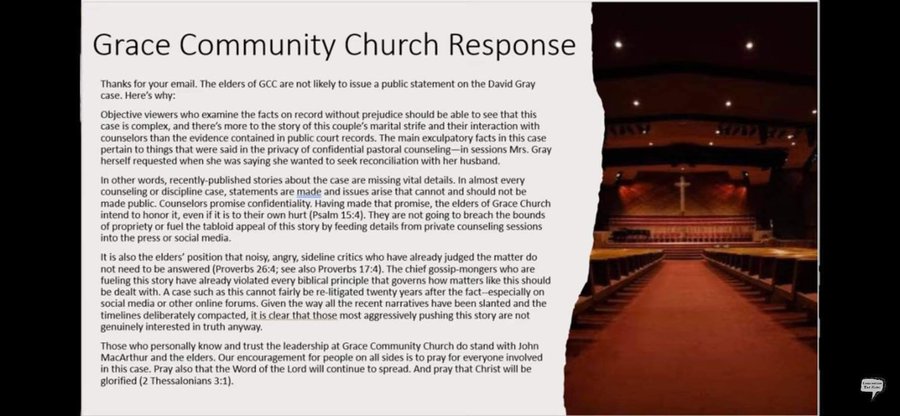
GCC has not publicly responded to the allegations, but this is the email (included in Jon’s video above) they’ve apparently been sending out in response to individual inquiries:

Jon posted a follow-up episode, Recap of David Gray Situation and Russell Moore Weighs in on Abuse and Divorce on March 26. The two main points he made recapping his previous episode were: 1) to apologize for accidentally calling the woman at the center of the issue “Elaine,” throughout the original video, when her actual name is “Eileen,” and 2) to clarify that the “Grace Community Church Response” (above) is not an official, public statement from GCC, but rather what amounts to a “form letter” email sent as a reply to individuals inquiring about the situation.

Jon released yet another follow-up today, March 29: My Position on David Gray & Revisiting the Chicago Statement, responding to pushback and requests for clarification from his initial video. One interesting point you may want to make note of for future reference: In the initial video, Jon said that even if GCC could not release a public statement on the matter due to the confidentiality required in counseling situations, church members who were well acquainted with the Grays and the situation might come forward and speak publicly about what happened. Jon apparently received such an email from a GCC member who is prayerfully considering speaking out. She did not find Eileen’s testimony at trial to be credible.

My personal take on this situation is the same as it was before Roys’ most recent allegations. Julie Roys has an ax to grind against John MacArthur and is not a trustworthy source. (She is not a trustworthy source like the Grand Canyon is not a little hole in the ground.) I would recommend you stay as far away from her writing as possible and get your information from a fair, reliable, biblical source not tainted by ulterior motives.

When I have said things like this on social media, Roys’ supporters have, not surprisingly, accused me of thinking John MacArthur can do no wrong. Not so. First of all, there have been several times over the years when I’ve thought things John MacArthur has said or done were wrong, and I also don’t align 100% with his theology. Second, if Roys went after anybody else, Iโ€™d say the same kinds of things, because the main issue here is not the object of her accusations, but her tactics. And, finally, if Roys’ accusations were reported by a reliable source, and/or admitted to by John MacArthur or Grace Community Church, Iโ€™d believe them.

And that’s all I’ve got to say about this issue.

(If you haven’t already, please read and follow the instructions above the comment box before commenting. I will not be debating this further in the comments section, via email, or on social media, and I will not be publishing any comments, responding to any emails, or entertaining any social media comments which are argumentative or accusatory in nature. You’re free to state your arguments and accusations on the issue on your own platforms.)


1I am intentionally not providing a link to Roys’ article for three reasons: first, because her slander doesn’t deserve the clicks (and the subsequent boost to her analytics); second, because the content of her article is emotionally manipulative, and the purpose of my article is to provide some objectivity; and third, because you can get the salient points of her story (without being emotionally manipulated) from the information I’ve provided here. If you feel you absolutely have to read her article, you’re free to find it by Googling.

Complementarianism, Mailbag, Worship

The Mailbag: Women “Worship Leaders” and Confusing Ecclesiology

I have read on previous pages about your response to female worship leaders, and reading your article Women Preaching: It’s Not a Secondary Doctrinal Issue prompted a few questions from me. Our church is now allowing women to lead worship from the stage. The official music director is male. Women will now be allowed to fill the role of band leader on a rotating basis on Sundays (along with a few males). They will pick songs for their Sunday set that must be approved by the music director and elders. It is being put forth to us as not being a problem because the preaching elder is the actual โ€œworship leaderโ€ and that this is no different than women leading a few songs in a worship set. And that it doesn’t violate authority because she can’t โ€œteach in an authoritative way.โ€ And we have an upcoming discussion with the elders because we believe this violates the authority aspect of 1 Timothy 2:12. Can you weigh in? Are we wrong in this? Also, is this a sin issue or a secondary issue?

I’m so sorry this has become a dilemma in your church. I know things like this can be distressing when you love your church and are concerned about its fidelity to Scripture.

I’m really sorry, but I am thoroughly confused by what it is that these women are actually doing with regard to leading the music portion of the worship service, and who is in charge of, or leading, what. And I suspect this confusion points to a deeper issue. So let me just offer a few general thoughts and principles.

Part of the confusion here (at least on my part) is the term “worship leader”. It’s too generic and interpreted in so many different ways by different people.

I understand what your pastor (preaching elder) is saying when he says that he is the “worship leader” because I’ve heard other pastors say this as something of a pushback against the idea that “worship” equals “singing,” when, really, all of the worship service (preaching, prayer, singing, etc.) is worship.

So he’s saying he’s the “worship leader” because the buck stops with him on all elements of the worship service, and he’s leading the worship service. I don’t disagree with that, but the terminology is confusing, and this concept muddies the water when it comes to biblical ecclesiology and to questions like yours. It is not biblical for a woman to serve as this kind of “worship leader” because the biblical terminology for this position is “pastor” or “elder” and Scripture prohibits women from being pastors and elders.

Then you have people who use the term “worship leader” to mean “minister of music” or “music pastor” – the pastor who oversees and puts together the music portion of the worship service and directs the choir, instruments, and congregation during the worship service. It is not biblical for a woman (or a biblically unqualified man) to serve as this kind of “worship leader” because this is a pastoral/elder position of leadership in the church, and Scripture prohibits women (and unqualified men) from being pastors and elders.

Finally, there are people who use the term “worship leader” to mean anyone on the platform who’s directing, singing, or playing an instrument. People in the choir or on the praise team are “worship leaders”, the pianist and drummer are “worship leaders”, etc. With the exception of filling the position of minister of music, it is biblical for women to be this kind of “worship leader” – singing and playing instruments under the leadership of the minister of music. The problem here is the word “leader”. These women are not leading, they are being led by the minister of music.

So the term “worship leader” is already confusing. Now we’ve got women “leading worship from the stage,” “official music director,” “band leader,” and women “leading a few songs in a worship set”. Please understand, dear reader, that I’m not faulting or criticizing you for using any of this terminology – I completely understand that you were only trying to be clear. But it’s still all very confusing to me, because it seems to be a confusing model for worship.

When you say women are “leading worship from the stage” and “leading a few songs in a worship set,” I don’t know if that means they are stepping up and acting as if they’re the minister of music, or if they’re simply on the platform singing under the direction of the minister of music, or if they’re singing a solo during one of the songs. Are “official music director” and “band leader” the same thing or two different positions? Is this person only conducting the musicians on the platform or the entire congregation? When you say that songs must be approved by the “music director and elders” does this mean the person in charge of the music portion of the worship service is not an elder (even though this is a pastoral position)?

My point here is that if I’m confused, and you’re unclear on whether or not women should be doing whatever it is they’re doing, musically, before and during the worship service, there are probably a lot of people in your church who are also confused and unclear.

I suspect that most, if not all, of this confusion could be cleared up if your church had a solid ecclesiology regarding the pastoral/elder position of minister of music. Because, right now, what should be one pastor/elder in the position of minister of music, who should be overseeing and leading all of the things you mentioned, sounds like a chaotic revolving door of a multitude of people (most of whom, I doubt are biblically qualified as pastors/elders). I’m guessing the foundational problem here is not what the women are or aren’t doing, but that you don’t have a pastor/elder in the position of minister of music.

Also at issue is that it sounds like your church is following what I call a “concert” model of worship rather than a “congregational” model of worship. There’s nothing wrong with Christian bands and concerts per se, but that is extra-curricular worshiptainment, not a model for the church’s worship service. The music portion of the worship service is not to be led by a “band” performing a “concert,” and the people in their “audience” can sing along if they want to, and happen to know the words and melody, and can follow all the bridges and ad libbing.

The music portion of the worship service is where the pastor/elder of music shepherds, leads, and instructs the congregation in skillfully and worshipfully praising and exalting God together as a body and building one another up through the Word in song:

…be filled with the Spirit, addressing one another in psalms and hymns and spiritual songs, singing and making melody to the Lord with your heart, giving thanks always and for everything to God the Father in the name of our Lord Jesus Christ,

Let the word of Christ dwell in you richly, teaching and admonishing one another in all wisdom, singing psalms and hymns and spiritual songs, with thankfulness in your hearts to God.

Ephesians 5:18b-20, Colossians 3:16

The confusion and chaos taking place in your church seems to prove these things out. And remember what the Bible tells us in 1 Corinthians 14, that great chapter on orderly worship:

God is not a God of confusion but of peace.

1 Corinthians 14:33a

Regarding the selection of songs for the worship service: Again, this would not be an issue if you had one pastor/elder as a minister of music. There’s certainly nothing wrong with any church member suggesting a particular song to the minister of music. He can prayerfully consider the suggestion and use it or not as it fits in with his pastoral objective for the music portion of the worship service. But with this “revolving door” leadership model at your church, there’s confusion, and the issue of women planning the worship service arises, when that’s really the job of the pastor/elder minister of music.

To me, the questions of “Is this sin or a secondary issue?” and “Does this violate the authority clause of 1 Timothy 2:12?” as it pertains to your particular church are nearly moot. The main issue is not what the women are doing. The women are like pictures hanging crookedly on the wall of a house that has a crack in the foundation. The issue is not the crooked pictures, but that the foundation needs to be fixed. When the crack in the foundation is fixed, the pictures will hang straight.

How to get started fixing that foundation? I would highly recommend that your elders keep an eye out for the next G3 Worship Workshop and make every effort to attend. And also that they should read everything they can get their hands on by Scott Aniol.

I want to commend you and your husband for meeting with the elders to calmly, biblically, and directly discuss your concerns. That’s exactly what you should be doing and exactly what I recommend church members do in situations like this. Great job!

For anyone who would like to explore the subject more, I have explained in more detail why women should not fill the position of minister of music in my article Rock Your Role FAQs (#16).


If you have a question about: a Bible passage, an aspect of theology, a current issue in Christianity, or how to biblically handle a family, life, or church situation, comment below (Iโ€™ll hold all questions in queue {unpublished} for a future edition of The Mailbag) or send me an e-mail or private message. If your question is chosen for publication, your anonymity will be protected.