Uncategorized

E-Mail, Messages, and Blog Comments Policy

mailbox-595854_1280

I’ve got mail. Lots of mail. Which is awesome. I love hearing from readers and I love responding back. But if you’ve been following me for any length of time or if you’ve sent me an e-mail, social media private message, or blog comment requiring a teaching response from me, you know that finding the time to respond is a struggle for me.

I don’t discuss this frequently (because you’re here for content that will point you to God’s word and edify you in your walk, not to hear about me), but I do my best to keep my life priorities in a biblical order:

1. My personal relationship with Christ
2. Serving and ministering to my husband
3. Serving and ministering to my children
4. Being a faithful, active member of my church
5. Spending time with friends and loved ones
6. Everything else

I think the rightful place for any online ministry I do (blogging and responding to readers) is at #6, or sometimes further down the list if I feel like there’s something more urgent God wants me to attend to at the moment. God has blessed me with a husband and children, and my primary job is to minister to them.

This is the framework I try to work from every morning when I get up and begin to order my day. But, like Paul said, I know the right thing to do, I just don’t always do it. I was talking to my husband about this the other day, and I realized I’ve been blowing it lately. I’ve sinned against my family by not giving them the time they need from me. And that has to stop.

And one of the ways that’s going to stop is that I’m going to cut way back on responding to e-mails, private messages, and blog comments- probably by about 90%. I love y’all and I want to help each and every person who writes to me, but the amount of mail I get is just too overwhelming for me to be able to do that any more.

Also, I will not be responding to (and often, not publishing) blog comments which require more than five minutes of my time to answer. While I love hearing from readers, it is simply taking too much time to engage in long, in depth, or teaching conversations in the comments section of my articles.

However, I do want you to get the answers, information, and help you need, so I’m hoping these pointers will help:

Read my article Blog Orientation for New Readers and Old Friends for helpful information and resources about me and about the blog.

It’s still OK to send me an e-mail. A lot of the stand-alone articles I write are in response to readers’ needs and questions, as well as trends I see in the church and evangelicalism. Even though I probably won’t be able to respond, help me stay aware of things like this by dropping me a quick note with your question and any applicable links. If you have a question you need answered, your best bet is to email me rather than commenting on an article or sending me a private message on social media. Your question may be answered via The Mailbag (see below).

If you send me an email or social media private message with a question or a request for advice, it may be used โ€“ with identifying information removed โ€“ in a future edition of The Mailbag (see below). If you do not want your email/PM used in a Mailbag article, you must specify this somewhere in your email/PM (with the understanding that your email/PM probably will not be answered, as Iโ€™ve mentioned above).

I would respectfully request that you not re-send the same email/PM multiple times or send the same message to my email and social media PMs in an attempt to urge me into responding.

The Mailbag– I run a weekly feature on the blog called The Mailbag, the sole purpose of which is to answer readers’ questions. Keep an eye out to see if the question you’ve sent in has been answered. (As always, your anonymity will be protected.)

Click the hyperlinks. If you’re reading an article and see a word in a different color text that’s underlined when you hover over it, clicking on it will take you to another article or resource that will provide you with more information.

Use the search bar. I get lots of questions that could easily be answered by using the search bar and reading the article(s) I’ve already written on the subject. The search bar is located at the very bottom of every page of the blog. There’s also a tab labeled Search Bar in the blue menu bar at the top of the blog.

Use the tabs at the top of the blog. (In the blue menu bar.) I’m often asked about teachers whose names appear under either the “Popular False Teachers” tab or the “Recommended Bible Teachers” tab. You’ll also find my statement of faith and answers to other commonly asked questions.

Read the Welcome & FAQs- Start Here tab. I don’t publish every blog comment or respond to every message. Here’s why, as well as other information I’m often asked about.

Information on false teachers Again, first use the tabs in the blue menu bar at the top of the page and the search bar (be certain you’re spelling the name correctly). If you don’t find the person you’re looking for, please ask me. If I get enough inquiries about a particular teacher, ministry, etc., I’ll look into it and put the information in an article. If you need an immediate answer, please click here. These are the guidelines I use when researching teachers. I hope they’ll be helpful to you as you do your research.

Objecting to my warnings against false teachers While I understand how disconcerting it can be to see a warning against a celebrity Bible teacher you happen to love, please don’t waste your time commenting (it won’t be published), messaging, or e-mailing me to lambaste me for doing so. Your objection is not unique, clever, or biblical, and it is answered in this article:ย Answering the Opposition: Responses to the Most Frequently Raised Discernment Objections. Additionally, please don’t attempt to manipulate or guilt me out of writing discernment articles by hand-wringingly telling me how sad, grieved, devastated, depressed, etc., you are to have discovered my blog.

Ask your pastor Or your Sunday School teacher, a trusted, godly friend, etc., when you have questions about the Bible or how it applies to your particular situation.

Set up an appointment with your pastor for pastoral counsel. Sometimes I receive questions about what to do in a catastrophic life circumstance, major situations at church, and so on. As much as I wish I could help with these things, I’m not equipped to do so via e-mail from thousands of miles away, and it would be both irresponsible and unbiblical for me to try. These are situations in which you need to set up an appointment with your pastor for counseling, talk to one of your elders, or ask a godly friend to help you through. (Sometimes a certified biblical counselor is also an option.) This is just one of the dozens of reasons why it’s crucial to join and be an active member of a doctrinally sound local church. Your pastor, elders, and brothers and sisters in Christ in your church are there to help you. Regretfully, I cannot engage in discipleship or counseling relationships with readers via e-mail.

If you need fellowship I often hear from ladies who say it’s hard to find Christian friends, or discerning friends, to talk to. I totally get that. It’s hard for me, too. The primary solution to that dilemma is to find the most doctrinally sound church you can, get involved, and go about the business of proactively investing in friendships. Have lunch. Go out for coffee. Find another lady to study the Bible or a good book with. Have another couple over for supper. Don’t expect pre-fab friends, make them. Secondarily, there are many excellent Facebook groups where you can discuss theology, personal issues, and make online friends.

I’m sorry I won’t be able to correspond as much from here on out, but please know you have my, and my family’s thanks for understanding.

Bible, Mailbag

The Mailbag: Which Bible Do You Recommend?

I was saved out of Mormonism but, as a new Christian, spent some time in the Word of Faith movement. I want a Bible that hasn’t been tampered with by a false religion, but I’m not sure which one I can trust. Which Bible do you recommend?

What a blessing it is to even be able to ask this question! You would not ask this question if God had not graciously saved you, and you could not ask this question if there weren’t a ton of different Bibles available in English, nor if you lived in a country where it is illegal to own a copy of God’s word. It’s a dilemma, but it’s a good dilemma to have.

The good news is that there are many fantastic Bibles out there- far more good ones than bad, and far more than I could recommend in this brief article. So, please don’t take this as an exhaustive list or think that because I’ve left a certain Bible out that it isn’t any good.

The first thing you want to look for is a good translation, not a paraphrase. You want to know what God said through Paul, not what somebody 2000 years later thinks about what God said through Paul. You’re looking to get as close to the original wording as is possible.

There are several great English translations on the market. I started using the English Standard Version (ESV) about four years ago, and I love it. Prior to that I used the New American Standard Bible (NASB) for about 20 years. It is also an excellent translation. If you’re familiar with various Bible translations, ESV is, in my opinion, like a more accurate, more linguistically sophisticated 1984 New International Version (NIV). NASB is like a cross between the King James Version (KJV) and the 1984 NIV, but more accurate. The Legacy Standard Bible (LSB), is excellent and is basically a recent precision update of the NASB. In my opinion, ESV, NASB, and LSB are the best translations out there today.

There are, however, several other solid translations such as the New King James Version (NKJV), the Lexham English Bible (LEB), the Christian Standard Bible (CSB– This is a newly revised version of the Holman Christian Standard Bible {HCSB}, and they’re dropping the “Holman”. So HCSB and CSB – whichever one you happen to see – are the same thing.), and the “old” or “1984”ย NIV (You want to stay away from the TNIV {Today’s New International Version}, now out of print, and any 2011 or later NIV, as those both contain gender neutral/inclusive language. The 1984 edition is also out of print, but you may be able to acquire one from a second hand store.)

The KJV is a good translation and the language is beautiful, but if you have trouble with 1611 English, itโ€™s not the only game in town anymore. Some of our modern translations are actually more accurate than the KJV because thousands more biblical manuscripts have been discovered since it was first published, allowing translators to be more precise.

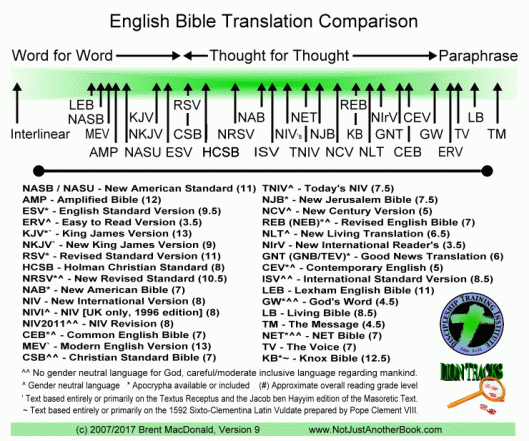
Below is a helpful chart from Brent MacDonald of Not Just Another Book comparing a number of different translations and paraphrases. (On this chart, it’s good to be a “leftist”).

bibletranslationcomparisonsmall

You can try most of these translations out for free at Bible Gateway. There’s even a great feature that allows you to compare several versions side by side:

Just as there are a number of good Bible versions I would recommend, there are a few I’m familiar with which I would strongly recommend against: The Message, The Voice, The Passion Translation, The Amplified Bible, and any “translation” that uses gender neutral language.

More than a few articles have voiced concerns over The Message’s – a paraphrase – often misleading texts. (I would add that Eugene Peterson {author of The Message} frequently shows poor discernment. One recent example is his front cover endorsement of the heresy-laden book – and movie – The Shack.)

The Voice is not only a paraphrase, its contributors include female “pastors” and false teachers such as Brian McLaren, Phyllis Tickle, Chris Seay, and Leonard Sweet.

The Passion Translation is a New Apostolic Reformation version of the Bible which actually changes the wording of many verses in order to fit the NAR agenda. Click here for a Bible translation scholar’s review of Passion’s version of Psalms.

The Amplified Bible falls prey to an improper translation technique called illegitimate totality transfer, which, in its attempt to clarify a particular word or phrase, may actually end up causing you to misunderstand the correct meaning of the verse.

I’ve already mentioned the post-1984 versions of the NIV, but be sure to avoid any “translation” of the Bible that uses gender neutral language extensively or exclusively. And you certainly don’t want a “Bible” that uses neutral or feminine pronouns or references to God – those should always be male.

There are some perfectly reliable and accurate newer Bible translations that will, for example, occasionally render (or add a footnote) “brothers” as “brothers and sisters” when it’s clear from the context that Paul is talking to or about the entire church. That’s not what we’re talking about here. We’re talking about changing passages clearly referring only to men to include women. Thus, these “translations” are actually changing God’s words. Let me give you an example from the Common English Bible (CEB). This is 1 Timothy 3:1-7:

This saying is reliable: if anyone has a goal to be a supervisor in the church, they want a good thing. 2 So the churchโ€™s supervisor must be without fault. They should be faithful to their spouse, sober, modest, and honest. They should show hospitality and be skilled at teaching. 3 They shouldnโ€™t be addicted to alcohol or be a bully. Instead, they should be gentle, peaceable, and not greedy. 4 They should manage their own household wellโ€”they should see that their children are obedient with complete respect, 5 because if they donโ€™t know how to manage their own household, how can they take care of Godโ€™s church? 6 They shouldnโ€™t be new believers so that they wonโ€™t become proud and fall under the devilโ€™s spell. 7 They should also have a good reputation with those outside the church so that they wonโ€™t be embarrassed and fall into the devilโ€™s trap.


Compare this to any reliable translation, and you’ll see the problem (and not just with the gender neutral language). I recently saw a woman “pastor” defend her right to serve in that office from this passage in the CEB “translation,” which, I imagine, is precisely the reason it was rendered this way. (It appears that there are likely a number of other problems with the CEB, as well. I looked only at the passage above and 1 Timothy 2:11-15, and the translation of that passage is completely botched as well, erroneously rendering “woman” and “man” as “wife” and “husband,” removing the “for/because” at the beginning of 13, and completely mangling the meanings of verses 14 and 15. This passage could also be used to support the sins of women preaching, pastoring, and holding authority over men in the church. Again, compare this to any reliable translation.)

If you’re looking for a good study Bible (or want to avoid a bad one), I’ve discussed that a bit here (#4). I frequently use and highly recommend both the ESV MacArthur Study Bible and the Faithlife Study Bible (which is FREE!). When shopping for a study Bible, do you homework and vet the contributors. Avoid any study Bibles whose contributors are false teachers, theologians from apostate churches, female “pastors,” etc. Some in particular I would recommend you avoid are the CSB LifeWay Women’s Bible, ESV Women’s Study Bible and the YouVersion app (all feature false teachers). And check out this article from Tim Challies: What Makes a Really Good Study Bible?.

Looking for a great Bible app? Check these out.


If you have a question about: a Bible passage, an aspect of theology, a current issue in Christianity, or how to biblically handle a family, life, or church situation, comment below (Iโ€™ll hold all questions in queue {unpublished} for a future edition of The Mailbag) or send me an e-mail or private message. If your question is chosen for publication, your anonymity will be protected.

Obedience, Sanctification

40 Things to Give Up for Lent

Although, as a Louisiana girl, I’ve had a decades long love affair with king cake, and I totally support the increased availability of fish entrรฉes at local restaurants and getting a few days off school or work, I’m not a big fan of Mardi Gras and Lent.

The intrinsic philosophy behind Mardi Gras – a day of revelry, indulgence, and debauchery to get it all out of your system before you have to start “being good” for Lent – is patently unbiblical.

The practice of Lent often is, as well. Lent is the forty day period, beginning with Ash Wednesday and ending with Easter Sunday, observed by Catholics and some Protestants. Originally, it was simply a time of fasting, prayer, and worship in anticipation of Easter, and for Christians who continue to observe it this way, it can be a valuable and meaningful time of respite and renewal with the Lord.

For many, however, Lent – particularly the aspect of giving something up for Lent in an act of self-denial – is nothing more than an empty religious ritual, or worse, works righteousness. Giving something up for Lent because, “I’m Catholic and that’s what good Catholics do,” or to atone for your sins, or to curry favor with God, or to flaunt your self-righteousness flies in the face of grace alone, faith alone, Christ alone biblical Christianity.

If you give something up for Lent, why do you do so? If it’s for one of the aforementioned unbiblical reasons (or others), or even if you don’t observe Lent at all, I’d like to challenge us all to give up the things below for Lent:

1. Give up Lent for Lent.

2. Give up attending any church that requires the observance of Lent in a sacramental way and find a doctrinally sound one.

3. Give up thinking your good behavior earns you right standing with God.

4. Give up the idea that there’s any such thing as truly good behavior.

5. Give up thinking your good deeds could ever outweigh your sins.

6. Give up willfully indulging in sin as long as you “make up for it” later.

7. Give up the notion that penance or self-denial can pay for your sins.

8. Give up thinking that penance or self-denial curries favor with God.

9. Give up the idea that repentance and obedience belong to a certain season on the calendar. We are to walk in repentance every day.

10. Give up the concept that Christmas and Easter are Christian “high holy days.” We celebrate Christ’s incarnation and resurrection every Sunday, and should prepare ourselves all during the week. Every Sunday is a high holy day for the Christian.

11. Give up rote participation in church rituals. Search the Scriptures and see if they’re biblical first.

12. Give up thinking God concerns Himself strictly with your external behavior rather than the condition of your heart.

13. Give up “sounding a trumpet before you” with humblebrags on social media and in real life about giving things up for Lent, fasting, giving offerings, or any other good works you might do. You just lost your reward, baby.

14. Give up approaching church attendance as punching the time clock for God. The Christian’s entire life, our very beings, belong to Christ, not just a couple of hours on Sunday.

15. Give up the delusion that you’re basically a good person. You’re not.

16. Give up biblical ignorance and become a good student of God’s word.

17. Give up forsaking the assembly and become a faithful, serving member of your local church.

18. Give up thinking that everyone and everything that calls itself “Christian” actually is.

19. Give up the desire to have your itching ears scratched and long for the truth of God’s word. Even when it’s hard to hear.

20. Give up neglecting the daily study of God’s word.

21. Give up rejecting parts of the Bible you don’t agree with. We don’t sit in judgment over Scripture. Scripture sits in judgment over us.

22. Give up neglecting your prayer life.

23. Give up making excuses for failing to memorize Scripture. You can do it!

24. Give up being a non-serving member of your church.

25. Give up being a non-giving member of your church.

26. Give up thinking you’re hearing God speak to you. If you want to hear God speak to you, open your Bible and study it. God has spoken in His word and many are largely ignoring what He has already said.

27. Give up following false teachers and be a good Berean.

28. Give up being afraid to share the gospel and just do it.

29. Give up thinking you can please God apart from faith in Christ.

30. Give up basing your doctrine and beliefs on your own (or anyone else’s) opinions, experiences, and feelings, and base them on correctly handled Scripture instead.

31. Give up following your wicked and deceitful heart, take up your cross daily, and follow Christ.

32. Give up thinking you have to do big things for God in order for Him to be pleased with you and “aspire to live quietly, and to mind your own affairs, and to work with your hands.”

33. Give up worrying and trust God.

34. Give up neglecting to fear God’s wrath if you don’t know Christ.

35. Give up fearing God’s wrath if you do know Christ.

36. Give up the idea that “God is love” means God is a pushover who won’t judge you.

37. Give up thinking you’ve been so bad that God could never forgive you.

38. Give up thinking you’re so good that you don’t need God to forgive you.

39. Give up refusing to forgive others when Christ has forgiven you so much.

40. Give up everything and be saved by grace alone, through faith alone, in Christ alone, and walk in His ways, all the days of your life, to the glory of God alone.

The Ten (10 Commandments Bible Study)

The Ten: Lesson 13

Previous Lessons: 1, 2, 3, 4, 5, 6, 7, 8, 9, 10, 11, 12

Exodus 20:18-20

Now when all the people saw the thunder and the flashes of lightning and the sound of the trumpet and the mountain smoking, the people were afraid and trembled, and they stood far off 19 and said to Moses, โ€œYou speak to us, and we will listen; but do not let God speak to us, lest we die.โ€ 20 Moses said to the people, โ€œDo not fear, for God has come to test you, that the fear of him may be before you, that you may not sin.โ€

Exodus 24:3-8

Moses came and told the people all the words of the Lord and all the rules. And all the people answered with one voice and said, โ€œAll the words that the Lord has spoken we will do.โ€ 4 And Moses wrote down all the words of the Lord. He rose early in the morning and built an altar at the foot of the mountain, and twelve pillars, according to the twelve tribes of Israel. 5 And he sent young men of the people of Israel, who offered burnt offerings and sacrificed peace offerings of oxen to the Lord. 6 And Moses took half of the blood and put it in basins, and half of the blood he threw against the altar. 7 Then he took the Book of the Covenant and read it in the hearing of the people. And they said, โ€œAll that the Lord has spoken we will do, and we will be obedient.โ€ 8 And Moses took the blood and threw it on the people and said, โ€œBehold the blood of the covenant that the Lord has made with you in accordance with all these words.โ€


Romans 3:19-20

Now we know that whatever the law says it speaks to those who are under the law, so that every mouth may be stopped, and the whole world may be held accountable to God. 20 For by works of the law no human being will be justified in his sight, since through the law comes knowledge of sin.

Romans 7:1-12

Or do you not know, brothersโ€”for I am speaking to those who know the lawโ€”that the law is binding on a person only as long as he lives? 2 For a married woman is bound by law to her husband while he lives, but if her husband dies she is released from the law of marriage. 3 Accordingly, she will be called an adulteress if she lives with another man while her husband is alive. But if her husband dies, she is free from that law, and if she marries another man she is not an adulteress.

4 Likewise, my brothers, you also have died to the law through the body of Christ, so that you may belong to another, to him who has been raised from the dead, in order that we may bear fruit for God.5 For while we were living in the flesh, our sinful passions, aroused by the law, were at work in our members to bear fruit for death. 6 But now we are released from the law, having died to that which held us captive, so that we serve in the new way of the Spirit and not in the old way of the written code.

7 What then shall we say? That the law is sin? By no means! Yet if it had not been for the law, I would not have known sin. For I would not have known what it is to covet if the law had not said, โ€œYou shall not covet.โ€ 8 But sin, seizing an opportunity through the commandment, produced in me all kinds of covetousness. For apart from the law, sin lies dead. 9 I was once alive apart from the law, but when the commandment came, sin came alive and I died. 10 The very commandment that promised life proved to be death to me. 11 For sin, seizing an opportunity through the commandment, deceived me and through it killed me. 12 So the law is holy, and the commandment is holy and righteous and good.

Galatians 3:23-26

Now before faith came, we were held captive under the law, imprisoned until the coming faith would be revealed. 24 So then, the law was our guardian until Christ came, in order that we might be justified by faith. 25 But now that faith has come, we are no longer under a guardian, 26 for in Christ Jesus you are all sons of God, through faith.


Romans 13:8-10

Owe no one anything, except to love each other, for the one who loves another has fulfilled the law.9 For the commandments, โ€œYou shall not commit adultery, You shall not murder, You shall not steal, You shall not covet,โ€ and any other commandment, are summed up in this word: โ€œYou shall love your neighbor as yourself.โ€ 10 Love does no wrong to a neighbor; therefore love is the fulfilling of the law.

1 John 5:2-3

By this we know that we love the children of God, when we love God and obey his commandments. 3 For this is the love of God, that we keep his commandments. And his commandments are not burdensome.


The Holy Bible, English Standard Version. ESVยฎ Permanent Text Editionยฎ (2016). Copyright ยฉ 2001 by Crossway Bibles, a publishing ministry of Good News Publishers.


Questions to Consider:

1. In Exodus 20:18-19, how did the Israelites react to God’s appearance to Moses? What was Moses’ response to them? (20) What did Moses say would be two results of God testing the people? (20) How many times does the word “fear” appear in verse 20? What is the difference in meaning between the first “fear” and the second one?

2. Briefly skim Exodus 20:21-23:33. In addition to the Ten Commandments, what are some of the other laws, or categories of laws, God gave Moses? In the Exodus 24 passage above, what was the people’s response to hearing all of these laws? (3) Describe the sequence of events taking place in Exodus 24:3-8. Why did the people respond twice? (3,7) Was there any difference between these two responses? Compare the people’s response in this passage with their response in Exodus 19:5-8. What events transpired between the response in chapter 19 and the response in chapter 24?

3. In Exodus 24:6,8, why did Moses sprinkle the altar and the people with blood? How did this formalize Israel’s agreement to the Mosaic covenant? How does the Mosaic covenant point ahead to the new covenant in Christ? Are Christians still bound by the Mosaic covenant?

4. In what ways did the giving of the law and Israel’s agreement to the Mosaic covenant help officially establish Israel as a nation and set Israel apart from the surrounding pagan nations?

5. Examine the Romans 3 and 7 passages. What does it mean that the law makes us “accountable” to God? (3:19) Why can’t we be made righteous in God’s eyes by simply striving to keep His laws? (3:20) Read Romans 3:20 and 7:7-8 together. What do these verses tell us about the connection between knowing the law and sin?

6. Explain the analogy of dying to works of the law that Paul is trying to convey in Romans 7:1-6. Compare verse 6 to Galatians 3:23-26. What does Galatians say was the purpose of the law, and what is our obligation to it now? What does the latter part of verse 6 – “we serve in the new way of the Spirit and not in the old way of the written code” – mean? Does this mean we no longer have to obey God’s moral laws such as the ones in the 10 Commandments? (12)

7. Study the Romans 13 and 1 John 5 passages. What is the theme of these two passages? What does Paul mean when he says, “the one who loves another has fulfilled the law”? (13:8) Who are the two parties we demonstrate love for when we keep God’s commands? How does loving God and keeping His commands automatically translate into loving others? (5:2) How does loving God and our neighbors, thus keeping God’s commands, demonstrate to others that we belong to Christ?


Homework:

This week, view your sin or obedience through the lenses of love. Examine the sins you commit. How do they demonstrate your failure to love God and love your neighbor? Examine instances of your obedience to God’s commandments and think about how they demonstrate your love for Him and for your neighbor. As you pray, ask God to increase your love for Him. Increased love leads to increased obedience.

Discernment

Discernment Resources Potpourri

discernment

There are scads of fantastic discernment resources out there. Here are a few good ones that have come across my desk in the past few weeks…


deadlydoctrine-01Tim Challies is running a really good series right now called Deadly Doctrines. “In a new series of articles, we will consider false doctrine, sound doctrine, and how to train ourselves to distinguish between them. We will see how God calls us to respond to false and sound doctrine, as well as false and sound teachers.”


download-1Here’s Sinclair Ferguson over at Ligonier with What is Discernment?ย “We are on our guard against being led astray by false teachers. But there is more to discernment than this. True discernment means not only distinguishing the right from the wrong; it means distinguishing the primary from the secondary, the essential from the indifferent, and the permanent from the transient. And, yes, it means distinguishing between the good and the better, and even between the better and the best.”

And, of course, Pastor Gabriel Hughes of When We Understand the Truth is always there with his awesome WWUTT teaching videos. Here’s What is Discernment?


And here is Essential Doctrines?:


Below is a screen shot from the the Essential Doctrines video that might be helpful to print out and keep in your Bible or use when you teach a Bible study. Each letter in the word “DOCTRINES” stands for a primary area of biblical doctrine. Any teaching that conflicts with what the Bible says on any of these points is heresy:

c2eurnduoaa18km(Note: “Eschatology” here does not mean a specific flavor of end times theology such as pre-trib, post-millennial, etc. It refers to the foundational, general doctrine that Christ willย come again in final judgment and to claim His bride, the church.)


Hope y’all find these as helpful as I did!