I’m going to take a little break before starting our next study, so for the next several Wednesdays, you’ve got some options:
📖 You can finish up The Sermon on the Mount or any of my other studies you’re currently working on.
📖 You can choose a book(s) of the Bible to work through on your own.
📖 You can choose one of my studies to work through at the Bible Studies tab in the blue menu bar at the top of this page. (I would choose one of the shorter ones, like Colossians or Ruth rather than one of the longer ones if you’re only trying to fill the space between now and the beginning of our next study.)
📖 You can follow along with the sampling of “re-run” lessons and resources I’ll be posting here on the blog each week.
And speaking of re-runs, here’s the first one!
Did you miss Bible Reading Plans for the New Year – 2021 when I posted it last December? Or maybe you’re new to the blog since then? There are all kinds of Bible reading plans here, including some that are only a few days or weeks in length.
If you’re just looking for a plan that fills the time between now and the beginning of our next study, #5, #12, #18, or #20 might be a good choice. Also be sure to check the links under Need more suggestions? for shorter plans. Or, you might wish to modify or just do part of, one of the longer plans. Go exploring and choose the plan that works best for you!
You can always find the link to the current year’s “Bible Reading Plans for the New Year” at the “Bible Studies” tab in the blue menu bar at the top of this page.
Want to take a guess on which book of the Bible we’ll be studying next? Comment below!
Things just keep looking worse and worse for NAMB (the North American Mission Board of the Southern Baptist Convention).
Earlier this year, NAMB was in hot water when it was discovered that some of their church plants were harboring women “pastors”.
Now Kyle Whitt, NAMB church planter in Washington state, has bravely and lovingly come forward to raise awareness about NAMB pimping the gospel out to social justice principles. (Go to the video on YouTube for links to the documents he mentions.)
I’ve written and spoken before about the plague of conflation that’s spreading in the church. For example: Some mistakenly conflate evangelism (sharing the gospel with the lost outside the church) with preaching (expositing the Scriptures to the saved inside the church), and therefore wrongly conclude that since it’s OK for a woman to share the gospel with a man, it’s OK for that same woman to preach the Sunday sermon in church.
What Kyle is talking about in this video goes beyond conflation of two discrete concepts by the biblically ignorant. It’s an intentional adulteration of the gospel by SBC seminary-trained denominational leaders with a woke / social justice agenda.
To boil it down for you, the gospel is: You have transgressed God’s law, and you’re a sinner. You must repent of your sin and trust in Christ’s death, burial, and resurrection to atone for and forgive your sin in order for you to be in right standing with God.
Period. End of story. Yes, there are other important things in the Bible, but they’re not the gospel. They’re something else.
But NAMB is saying that’s not the “complete” gospel. NAMB adds to the gospel what they’re calling “the Great Requirement” – a work – the belief in, and practice of, social justice principles. That’s their “complete gospel.” And that’s what they’re requiring their church planters to preach, teach, and practice.
If you’re a Southern Baptist, you’ve got to watch this. This is what your Annie Armstrong Easter Offering and your church’s contributions (your offerings) to the Cooperative Program are paying for.
But even if you’re not Southern Baptist, you need to know what’s coming down the pike for your church or denomination so you can stand on God’s Word and keep it out.
Or maybe I answered your question already? Check out my article The Mailbag: Top 10 FAQs to see if your question has been answered and to get some helpful resources.
In response to the question about Simeon [in this article], would you consider John (the John that wrote Revelation) to be a prophet? I know he was an apostle but I was just wondering if he would also be considered a prophet due to all the Lord showed him regarding Revelation.
Great question! I love it when women are thinking deeply about the things of God. Since you’re asking my opinion, I didn’t delve into any scholarly works on the subject, I’m just going to give you my take on it based on what I know of Scripture.
As you probably know, in the Old Testament, there were two different types of people who prophesied:
Men who held the office of prophet – what we might think of as a “professional prophet,” so to speak – like Isaiah, Jeremiah, Elijah, Elisha, and so on.
People to whom God gave a “one and done” (or maybe twice or thrice) word of prophecy for a particular reason or moment in time, like Eldad, Medad, and the 70 elders, Saul, Eliezer, and others.
Jesus was, and is, the final, permanent occupant of the offices of prophet, priest, and king. This is why we don’t see the office of prophet or priest in the New Testament church or anyone installed as “king” over New Testament Christians.
Until the canon of Scripture was complete, however, and foretelling prophecy become obsolete, we do see occasional references to the second type of prophecy in the New Testament church. It seems to me that second category is the category John’s prophecy in Revelation would fall into. He held the office of Apostle, but not the office of prophet (since that position was filled), and God gave Him a “one and done” prophecy to communicate to us.
I’m learning so much from your articles, and I think my husband would benefit from and enjoy hearing what I’m learning. Can I share your posts with him? I don’t want YOU to be teaching my husband and break that command.
It’s always important to be obedient to God’s commands, but it’s equally important that we understand exactly what the command does and doesn’t prohibit so we can obey it properly.
For example, the sixth Commandments says, “You shall not murder,” but this Commandment doesn’t preclude self defense, capital punishment, fighting in a war, or vehemently annihilating an uppity rat or snake with a shovel (I hate rats and snakes. :0)
In the same way, the New Testament’s prohibition on women instructing men in the Scriptures doesn’t mean no male can ever learn anything – even biblical things – from a woman. For example, we see Lois and Eunice instructing Timothy in the Scriptures when he was a boy, and Priscilla, along with her husband Aquila, privately correcting and instructing Apollos.
The biblical prohibition against women teaching men in 1 Timothy 2:11-3:7 has a very specific context. Women are prohibited from preaching to or instructing men (not boys, girls, or other women), in the Scriptures (not in other subjects), or holding authority over men, in the context of the gathering of the body of Believers (the church). Women are also prohibited from holding the office of pastor or elder.
Long story short, yes, you can feel free to show your husband my articles and discuss them with him. Showing your husband one of my articles and having a private discussion with him about what you’ve learned from it doesn’t meet the criteria of the biblical prohibition against women instructing men. A blog is not the gathering of the church body, and as you can tell from the title of it, “Discipleship for Christian Women” I’m teaching you as a woman, not him as a man. The principles in these Scriptures are the applicable ones for sharing with your husband in this way, not 1 Timothy 2:12.
What do you think about Teacher X? She preaches to men…he partners with a bunch of false teachers…his church seems to hold New Apostolic Reformation beliefs…she teaches evolution…
While I’m always honored when y’all ask for my thoughts on a particular teacher, if you already know a teacher is sinning by preaching to (or allowing a woman to preach to) men, yoking with false teachers, teaching false doctrine, or unrepentantly doing something else unbiblical, you don’t need my – or anyone else’s – input or approval to stop following that teacher, refuse to use that teacher’s materials, etc. You’ve done what you’re supposed to do – you’ve compared that teacher’s behavior and teaching to Scripture and found it to be contradictory. You’ve been a good Berean. Go ahead and stay away from that teacher.
This week two separate women from different churches and ministry settings have used the words “Too Christianese” to describe words in a song or tract that were being considered for ministry with children. I wonder where this term has come from and why this has become a catchphrase. To me it felt critical and condescending at the same time as well as limiting to the church ministry to have to feel around for words so they are not labeled in this way. I should note we live in New Zealand so I’m not sure if this line of thinking is solely a problem for here or if it is an issue elsewhere.
I think that the foundational issue here is not the word “Christianese” itself, but the underlying paradigm that’s at play.
Sometimes, as might be the case in your situation, when people say, “This has too much Christianese in it,” they’re saying, “People don’t understand biblical terms like ‘sin,’ so we should ditch those terms in favor of other words most people understand, like ‘mistakes’.”
In other words: dumb the Bible down for people. That’s not a biblical paradigm. (And yes, that’s just as much a thing in the U.S. as it apparently is in New Zealand.) The biblical approach is to use biblical terms and teach people what they mean, especially when you’re dealing with children.
On the other hand there’s a lot of churchy “inside language” we use, often without even realizing it, that can make new Christians and people who don’t have a church background feel left out because they don’t know what we’re talking about. For example: “Unspoken prayer request,” “the right hand of fellowship,” “extend grace,” “backslider,” “altar call,” “rededication.” With these sorts of non-theological terms, it might be appropriate to find a clearer way to say things, or it might be appropriate to just explain what they mean.
As to where the term “Christianese” came from and why it has become a catchphrase, I plead ignorance. :0)
We used to regularly follow and enjoy the Sherwood people/movies (i.e. the Kendrick brothers and their crowd)…We’ve pretty much moved away from them due to some theology & discernment concerns (working with/fellowships with Beth Moore, Priscilla Shirer, as well some muted undertones of the prosperity gospel) and was hoping to hear your opinion on where you’d classify them.
I guess I’d stick those movies in the same category as “Christian fiction” books, meaning that I don’t hold works of fiction to the same high standard as, say, Bible study or theology books, but that doesn’t mean anything goes, either. (I’ve explained more about that here.)
Here’s where I’d land on those movies, or any other work of Christian fiction:
Don’t get your theology from works of fiction. This includes any “Bible” studies, devotionals, journals, curricula, programs, or any other materials based on a novel or movie. Get your theology from the Bible, from good teaching and preaching at your church, and from theological books from trustworthy authors/teachers.
Think about the financial angle. Will your conscience allow you to financially support the people who made the movie, the actors in the movie, and any false teachers or false doctrine in, or associated with, the movie?
Evaluate your spiritual maturity and level of discernment. If you’re spiritually mature and skilled in discernment, you may be able to step around a few doctrinal “cow pies” in a novel or movie that’s otherwise generally in compliance with Scripture. If you’re a new Christian or have not honed your discernment skills, you might want to forego certain novels and movies, or at least watch or discuss them with a spiritually mature, discerning friend.
Thank you thank you for the article on being discreet when breastfeeding. There was a lady at the ballpark yesterday, walking around, and sitting down with it popped out in front of everyone!!!!! I just about lost it and don’t want to. But I need to know how to approach her nicely. I hope and pray I can.
Hang on just a sec, there. I think you might be misunderstanding something. That article was addressed to Christian women about policing their own personal behavior. It was not written to anyone about addressing other people’s behavior.
If you have a personal discipling relationship with a Christian young woman for whom this is an issue, and she’s open to it, you may want to share that article with her and disciple her in the area of modesty.
But don’t go up to random strangers and address this issue. It doesn’t matter how nicely you approach her, it’s not going to go well. And, assuming she’s lost, she’s not going to care about biblical reasons for modesty. Please trust me, and the massive number of emails and comments I got from professing Christian women who were offended by that article, on this. Avert your eyes, mind your business, and look for an opportunity to share the gospel with her instead.
If you have a question about: a Bible passage, an aspect of theology, a current issue in Christianity, or how to biblically handle a family, life, or church situation, comment below (I’ll hold all questions in queue {unpublished} for a future edition of The Mailbag) or send me an e-mail or private message. If your question is chosen for publication, your anonymity will be protected.
The Servanthood Survey is a free resource for churches and individuals – a biblical alternative to spiritual gifts inventories and quizzes.
Originally published July 19, 2019
Over the last few months I’ve been asked more than once, “How can pastors help women find a biblical place of service in the church?”. And each time I’ve been asked, my heart’s desire to create a resource to help pastors get people serving in the church has increased, which resulted in The Servanthood Survey.
The Servanthood Survey takes church members desiring to serve through a brief study of the Scriptures describing what biblical servanthood is, the value of servanthood to God and to the church, following Jesus’ example and teaching on servanthood, the biblical parameters God has placed on certain roles in the church, and prayerful consideration of how God has designed and equipped the individual for service.
The survey can be used with men or women, and even teens or children desiring to serve their local Body. I envision it being sent home with a church member to work through and pray about, followed up by a meeting with the pastor (or whoever assigns positions of service in your church) to discuss the church member’s responses and potential place of service. But churches could also integrate the survey into their new member classes, create a mini (2-4 weeks?) class around the survey, work through it during midweek services, or whatever works best for that particular church.
The survey itself is also meant to be tweaked for use by each individual church. You may not like the way I worded something or you might like to add something (you’ll see at the end, you’ll need to add a sheet with a list of opportunities for service for your particular church). To that end, I’ve made the survey available as a Google Doc as well as providing the text below so you can copy, paste, and edit it in a way that works for your church.
You may notice that my name and website do not appear on the survey. That’s intentional. This is my gift to you to take, make your own, and use as a tool in your church. (I would ask that you please not credit me or include my website on the document if you modify the theology of the survey.)
I hope you’ll find this to be a useful tool for helping the men and women of your church to get plugged in and serve the Body.
The Servanthood Survey
Every Christian who’s able should be serving in the local church. This survey is designed to help you find a place of service in our church. It will help you understand the biblical concept of servanthood and to consider which place of service God may be leading you to as you think about the ways He has uniquely gifted and equipped you.
What is biblical servanthood?
Unfortunately, in Christian culture today, the concept of servanthood has been lost or abandoned in favor of the desire for notoriety. Our flesh wants to be recognized, applauded, and patted on the back for what we do in the church. But what does the Bible teach about serving?
Jesus is our ultimate and perfect example of servanthood:
In a culture in which people often went barefoot or wore sandals and public sanitation was not what it is today, foot washing was a dirty, sometimes disgusting, task. Because it was a job nobody wanted, and considered beneath the dignity of more highly positioned servants, foot washing was usually assigned to the lowest ranked servant in the household.
Who took on the task and the position of lowest ranked servant in this passage? (3-4)
Why was Peter upset when Jesus tried to wash his feet? (6,8) How did Peter normally view and think of Jesus (see Matthew 16:15-16) that would have caused him to be appalled that Jesus would lower Himself in such a way?
What was the “example” (15) Jesus gave, and how should we carry out His example? (14)
Who do the “servant” and “messenger” represent in verse 16? The “master” and “the one who sent him”? What does verse 16 mean?
Look closely at verse 17. What is the difference between “knowing” and “doing” these things? What is the consequence “if you do them”?
Prayerfully examine and compare your heart attitude about serving in the church to what Jesus taught and demonstrated in these two passages:
Compare your willingness to Jesus’ willingness. His humility to your humility. What He taught about lowliness and serving in anonymity to your thoughts and attitudes about serving in lowliness and anonymity.
Is your heart’s desire to fill a “spotlight” position in the church because you crave recognition and praise from others?
Do you desire to be “first” and “great” in the eyes of others, or in the eyes of God?
Jesus’ regular ministry was teaching, not foot washing. Are you willing to pitch in and do whatever needs to be done at the moment even if it’s a thankless task, a dirty job, or “not your ministry”?
Knowing Our Roles
When Jesus came to earth, God had a special, well-defined role of service for Him. He was to live a sinless life, teach, perform miracles, die on the cross for our sins, and rise again. He was not to be a husband, father, chief priest, scribe, farmer, or soldier. One of the ways Jesus obeyed God was by staying within the parameters God had set for Him and joyfully and robustly fulfilling His role without coveting the roles of others or complaining about the role God had assigned Him.
God has also assigned certain roles of service in the church to certain people. We must be sure to follow Jesus’ example by joyfully embracing, and robustly fulfilling, the role He has given us and not coveting the roles of others.
What does this passage teach us about the value of each church member’s service to the Body?
Is it right for any church member to look down on anyone else’s role of service? (21) Is it right for us to look down on our own “lowly” role of service and be jealous of someone else’s more “prestigious” role of service? (15-17)
Who arranges members – and, consequently, their roles of service – in the Body? (18) Did He do so arbitrarily or with purpose? (18) What does that tell us about the importance of obeying God by staying in the role He has assigned us?
What is the effect when we embrace the role God has assigned to us and encourage others in the role God has assigned to them? (25)
Most roles of service in the church are open to many Christians. But in the same way there are good reasons we wouldn’t allow a five year old to drive the church van or a man to chaperone the girls in their sleeping quarters at youth camp, God has good reasons that He restricts certain people from serving in a few specific roles, and that He requires certain people to step up and fill certain roles.
God requires that certain biblically qualified men to step up and take on the leadership of the church as pastors, elders, and deacons.
What are the qualifications for each of these offices in the 1 Timothy 3/Titus 1 passages?
Is every Christian man qualified to serve in these roles? What are some things from these passages that would disqualify a man from serving in one or more of these roles?
Must every man who is biblically qualified serve in one of these offices? (1 Timothy 3:1) What would be some reasons a biblically qualified man might not or should not serve in one of these offices? Should a man who is biblically qualified give serious prayerful consideration to serving in one of these offices?
Is a godly man’s service to the church any less valuable if he does not serve in one of these roles? (You may wish to review 1 Corinthians 12:12-31)
God requires that women who are mature in the faith train up younger women and children in godliness. However, as we have seen in the 1 Timothy 3/Titus 1 passages, He has restricted the offices of pastor, elder, and deacon to biblically qualified men. First Timothy 2:12-14 shows us that women are also restricted from carrying out two of the functions of these offices: preaching and teaching the Bible to co-ed/men’s groups in the church setting, and exercising teaching or non-teaching authority over co-ed/men’s groups in the church setting. This means that our church will place qualified men in any position of service which requires preaching or teaching the Bible to men, and/or holding authority over men.
Recalling 1 Corinthians 12:12-31, does God’s restricting these few church offices/functions to biblically qualified men mean that He values the service of women or men who don’t serve in these roles any less than He values the service of men who do serve in these roles? Should we value their service less?
What are some ways you see men and women serving in our church which do not require them to preach/teach the Bible to men or exercise authority over men? Explain the importance of a few of these roles of service and their value to the church.
Everyone sins, and everyone deals with different temptations to sin. If there are certain roles of service in our church that would tempt you to sin, it is not wise for you to serve in that position of service. For example, if you struggle against the temptation to steal, we want to lovingly help you avoid that temptation by not making you our church treasurer.
What does Jesus say we should do with things that tempt us to sin?
Prayerfully consider your areas of weakness and temptation. Are there any areas in our church in which you feel it would be unwise for you to serve?
Have you ever been convicted of a crime? Are there any areas in our church in which it would be illegal or violate your probation/parole for you to serve?
If you’re struggling to embrace the role in the church that God has assigned to you, prayerfully examine your heart to discover why that might be. Compare the way Jesus embraced the role God assigned Him with your heart attitude about embracing the role God has assigned you.
Suited to Serve
God has created each human being with unique talents, abilities, and interests, and gives Christians spiritual giftings for service (see Romans 12:3-8). This is one of the ways He equips us for ministry in the church. While we should always be ready to pitch in and help whenever a need arises, most of the time, God does not assign people long term roles of service that go against the grain of the way He wired them. However, there are times when we serve in a capacity we think we’ll hate, and we end up loving it, discovering giftings and abilities we never knew we had!
Take some time to prayerfully consider your character traits, interests, abilities, experience, talents, and gifts that may help match you up with a place of service in our church:
Have you ever worked on a task or project that gave you the sense that, “This is what God put me on this earth to do,” or brought you great joy? Describe that task or project. Would others objectively look at the results and say you did a good job? Is there a way you could serve our church by doing that same thing or something similar?
What kinds of things do unbiased people (not close friends/family) tell you you’re good at and encourage you to pursue?
Make a list of ten categories of work you enjoy and are good at (ex: organizing, working with children, repair work, writing, hospitality, etc.). Is there a way you could serve our church in one of these capacities?
Are you willing to give a role of service a try even if you’re inexperienced in that area or it’s not your favorite area?
When looking out across the landscape of our church, do you think, “Somebody needs to do something about _______,”? Pray about the possibility that God has put this need on your heart because He is moving you to do something about it, help someone else do something about it, or facilitate (provide finances, materials, a meeting place, etc.) someone else doing something about it.
Prayerfully look over the attached list of roles of service needing someone to fill them. Is there a certain role God seems to be leading you to or that you believe would be a good fit for the way God has created and equipped you? Is there a need you see in our church that’s not on the list that God has placed on your heart to fill? Make an appointment with the pastor, elder, or other appropriate leader and discuss the role of service you would like to take on.
(Pastors using the survey: You will need to attach your own list of specific opportunities for service available in your particular church HERE.)
If you are considering commenting or sending me an e-mail objecting to the fact that I warn against certain teachers, please click here and read this article first. Your objection is most likely answered here. I won’t be publishing comments or answering emails that are answered by this article.
This article is kept continuously updated as needed.
I get lots of questions about particular authors, pastors, and Bible teachers, and whether or not I recommend them. Some of the best known can be found above at my Popular False Teachers tab. The teacher below is someone I’ve been asked about recently, so I’ve done a quick check (this is brief research, not exhaustive) on him.
Generally speaking, in order for me to recommend a teacher, speaker, or author, he or she has to meet three criteria:
a) A female teacher cannot currently and unrepentantly preach to or teach men in violation of 1 Timothy 2:12. A male teacher or pastor cannot allow women to carry out this violation of Scripture in his ministry. The pastor or teacher cannot currently and unrepentantly be living in any other sin (for example, cohabiting with her boyfriend or living as a homosexual).
b) The pastor or teacher cannot currently and unrepentantly be partnering with or frequently appearing with false teachers. This is a violation of Scripture.
c) The pastor or teacher cannot currently and unrepentantly be teaching false doctrine.
I am not very familiar with most of the teachers I’m asked about (there are so many out there!) and have not had the opportunity to examine their writings or hear them speak, so most of the “quick checking” I do involves items a and b (although in order to partner with false teachers (b) it is reasonable to assume their doctrine is acceptable to the false teacher and that they are not teaching anything that would conflict with the false teacher’s doctrine). Partnering with false teachers and women preaching to men are each sufficient biblical reasons not to follow a pastor, teacher, or author, or use his/her materials.
Just to be clear, “not recommended” is a spectrum. On one end of this spectrum are people like Nancy Leigh DeMoss Wolgemuth and Kay Arthur. These are people I would not label as false teachers because their doctrine is generally sound, but because of some red flags I’m seeing with them, you won’t find me proactively endorsing them or suggesting them as a good resource, either. There are better people you could be listening to. On the other end of the spectrum are people like Joyce Meyer and Rachel Held Evans- complete heretics whose teachings, if believed, might lead you to an eternity in Hell. Most of the teachers I review fall somewhere in the middle of this spectrum (leaning toward the latter).
If you’d like to check out some pastors and teachers I heartily recommend, click the Recommended Bible Teachers tab at the top of this page.
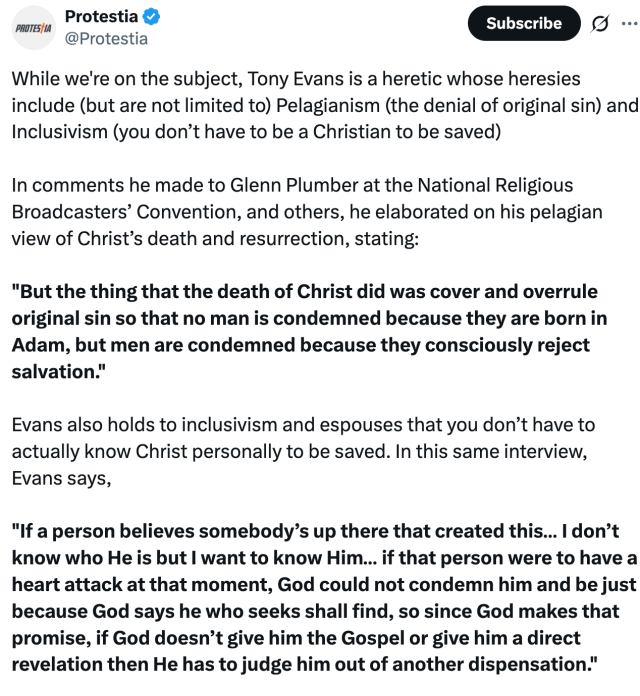
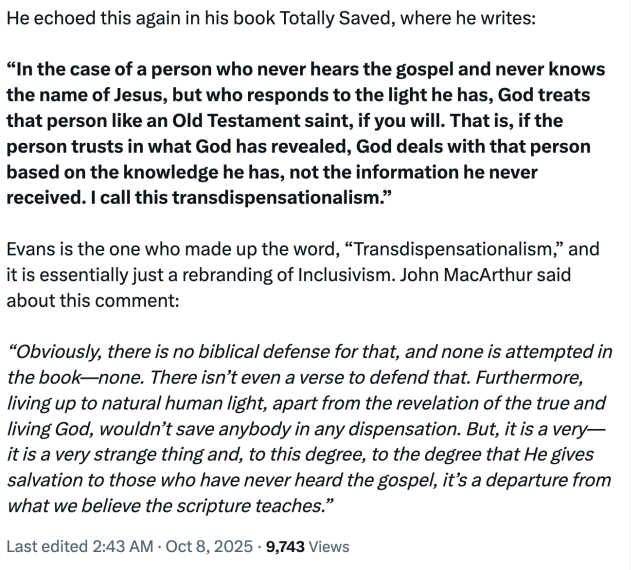
Tony Evans Not Recommended
Until he stepped down in June 2024 over an unspecified sin from his past*, Tony Evans had been the senior pastor of Oak Cliff Bible Fellowship for over forty years. He has authored over 100 books, hosts a daily radio program, The Alternative with Tony Evans, and served as chaplain to the Dallas Mavericks and the Dallas Cowboys.
*(Tony apparently submitted to a 1+ year long church discipline plan imposed by the elders of OCBF, who, in October 2025, restored him to “ministry,” but not to any sort of leadership at OCBF. The sin he committed was never named nor publicly repented of. This mishandling of church discipline and restoration to ministry is yet another reason I recommend you avoid Tony Evans. More in the “Additional Resources” section at the end of this article.)
In 2016, Tony’s wife, Lois, was in attendance at The Potter’s House, where, during a God’s Leading Ladies graduation ceremony, their daughter, Priscilla Shirer, accepted the “Lady of Destiny” award.
Lois Evans, above right
Notice the captions in the images. Priscilla declares that the women in her family -which would include her mother, Tony’s wife- “love and admire” T.D. Jake’s wife, Serita. Lois says she’s “proud” of Priscilla for winning this award from a heretical (modalism and Word of Faith) organization, and that Priscilla attributes her success -yoking with heretics/false teachers, preaching to men, teaching false doctrine- to the support of her family, which includes her father, Tony.
One of the biblical qualifications for a pastor is being a godly husband and father:
He must manage his own household well, with all dignity keeping his children submissive, for if someone does not know how to manage his own household, how will he care for God’s church?
…his children are believers and not open to the charge of debauchery or insubordination.
1 Timothy 3:4-5, Titus 1:6c
Tony Evans has a (late) wife and two daughters who are enamored of and yoke with false teachers. His daughters teach false doctrine. At least one of his daughters (Priscilla) preaches to men. This is not a man who has managed his household well, so, as Paul says, “How will he care for God’s church?”
Even if we were to stipulate that these verses are speaking of minor children in the home, Tony is still not carrying out his Titus 1:9 duty (also a biblical qualification for the pastorate) to rebuke them for their violations of Scripture:
He must hold firm to the trustworthy word as taught, so that he may be able to give instruction in sound doctrine and also to rebuke those who contradict it.
Titus 1:9
Rather, he encourages them in their ministries by endorsing their books and allowing them to teach and minister in his church. According to Scripture, he is disqualified from the pastorate.
Tony’s position on the role of women in the church is also unbiblical:
Let me add that I am not talking about spiritual gifts here, but the office of elder. Women in the church are very gifted, even more so than men in many cases. And God allows women to use their gifts in the church. In fact, I believe women can do anything in church except be an elder or a pastor. But final leadership in the church is restricted to men.”
The important scriptural principle for women’s leadership in the church is that it must be under legitimate male authority…Women can have any gift that is authorized under the authority of the final leadership of the church.
“Women can have any gift that is authorized…” is, at best, an extremely poor choice of words. God gives spiritual gifts to Believers. No human gets a say in whether or not she “can have” a certain gift, nor can any human “authorize” a gift. Furthermore, since God is the giver of the gift, and our Creator and Master, He, and He alone has every right to place parameters on how we can or can’t use the gifts He gives us. And the parameters he places on women to whom He gives the gift of teaching (presumably the “gift” mentioned) is that we must only use that gift to teach women and children.
But aside from erroneously conflating a spiritual gift with the use of that gift, this is again an unbiblical belief, and patently false on its face. If it is an “important scriptural principle” that women can lead as long as they’re under “legitimate male authority,” where does Scripture say this? Why was no Scripture reference given to accompany this pronouncement?
Because there isn’t one. Because Scripture doesn’t teach this. As I’ve explained at length, “No one – not your pastor, your husband, your parents, your best friend, the Pope, nobody – has the authority to tell you that it’s OK to do something God has said is sin.” When God says “no,” no man has the right to say “yes.”
These beliefs of Tony’s aren’t just a mishandling of Scripture, they invite and encourage women to sin by doing things like preaching the Sunday morning sermon to the congregation, teaching co-ed adult Sunday school and Bible study classes, preaching to men at co-ed Christian conferences, etc. Scripture is abundantly clear that women are not to hold the office of pastor / elder or preach to, teach Scripture to, or hold authority over men in the gathering of the body of Believers.
Also, if Tony believes women can’t be pastors or elders, why is a female pastor speaking at his church’s women’s conference, Desperate for Jesus 2021, this year?
Jan Greenwood is the “Equip [discipleship] Pastor” at false teacher, Robert Morris‘ Gateway “Church”. According to Tony’s own beliefs wouldn’t that mean she is living in unrepentant sin? Why would he allow someone he would view as living in unrepentant sin to lead the women of his church when it could lead them into sin?
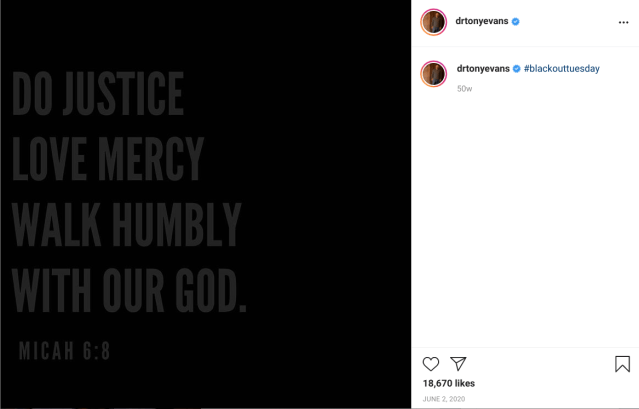
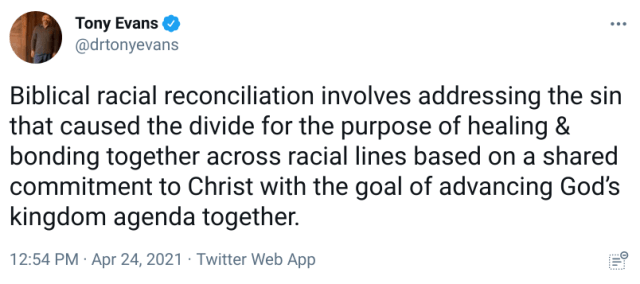
Finally, Tony’s views and affiliations in the area of race relations are concerning.
In this video, What Is Systemic Racism, Tony seems to say that America is systemically racist.
In this video, Race and the Church – Tony Evans on Faith & Prejudice, at the 15 minute mark, interviewer, Nona Jones asks Tony about the racism section of the Statement on Social Justice and the Gospel (which was produced by John MacArthur, James White, Justin Peters, Voddie Baucham, Tom Ascol, Darrell Harrison, and other doctrinally stellar men). Tony’s answer: “They do not clearly understand ‘the whole counsel of God’.” They are “heavenly minded, and of no earthly good, except when the issue affects them”.
I beg your pardon, but not only were three of the initial crafters/signers black, but in a world where white people are told to repent for their whiteness, pay reparations, that they are intrinsically racist, and so on and on, the issue of racism most certainly affects us all.
And yet, Tony sprinkles remarks like this, which seem right on the money, biblically speaking, throughout his talks and materials on race, sometimes masking his biblically problematic views.
In November 2020, the presidents of all six Southern Baptist seminaries, along with SBC president, J.D. Greear released a statement declaring that the “affirmation of Critical Race Theory, Intersectionality and any version of Critical Theory is incompatible with the Baptist Faith & Message.”
The statement drew backlash from a few progressive/woke black SBC pastors, some leaving, or threatening to leave, the SBC. In response, the members of the 2019 SBC resolutions committee, which crafted Resolution 9 (a resolution passed at the 2019 SBC annual meeting, which affirmed CRT as a “useful analytical tool,” and was the impetus for the current division in the SBC over CRT) released a statement, Affirmation of Recent Statements from Christian Leaders on Critical Race Theory in which they briefly invoked Tony Evans’ name, saying,
“Recently, we have been encouraged by and agree with, statements by Dr. Tony Evans on CRT. In a sermon in which he deals with CRT, Dr. Evans makes a clear affirmation for the sufficiency and authority of Scripture over all ideologies.”
In light of recent statements by Christian leaders regarding Critical Race Theory and Intersectionality, members of the 2019 Resolution Committee of the SBC have drafted the following statement: pic.twitter.com/EfSxyLo4cB
Perhaps surmising that CRT and other race relations advocates would take this allusion to his sermon as his denunciation of CRT, or that he was now in some way on the wrong side of the race issue, and desiring to distance himself somewhat from both the seminary presidents’ and the resolutions committee’s statements, Tony released his own statement “clarifying” (actually reiterating) exactly what the 2019 resolutions committee said of his sermon: he “[clearly affirms] the sufficiency and authority of Scripture over all ideologies”:
“Members of the 2019 Resolution Committee of the SBC, without my awareness or permission, used my name in their recent [statement]…They have referenced a portion without giving it the context of my sermon…I did not say, nor imply, that CRT or other ideologies lack beneficial aspects – rather that the Bible sits as the basis for determining that. …”
It would seem that Tony would be in alignment with the original position of the 2019 resolutions committee, that CRT can, in some instances, be beneficial.
Image courtesy of G3 Ministries
Tony’s position on race may seem biblical at times, but his “Kingdom Race Theory” paradigm is decidedly unbiblical. It is closely related to, and, at points, borrows from Critical Race Theory, as Virgil Walker helpfully explains in his article for G3 Ministries, Kingdom Race Theology: Is This God’s Plan or Something Else?.
Tony Evans seems like a great guy, a dynamic speaker, and he certainly loves his family. But I’m afraid, for all of the reasons above, I cannot commend him to you as a pastor or Bible teacher.
This is a great question, re: the Tony Evans situation.
Let's set aside for a moment the fact that he has been teaching false doctrine for years, should have been disciplined for that decades ago, and shouldn't have had a pastorate to step down from in the first place… https://t.co/2tiOfREkjn