Mailbag, Prayer

The Mailbag: Potpourri (“Prayers” from pagans… “Good” pride… Laying on of hands)

Welcome to another “potpourri” edition of The Mailbag, where I give short(er) answers to several questions rather than a long answer to one question.

I like to take the opportunity in these potpourri editions to let new readers know about my comments/e-mail/messages policy. I’m not able to respond individually to most e-mails and messages, so here are some helpful hints for getting your questions answered more quickly. Remember, the search bar (at the very bottom of each page) can be a helpful tool!

Or maybe I answered your question already? Check out my article The Mailbag: Top 10 FAQs to see if your question has been answered and to get some helpful resources.


What do we do when a non-Christian (or a “Christian” who really isn’t, or someone from another faith) offers their prayers to you in times of need or trial? My husband recently had surgery, and he got good luck money from a Buddhist, prayer from a Catholic/New Ager (who also told her friends to send “their angels” to him). What should we say or do in these instances?

It is a blessing to have caring people in your life, even if they are pagans. Say a prayer of thanksgiving to God that He has placed them in your path so that you might have an opportunity to demonstrate your care for them by sharing the gospel with them. This is one of the purposes of our suffering – to point to our Savior and sustainer, Jesus.

I’m not familiar with “good luck money” but I’m assuming it’s not just, “Here, I want to help with your medical bills,” but rather has some sort of spiritual significance in Buddhism.

When Mr. Buddhist comes to the hospital to visit, hands you an envelope with cash in it, and says, “This money has been specially blessed by the Dalai Lama to bring you good luck for your surgery,” (or whatever the case may be) you could say, “Thank you so much for your kindness and generosity, Mr. B, but I’m afraid God would not be pleased for me to accept this.”. When Mr. B asks why (or if he doesn’t: “May I explain why?”), it’s a perfect opening to explain that you worship the only true God of the universe and that He will have no other gods before or besides Him… and then you’re off to the races with sharing the gospel.

When the Catholic / New Ager offers to pray for you, just turn the tables, “That’s so kind of you to offer, Cath, but would you mind if I pray for you instead?” And then don’t give her a chance to answer. Just start praying. When you’ve finished, depending on which way the wind is blowing, you could launch right into a gospel presentation, or an immediate change of subject (…amen. It was so good of you to come visit, Cath. How’s your daughter doing? I heard she’s about to graduate high school. What are her plans after graduation?)

Sometimes, doing something unexpected like that knocks people off their game enough that you can kindly and lovingly shift the interaction in a direction that alleviates awkwardness and is more pleasing to God.


My question is about pride. Why are we proud (of our children, our country, our jobs well done, etc.) when pride is a sin? If you are going to tell me there is such a thing as “good pride,” please follow with where good pride came from.

I’ve tried to stop saying I’m proud of my children, by saying other things like, “You make my heart happy,” “I’m so glad you’re my son (or daughter),” etc.

Yes, I’ve asked my husband, my pastor, my previous pastor, a like-minded friend and done my own research- I have not found, nor been given, an answer. Can you please clear this up?

Wow, it sounds like you’ve been studying on this a good bit. That’s great! When we have questions like this, we should always go to our Bibles and, if possible, seek counsel from our husbands and pastors.

Even as Christians, we often misunderstand and mislabel our emotions. There is no such thing as “good pride” because the Bible’s definition of pride is much narrower than all of the things the word “pride” covers in the common vernacular.

If you will look up the words pride and proud in Scripture (particularly in Psalms and Proverbs) and begin reading the verses that contain those words as well as the surrounding context, you’ll start to get a better feel for the way the Bible, rather than the world, defines pride. You’ll see the words “pride” and “proud” mostly paired with, and surrounded by words like “arrogant,” “haughty,” “pompous,” “boasting,” and pride as opposed to humility.

As you’re looking at verses containing the words “pride” and “proud,” you’ll come across the stories of some folks who show us what it means to be prideful, but I can’t think of two better examples than Nebuchadnezzar (see v. 30) and Herod (see 22-23), so be sure to read those.

In the pride of his face the wicked does not seek him; all his thoughts are, “There is no God.”

Psalm 10:4

This is the sin of pride. It is the boastful arrogance – whether expressed outwardly or cherished in the heart – that says, “I did this grand and glorious thing myself. It redounds to my glory. Look at me. Look at ME! I didn’t need God to do this thing, and I don’t need Him now.”

Non-Christians might look at their careers, and maybe even their children that way, but Christians don’t. Christians know that every good and perfect gift is from above, coming down from the Father. We know, better than anyone else on the planet, that we are nothing without Him, and that we can do nothing without Him. We can’t even cause our own hearts to beat! The Lord gives, and the Lord takes away.

So when you look at your kid, if you feel pride – the way the Bible describes it – you’d better repent before you end up like Nebuchadnezzar or Herod. But, I’m guessing that’s not what you feel. I’m guessing you feel just like I do when I look at my kids: a white hot, God-given love that would propel you barefoot over hot coals for them, a heart that is bursting with joy, and undying gratitude and humility that the God of the universe would graciously give you – one so undeserving – a child who is pleasing.

That’s not pride. That’s the opposite of pride.

And, yeah, maybe we should lose, “I’m so proud of you!” for “I’m so grateful to God for you!”.


We had a ladies’ fellowship weeks ago. One of our sisters was going to the hospital to have a procedure and our leader asked us to gather to pray and lay hands on her.

I’m ok with praying, but the laying on of the hands triggered in me an awkward feeling since I was part of the charismatic movement many years ago and that was a common practice. However, I also read in the Bible that the LORD and the apostles laid hands on people although maybe the context was different. It may not be an unbiblical practice and I’m just being too reactive to it. Do you have any thoughts or comments on that?

I can certainly understand why that triggered you, considering your background.

In charismatic / NAR circles the laying on of hands is typically to bestow some sort of supernatural “impartation” – of healing, imbuing someone with a “prophetic mantle,” or “gift of the Spirit,” conferring a position of leadership onto someone, using a person as a touch point to receive a “word of knowledge” about her, etc. They got this (and twisted it) from the passages of Scripture that mention Jesus and others laying their hands on people to heal, confer the Holy Spirit, and so on.

Naturally, if the Lord has saved you out of that hot mess of heresy, you don’t want to see anything remotely like it in your new, doctrinally sound church.

In doctrinally sound churches, the laying on of hands and praying for someone was, at one time, usually reserved for ordination-type ceremonies. One of the practices in the many deacon ordinations I’ve attended has been for the pastor to call upon all the ordained men attending the service to lay hands upon the deacon candidate and pray for him (not confer anything upon him). Sometimes this will be a small group of men who will surround him, lay hands on him, and pray together. I’ve also been to ordination services where there was a line of ordained men wrapped around the perimeter of the sanctuary, and each one took his turn laying hands on, and praying individually, for each deacon candidate. It’s very sobering and very special.

I think this practice, combined with the spirit of James 5:14, is how, in the doctrinally sound church, we sort of morphed into small groups laying hands on the sick or others as we pray for them. In that context, there’s certainly nothing biblically wrong with it. I’ve taken part in praying for people this way, and I’ve been prayed for this way, too. (Honestly, it usually turns into more of a group hug and you have to be careful not to smother the person being prayed for!).

Laying hands on someone isn’t necessary and it doesn’t make your prayers any more efficacious. It just creates an atmosphere of unity in prayer and makes the person being prayed for feel that she’s surrounded by brothers and sisters who love her and are interceding for her (because she is, quite literally). If you’re uncomfortable participating, you don’t have to, but as you grow in Christ and begin growing out of those old triggers, you may change your mind one day.


If you have a question about: a Bible passage, an aspect of theology, a current issue in Christianity, or how to biblically handle a family, life, or church situation, comment below (I’ll hold all questions in queue {unpublished} for a future edition of The Mailbag) or send me an e-mail or private message. If your question is chosen for publication, your anonymity will be protected.

Discernment Bible Study

Choose What Is Right: A Study in Discernment- Lesson 5


Previous Lessons: 1, 2, 3, 4,


False Teachers, God’s View, Our Response

Read These Passages


Questions to Consider

Throughout this study we will be looking at various passages of Scripture rather than working our way through a book of the Bible verse by verse. Because of that, we will need to be extra vigilant to rightly handle these passages in context. I will always attempt to provide the context you need for understanding these passages correctly, but if you need more clarity please feel free to read as much of the surrounding text as you need to – even the whole book, if necessary – in order to properly understand the passage presented.

1. Examine today’s passages and answer these four questions about each (if applicable):

  • How does God describe false teachers in this passage?
  • What is God’s opinion of false teachers in this passage, and what consequences will they face?
  • How does this passage describe the way people respond to and/or should respond to false teachers?
  • What is God’s opinion of people who follow false teachers, and what consequences will they face?

Using your answers to the first two questions, write a character sketch of a typical false teacher.

Using your answers to the last two questions, write out a description of the way God is generally disposed toward those who follow false teachers and how He wants us to regard and respond to false teachers instead.

2. Considering the Isaiah passage alongside 2 Timothy 4:3-4, are people who follow false teachers innocent victims of these teachers? Why or why not, according to these passages? How do these passages describe people’s disposition toward God before they start following false teachers?

3. Examine the 2 Corinthians passage. Who do false teachers disguise themselves as? (13,15) Instead of “apostles,” “workmen,” and “servants,” what words or titles do we generally use for these people today? (Hint: Think of a popular false teacher. What position or title does s/he hold?) How do false teachers characterize their work or “ministry”? (12) Rather than serving Christ, who do false teachers really serve? (15) How does verse 14 connect to Genesis 3:1-5?

4. Compare the light/darkness, and the fruit/unfruitful motifs of the Ephesians passage to verses 17-19 of the Matthew 7 passage.

How does verse 11 of the Ephesians passage refute these ideas held by some professing Christians?

  • “I know Teacher X teaches some things that are false, but I just chew up the meat and spit out the bones.” (11a)
  • “You shouldn’t warn against false teachers, you should just pray for them.” (11b)
  • “I don’t name the names of false teachers in my sermons, I only preach sound doctrine. That’s the way people learn to recognize false teachers. After all, that’s how bank tellers learn the difference between counterfeit and real money, by only familiarizing themselves with real money.” (11b, see also verse 9 of the Titus passage- Consider this: If there were counterfeiters running around your town passing fake money, what do you think the police and news media would do to alert the banks and the public so they could catch these criminals, stop them, and mete out justice to them?)

5. In the Matthew 7 passage- explain in your own words what the sheep and wolves metaphor in verse 15 means. How do the examples in verse 16 relate to the sheep and wolves metaphor in verse 15, and also to the concept of false teachers disguising themselves in the 2 Corinthians passage?

In 17-19, who are the healthy and unhealthy trees? What is the good and bad fruit of these trees? Who is the fruit of a false teacher’s ministry, and how would you characterize them? Who is the fruit of a sound teacher’s ministry, and how would you characterize them?

Think about people you know who loyally and diligently follow false teachers. Are they growing in holiness as the Bible describes it? Forsaking sin more? Growing in spiritual maturity? Increasingly exhibiting fruit of the Spirit? Studying their Bibles (not the teacher’s books and materials, but the Bible) and praying better and more frequently? Increasing in their love for and service at a doctrinally sound church? Becoming more skilled at rightly handling, understanding, and obeying God’s Word in context? These things are the fruit of a teacher’s ministry.

Christians often wonder whether false teachers knowingly teach false doctrine and deceive people, or if they’re so deceived that they actually think they’re genuine Christians teaching biblical truth. Compare 21-23 with the 2 Corinthians passage. What do you think? Could there be some of each?

6. Think back to lesson 3 (link above) and the difference between antinomianism and legalism. In the Matthew 23 passage, is Jesus rebuking the Pharisees for being antinomians or legalists?

If your pastor preached Matthew 23 to or about a specific false teacher or group of false teachers and posted the video of it on social media, what do you think non-Christians would say about him? What do you think most professing Christians would say about him? Some professing Christians think it is mean, hateful, unloving, unkind, even unChristlike to call out a false teacher or even suggest that people shouldn’t follow a certain false teacher, no matter how gently and kindly it is done. Is that true? How do you know, based solely upon Matthew 23?

7. Examine the Titus passage. Who is “he” in verse 9 (see verses 5-8)? What two things does God require of pastors and elders in verse 9? If a pastor only preaches sound doctrine and never rebukes, preaches against, or warns against false doctrine and false teachers, is it fair to say he’s only doing half his job? Why or why not? (Support your answer from rightly handled Scripture, not emotion or personal opinion.)

Consider verse 11 alongside 2 Timothy 3:6-7. What is the impact on the family when women follow false teachers and bring their false doctrine into the home?

Note the word “rebuke” in verses 9 and 13? Why are pastors to rebuke false teachers and those who follow them?

8. Sometimes Christians wonder whether or not false teachers (at least some of them) are truly born again. In today’s passages, carefully examine together 2 Corinthians 11:15, Ephesians 5:6, Matthew 7:15, 19, 21, 23, Matthew 23:15, 33, Titus 1:15-16. What do these verses indicate is the answer to that question? Think about the way Scripture describes and characterizes the life and eternity of Christians. Do these verses about false teachers match Scripture’s description and characterization of Christians?


Homework

Read my article Answering the Opposition- Responses to the Most Frequently Raised Discernment Objections. Which of the Scriptures you studied today answer some of these objections? How? Are there other objections to discernment that you’ve heard that are not on the list, but are answered by today’s passages? Which objections would you add to the list, and how would you answer them from today’s passages (and others)?


Suggested Memory Verse

Mailbag, Southern Baptist/SBC

The Mailbag: Where can I get info on #SBC23?

Will you be attending the Southern Baptist Convention in New Orleans this year? I am interested in any news or updates on the Convention. Do you know where I can get reliable information?

The 2023 annual meeting of the Southern Baptist Convention will be held June 13-14 at the Morial Convention Center in New Orleans, Louisiana. The actual business and voting will take place Tuesday, the 13th and Wednesday, the 14th. Ancillary events and activities will take place Saturday June 10 – Wednesday, June 14th. (See the Convention website for more details.)

Yes, Lord willing, I am planning to attend, at least the 13th and 14th. I will probably do some pop up “meet and greets” at the convention center for anyone who would like to stop by and say hello. Those were a lot of fun last year, and meeting so many of you was one of the best things about the ’22 Convention. The timing and location of these will be impromptu, and I will announce them only on Twitter, so be sure to follow me to catch those announcements.

Over the past couple of years, I have written detailed articles (like this one, this one, and this one) in anticipation of the annual meeting to keep my readers informed on the issues and events, and to encourage them to vote biblically. Many thanks to those who have contacted me this year to ask about a similar article for 2023, and have kindly mentioned how helpful previous years’ articles were. For a variety of reasons, I’ve decided against writing an article about this year’s Convention. Other than this one, that is. 🙂

I would recommend following these ministries, organizations, and accounts on Twitter (or wherever you can) for reliable information and a biblical perspective (except Baptist Press) about the latest happenings in the SBC:

I would strongly suggest following these accounts on Twitter rather than another platform because a lot of information comes out in interpersonal conversations rather than just in links to blog posts and such.

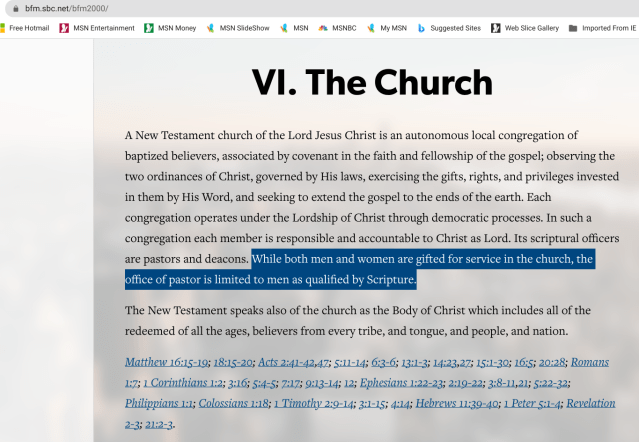
One item of business that is unfolding is a proposed amendment to the SBC constitution (not the BFM) that would exclude churches with women “pastors” from being in friendly cooperation with the SBC. This includes women who bear the title of pastor, even if they’re not functioning as pastors (e.g. “Women’s Pastor” “Children’s Pastor”) as well as women who are functioning as pastors even if they don’t bear the title of pastor (e.g. “Worship Leader” “Director of Education and Discipleship”). Churches with women in these positions or bearing these titles would not be allowed to “join” the SBC. If such a church is already a “member” of the SBC, it would be disfellowshipped (excommunicated) from the SBC.

At the moment, it has not been determined whether or not messengers will get to vote on this amendment. There is a letter of support pastors can sign, and you can get much more information at the SBC Amendment website.

The spotlight issue is going to be Rick Warren’s challenge of the Executive Committee’s decision to disfellowship (cut ties with) the “church” he “pastored” for over forty years – Saddleback, in Lake Forest, California. Saddleback currently has husband and wife “co-pastors” at the helm (appointed by Rick Warren prior to his retirement).

Earlier this year, the Executive Committee announced that Saddleback had been disfellowshipped for this reason, causing quite the stir among Southern Baptists in the know. Less than a year ago at the 2022 Convention, the head of the Credentials Committee, which is responsible for assessing whether or not a church seems to be in friendly cooperation with the SBC, proposed that messengers approve a year long study committee so the CC could figure out what a pastor is.

But apparently, they managed to figure it out without the study committee and quickly determined that Saddleback is, indeed, not closely enough aligned with the Baptist Faith and Message (the SBC’s statement of faith) to remain in fellowship with the SBC.

Conspicuously quickly, that is. Some have suggested that this was a strategic move designed to maneuver Rick Warren (or in collusion with him) into challenging the disfellowshipping. If he can successfully convince the messengers (voting attendees) to vote to overturn the decision (and judging from the standing ovation they gave him after his 6 minute, out of order, ode to himself last year, that’s very likely), the four other churches that were disfellowshipped at the same time as Saddleback can push to have their decisions overturned. And, assuming they’re successful, how much time and energy do you think the CC is going to put into any future complaints about other churches with women pastors? (None. That’s how much.) Not long after that, they’ll amend the BFM and remove the part above about women being pastors.

And that’s how the approval of women pastors is going to end up codified into SBC policy. It’s not a stretch. I think the first time I said that the SBC would affirm women “pastors” within five years was last year. Barring a certifiable miracle, I still believe that.

Now, just because that’s going to be the spotlight issue doesn’t mean that’s all you have to worry about. The whole abuse issue (Guidepost, the ARITF, etc.) is going to be another fairly major issue as well. Plus, there are going to be people who are counting on messengers being so distracted by Warrengate and the abuse advocacy grifters that they won’t be paying attention to any other issues. Keep your eyes and ears open, and pay attention. I’d bet my bottom dollar somebody’s going to try to pull a fast one with some sort of unbiblical issue while everybody’s out of the room.

So, if you haven’t already, talk to your pastor about becoming a messenger, get to New Orleans in June and…

  • Read or listen carefully to anything that’s up for a vote, make sure you understand it correctly, and vote according to Scripture.
  • Be in the room for every vote.
  • Vote against anything Rick Warren / Saddleback proposes
  • Vote for Mike Stone for president. (God bless him, he is not only godly but courageous and tenacious to boot.)
  • Support the constitutional amendment to disfellowship churches with women pastors (read it carefully before voting – sometimes items like this are re-worded from the original)
  • Don’t just blindly trust whoever’s at the podium or let them tug at your heartstrings. Listen, engage your brain, and think critically, biblically, and objectively about the issue.

…and prepare yourself to lose, and lose big time. I was prepared to lose every vote last year. And we did. And it still took a spiritual and emotional toll.

And it was worth it. I would do it all over again – which I kinda am, since I’ll be there again this year.

It’s worth it to know that one day I’ll stand before the Lord and say (speaking only for myself and my own conscience) about this moment, “Lord, by Your grace and strength, I didn’t give up. I did my best with what You gave me in order to honor and glorify You.”.

Won’t you join me in June in New Orleans?


If you have a question about: a Bible passage, an aspect of theology, a current issue in Christianity, or how to biblically handle a family, life, or church situation, comment below (I’ll hold all questions in queue {unpublished} for a future edition of The Mailbag) or send me an e-mail or private message. If your question is chosen for publication, your anonymity will be protected.