Mailbag

The Mailbag: Potpourri (Unfollowing iffy teachers, Teacher training, Church search & 9Marks, Charitable giving, SBC21, AWFS transcripts)

Welcome to another โ€œpotpourriโ€ edition of The Mailbag, where I give short(er) answers to several questions rather than a long answer to one question.

I like to take the opportunity in these potpourri editions to let new readers know about my comments/e-mail/messages policy. Iโ€™m not able to respond individually to most e-mails and messages, so here are some helpful hints for getting your questions answered more quickly. Remember, the search bar (at the very bottom of each page) can be a helpful tool!

Or maybe I answered your question already? Check out my article The Mailbag: Top 10 FAQs to see if your question has been answered and to get some helpful resources.


Iโ€™m currently listening to a [Bible study] podcast. I have enjoyed it so far because after I read, Iโ€™m able to hear a different perspective, maybe the speaker goes over something I didnโ€™t catch, or maybe the speaker says something that isnโ€™t how I interpreted the text. I always go back to the Scripture and compare when her opinion and mine differ to see what the scripture says. Thereโ€™s now been two issues that I just believe she is plan wrong about. At what point would you cut ties? My husband has told he wants me to really ponder if the teacher is trustworthy if she adds to Scripture or changes God’s intent. Iโ€™m all for testing everything I read/listen to against Scripture, but at what point would you consider not following a teacher due to misleading or just plain wrong information?

At the point at which my (doctrinally sound) husband expressed concern, if I hadn’t already unfollowed her on my own.

Ladies- if you have a godly, doctrinally sound husband who knows his Bible, be thankful (as I’m sure the reader who sent in this question is). What a wonderful gift God has given you! He’s able to give you a biblical perspective on things you might not have thought about before, he can give you godly counsel on those things, and he cares about your spiritual life and growth in holiness.

If you have a husband like that and he’s saying, “I don’t think you should listen to that podcast, read that author, etc.,” I would urge you to give serious thought to what he’s saying. I would also recommend heeding his leadership and unfollowing that person, even if you don’t totally agree with him. It’s very likely that one day, you’ll look back at that author or podcaster and see your husband’s concerns more clearly, and be glad you took his advice. And even if you don’t, or even if he turns out to be wrong, you’re still demonstrating respect for, and submission to his spiritual leadership – and that’s worth way more to your marriage and to being a godly wife than any podcast, book, YouTube channel or anything else.

If you’re in a position in which you’re having to decide for yourself whether or not to continue following a certain “iffy” teacher, here’s what I’d recommend:

  • Make sure the “red flags” you’re seeing are actually biblical issues (as this reader’s red flags were), not personal preferences. You may not like that a pastor likes hymns instead of more contemporary (doctrinally sound) worship music or that a (doctrinally sound) female teacher has really short hair, but that’s personal taste, not being unbiblical.
  • Be sure you understand and can rightly handle Scripture well enough to make sure it’s the teacher who’s the one in error, not you.
  • Make certain that what you’re hearing as a red flag wasn’t just a “one and done” instance of the teacher accidentally misspeaking, flubbing her words, or not being as clear as she could have been.
  • If you’re seeing red flags and you’re a new Christian or you know yourself well enough to know you could be easily swayed by this teacher into believing something wrong, stop following her.
  • Consider that for every red flag you’re seeing, there could be another red flag that your’e not recognizing or that this teacher hasn’t revealed yet.
  • If you’re a mature Christian who’s following this teacher for biblical instruction and you’re increasingly seeing red flags, that’s God’s way of telling you -through what you know from His Word- that you don’t need to be receiving teaching from this person.
  • If you don’t want to follow or are uncomfortable following a certain teacher, that doesn’t require you to make any sort of public declaration that others shouldn’t follow her or that she is a false teacher. You can simply make the quiet, personal decision to stop following her.
  • Remember, there’s no law that says you have to follow any particular teacher, or any teachers at all for that matter. Christians have been doing just fine for 2000 years simply being taught by their own pastor, elders, and teachers at church.

While reading your article, McBible Study and the Famine of Godโ€™s Word, I finally realized my struggle with leading the womenโ€™s study is because I havenโ€™t been trained to teach. Unfortunately, there arenโ€™t any strong teachers in my church – a big problem. Do you have any suggestions or recommendations for learning how to learn? Online, books, etc.?

The first thing I would recommend is that you explain your dilemma to your pastor and ask him to train you (and others in your church – One on one meetings between a pastor and a woman are not a good idea. Plus, it sounds like a lot of people in your church need to be trained.) to teach.

If your pastor is not a “strong teacher” or is incapable of training others to teach, you probably need to start looking for a new church. One of the biblical qualifications for pastors is that they be “able to teach” (1 Timothy 3:2) and be “able to give instruction in sound doctrine” (Titus 1:9). Paul exhorted Pastor Timothy: “what you have heard from me in the presence of many witnesses entrust to faithful men, who will be able to teach others also.” Pastors ought to be able to teach others to teach.

As your pastor is training you, you may wish to work through some of my Bible studies, or use them as studies for your women’s class. My studies are designed to teach women how to study or teach straight from the text of Scripture in a “learn by doing” sort of way. Once you get a feel for the kinds of things you should be seeing in the text and questions you should be asking of the text, you can take off those “training wheels” and fly solo.


Are you suggesting that the churches listed at the search engines at your Searching for a new church? resource are the only churches that are teaching biblically?

Not at all. That resource is not, nor is it meant to be, a comprehensive list of every doctrinally sound church on planet Earth. That would be impossible. I’m sure there are thousands of other perfectly doctrinally sound churches out there (and if you are personally connected to any others, please let me know.) That resource is merely a suggestion of some of the doctrinally sound churches in various areas of the world that Christians can check out if they’re looking for one to join.

I would like clarification on 9Marks website.

It’s a little hard to “clarify” when I’m not sure what the question is. :0) I can only infer that, like others, you’ve noticed Mark Dever and a few other pastors/teachers in that circle who, over the past few years, seem to have occasionally dipped a toe into the social justice waters.

I added the 9Marks “church search” to my list of church search engines several years ago before that became an issue. I believe that the majority of churches that are listed at the 9Marks site probably also applied to be listed before this became an issue or are not aware that it is currently an issue.

So far, as far as I know, Mark Dever and 9Marks haven’t turned rabidly woke, given a full-throated endorsement of Critical Race Theory, spoken out in favor of clear progressivism or liberalism, etc. I’ll continue to keep an eye on them, and if and when that happens, I’ll remove the 9Marks church search. But right now, they’re still at the stage of being decent brothers in Christ who every once in a while make an iffy statement or two. The churches on the 9Marks list aren’t required to agree or align with everything Mark Dever and 9Marks say, and, at the moment, I believe that the majority of the churches on that list are doctrinally sound.

If you have misgivings about 9Marks, by all means, skip that church search engine and use the others I have listed. And, as the disclaimer on that page says: “Please use this list only as a suggestion of churches to check out using biblical wisdom and discernment.” You are responsible for personally vetting any church you choose to visit or join.


Do you know of, and/or recommend, any particular causes or charities that areโ€ฆ well, Godly (moral and ethical)? There are so many charities that don’t use their donated funds for their advertised causes (you know, instead the donations go to support the CEO’s million dollar mansion and such). I want to give, I just don’t know to whom or what.

The first place you should be giving is to the offerings of your local church – to support your pastor and staff, pay the bills, contribute to the upkeep of the church, support missionaries, etc. This is part of being a faithful church member.

If you still have money left over after that, ask your pastor about the missionaries and other Christian organizations (ex: a local crisis pregnancy center, orphanages, church plants, etc.) your church supports financially, and give more money directly to these organizations. You should follow your pastor’s leadership and work hand in hand with your church in supporting these entities.

And if you still have money left over after that, would you adopt me? :0) Just kidding. If you follow any doctrinally sound podcasts, pastors, teachers, or authors, find out which parachurch organizations they support. For example, two of the ministries I follow are Grace to You and Wretched. I would love to be able to support The Master’s Academy International, which trains indigenous pastors all over the world to minister in their context. One of Wretched’s sponsors I would contribute to is Pre-Born, a pro-life ministry that emphasizes sharing the gospel.

(And just FYI: I do not recommend Samaritan’s Purse / Operation Christmas Child.)

May God bless your generosity.


Will there be a 2021 version of the Arrive Prepared resource for this yearโ€™s SBC Annual Meeting?

I thought about that a couple of weeks ago, but to be perfectly transparent I am so disillusioned with and depressed by the state of the Southern Baptist Convention at the national level right now that I just don’t have the heart for it.

Last year, I was in more of a “Let’s charge into hell with a water pistol and DO this thing!” frame of mind. This year, that has been replaced by a heaviness of spirit. Though there are many individual (and autonomous – for those not in the know, all SBC churches are autonomous) doctrinally sound SBC churches out there, including my own (and I’m so thankful for all of them), I just don’t have any reason to believe that anything is going to change at the national level. I think it’s just going to continue to get worse – more false teachers, more false doctrine, more egalitarianism, more Critical Race Theory, more liberalism, more biblical ignorance, more tolerance for sin, more 11th Commandment, more erosion of the authority and sufficiency of Scripture, and continued disdain for those of us in the Calvinist ghetto of the SBC.

I have never in my life more fervently hoped to be proved wrong, and I completely support my doctrinally sound brothers and sisters who are still standing in the flames brandishing their water pistols. But I’m shell shocked. That’s honestly just where I am right now.

In my estimation, about 85% of the information in the “Arrive Prepared” article is still accurate and relevant for this year’s annual meeting. Since the 2020 annual meeting was canceled due to COVID, my thinking is most of the same issues will be addressed this year, particularly abuse and Critical Race Theory / Resolution 9 (if you haven’t yet checked out the CRT video series I posted a few weeks ago, that would be a great resource).

I imagine issues surrounding COVID and the vaccine, the Equality Act, and persecution of the Western church will also be brought up. I hope the issues with NAMB (the North American Mission Board), including their church plants that have employed female “pastors” and co-“pastors,” will be biblically addressed, but my guess would be that that issue will be tabled or sent to committee or buried under procedural regulations and nothing will really be done about it clearly and publicly.

If you want to keep up on the issues, I would suggest following the people and organizations listed at the end of that article.

Sorry to sound like a Debbie Downer. I promise I’ll continue to think and pray about it, and if the Lord changes my mind, I’ll write a piece on it.


Could you please provide transcripts for each episode of A Word Fitly Spoken?

No, but we can come really close in two ways:

  1. Amy has started uploading our episodes (audio only) to our YouTube channel. There’s a “CC” button at the bottom of each YouTube video that allows you to turn on captions. (She has posted several of our past episodes as well.)
  2. All of our episodes are scripted, and we stick pretty closely to the script. Going forward, I’ll be posting the link to the Google Doc of our script for each episode in the show notes of that episode. Just click on “(Tran)Script” in the show notes. Many of our earlier episodes have been scripted from one of Amy’s or my blog articles, and if you’ll look in the show notes for that episode, you’ll find the link for that article.

If you have a question about: a Bible passage, an aspect of theology, a current issue in Christianity, or how to biblically handle a family, life, or church situation, comment below (Iโ€™ll hold all questions in queue {unpublished} for a future edition of The Mailbag) or send me an e-mail or private message. If your question is chosen for publication, your anonymity will be protected.

Christian women, Church, Complementarianism, Rock Your Role

Sisters Are Part of the Family of God, Too!

I’ve got some wonderful, godly male friends and acquaintances on social media. I’ve learned from their wisdom, referred people to their churches, and had a great time joking around with them.

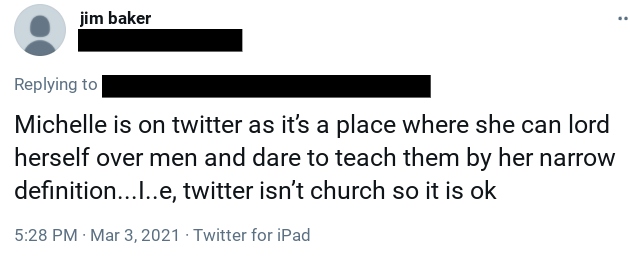
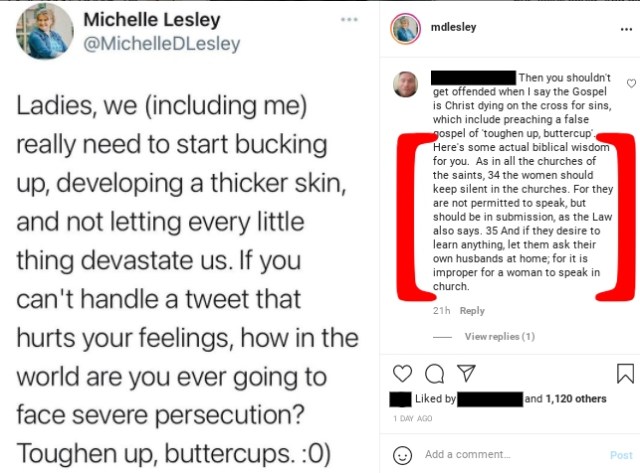
But every now and then there are men who stumble across my social media accounts or blog or podcast, seemingly drunk with biblical ignorance, who clearly don’t think women should have any sort of a voice when men are around – or at all, I guess. In my mind I call them the “Shut up and go sit in the corner” guys, because that’s what it feels like they’re saying to me, and to women everywhere.

One of the errors of the Pharisees’ legalism was that they stretched the boundaries of God’s laws farther than God intended them to go. This is why, when we see Jesus and the disciples walking through the fields and picking kernels of grain to eat in Matthew 12, the Pharisees accused them of “doing what is not lawful to do on the Sabbath”. Because this was, ostensibly, “harvesting” and “threshing” – working on the Sabbath.

But as Jesus went on to explain to them, this kind of unbiblical overreach of the fourth Commandment was never God’s intent. The Sabbath was a gift of rest meant to benefit God’s people, not to oppress and enslave them to nitpicking, nor to keep them from enjoying God’s blessings.

Today, the pendulum has swung to the other extreme, and antinomianism, rather than legalism, is the false teaching du jour. Antinomianism stretches the boundaries of God’s grace farther than God intends it to go. That’s why we have to spend so much time teaching and explaining that the Bible prohibits women from being pastors and elders, and from preaching, instructing men in the Scriptures, and holding authority over men inside the biblical boundaries of the formal gathering of the church body. Because, for the antinomian, practically anything, anywhere, goes.

But the “Shut up and go sit in the corner” guys help us to see that the same type of legalism the Pharisees practiced – though not as prolific – is still alive and well today. They stretch the boundaries of God’s command for the role of women in the church gathering to all other venues in which women might have a voice – to anyone, about anything. Some even say women aren’t permitted to teach other women and children, which is clearly at odds with Scripture.

The God who consistently values women holistically – their skills and talents, their intelligence, their contributions and hard work – throughout Scripture never intended this kind of unbiblical overreach of His commandment regarding the role of women in the church. This command was a gift meant to benefit God’s people, not to oppress and enslave women nor to keep us – or our brothers – from enjoying God’s blessings, especially the blessing of each other.

God consistently values women holistically – their skills and talents, their intelligence, their contributions and hard work – throughout Scripture.

Sometimes we lose sight of the fact that there’s a difference between the “set apartness” and formal structure and hierarchy of God’s house for worship and instruction, and the informal, unstructured “family time” around the table, around the living room, around the Twitter machine. And we forget that these two different environments serve two different purposes.

Worship and instruction are vital and primary. But we are the family of God. Brothers and sisters. Siblings. We need each other. The give and take. The back and forth. The jokes and laughter. The sharing, advice, support, encouragement, and yes, even the occasional, biblically appropriate brotherly or sisterly reproof. We’re to relate to each other as family – especially during “family time,” which is different and discrete from worship and instruction time.

We are the family of God. Brothers and sisters. Siblings. We need each other.

How dysfunctional would a family be if, during informal times of fellowship all of the sisters were prohibited from taking part in the discussion, sharing thoughts, offering insight, setting an example, and even proffering loving words of correction?

Normal, healthy, natural families don’t operate that way. And God uses the natural family as the metaphor for the way He relates to us: Father to child, the way we relate to Him: child to Father, and the way we relate to each other: brothers and sisters.

We’re to love one another and draw strength and help from one another, not amputate half of us from fellowship. When legalistic men unbiblically silence women…

…they’re out of alignment with the God who values women.

God showed us that women are valuable by purposefully and intentionally taking the time and effort to craft a woman in the first place. He could have stopped with Adam, but when He finished forming man, for the first time in Creation, He said, “It is not good…”. And the crowning glory, the final masterpiece of His world, was woman.

Throughout Scripture, from Sarah, Hannah, Esther, and Deborah, to Mary, Anna, Priscilla, Phoebe, and so many more, we see God using women to glorify Him and further His Kingdom.

Jesus and the epistles instruct men to love and protect women, to respect women, and to treat them with honor and dignity.

The God who sees women as a valuable part of His creation, who requires the respect of their worth, would never shut them out of family life, treating them as though they don’t matter.

…they are rebelling against God’s complementary Creative design.

Why did God say at Creation that it wasn’t good for man to be alone? Because he needed a helper “fit for him,” or “corresponding to him”.

Yes, God was speaking of that particular man, Adam. Yes, God was speaking of all husbands yet to come. But there’s a very real sense in which God was also saying, “It is not good for male humanity to be alone on planet Earth. Therefore, I’m going to make women as well.”.

Mankind needs the complementarity of womankind. Heโ€™ll be strong where sheโ€™s weak and sheโ€™ll be strong where heโ€™s weak. He will fill out Creation with masculine beauty that she canโ€™t contribute and she will fill out Creation with feminine beauty that he canโ€™t contribute. He’ll see things from one perspective, and she, from another. Itโ€™s like two gears in a machine that fit together perfectly and work together perfectly, yet each doing its own distinct part.

God wasnโ€™t finished with Creation when He created man. Something was still missing that God wanted to supply, and He filled in that hole in Creation with woman.

God wasnโ€™t finished with Creation when He created man. Something was still missing that God wanted to supply, and He filled in that hole in Creation with women.

And when you basically tell women, across the board, to sit down and shut up, you’re denying and suppressing God’s Creative design for women… and men.

…they are crippling the church’s ability to carry out the “one anothers” in a healthy way.

Loveย one another.ย Comfortย one another.ย Forgiveย one another.ย Serveย one another.ย Bearย one anotherโ€™s burdens.ย Confessย your sins to one another and pray for one another.

Because men and women complement one another in our strengths and weaknesses, we need both men and women to minister the one anothers to each other in the church. Otherwise, the balance is completely thrown off. Without the compassion and nurturing God has uniquely wired into women, a man’s “Comfort one another,” could turn into, “Suck it up and rub some dirt on it. You’re fine.” “Forgive one another,” might become, “I’ll forgive you….but first I’m going to punch you in the mouth.” Without the dispassionate objectivity and firmness more common to men, women’s comfort might turn into enabling, and forgiveness into being a doormat. And how can a woman properly bear the burden of a man who’s struggling with lust, or a man the burden of a woman facing infertility?

We minister to one another together. We need both halves of the church for it to be healthy and whole.

We’re family, folks. We sisters need you brothers, and, yes, you brothers really do need us sisters – even you “Shut up and go sit in the corner” guys. That’s not feminism, it’s not rebellion, it’s not sin…it’s family. When we understand and embrace this, we’ll discover what a precious gift God has blessed us with.

The gift of each other.

Additional Resources:

Rock Your Role series

Rock Your Role FAQs

Sermon on the Mount Bible Study

The Sermon on the Mount ~ Lesson 6

Previous Lessons: 1, 2, 3, 4, 5

Matthew 5:27-32

Questions to Consider

1. Briefly review the “middle parts” (ex: merciful, poor in spirit) of the Beatitudes, the “salt and light” passage, and the “heart of the law” passage in Matthew 5:1-12, 13-16, 14-20. Now read 27-32 in light of those passages.

Summarize, in your own words, the main idea of 27-32.

In the Beatitudes, Jesus lists the traits that define Christian character. In much of the rest of the Sermon on the Mount He fleshes out what many of these character traits look like when walked out in “real life”. Which of the traits (the “middle parts” – there could be several) listed in the Beatitudes is Jesus expanding on in 27-30 and 31-32? How?

How do lust, adultery, and unbiblical divorce bland your saltiness? (13-16) How can crucifying your lust and being faithfully devoted to your husband make you saltier and brighter?

2. Review from our previous lessons (links above) the idea that the Sermon on the Mount is to the New Testament / new covenant what the Ten Commandments were to the Old Testament / old covenant.

How does Jesus refer back to the Ten Commandments in verse 27? How do Jesus’ phrases “You have heard it said…but I say to you…” verbally transition the people from their focus on outward obedience to the letter of the law to zeroing in on the attitude of their hearts and the spirit of the law? Explain how refraining from lust and being faithful and committed to your marriage is the heart of the law (17-20) behind the seventh and tenth Commandments. Connect these passages with 27-32. Where should our outward, behavioral obedience to Christ spring from?

3. Review: Examine again the “You have heard it said…but I say to you…” proclamation. Who had the people heard it (the law) said by? Who taught them the law? How does Jesus saying, “But I say to you…” establish Jesusโ€™ supremacy over the Pharisees, scribes, priests, etc. Imagine you’re one of these Jewish leaders and you’re hearing Jesus say this. What might your initial reaction be?

Recalling our Sermon on the Mount / Ten Commandments motif, how might Jesus’ “You have heard it said…but I say to you…” proclamation have evoked images of Moses as lawgiver, and signaled to the Jewish leaders and people that the better Moses was here?

4. What is โ€œlustful intentโ€? (28) Make the connection between lust, adultery, and divorce. How could lusting after someone else eventually culminate in divorcing your spouse?

5. Notice the progression from temptation to commission of outward sin in 28-30:

  • Sin of the e_____(28a, 29) leads to…
  • Sin of the h_____(28b) leads to…
  • Sin of the h_____(30)

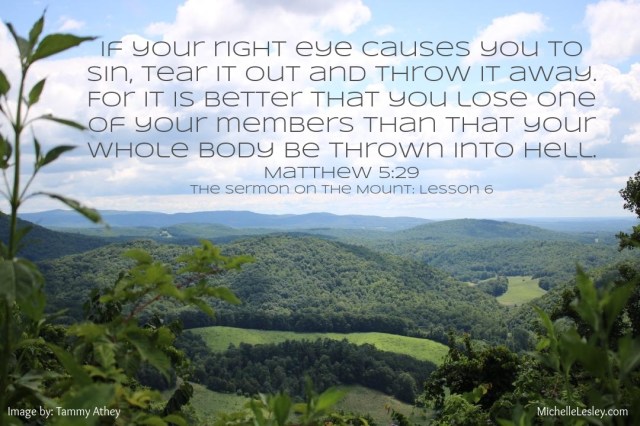
Which sexual sins does this progression apply to? Which other sins does this progression apply to? Is it fair to say that this progression applies to all sin? Explain what Jesus means by gouging out your right eye and cutting off your right hand as it applies to this progression from temptation to commission of outward sin. How can removing things in your life that are conducive to temptation and sin stop this progression?

6. Using your cross-references for verse 31, what were the Old Testament parameters for divorce? Why, according to Jesus, was this allowance made?

A spouse’s “sexual immorality” (usually adultery) (32) is one of the biblically permissible reasons for divorce. What is the other? Study these passages. How is marriage symbolic of God’s relationship with His people? If marriage symbolizes how God (the “husband”) cares for His people (His “bride”), what does divorce (for unbiblical reasons) say about God? About His people?

Compare 32 to Matthew 19:3-9. Why is divorce so closely tied to adultery? Who joins two people together and makes them one in marriage? Besides divorce due to adultery and abandonment1, what is the only other way God considers a marriage dissolved? Do man’s scribblings on a piece of paper (“certificate of divorce” for unbiblical reasons) change the fact that God still considers those two people married? How does this better help you understand Jesus’ statement in Matthew 19:6: “What God has joined together, let not man separate.”? How does this concept help you understand why, in unbiblical divorces, God considers remarriage to be adultery?


1I know at this point many of you have “Yeah, but…” and “What if…” questions about abusive marriages and/or your own divorces. We can’t deal with those properly here. I would encourage you to use your cross-references and concordance to search the Scriptures about divorce and rightly apply them to your questions, and to get wise counsel from your pastor. If you are currently being abused: please get to a safe place and reach out to your pastor, the police, or another appropriate person for help. Getting to a safe place is not a sin, and it is not the same as an actual divorce.


Homework

  • Read my article The Mailbag: Is Lust a Sin for Women, Too? and study the Scriptures therein.
  • Think of one pernicious sin in your life in which you can see the progression of: sin of the eye>>sin of the heart>>sin of the hand. Explain how each of these steps are fleshed out in your particular sin. What is something you could remove from or add to your life that would make it more difficult for you to be tempted to commit this sin? Prayerfully develop a plan or strategy to “cut off your right hand / gouge out your right eye” (metaphorically speaking) in this area and begin implementing it this week.

Suggested Memory Verse

Suffering

Erin Coates Interview

Normally, when I feature a full length video in a post, it’s for leisure time entertainment, or maybe it even focuses on something important that you need to educate yourself about.

This time, it’s urgent.

Let me get this part out of the way first because I know some of you, like me, looked at that 3 hour time stamp on the video and your visceral reaction was, “There’s no way I have the time or the attention span to watch all of that.” I get it. But here’s how the video breaks down:

  • Justin Peters’ interview with Erin: About 45 minutes long
  • James Coates’ February 14 sermon: About an hour
  • GraceLife Associate Pastor Jacob Spenst’s February 21 sermon: A little over an hour.

If you read my article from last Friday, 4 Things You Need to Understand About Christian Persecution, or if you’ve been paying attention to Christian news and social media, you’re familiar with the story of Pastor James Coates of GraceLife Church in Edmonton, Alberta, Canada. (And if not, it’s explained in the video.)

I want to urge you to at least listen to the interview with Erin and pray for her, James, their family, and GraceLife, especially today and tomorrow. Thursday is the hearing to determine whether James can bail out of jail without agreeing to the shamefully discriminatory bail conditions that have been put in place. Erin explains more in this Instagram post:

At the end of the interview, Justin asks Erin if there’s anything we outsiders can do to help. Here’s what you can do:

  • Pray
  • Contact Jason Kenney, Premier of Alberta, Canada via phone, mail, email, or via Facebook and Twitter, and request that all charges against James be dropped. Do so kindly and politely. Remember, you are representing Christ. Mention where you’re from. Even if you don’t live in Alberta or anywhere in Canada, the Premier needs to know this is a bad look for Canada in the eyes of a watching world – and so do other world leaders who are undoubtedly watching to see what Canada will do in this case. Never underestimate the power of negative publicity in the hands of an Almighty God.
  • Help get the word out. Share this post with your pastor. Post it on social media and ask all your friends to share. If you have any contacts in the media or anyone with a large platform who could aid in spreading the word, ask that they help shine some light on this situation. The more publicity, the better.
  • Pastors, open your churches. Especially if you’re Alberta. Not only is it obedient to Scripture, can you imagine how encouraging it would be to Pastor James and GraceLife to see other churches and pastors standing in solidarity with them?
  • Keep your mouth shut. I can’t tell you how many horrifying comments I’ve read from professing Christians about this situation. If you can’t be an encouragement to your brother in Christ, just be quiet, and maybe examine yourself against Scripture. I definitely won’t be publishing any comments or reading any emails that are discouraging or critical.

Watch. And pray.

Then the righteous will answer him, saying, โ€˜Lord, when did we see you…in prison and visit you?โ€™ And the King will answer them, โ€˜Truly, I say to you, as you did it to one of the least of these my brothers, you did it to me.โ€™

Matthew 25: 37a, 39-40

Mailbag

The Mailbag: Potpourri (Prosperity gospel, Friendship, Christian colleges, Calvary Chapel, Non-denoms, “Unspoken”)

Welcome to another โ€œpotpourriโ€ edition of The Mailbag, where I give short(er) answers to several questions rather than a long answer to one question.

I like to take the opportunity in these potpourri editions to let new readers know about my comments/e-mail/messages policy. Iโ€™m not able to respond individually to most e-mails and messages, so here are some helpful hints for getting your questions answered more quickly. Remember, the search bar (at the very bottom of each page) can be a helpful tool!

Or maybe I answered your question already? Check out my article The Mailbag: Top 10 FAQs to see if your question has been answered and to get some helpful resources.


What is the prosperity gospel? Thanks!

It’s a theological framework that sounds Christian-ish, but it’s really not. There are a lot of unbiblical tenets of the prosperity gospel (more formally called Word of Faith heresy, less formally called “name it and claim it / blab it and grab it”) but the two you’re most likely to be familiar with are:

  • “It’s never God’s will for you to be sick, poor, or unsuccessful. If you are, that’s your fault for not having enough faith. If you just have enough faith, God is obligated to give you whatever you ask him for.”
  • From televangelists: “‘Sow a seed’ (i.e. “send me money”) into my ministry and God will bless you. The more you send, the more material stuff God will bless you with.”

Most “churches” and evangelical celebrities that espouse the prosperity gospel these days are also into New Apostolic Reformation (NAR) heresy. The easiest way to explain the NAR is that it takes the prosperity gospel and adds on weird (and unbiblical) “signs and wonders” such as faith healing, supernatural visions, “trips to heaven,” false prophecy and so on. Joel Osteen and Joyce Meyer are examples of prosperity gospel heretics who are not also NAR. Bethel “Church” and Todd White are examples of combined prosperity gospel and NAR heresy.

Here are some resources you may find helpful:

What does the Bible say about the prosperity gospel? at Got Questions

God, Greed, and the (Prosperity) Gospel by Costi Hinn

The Mailbag: What is the New Apostolic Reformation?


I have a question regarding friendship. I have a friend/co-worker who is unrepentantly continuing a sinful behavior. I have tried to lovingly several times to point her back to Jesus as she is Christian. Her behavior happens to be quite triggering for me and my husband isnโ€™t a particular fan of her as well. My question is, am I wrong for not wanting to continue the friendship? And if not, how do I do this in a loving, Christ-like way since we work together?

Wow, usually when you confront someone in her sin, the question of whether or not to remain friends takes care of itself, because the confront-ee isn’t too fond of the confront-or any longer. You must have found a wonderfully loving and gentle way to talk to her – great job!

The first thing we would need to clear up is what you mean by “friend”. To me, a friend is someone you choose to spend time with socially because you enjoy that person’s company. You have lunch together, go to the movies together, visit each others’ homes, etc. That’s not the same as being friendly with people you have no choice about being around. You’re probably friendly with your next door neighbor, your co-workers, and the people at your church, but you don’t make any effort to spend time socially with most of those people outside of those particular venues. (For more clarity, you might enjoy reading my article How Can We Be Friends? in which I discuss different levels of friendship.)

There’s nothing in the Bible that says you have to be friends with any specific person. In fact, the Bible speaks more about not developing or maintaining close relationships with people who are ungodly influences. (Here are just a few that came to mind.) But the Bible does instruct us to be kind and loving to those we come in contact with. In other words – going back to the difference between being friends and being friendly – you do not have to be friends with this person, but you do have to be friendly (kind and loving) toward her when you run into her at work.

If you are friends, which of you normally initiates your get-togethers? If it’s you, or if it’s about 50-50, you can gradually back off of inviting her to spend time time together, get busier with other plans (actual plans – don’t lie), and so on, and the friendship may dissolve organically.

If it’s her, or if you just want to be more direct, you can sit her down and kindly and gently explain that, while you enjoy your friendly working relationship with her, you won’t be able to spend time with her outside of work any more. Then explain the biblical reason why (spending time with her tempts you to sin, your husband doesn’t approve of the friendship and you need to respect his wishes, 1 Corinthians 5:11‘s admonition not to associate with professing Christians who persist in sin, etc.). If she’s actually a Christian, she ought to understand, and hopefully, losing a friend will provide her with additional incentive to repent.


My daughter will be heading to college next year. Do you have any Christian college recommendations? She visited one today and the Baptist church on campus that they use for their chapel has a woman pastor. The school also has a LGBT group for alumni, students and faculty. So sad. She is spiritually tired from high school and looking for an uplifting school that values both education and true spiritually.

I wish I had better news for you, but I think you’re going to find problems like that, as well as false doctrine being taught and promoted inside and outside the classroom, at the majority of Christian colleges you consider.

The only Christian college I’m familiar with that I would be comfortable recommending is The Master’s University (TMU is separate from The Master’s Seminary. TMU is a regular Christian college that admits both men and women. TMS is solely focused on preparing men for the pastorate and does not admit women.)

Readers, you’re welcome to make other recommendations in the comments. I would just urge anyone considering those recommendations to carefully vet any college that is mentioned.


I really want to know what is wrong with Calvary Chapel doctrines?

I think the only place on the blog I’ve mentioned anything about Calvary Chapel is on my Reader Recommended Churches resource. And on that page, the only thing I’ve mentioned is that I don’t accept recommendations for Calvary Chapel churches (among others) for doctrinal reasons.

There are two doctrinal reasons I’ve chosen not to add Calvary Chapel churches to the list:

  1. The Calvary Chapel statement of faith clearly states that its churches believe and practice continuationism, and I don’t list continuationist churches. While I don’t believe otherwise doctrinally sound continuationist churches and Christians are heretics or false teachers, I also don’t believe this view is a correct handling of Scripture. Additionally, in my experience, continuationist churches are far more likely to fall into other doctrinal error and yoke with false teachers than cessationist churches are (not that cessationism guarantees a perfect church).
  2. Several years ago, there was a split in the Calvary Chapel denomination. I don’t remember all the details, I just recall that the churches on one side of the disagreement went in a doctrinally unsound direction, and the churches on the other side maintained biblical fidelity, but both sides kept the name Calvary Chapel. Since I vet every church that’s submitted for inclusion on the list, it would be extraordinarily difficult and time consuming to try to find out which side of the split a particular Calvary Chapel church ended up on.

Is a non-denominational church any good?

There are good non-denominational churches and bad non-denominational churches just like there are good denominational churches and bad denominational churches. It really depends on the individual church and their practices and teachings.

It’s important to carefully vet any churches you’re considering joining on an individual basis. Need a little help? Check out the “What to look for in a church” section of the Searching for a new church? tab in the blue menu bar at the top of this page.


Are unspoken prayer requests supported biblically? I Googled it and many sites said no. Even though I need prayers from my Sunday school class I always pass because I donโ€™t want to say why and I donโ€™t know if unspoken prayer requests are biblical.

For any readers who are new to Christian-ese, an unspoken prayer request is when a Christian is asking others to pray for her, but doesn’t want to disclose the details due to sensitive information, embarrassment, privacy, etc., so she just says, “I have an unspoken prayer request,” or “Unspoken.”

While I really can’t think of anything in Scripture that prohibits or even discourages this, I would personally encourage anyone asking for prayer to at least give the people she’s asking some sort of direction. You don’t have to (and in many cases, shouldn’t) give private details, but you could say something like: I can’t give all the details, but please pray for me about: a problem I’m having at work, or a situation with a friend, or a difficult decision I have to make, or a sin I’m struggling against, or I have a challenging week coming up.


If you have a question about: a Bible passage, an aspect of theology, a current issue in Christianity, or how to biblically handle a family, life, or church situation, comment below (Iโ€™ll hold all questions in queue {unpublished} for a future edition of The Mailbag) or send me an e-mail or private message. If your question is chosen for publication, your anonymity will be protected.