For the next several weeks, I’ll be making preparations to speak at a conference, so our next regular weekly Bible study won’t start until after I return home and get my household back in order (I’m thinking probably mid-April-ish, but don’t quote me on that.). :0) I have a study in mind, but will keep thinking and praying about it for a few more weeks.
So anyway, for the next several Wednesdays, you’ve got some options:
📖 You can finish up Imperishable Beauty or any of my other studies you’re currently working on.
📖 You can choose a book(s) of the Bible to work through on your own.
📖 You can choose one of my studies to work through at the Bible Studies tab at the top of this page. (I would choose one of the shorter ones, like Colossians or Ruth rather than one of the longer ones if you’re only trying to fill the space between now and the beginning of our next study.)
📖 You can follow along with the sampling of “re-run” lessons I’ll be posting here on the blog each week.
Here’s today’s “re-run”:
Wednesday’s Word
Wednesday is Bible study day here on the blog. In my Wednesday’s Word study, you’ll find miscellaneous, one lesson Bible studies from each book of the Bible. One chapter of Scripture followed by study questions. This sampler series demonstrates that there’s nothing to be afraid of when approaching those “lesser known” books and that every book of the Bible is valuable and worth studying.
Wednesday’s Word ~ Zechariah 7
In the fourth year of King Darius, the word of the Lord came to Zechariah on the fourth day of the ninth month, which is Chislev.2 Now the people of Bethel had sent Sharezer and Regem-melech and their men to entreat the favor of the Lord,3 saying to the priests of the house of the Lord of hosts and the prophets, “Should I weep and abstain in the fifth month, as I have done for so many years?” Keep reading…
I’ve changed the blog’s URL from MichelleLesleyBooks.com to MichelleLesley.com. Same blog, same content, just drop the “books” and you’re good to go. For the next year, the old address will seamlessly automatically redirect you to the new address. (See update below.)
I’m trying to make my way around the web to change the site address anywhere I have it listed, but after seven years with the old address, I can’t begin to remember all the nooks and crannies I need to search out and correct.
If you happen to see my old web address listed somewhere, I surely would appreciate a heads up so I can get over there and update it to the new address.
And if you’ve been so kind as to link to my blog or any of my articles on your own web site, the old address will work just fine for the next year, but after that, the links will need to be changed to the new URL or they won’t work.
Why the change? I originally moved over to WordPress from Blogspot because I was told it was a better platform for marketing and publicity for my book which we were trying to get off the ground at the time. I wanted to use MichelleLesley.com when I was getting settled in at WP, but someone else had already purchased and was using that domain (Can you believe there are TWO of us? :0) So I stuck “books” on the end of the address because the blog was originally intended to be the vehicle for promoting and selling my first book and any to come in the future.
So now that my book is out of print, the “books” part is cumbersome and doesn’t make much sense, AND MichelleLesley.com is finally freed up for me to use, so, voila!
Update (March 2019):
Wow, the last year just flew by! My old URL, MichelleLesleyBooks.com expired over the weekend. All of my content is still here at MichelleLesley.com, but if you’re using an old link that has “books” in it, it’s not going to work any more, and you won’t be automatically redirected to the new URL. Just go to your browser bar, delete the “books” part of the link, and you should get to the article you’re looking for just fine.
If you happen to be reading one of my articles, or someone else’s blog or article, that links to one of my articles with an old link, I’d greatly appreciate it if you’d let them or me know so we can get it fixed. Thanks!
How do I know if a church is doctrinally sound? Do I base it off their statement of faith?
This is such a great question in a day when you can’t really trust that a building with the word “church” on the sign out front actually teaches and practices sound doctrine.
Because it would be impossible to cover every single aspect of doctrine that churches need to handle biblically, and because many of my readers are new to some of the deeper points of theology, what I want to do is give you some “signposts” to look for as you’re checking out a new church that will help indicate whether or not that particular church is likely to be one that handles those harder to understand points of theology in a doctrinally sound way.
First, check out these resources under “What to look for in a church” at my Searching for a new church?tab at the top of this page. These should be helpful if you’re unfamiliar with the biblical issues that a church should be handling correctly:
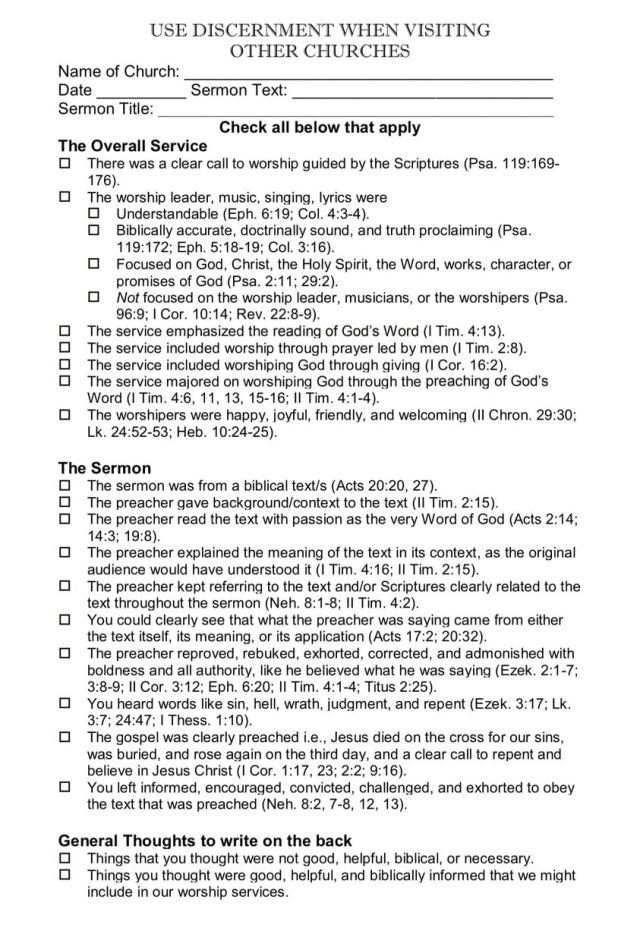
Here’s a handy evaluation sheet created by Dr. Jack Hughes. Use it when you visit a potential church to determine whether or not it’s worth pursuing. (Save the photo and print it out, or type the questions into your own document.)
If you are a brand new Christian and you aren’t sure what the answers to the questions in these articles should be, ask the person who led you to Christ, a pastor you know to be biblically trustworthy, or a friend who’s a mature Christian to help. You can also use the search bar at the top of this page to see if I’ve addressed your question. And, make liberal use of Got Questions?It’s a wonderful website that gives simple, biblical answers to all kinds of questions about the Bible, church, theology and other issues.
A church’s stance on many of these theological issues can be found in their statement of faith, which most churches post on their websites (often under the heading “What We Believe,” “Doctrinal Distinctives,” or something similar). While you’re on the church website, here are some other things to look for that can give you a fuller picture of whether or not the church is likely to be doctrinally sound.
⛪ Be wary of a church with no statement of faith on their website at all, and be cautious if they have a very simplistic statement of faith with few or no Bible verses cited to support it. Generally speaking, in my experience, the longer and more detailed a statement of faith is, and the more Scripture references it has, the more likely it is to be a doctrinally sound church.
⛪ A few things to look for in the statement of faith:
•The Trinity: You’re looking for language along the lines of, “We believe in one God in three persons.” If you see three “modes” or three “manifestations,” that’s the language of modalism, and it is not a doctrinally sound church.
•Some churches have a section of their statement of faith on spiritual gifts or the Holy Spirit and include wording indicating whether they are a continuationist (ex: “we believe all the spiritual gifts are in operation in the church today”) or cessationist (ex: “we believe God has ceased giving supernatural gifts such as healing and tongues to individual Christians”) church. Generally speaking, a church is more likely to be doctrinally sound if it holds the cessationist view. (No, I am not saying every continuationist church is heretical. I’m strictly talking probabilities here.) If there is anything in the statement of faith that indicates that a Believer will or must speak in tongues in order to be saved or as a result of salvation, or that the “baptism of the Holy Spirit” occurs separately from salvation, it is not a doctrinally sound church.
•Some churches intentionally indicate that they are complementarian in the “Marriage and Family” or “Church Leadership” section of their statement of faith by stating that the husband leads the family and the wife submits to her husband, or by explaining that the roles of pastor and elder are limited to men. It’s usually a good sign when a church makes a point of saying these things. A church that indicates it’s egalitarian is not doctrinally sound.
⛪ If you find the pastor’s name listed here, it’s not a doctrinally sound church.
⛪ If a church subscribes to a creed/confession/catechism you know to be biblical (ex: 1689 London Baptist, Westminster, Heidelberg, etc.) there’s a better chance they’re a doctrinally sound church.
⛪ Some churches have a page on their website where they recommend books, blogs, and other resources. If they’re recommending doctrinally sound materials by trustworthy authors and teachers (click here for a few), that can be a good sign. Conversely, if they’re recommending materials by authors and teachers listed here, that’s a bad sign.
⛪ If they have a women’s ministry page, check out who’s speaking at the next conference they’re going to and who is the author of the Bible study materials they use.
⛪ Check the staff page and make sure they don’t have women serving as pastors/elders. (Be aware that some churches are now using titles like “Coach,” “Director,” “Facilitator,” etc. to disguise the fact that women are serving in unbiblical positions of leadership. Regardless of the way the position title is worded, women are not to serve in pastoral or elder offices or in any position in which they will be teaching or exercising authority over men.)
⛪ Check the sermon archives for a couple of things: 1) to see if they invite women or false teachers as guest preachers, and 2) does the pastor preach mainly expositorily or topically? Listen to several sermons to familiarize yourself with his style and presentation.
⛪ Some churches post videos of their entire worship service on YouTube, Vimeo, or Facebook. This is also a good way to listen to sermons and to discover whether or not women are unbiblically leading parts of the worship service.
Additionally, videos of the entire worship service allow you to find out about the church’s music. Be extremely cautious of churches who use music from Bethel, Hillsong, Elevation, Phil Wickham, Brandon Lake, and other heretical sources, particularly if they also darken the sanctuary and what you’re seeing looks more like a rock concert than an orderly, reverent worship service. Churches that leave the lights on, sing hymns and worship songs from doctrinally sound sources, and are led by a minister of music rather than a band or someone who reminds you of a rock star are much more likely to be doctrinally sound.
Keep in mind, however, that there are lots of churches out there who look perfectly doctrinally sound “on paper,” or even on video, but are not practicing what their website or woship service videos preach. Take a look at these statements of faith for example: Lakewood (Joel Osteen), North Point (Andy Stanley), and Bethel (Bethel). On the surface, and especially to those newly saved or not very familiar with the Bible, these statements of faith look fairly decent (although…notice that few to no Scriptures are listed, and they are short and/or somewhat vague), but the practices of these churches may be surprising in comparison.
Because churches’ practices and teachings often differ – sometimes significantly – from what you see in their statement of faith, you’ll have to dig deeper in order to get a better feel for the church’s doctrine. Make an appointment to go in and talk to the pastor about what the church teaches and ask any questions you might have. And visit the church for a while before joining to see how things actually go. The most a church website can do is help you weed out the churches that are definitely bad. A church website cannot tell you that a church is definitely good.
If you’re looking for a new church but you aren’t sure where to start, check the church search engines and churches recommended by my readers at the Searching for a new church?tab at the top of this page.
If you have a question about: a Bible passage, an aspect of theology, a current issue in Christianity, or how to biblically handle a family, life, or church situation, comment below (I’ll hold all questions in queue {unpublished} for a future edition of The Mailbag) or send me an e-mail or private message. If your question is chosen for publication, your anonymity will be protected.
Hi ladies! I hope you enjoyed our most recent Bible study, Imperishable Beauty, which we wrapped up at the end of February.
For the next several weeks, I’ll be making preparations to speak at the Reliance on God and His Wordconference (Need a speaker for your next women’s event or podcast? Click the Speaking Engagements tab at the top of this page.), so our next regular weekly Bible study won’t start until after I return home and get my household back in order (I’m thinking probably mid-April-ish, but don’t quote me on that.). :0) I have a study in mind, but will keep thinking and praying about it for a few more weeks.
So anyway, for the next several Wednesdays, you’ve got some options:
📖 You can finish up Imperishable Beauty or any of my other studies you’re currently working on.
📖 You can choose a book(s) of the Bible to work through on your own.
📖 You can choose one of my studies to work through at the Bible Studies tab at the top of this page. (I would choose one of the shorter ones, like Colossians or Ruth rather than one of the longer ones if you’re only trying to fill the space between now and the beginning of our next study.)
📖 You can follow along with the sampling of “re-run” lessons I’ll be posting here on the blog each week.
Here’s today’s “re-run”:
During 2014, I led my ladies’ Sunday School class in a chronologicalread-through of the entire Bible. Each week I taught a lesson from that week’s reading and posted it here on the blog.
Are you using the chronological plan this year? If so, you can find my weekly lessons here (in reverse chronological order, ironically – you’ll have to scroll back to get to the beginning) if you’d like to supplement your reading plan with them. And even if you’re using another reading plan or simply studying through a book of the Bible, maybe you’d like to match up what you’re reading with my lesson that corresponds to the passage you’re currently studying.
Here’s a lesson that goes with this week’s reading in the chronological plan:
Through the Bible in 2014 ~ Week 10 ~ Mar. 2-8 Numbers 16-32 Tackling Tough Issues: Genocide in the Old Testament
Genocide: It’s defined (by dictionary.com) as, “the deliberate and systematic extermination of a national, racial, political, or cultural group.” This week in our reading, we dealt with a passage in which God commanded the Israelites to kill nearly all of the Midianites, even those we might consider “innocent.” Was God being cruel or capricious? How could a loving God command such a thing? Click here to keep reading…
For an expanded and more detailed treatment of this topic (based on this brief article), please listen to the Mardi Gras, Ash Wednesday, and Lent episode of A Word Fitly Spoken.
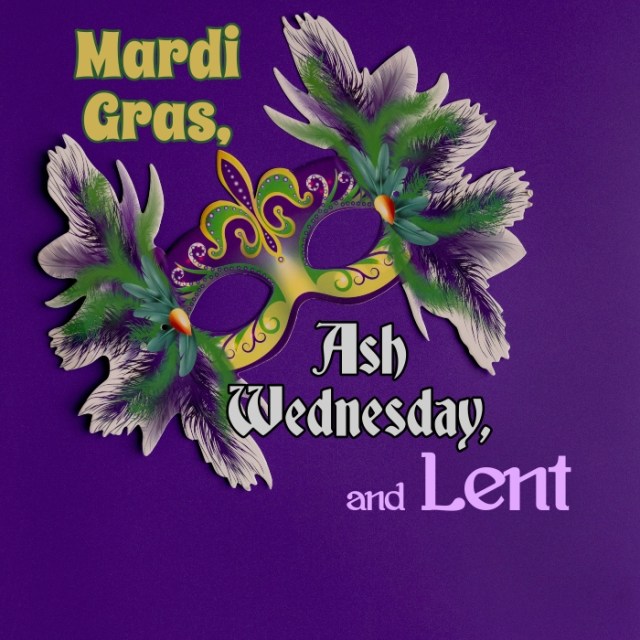
What are Mardi Gras, Ash Wednesday, and Lent? Are they biblical? Should Christians participate in them?
If you don’t live in Louisiana or a heavily Catholic area, maybe you’re not very familiar with these observances. Let’s take a look at each of them:
What is…
Lent– Lent is a forty day period (not counting Sundays) leading up to Easter. It is observed by Catholics and some Protestants. Historically, it is supposed to be a period of repentance, penance, fasting, and self-denial. The aspect of Lent that people tend to be most familiar with is the idea of giving something up (self-denial/penance) for Lent such as watching TV, chocolate, smoking, or eating meat.
Ash Wednesday– Ash Wednesday is the first day of Lent. Ashes are applied to the forehead in the shape of a cross to indicate repentance and that the recipient will begin the Lenten fast. Ash Wednesday is primarily observed by Catholics and some Protestants.
Mardi Gras (Fat Tuesday)– Mardi Gras is the day before Ash Wednesday. It has its roots in Shrove Tuesday, which was originally a day of feasting on all of the foods that were forbidden during Lent so these foods would not spoil or go to waste since they could not be eaten again until after Easter. Through the years, this day of feasting has morphed into drunken revelry – sort of a “last hoorah” for getting all the sin out of your system before you have to start “being good” for Lent. In Louisiana (and a few other places), it is much more a cultural holiday than a religious observance. People from various religions as well as non-religious people participate in Mardi Gras. It is celebrated with numerous parades, balls, and other festivities. The colors of Mardi Gras are purple (representing justice), green (representing faith), and gold (representing power).
Lent– Yes and no. Mostly no. The fundamental components of Lent – repentance, fasting, and the pursuit of holiness – are biblical. Repentance and holy living should be practiced by all Christians every day, and biblical fasting as the Holy Spirit convicts the individual Believer.
However, Lent is not mentioned or even hinted at in the Bible, and any Catholic observance (of Lent or anything else) is fundamentally unbiblical because the Catholic religion itself is unbiblical. It is also unbiblical for a church to require that its members observe a man-made religious ritual or to imply or teach that participating in this ritual earns favor with God or absolves or makes up for sin. Furthermore, to teach that there is a special time of the year set aside for repentance and holiness is unbiblical. Christians are to walk in holiness and repentance every day.
Ash Wednesday– Again, yes and no. Mostly no, and for most of the same reasons Lent is generally unbiblical. The fundamental components of Ash Wednesday – repentance of sin and the pursuit of holiness – are biblical and should be practiced by all Christians every day.
In addition to the unbiblical facets of Lent, Ash Wednesday’s forehead ashes “disfigure[s] their faces that their fasting may be seen by others” which is the exact opposite of the humble way Christ teaches us to fast.
Mardi Gras– No. The drunkenness, sin, and lasciviousness that go along with typical Mardi Gras celebrations are patently unbiblical as is the idea of getting all the sin out of our systems before we have to start being good. The Bible teaches against these things.
Should Christians participate in…
Lent– Catholic observances of Lent – no. Some doctrinally sound churches and individuals freely choose to set aside a time of biblical fasting, prayer, and worship in anticipation of Easter. For Christians who observe Lent in this way, as long as it is observed in keeping with Scriptural principles, it can be a valuable and meaningful time of respite and renewal with the Lord just as it could if observed at any other time of the year.
Ash Wednesday– No. It is unbiblical, as cited above.
Mardi Gras– Christians should not participate in any sinful activities any day of the year, including Mardi Gras, nor believe or portray to others by their actions, the unbiblical “theology” behind Mardi Gras. (And as a non-theological aside, violent crime in New Orleans during Mardi Gras has made attending Mardi Gras parades and other events very dangerous.)
However, as I mentioned, in Louisiana, Mardi Gras has become much more of a cultural holiday than an observance with religious undertones. Many smaller towns (and even some larger ones) eschew the debauchery that takes place in New Orleans and offer family-friendly parades which are basically as innocuous as our local Christmas parades or a Fourth of July fireworks show. For Christians who have worked and prayed through the appropriate biblical principles and whose consciences allow them to participate in non-sinful Mardi Gras activities such as attending these types of parades, I believe this is an issue of adiaphora(Christian liberty) similar to participating in non-sinful aspects of Halloween. (Don’t forget to take along some tracts to hand out!)
*These articles are linked for informational purposes only. Obviously, I’m not endorsing Catholic websites or anything on a secular website that’s ungodly.
If you have a question about: a Bible passage, an aspect of theology, a current issue in Christianity, or how to biblically handle a family, life, or church situation, comment below (I’ll hold all questions in queue {unpublished} for a future edition of The Mailbag) or send me an e-mail or private message. If your question is chosen for publication, your anonymity will be protected.