
Christmas, Random Ramblings Ruminations Resources

Random Ramblings, Ruminations, and Resources

A couple of months ago, I “beta tested” a new feature here at the blog, which I alliteratively titled Random Ramblings, Ruminations, and Resources. People seemed to like it … or … at least the majority of readers didn’t seem to hate it too much. So I decided to bring it back every once in a while when I’m feelin’ it.

I’m feelin’ it today. So here’s the Christmas/New Year’s edition of Random Ramblings, Ruminations, and Resources.

Christmas Cards

If you don’t follow me on Facebook, Twitter, or Pinterest you might have been missing the Christmas-themed memes I’ve been posting since Thanksgiving. Here are a few:

Need Gift Ideas?

I was going to do a whole article on this, but I felt like with this article and this one, readers might be getting tired of articles on Christmas shopping. So, let me just recommend three items I’ve personally gotten my hands on recently that would make great gifts for your pastor or the theology nerd in your family.

Herman Who?– This is an awesome little DVD series from Wretched that will teach you all the ins and outs of biblical hermeneutics (the science of interpreting Scripture) in a four- or twelve-week course. Teacher and student guides are included, and right now, they’re also throwing in a copy of It’s Not Greek to Me (an introduction to biblical Greek) for free.


Clouds Without Water II– If you’ve never had the privilege of attending a Justin Peters lecture on the New Apostolic Reformation, this DVD set (revised and updated from the original) is the next best thing. You’ll get the history of the NAR, key figures in the movement, an explanation of NAR “theology” and much more. Helpful for any Christian, but, I’m telling you, your pastor needs this in his personal library. And while you’re over there at his online store, pick him up a copy of Do Not Hinder Them, too, especially if you’re Southern Baptist. (Be sure to scroll all the way down the page. Justin has some special deals on combo packages.)


ESV Archaeology Study Bible– I got this the other day as an early Christmas present, and I already love it. Tons of articles, study notes, photos, maps, and diagrams pairing the biblical text with what’s been dug up that relates to that text. It’s just fascinating. You can order directly from Crossway, but they’re offering a special deal through ChristianBook.com right now where you can get the hardcover edition for only $24.99! (Word to the wise- go ahead and get a Bible cover for it now if this is going to be someone’s “walking around” Bible.)

Mary Was the First One to Carry the Gospel

(Ugh, that song skeeves me out.)

But Joseph was a close second. Matthew 1:18-20,24-25 tells us:

Now the birth of Jesus Christ took place in this way. When his mother Mary had been betrothed to Joseph, before they came together she was found to be with child from the Holy Spirit. And her husband Joseph, being a just man and unwilling to put her to shame, resolved to divorce her quietly. But as he considered these things, behold, an angel of the Lord appeared to him in a dream, saying, “Joseph, son of David, do not fear to take Mary as your wife, for that which is conceived in her is from the Holy Spirit…When Joseph woke from sleep, he did as the angel of the Lord commanded him: he took his wife, but knew her not until she had given birth to a son. And he called his name Jesus.

In Joseph and Mary’s day, a pregnancy outside of wedlock was much scarier than it is today. Old Testament law called for the death penalty for adultery. If Mary had really committed adultery, Joseph would have been well within his rights to haul her out into the public square and cast the first stone.

But notice that verse 19 says Joseph was both “just” and “unwilling to put her to shame.” He had an obligation to the law, but he loved Mary and wanted to show her mercy so that she might live. Joseph’s dilemma shows us, albeit through a glass darkly, where God stands in relation to sinful mankind.

Though Mary only appeared to have sinned, we really have sinned. And the penalty for our sin is death. But God loves us and wants to show us mercy. And just as an innocent Joseph stepped between Mary and the wrath of the Law that might have been carried out against her, taking her as his wife and bearing her shame and scorn upon his own strong shoulders, God sent the sinless Christ to bear our punishment and our shame, taking us as His bride, so that we might live. But it wasn’t a dilemma for God. He had it all planned out from eternity past.

Mary might have been the first one to carry the gospel, but maybe Joseph was the first one to carry it out.

(I can’t take all the credit for this one. My pastor mentioned the idea of Joseph portraying the gospel in his treatment of Mary in his sermon last week and he said he got it from Herschel Hobbs. I can’t find where Dr. Hobbs shared this idea {if you know, fill me in} to cite it or quote him, so I’ve taken his original thought and used it as a springboard for my own observations.)

Reindeer Games

Need a fun game to play at your Christmas party? Give this one from ornamentshop.com a try!

Here are the answers. No cheating or it’s lumps of coal in your stocking this year!

A 2019 Canon Cleanse

My philosophy of Bible study is pretty simple: Christian women need to study the Bible. Not a steady diet of secondhand accounts of what somebody else has studied (or, heaven forbid, what somebody “heard” God say to her) in “canned” studies, but the Bible itself.

The other day, LifeWay Women tweeted out suggestions of canned studies (you guessed it – most of them authored by false teachers) to kick off the New Year with.

I’d like to challenge you to do something different.

Take this next year to set aside all the pre-fab books, workbooks, DVDs, etc. – even those you consider doctrinally sound – and cleanse your heart, mind, and spirit with the washing of the water of the Word. Just you, your Bible, and, if you’re so inclined, some paper to take notes on.

If you’re not sure how to get started, mark your calendar to check in here on January 1. It’s become my New Year’s Day tradition to post an annual round up of scads of Bible reading plans. Some of them are as short as a few days in length, others, as long as a few years. Some will take you through a biblical topic, some, through a certain part or book of the Bible, some through the whole Bible.

Tune out the noise of other people’s thoughts, ideas, and observations, and hear God speak directly to you through His written Word. Don’t watch someone else mine for gold. Grab your pick and your shovel and discover the joy that only comes from finding that gold for yourself!

Who’s up for the challenge?

Biblical Womanhood Bible Study

Imperishable Beauty: Lesson 10- Beautiful Daughterhood

Previous Lessons: 1, 2, 3, 4, 5, 6, 7, 8, 9

Read These Selected Scriptures

In lesson 9, we looked at having beautiful feet that take the good news of the gospel to a lost and dying world. Starting with lesson 10, our lessons will be focusing more specifically on God’s unique roles for women, beginning with our role as daughters.

Questions to Consider

1. Before we delve into the Scriptures, take a moment to think about your parents and your role as their daughter. Describe how your relationship functions. Is it loving and healthy, or strained and difficult? Are you a child, adolescent, or adult? Are your parents saved or unsaved? Living or deceased? Present in your life or absent? Caring or abusive? Every relationship is different, so you will need to be careful to wisely apply today’s Scriptures to your relationship with your parents. What can our relationship with our parents teach us about our relationship with God? How does being a godly daughter to your parents reflect being a godly daughter of God?

2. Examine the Exodus, Ephesians, and Colossians passages together. What are the similarities and differences among these verses? What is the main verb in Exodus 20:12? In the Ephesians and Colossians verses? To what group of people are the Ephesians and Colossians verses addressed? The Exodus verse? What is the difference between obeying your parents and honoring your parents? Is there ever an age at which adults no longer have to obey their parents, but continue to honor them? Describe this dynamic with your own parents.

What do these verses say are the consequences of obeying or honoring one’s parents? Be sure to consider the context of what was happening in Israel’s history with regard to the promise attached to Exodus 20:12. How does the Colossians verse best explain the consequences of honoring and obeying one’s parents?

How does God use the parent-child relationship to introduce us to the idea that He is our supreme Father? That we are to honor Him, obey Him, and submit to His authority?

3. Consider how a godly woman might show honor to parents who abused or neglected her. How could she honor them by sharing the gospel with them, praying for them, forgiving them, or blessing them? How can a godly woman honor parents who are deceased or whom she never knew?

4. Examine the John passage. How did Jesus set an example of honoring His mother? Can you think of any other instances from Jesus’ life that show Him honoring His parents? How can you imitate Him with regard to your parents?

5. Consider the Proverbs and 1 Timothy passages together. What do these passages teach us about caring for our parents in their old age? To whom does God reserve the ministry of caring for widows (and, by extension, elderly relatives) in 1 Timothy 5:16? Explain how God has uniquely equipped women to serve their families and their churches this way. Why does God choose to honor women with this special position of ministry instead of men? How can a woman be a daughter to elderly relatives she is caring for even if they are not her parents?

6. Study the Luke and Matthew passages together. Describe how the gospel can cause a rift between a believing daughter/(in-law) and her unsaved parents/(in-law). To Whom are we to give our highest love and loyalty? Why? Explain why Jesus’ remarks in the Matthew and Luke passages do not conflict with the Exodus/Ephesians/Colossians admonitions to honor and obey one’s parents. What are some ways a believing daughter/(in-law) honor her lost parents/(in-law)?

Explain Matthew 19:29 in terms of God blessing Believers with spiritual fathers and mothers, especially when their biological parents are lost. How can we, as godly daughters, honor our spiritual fathers and mothers? How is God a “Father to the fatherless” for those who have unbelieving parents?

7. Summarize, in your own words, a biblical perspective of “daughterhood”. How does obeying, honoring, and submitting to the authority of our parents teach us to obey, honor, and submit to the authority of God? How is being a godly daughter to your parents, those you love like parents, and your spiritual parents, a major component of biblical womanhood?


Homework

Read the book of Ruth and/or Esther, specifically examining their example as daughters. How did Ruth and Esther exemplify godly daughterhood as adults, even though Ruth was Naomi’s daughter-in-law and Esther was Mordecai’s cousin?


Suggested Memory Verse

Honor your father and your mother, that your days may be long in the land that the Lord your God is giving you.
Exodus 20:12


Christmas, Favorite Finds

Favorite Finds ~ December 11, 2018

Here are a few of my favorite recent online Christmas finds…

Christmas might be the easiest time of the year to get a foot in the door to share the gospel with unsaved friends, loved ones and strangers. That’s why I love this article by Allen Nelson over at Things Above Us called A Christmas Gift for You. You can share it around on your social media pages to help others understand what Christ did to save us. And if you’d like to use it as a devotion at a Christmas party, tuck it into your Christmas cards, use it as a bulletin insert at church, or something like that, you can contact Allen for permission to reprint it.

 

If you love Handel’s Messiah, check out Messiah: The Podcast Series Advent Calendar. “It took George Frideric Handel 24 days to complete the musical score of Messiah – the most famous oratorio ever written. This podcast advent calendar tells all the stories about the people, the places, the music, the drama and the gossip that is connected to the maiden performance in Dublin 275 years ago.” (I think this is more of a history website than a Christian website.)

 

Wonder why some Christmas songs are so ear-catchingly popular? Music nerds can tell you, and here’s one to do just that. Vox gives us Adam Ragusea explaining The Secret Chord that Makes Christmas Music Sound So Christmasy. 


And speaking of Christmas music…need some to listen to? Amazon has several Christmas songs and albums you can download for free! (Listen discerningly.) And if you’re shopping at Amazon, be sure to check out Amazon Smile and donate part of your purchase to the Christian ministry, organization, or church of your choice!
 

When Christians think “Christmas” we usually think Luke 2, and maybe Matthew 1-2. But…John? My friend and fellow LSU alum, Nicholas Maricle, shares this lovely article on the Incarnation: John 1, the Word, and Jesus over at his blog Thinking Theologically. Do yourself a favor and give him a follow!

 

Josh Buice has another awesome quiz for us at his blog, Delivered by Grace. Test your knowledge with: Christmas Quiz: How much do you know?
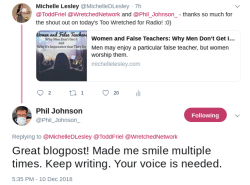
 

And last of all, an early Christmas present for me (thanks to reader and contributor, Laura!). Phil Johnson and Todd Friel discussed part of my article Women and False Teachers: Why Men Don’t Get It, and Why It’s Imperative That They Do on the December 10 episode of the Too Wretched for Radio podcast (around the 15:42 mark). I’ve mentioned that Todd was the first to introduce me to the idea of biblical discernment when I “accidentally stumbled across” the Wretched TV show one night while flipping through the channels. And I listen to Phil often, love his preaching, and have a great deal of respect for him on a number of different levels. So while this brief mention on a podcast that the majority of the world has never heard of wouldn’t mean much to most people, it was a real honor for me.
Biblical Womanhood Bible Study

Imperishable Beauty: Lesson 9- Beautiful Feet (Evangelism)

Previous Lessons: 1, 2, 3, 4, 5, 6, 7, 8

Read These Selected Scriptures

Lesson 8 was all about obeying, and being “doers” of, God’s Word. Today, we’re taking a look at one way of “doing” the Word: having beautiful feet that take the good news of the gospel to a lost and dying world.

Questions to Consider

1. What is evangelism? In your own words, give a brief definition of what evangelism involves and why we evangelize. Briefly review lessons 7-8 (links above). Describe how knowing and loving God’s Word (lesson 7) leads to obeying God’s Word (lesson 8), which leads to sharing the gospel with others.

2. If evangelism is sharing the gospel with others, we want to be certain we’re sharing the complete and true gospel. Briefly review my article: Basic Training: The Gospel and the Scriptures it contains.

3. Study the Matthew 28 passage. This passage of Scripture is often called The Great Commission. Break the passage down into three parts, and exposit each part:

The Preamble (18): Describe Jesus’ authority, motivation, and reasons for giving the instructions and promise that follow.

The Prescription (19-20a): What are the four verbs (action words) in this passage that Christ instructs us to do? Explain how Christians in general, and you personally, can carry out each of these actions.

The Promise (20b): What promise does Christ make to us as we carry out The Great Commission? What are some of the things He does not promise us? Explain why His promise to be with us is the perfect promise – the one we need the most – as we share the gospel with others.

4. Examine Acts 1:8 (and read verses 1-7 for context) and Romans 10:13-15. In your own words, set the scene for Jesus speaking the words in Acts 1:8. How is verse 8 an explanation of the word “go” in Jesus’ instructions to the disciples in The Great Commission? Who will empower them to carry out The Great Commission? Relate this empowerment to the authority Jesus spoke of in Matthew 28:18. How are they to make disciples? Think of a witness in a courtroom. How were the disciples witnesses of Christ? Where are they to “go therefore” to find these people to witness Christ to and make into disciples? How does Romans 10:13-15 also explain the “how to” of The Great Commission? Why are the feet of those who bring the gospel “beautiful”?

5. Look at a 1st century map containing Jerusalem, Judea, and Samaria. Think about what you know (or search a concordance) about the disciples’ relationship to each of these places. Was Jesus just naming random places for them to go preach the gospel? What was the meaning the disciples would have mentally attached to each of these places that told them about the people they would be reaching in each of these places? Explain the expanding geography of the gospel: Jerusalem→Judea→Samaria→ends of the earth.

How can you make application of both of these points (the meaning of each place and the expanding geography of the gospel) to your own life and to your church? How can you take the gospel to:

“Jerusalem”– The people and physical location closest to you: members of your own household, family, closest friends. Your neighborhood, community, town.

“Judea”– People who aren’t quite as close, literally or figuratively: acquaintances, co-workers, extended family, cashiers/bank tellers/service people/your child’s teacher. People who live in farther away areas of your state or country.

“Samaria”– Remember the Jews’ and Samaritans’ attitudes toward each other? Explain how The Great Commission involves going out of your way to take the gospel, not just to the people you like and have much in common with, but to our enemies, or to people who look, talk, and act differently than we do, and are from different backgrounds and cultures.

“The Ends of the Earth”– How can we reach “the ends of the earth”? Have you ever seriously considered working in full-time, vocational missions, either as a field missionary or on staff with a support organization? Give it some thought. But even if God has not called us to vocational missions, we can still “hold the rope” for those who go. What are some ways you and your church can support missionaries, missions organizations, Bible translators, indigenous pastor training programs, etc.?

6. Study the 2 Corinthians passage. What is the message Christ has entrusted to us? What does it mean that we have been given the ministry of reconciliation, that we are ambassadors for Christ, and that God makes His appeal through us?

7. “Put flesh on” The Great Commission by reading the story of Philip (Acts 8) and/or the story of the woman at the well (John 4, especially v. 28-30, 39-42). What catches your eye about the way s/he shared the good news of Jesus? In what way did s/he set a good example for Christians today of sharing the gospel? What was the effect on the person(s) being shared with? How do these two stories demonstrate that God can use our circumstances, skills, and personalities as tools for sharing the gospel?


Homework

Read one of the articles below, choose one of the resources or practical suggestions for sharing the gospel, and implement it this week.

10 Fun, Practically Effortless, and Free Ways to Do Missions and Evangelism

10 Ways to Share the Gospel During the Holidays

Share the Gospel Like a Twelve Year Old

Street Preaching: A Call to Arms


Suggested Memory Verse

And Jesus came and said to them, “All authority in heaven and on earth has been given to me. Go therefore and make disciples of all nations, baptizing them in the name of the Father and of the Son and of the Holy Spirit, teaching them to observe all that I have commanded you. And behold, I am with you always, to the end of the age.”
Matthew 28:18-20

Christmas, Church

The 25 Churches of Christmas

This Christmas season, I’d like to offer you an opportunity to help me give our brothers and sisters in Christ a gift – a gift that won’t cost you a dime.

If you’ve followed me for a minute, you know I’m passionate about helping people find doctrinally sound churches to join. And if you’ve ever perused my list of Reader Recommended Churches, you’ve probably noticed that we have tons of listings for churches in some states, only one or two for others, and hardly any for countries outside the U.S.

What I’m hoping to do is add 25 doctrinally sound churches to the list in the states and countries that are lacking. Of course anyone is welcome to recommend a church anywhere, but in order for it to “count” toward The 25 Churches of Christmas, it needs to be a recommendation for a church:

⛪️ in one of our U.S. states that has two or fewer recommendations (currently: Alaska, Connecticut, Delaware, Massachusetts, New Hampshire, North Dakota, Rhode Island, West Virginia)

OR

⛪️ a church in any country besides the U.S.

I’ve made the list, you check it twice. If recommendations are naught, be nice and make one! :0) If you have a personal connection to a solid church that’s not on the list, comment below with:

🎄The full, correctly spelled name of the church
🎄The city and state, or city and country it’s located in
🎄The church’s website (please, please, please include this – it saves me a lot of time).

Think we can add 25 churches by Christmas Day? Let’s give it a shot and make it a merry Christmas for our brothers and sisters who are searching for a new church! Thanks for your help! :0)