1. Genesis 18:16 begins with the phrase, “Then the men set out from there“. When you begin to study a passage of Scripture that starts with a transitional phrase like this, it’s important to find out about the back story you’re dealing with. Briefly review lesson 13 (link above) or Genesis 18:1-15. “Then” means what you’re about to read is the next thing that happened in a succession of events. What event happened first? Who are these “men” verse 16 speaks of, and where is the “there” they set out from? What have we previously learned about Sodom?
2. Examine 18:17-19. Why did God decide to reveal to Abraham what He was about to do to Sodom and Gomorrah? Look closely at Abraham’s negotiation with the Lord in 18:22-33. What might have been a secondary reason God revealed His plans for Sodom to Abraham? What was God trying to reveal about Himself to Abraham or teach Abraham through this interaction?
3. Compare Abraham’s persistence in 18:22-33 to the parable of the persistent widow. What do both of these passages teach us about persisting in prayer? About God’s attitude toward His children who “pester” Him? Does what we’re persisting in prayer about, or why we’re persisting about it matter (ex: kingdom-mindedly praying for someone’s salvation vs. greedily praying for an exorbitant car)?
4. Read this article¹ about the customs of ancient Middle Eastern hospitality between travelers and hosts. It would have been shameful for Lot to have allowed the men to stay in the square for the night and not to have hosted them lavishly. How does this knowledge of Lot’s culture help you better understand the things he said and the ways he acted in 19:1-10?
5. Even understanding the intense nature of his culture’s hospitality, was Lot’s offer of his daughters in 19:6-8 right? Compare Lot’s behavior in this passage with what you know the Bible says about parenting. Was Lot putting being a godly father first or man’s opinion of him (regarding his hospitality) first? What does the Bible say about holding to cultural rules or laws above holding to God’s law? How do you think Lot’s behavior impacted his daughters’ trust in him, their belief that he would protect them, and their respect for him?
6. Put yourself in Lot’s wife’s shoes and examine his behavior in 19:1-10 in light of these Scriptures. Do Lot’s actions lead you to trust his judgment? To feel secure and protected? To respect him?
7. Examine 19:12-14, and consider a) the evil the men of the city have already committed, and b) the fact that God is about to destroy the city for its wickedness. What kind of men had Lot chosen as husbands for his daughters? What perspective on these men might Lot’s daughters have had?
8. Lot was told to take his wife and daughters to safety (15), “but he lingered,” (16) most likely for the same reason his wife looked back at Sodom (26). Notice verse 26 says she was behind Lot. She was following him literally in that moment, but she was also following him as the leader of her family. He lingered. She looked back. Why? What impact had living in Sodom had on their spiritual lives?
9. How is God showing mercy to Lot’s family and saving them, Himself, from His wrath against sin, a picture of the gospel? What do we learn about God’s judgment and wrath toward sin from this story?
10. Read 19:30-38. Has God said anything thus far in Genesis that would have led Lot’s daughters to believe that dying childless would have been the end of the world? Recall how important it was to a woman’s standing in her culture at that time to bear children. In what ways did Lot’s daughters follow in his footsteps by bowing to culture above bowing to God? How did the immorality of the culture they were raised in influence their actions?
11. What do you know from Scripture about the Moabites and the Ammonites? Consider the far-reaching impact of the sin of Lot’s daughters.
¹This link is an endorsement of this particular article only. I do not endorse this site in any way in which it deviates from my beliefs as outlined in the Statement of Faith and Welcome tabs at the top of this page.
Homework
In today’s study we saw examples of both Lot and his daughters conforming to culture rather than conforming to godliness. The Bible tells us we are not to be conformed to this world, and that friendship with the world is enmity toward God. Have you ever put cultural expectations, political correctness, popularity, or being on the cutting edge ahead of being obedient to Christ? Have you repented of that sin? Write a paragraph or two about how you could have handled the situation in a godly way, staying true to Christ and His commands.
Suggested Memory Verse
Far be it from you to do such a thing, to put the righteous to death with the wicked, so that the righteous fare as the wicked! Far be that from you! Shall not the Judge of all the earth do what is just? Genesis 18:25
My name is Addie and I was born in 1956 into a 100% Catholic community to Cajun French speaking parents in a very small secluded town located on the banks of the Bayou Teche. Not unlike most children, in my younger years, my whole world encompassed what I was familiar with, the Cajun French culture and Catholicism.
In retrospect, my first memories are of a highly volatile dysfunctional family unit of physical and verbal abuse with vague intermittent blurbs of minimal peace and happiness. I do not reveal this personal part of my life to disparage my parents, who simply did the best they could with what they knew, but rather to establish the reason for the inquisitive search I had for the God, which I always acknowledged existed even from my earliest recollections.
As the 3rd daughter of 4 children, I was the naturally more religious of all the siblings and enthusiastically participated in all the religious rituals of the denomination of my German and French ancestors. The local Catholic Church and cemetery, located directly across the road from our residence, became a constant refuge from the upheavals that were a weekly occurrence within our home. Although, it was by my early teens that I began questioning “the what’s and the whys” of the religion of my birth while slowly becoming aware that though I faithfully practiced all the required rituals, I had yet to come to know the true personal God I knew was my Creator, and who had sent His Only Son to die for me, a sinner!
For the next 4 to 5 years my spiritual questions multiplied while very few answers were forthcoming, and, eventually, much to my mother’s disapproval, resulted in my decision to discontinue participating in all the rituals of Catholicism. I did continue to attend Mass periodically to appease my mother but had lost my desire to know God and Jesus Christ, His Son through what I had come to realize was a vicious cycle of man made rituals and religion with no finality. Is this who God is and can no true truth be found? Believing the answers to be unknowable, I then gave up on my search for the One True God of my childhood and turned to the world for answers.
By the time I was 24, I was divorced and steeped in many of the superficial self destructive beliefs the world had to offer. I had, sadly, become a very selfish, enraged, self destructive, pro-abortion women’s-libber with many talents but no sense and even less direction. Going through life riding on monstrous waves of emotional highs and lows living on the very edge of self destruction, my life was literally out of control and all of my own making. It was at this deepest, darkest period in my life, I met my “love at first hearing”, singer/songwriter husband, Prentiss of, at present, 32 years, and providentially, I met his mother, a born again Christian, who as the Lord would have it, was a former Catholic! During the following 4 years of living through a severe accident nearly taking Prentiss’s life and the continuing highs and lows of my personal emotional turmoil, Prentiss’s mom took me into her home, and loved me when I was the most unlovable, as she patiently answered all my questions by opening…THE BIBLE!
In the Lord’s time, my coming in brokenness, with “the” true biblical understanding of salvation by grace alone, through faith alone, in Christ alone, I was born again in 1985, at the age of 28. I followed immediately in believer’s baptism and married, Prentiss, the perfect man “for me!” I can not express in words the joy that filled my heart, as it remains so to this very day.
I have since followed my husband to Nashville, and back home again, all the while consciously placing myself under biblical teachers and preachers. As my hunger grew to know more of the contextual understanding of God’s Word, I also set out to learn more about the Catholicism of my Cajun culture including finding the answers to my many long held questions. As I dove head long into research, availing myself to several foundational seminary courses and reading related books on Catholicism, Catholic Mystics, as well as, other diverse forms of religion, I also found myself investigating other various beliefs and movements, especially those with questionable and controversial teachings “claiming” to be Christian.
It was at the onset of the 1990s when I developed concerns about some pseudo-Christian beliefs and teachings, of which I had uncovered in my years of research, coming into once solid biblical churches, one of them being my very own little Baptist church. It was then I became aware of a purpose driven, emergent, postmodern, mystical infiltration which simply caused me to investigate that much deeper and wider covering more than 25 years of study.
Once again, in the Lord’s time and in His providence, this unquenchable drive has given birth to Discerning the Drift Teaching Ministry. God has, also, graciously brought fellow believers of like mind into my life, who are of great emotional and spiritual support. In this continuing life of sanctification, I finally have all my “necessary” questions answered and am looking forward to what the Lord has in store for my pilgrimage here and in eternity future.
All because of the Jesus Christ of Scripture, Addie
Ladies, God is still at work in the hearts and lives of His people, including yours! Would you like to share a testimony of how God saved you, how He has blessed you, convicted you, taught you something from His word, brought you out from under false doctrine, placed you in a good church or done something otherwise awesome in your life? Private/direct message me on social media, e-mail me (MichelleLesley1@yahoo.com), or comment below. Try to be brief (3-4 paragraphs or less) if possible. I’ll select a few to share on the blog another time. Let’s encourage one another with God’s work in our lives!
Welcome to another “potpourri” edition of The Mailbag, where I give short(er) answers to several questions rather than a long answer to one question. I also like to take the opportunity in these potpourrri editions to let new readers know about my comments/e-mail/messages policy. I’m not able to respond individually to most e-mails and messages, so here are some helpful hints for getting your questions answered more quickly. Remember, the search bar can be a helpful tool!
In the Apostles Creed, there is a section that states Christ descended into hell and was resurrected. Isn’t that what Joyce Meyer teaches? What about the part about the “holy catholic church: the communion of the saints”? Is that talking about Catholicism and the mass?
These are very common questions (I threw in the second part about Catholicism and the mass, since that’s also commonly asked.), and it’s good to ask, because if you’re confused, other people probably are, too.
I believe in God, the Father Almighty,
the Creator of heaven and earth,
and in Jesus Christ, His only Son, our Lord:
Who was conceived of the Holy Spirit,
born of the Virgin Mary,
suffered under Pontius Pilate,
was crucified, died, and was buried.
He descended into hell.
The third day He arose again from the dead.
He ascended into heaven
and sits at the right hand of God the Father Almighty,
whence He shall come to judge the living and the dead.
I believe in the Holy Spirit, the holy catholic church,
the communion of saints,
the forgiveness of sins,
the resurrection of the body,
and life everlasting.
Amen.
It’s a beautiful, basic reiteration of the gospel which many churches and ministries use as part of their official statement of faith. Some churches even recite the Apostles’ Creed during their worship services.
The earliest written record of the creed is from AD 390, in Greek, so you can imagine that some of the terminology used had different connotations back then than those terms have in 21st century America.
Providentially, my friend, Pastor Gabe Hughes, was also recently asked this same question and addressed it both on his podcast and in a WWUTT video, so I’m going to let him do the “heavy lifting” of Scripture and history in the resources below and just give you the short and sweet version:
📜 You’re quite right in saying that Joyce Meyer teaches that Jesus went to hell between His death on the cross and His resurrection. The Bible doesn’t say this anywhere, and this is a heretical teaching. Just one of the multiple reasons no Christian should follow Joyce Meyer.
📜 The word “hell” in the Apostles’ creed is based on a mistranslation or confusing translation. The literal meaning of the phrase is that he descended into the grave or was buried.
📜 You might have noticed that the word “catholic” in the creed starts with a lowercase “c” rather than a capital “C”. The noun “catholic” with a lowercase “c” simply means the universal church – all genuinely regenerated Believers across the globe, past, present, and future. Roman Catholicism is (or at least by rules of grammar is supposed to be) denoted by a capital “C”.
📜 “Communion” in the creed does not refer to the Roman Catholic mass or even to the Protestant Lord’s Supper. A clearer word to us today would be “fellowship” or “unity”. The sense is that Believers commune with on another.
Some churches have modernized and clarified the creed by replacing these phrases with “He descended into the grave” or “He descended to the dead” and “the holy Christian church.”
I was wondering if you could post your articles in a larger font. I have an old computer that messes up when I try to make the font bigger. My old eyes are a real struggle.
At first, I thought I was the only one having this problem, but I’ve gotten this question a couple of times, so I know it’s not just my own aging eyes :0)
I’m going to play around with the font a little bit and see if I can find one that’s bigger. Just a few things to understand as I’m working on it: WordPress gives me a limited number of fonts to choose from, and the sizes of those fonts are pre-set. In other words, I can’t set it to 12 point or 18 point, I can only choose from tiny, small, normal, large, and huge. (Right now it’s set on “normal” if you can believe that. “Tiny” is virtually invisible.)
Additionally, when I change the font size, it doesn’t just change the size of the font in the body of my articles, it also changes the size of things like the tags (to the immediate upper left of every article), the sidebar (far left of the page), and the tab titles (top of the page), which, as you can see, are already much larger than the font in the article body. When the font of those texts gets larger, it throws the layout of the whole page out of whack. You might not notice it on a desktop computer with a large monitor, but it can be problematic for people who are viewing the blog on a phone or tablet.
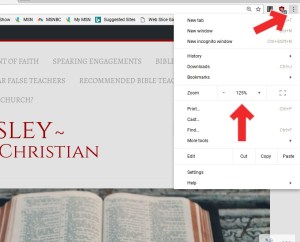
Like I said, I’ll play around with it and see what I can do, but if I’m not able to enlarge the font, there are two workarounds that may help:
1. The reader said she’s unable to change her screen magnification, but it works for me and might work for others. Here’s what it looks like on my computer. Maybe yours is similar:
2. If worse comes to worst, you can highlight and copy the body of the article, paste it into your word processing program, and enlarge the font accordingly.
I have been leading a women’s small group at our church for a couple of years now. My husband and I have decided to leave the church because, even after confronting leadership about the direction the church is being led doctrinally, they continue to espouse unsound doctrine. What do you think is a wise way to tell the ladies I will no longer be teaching? Do I tell them we are leaving? If so, do I tell them why? What do you think you would do?
It’s hard to say exactly what I would do because every situation and every church is different. But I can tell you that the first thing I would do is talk it through with my husband and ask his advice. There have been many times when he has had very good ideas about how to address (or not address) certain issues, and he will sometimes bring out an aspect of the situation that I hadn’t thought of before. I would encourage you to do that first, and also to make sure you’re submitting to your husband in whatever ways might be applicable in this situation.
My inclination is to advise you to take the “the less said, the better” route with regard to the whole class. (There may be other venues, such as you and your husband meeting with the elder board, in which you’ll need to clearly spell out all the problems, but let’s just focus on the class right now.)
I would probably wait until the end of the very last class and say something generic, like, “I’ve really enjoyed leading this class, but I wanted to let you know I won’t be teaching any more. I encourage you to continue studying God’s Word and growing in Christ. Class dismissed.” Then, go home fairly quickly.
The next level is going to be women coming up to you individually and asking why you won’t be teaching any more. Unless she’s a very close friend, I’d still keep it pretty generic: “We love our brothers and sisters at this church, but we’re finding we disagree with some of the doctrine that’s being taught here, and we’ll be going to a new church.”
For very close friends, you might wish to disclose more about the doctrinal problems, but do so wisely, making sure your focus is on doctrine, not on personal conflicts with the pastor or others. You don’t want people jumping to the wrong conclusion about why you’re leaving.
I really would not talk to people about leaving other than discreetly informing those who need to know. If you give details or talk about it a lot there could be an ugly blow up, and most people will make wrong assumptions about why you’re leaving.
Do you have any information on the Orange Curriculum for children’s Sunday School?
The main thing I know about the Orange Curriculum (or Orange Strategy) is that it is put out by Andy Stanley’s “church”. That’s enough for me to warn people to stay far, far away from it. Andy Stanley is a Scripture-twisting false teacher. You don’t want your children being taught by him or his disciples.
My friend Amy Spreeman over at Berean Research was asked the same question by a reader. I refer you to her article, Parents: If your church is “Turning Orange…” for more details.
How would you respond to someone’s who says that [1 Timothy 2:12] was meant only for that time and culture?
It’s one of the most common arguments made by people who are looking for an acceptable way to rebel against God’s clear command, “I do not permit a woman to teach or to exercise authority over a man; rather, she is to remain quiet.” I have never had a woman who was humbly seeking to deny herself and obey Scripture make this argument, only those who stubbornly want to have their own way despite what the Bible says, yet simultaneously want to cloak themselves in the appearance of obeying Scripture.
God gave us His exact reasons for this command in verses 13 and 14 (almost as if He somehow knew this argument was coming!), and those reasons weren’t restricted to the women in the first century Ephesian church. The first reason was the Creative order – Adam was formed first, then Eve. The second reason is that Eve was deceived. Both of those reasons are universal (applying to all women and churches everywhere regardless of era or culture). It makes no sense that these two reasons related to Eve would apply only to first century Ephesus any more than it would make sense for them to apply only to tenth century Damascus or seventeenth century Paris.
Next, examine the context of 1 Timothy 2. There are all sorts of instructions to the church in that chapter. Was the instruction to pray for governmental leaders (1-2) limited to the first century Ephesian church? Were only the men of the first century Ephesian church to pray without quarreling (8)? Was modesty (9-10) only required of women in the first century Ephesian church? Then why pick out this one instruction in verse 12 and claim it was limited to that time and culture?
Finally, look at the overall general pattern of male headship and leadership in Scripture. First human created? A man. The Patriarchs? As the word implies – all men. Priests, Levites, Scribes? Men. Heads of the twelve tribes of Israel? Men. Major and minor prophets? Men. All kings of Israel and Judah? Men. Noahic, Abrahamic, Mosaic, and Davidic Covenants? All established between God and men. Authors of Scripture? Men. The forerunner of Christ? John the Baptist – a man. Messiah? A man. All of the apostles? Men. All of the pastors, elders, and deacons of churches in the New Testament? Men. Founder and head of the church? Christ – a man. Leader and head of the family? Men. Now which fits better with this pattern, women preaching to, teaching, and exercising authority over men in the church, or women not preaching to, teaching, and exercising authority over men in the church?
But the truth is, you can have all the biblical evidence in the world, and it’s not going to convince someone who’s in rebellion against Scripture because self is reigning on the throne of her heart. She’s not concerned with actually obeying God’s Word, she just wants to be able to claim that Scripture supports what she wants to do, either to look good to others or to attempt to drown out the Holy Spirit’s conviction of her sin.
If you have a question about: a Bible passage, an aspect of theology, a current issue in Christianity, or how to biblically handle a family, life, or church situation, comment below (I’ll hold all questions in queue {unpublished} for a future edition of The Mailbag) or send me an e-mail or private message. If your question is chosen for publication, your anonymity will be protected.
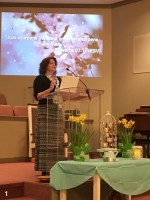
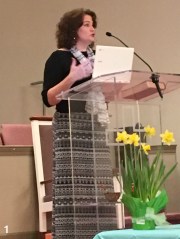
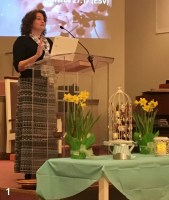
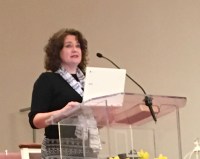
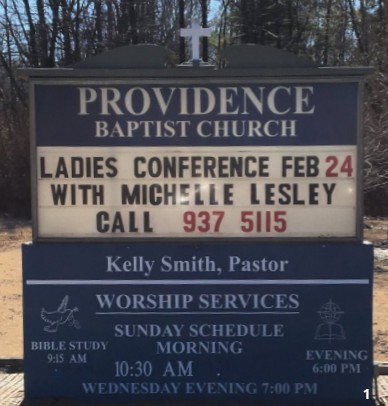
A couple of weekends ago I had the blessing of speaking at Providence Baptist Church’s spring women’s conference. It was such an encouraging experience I wanted to share a little about it with you.
Pastor Kelly & Gayle Smith, Scott & Michelle Lesley
What a joy it was to finally meet my Twitter friend Gayle, who heads up the women’s ministry at Providence, and her husband, Pastor Kelly. PBC generously and graciously hosted not only me, but also my husband and two of our sons, for the weekend. After we arrived in Memphis Friday afternoon and got settled in to our lovely hotel rooms – hospitably stocked by Gayle with every snack two teenage boys (and their parents!) could dream of, as well as some charming locally made gifts – Gayle and Kelly took us out for – what else? – barbecue!
Corky’s BBQ not only had this amazing sweet and spicy barbecue sauce, they had a phenomenal Memphis specialty, the Sweet Tea Fried Chicken Sandwich. They marinate the chicken filet in sweet tea overnight before frying it. There are not words, y’all. You’ll just have to find a Corky’s and order this delicacy for yourself.
On Saturday, the gents set off to see the sights of Memphis, including the iconic Memphis Pyramid, which now houses a spacious Bass Pro Shop (yeah, you might have to be Southern to grasp the attraction)…
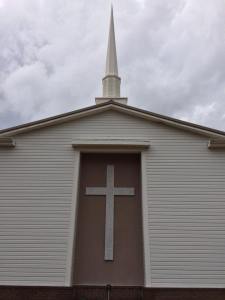
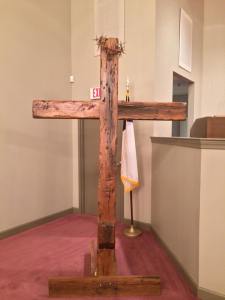
…while I was treated to the sights of a beautifully bedecked PBC, all set to welcome the ladies coming to the conference.
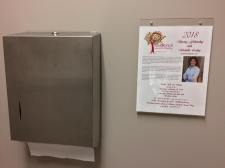
(Trust me, if you want to be sure the women of your church see something,
put a flier in the ladies room!)
One of the primary issues Christian women need instruction on today is the centrality of the Bible in our lives and our churches, so that was the core message of the two sessions I taught. In the morning session, The Necessity of the Bible, we focused on the fact that Scripture is the very words from the lips of God Himself, our desperate need for the Bible, and practical ways to import more of God’s Word into our daily lives.
After a delicious luncheon and warm fellowship, we gathered again for Recapturing Sola Scriptura: The Sufficiency and Authority of Scripture. In this session, we zeroed in on the folly of extrabiblical revelation, the supremacy of God’s Word, and the need for our lives and our churches to be ruled by rightly handled Scripture.
You can read some of what I spoke about in my Basic Training series articles:
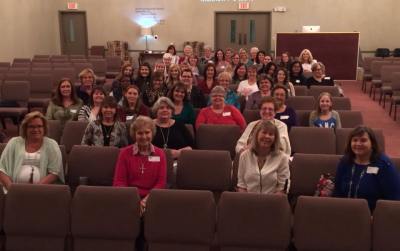
I couldn’t have asked for a kinder reception
or a sweeter group of ladies!
There was just enough time for a brief rest, and then it was off to another Memphis favorite, Gus’ World Famous Fried Chicken, for supper. These folks know how to do chicken spicy, just like I like it!
Sunday morning was a warm time of worship and fellowship with the saints at PBC under the excellent preaching of Pastor Kelly. What a kind and welcoming church body this is! If you’re looking for a friendly, doctrinally sound church in the Memphis area, I couldn’t recommend one more highly than Providence Baptist of Bartlett.
If your church is ever in need of a speaker for a women’s event, I’d love to come share with your ladies as well. Click here for more information.
Photo Credits:
1- Photos courtesy of Gayle Smith, Providence Baptist Church
2- Photo courtesy of Corky’s Memphis (Facebook)
(All other photos by Michelle Lesley)
1. Briefly review lessons 11 and 12 (links above).
2. Read Genesis 16:16 and 17:1. How many years passed between the birth of Ishmael and the appearance of the Lord in 17:1?
3. Compare 17:1-8 with Genesis 15:1-6. Write out the stipulations of the Abrahamic Covenant. Think further ahead into Old Testament history (Exodus-ish). What is God laying the foundation for here with Abraham? How does Abraham serving as the “cornerstone” as it were, of the nation of Israel point ahead to Christ as the cornerstone of Christianity?
4. What was the sign that a person was under the Abrahamic Covenant? (17:9-14) What were the “policies and procedures” regarding circumcision in this passage? Are Christian men today required by Scripture to be circumcised? What is the New Testament sign that a person is in Christ and under the new covenant of grace?
5. Why do you think both the covenant and the sign of the covenant were male-centric? Why didn’t God make the covenant with Abraham and Sarah? Why circumcision, which was specifically male-only, instead of something like ear-piercing which could have also been performed on females?
6. Why did God change Abram’s name to Abraham (17:5), and Sarai’s name to Sarah (17:15)? What did their former and new names mean? Why didn’t God change Hagar’s name?
7. Compare and contrast Abraham’s reaction to the news of Sarah’s impending pregnancy (17:15-18) to Sarah’s reaction to this news (18:10-12). How were their reactions similar? How were they different? How did God respond to Abraham’s reaction? (17:19-21) To Sarah’s? (18:13-15) From God’s individualized responses to each of them, what can you infer about the differences between Abraham’s and Sarah’s thoughts and concerns about the upcoming pregnancy? Why do you think God picked the name Isaac for their son? (see footnote on 17:9, Genesis 21:5-7)
8. Examine more closely Sarah’s response to the news of her impending pregnancy in 18:11-15. Recall or review (lesson 11) Sarah’s failure to trust God. How does her initial reaction here again demonstrate that she did not believe God’s word, or trust God’s character to keep His promise?
9. Verse 18:12 begins with the word “So”, indicating that the reason Sarah reacted the way she did was because of the information in verse 11. What circumstances (11) were Sarah’s reaction (12) based on? Did she have more faith in the her circumstances and her own personal experience, or in God and His Word? In that moment, was her faith rightly or wrongly placed? Examine Hebrews 11:11. Even though Sarah initially failed to trust God and wrongly placed greater faith in her circumstances and experiences, did her heart, her faith, and her trust remain that way?
10. Carefully examine 18:1-10. What can we learn about the customs of Middle Eastern hospitality at that time? What were some of Sarah’s duties and appropriate behaviors in welcoming guests according to her culture?
11. Review the verses in this passage that specifically talk about Sarah. What else can we learn about her character or her faith that set a good, or bad, example for us as Christian women today?
Homework
“Is anything too hard for the Lord?” Even though Sarah’s initial reaction to God and His Word was one of unbelief and distrust, God brought her along and grew her into someone who was commended for her faith in Hebrews 11 (often called the “roll call of the faithful” or “the Hall of Faith”). Think back over your walk with the Lord. Can you think of a Scripture you once rejected in disbelief or rebellion that you now embrace and obey? A life situation in which God grew your faith in Him? What circumstances, Scriptures, or people did God use to bring you along from unbelief to belief, disobedience to obedience, distrust to trust? Spend some time in prayer thanking God for growing you through that situation.
Suggested Memory Verse
Is anything too hard for the Lord? At the appointed time I will return to you, about this time next year, and Sarah shall have a son. Genesis 18:14










 Pastor Kelly & Gayle Smith, Scott & Michelle Lesley