Women of Genesis Bible Study

The Women of Genesis: Lesson 9- Sarah

Previous Lessons: 1, 2, 3, 4, 5, 6, 7, 8

๐Ÿ“–๐Ÿ“–๐Ÿ“–๐Ÿ“–๐Ÿ“–

Read Genesis 11:27-12:20

๐Ÿ“–๐Ÿ“–๐Ÿ“–๐Ÿ“–๐Ÿ“–


Questions to Consider

1. What facts can we glean about Sarah from this passage? What was her original name? (11:29) Who were her family members? (11:27-29, 31) Where was she originally from, and where did she move to? (11:28,31) What was her physical condition (11:30) and why is this “backstory” being given to us? (12:7) What was Sarah’s physical appearance like? (12:11,14)

Click for larger view

2. We can learn more about Sarah from other passages of Scripture. What does the name Saraiย (see footnote) mean? What was Sarah’s familial relationship to Abraham? How old did Sarah live to be? How does Paul use Sarah as an allegorical example in Galatians? How does Hebrews describe Sarah’s faith? How does Peter hold Sarah up as a godly example to Christian women? Overall, how does the Holy Spirit frame and describe Sarah’s character in the New Testament? Does this mean her thoughts and behavior were always flawless?

3. Consider that Sarah, though sinful and imperfect in many ways, is spoken of by the Holy Spirit in the New Testament as a woman of faith and godly character, and an example to be looked up to by Christian women. Does this bring you comfort and reassurance as a sinful and imperfect, yet faithful, follower of Christ? What are some ways you can set a godly example for other Christian women even though you sometimes stumble into sin? How will God speak of your faith and character at the end of your life?

4. While the events in Genesis 11-12 are told from Abraham’s perspective, Sarah, his wife was right there with him, experiencing those same events. Consider the following parts of the story from Sarah’s perspective:

Barrenness (11:30):ย In a patriarchal society in which women established status largely by bearing sons, what might Sarah have thought about being barren?

Traveling and relocating (12:1-9): Examine the map above. Strange lands she’d never been to before. Strange and possibly hostile people. How far would Sarah and her family have had to travel? What might have been some of Sarah’s concerns for her family?

God’s promises and instructions (12:1-3,7): What questions might Sarah have had about her role in God’s promises to Abraham, how her barrenness would affect God’s promise for offspring, and how it would all play out once God’s promises were fulfilled?

Trusting, obeying, and worshiping God (12:1-9): In instructing Abraham, God was also instructing Sarah, as his wife, to obey and follow Him. What were some ways Sarah would have had to obey God? How could she have served as a helper to her husband? How would she have needed to trust God? How would trusting and obeying God have led to worship for Sarah, right alongside her husband? (7,8) How might Sarah’s relationship with God have grown through this experience?

5. Examine 12:10-20. Summarize the story in your own words. What did Abraham ask Sarah to tell the Egyptians in verse 13? Why? Was this true? What can we learn from this story about honesty, deception, and half truths? How did Abraham’s deception put Sarah in danger? In what way did Abraham put his own needs ahead of Sarah’s well-being? How might Abraham’s actions have damaged his relationship with his wife?

6. Compare Abraham’s trust in God in 12:1-9 with his lack of trust in God in 12:10-20.

7. In what ways did Sarah have to trust God and trust her husband in 12:1-9? In what ways did she have to trust God and trust her husband in 12:10-20? Was Abraham acting in a trustworthy way in both of these instances? Why or why not?

8. Have you ever had to trust God through a situation in which your husband, parent, or someone else you depended on, wasn’t acting trustworthy? What did this teach you about God and His trustworthiness and dependability?

9. True or false: “In some ways and at some times Sarah may have had to trust God even more than Abraham did.”? Why?


Homework

How can trusting God through a difficult time lead you to worship Him? Describe a trial you’ve been through and how you trusted God in the midst of it. Take some time to worship God for the specific ways He carried you through that trial: how He provided for you, comforted you, strengthened you, and encouraged you.


Suggested Memory Verse

Then the Lord appeared to Abram and said, โ€œTo your offspring I will give this land.โ€ So he built there an altar to the Lord, who had appeared to him.
Genesis 12:7

Biblical Resources

Christian Freebies

Here are some great freebies I’ve come across and wanted to share with you…

First Love Publicationsย is a resource I discovered at the G3 Conference. They provide free evangelistic, devotional, doctrinal, and discernment books, tracts and other literature to ministries and individuals in the United States and abroad. You can order up to five free books and 100 free tracts per month. I am not familiar with all the authors in their catalog, but I can certainly recommend A.W. Pink, J.C. Ryle, Warren B. Smith, J. Hudson Taylor, and E.M. Bounds. As always, read discerningly and compare everything with Scripture.

Freegalย is a music download and streaming app (you can also access it on the web from a computer) which allows you to download up to seven free songs per week. It is offered through local libraries, so your local library must be connected to Freegalย and you must have a valid library card. Other than that, it is completely free and legal (thus the name). Freegal isn’t a Christian app, but it does contain tons of Christian music of various genres, including accompaniment tracks.

Amazon has lots of free Christian MP3 downloads including music and audio Bible excerpts in a variety of languages. They also have thousands of free Christian e-books – fiction, non-fiction, and even whole Bibles – for download. Now bear in mind that any musician or author can call herself and her work “Christian” and the good – yet lost – folks at Amazon don’t know any different. My advice is to have your discernment radar on high, or to simply stick with musicians and authors you already know are doctrinally trustworthy.

Ligonier offers a number of free, online courses in their Teaching Series library. Not for college or seminary credit, just for deepening your knowledge of theology and the Bible, courses include titles like: The Atonement of Jesus, Understanding the Gospel, Pleasing God, Galatians, and many others.

Mailbag

The Mailbag: Should I correct my boss’s errant theology?

ย I work in a Christian child care facility where the leadership is neck deep in false doctrine. Nearly a year ago, I stepped out of the classroom and into a management position so now I feel Iโ€™m more on the front lines. Most of the people believing all the false teaching (Bethel, Hillsong, Todd White, Sarah Young, etc.) are gone but the big boss is still in it. Iโ€™ve been bold to speak out against it to some of the young women who work there, but when it comes to my boss, Iโ€™m a lot less bold. So I guess my question is, am I wrong for not standing up to her and pointing out her error? Iโ€™m afraid Iโ€™ll get fired. What are your thoughts on this? Should I be bold and point out error? Should I even be working there?

Sounds like a sticky and uncomfortable spot to be in. Maybe we can sort things out a little.

Let’s start by remembering whose authority you’re under. First, you’re under God’s authority, so you need to make sure your highest priority is obeying Scripture regardless of the circumstances. If you’re married, your next authority is your husband. Make sure the two of you talk it through thoroughly and that you submit to any decisions he makes. You (and maybe your husband too) might want to bounce this situation off your pastor or elders and see what their counsel is. There’s wisdom in an abundance of counselors. Finally, at work, you are under your boss’s authority. She is not a friend or a co-worker, she is your boss. The two of you are not equals, you’re subordinate to her in the workplace. “Boldly” telling her she’s wrong about something (especially if it’s in regard to something that’s not work related) is not in keeping with God’s instruction to you to submit to her authority.

I’m not really clear on whether the false doctrine is a personal belief held by your boss that has no effect on the workplace, or whether the false doctrine is workplace policy. In other words, the false doctrine is part of the classroom curriculum you have to teach, or employees are required to take part in Word of Faith type devotions and contemplative prayer every morning, or in your role as administrator you have to do business with heretical “churches,” etc. So let’s take a look at it from both angles.

If the false doctrine is not affecting your work environment and is only a personal belief held by your boss, it is not necessary, and may not be wise, to proactively push the issue any more than you would be pushy about sharing the gospel with your boss if she were a garden variety lost person. It’s something that needs to be handled carefully and with wisdom about timing, how deep to go, etc. A good rule of thumb might be to address the issue only if she brings it up and asks for your opinion.

If it’s a situation where she’s constantly pushing the false doctrine on you and assuming you’re amenable to it, one way to handle it might be to say something like, “I’m kind of uncomfortable talking about this right now. Could I take you out to lunch and explain why?” At lunch, you’ll need to briefly, carefully, and biblically explain where you stand from the perspective of, “These are my personal beliefs,” helping her to grasp that when she pushes her personal beliefs (i.e. false doctrine) on you, you feel pressured and uncomfortable because you want to please her as your boss (the Bible teaches us that we’re to submit to those in authority over us and work hard for our employers), but you also don’t want to compromise your beliefs (“We must obey God rather than men.”) Hopefully she will get the message that she’s creating a hostile work environment and will tone it down. If she doesn’t, you’ll need to consider whether or not you want to keep working there.

If the false doctrine is part of workplace policy, you’ll need to figure out how pervasive it is and whether or not it’s something that can be worked around in accord with biblical principles and your conscience. If the false doctrine pretty much permeates your job (for example, if you were a teacher and it was interwoven into the curriculum you had to teach), it’s probably time to start looking for another job, and to make an appointment with you boss and politely explain why you’ll no longer be working there.

If it’s only a small part of your (otherwise doctrinally sound) job – for example, the aforementioned morning devotions – see if there’s a workaround. Employees are given all kinds of exemptions and accommodations these days, even for religious reasons. Perhaps you could be excused from the devotions or a co-worker could handle business with the heretical “churches” while you take on another task. “If possible, so far as it depends on you, live peaceably with all,” Romans 12:18 says. Be as cooperative and flexible as you can.

If you decide to stay at your job, the best way you can have an impact on your boss is by being a godly example. Pray fervently that God would open her eyes to the false doctrine she’s believing. Ask God to give you opportunities to slip in a doctrinally sound “word fitly spoken” in conversation from time to time. Be an “above and beyond” employee with a great attitude. Show kindness to your boss and co-workers, asking how you can pray for them, inquiring after their families, health, etc. Give doctrinally sound books as office Christmas gifts. Invite your boss and co-workers to an occasional event at your church. Suggest a doctrinally sound podcast you love if the topic comes up. There are lots of ways you can have a biblical influence on you boss. It doesn’t necessarily have to be “confront or quit.”


If you have a question about: a Bible passage, an aspect of theology, a current issue in Christianity, or how to biblically handle a family, life, or church situation, comment below (Iโ€™ll hold all questions in queue {unpublished} for a future edition of The Mailbag) or send me an e-mail or private message. If your question is chosen for publication, your anonymity will be protected.

Doctrinally Sound Teachers, Special Events

Report Back: Reflections on G3 Conference 2018


A week ago today, I was drinking from the fire hose of good teaching and good fellowship at the 2018 G3 Conference: Knowing God – A Biblical Understanding of Discipleship.ย I not only had the blessing of being able to hear many of my heroes in the faith speak for the first time in person, but I also had the joy of meeting numerous social media friends – finally! – face to face.

Some of the wonderful brothers and sisters I got to hear from:
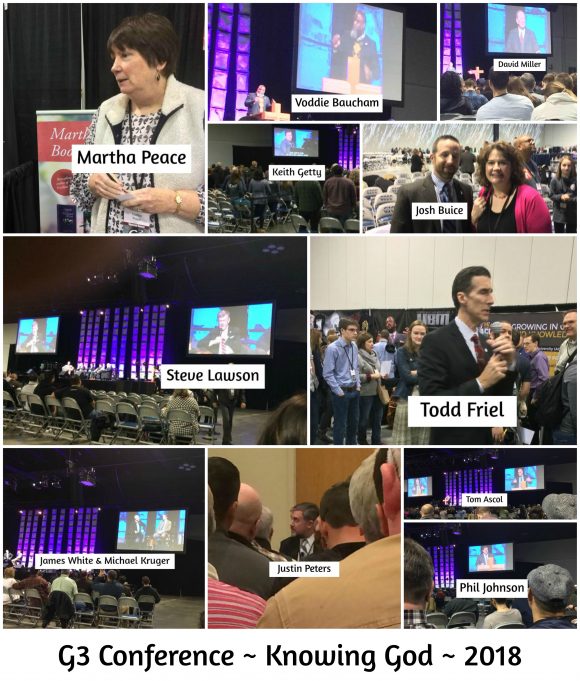
I remarked to a friend that it felt strange to me when readers approached me during the conference to thank me for being a good resource for them. “I’m not really a resource,” I said, “I point people toย others who are good resources.” So, in keeping with pointing you to good resources, I’d like to share a little about some of the pastors and teachers I sat under last weekend – not so much aboutย whatย they taught, but more about how God uniquely crafted and fit each of them into the Body to minister to their local churches, and the church at large, in their own special way. I highly recommend each of them to you.

Josh Buice

A superb example to other pastors, Josh has the heart of a shepherd and a servant. He is genuine and humble, and his greatest concern is that His people know and serve God through their local church. I’ve previously recommended Josh hereย and have had the pleasure of linking to many of his materials.


Tim Challies

Tim is someone who has figured out his ministry context and is flourishing in it. He not only serves his church well, but is intent on learningย from his church in order to serve it better. Tim’s is one of the handful of blogs I follow regularly.


David Miller

Kindness and grace personified,ย David has a way about him of speaking hard truths in gentleness. Due to degenerative muscular atrophy, David uses a wheelchair and had to memorize his entire sermon including the lengthy Scripture passages he cited, which was very encouraging to me for my own Scripture memory. David reminded me of older, small church pastors I have known who are so good at loving and caring for their sheep.


Justin Peters

If you’ve ever wondered what biblical meekness looks like, you need to get to know Justin Peters. Calm, kind, graceful, knowledgeable, and with a quick wit, Justin cares deeply about sound doctrine and calling out false teachersย because he has a heart for people to be saved and know the truth of the gospel. Justin taught two breakout sessions on the New Apostolic Reformation, and I am overjoyed to report to you that there was standing room only (and there wereย many standing) for both sessions. What a joy to see Christians getting informed so they can protect themselves and their churches! I have recommended Justin hereย and have linked to several of his resources.

Justin’s a Louisiana expat in the Northwest, so I brought him
some essentials from home: king cake and crawfish :0)


Voddie Baucham

Voddie isย intense. He is passionate about preaching and the Scriptures to such an extent you begin to sense that, if he could, he’d grab you by the shoulders and physically stuff you with Scripture and a proper understanding of it. He wants the church toย get it. I’ve recommended Voddie here.


Martha Peace

Gracious. Godly. Gutsy. That’s the “G3” of Martha Peace. Unlike so many of today’s “divangelistas” Martha is not a young, silly, hyper Barbie doll. She’s older, mature, and sedate, yet still fun to be around. She doesn’t have the perfect figure or the trendiest clothes. She looks and acts like your average, older, wiser sister at church. And that’s a good thing. We needย far more mature sisters like that to look up to. It was a blessing to see her breakout sessions full of younger women whoย want that kind of biblical teaching and example from a Titus 2 woman. I’ve recommended Martha before, based largely on others recommending her to me. Now it’s my pleasure to commend her to you, having personally heard her speak.


My dear friend, Darlene (left), with her hero of Biblical Counseling and women’s Bible study, Martha Peace.


James White and Michael Kruger

Drs. White and Kruger presented a joint session on the canon of Scripture. Lovable eggheads both, they showcased the fact that Believers don’t have to gullibly check their intellects at the door of Christianity and that academicians don’t have to be godless liberals. They made “doctrinally sound smart” look beautiful.

Paul Tripp

I thought I was a fairly decent parent until I sat under Paul Tripp’s teaching, but I get the feeling he can make pretty much any parent feel like a failure. There’s a purpose to that: without God’s grace and the empowerment of the Holy Spirit, relying on your own efforts, youย are a failure as a parent. Paul wants you to see that so you’ll stop trying to parent in the flesh and parent with the gospel instead so that your children might beย saved.


Derek Thomas

Derek Thomas is the iconic image of an elder statesman pastor, a breath of fresh air standing in stark contrast to today’s cool, hipster, twentysomething pastors. There is a Bible-fueled furnace deep in Derek’s soul that empowers his preaching. He is living proof that formal doesn’t have to equal cold and boring.


Tom Ascol

This is a man who knows God and wants you to know Him, too. Tom is a regular Joe who’s good at explaining biblical concepts simply and lovingly, like the uncle who taught you how to tie your shoe or ride a bike. I was pleased to learn that he is Southern Baptist as well as the executive director of Founders Ministries, and am looking forward to hearing more from him.


Steve Lawson

Long one of my favorite pastors, Steve Lawson is the definition of unction in preaching. The man is a preachingย machine,ย and I don’t see how he replenishes all the calories he must burn off in the pulpit. There is an urgency about his preaching that says, “You need to know this, and you need to know itย now because it will help you love Jesusย more, and you don’t want to wait another second to love Him more, do you?” It’s been my pleasure to recommend Dr. Lawson here. If you listen to preaching and podcasts, you’ll want to add him to your queue.


Phil Johnson

The man knows his stuff, and he tells it like it is. He’s a straight shooter. That’s the main thing I appreciate about Phil Johnson. There’s no way I could briefly capture the awesomeness that is Phil, so I’ll just leave you with a little tidbit I learned on this trip, that made him even dearer to my heart. He said he was a terrible extemporaneous speaker, but a decent writer, so when he preaches, he writes out his manuscript word for word and reads from it at the pulpit. I’m exactly the same way when it comes to speaking. If you’re not already listening to, and reading Phil, get caught up. I’ve enthusiastically recommended him here.


Equally as important as the wonderful teaching at G3 was the opportunity to meet so many good friends I’d only been able to get to know on social media. I even got to meet a few readers, too!

Nate Pickowicz, Gabriel Hughes, Me, Beki Hughes, Sonya Walker


Josh Buice said something during his sermon that really stuck with me: Attending a conference is an unbelievably wonderful experience, but it isn’t church. Church is where we go back to when a conference is over – to do the hard and joyful work of ministry and the long-term labor of love of discipling and being discipled in the local body.

And Josh was absolutely right. God doesn’t call us to be conference junkies, bouncing from event to event because we’re addicted to the high we get from “mountaintop experiences.” That’s not real life. And it’s not biblical life, either. God calls every Christian to be plugged into a local body of Believers. To walk with the same group of people week in and week out through sorrows and joys, sins and victories.

Aaron Armstrongย  ย  ย  ย  ย  ย  ย  ย  ย  ย  ย  ย  ย  ย  ย  ย  ย  ย  ย  ย  ย  ย  ย  ย  ย  ย  ย  ย  ย  ย  Allen Nelson

But in another sense, the very reason conferences like G3 are so addictive, is that theyย areย the church. The universal church. The church catholic. The family of Believers we’ll spend eternity with.

I can’t tell you how many times I totally tuned out the preaching or the music and just looked out over that sea of people I’d never seen before – enraptured by the words ofย  God, praising the name of our dear Savior – and thought, “This is the tiniest little taste of what Heaven is going to be like.”

Kevin and Lynnette

And every time I shrieked with delight at the first glimpse of a precious friend I’d previously known only online, I thought again, “This is what Heaven will be like!” A glorious family reunion with loved ones – those we’ve known personally, those we’ve known from afar, and those we’ve never met before – all bound together by our mutual love, adoration, and worship of Jesus.

Thanks so much to those of you who generously gave financial gifts which enabled me to attend G3. Your investment and kindness meant so much to me, and I hope you’ll be blessed by the way God has grown and encouraged me through this conference as I continue to serve you through this online ministry.

If you ever get the chance to attend G3, I can’t recommend it enough. But if you don’t, you can download the G3 app, listen to all the teaching from past conferences, and soon, from this year’s conference.

The G3 Conference was a wonderful experience, and I hope I’ll have the opportunity to go back. I think the most important thing I learned at G3 is that a Christian conference can do lots of things, but if it doesn’t send you back home loving your own church more and equipped to serve it better, it hasn’t done its job. I came home with both. Thanks, Josh Buice, Pray’s Mill Baptist Church, and everyone associated with the G3 Conference.


Women of Genesis Bible Study

The Women of Genesis: Lesson 8

Previous Lessons: 1, 2, 3, 4, 5, 6, 7

๐Ÿ“–๐Ÿ“–๐Ÿ“–๐Ÿ“–๐Ÿ“–

Read Genesis 10-11:26

๐Ÿ“–๐Ÿ“–๐Ÿ“–๐Ÿ“–๐Ÿ“–


Questions to Consider

1. Read through the names and places listed in chapters 10 and 11. Do you recognize any of them from other parts of the Bible? What roles did they play in biblical history?

2. Often, when we approach “list passages” of Scripture (such as genealogies, censuses, inventories, etc.) we do so in a very ego-centric way: “How does this help me?” “How does this apply toย my life?” “This is boring to me.” Could it be that God had a purpose for including these things in Scripture that have nothing to do with your personal life or mine? Why did God put the genealogies of Genesis 10-11 in the Bible? Examine these genealogies in light of 2 Timothy 3:16-17. How are they profitable, how do they equip, etc.?

3. Matthew 1ย traces the genealogy of Christ back to Abraham. Can you pick up where Matthew leaves off and follow Christ’s family tree from Abraham (Abram) back to Noah? (Hint: start at 11:26 and work backward)

4. Why don’t the genealogies of Genesis 10-11 list any women? (Hint: think about Israel’s societal structure, the twelve tribes of Israel, inheritance, land allotment, etc.)

5. Compare 10:5,20,31 with 11:1,6. What do these verses say about the language(s) of the peoples? Is this an example of Scripture contradicting itself or of non-linear chronology in Scripture? Briefly review Lesson 2, question 1 (link above). Are we seeing something similar in chapters 10-11 to what we saw in chapters 1-2 (the “two” Creation accounts)?

6. Read 11:2,4 with 10:8-10. Who led the people to settle in Shinar? According to God’s command in Genesis 9:1, were they supposed to settle down or spread out? (11:4) What happened as a result of God confusing their languages? (11:8-9)

7. Besides rebelling against God’s command to spread out and fill the earth, what sin were the people committing by building the tower? (11:4) What does the Bible say about those who act in pride or attempt to take God’s glory for themselves? Why is it so important to glorify God in everything we do?

8. In your job, at your church, on social media, among your friends and family, etc., do you try to “make a name for yourself” (11:4) by the way you act and speak? Do you hunger to be the center of attention, crave adulation, constantly try to impress people? How might pride and love of self be the foundation for these actions and attitudes? Is there anything you need to repent of and ask God’s forgiveness for? Nimrod’s people would have brought glory to God by obeying His command to spread out and fill the earth instead of building the tower. What are some practical ways you can glorify God by obeying Him instead of glorifying yourself?


Homework

If you’d like to read up more on biblical genealogies and their importance, here are a couple of good resources:

Why were genealogies so important to Israel?ย at Got Questions

Why the Genealogies? at Grace to You


Suggested Memory Verse

Therefore its name was calledย Babel, because there theย Lordย confusedย the language of all the earth. And from there theย Lordย dispersed them over the face of all the earth.
Genesis 11:9