Mark Bible Study

Mark: Review Lesson


Previous Lessons: 1, 2, 3, 4, 5, 6, 7, 8, 9, 10

No new lesson in Mark today since I’m still teaching Vacation Bible School at church, so I thought we could use this week to review.

If there are any lessons you already know you’d like to go back and spend more time on, homework assignments you haven’t gotten to yet, or chapters of Mark you’d like to re-read, go for it with a “freestyle” review time. If not, here are a few questions and items to springboard your review time.

Review Questions

What are some of the things you’ve learned about the nature and character of Christ, God the Father, and the Holy Spirit?

Give some examples of how Christ demonstrated His authority, power, compassion, divinity, and identifying with His people.

Imagine you’re one of the disciples – such as Peter, James, or John – who will go on to play an important part in the establishment of the New Testament church. What have you learned thus far, serving with Jesus, that will equip you for later ministry?

Imagine you’re a first century Gentile (with little knowledge of the Old Testament or the promised Messiah) reading Mark’s gospel for the first time. What questions would you have about Jesus? What, in chapters 1-7, is surprising to you? What do you find difficult, or easy, to believe?

What was the scribes’ and Pharisees’ main beef with Jesus? How did Jesus attempt to correct them? What can we learn from them and their beliefs not to do in the church today?

Memory Verse Review

Now after John was arrested, Jesus came into Galilee, proclaiming the gospel of God, and saying, “The time is fulfilled, and the kingdom of God is at hand; repent and believe in the gospel.”
Mark 1:14-15

And when Jesus heard it, he said to them, “Those who are well have no need of a physician, but those who are sick. I came not to call the righteous, but sinners.”
Mark 2:17

For whoever does the will of God, he is my brother and sister and mother.”
Mark 3:35

And they were filled with great fear and said to one another, “Who then is this, that even the wind and the sea obey him?”
Mark 4:41

And he did not permit him but said to him, “Go home to your friends and tell them how much the Lord has done for you, and how he has had mercy on you.”
Mark 5:19

When he went ashore he saw a great crowd, and he had compassion on them, because they were like sheep without a shepherd. And he began to teach them many things.
Mark 6:34

There is nothing outside a person that by going into him can defile him, but the things that come out of a person are what defile him.
Mark 7:15


Homosexuality

The Peterson Predicament and LifeWay’s Peculiar Policies

Last week, the news broke that Eugene Peterson, author of The Message, (a popular mutilation paraphrase of the Bible) has, for quite some time, held the position that there’s nothing wrong with homosexuality, that he was on staff at a church that considered hiring a homosexual minister of music, and that he would perform a homosexual wedding if asked. (It was quite the kerfuffle. Play by play at the end of this article if you’re interested.)

LifeWay quickly – and rightly – released a statement saying that if they could verify that these are, in fact, Peterson’s beliefs, they would pull “The Message” and all of his other materials from their stores.

The next day, Peterson publicly retracted his statement about being willing to perform a same sex wedding – saying he affirms the biblical view of marriage – and LifeWay said they’d keep his materials on the shelf.

I commend LifeWay for pulling authors who support homosexuality. That’s a good and right thing and I don’t want to minimize it. This is absolutely something they should do, and I’m glad this is their policy.

However, what about the fact that The Message is such a poor and misleading paraphrase that, as many have said, it should never have been on the shelves at LifeWay in the first place?

What about the fact that Eugene Peterson wrote a front cover endorsement for The Shack– a book that teaches the heresies of universalism, patripassianism, and blasphemies regarding the Trinity? Why was that sin not grievous enough, but his endorsement of homosexuality was?

When LifeWay only makes a splash in the media about removing books whose authors endorse homosexuality, they’re sending two very important messages:

1. Things like false doctrine, female authors/celebrities who defy Scripture by preaching to men, and teachers and authors who disobey God’s word by partnering with false teachers, don’t matter. All that matters is if you’re on the right side of homosexuality.

2. It sends the message to homosexuals and the rest of the world – not to mention members of our own SBC churches – that Southern Baptists think homosexuality is the worst sin out there and the only one we really care about people repenting from.

How hypocritical that LifeWay will turn a blind eye to Beth Moore’s sins of teaching false doctrine, preaching to men, and partnering with false teachers, and make her a wealthy celebrity, but will take a stand against other authors (whose materials don’t sell as well as Moore’s) for the sin of endorsing homosexuality.

Sin is sin in God’s eyes, but not in LifeWay’s, apparently.


Play by Play of the Peterson Predicament

Wednesday, July 12:
News breaks that Eugene Peterson has “changed his mind” regarding the biblical view of marriage.
LifeWay announces that if Peterson’s remarks can be confirmed, they will cease selling all of his materials including The Message.

Thursday, July 13:
Peterson retracts his original comments about same sex marriage and says he “affirms a biblical view of marriage.”
LifeWay announces that, due to the retraction, they will continue to carry Peterson’s materials.
♦ The reporter (Jonathan Merritt) who originally broke the Peterson story offers his take and behind the scenes insights on the retraction.
♦ In an additional article, Merritt offers evidence that Peterson made statements affirming homosexuality as recently as 2014.

Mailbag

The Mailbag Guest Post: What is the biblical understanding of spiritual warfare?

If your theology pretty much matches up with mine (as outlined in the “Welcome” and “Statement of Faith” tabs) and you’d like to contribute a guest post, drop me an e-mail at MichelleLesley1@yahoo.com,
and let’s chat about it.


Due to teaching Vacation Bible School at church this week, I’m turning today’s Mailbag over to guest poster, Nikki Campbell. This article was originally published at her blog.

What is the biblical way of understanding exactly what spiritual warfare is? How do we “do” spiritual warfare in a way that lines up with Scripture?

Biblical Spiritual Warfare
by Nikki Campbell

Have you ever prayed for a hedge of protection around someone? Have you ever rebuked Satan in Jesus’ Name? Have you ever walked around your house and prayed in ‘Jesus’ Name’ for the cleansing of each room?

If so, then you may be as surprised as I was a couple of years ago when I found out that none of these are Biblical. I was taken by surprise because these are terms and phrases that are widely taught by many popular teachers in the “Christian” world.
And, so I assumed that they were Biblical.

“Few areas of the Christian life are more misunderstood than that of spiritual warfare”, writes Justin Peters in the forword for the book Truth or Territory.  He goes on to say, “Books and conferences on the subject provide instructions on how to wage this warfare by breaking generational curses, praying hedges of protection, exorcisms, mapping the spiritual realm, rebuking and binding the demonic hierarchy all the way up to Satan himself……Would it surprise you to learn that none of these techniques is necessary or even biblical?”

In fact, some of these superstitious techniques can lead to much fear and bondage. When we believe that we have the power and responsibility to rebuke and bind Satan and his demons, we can often feel trapped in a cycle of feeling the need to do it day after day in order to be safe.

“It is critical to accurately understand and apply what the Bible has to say about overcoming temptation and withstanding the wiles of the devil. If the evil one could convince a large enough percentage of Christians to substitute a superstitious approach to doing battle with him in place of the Biblical model, he would largely neutralize the witness of the church.” (Spiritual warfare- God’s way, Elliot Miller)

So, what is true, Biblical spiritual warfare?

Here are some suggestions of how to dig deeper in the Word regarding this subject.

1) Read Ephesians 6:10-20 several times. Notice that the word “stand” is mentioned four times. Why do you think it is emphasized? What are we standing against? Do a word study on the word “schemes”. Where else is it used in the Bible?

(Blue letter Bible is a great tool where you can find root word definitions, cross references and commentaries)

2) The Bible clearly teaches that our flesh, not the devil is our most influential enemy. Look up how many times the NT refers to the “flesh”, and how many times it refers to “demons”.

(Bible Gateway is a great tool for this)

“We have three enemies-the world, the flesh and the devil. These three work in concert with each other against the believer.  If our focus is only one of these enemies, we will quickly find that we are losing the battle on the other two fronts. Too often attention is focused on the devil and defeating him, while the battle against the world and flesh is neglected. As a result of being so preoccupied with only one phase of the battle, many Christians have suffered great infiltration on the fronts of the world and the flesh” (Jim Osman, Truth or Territory).

Here is an amazing sermon by Voddie Baucham, that addresses how the world the flesh and the devil work together.

Did you see “War Room”, where the main character walked around the house in one scene screaming at the devil to leave and go back to hell where he belongs? This movie, along with many famous preachers and teachers today, falsely teach that Christians have some kind of power and authority to boss Satan around. I encourage you to be wary of women’s Bible studies on spiritual warfare that teach women to ‘speak out loud so that that Satan can hear’, and that ‘we are to put Satan back in his place in Jesus’ Name’.

Ladies, we can’t just add “in Jesus’ Name” to the end of sentences and think that gives us the power and authority to do whatever we want. Other than Jesus Himself and His Apostles who were given Apostleship power, no where else in the New Testament are we told that we have the power to do this kind of thing.

In fact, let’s see what the Bible says about people who boldly and willfully yell at and command demons.

3) Look up 2 Peter 2:10-12 and Jude 8-13. What do these passages say about those who blaspheme the glorious ones (angels and demons)?

Did you notice that even the archangel Micheal would not not pronounce a blasphemous judgement against the devil, but said, “The Lord rebuke you.”

4) In 2 Corinthians 12:7 Paul referred to being given a thorn in the flesh, a messenger of Satan to harass him. Although the Bible doesn’t specify what this messenger of Satan was, some people believe that it was some kind of demonic harassment.

(Other views are that it could be (1) an inner psychological struggle, or (2) continued persecution from an opponent, or (3) some kind of a physical affliction. I tend to lean toward the physical affliction.)

For the sake of those who take the view point that it was demonic harassment, let’s look further into how Paul handled it. Look at verse 7 to see why it was given him. Did Paul command this messenger of Satan to leave in ‘Jesus’ Name’?  No!  What did he do/who did he turn to about this? (Verse 8).

Paul pleaded with God to remove this thorn, but when God responded with, “My grace is sufficient for you, for my power is made perfect in weakness” (2 Cor 12:9), Paul not only accepted God’s will, but boasted about his weakness so that the power of Christ would rest on him.

5) 2 Corinthians 10:3-6  is one of my favorite passages addressing spiritual warfare.

According to this passage, what do the weapons of our warfare have the divine power to destroy (Verses 4 and 5)?

“The weapons of our warfare are not physical, but spiritual, such as prayer, the Word of God, faith, and the power of the Holy Spirit. By the Spirit we tear down the strongholds of wrong thinking and behavior.” (ESV study Bible notes, pg 2235)

This is a truth war. A battle for the mind. Not a territorial, physical battle against Satan and his demons.

I highly recommend the book Truth or Territory, by Jim Osman. It really gave me great insight in understanding this subject from a Biblical perspective. So good!

I also recommend the 4 part sermon series called, Angels, Demons and Spiritual Warfare, by David Platt. HereHere, and Here are the other three parts.


Nikki Campbell is a Christ-follower, a wife, and a mom of two. She loves spending time in God’s Word, being with her family, and discipling women. She has a passion for learning and encouraging others to walk in truth. Her prayer is that God would be glorified, His kingdom would advance, and women would grow in knowledge, discernment and unity through her blog Unified in Truth.


ALTHOUGH I DO MY BEST TO THOROUGHLY VET THE THEOLOGY OF THE BLOGGERS WHO SUBMIT GUEST POSTS, IT IS ALWAYS POSSIBLE FOR THINGS TO SLIP THROUGH THE CRACKS. PLEASE MAKE SURE ANY BLOGGER YOU FOLLOW, INCLUDING ME, RIGHTLY AND FAITHFULLY HANDLES GOD’S WORD AND HOLDS TO SOUND BIBLICAL DOCTRINE.
Uncategorized

This Week’s Blog Schedule

This week, I have the honor and responsibility of teaching God’s word to a very important group of people- people who will shape the future direction of the church – the third and fourth graders attending my church’s Vacation Bible School. I would greatly appreciate your prayers as I teach, that the gospel would be clear to these little hearts and minds, and that God would graciously save souls.

If you’ve ever participated in VBS (and if you haven’t, you should!) you know that it takes a lot of time and energy. I’m not going to have much left over for blogging, so the schedule this week will be a bit different. I’ve got some great guest posts and posts from the archives scheduled that I think you will find edifying.

Have a great week!

Guest Posts

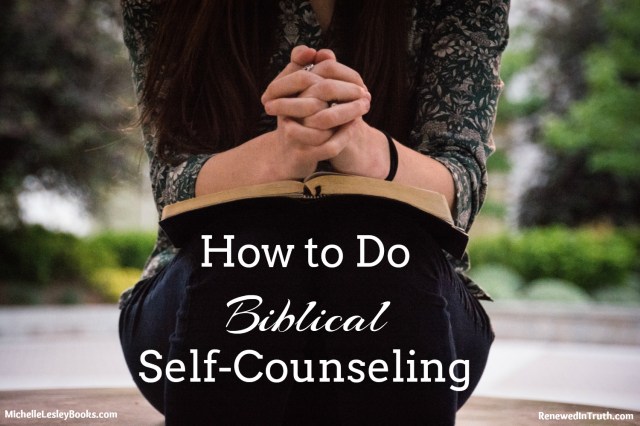
Guest Post: How to Do Biblical Self-Counseling

If your theology pretty much matches up with mine (as outlined in the “Welcome” and “Statement of Faith” tabs) and you’d like to contribute a guest post, drop me an e-mail at MichelleLesley1@yahoo.com,
and let’s chat about it.

How to do Biblical Self-Counseling
by Lara d’Entremont

I can be far too dependent upon others for growth and change. When a problem, question, decision, or sin becomes apparent in my life, my first step is to run to the comfort of others and seek their help. There’s nothing inherently wrong with this; believers within the body of Christ are meant to support and build one another up. Galatians 6:1-2 says, “Brethren, even if anyone is caught in any trespass, you who are spiritual, restore such a one in a spirit of gentleness; each one looking to yourself, so that you too will not be tempted. Bear one another’s burdens, and thereby fulfill the law of Christ” (NASB).

However, the book of Galatians doesn’t end there. If we keep reading, we find an interesting exhortation: “For if anyone thinks he is something when he is nothing, he deceives himself. But each one must examine his own work, and then he will have reason for boasting in regard to himself alone, and not in regard to another. For each one will bear his own load.” (vv. 3-6).

So while fellow believers are to help, support, exhort, and encourage us, there comes a time when we must bear our own load and deal with our own sins. While your fellow sisters in the faith may be able to point sin out to you, give you advice to overcome it, keep you accountable, and pray for you, there comes a point where you need to step up and actually do something. We cannot rely on other people to change us and fix our issues. We need to do biblical self-counseling.

This is what Paul called, “Working out your salvation with fear and trembling” (Philippians 2:12). In other words, this is our side of sanctification. In realizing all this, I was intimidated. If you are feeling that same overwhelm, don’t panic; I have a few steps to help you.

Step One | Choose an Issue to Work On

It may be tempting to become distressed by all the sins in your life and feel hopeless (at least that’s what I often experience). But we can’t allow that to discourage us. Instead, simply choose ONE issue to attack.

Once you choose your sin or issue, find a journal and write out this problem in detail, explaining what it is, when it shows up, what causes it, and why you should stop it. I would also suggest doing some biblical research and finding a few Bible verses to support your decision and writing them down to memorize in the future.

At this point, you should also be confessing to those who have been effected by this problem, especially God. He’s the one our sin is truly against, and we must own up to it. Remember, “If we say that we have no sin, we are deceiving ourselves and the truth is not in us. If we confess our sins, He is faithful and righteous to forgive us our sins and to cleanse us from all unrighteousness” (1 John 1:8-9 NASB).

Step Two | Create a Thought Journal

You will want to create a thought journal in which you track when the problem shows up. Here is a list of things you could include in your thought journal:

  • The temptation/sin/emotional issue
  • The circumstance:
    • What happened?
    • Who was involved? What did they do and/or say?
    • How did you respond? (To the people and/or situation)
  • The unbiblical thought & response
    • What did you want in that situation?
    • What did you get that you didn’t want in that situation?
    • What were your sinful thoughts in this situation?
    • What was sinful about how you responded? (provide Scripture)
  • The biblical thought & reaction: (provide Scripture for each answer)
    • How could you have reacted biblically?
    • How could you have changed your thinking to be biblical?

Answering questions like these will help you to see if there are any common denominators in your problem and help you root out the true root sin. For example, you may realize that your anxiety comes up whenever there’s a financial issue, which then leads you to realize that you love money too much. Knowing that, you can now better attack the sin; rather than managing your anxiety symptoms, you can work on loving money less.

If you would like a journal for your specific issue, you can find a few like that here.

I suggest keeping this journal during the entire process so you can see how you are improving on the issue as you go.

Step Three | Develop a Plan of Action

Now that we have a sin to attack and are learning what the root cause may be, we need to determine a biblical plan of action.

Start with choosing a few Bible verses to memorize. People sometimes undervalue the power of memorizing Scripture, but it is a great tool for overcoming sin. The Psalmist knew this: “Your word I have treasured in my heart, that I may not sin against You” (Psalm 119:11 NASB).

Important Side Note: Please make sure you don’t take a random verse and rip it out of context. Instead, study the passage and make sure it means what you have interpreted it to mean. This will also be helpful in both your memorization and conquering your issue.

Along with the Bible verses, find some biblical material to read on the subject. When I was working at my anxiety, I read Trusting God by Jerry Bridges, which taught me why I did not need to fear but instead trust God wholly. I suggest looking for resources on ACBC’s approved reading list.

Through doing those steps, you should be able to create a put off (sins to stop) and put on (righteous actions to start) list. If you were struggling with anger, your list may look like this:

Put Off:

  • Angry outbursts
  • Impatience
  • Listening to angry music
  • Hitting things
  • Unkind words

Put On:

  • Kindness & patience
  • Trusting God with how people react
  • Praying in moments of anger

Finally, find at least two or three accountability partners to keep you on track. This doesn’t mean confessing to two people who will never bring this up again. Find people who will be intentional and love you enough to ask, “Did you sin today? Did you remember to put on patience?” Find people who will remember you in prayer and are mature in their faith to provide biblical guidance.

Step Four | Rely On God

At this point you’re probably feeling one of two things:

  1. Easy enough! I’ll be on my way to overcoming this sin on my own in no time.
  2. It’s too much! I’ll never be able to do all this on my own.

Neither of these feelings are biblical or helpful to the self-counseling process. Consider Paul’s words to the Philippians: “So then, my beloved, just as you have always obeyed, not as in my presence only, but now much more in my absence, work out your salvation with fear and trembling; for it is God who is at work in you, both to will and to work for His good pleasure” (2:12-13 NASB).

To the person who thinks this is easy and will be finished before the end of the week, remember that you are a depraved sinner incapable of change on your own. You are utterly dependent on God in this. That means it’s in His timing and His power. So put off your pride and conquer your sin with reverent “fear and trembling” knowing that it is “God who is at work in you, both to will and to work for His good pleasure.”

To the discouraged person, you are right that you cannot do it on your own! Congrats on humbly recognizing your own inability. Now, find courage and confidence, because you have the Holy Spirit working in you. Consider 2 Corinthians 12:9, “But he said to me, ‘My grace is sufficient for you, for my power is made perfect in weakness.’ Therefore I will boast all the more gladly about my weaknesses, so that Christ’s power may rest on me.” Find your boast in your weakness, realizing that your ability to conquer sin is found in the power of God.


Lara d’Entremont is a child of God, a wife, and Biblical Counselor in training. Having been made new by God and completely transformed by Him, her desire is to point others back to that same gracious Saviour. Find more of Lara’s writing at her blog, Renewed in Truth.


ALTHOUGH I DO MY BEST TO THOROUGHLY VET THE THEOLOGY OF THE BLOGGERS WHO SUBMIT GUEST POSTS, IT IS ALWAYS POSSIBLE FOR THINGS TO SLIP THROUGH THE CRACKS. PLEASE MAKE SURE ANY BLOGGER YOU FOLLOW, INCLUDING ME, RIGHTLY AND FAITHFULLY HANDLES GOD’S WORD AND HOLDS TO SOUND BIBLICAL DOCTRINE.