Bible, Obedience, Old Testament, Sunday School, Worship

Worship, Grief, and Obedience: Three Responses to God’s Word ~ Sunday School Lesson ~ 9-28-14

worship grief obedience 1Through the Bible in 2014 ~ Week 39 ~ Sep. 21-27
Zechariah, Esther, Ezra 7-10, Nehemiah 1-8
Worship, Grief, and Obedience: Three Responses to God’s Word

These are my notes from my ladiesโ€™ Sunday School class this morning. Iโ€™ll be posting the notes from my class here each week. Click here for last week’s lesson.

Background/Time Line:
Judah had been in exile for 70 years. As there had been three waves of deportations (605 B.C., 597 B.C., and 586 B.C.) to Babylon, there were three waves of return from Babylon.

1. 539 B.C.- There’s a new sheriff in town as world domination changes hands. Babylon is out. Persia is in.

2. 538 B.C.- Zerubbabel (Jerusalem’s first post-exilic governor) leads the first return wave. Many of Israel’s feasts and ceremonies are reinstituted, and work on the rebuilding of the temple begins.

3. 536 B.C.- Work on the temple is abandoned shortly after it begins and is not resumed for another 16 years.

4. 516 B.C.- Temple completed.

5. 483-473 B.C.- The events of Esther take place. These events happen between Ezra 6 and 7.

6. 458 B.C.- Ezra leads the second return wave (Ezra 7ff).

7. 445 B.C.- Nehemiah leads the third and final return wave. The city wall is rebuilt.

Nehemiah 8
The exiles were all finally back after 70 long years in captivity, and the wall was finished. They were home and they were safe. It was time to re-establish the nation by ceremony and celebration.

8:1: The Feast of Booths (Ezra 7:10, Leviticus 23:33-44, Deuteronomy 16:13-17)
Ezra was a scribe and a teacher of Scripture. Ezra 7:10 tells us,

“For Ezra had set his heart to study the Law of the Lord, and to do it and to teach his statutes and rules in Israel.”

It would have been natural for Israel to look to Ezra for biblical instruction. It’s interesting to me to think back to Jeremiah at this point and recall how, before the exile, all the people came together against him to oppose the word of God. Now, after the exile, the people gather en masse and ask Ezra to teach them the word of God.

It’s a little unclear in verse 1 whether the people knew it was near time for the Feast of Booths (it was supposed to start on Tishri {7th month} 15, and this was the 1st) and that’s why they asked Ezra to read the Law (it was “required reading” at the Feast of Booths), or they just longed to hear the word of God, and the elders learned during the reading or their study time (8:13) that it was time for the Feast.

At any rate, the Feast was on. God had commanded that the Feast of Booths (or Tabernacles) be held every seven years, in the autumn after the harvest had been gathered in. The first and eighth days were days of rest, and sacrifices and offerings, as well as the reading of the Law were done on the remaining days. The Feast of Booths immediately followed the Day of Atonement, a solemn assembly in which the nation’s sins were atoned for. The Feast of Booths had not been held since the days of Joshua.

The Feast of Booths had been instituted as a reminder to Israel of how God had delivered them from “captivity” in Egypt and cared for them during their “exile” in the wilderness. The booths were lean tos or huts built from leafy branches, and the people were to live in these huts during the feast as a reminder of their temporary homes during the wilderness wandering. It is the only feast in which rejoicing is commanded.

What more appropriate feast could there have been on this day in Israel’s history? Their sin had been atoned, and God had “harvested” the apple of His eye from their temporary home in captivity and exile. It was certainly a time for rejoicing.

8:2-12: The Reading of God’s Word
2- God’s word is important for everyone: women, children, families, not just men. Not only did God want His word ministered to everyone, but “all who could understand” in verses 2 and 3 indicates that they would be held responsible for what they had heard. They were to know what God commanded, what He prohibited, and obey accordingly.

3-5- Ezra read from “the Law.” Often, the phrase “the law” or “the book of the law” can mean the entire Pentateuch (Genesis – Deuteronomy), but in this instance, it seems to mean the actual “law” portions of the Law. As he read, Ezra stood on a raised platform so that he could be seen and heard. The men standing with him to show their agreement and support were probably priests and/or elders.

“From early morning until midday” would have been about 6 hours, from dawn to noon. Outdoors (in the square). Standing. Yet, the people were still attentive. Compare this to our one or two hour worship services, indoors, sitting, where the pastor is not usually focusing on the finer aspects of how much you’ll be fined if your ox tramples your neighbor’s fence.

These people were starving for God’s word. Eager to get back to living as His people. How intense is our own hunger for God, His word, holy living?

Responding to God’s Word with Worship:
6- Ezra opened with a prayer, blessing the Lord. Joining together freely in their own land to worship and hearing God’s word taught in public by one of their own teachers was a new experience for the generation that had been born and raised in captivity. By this time, overwhelmed and overcome by all God had done for them, their only possible response was humble worship. Worship is one of the right responses to God revealing Himself in His word.

7-8- Because many of the people were hearing God’s law for the first time, they needed some help in understanding it. God had raised up godly men to teach the people. This is what godly teachers do. They read out God’s word and explain it to people (exegesis). They don’t come up with fanciful ideas of their own and bend God’s word to make it fit their ideas (eisegesis).

Responding to God’s Word with Grief:
9-12 (Romans 10:13-14, Ecclesiastes 3:1)- The Holy Spirit works primarily through the teaching and preaching of His word, and that’s just what He was doing here. The people heard the word and the Holy Spirit worked through it to convict them of their sin. They began to mourn over their sin and repent. Grieving over our sin is another right response to God revealing Himself in His word.

But grieving over sin was for the Day of Atonement, a form of which, this time, would follow the Feast of Booths instead of preceeding it (see chapter 9). This was a time of rejoicing for all God had done for them in spite of their sin. As we read in Ecclesiastes,

For everything there is a season, and a time for every matter under heaven:

Confession would have to wait.

And why did the people rejoice? Not because God performed a miracle or made their lives nice and comfy or gave them a bunch of stuff. They rejoiced because “they had understood the words that were declared to them.” How often do we rejoice in understanding God’s word or having it preached to us? It’s not often we see a Facebook status that says, “Praising God for understanding the Bible passage I read in my quiet time today!”

8:13-18: Studying God’s Word
13-14- For a Believer, one of the effects of hearing God’s word is the desire to hear more of God’s word. Hearing God’s word preached and taught led the elders, priests, and Levites to want to study the Word even further. As they studied, they discovered that there are things that God’s word actually tells us to do.

Responding to God’s Word with Obedience:
14-18- The leaders learned that there were some actual, tangible, behavioral things God had told Israel to do with regard to the Feast of Booths. They were obedient to God’s word by studying to understand these things, teaching them to the people, exhorting them to obey, and setting the example by obeying the instructions themselves.

The people responded in obedience to the word by heeding the instruction of their spiritual leaders, and by going out, gathering branches, constructing the booths, and living in them during the feast. As each individual obeyed, it encouraged others to obey, so that the whole assembly came together in obedience. And what was the result? “There was very great rejoicing.” (17)

Our response to God’s word should be no different than Israel’s. We should hunger for God’s word and desire more of it with each passing day. It should inspire us to worship the glorious King who sent His son to die for us. It should convict us of our sins and cause us to grieve over them and repent. And, we should obey God’s word, and through our obedience, encourage the rest of the body of Christ to do the same. Then, there will be “very great rejoicing.”
Wednesday's Word

Wednesday’s Word ~ Jeremiah 23

1937485_824377827603153_712723081626384146_n

Jeremiah 23:

โ€œWoe to the shepherds who destroy and scatter the sheep of my pasture!โ€ declares the Lord. 2 Therefore thus says the Lord, the God of Israel, concerning the shepherds who care for my people: โ€œYou have scattered my flock and have driven them away, and you have not attended to them. Behold, I will attend to you for your evil deeds, declares the Lord. 3 Then I will gather the remnant of my flock out of all the countries where I have driven them, and I will bring them back to their fold, and they shall be fruitful and multiply. 4 I will set shepherds over them who will care for them, and they shall fear no more, nor be dismayed, neither shall any be missing, declares the Lord.

5 โ€œBehold, the days are coming, declares the Lord, when I will raise up for David a righteous Branch, and he shall reign as king and deal wisely, and shall execute justice and righteousness in the land. 6 In his days Judah will be saved, and Israel will dwell securely. And this is the name by which he will be called: โ€˜The Lord is our righteousness.โ€™

7 โ€œTherefore, behold, the days are coming, declares the Lord, when they shall no longer say, โ€˜As the Lord lives who brought up the people of Israel out of the land of Egypt,โ€™ 8 but โ€˜As the Lord lives who brought up and led the offspring of the house of Israel out of the north country and out of all the countries where he had driven them.โ€™ Then they shall dwell in their own land.โ€

Lying Prophets
9 Concerning the prophets:

My heart is broken within me;
all my bones shake;
I am like a drunken man,
like a man overcome by wine,
because of the Lord
and because of his holy words.
10 For the land is full of adulterers;
because of the curse the land mourns,
and the pastures of the wilderness are dried up.
Their course is evil,
and their might is not right.
11 โ€œBoth prophet and priest are ungodly;
even in my house I have found their evil,
declares the Lord.
12 Therefore their way shall be to them
like slippery paths in the darkness,
into which they shall be driven and fall,
for I will bring disaster upon them
in the year of their punishment,
declares the Lord.
13 In the prophets of Samaria
I saw an unsavory thing:
they prophesied by Baal
and led my people Israel astray.
14 But in the prophets of Jerusalem
I have seen a horrible thing:
they commit adultery and walk in lies;
they strengthen the hands of evildoers,
so that no one turns from his evil;
all of them have become like Sodom to me,
and its inhabitants like Gomorrah.โ€
15 Therefore thus says the Lord of hosts concerning the prophets:
โ€œBehold, I will feed them with bitter food
and give them poisoned water to drink,
for from the prophets of Jerusalem
ungodliness has gone out into all the land.โ€

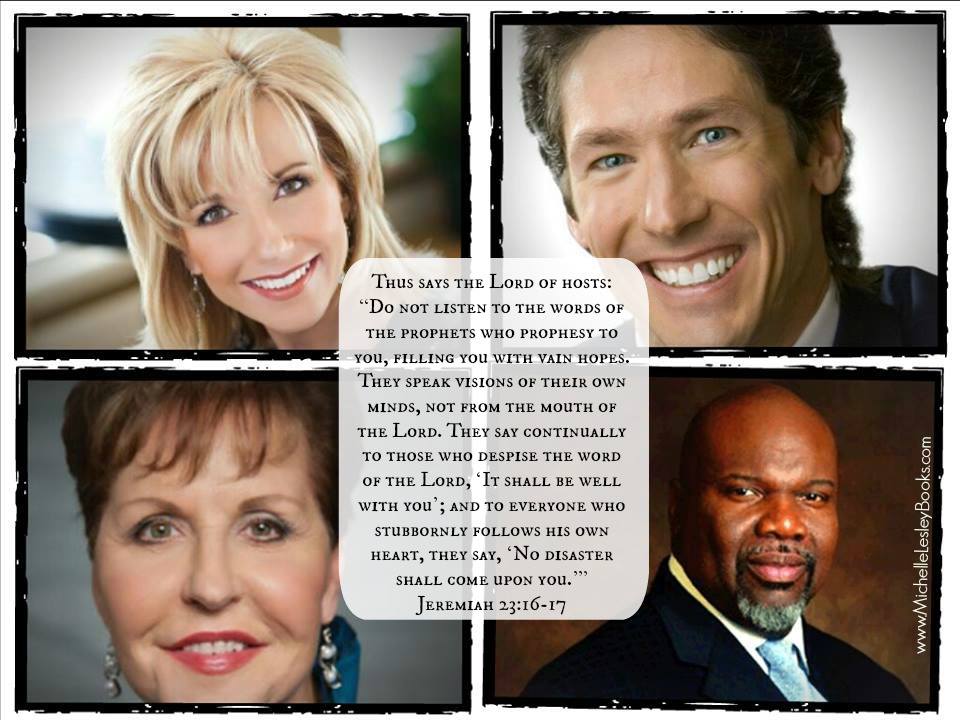
16 Thus says the Lord of hosts: โ€œDo not listen to the words of the prophets who prophesy to you, filling you with vain hopes. They speak visions of their own minds, not from the mouth of the Lord. 17 They say continually to those who despise the word of the Lord, โ€˜It shall be well with youโ€™; and to everyone who stubbornly follows his own heart, they say, โ€˜No disaster shall come upon you.โ€™โ€

18 For who among them has stood in the council of the Lord
to see and to hear his word,
or who has paid attention to his word and listened?
19 Behold, the storm of the Lord!
Wrath has gone forth,
a whirling tempest;
it will burst upon the head of the wicked.
20 The anger of the Lord will not turn back
until he has executed and accomplished
the intents of his heart.
In the latter days you will understand it clearly.

21 โ€œI did not send the prophets,
yet they ran;
I did not speak to them,
yet they prophesied.
22 But if they had stood in my council,
then they would have proclaimed my words to my people,
and they would have turned them from their evil way,
and from the evil of their deeds.

23 โ€œAm I a God at hand, declares the Lord, and not a God far away? 24 Can a man hide himself in secret places so that I cannot see him? declares the Lord. Do I not fill heaven and earth? declares the Lord. 25 I have heard what the prophets have said who prophesy lies in my name, saying, โ€˜I have dreamed, I have dreamed!โ€™ 26 How long shall there be lies in the heart of the prophets who prophesy lies, and who prophesy the deceit of their own heart, 27 who think to make my people forget my name by their dreams that they tell one another, even as their fathers forgot my name for Baal? 28 Let the prophet who has a dream tell the dream, but let him who has my word speak my word faithfully. What has straw in common with wheat? declares the Lord. 29 Is not my word like fire, declares the Lord, and like a hammer that breaks the rock in pieces? 30 Therefore, behold, I am against the prophets, declares the Lord, who steal my words from one another. 31 Behold, I am against the prophets, declares the Lord, who use their tongues and declare, โ€˜declares the Lord.โ€™ 32 Behold, I am against those who prophesy lying dreams, declares the Lord, and who tell them and lead my people astray by their lies and their recklessness, when I did not send them or charge them. So they do not profit this people at all, declares the Lord.

33 โ€œWhen one of this people, or a prophet or a priest asks you, โ€˜What is the burden of the Lord?โ€™ you shall say to them, โ€˜You are the burden, and I will cast you off, declares the Lord.โ€™ 34 And as for the prophet, priest, or one of the people who says, โ€˜The burden of the Lord,โ€™ I will punish that man and his household. 35 Thus shall you say, every one to his neighbor and every one to his brother, โ€˜What has the Lord answered?โ€™ or โ€˜What has the Lord spoken?โ€™ 36 But โ€˜the burden of the Lordโ€™ you shall mention no more, for the burden is every man’s own word, and you pervert the words of the living God, the Lord of hosts, our God. 37 Thus you shall say to the prophet, โ€˜What has the Lord answered you?โ€™ or โ€˜What has the Lord spoken?โ€™ 38 But if you say, โ€˜The burden of the Lord,โ€™ thus says the Lord, โ€˜Because you have said these words, โ€œThe burden of the Lord,โ€ when I sent to you, saying, โ€œYou shall not say, โ€˜The burden of the Lord,โ€™โ€ 39 therefore, behold, I will surely lift you up and cast you away from my presence, you and the city that I gave to you and your fathers. 40 And I will bring upon you everlasting reproach and perpetual shame, which shall not be forgotten.โ€™โ€


The Holy Bible, English Standard Version Copyright ยฉ 2001 by Crossway Bibles, a division of Good News Publishers.


Questions to Consider:

1. What is the purpose of theย bookย ofย Jeremiah? Which genre(s) of biblical literature (prophecy, epistle, narrative, wisdom, etc.) is the book of Jeremiah? What is the historical backdrop for this book?

2. Who are the “shepherds” in 1-4? Compare these shepherds to the “thieves and robbers,” “strangers,” and “hired hands” (false teachers), the gatekeeper (faithful pastors; also here), and the Good Shepherd (Jesus; also here) in John 10. What have they done that they should not have done? What have they failed to do that they should have done?

3. Who is “the righteous Branch” (5) and “the Lord is our righteousness” (6)?

4. How does this chapter of Jeremiah point us ahead to Jesus’ first and second coming? Take note of all of the instances in this chapter in which God says, “I will” do thus and so, such and such will happen, and “the days are coming when…”. Which of these things were accomplished in Jesus’ first coming, and which will be accomplished when He comes back?

5. Make a chart with the following columns and fill it out as you start at the beginning of chapter 23 and work your way through to the end:

False prophets characterized:

Things false prophets say:

How God says things should or will be:

God’s true word characterized:

God characterized:

God’s judgment on false prophets:

How God’s people should respond to false prophets:

Do you see any similarities between the false prophets of Jeremiah’s day and the false teachers of today? What do today’s false teachers promise and “prophesy”? Does God characterize today’s false teachers the same way as the false prophets of Jeremiah’s day, and will He judge them the same way? What should be our (the church, and individual Christians) response be to false teachers today?

Faith, Old Testament, Suffering, Sunday School, Trust

But Even If He Does Not… ~ Sunday School Lesson ~ 9-21-14

Shadrach

These are my notes from my ladiesโ€™ Sunday School class this morning. Iโ€™ll be posting the notes from my class here each week. Click here for last week’s lesson.

Through the Bible in 2014 ~ Week 38 ~ Sep. 14-20
Daniel, Ezra 1-6, Psalm 137, Haggai
But Even If He Does Not…

Exile. God has been warning Israel of the consequences of idolatry for centuries and has finally brought it to fruition. Last week we saw Ezekiel comfort the people with the good news that God’s anger and their punishment would not last forever, but today we find them smack dab in the middle of their time as Babylonian expatriates. How could they live as God’s people while being punished in a pagan nation? How could they please Him apart from temple sacrifices and offerings? Shadrach, Meshach, and Abednego are going to show us.

Daniel 3

The Problem- 1-7 (Exodus 20:1-6)
Here, the stage is set for the drama that is about to unfold. Nebuchadnezzar set up a 90 foot tall (probably much of that was a large base), 9 foot wide statue of himself, and commanded everyone under his rule to worship it. Emperor/king worship was not uncommon at any time during the Old or New Testament periods. While the emperor’s ego certainly must have played into this, it was mainly about loyalty and obedience to that leader and his rule. He was trying to preclude any hint of sedition while reinforcing to the people that he had control over every aspect of their lives. This was an especially important message to drive home to all of the governmental officials (2), because they were the ones most likely to slaughter the emperor and stage a coup.

From the emperor’s perspective, emperor worship also had less to do with actual religion and worship than submission to his absolute rule. Nebuchadnezzar and nearly everyone else in Babylon worshiped a panoply of gods, which was fine with Nebuchadnezzar as long as none of those gods superseded him and his rule in the eyes of his subjects. He was to be esteemed and obeyed above all others. That’s where our young Hebrew friends found themselves butting heads with Nebuchadnezzar’s new law. God is not OK with his people worshiping any other god before, besides, instead of, or in addition to Him. He is the only God, and He alone is to be worshiped, even if your life is on the line.

The Persecution- 8-12 (2 Timothy 3:12, John 15:18)
Shadrach, Meshach, and Abednego were three of the Judean exiles. We saw in chapter 1 that they, along with Daniel, were godly young men who risked their lives to be obedient to God’s commands. By the end of chapter two, Nebuchadnezzar had promoted them to prominent positions in his government. This is probably why the Chaldeans accused them– they were jealous. As with Daniel’s accusers in 6:4-5, they likely could not find any other grounds on which to discredit Shadrach, Meshach, and Abednego because they were upstanding, ethical, loyal citizens.

Satan hates God and anyone who loves and serves Him. John 15:18 says,

If the world hates you, know that it has hated me [Jesus] before it hated you.

Because of this hatred, Satan will do anything in his power to get God’s people to turn away from Him or sin against Him. He is the force behind all persecution, and he often uses his own servants to attack God’s servants. This was true for Shadrach, Meshach, and Abednego, and it is true for us today. Second Timothy 3:12 says,

Indeed, all who desire to live a godly life in Christ Jesus will be persecuted,

If we love God and strive towards holiness, we will find ourselves under attack at times.

The Predicament- 13-15
Being a child of God can often mean facing scary situations in which we are tempted to cut corners or sin. Shadrach, Meshach, and Abednego were tempted to bow down to the image the first time when the music played. Here, the heat is turned up because they’re standing in front of the man who holds their lives in his hands, and they face the same temptation a second time. Why not just do it? God will understand and forgive them, right?

The Profession- 16-18 (Psalm 115:3, Romans 8:28)
Although it’s tempting to think that way, we can’t, and Shadrach, Meshach, and Abednego prove this out beautifully. They would rather die than disobey their true King. And notice the strength of their testimony in the simple fact that they needed no time to consider Nebuchadnezzar’s offer (16). Immediately, they answered that their minds were made up. Under no circumstances would they bow to the image.

Why? Because they knew nothing was going to happen to them? No. We know that because we have the rest of the story. We have to remember that this was a real event happening to real people in real time, the same way things happen to us. They didn’t know what was going to happen next. For all they knew, they were toast. Yet they stood and boldly declared that God was able to do anything and they trusted Him no matter what.

But even if he does not…Those are probably the most important words in this story. To Shadrach, Meshach, and Abednego, God was still God, still worthy of worship and obedience, whether he spared their lives or not. Can we say the same?

There are a lot of false teachers out there that will tell you it is always God’s will for you to be healed, wealthy, successful. And if you’re not, it’s your fault because of your lack of faith. But the Bible clearly teaches the opposite. If God had not saved Shadrach, Meshach, and Abednego, could anyone say it was due to their lack of faith? Did God refuse to take away Paul’s thorn in the flesh because of his lack of faith? Were 11 of the 12 disciples martyred because they lacked faith?

The truth is, Our God is in the heavens; he does all that he pleases. (Ps.) God does what He does for His glory and our good. And, much like when we take our children to the doctor for a shot, what’s good for us can be scary and painful. What if God doesn’t heal you? What if your child dies? What if your marriage isn’t reconciled? What if you lose your job? For those that love God and are called out to His purposes, He works all things together for good (Rom.) He has not promised us an easy way, but a difficult way. But He has promised to be with us all the way. Can we stand in faith with Shadrach, Meshach, and Abednego and say, but even if He does not…?

The Peril and the Protection- 19-30
If we were writing this story, it would probably end right after verse 18 with Nebuchadnezzar so impressed with Shadrach, Meshach, and Abednego that he backed down and honored them for their courage and integrity. But God’s didn’t want Nebuchadnezzar to be impressed with Shadrach, Meshach, and Abednego. God wanted Nebuchadnezzar to be impressed with Him.

If you’ll notice, God did not rescue Shadrach, Meshach, and Abednego after their profession of Him. Things got worse. Nebuchadnezzar got angrier. The fire got hotter. God did not rescue them before they got tied up. Or before they got to the furnace. Or before they were thrown into the furnace. Or before they hit the bottom of the furnace. God allowed these three men who loved Him and were loyal to Him above all else to hit bottom before He rescued them. He didn’t rescue them from the furnace, He rescued them through the furnace.

God (possibly the preincarnate Christ in a theophany) was with them in the fire and, eventually, He brought them out on the other side. What do you think that did for their faith in Him? How much more intimately did they know Him, how much more thankful were they, and how much more intensely did they worship Him after God walked through the fire with them?

It’s the same for us. We grow to know and love God so much more intimately, when, instead of rescuing us from trials, He walks through them with us. I would not know and trust God as provider the way I do today had He not walked with me through some very difficult situations that only He could provide for. Others know God as healer or comforter or strength because of what He has walked through with them.

And what happened to Shadrach, Meshach, and Abednego wasn’t just about them, personally. God had a broader purpose for their suffering, and also for Daniel’s experience in the lions’ den. In those two incidents (and others), God got to pull back the curtain and reveal Himself to pagan people who desperately needed Him. He showed that He was superior to their gods, that they needed to repent and turn to Him, and that He loves His children. It had always been God’s plan to make Himself known to the Gentiles as well as the Jews, and here were God’s first missionaries. If these four men hadn’t gone through what they went through, Nebuchadnezzar and the rest of watching Babylon would not have seen God. What they went through showcased the great God they served.

Likewise, our trials can be an opportunity to point people to the Christ who has rescued us from the ultimate fire, and who can rescue them as well. Even if He does not…is a glorious opportunity to shine the spotlight on our great, mighty and merciful God.

Marriage

Blog Swap ~ Helpmeet Defined

blog swap

It’s time for another awesomeย blog swap! Blog swaps give me the opportunity to share other talented bloggers with you, plus offer you fresh content that’s a great supplement to our regular fare here. If you’d like to do a swap, click on the link above for more information.

Today, we’re swapping with Kaylene of Faithful Feat.ย Kaylene has written some insightful articles about marriage that will be especially helpful to Christian wives.

hand-382684_640

God did not create the woman of lesser value, but rather values her equal to the man.ย He created the woman as a counterpart to the man,ย not a doormat, slave or possession.

Click hereย to continue reading, and don’t forget to subscribe and follow Faithful Feat on social media!

Evangelism, Old Testament, Sunday School, Types and Shadows

Dem Bones ~ Sunday School Lesson ~ 9-14-14

Dem BonesThese are my notes from my ladiesโ€™ Sunday School class this morning. Iโ€™ll be posting the notes from my class here each week. Click here for last week’s lesson.

Through the Bible in 2014 ~ Week 37 ~ Sep. 7-13
Ezekiel 35-48, Joel
Dem Bones

And beginning with Moses and all the Prophets, [Jesus] interpreted to them in all the Scriptures the things concerning himself. Luke 24:27

The most beautiful thing about the Old Testament is that Jesus’ fingerprints are all over it. The imagery and symbolism displaying His life and the gospel pop out from the least expected places to surprise and delight us. And at the same time we see the “far,” New Testament application, of Old Testament passages, we can also see the “near,” or immediate application the passage has for the Bible characters the story is literally happening to. It’s like getting two lessons in one.

Ezekiel 37:1-14

Something Old
God sent this vision to Ezekiel the night before the messenger came with word of the fall of Jerusalem. The people of Israel were devastated and fearful, and this vision was meant to comfort and reassure them.

The valley (1) represented the areas of the world to which Israel and Judah had been (or would shortly be) exiled. As the skeletons were scattered all over the valley, so God’s people were scattered in various parts of the world.

The bones (2-3, 11) are a picture of death. With exile impending, Israel felt that all hope was dead and gone. The fact that the bones in the valley were “very dry” means that they had been there for quite a while, just as Israel would be in exile for seventy long years. It was the death of life as they knew it.

The prophecy (4-10, 12-14, Jeremiah 3:12, Isaiah 54:8, Psalm 30:5) this time, after so many prophecies of God’s coming wrath, was a prophecy of hope and restoration. God would breathe the breath of life and hope back into Israel. He would raise them up out of the grave of those pagan lands and resurrect them to a new life back in the Promised Land.

Go, and proclaim these words toward the north, and say, โ€œโ€˜Return, faithless Israel, declares the Lord. I will not look on you in anger, for I am merciful, declares the Lord; I will not be angry forever. (Jer.)

In overflowing anger for a moment I hid my face from you, but with everlasting love I will have compassion on you,โ€ says the Lord, your Redeemer. (Is.)

For his anger is but for a moment, and his favor is for a lifetime. Weeping may tarry for the night, but joy comes with the morning. (Ps.)

What a kind and compassionate God! He justly executes judgment, but graciously forgives sin when His people repent.

Something New
The first layer of our lesson today was the “near” application– the literal, immediate application to Israel. From that, we’ve learned that God will not tolerate idolatry, that He is patient with His children, but does discipline them, and that He is merciful and forgiving towards Israel.

The second layer of the story is the “far,” or New Testament layer. It takes those attributes of God and redemption that we’ve just learned about in Israel’s story and shows us how Jesus “fleshed them out.”

The valley (1) could be anywhere. People are scattered over the whole earth just the way the bones were scattered across the valley.

The bones (2-3, 11, Ephesians 2:1-2a, John 15:16; 6:44, Hebrews 11:6, Romans 6:23) are people who are still dead in sin and have never come to repentant faith in Jesus Christ.

Let’s take a look at Ephesians 2:

And you were dead in the trespasses and sins in which you once walked.

Prior to salvation, we are spiritually dead. Just like a corpse can’t move, act, think, or decide, we can’t do anything to choose God (Jn. 15), or please Him (Heb.), or decide on our own to get saved (Jn. 6).

And not only are we spiritually dead during our time on earth, but eternal death awaits us when our earthly lives are over (Rom.). Without Christ, we are born dead, live dead, and die unto eternal death.

Gives you kind of a hopeless feeling (like the Israelites had) doesn’t it?

The prophecy (4-10, 12-14, Matthew 13:57, John 11:25-26; 3:6-7; 16:7; 20:22, 2 Timothy 3:16, Romans 6:4, Ephesians 2:4-7, 2 Corinthians 1:22)
Just like God sent the prophet Ezekiel -“Son of Man” (God calls him this 93 times)- to his people with the good news of the hope of new life, He sent His Son -also called the “Son of Man” (87 times in the New Testament)- the greatest prophet (Matt.), not just to proclaim the good news of new life, but to become that good news by giving His life on the cross so that we might not die, but live.

Verse 6 says: And I will lay sinews upon you, and will cause flesh to come upon you, and cover you with skin, and put breath in you, and you shall live, and you shall know that I am the Lord.โ€

At Lazarus’ tomb, “Jesus said to her, โ€œI am the resurrection and the life. Whoever believes in me, though he die, yet shall he live, and everyone who lives and believes in me shall never die. Do you believe this?โ€ (Jn. 11)

Just as Ezekiel prophesied to the bones (7-10) and they were born again from the dead, Jesus preached, “You must be born again.” (Jn. 3:7). And just as the bodies in verse 8 were fully fleshed out but had no spirit in them, Jesus said, “That which is born of the flesh is flesh, and that which is born of the Spirit is spirit.” (Jn. 3:6)

Ezekiel prophesied to the breath and it entered the dead bodies and brought them to life. You may have a footnote in your Bible on the word “breath” in verse 5, 6, 9, or 10 that says “or spirit.” The Hebrew (the Old Testament was written in Hebrew) word ruah is the same for “breath” or “spirit.”

In John 16, Jesus prophesied to His disciples that the Holy Spirit would come and fill them: “Nevertheless, I tell you the truth: it is to your advantage that I go away, for if I do not go away, the Helper will not come to you. But if I go, I will send him to you.”

And in John 20: “…he [Jesus] breathed on them [the disciples] and said to them, โ€œReceive the Holy Spirit.”

Interestingly, the Greek (the New Testament was written in Greek) word pneuma means both “spirit” and “breath.” You probably recognize this Greek word as the root of our English word “pneumonia,” a disease of the lungs, or “breath.” The branch of theology that deals with the study of the Holy Spirit is called pneumatology. When 2 Timothy 3:16 says, “All Scripture is inspired by God…” the word translated “inspired” is theopneustos, or God (theo) breathed (pneustos). It is not until the Holy Spirit, the breath of life, enters us that we are “raised to walk in newness of life.” (Rom.)

As God said to Israel in verses 13-14, “And you shall know that I am the Lord, when I open your graves, and raise you from your graves, O my people. And I will put my Spirit within you, and you shall live, and I will place you in your own land. Then you shall know that I am the Lord; I have spoken, and I will do it, declares the Lord.โ€

so He says to us in Ephesians 2, “But God, being rich in mercy, because of the great love with which he loved us, even when we were dead in our trespasses, made us alive together with Christโ€”by grace you have been savedโ€” and raised us up with him and seated us with him in the heavenly places in Christ Jesus, so that in the coming ages he might show the immeasurable riches of his grace in kindness toward us in Christ Jesus.”

“and who has also put his seal on us and given us his Spirit in our hearts as a guarantee.” (2 Cor.)

Something Borrowed, Just for You
We have seen the “near” application to the Israelites, and the “far” application to the gospel, so what is the “now” application for us? What can we “borrow” from this passage to do in our own walk with the Lord?

We are to follow in the footsteps of Ezekiel and Jesus and preach (share) the gospel of the resurrection to new life to dry, dead bones, and pray God to do His mighty work of raising sinners from the dead.

Can these bones live? Oh, Lord God, You know.