Church, Worship

Throwback Thursday ~ Rolling Out the Welcome Wagon

Originally published August 25, 2010

The LORD said to him, “I have heard your prayer and your supplication, which you have made before Me; I have consecrated this house which you have built by putting My name there forever, and My eyes and My heart will be there perpetually. I Kings 9:3

As Golden Girl Sophia would say, “Picture it:”

After church one Sunday, a friend says, “Why don’t you come over to my house tomorrow night for dinner?”

So, the appropriate time comes on Monday evening, and you drive over to her house. The door is standing open because she is expecting you, and you’re familiar enough with each other that you feel comfortable just walking on in.

As you’re walking in, you see your friend standing there, and you say to her, “I invite you into this house! You are welcome here!”

Anything seem a little off about that?

Well, of course that seems strange. It’s her house.

But that’s what is taking place in churches all over America every Sunday morning. I saw it in a televised local church service last week. The worship leader stood up to lead the first song and said, “God we welcome you into this place!” I’ve heard others say things like, “Lord, we invite you into this house this morning!” We sing songs like Holy Spirit, Thou art Welcome and Lord, we Invite You.

‘Scuse me? Isn’t the church God’s house?

Of course, it isn’t God’s house in the same way the temple was God’s house, in that there isn’t a holy of holies where the actual presence of God resides. On the other hand, I wouldn’t go so far as to say that it’s only a building, like the post office or a doughnut shop.

At some point, way back when, or maybe even recently, a body of Believers got together and asked God to give them a place where they could worship Him. God saw fit to answer that prayer. He provided the land, the permits, and every brick, nail, and piece of sheetrock. He allowed His name to be placed there when we decided to call it “Grace Fellowship”, “St. Luke’s”, or “First Baptist”. He protects that building and allows it to stand as a testimony to the community: God, and God’s people, can be found here.

It’s not your church. It’s not my church. It’s God’s church. And it exists for His glory.

But somewhere along the way, we’ve forgotten that. Somewhere along the way, we gave God an eviction notice and became squatters on His property. How arrogant have we become that we strut into church as though we own the place, and dare to invite Him, to welcome Him into His own house as though He were a guest? How dare we?

Maybe it’s partly because we no longer have a holy of holies that we don’t see God’s house as sacred. “Ah,” you may say, “but that’s Old Testament thinking. Now we understand that when we gather together in His name, He is with us.”

Really?

When it’s my church, my comfort, my pew, my ministry that nobody else better touch, my style of music, my opinion about how long the sermon should be, my feelings that got hurt, my idea of how things should operate, what I got out of the service, are we really gathering in His name?

Welcome, Lord. Are You sure You want to come in?

Worship

In My Humble Opinion…The One with the Modernized Hymns

I don’t often share my personal, completely subjective opinions with y’all. I figure there’s enough of that in the world and what’s sorely lacking is unambiguous biblical truth. So that’s what I try to share instead.

But today, I have an opinion. I’m sure it’ll be wildly unpopular and generate a bunch of hate mail, but that’s in my wheelhouse, so here goes:

I don’t really like most modernizations of hymns.

I didn’t say, “I don’t like modern hymns.” There are several of those I like, and contemporary hymn writers like the Gettys are doing a bang up job of writing lovely new, doctrinally sound hymns. Frankly, we need more theologically rich contemporary hymns.

What I mean is that I don’t like some well-meaning hipster to pick up How Great Thou Art and go, “Hey, those words – most of them anyway…or…at least a few of them – are cool, but that melody, harmony, tempo, and syncopation? Haul out the mothballs! We can’t be singing THAT in church! It’s gotta sound like something on CCM radio! Relevant! Fresh! Cutting edge!”. And then they proceed to put their grubby little paws all over someone else’s hard work and mangle it into something barely reminiscent of the work of art it once was.

It’s kind of the same reason I hate modern remakes of movies of yesteryear. It takes something that was great the way it was and ends up diminishing it to make it palatable and marketable to today’s consumer.

Hymn modernizers are often melody driven. They take a melody they like and force the original hymn lyrics to fit it – leading to awkward phrasing or the need to change words – rather than letting the lyrics lead and crafting a melody around them.

What’s wrong with the original music? I mean it. What on earth is wrong with the original music to the hymn? Nobody’s clamoring for the modernization of Gregorian chant or classical music or big band or 50’s rock, or 60’s folk music, or disco. People listen to those genres and appreciate them for what they are, and if they want to listen to a different genre, they switch genres, they don’t play musical Silly Putty with the current genre. If every generation of people had taken the hymn modernizers’ approach, we’d currently be listening to the 21st century version of Nebuchadnezzar’s horn, pipe, lyre, trigon, harp, and bagpipe.

To me, it’s functionally musical plagiarism even if it doesn’t fit the technical legal definition. They take an existing piece of someone else’s work, change at least 50% of it (sometimes more if they change some of the lyrics in addition to the music) and popularize it under their own name. Whatever happened to “Keep your eyes on your own paper and do your own work.”?

Most of the hymns now being modernized were written at a time when people sang like normal human beings, which nobody seems to know how to do any more. Today, when listening to modernized hymns, you have two choices of “artists”: the wispy, breathy ones who sound like a stiff breeze would knock them over, or the moany, growly ones whose vocalizations are more fit for a Barry White ditty (let the reader understand) than a hymn.

But…but…but…

Yes, I know all the exceptions to everything I’ve just said. I know various hymns have been modernized from time immemorial. I know lyrics of songs are often changed to fit existing melodies. I know some people like modernized hymns and growly or wispy singers.

But that’s kind of the point of why I posted an opinion today. This is my personal preference. I get to like what I like and dislike what I dislike as long as I’m within the confines of Scripture. So do you. So does everybody in the Body. And that’s OK.

Varied personal opinions and preferences – not biblical truth, mind you; we have to know the difference – are not things to divide over. We need to make sure we’re listening to each other, understanding each other, and valuing the unique quirks and characteristics God created in each other. God put each of us together differently for His glory. Those differences show the kind of creativity and diversity He is capable of.

So you have your subjective opinion and I’ll have mine, and we’ll love each other and have those opinions to the glory of God.

Just keep your mitts off How Great Thou Art, if you please.

Random Ramblings Ruminations Resources

Random Ramblings, Ruminations, and Resources

Great balls of fire, the world has gone ya ya and we haven’t had a 4R since last July. Goodness. Well, we’ll fix that faster than a Costco shopper on a pallet of toilet paper.

Let’s jump into some Random Ramblings, Ruminations, and Resources, shall we?

Photo Credit

M-m-m-my Corona(virus)

The other day I asked on Facebook if y’all wanted an article about Christians and the Coronavirus or something else. The overwhelming response was, “Something else! Anything else!” It seems many of us have reached out saturation point when it comes to hearing about the virus:
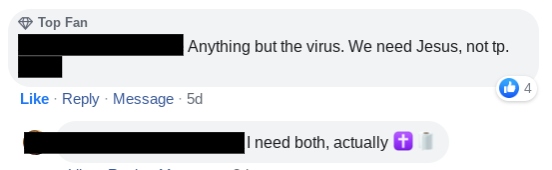
But there were a few hardy souls who wanted to hear a Christian perspective on how we and our churches should be reacting to all the ramifications of quarantines, social distancing, and church closures. So here are a few brief thoughts I had:

😷Wash your hands like your life depends on it, because it might. Instead of singing a song while you’re washing your hands, recite your memory verses. Or if you’re in a public restroom, share the gospel with the poor sap lady who’s washing her hands in the sink next to you. You know she’s going to be there a while- captive audience!

😷You shouldn’t have to be told to cover your mouth when you cough or sneeze. You should already be doing it. That is basic home training and basic loving and serving your neighbor.

😷Stay home if at all possible (I thought this was just called “being normal, but it turns out I’m an introvert. Or a hermit.). The sooner this thing stops spreading, the sooner we can all get back to church, work, and normal life (which, for me, is staying home if at all possible – it’s the circle of life. Or something.).

😷Christians are not hoarders. Christians are sharers. It’s one thing to lay in a reasonable supply. It’s a whole ‘nother animal to buy into the mindset that purchasing huge amounts of supplies will somehow magically ward off harm. It won’t. That’s superstition. It is failing to trust God to provide for you. Do business with God and discern whether or not you’ve been hoarding. If you have, repent, and make like Zacchaeus and give it away to people who need it. 

😷If you have a godly pastor, he has probably agonized over whether or not to cancel worship service or modify your church’s regular activities. It doesn’t matter what decision he makes, somebody is going to be unhappy about it and give him an earful. Don’t be that person. Give him some love and encouragement (from a safe social distance). He probably needs it now more than usual. And on that same note, whatever decision he makes, just roll with it for the time being, OK? We’re all playing this thing by ear right now, including your pastor. Don’t make me go all Hebrews 13:17 on y’all.

😷If you think nothing of skipping church for frivolous reasons, it’s hypocritical to complain now about your church’s services being canceled or modified for a much more important reason. (I’m not talking about First Amendment stuff here, I’m talking about your heart.)

😷”Online church” can be a blessing in an emergency situation like this, but this virus is going to pass and things are going to get back to normal. Do not fall into the fleshly mindset of, “Online church worked out just fine during the crisis, so I’ll just keep doing that instead of physically going back to church.” Uh uh. That’s spiritually lazy, and it’s sinfully forsaking the assembly. For Christians, Church is Not Optional, and that’s Non-Negotiable.

😷Have you ever stopped to think that this whole quarantine and limiting of meeting sizes thing could be God giving us a dry run of what it’s going to be like when real persecution comes, our church buildings are shuttered for good, and we have to meet in small groups in secret? That’s already real life for many of our brothers and sisters across the world. Maybe we should quit complaining and use this as a drill.

😷Where are Benny Hinn, Todd White, Bethel, and the rest of the faith healing crowd in all this? Time to put up or shut up.

😷Take reasonable precautions, but look for opportunities to help others and to share the gospel. Let your faith in God be greater than your fear of illness.

That’s pretty much my take on the whole shebang. If you haven’t had enough of all things Coronavirus, here are some more good resources:

Coronavirus Articles at The Cripplegate

Coronavirus and the Christian Faith on The Sword and the Trowel Podcast

The Coronavirus Pandemic – Bringing Hope to Those in Fear on Voice of Reason Radio

Q&A Corona Virus, Saturday Podcast, the Bible Project? at When We Understand the Text

Wisdom, Not Worry on Relatable with Allie Beth Stuckey

Kudos to one of my followers, Camille, who has been hard at work curating the best Coronavirus memes on the web, part 1 and part 2. (This is meant to be lighthearted and funny. If you only do serious, please don’t click.)

Get Your Worship On

This kind of goes along with my TBT article from yesterday, God’s Not Like “Whatever, Dude,” About The Way He’s Approached in Worship. (Also meant to be lighthearted and funny, so please don’t click if that’s not your bag.). And some of you youngsters wonder why us old codgers like hymns so much!

The Real Deal, or the Fake Heal?

I was reading Acts 3, the story of Peter and John healing the lame beggar, and it struck me how starkly different this account is from the chicanery of New Apostolic Reformation “faith healers” today…

💥Peter and John didn’t have a “healing ministry”, they had a “preaching the gospel ministry.”

💥The lame beggar didn’t show up at “church” (i.e. the temple) to be healed, and didn’t seek Peter and John out for healing.

💥The lame beggar asked them for money rather than them asking him for money.

💥Peter and John had no silver, no gold, no Rolexes, no mansions, no private jets…

💥Peter said, “…what I have, I give to you.” The beggar was not asked to “sow a seed” into Peter and John’s ministry.

💥Faith isn’t mentioned once prior to the healing. Peter didn’t tell the beggar that if he just had enough faith, God would heal him.

💥No faith or money was required. The beggar played no part in “earning” his healing with his own good works. God healed him for His own glory.

💥The beggar was healed from a lifelong, obvious, eyewitnessed disability, and his healing was immediate and permanent.

💥Peter downplays both himself and the miracle and points to the Miracle Worker, Jesus.

💥Peter uses the opportunity of the gathered crowd to preach the gospel.

💥The gospel Peter preached was not, “Come to Jesus for miracles,” but “Jesus came to you, and you killed Him. Repent.”

💥Peter didn’t make crazy prophecies that didn’t come true. He pointed to the prophets of Scripture, and their prophecies fulfilled in Christ.

NAR preachers and faith healers want us to think they’re just like the apostles – even calling themselves “apostles” – but their words and actions don’t match up with what the apostles said and did.

They Aren’t Heretics Because You Disagree with Them

Of course not. So I’m not going to call Jared Wilson – who I have no reason to believe is anything other than a good, solid brother in Christ – a heretic because I disagree with the thrust of his article, They Aren’t Heretics Because You Disagree with Them. But, with genuine respect, I am going to call him “perhaps under educated” and “possibly somewhat lacking in experience” when it comes to the depth of the seemingly bottomless pit of false teaching and heresy out there.

Or perhaps our experiences are just different. Perhaps, in his world, there are throngs of people running around calling Presbyterians heretics because they believe in paedo-baptism. Or who cry “Heretic!” on anyone with a different eschatalogical view from their own.

That’s not the world I – and I would guess, most Christians – live in. In my world, the people who get called heretics and false teachers have generally earned the label by their biblically demonstrable false teaching and sinful behavior. There might be a few Baptists calling Presbyterians heretics and vice versa, but in my experience they are the rare exception, not the rule Jared’s article – putting the best possible construction on it – seems to be trying to address. And I get the feeling I swim in these particular waters much more frequently than he does.

I would certainly agree with Jared that the aforementioned types of issues are not matters of heresy, they are secondary issues on which Christians in good standing can disagree. But he lumps in some other issues (the role of women, extra-biblical revelation, yoking in ministry with “people who teach wacky things”) we cannot “agree to disagree” on because they are sin or false teaching that undermine the authority of Scripture, the sufficiency of Scripture, and the spiritual health of the church.

Jared has made the same categorization error regarding “secondary issues” that I believe Al Mohler made in his article on “theological triage” (which Jared links to in his article) – namely, that issues of sin (disobedience to clear Scripture) are not the same thing as secondary theological issues. Sin belongs all in its own category: sin. (I discussed this categorization error at length in my article Women Preaching: It’s Not a Secondary Doctrinal Issue.)

Jared uses no Scripture used to back up his opinions, making them no more valid than the “opinions” he critiques. He cites the Baptist Faith and Message (the statement of faith of the Southern Baptist Convention), but the BFM is not Scripture, and we are Christians first, Baptists second. We are Bible first, BFM second. So anywhere the BFM might contradict Scripture, go beyond Scripture, or not rise to the level of Scripture (and it does not rise to the level of Scripture regarding the role of women in the church, restricting only the office of pastor, but not the function of preaching), it is moot and useless.

Does Jared not recall that Scripture says, “A little leaven leavens the whole lump.”? And that we are to “cleanse out the old leaven…and celebrate with the unleavened bread of sincerity and truth“? Yet the thrust of his article seems to be akin to saying, “Don’t worry about that little misshapen mole on your arm. It’s just your arm having a ‘different view’ of skin. Only rampant, stage 4 cancer should be called cancer and treated.” That is not a biblical approach to false teaching.

How would Jared have advised Old Testament people who had a “different view” of worshiping household gods alongside God? Or offering strange fire in worship? Or syncretism and idol worship taking place inside the house of God? Or marrying and divorcing foreign wives? Or, in the New Testament, Ananias and Saphira? Or those who forbid marriage and certain foods? None of these are soteriological heresies, and yet look how strenuously God dealt with each situation. Most involved the death of the perpetrators.

As much as many Christians would like us all to get along and play nice with anyone and everyone who names the name of Christ, we cannot do that and still be faithful and obedient to the Word of God that tells us to contend for for the faith and silence false teachers. False teaching, even non-soteriological false teaching, is a big deal to God, and it should be to us, too.

Worship

“Attracting” God?

Don’t plan your worship services to attract people — plan your worship services to attract God.

I hope this quote from a while back was just a poor choice of words on the part of a former president of the Southern Baptist Convention. If not, I find this statement concerning.

Can you think of a story in the Bible in which people planned a “worship service” in order to attract their god? I can, only it wasn’t Peter or Paul or Samuel or Moses. It was the 450 prophets of Baal in 1 Kings 18:20-40 who ranted and raved and jumped around and cut themselves in an attempt to “attract” their god and get him to show up and answer them.

Christians worship an omnipresent God. That means God is everywhere. We don’t need to do anything to “attract” Him, conjure Him up, or even “welcome” Him into our worship services. He is already there.

What we need to do is plan worship services that honor God. Worship services in which we humble ourselves before Him, confess our sins, cry out to Him in prayer and praise, give our offerings to Him, and hear from Him as His word is preached. Worship services in which He is King and we bow the knee to Him. Worship services in which He must increase and we must decrease.

The idea of “attracting God” makes God small. Less than who He is. It makes His presence dependent on us and our actions. It puts us in the driver’s seat, in charge, over God.

And that is exactly the wrong place for us to be. Especially in a worship service.

Sanctification, Sin

Throwback Thursday ~ Wise to the Ways of the Worldly: 4 Ways Worldliness Sneaks In, and the Scriptures to Slay It

Originally published August 31, 2018

Lately, every time I turn around, I keep bumping up against the same biblical concept. It’s showing up in my personal Bible study time. In Sunday School. In sermons. Even in a revival my husband and I served at this week.

Worldliness, and the need for Christians to be set apart.

What is worldliness? It’s thinking, acting, and “attituding” the way lost people think, act, and attitude. It’s taking everything in through a fleshly filter instead of a biblical one and putting yourself out there through a fleshly filter instead of a biblical one. It’s dealing with the world around you in any way Jesus wouldn’t.

God has called His people to be set apart from the world from day one. (OK, day six, if you want to get all technical about it.) You can’t be more set apart than living at an address God personally designed for you and plopped you down in the middle of.

The whole purpose of the Promised Land, the Law, driving out the pagan nations and destroying them, depending on God to miraculously win wars and conquer the enemy, was for God to set apart a people for Himself. To raise up a nation that the rest of the world could look at and say, “Hey, those Israelite folks are different, and their God is different, too. What’s their one God got that our pantheon doesn’t?”.

Jesus reminded God’s people what it looked like to be different and set apart from the world. So did His disciples. And the New Testament is chock full of passages in which the apostles exhort Christians and the church to be holy and distinct from the world in heart, mind, and behavior.

Why? Because being different, and holy, and counter-cultural is weird, and counter-intuitive, and attention-grabbing to the world. And once we’ve got their attention, we’ve got an opportunity to share the gospel with them.

Yes, sister, God has called you to be a weirdo for Jesus.

And you’re going to have to fight the flesh to do it, because worldliness is insidious and subtle. Just like that sneaky, slimy serpent slithered in to paradise with no alarm bells ringing, we modern day Eves often don’t even notice worldliness has slipped in and tempted us to think and act in ways it has never even occurred to us aren’t godly. Sure, we don’t drink, and we don’t chew, and we don’t go with boys who do. And we don’t rob banks or murder people. But is that all there is to it? Avoiding the big, bad, behavioral no-no’s?

Before Eve ever extended her hand to pluck the fruit off the tree, Satan had already won several skirmishes with her heart. He had gotten her to doubt God’s character, disbelieve God’s word, and disregard God’s desires in favor of her own. And isn’t he still doing that with us today? Jesus warned us:

The good person out of the good treasure of his heart produces good, and the evil person out of his evil treasure produces evil, for out of the abundance of the heart his mouth speaks. Luke 6:45

As we look at these four ways worldliness can tiptoe into our actions unannounced and unnoticed, let’s also think about how our actions are merely the fruit of what’s going on in our hearts.

What are some of those sneaky snakes of worldliness, and how can we mortify those sins and respond in a godly way?

1.
Being quick to take offense

It’s getting to the point where you can hardly carry on a mundane, “Nice weather we’re having,” conversation any more without being accused of racism, gender bias, or having some sort of “privilege”. Even compliments and positive comments are likely to be twisted and heard by the easily offended as insults or condescension.

Think of the way Jesus endured and responded to the verbal abuse and false accusations intentionally and maliciously hurled at Him. Can you imagine Him freaking out at an innocent, offhand remark, someone’s tone of voice, or somebody unintentionally sticking her foot in her mouth?

Neither can I, yet this form of worldliness is probably my biggest area of weakness. It’s just the pride of life, pure and simple. (Well, not pure, I guess.) How dare anyone ruffle my feathers!

And how do I respond? Maybe the same way you do. I get my back up and strike back, fighting fire with fire. I rarely take a moment to step back and think that maybe this person didn’t intend for her tone to sound like that, or maybe to her that word means something different than what it means to me, or maybe she’s just PMS-ing today, or maybe I misheard or misinterpreted what she actually said. I don’t think, “How can I respond in godly love to this person?”. I don’t think at all. I just vomit my fleshly emotions all over her. Instead, I’m to respond in patience, kindness, and love, even if the situation calls for standing firm on Scripture without budging.

The Serpent Slayer:

Do not repay evil for evil or reviling for reviling, but on the contrary, bless, for to this you were called, that you may obtain a blessing. 1 Peter 3:9

Live in harmony with one another. Do not be haughty, but associate with the lowly. Never be wise in your own sight. Repay no one evil for evil, but give thought to do what is honorable in the sight of all. If possible, so far as it depends on you, live peaceably with all. Romans 12:16-18

2.
Being “Tolerant”

The world has been torturing this poor word “tolerant” for at least a few decades now. The definition has morphed from its actual meaning of “peacefully putting up with something that bothers you” to “embracing and celebrating any and every behavior and ideology (except biblical Christianity) as worthy and valid.” You’re not even allowed to think someone else’s worldview or behavior is wrong. You have to think it’s good or you’re a terrible person.

Now, of course, most Christians would not go around blatantly proclaiming that any old religion is just fine or that sexual immorality and perversion are perfectly acceptable or that abortion is a valid health care choice. But what about shying away from sharing the gospel with our Muslim neighbor for fear of appearing to be an Islamophobe? What about attending the homosexual “wedding” of a friend or loved one in order not to offend him and to maintain the relationship? What about failing to stand up for what’s right at work when unethical practices are the industry standard?

The Bible is very clear that following Christ and loyalty to His Word divides people. It divides family members from one another. It divides friends from one another, and it divides God’s people from those who claim to be God’s people and from the rest of the world. Jesus came to unite repentant sinners to God, not to unite unrepentant sinners to saved people. We must do what is right and biblical, refusing to participate in sinful and worldly activities, and lovingly, yet firmly, calling sinners to repentance and faith in Christ, even if it costs us family members, friends, our reputations, our churches, or our jobs.

The Serpent Slayer:

“Do not think that I have come to bring peace to the earth. I have not come to bring peace, but a sword. For I have come to set a man against his father, and a daughter against her mother, and a daughter-in-law against her mother-in-law. And a person’s enemies will be those of his own household. Whoever loves father or mother more than me is not worthy of me, and whoever loves son or daughter more than me is not worthy of me. And whoever does not take his cross and follow me is not worthy of me. Whoever finds his life will lose it, and whoever loses his life for my sake will find it.” Matthew 10:34-39

You adulterous people! Do you not know that friendship with the world is enmity with God? Therefore whoever wishes to be a friend of the world makes himself an enemy of God…Submit yourselves therefore to God. James 4:4,7a

3.
Being Flippant or Consumeristic about Church

The world has no reason to think going to church is important. Why would they? They’re lost. And if they do darken the door of a church, it’s not because they love Christ and want to worship Him, it’s ultimately for self-centered reasons. To assuage their guilt, to get Mom or the wife off their back, to feel better about themselves, to satisfy their curiosity.

Gathering to worship God is what genuinely regenerated Christians do. We have a God-given craving for fellowship with brothers and sisters in Christ and approaching His throne in prayer, praise, and the study of His Word together. Skipping church at the drop of a hat, shopping around for a church with all the slappy happy bells and whistles that make you comfortable, demanding that your church cater to your feelings, opinions, and preferences, strolling in with a “what’s in it for me” attitude? Uh uh. Those are worldly, self-centered attitudes, and might even indicate that you’re not saved.

Christians see faithfully attending and serving at church as vital to their relationship with Christ and other Christians. It’s not, “What’s in it for me?” but “How can I serve you?”. It’s not, “What did I get out of the worship service?” but “How can I wholeheartedly throw myself into the worship of Christ?”.

The Serpent Slayer:

And let us consider how to stir up one another to love and good works, not neglecting to meet together, as is the habit of some, but encouraging one another, and all the more as you see the Day drawing near. Hebrews 10:24-25

even as the Son of Man came not to be served but to serve, and to give his life as a ransom for many. Matthew 20:28

So then, as we have opportunity, let us do good to everyone, and especially to those who are of the household of faith. Galatians 6:10

Therefore let us be grateful for receiving a kingdom that cannot be shaken, and thus let us offer to God acceptable worship, with reverence and awe, Hebrews 12:28

4.
Being Defiant

If ever there were a generation of Americans who treated defying authority as the national pastime, this is it. Have you seen all the videos of people pulled over by the police who refuse to comply with their every request, sometimes even turning violent? How about the way wives these days run their marriages and treat their husbands like children? And the way children are allowed to rebel at school and at home? What about the rioting in the streets we’ve seen over the last few years?

The more I study the New Testament, the more passages I find instructing Christians to submit to the authorities in our lives. I’m not sure if I’d call it a major theme of the New Testament, but it sure isn’t a minor one. We’re to submit to the government, governing officials, earthly “masters” (literally if we’re slaves, figuratively – bosses, supervisors, etc. – if we’re not), wives are to submit to our husbands, children are to submit to their parents, and church members are to submit to our pastors and elders. Every human institution.

God’s people are a submitting people. Submitting to the authorities in our lives paints a picture for the watching world that one day every knee will bow in submission to the ultimate authority – God. And because God is our ultimate authority, the only time we disobey the human authorities in our lives is when what they’re asking us to do would cause us to disobey or dishonor God. Otherwise, we humble ourselves and joyfully and graciously submit.

The Serpent Slayer:

Therefore God has highly exalted him and bestowed on him the name that is above every name, so that at the name of Jesus every knee should bow, in heaven and on earth and under the earth, and every tongue confess that Jesus Christ is Lord, to the glory of God the Father. Philippians 2:9-11

Be subject for the Lord’s sake to every human institution. 1 Peter 2:13a

But Peter and the apostles answered, “We must obey God rather than men.” Acts 5:29


There are so many more ways Satan tempts Christians to act like the world. We put our faith in politicians to fix things rather than in God. We approach the world with a posture of entitlement and demand our rights instead of laying them down to serve others. We lash out in bitterness at those who have hurt us, holding grudges and cutting them out of our lives instead of forgiving as Christ has forgiven us. The list could go on and on.

But however worldliness manifests itself, it all has the same serpentine root in the heart: doubting God’s character, disbelieving God’s Word, and disregarding God’s desires. And when our hearts become ambivalent about God, and we push His desires and directives aside, the void that’s left has to be filled with something.

That “something” is the idol of self. I want to do what I want to do and I don’t want anybody standing in my way. This thing, or person, or idea makes me happy and comfortable, and keeping it is more important to me than what God says about it. That’s ultimately what’s going on in our hearts when we think, speak, and act in worldly ways.

out of the abundance of the heart his mouth speaks

Submit to the Scriptures. Be subject to the Savior. Slay the serpent of worldliness.


What are some other forms of worldliness that can sneak into our lives,
and what Scriptures can we use to combat them?