Wednesday's Word

Wednesday’s Word ~ Philemon

philemon 6

Philemon

Paul, a prisoner for Christ Jesus, and Timothy our brother,

To Philemon our beloved fellow worker and Apphia our sister and Archippus our fellow soldier, and the church in your house:

Grace to you and peace from God our Father and the Lord Jesus Christ.

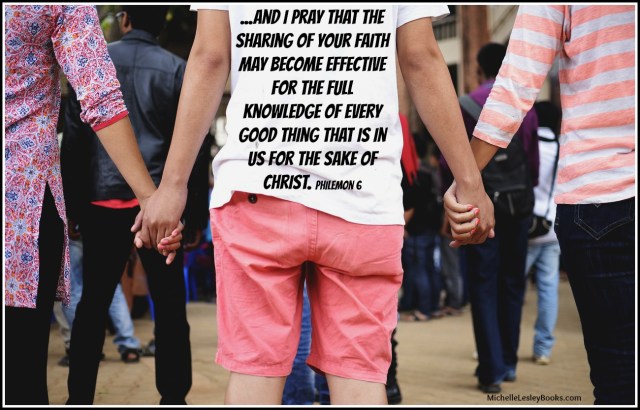
I thank my God always when I remember you in my prayers, because I hear of your love and of the faith that you have toward the Lord Jesus and for all the saints, and I pray that the sharing of your faith may become effective for the full knowledge of every good thing that is in us for the sake of Christ. For I have derived much joy and comfort from your love, my brother, because the hearts of the saints have been refreshed through you.

Accordingly, though I am bold enough in Christ to command you to do what is required, yet for love’s sake I prefer to appeal to you—I, Paul, an old man and now a prisoner also for Christ Jesus— 10 I appeal to you for my child, Onesimus, whose father I became in my imprisonment. 11 (Formerly he was useless to you, but now he is indeed useful to you and to me.) 12 I am sending him back to you, sending my very heart. 13 I would have been glad to keep him with me, in order that he might serve me on your behalf during my imprisonment for the gospel, 14 but I preferred to do nothing without your consent in order that your goodness might not be by compulsion but of your own accord. 15 For this perhaps is why he was parted from you for a while, that you might have him back forever, 16 no longer as a bondservant but more than a bondservant, as a beloved brother—especially to me, but how much more to you, both in the flesh and in the Lord.

17 So if you consider me your partner, receive him as you would receive me. 18 If he has wronged you at all, or owes you anything, charge that to my account. 19 I, Paul, write this with my own hand: I will repay it—to say nothing of your owing me even your own self. 20 Yes, brother, I want some benefit from you in the Lord. Refresh my heart in Christ.

21 Confident of your obedience, I write to you, knowing that you will do even more than I say. 22 At the same time, prepare a guest room for me, for I am hoping that through your prayers I will be graciously given to you.

23 Epaphras, my fellow prisoner in Christ Jesus, sends greetings to you, 24 and so do Mark, Aristarchus, Demas, and Luke, my fellow workers.

25 The grace of the Lord Jesus Christ be with your spirit.


The Holy Bible, English Standard Version Copyright © 2001 by Crossway Bibles, a publishing ministry of Good News Publishers.


Questions to Consider:

1. Who is the author (1,19) of this letter, and to whom (1) was it written? Who are Onesimus and Philemon? What was the purpose of this letter?

2. What is the overall tone of this letter? Is it rebuking? Tender? Friendly? What are some words and phrases which enlighten you to Paul’s tone? What kind of relationship did Paul and Philemon have? (1, 4-7)

3. How does Paul’s instruction to Philemon to consider his returning slave as a brother in Christ (15-16) relate to Galatians 3:28? How do both of these passages speak to the issue of different roles yet equal worth in Christ? Does God’s love for you depend on your station in life?

4. What does Paul mean in verse 19 when he says Philemon owes “me even your own self”? How much do we owe to the person(s) who shared the gospel with us? Have you ever thanked God for the person who shared the gospel with you? 

5. Many people think the Bible condones the kind of slavery that was legal in the United States in earlier centuries. Does it seem as though the book of Philemon would support that assertion? Why or why not?
Guest Posts

Guest Post: A Portrait of the Heaven-Bound Slave

Since I’ve had to temporarily cut back on blogging I’ve asked some friends to contribute guest posts. If your theology pretty much matches up with mine (as outlined in the “Welcome” and “Statement of Faith” tabs) and you’d like to contribute a guest post, drop me an e-mail at MichelleLesley1@yahoo.com, and let’s chat about it.

Kesha talents

A Portrait of the Heaven-Bound Slave
By: Kesha Griffin

When you think of the character of a Christian, what comes to mind? For some, we may think of loving, patient, kindness, giving, self-less, etc. (at least I hope this describes most Christians you know). Although all of these characteristics are important, I think many of us overlook one trait that our Lord often spoke about and held in high regard…faithfulness. In fact, the Bible teaches us that faithfulness (to the Word, to God, to His work) is a mark of a true believer. Sadly, we often hear how faithful God is to us (and He is), but rarely hear about the importance of being a faithful servant to our Master.

The Parable of the Talent is a great depiction of a faithful Christian. In Matthew 25:14-30, Jesus is speaking to His disciples about the kingdom of heaven and begins telling them this parable of the talents. The parable involves a master, his three slaves, and the master’s talents (a measurement of gold, silver, money, etc.).The master represents Christ and the slaves represent believers and unbelievers. The story as told by Jesus, says the master was going away on a journey, and entrusted his slaves with his talents to manage while he was away. When the master returns home from his journey, his slaves show him what they did with the talents they were given.

Let’s examine the slaves in more detail:

#1- The Slave’s Portion
The master gave each slave a talent. The talent did not belong to the slave, it was entrusted to the slave. It belonged to the master (vs 14). Also notice, that the master gave each slave the amount he wanted them to have; One slave had five talents, one had two talents, and the other slave was given one talent. Finally, notice that the amount of the talents given to each slave was given according to their own ability (vs 15). The slaves didn’t ask the master to give them a certain amount of talents, the master decided how much, and to whom.

#2- The Slave’s Character
In the parable, two of the slaves immediately went out and starting working. This implies they had a sense of urgency, didn’t waste any time, and were eager to do the work of their master. It also appears these slaves were hard-working, searched for opportunity, put in effort, for the Scripture says they “went and traded” (vs 16). Lastly, not only did these slaves spend their time working diligently for their master, they found opportunities to make more for their master. They both doubled what was initially given to them.

The parable also reveals the character of the last slave. Although this slave was only given one talent, he went away, dug a hole and hid the money (vs 18). This implies that he didn’t want to work, there was no sense of urgency, and no desire to please his master. In fact, the Scripture says, he was “lazy and wicked” (vs 26). After burying his talent in the ground, he must have spent the rest of his time doing…whatever he wanted to do. His life was free from toiling for his master, he could do as he pleased.

Not only was this slave lazy but he had several excuses as to why he didn’t work for his master. He blamed his master, to the point of attacking the master’s character, saying that his master was a “hard” man (vs 24), and he blamed fear, said he was afraid (vs 25). He also tried to cover up his lack of effort by presenting the master the one talent he was entrusted with, as if he honestly wanted to please his master (vs 25).

#3- The Slave’s Reward
The two slaves who diligently worked for their master, both doubled their portion originally entrusted to them. Notice that although one slave ended up with ten talents, and the other four talents, they both received the same reward. The master commended them both and gave them more. How thrilled the slaves must have been to fulfill their obligated duty to work for the master, and to be rewarded by Him for doing so. What joy to hear their master say “Well done, good and faithful slave. You were faithful with a few things, I will put you in charge of many things; enter into the joy of your master.” (vs 21 and 23)

Sadly, the wicked and lazy slave received condemnation and punishment from the master (vs 26-28). The one talent he had was taken and given to the slave who had the most. His master called him a worthless slave and cast him into outer darkness, a place of “weeping and gnashing of teeth” (vs 30). How tragic.

It seems like a harsh punishment for a slave who was simply lazy right? Well, let me suggest that this lazy slave was not simply lazy. He is a depiction of an unbeliever. A person who is wicked, and who doesn’t have a relationship with the Master. Notice the slave didn’t want to work or even attempt to please the master (buried the talent in the ground). He didn’t appear to know (personally/intimately) the master well, he accused the master of being a hard man. He didn’t make the most of the talent that was given to him, not even investing it in the bank to gain interest (vs 27). He was disobedient, not wanting to do as the master instructed, and lived his life for himself, not for the master.

Faithfulness is a characteristic of a true believer. Although not perfectly, are we truly living for Jesus, working diligently to make the most of all he has given us (our time, spiritual gifts, money, etc.), like a faithful slave? Is it our goal to please our Master? When Jesus comes to “settle the account” with us, will we hear the Master say “Well done my good and faithful slave…enter in”?


Kesha LOVES finding hidden treasures buried in Scripture and learning how to apply them to daily living. Her heart’s desire is that every Christian woman is equipped with sound doctrine, so that she may know God truthfully and intimately, and learn how to fight life with the sword, the Word of God. Follow Kesha at treasuresbykesha.com and on Twitter: @MrsKeshaGriffin and @treasurebyKesha.


ALTHOUGH I DO MY BEST TO THOROUGHLY VET THE THEOLOGY OF THE BLOGGERS who submit guest posts, IT IS ALWAYS POSSIBLE FOR THINGS TO SLIP THROUGH THE CRACKS. PLEASE MAKE SURE ANY BLOGGER YOU FOLLOW, INCLUDING ME, RIGHTLY AND FAITHFULLY HANDLES GOD’S WORD AND HOLDS TO SOUND BIBLICAL DOCTRINE.
Wednesday's Word

Wednesday’s Word ~ Song of Solomon 2

song of solomon 2 4

Song of Solomon 2

I am a rose of Sharon,
    a lily of the valleys.

He

As a lily among brambles,
    so is my love among the young women.

She

As an apple tree among the trees of the forest,
    so is my beloved among the young men.
With great delight I sat in his shadow,
    and his fruit was sweet to my taste.
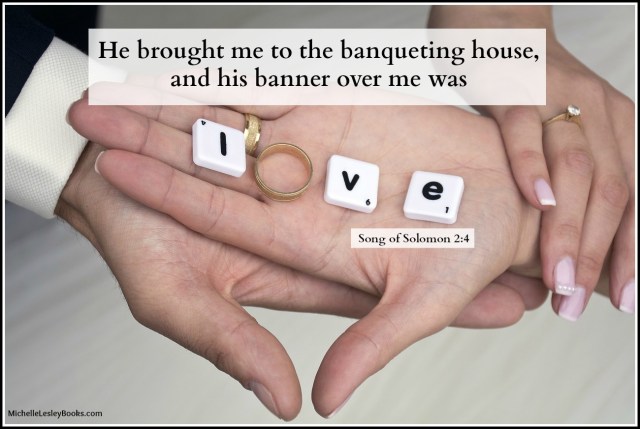
He brought me to the banqueting house,
    and his banner over me was love.
Sustain me with raisins;
    refresh me with apples,
    for I am sick with love.
His left hand is under my head,
    and his right hand embraces me!
I adjure you, O daughters of Jerusalem,
    by the gazelles or the does of the field,
that you not stir up or awaken love
    until it pleases.

The voice of my beloved!
    Behold, he comes,
leaping over the mountains,
    bounding over the hills.
My beloved is like a gazelle
    or a young stag.
Behold, there he stands
    behind our wall,
gazing through the windows,
    looking through the lattice.
10 My beloved speaks and says to me:
“Arise, my love, my beautiful one,
    and come away,
11 for behold, the winter is past;
    the rain is over and gone.
12 The flowers appear on the earth,
    the time of singing has come,
and the voice of the turtledove
    is heard in our land.
13 The fig tree ripens its figs,
    and the vines are in blossom;
    they give forth fragrance.
Arise, my love, my beautiful one,
    and come away.
14 O my dove, in the clefts of the rock,
    in the crannies of the cliff,
let me see your face,
    let me hear your voice,
for your voice is sweet,
    and your face is lovely.
15 Catch the foxes for us,
    the little foxes
that spoil the vineyards,
    for our vineyards are in blossom.”

16 My beloved is mine, and I am his;
    he grazes among the lilies.
17 Until the day breathes
    and the shadows flee,
turn, my beloved, be like a gazelle
    or a young stag on cleft mountains.


The Holy Bible, English Standard Version Copyright © 2001 by Crossway Bibles, a publishing ministry of Good News Publishers.


Questions to Consider:

1. Who wrote the book of Song of Solomon? What is the theme of this book? Which genre of biblical literature (epistle, poetry, historical narrative, etc.) is it? Why do you think God put this book into the Bible?

2. Refer back to chapter 1. Who are the “he” and “she” mentioned in chapter 2? Which person speaks the words in 2:1? (Hint: there were no chapter and verse numbers in this book when it was written.)

3. Examine the metaphors the man and woman use to describe each other. What are some of the objects each compares the other to? Why did they choose these particular objects? How does this chapter point to the importance of familiarizing ourselves with the culture and context of the Bible passages we study?

4. It has been said that the Bible has a “Victorian” or “repressed” view of sex. Do you think that’s true in light of this passage?

5. How does this passage (and the rest of Song of Solomon) fit in with God’s perspective of sex and marriage? Does it complement or conflict with passages such as 1 Corinthians 7:2-5, Hebrews 13:4, 1 Thessalonians 4:3, and Ephesians 5:22-33?


Wednesday's Word

Wednesday’s Word ~ Ecclesiastes 3

ecc 3 11

Ecclesiastes 3

For everything there is a season, and a time for every matter under heaven:

a time to be born, and a time to die;
a time to plant, and a time to pluck up what is planted;
a time to kill, and a time to heal;
a time to break down, and a time to build up;
a time to weep, and a time to laugh;
a time to mourn, and a time to dance;
a time to cast away stones, and a time to gather stones together;
a time to embrace, and a time to refrain from embracing;
a time to seek, and a time to lose;
a time to keep, and a time to cast away;
a time to tear, and a time to sew;
a time to keep silence, and a time to speak;
a time to love, and a time to hate;
a time for war, and a time for peace.

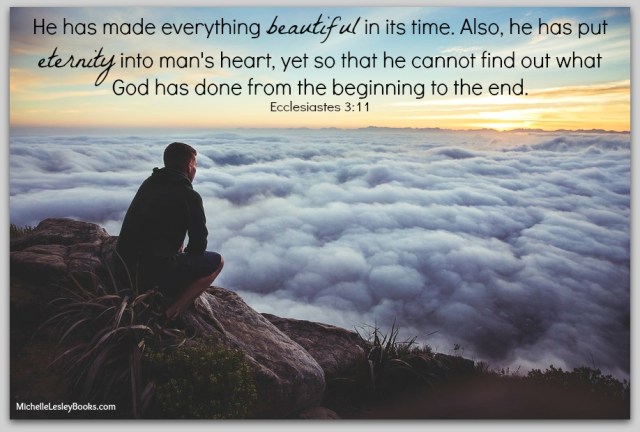
What gain has the worker from his toil? 10 I have seen the business that God has given to the children of man to be busy with. 11 He has made everything beautiful in its time. Also, he has put eternity into man’s heart, yet so that he cannot find out what God has done from the beginning to the end. 12 I perceived that there is nothing better for them than to be joyful and to do good as long as they live; 13 also that everyone should eat and drink and take pleasure in all his toil—this is God’s gift to man.

14 I perceived that whatever God does endures forever; nothing can be added to it, nor anything taken from it. God has done it, so that people fear before him. 15 That which is, already has been; that which is to be, already has been; and God seeks what has been driven away.

16 Moreover, I saw under the sun that in the place of justice, even there was wickedness, and in the place of righteousness, even there was wickedness. 17 I said in my heart, God will judge the righteous and the wicked, for there is a time for every matter and for every work. 18 I said in my heart with regard to the children of man that God is testing them that they may see that they themselves are but beasts. 19 For what happens to the children of man and what happens to the beasts is the same; as one dies, so dies the other. They all have the same breath, and man has no advantage over the beasts, for all is vanity. 20 All go to one place. All are from the dust, and to dust all return. 21 Who knows whether the spirit of man goes upward and the spirit of the beast goes down into the earth? 22 So I saw that there is nothing better than that a man should rejoice in his work, for that is his lot. Who can bring him to see what will be after him?

The Holy Bible, English Standard Version Copyright © 2001 by Crossway Bibles, a publishing ministry of Good News Publishers.

 Questions to Consider:

  1. Who wrote the book of Ecclesiastes? What is the theme of chapter 3?
  1. How would you summarize verses 1-8? What are some of the ways the New Testament says Christians should respond to joyful or difficult circumstance in our lives and in the lives of others?
  1. What does it mean that God has “put eternity into man’s heart”? (11) What does the remainder of verse 11 mean? How might the idea in this part of verse 11 connect with these other passages?
  1. What can we learn from verses 14-22 about God’s absolute sovereignty, supremacy, authority, and control over the world and the events that take place in it? Make a list of all the things, beings, and events from these verses that God is sovereign over. How can contemplating God’s sovereignty in these areas help us to have a proper, humble view of ourselves compared to Him?
  1. Taking verses 12-22 into consideration, why do verses 12, 13, and 22 encourage man to “be joyful,” “take pleasure,” and “rejoice” in his toil and work? What is the alternative? How does this relate to what the New Testament says about being joyful in work or difficulties? What impact might your joy have on an unbeliever?
Wednesday's Word

Wednesday’s Word ~ Titus 2

titus 2 3 4

Titus 2

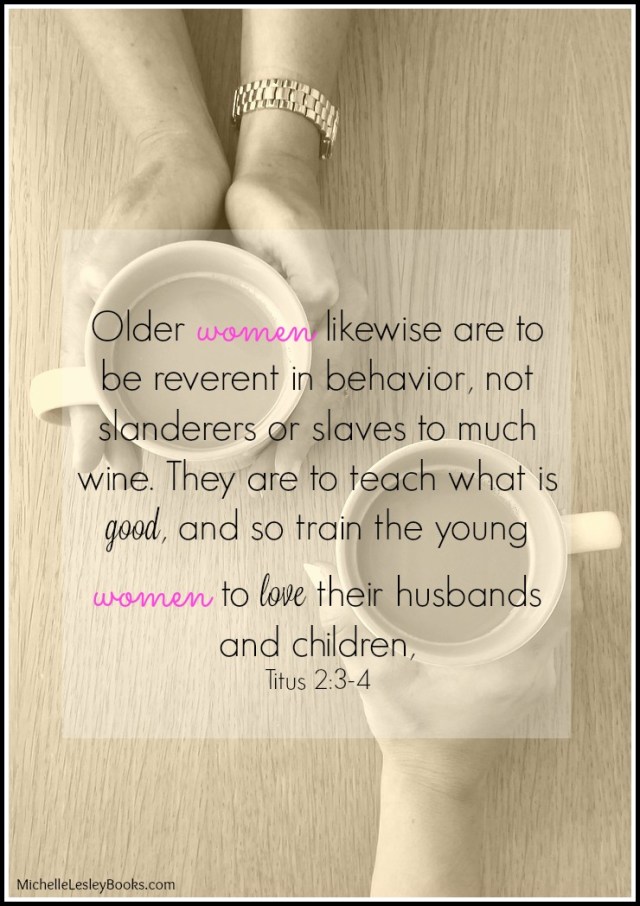
But as for you, teach what accords with sound doctrine. Older men are to be sober-minded, dignified, self-controlled, sound in faith, in love, and in steadfastness. Older women likewise are to be reverent in behavior, not slanderers or slaves to much wine. They are to teach what is good, and so train the young women to love their husbands and children, to be self-controlled, pure, working at home, kind, andsubmissive to their own husbands, that the word of God may not be reviled. Likewise, urge the younger men to be self-controlled. Show yourself in all respects to be a model of good works, and in your teaching show integrity, dignity, and sound speech that cannot be condemned, so that an opponent may be put to shame, having nothing evil to say about us. Bondservants are to be submissive to their own masters in everything; they are to be well-pleasing, not argumentative, 10 not pilfering, but showing all good faith, so that in everything they may adorn the doctrine of God our Savior.

11 For the grace of God has appeared, bringing salvation for all people, 12 training us to renounce ungodliness and worldly passions, and to live self-controlled, upright, and godly lives in the present age, 13 waiting for our blessed hope, the appearing of the glory of our great God and Savior Jesus Christ, 14 who gave himself for us to redeem us from all lawlessness and to purify for himself a people for his own possession who are zealous for good works.

15 Declare these things; exhort and rebuke with all authority. Let no one disregard you.


The Holy Bible, English Standard Version Copyright © 2001 by Crossway Bibles, a publishing ministry of Good News Publishers.


Questions to Consider:

1. Who wrote the book of Titus? Who was the audience of the book of Titus? Which genre of biblical literature is Titus (history, poetry, epistle, etc.)? What is the theme of Titus? If you have a few minutes, read the whole book – all three chapters (the longest of which is 16 verses) – of Titus.

2. In verses 2-12 Paul addresses character attributes that certain people are to display. Who are the people, and what are the attributes he mentions for each? What are the similar or dissimilar attributes these people are to display? How does the word “likewise” (3,6) connect similar attributes?

O____ M__ (2):

O____ W____ (3):

Y____ W____ (4-5):

Y____ M__ (6):

T____ (“yourself”) (7-8):

B________ (9-10):

A__ P____ (11-12):

3. Verses 3-5 outline two very important roles for older and younger women in the church. What is the role of older women? Younger women? Examine the things older women are to teach and younger women are to learn. What are some practical ways you can carry out these instructions in your life and in the church as an older or younger woman?

4. How can we apply Paul’s instructions to “bondservants” (9-10) to our lives today? What can we learn from these verses about being a godly employee?

5. What do verses 5, 8, 10, and 14, tell us is the reason for believers to be people of godly character? What is the main idea of this chapter?