Wednesday's Word

What’s Next on Wednesday’s Word?

13221149_1091405254239576_5911044701918356749_o

Ladies-

Tomorrow we’ll be finishing up our study of the book of Ezra on Wednesday’s Word, so starting next week, September 7, it’s on to something new! What would you like to study?

A few suggestions:

1. We could continue on to Nehemiah and finish the current storyline.

2. We could do another Old Testament or New Testament book.

3. We could do a topical study on something like prayer, the Fruit of the Spirit, a particular Bible character, etc.

So, let’s hear it. What would you like to study next on Wednesday’s Word? Comment below with your thoughts.

Ezra Bible Study

Ezra: Lesson 10

ezra-study-e1465330077513

Previous Lessons: 1, 2, 3, 4, 5, 6, 7, 8, 9

Ezra 9

After these things had been done, the officials approached me and said, “The people of Israel and the priests and the Levites have not separated themselves from the peoples of the lands with their abominations, from the Canaanites, the Hittites, the Perizzites, the Jebusites, the Ammonites, the Moabites, the Egyptians, and the Amorites. For they have taken some of their daughters to be wives for themselves and for their sons, so that the holy race has mixed itself with the peoples of the lands. And in this faithlessness the hand of the officials and chief men has been foremost.” As soon as I heard this, I tore my garment and my cloak and pulled hair from my head and beard and sat appalled.Then all who trembled at the words of the God of Israel, because of the faithlessness of the returned exiles, gathered around me while I sat appalled until the evening sacrifice. And at the evening sacrifice I rose from my fasting, with my garment and my cloak torn, and fell upon my knees and spread out my hands to the Lord my God, saying:

“O my God, I am ashamed and blush to lift my face to you, my God, for our iniquities have risen higher than our heads, and our guilt has mounted up to the heavens. From the days of our fathers to this day we have been in great guilt. And for our iniquities we, our kings, and our priests have been given into the hand of the kings of the lands, to the sword, to captivity, to plundering, and to utter shame, as it is today. But now for a brief moment favor has been shown by the Lord our God, to leave us a remnant and to give us a secure hold within his holy place, that our God may brighten our eyes and grant us a little reviving in our slavery. For we are slaves. Yet our God has not forsaken us in our slavery, but has extended to us his steadfast love before the kings of Persia, to grant us some reviving to set up the house of our God, to repair its ruins, and to give us protection in Judea and Jerusalem.

10 “And now, O our God, what shall we say after this? For we have forsaken your commandments,11 which you commanded by your servants the prophets, saying, ‘The land that you are entering, to take possession of it, is a land impure with the impurity of the peoples of the lands, with their abominations that have filled it from end to end with their uncleanness. 12 Therefore do not give your daughters to their sons, neither take their daughters for your sons, and never seek their peace or prosperity, that you may be strong and eat the good of the land and leave it for an inheritance to your children forever.’ 13 And after all that has come upon us for our evil deeds and for our great guilt, seeing that you, our God, have punished us less than our iniquities deserved and have given us such a remnant as this, 14 shall we break your commandments again and intermarry with the peoples who practice these abominations? Would you not be angry with us until you consumed us, so that there should be no remnant, nor any to escape? 15 O Lord, the God of Israel, you are just, for we are left a remnant that has escaped, as it is today. Behold, we are before you in our guilt, for none can stand before you because of this.”


The Holy Bible, English Standard Version Copyright © 2001 by Crossway Bibles, a publishing ministry of Good News Publishers.


Questions to Consider:

1. Ezra and the second wave of exiles had made it back to Jerusalem safely, but everything was not hunky dory. In your own words, summarize the dilemma this chapter deals with.

2. Which specific sin does this chapter address? (1-2) Which classes of Israelites had intermarried with foreigners? (1) Which class was leading the way in the sin of intermarriage? (2b) How does it affect God’s people when their leaders set a bad example by sinning? Why is it important today that pastors and elders are required to be “above reproach“?

3. What was the first thing Ezra did when he was informed of the intermarriages? (3-4) What did the people who feared God and had not sinned by intermarrying do? (4) Why do you think they did this? What was the second thing Ezra did? (5) Compare and contrast Ezra’s leadership and example with the leadership and example of the “officials and chief men” (2).

4. Why did Ezra react with such grief and repentance over the intermarriages? (7, 10-12a, 14) What are the “abominations” referred to in verses 11 and 14? Read 2 Corinthians 7:10. Does Ezra’s grief seem godly (grief over offending God) or worldly (solely afraid of sin’s consequences)? Did Ezra confess and seek forgiveness for his own sin or the people’s sin?

5. In what (spiritual) posture does Ezra approach God in prayer? (6a) Ezra’s prayer can be broken down into several smaller sections:

6-7 Admission of Israel’s G____t

8-9- Acknowledgement of God’s G___ness

10-12- Confession of Israel’s specific S_n

13-14- Recognition that Israel deserves P_____ment

15- Petition for God’s M___y

How can Ezra’s prayer serve as a model to us when we repent of our sin and ask God’s forgiveness?

6. To whom does the phrase “holy race” (2) refer? Does the word “race” in this phrase mean skin color? Some people try to use verses like this to support the fale teaching of Kinism. Considering the historical background and context of this chapter, can verse 2 be used to support banning interracial marriage and segregating worship in the church today? Why not? How does this demonstrate the importance of understanding and using Scripture in context?

Ezra Bible Study

Ezra: Lesson 9

ezra-study-e1465330077513

Previous Lessons: 1, 2, 3, 4, 5, 6, 7, 8

Ezra 8

These are the heads of their fathers’ houses, and this is the genealogy of those who went up with me from Babylonia, in the reign of Artaxerxes the king: Of the sons of Phinehas, Gershom. Of the sons of Ithamar, Daniel. Of the sons of David, Hattush. Of the sons of Shecaniah, who was of the sons of Parosh, Zechariah, with whom were registered 150 men. Of the sons of Pahath-moab, Eliehoenai the son of Zerahiah, and with him 200 men. Of the sons of Zattu, Shecaniah the son of Jahaziel, and with him 300 men. Of the sons of Adin, Ebed the son of Jonathan, and with him 50 men. Of the sons of Elam, Jeshaiah the son of Athaliah, and with him 70 men. Of the sons of Shephatiah, Zebadiah the son of Michael, and with him 80 men. Of the sons of Joab, Obadiah the son of Jehiel, and with him 218 men. 10 Of the sons of Bani, Shelomith the son of Josiphiah, and with him 160 men. 11 Of the sons of Bebai, Zechariah, the son of Bebai, and with him 28 men. 12 Of the sons of Azgad, Johanan the son of Hakkatan, and with him 110 men. 13 Of the sons of Adonikam, those who came later, their names being Eliphelet, Jeuel, and Shemaiah, and with them 60 men. 14 Of the sons of Bigvai, Uthai and Zaccur, and with them 70 men.

15 I gathered them to the river that runs to Ahava, and there we camped three days. As I reviewed the people and the priests, I found there none of the sons of Levi. 16 Then I sent for Eliezer, Ariel, Shemaiah, Elnathan, Jarib, Elnathan, Nathan, Zechariah, and Meshullam, leading men, and for Joiarib and Elnathan, who were men of insight, 17 and sent them to Iddo, the leading man at the place Casiphia, telling them what to say to Iddo and his brothers and the temple servants at the place Casiphia, namely, to send us ministers for the house of our God. 18 And by the good hand of our God on us, they brought us a man of discretion, of the sons of Mahli the son of Levi, son of Israel, namely Sherebiah with his sons and kinsmen, 18; 19 also Hashabiah, and with him Jeshaiah of the sons of Merari, with his kinsmen and their sons, 20; 20 besides 220 of the temple servants, whom David and his officials had set apart to attend the Levites. These were all mentioned by name.

21 Then I proclaimed a fast there, at the river Ahava, that we might humble ourselves before our God,to seek from him a safe journey for ourselves, our children, and all our goods. 22 For I was ashamed to ask the king for a band of soldiers and horsemen to protect us against the enemy on our way, since we had told the king, “The hand of our God is for good on all who seek him, and the power of his wrath is against all who forsake him.” 23 So we fasted and implored our God for this, and he listened to our entreaty.

24 Then I set apart twelve of the leading priests: Sherebiah, Hashabiah, and ten of their kinsmen with them. 25 And I weighed out to them the silver and the gold and the vessels, the offering for the house of our God that the king and his counselors and his lords and all Israel there present had offered. 26 I weighed out into their hand 650 talents of silver, and silver vessels worth 200 talents, and 100 talents of gold, 27 20 bowls of gold worth 1,000 darics, and two vessels of fine bright bronze as precious as gold. 28 And I said to them, “You are holy to the Lord, and the vessels are holy, and the silver and the gold are a freewill offering to the Lord, the God of your fathers. 29 Guard them and keep them until you weigh them before the chief priests and the Levites and the heads of fathers’ houses in Israel at Jerusalem, within the chambers of the house of the Lord.” 30 So the priests and the Levites took over the weight of the silver and the gold and the vessels, to bring them to Jerusalem, to the house of our God.

31 Then we departed from the river Ahava on the twelfth day of the first month, to go to Jerusalem. The hand of our God was on us, and he delivered us from the hand of the enemy and from ambushes by the way. 32 We came to Jerusalem, and there we remained three days. 33 On the fourth day, within the house of our God, the silver and the gold and the vessels were weighed into the hands of Meremoth the priest, son of Uriah, and with him was Eleazar the son of Phinehas, and with them were the Levites, Jozabad the son of Jeshua and Noadiah the son of Binnui. 34 The whole was counted and weighed, and the weight of everything was recorded.

35 At that time those who had come from captivity, the returned exiles, offered burnt offerings to the God of Israel, twelve bulls for all Israel, ninety-six rams, seventy-seven lambs, and as a sin offering twelve male goats. All this was a burnt offering to the Lord. 36 They also delivered the king’s commissions to the king’s satraps and to the governors of the province Beyond the River, and they aided the people and the house of God.


The Holy Bible, English Standard Version Copyright © 2001 by Crossway Bibles, a publishing ministry of Good News Publishers.


Questions to Consider:

1. Ezra was about to return from Babylon to Jerusalem bringing the second wave of exiles with him. What are some practical reasons it might have been important for Ezra to make this list of returnees and their genealogy? (1-14) What are some other reasons God includes census lists and genealogies in the Bible? How does this list demonstrate that God is a God of order and detail? Can you think of other examples of God’s orderliness and attention to detail?

2. Stop and consider for a moment that each name listed in verses 1-14 represents a real, flesh and blood person that God loved and cared for individually. Now consider how He loves and cares for you in a personal, individual way and spend some time thanking and praising Him for that.

3. Who were the sons of Levi (15) and why was it important that they be found and brought along (17b)? Why couldn’t just any willing person do what the Levites had always done? Compare the Old Testament requirements for Levites with the New Testament requirements for pastors, elders, and deacons. How do these passages demonstrate to us that God wants the church to be structured and run, and for His people to conduct themselves, in a decent and orderly way?

4. What did Ezra lead the people to do before starting on their journey back to Jerusalem and why? (21-23) What does this passage teach us about the necessity of humility, prayer, and dependence on God? How did Ezra’s actions show concern for protecting God’s reputation and demonstrating His power in the sight of pagans? How did God answer their prayer? (31) Can you think of a comparable situation in your own life when you have depended on God and lost people were able to see God’s faithfulness, power, or protection as a result? How might this have been an opportunity to share the gospel with those lost people?

5. Summarize verses 24-34 in your own words. How is this another example of God’s people acting in an orderly way? Consider Ezra’s emphasis on holiness in verse 28. In what ways should we emphasize holiness in the church, in our pastors and other church leaders, and in our own lives today? Do we take our churches and our ministry responsibilities as seriously and reverently as the priests in this passage?

6. How did the people respond to God giving them a safe journey to Jerusalem? (35-36) Notice that this is a corporate (all the people gathered together) time of worship, thanksgiving, celebration, and repentance. Does your church have similar times of corporate worship and thanksgiving? How did/does this build fellowship and biblical unity among God’s people? How did it serve to remind Israel (and us today) that God alone gets the glory in all our circumstances?

Ezra Bible Study

Ezra: Lesson 8

ezra-study-e1465330077513

Previous Lessons: 1, 2, 3, 4, 5, 6, 7

Chronologically, the book of Esther fits right here between Ezra 6 – the completion of the temple – and Ezra 7 – the second wave of returning exiles under Ezra’s leadership. If you’d like to read through the book of Esther, click here.


Ezra 7

Now after this, in the reign of Artaxerxes king of Persia, Ezra the son of Seraiah, son of Azariah, son of Hilkiah, son of Shallum, son of Zadok, son of Ahitub, son of Amariah, son of Azariah, son of Meraioth, son of Zerahiah, son of Uzzi, son of Bukki, son of Abishua, son of Phinehas, son of Eleazar, son of Aaron the chief priest— this Ezra went up from Babylonia. He was a scribe skilled in the Law of Moses that the Lord, the God of Israel, had given, and the king granted him all that he asked, for the hand of the Lord his God was on him.

And there went up also to Jerusalem, in the seventh year of Artaxerxes the king, some of the people of Israel, and some of the priests and Levites, the singers and gatekeepers, and the temple servants.And Ezra came to Jerusalem in the fifth month, which was in the seventh year of the king. For on the first day of the first month he began to go up from Babylonia, and on the first day of the fifth month he came to Jerusalem, for the good hand of his God was on him. 10 For Ezra had set his heart to study the Law of the Lord, and to do it and to teach his statutes and rules in Israel.

11 This is a copy of the letter that King Artaxerxes gave to Ezra the priest, the scribe, a man learned in matters of the commandments of the Lord and his statutes for Israel: 12 “Artaxerxes, king of kings, to Ezra the priest, the scribe of the Law of the God of heaven. Peace. And now 13 I make a decree that anyone of the people of Israel or their priests or Levites in my kingdom, who freely offers to go to Jerusalem, may go with you. 14 For you are sent by the king and his seven counselors to make inquiries about Judah and Jerusalem according to the Law of your God, which is in your hand, 15 and also to carry the silver and gold that the king and his counselors have freely offered to the God of Israel, whose dwelling is in Jerusalem, 16 with all the silver and gold that you shall find in the whole province of Babylonia, and with the freewill offerings of the people and the priests, vowed willingly for the house of their God that is in Jerusalem. 17 With this money, then, you shall with all diligence buy bulls, rams, and lambs, with their grain offerings and their drink offerings, and you shall offer them on the altar of the house of your God that is in Jerusalem. 18 Whatever seems good to you and your brothers to do with the rest of the silver and gold, you may do, according to the will of your God. 19 The vessels that have been given you for the service of the house of your God, you shall deliver before the God of Jerusalem.20 And whatever else is required for the house of your God, which it falls to you to provide, you may provide it out of the king’s treasury.

21 “And I, Artaxerxes the king, make a decree to all the treasurers in the province Beyond the River: Whatever Ezra the priest, the scribe of the Law of the God of heaven, requires of you, let it be done with all diligence, 22 up to 100 talents of silver, 100 cors of wheat, 100 baths of wine, 100 baths of oil, and salt without prescribing how much. 23 Whatever is decreed by the God of heaven, let it be done in full for the house of the God of heaven, lest his wrath be against the realm of the king and his sons.24 We also notify you that it shall not be lawful to impose tribute, custom, or toll on anyone of the priests, the Levites, the singers, the doorkeepers, the temple servants, or other servants of this house of God.

25 “And you, Ezra, according to the wisdom of your God that is in your hand, appoint magistrates and judges who may judge all the people in the province Beyond the River, all such as know the laws of your God. And those who do not know them, you shall teach. 26 Whoever will not obey the law of your God and the law of the king, let judgment be strictly executed on him, whether for death or for banishment or for confiscation of his goods or for imprisonment.”

27 Blessed be the Lord, the God of our fathers, who put such a thing as this into the heart of the king, to beautify the house of the Lord that is in Jerusalem, 28 and who extended to me his steadfast love before the king and his counselors, and before all the king’s mighty officers. I took courage, for the hand of the Lord my God was on me, and I gathered leading men from Israel to go up with me.


The Holy Bible, English Standard Version Copyright © 2001 by Crossway Bibles, a publishing ministry of Good News Publishers.


Questions to Consider:

1. What does the phrase, “Now after this” in verse 1 indicate? The temple was completed in 516 B.C., and the second wave of exiles returned to Jerusalem under Ezra’s leadership in 458 B.C. How many years transpired between the end of Ezra 6 and the beginning of Ezra 7?

2. Examine the three major aspects of Ezra’s pedigree in verses 1-6, 11. What do verses 1-5 tell us about his background? What do verses 6a and 11 tell us about his qualifications? What is the very last statement about Ezra in verse 6? Why did the king grant Ezra all he asked? Was it his genealogy, his professional qualifications, or the hand of God being upon him? Does this mean Ezra’s background and skills weren’t relevant to the work God had for him? How might your background and skills be relevant to the good works God has prepared for you to walk in? But how is having “the hand of the Lord your God” upon you more important?

3. Three times in this chapter (6, 9, 28), Ezra says that “the hand of God was on him.” What does this phrase say about God? About Ezra? Is Ezra bragging on himself or giving glory to God by saying this? How does Ezra sum up this chapter and whom does he credit with the outcome of the king’s actions and decisions? (27-28) How can we give glory to God in a similar way as we talk to others about Christ?

4. Compare verse 10 with 1 Timothy 3:1 and James 3:1. What can we learn from these verses about teaching God’s word to others?

5. Examine the ways King Artaxerxes refer to God in verses…

12, 21, 23- the God of ____

15- the God of ___

16, 17- ____ God that is ___

18, 19, 20- ___ God

What does the way Artaxerxes talked about God tell us about his beliefs about God? What does the way you talk about God tell others about your beliefs about Him? What was Artaxerxes’ motive for being so generous to Ezra and Israel? (23) Why would Artaxerxes have wanted the people to learn and obey God’s law? (25-26) How did God’s sovereignty play into Artaxerxes’ actions and decisions? (6b, Proverbs 21:1) Is God still sovereign over our earthly leaders today?

Church, Discernment

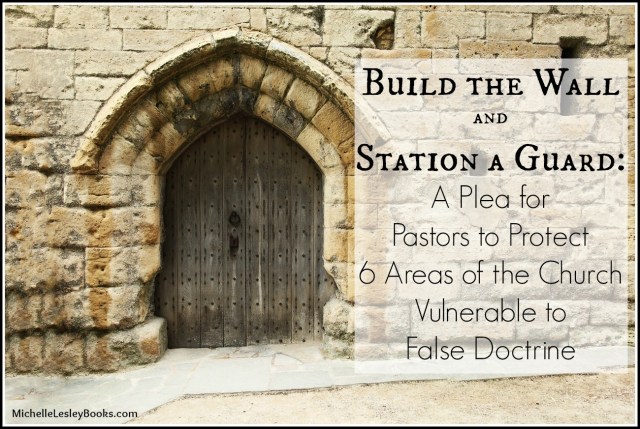
Build the Wall and Station a Guard: A Plea for Pastors to Protect 6 Areas of the Church Vulnerable to False Doctrine

Pastors, your church is vulnerable to false doctrine in these 6 areas. Here's how you can protect it.

The Great Wall of China

The Wailing Wall

The walls of Jericho

Walls. Sometimes they go up, and sometimes they come a tumblin’ down. When I was a kid it was, “Mr. Gorbachev, tear down this wall!” Now it’s, “Elect me and I’ll build a wall between the United States and Mexico.”

There was a time in history when it was common practice for a city to have a wall built around its perimeter. Walls have historically been built for protection, to keep inhabitants safe from attacking marauders. When Israel returned to Jerusalem after Babylonian captivity, their first priority was to rebuild the altar – their focal point of worship. Next came the temple – to consecrate, or set apart, their worship. And, finally, the city wall – which protected everything, including their worship.

Today, when Christians plant a church, we start off with our focal point of worship, the author and finisher of our faith, Jesus Christ. He is the foundation of the church, the center of our worship, our rallying point.

As the church grows, we consecrate it, setting it apart from other organizations and gatherings by buying or constructing its own special building. It’s not a store or an office or a restaurant. It’s a church. It’s where believers gather to worship, fellowship, and be trained in God’s word.

But somehow we never get around to protecting our churches from enemy attack. Indeed, it hardly ever occurs to most pastors and church members that there’s a need for a wall.

But there is. A huge need. And for some churches, it’s already too late.

Pastor, I plead with you- it’s time to build a wall around your church. A “walls of Jericho”-high wall. A chariot races on top- thick wall. And an armed guard posted at the gate. Not to keep out visitors or people who might look or act differently from your congregation- God forbid! It’s to keep out the false doctrine that’s infiltrating and attacking the Body in so many ways. And some areas of your wall are going to need extra fortification because they’re protecting these six vulnerable areas.

1. The Preaching of the Word

Pastor, the buck starts and stops with you. Are you preaching the Word? In season and out of season? Are you rightly handling God’s word? Preaching sound doctrine and rebuking those who contradict it? Declaring the whole counsel of God? Or is your focus on preaching to entertain, to keep people happy, to encourage giving, or to keep from rocking the boat? Only you can answer these questions. Strong preaching is the first step in building a strong wall to protect your church.

2. The Teaching of the Word

How much do you know about how, and what, your Sunday School, Bible study, or other small group leaders teach? Have you ever observed, evaluated, or interviewed any of your teachers? Does your church have any formal qualifications for teachers? Are they required to go through any sort of training? Who are their spiritual influencers? Which celebrity pastors and authors are they recommending to their classes?

A teacher who is listening to or reading materials by false teachers during the week is going to have her theology shaped by those false teachers, and she’s going to bring that warped theology into the classroom where it will infect the students. A teacher whose main discussion questions are, “How do you feel about this verse?” or “What does this verse mean to you?” is not handling God’s word properly and, thus, not properly training her students. Find out what’s going on in your Sunday School classrooms, and strengthen your wall by strengthening your teachers.

3. Sunday School/Small Group Curricula

Because so few teachers are properly trained, churches tend to rely heavily on the Sunday School curricula to do the actual teaching. Have you examined your curricula lately? Are the lessons anchored in copious amounts of rightly exposited Scripture or are they mainly comprised of inspirational stories and illustrations? Are the discussion questions watered down pablum or do they challenge people to think and search the Scriptures for understanding? Does the curriculum recommend supplementary materials or music from doctrinally sound, or questionable, sources? Does the curriculum recommend “homework assignments” that include unbiblical practices such as contemplative prayer or yoga? Build a solid wall with solid curricula.

4. Women’s Bible Study

This is an area of your wall which needs major fortification. In many churches, it is the primary avenue through which false teaching infiltrates the Body. Is your women’s ministry using studies or materials by a best selling author like Beth Moore, Priscilla Shirer, Christine Caine, Joyce Meyer, Lysa TerKeurst (Proverbs 31), Jen Hatmaker, Lisa Harper, Lisa Bevere, Victoria Osteen, Jennie Allen, Rachel Held Evans, Ann Voskamp, Sheila Walsh, or anyone with “Jakes” in her name? Are they attending conferences, retreats, or simulcasts headlined by any of these people? Then the women of your church are being taught false doctrine. Your men’s Bible study curriculum also needs to be examined, but women’s Bible study is a major foothold of false doctrine.

5. Music

If your church uses KLOVE’s playlist to formulate its worship set, you’re probably importing false doctrine right into your worship service. You’ve got to vet both the lyrics (hymns don’t get a pass on this, by the way) and the artists for sound theology. When it comes to contemporary worship music, the most popular and common sources of false doctrine are Hillsong, Elevation, and Bethel/Jesus Culture. Here’s another good resource.

6. Ecumenism

Is your church partnering or fellowshipping with other local churches outside your own denomination? Are you thoroughly familiar with their beliefs and practices? Are those beliefs and practices biblical? Where do they stand on female pastors, elders, and teachers? Homosexuals as church members or leaders? Abortion? The inerrancy, infallibility, and supremacy of Scripture? Extra-biblical revelation? Signs and wonders? Works righteousness? Do they have a biblical statement of faith “on paper” but stray from it in practice? Not every organization that calls itself a Christian church actually is one by biblical standards, and we are not to partner or fellowship with those whose beliefs and practices do not line up with Scripture.

That’s a lot of vetting to do for a pastor who’s probably already overwhelmed and stretched thin. May I make a suggestion? Don’t try to do it alone. After all, those cities with protective walls hired soldiers to guard the gates. Is there an associate pastor who could take on vetting curricula and fellow churches and conference speakers? Is there a mature, discerning layman or woman you trust who would be willing to lend a hand with researching your music or women’s Bible study books? Do you have a “master teacher” capable of training your Sunday School and small group teachers? Ask your people for help. Use the able. Train the willing. Get that wall built to shut out false doctrine, and station your armed guards at the gates to check out everything that comes in.

The enemy is out there, dear pastor. Let’s make sure that’s where he stays.