Women of Genesis Bible Study

The Women of Genesis: Lesson 10

Previous Lessons: 1, 2, 3, 4, 5, 6, 7, 89

๐Ÿ“–๐Ÿ“–๐Ÿ“–๐Ÿ“–๐Ÿ“–

Read Genesis 13-15

๐Ÿ“–๐Ÿ“–๐Ÿ“–๐Ÿ“–๐Ÿ“–


Questions to Consider

1. Briefly review lesson 9 (link above) about Sarah. Other than 13:1, this week’s passage does not mention Sarah. But as you read 13-15, read it understanding that, even though she is not mentioned, Sarah is experiencing all these things in some form or fashion because she’s married to Abraham. So, we learn from 13:1 that Sarah again had to pack up and move. In 13:2-7, we learn that Sarah was wealthy and likely managed a large household. Write down what else you can – carefully and reasonably – surmise about Sarah from chapters 13-15.

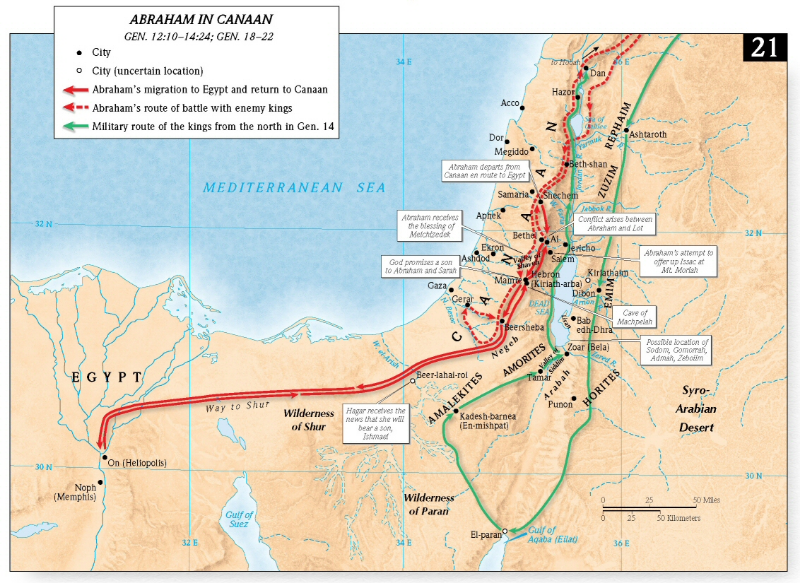
2. What/where was “the Negeb“? (13:1)? Trace Abraham’s, Sarah’s, and Lot’s trip from Egypt (13:1) back to “between Bethel and Ai” (13:2) on the map below. Find the remainder of the locations mentioned in 13-15 on the map.
3. Read Proverbs 3:5-6. How do we see Abraham trusting God and God directing Abraham’s paths in chapter 13? Canaan, where Abraham settled (13:12), eventually became known as what? How does chapter 13 demonstrate God’s sovereignty?

4. What does chapter 13 teach us about making wise and godly decisions? Can you look back on an incident in your life where you had to trust the Lord and make the wisest, most God-honoring decision you could? How did God “direct your paths” in that situation?

5. List all of the things God promised Abraham in chapters 13-15. Can you find the passages of Scripture where these promises came true?

6. Examine the instances in chapters 13-15 where Abraham worshiped the Lord. How would you characterize his worship? What caused him to worship?

7. Compare 15:6 to Romans 4 and Galatians 3. What does the Holy Spirit want New Testament Believers to understand about faith from Abraham’s example?

8. Compare and contrast Abraham’s interaction with God in chapter 15 about what God was promising him to Zechariah’s interaction with God about what God was promising him. How were Abraham’s and Zechariah’s reactions to God’s promises similar? How were they different? How and why did God react differently to Abraham’s questions than to Zechariah’s questions?


Homework

Compare Genesis 14:17-24 with Hebrews 7. How is Melchizedek a type of Christ? Why would the writer of Hebrews (14:13) refer his audience back to Melchizedek as an illustration of Christ as eternal high priest?


Suggested Memory Verse

And [Abram] believed the Lord, and he counted it to him as righteousness.
Genesis 15:6

Women of Genesis Bible Study

The Women of Genesis: Lesson 9- Sarah

Previous Lessons: 1, 2, 3, 4, 5, 6, 7, 8

๐Ÿ“–๐Ÿ“–๐Ÿ“–๐Ÿ“–๐Ÿ“–

Read Genesis 11:27-12:20

๐Ÿ“–๐Ÿ“–๐Ÿ“–๐Ÿ“–๐Ÿ“–


Questions to Consider

1. What facts can we glean about Sarah from this passage? What was her original name? (11:29) Who were her family members? (11:27-29, 31) Where was she originally from, and where did she move to? (11:28,31) What was her physical condition (11:30) and why is this “backstory” being given to us? (12:7) What was Sarah’s physical appearance like? (12:11,14)

Click for larger view

2. We can learn more about Sarah from other passages of Scripture. What does the name Saraiย (see footnote) mean? What was Sarah’s familial relationship to Abraham? How old did Sarah live to be? How does Paul use Sarah as an allegorical example in Galatians? How does Hebrews describe Sarah’s faith? How does Peter hold Sarah up as a godly example to Christian women? Overall, how does the Holy Spirit frame and describe Sarah’s character in the New Testament? Does this mean her thoughts and behavior were always flawless?

3. Consider that Sarah, though sinful and imperfect in many ways, is spoken of by the Holy Spirit in the New Testament as a woman of faith and godly character, and an example to be looked up to by Christian women. Does this bring you comfort and reassurance as a sinful and imperfect, yet faithful, follower of Christ? What are some ways you can set a godly example for other Christian women even though you sometimes stumble into sin? How will God speak of your faith and character at the end of your life?

4. While the events in Genesis 11-12 are told from Abraham’s perspective, Sarah, his wife was right there with him, experiencing those same events. Consider the following parts of the story from Sarah’s perspective:

Barrenness (11:30):ย In a patriarchal society in which women established status largely by bearing sons, what might Sarah have thought about being barren?

Traveling and relocating (12:1-9): Examine the map above. Strange lands she’d never been to before. Strange and possibly hostile people. How far would Sarah and her family have had to travel? What might have been some of Sarah’s concerns for her family?

God’s promises and instructions (12:1-3,7): What questions might Sarah have had about her role in God’s promises to Abraham, how her barrenness would affect God’s promise for offspring, and how it would all play out once God’s promises were fulfilled?

Trusting, obeying, and worshiping God (12:1-9): In instructing Abraham, God was also instructing Sarah, as his wife, to obey and follow Him. What were some ways Sarah would have had to obey God? How could she have served as a helper to her husband? How would she have needed to trust God? How would trusting and obeying God have led to worship for Sarah, right alongside her husband? (7,8) How might Sarah’s relationship with God have grown through this experience?

5. Examine 12:10-20. Summarize the story in your own words. What did Abraham ask Sarah to tell the Egyptians in verse 13? Why? Was this true? What can we learn from this story about honesty, deception, and half truths? How did Abraham’s deception put Sarah in danger? In what way did Abraham put his own needs ahead of Sarah’s well-being? How might Abraham’s actions have damaged his relationship with his wife?

6. Compare Abraham’s trust in God in 12:1-9 with his lack of trust in God in 12:10-20.

7. In what ways did Sarah have to trust God and trust her husband in 12:1-9? In what ways did she have to trust God and trust her husband in 12:10-20? Was Abraham acting in a trustworthy way in both of these instances? Why or why not?

8. Have you ever had to trust God through a situation in which your husband, parent, or someone else you depended on, wasn’t acting trustworthy? What did this teach you about God and His trustworthiness and dependability?

9. True or false: “In some ways and at some times Sarah may have had to trust God even more than Abraham did.”? Why?


Homework

How can trusting God through a difficult time lead you to worship Him? Describe a trial you’ve been through and how you trusted God in the midst of it. Take some time to worship God for the specific ways He carried you through that trial: how He provided for you, comforted you, strengthened you, and encouraged you.


Suggested Memory Verse

Then the Lord appeared to Abram and said, โ€œTo your offspring I will give this land.โ€ So he built there an altar to the Lord, who had appeared to him.
Genesis 12:7

Mailbag

The Mailbag: How do I move on after God says “no”?


I loved your article, When God Says “No”. I have a question though: At what point do you move on from the hope or desire? Iโ€™m a single mother and feel that I will always have a natural desire for a spouse and I will always desire that for my young children, but the Lord has not provided this for me. At what point do you stop asking for the thing, weep deeply over the life you hoped would be, and move forward?

A dear reader asked this in the comments section of my articleย When God Says No, and I wanted to share my answer to her here onย The Mailbag, because I think it’s something a lot of us struggle with.

When God seems to be saying no to a desire, I think thereโ€™s a sense in which moving forward is something you do over and over again every day until or unless God takes that desire away. Taking life โ€œone day at a timeโ€ sounds clichรฉ, but if youโ€™ll look at the way Jesus teaches, thatโ€™s very much the mindset He wants us to have.

In the Lordโ€™s Prayer, Jesus instructs us to ask for daily bread. This is an echo of the manna God provided in the wilderness on a daily basis. Later in the Sermon on the Mount, Jesus teaches us not to be anxious for the things we donโ€™t have and not to worry about the future. โ€œTherefore do not be anxious about tomorrow, for tomorrow will be anxious for itself. Sufficient for the day is its own trouble.โ€ He says.

Those passages are hard for me because Iโ€™m a planner, and I donโ€™t like surprises. I like to have everything mapped out and know in advance whatโ€™s going to happen so I can feel secure. But I’ve found that when I’m secure and everything is going well and I don’t really have any problems or unfulfilled desires, I tend to pray less. Depend on God less. Needย Him less. And God knows that, more than anything we might desire, what we really need is to need Him.ย So God does the “daily” thing. God likes for us to get up every day and depend on Him for that day.

So I think what you โ€“ what all of us โ€“ need to do is get up tomorrow morning, spend time with the Lord, and ask Him to help us honor and glorify Him through our words, actions, decisions, etc., that day. Then, we get up the next day and the next and the next, and do the same thing. We put our hope in the Lord Himself, not in what He might or might not do in our lives, and we simply seek to walk with Him and be obedient to Him day by day.

If it would be something that would help you – sort of a โ€œmemorial stoneโ€ type of thing – you can set aside some time, maybe even in a special place, to hash everything out with the Lord about your situation. Pour out your heart to Him in prayer, cry, repent of anything you might need to repent of, study some applicable Scripture, commit your heart to trust Him, and, as the old gospel song says, โ€œtake your burden to the Lord and leave it there.โ€ In the future, if you start feeling sad or frustrated with God about not having a husband, you can look back on that time as a reminder that you committed to trust God and leave this issue with Him.

Finally, (and I know this might sound silly, but I have to remind myself of this all the time) remember that Godโ€™s provision isnโ€™t dependent on our prayers. He truly does know what we need before we ask. In other words, you could stop praying for a husband right this minute and never pray about it again and God is not going to forget that thatโ€™s what you want, or move it to a lower priority level on His prayer-answering list, or punish you by denying you a husband simply because you stopped praying about it. There are things God blesses us with that weโ€™ve never spent a moment praying for. There are things we stop praying for that God finally gives us years later. And there are things we pray constantly for that God says โ€œnoโ€ about. God is going to do what is best for you and what brings Him the most glory, and that doesnโ€™t hinge on whether you pray about that specific thing every day or not. The purpose of prayer is not to get God to do what we want Him to do. The purpose of prayer is to get us on the same page Heโ€™s on- so that we want what He wants.

It can be really difficult and sad when God doesn’t grant our desires, especially when we know they don’t conflict with Scripture, but the blessing is that God can use these circumstances to increase our dependence on Him and conform our desires to His own.


If you have a question about: a Bible passage, an aspect of theology, a current issue in Christianity, or how to biblically handle a family, life, or church situation, comment below (Iโ€™ll hold all questions in queue {unpublished} for a future edition of The Mailbag) or send me an e-mail or private message. If your question is chosen for publication, your anonymity will be protected.

Sanctification, Throwback Thursday

Throwback Thursday ~ In Dependence

Originally published November 12, 2010

“Now, O LORD my God, You have made Your servant king in place of my father David, yet I am but a little child; I do not know how to go out or come in. Your servant is in the midst of Your people which You have chosen, a great people who are too many to be numbered or counted. So give Your servant an understanding heart to judge Your people to discern between good and evil. For who is able to judge this great people of Yours?”

It was pleasing in the sight of the Lord that Solomon had asked this thing.
1 Kings 3:7-10

Solomon was a little freaked out. God had just given him the huge responsibility of leading the nation of Israel. And King David was a tough act to follow.

“Help, Lord,” he said, “I have no idea what I’m doing.”

Big, strong Solomon felt the same way we all do when faced with a daunting task– like a scared little kid, clomping around in Daddy’s shoes.

It was, at that moment, that God had him right where He wanted him. Vulnerable. Dependent. Seeking God’s face.

In America, we prize an independent, pull yourself up by your bootstraps, self-made man. God desires exactly the opposite. He wants us to realize that without Him we literally can do nothing. He wants to act for His glory and our good through people who are completely dependent on Him for everything.

And, so, sometimes He leads us to places where we have no other option but to cry out to Him for His help, His strength, His wisdom.

I’m in a place like that right now. My first book will be coming out in less than a year, and I’m learning the ins and outs of the publishing world. Fast. Marketing plans, publicity, sales – all, to one extent or another, my responsibility. Are you kidding me? I’m a homemaker with a degree that’s nowhere near the field of business. My sales experience consists of youth fundraisers and a brief stint as a clerk in an office supply store while I was in college. I am totally out of my element. I’m a little freaked out.

Help, Lord, I have no idea what I’m doing.

I think He’s got me right where He wants me. And it’s a great place to be.

Faith, Prayer

Hamartiology Hits the Homefront

I admit it. I struggle against sin. A lot of sin. Often.

Sometimes itโ€™s a small, easily won skirmish. Sometimes itโ€™s a hard fought, bloody battle. Yesterday, God helped me take a hill.

For a couple of weeks, Iโ€™d been feeding on this sort of casserole of worry, doubt, fear, unbelief, distrust, and frustration with the Lord. I needed Him to act, and He wasnโ€™t acting. Every time I tried to pray about the issues that were tempting me into this mรฉlange of anxiety, I ended up feeling even more anxious.

So I quit praying about it. Smart and spiritually mature, huh?

โ€œLord, You know what all these issues are. Please, just handle it.โ€

From time to time, it can be helpful to pray like that. But not when youโ€™re using it as a semi-spiritual cover for avoidance, which is what I was doing.

Yesterday, I finally heard the bugle sound the call to arms. I felt God pushing me toward the battle line. The urgency to pray through this mess was absolutely compelling.

So I laid it all out before God. Every last bit of it.

And as I did, conviction of sin rolled in.

Sometimes we think of conviction as a negative thing. It makes us feel bad. Guilty. Humiliated.

But conviction of sin by the Holy Spirit is really a good thing for the Christian. It gives us pinpoint accuracy and clarity on exactly how weโ€™re offending God. It gets everything out in the open and brings things to a head so that we can repent, be made right with Him, and start fresh. None of us are so weak that we canโ€™t deal with a little guilt if it pushes us up and over the wall of repentance to reconciliation. Buck up, soldier.

As I continued to pray, God began bringing all manner of applicable Scripture to my mind (this is how God speaks to usโ€”through His written word). I remembered how God dealt with the ungrateful, complaining Israelites in the wilderness. I also remembered what David said in Psalm 103:2-3

Bless the Lord, O my soul,
and forget not all his benefits,
who forgives all your iniquity,
who heals all your diseases,

I realized my sin was a double edged sword of commission and omission. It wasnโ€™t just what I was doingโ€”doubting and worryingโ€”it was also what I wasnโ€™t doingโ€”being thankful and remembering how God had been faithful to me in the past.

convection_weather2

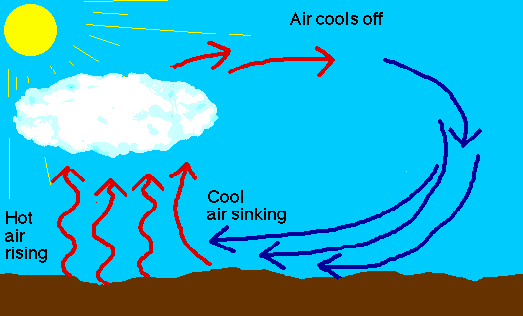
It reminded me of the way wind is formed. Warm air rises into the atmosphere, and cold air rushes in to fill the void left by the warm air. Voids donโ€™t last long in our spiritual lives. Something is always rushing in to fill them.

At the end of a long day of fighting, my doubt, fear, unbelief, worry, distrust, and frustration lay on the battlefield as bloody casualties, replaced by fresh, mighty warriors of faith, gratitude, love, and remembrance.

Sin. Itโ€™s the only battle you can win by surrendering.

Bless the Lord, O my soul,
and all that is within me,
bless his holy name!
2 Bless the Lord, O my soul,
and forget not all his benefits,
3 who forgives all your iniquity,
who heals all your diseases,
4 who redeems your life from the pit,
who crowns you with steadfast love and mercy,
5 who satisfies you with good
so that your youth is renewed like the eagle’s.

6 The Lord works righteousness
and justice for all who are oppressed.
7 He made known his ways to Moses,
his acts to the people of Israel.
8 The Lord is merciful and gracious,
slow to anger and abounding in steadfast love.
9 He will not always chide,
nor will he keep his anger forever.
10 He does not deal with us according to our sins,
nor repay us according to our iniquities.
11 For as high as the heavens are above the earth,
so great is his steadfast love toward those who fear him;
12 as far as the east is from the west,
so far does he remove our transgressions from us.
13 As a father shows compassion to his children,
so the Lord shows compassion to those who fear him.
14 For he knows our frame;
he remembers that we are dust.

15 As for man, his days are like grass;
he flourishes like a flower of the field;
16 for the wind passes over it, and it is gone,
and its place knows it no more.
17 But the steadfast love of the Lord is from
everlasting to everlasting on those who fear him,
and his righteousness to children’s children,
18 to those who keep his covenant
and remember to do his commandments.
19 The Lord has established his throne in the heavens,
and his kingdom rules over all.

20 Bless the Lord, O you his angels,
you mighty ones who do his word,
obeying the voice of his word!
21 Bless the Lord, all his hosts,
his ministers, who do his will!
22 Bless the Lord, all his works,
in all places of his dominion.
Bless the Lord, O my soul!

Psalm 103

Sin. Itโ€™s the only battle you can win by surrendering.