Christian women

Throwback Thursday ~ Sacrificing Truth on the Altar of Tone

Originally Published April 17, 2014

Ladies, do you believe in womanโ€™s intuition? Do you have it? Iโ€™m not talking about premonitions– having a feeling that some future event is going to take place- I mean intuition. Being able, for example, to sense from a friendโ€™s tone of voice that sheโ€™s having a bad day, noticing from the body language of two people who are โ€œjust friendsโ€ that romance is brewing beneath the surface, or discerning the tension between two people who are seemingly cordial to one another.

wonder-woman-552109_1280

Maybe men have this โ€œsuper powerโ€ too, but Iโ€™ve noticed it more with women. I believe it might have something to do with the way God has hard wired us. Nothing against men here (yโ€™all are awesome in your own masculine way), but we women generally tend to be more sensitive to and concerned about other peopleโ€™s feelings, we listen โ€œbetween the lines,โ€ and we hear and analyze tone of voice more. Itโ€™s one of the great things about the way God has created us that helps us as we nurture, comfort, and care for others.

But lately, Iโ€™m noticing that this โ€œsuper powerโ€ of ours can also be a super problem.

Our sensitivity to tone (of voice, of writing, someoneโ€™s demeanor, etc.) is a hindrance rather than a help to us when we refuse to evaluate the content of what someone is saying to us simply because his manner of speaking, writing, or behavior has offended our sensibilities. This is especially harmful when that content is biblical truth.

Our sensitivity to tone is a hindrance rather than a help to us when we refuse to evaluate the *content* of what someone is saying simply because his manner of speaking, writing, or behavior has offended our sensibilities.

I have recently observed several instances of this, all involving women who, at best, found it difficult (with some outright refusing) to put aside their feelings of offense at the writerโ€™s or speakerโ€™s tone in order to compare the content of his speech or writing to Scripture to see if it might be true. (And, by the way, the speech and writing Iโ€™m referring to here are sermons, commentary, and articles, not someone writing or speaking to these women personally.) I can sympathize. It’s happened to me plenty of times.

Often, when we hear a fellow Christian put biblical truth bluntly in black and white and it rubs us the wrong way, our first reaction is to quote part of Ephesians 4:15 and chastise him for failing to โ€œspeak the truth in love.โ€ But is that the only point of Ephesians 4? Letโ€™s take a look at it in context:

And he gave theย apostles, the prophets, theย evangelists, the shepherdsย and teachers,ย to equip the saints for the work of ministry, forย building upย the body of Christ,ย until we all attain toย the unity of the faith and of the knowledge of the Son of God,ย to mature manhood,ย to the measure of the stature ofย the fullness of Christ,ย so that we may no longer be children,ย tossed to and fro by the waves and carried about by every wind of doctrine, by human cunning, by craftiness inย deceitful schemes.ย Rather,ย speaking the truth in love, we are toย grow up in every way into him who isย the head, into Christ,ย from whom the whole body, joined and held together by every joint with which it is equipped,ย when each part is working properly, makes the body grow so that it builds itself up in love.

Ephesians 4:11-16 (emphasis mine)

When I was in elementary school, one of the reading comprehension tasks we were often assigned was to find the โ€œmain ideaโ€ of a piece of writing. So, what is the โ€œmain ideaโ€ of this passage in Ephesians 4? Iโ€™ll even make it multiple choice (my favorite!).

Is the main idea of the passage:

a) Teachers and preachers should speak the truth in love so that they will not offend anyone.

b) A discussion of the different types of leadership roles in the church.

c) Christian leaders are to equip church members to grow to spiritual maturity which builds spiritually healthy and unified churches.

While the passage touches on some of the ideas in a and b, the main point is c. Weโ€™re to grow up. We are to listen to preachers, teachers, and writers who rightly handle Godโ€™s word, even if we come across one every now and then who steps on our toes with his demeanor or tone.

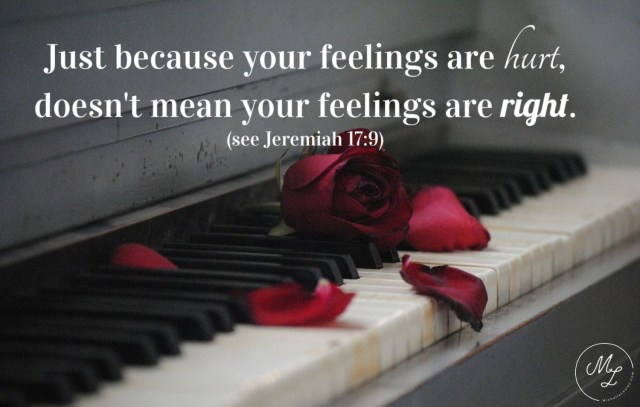
And it’s important to remember that just because our feelings are hurt doesn’t necessarily mean the other person sinned or did anything wrong. Sometimes you and I take things the wrong way because we’re not listening, we’re not understanding, or because we’re incorrectly reading our own hurts and past experiences into what the other person is saying. And none of that is her fault.

Sometimes the reason we’re offended is because the other person is speaking or writing simply and directly without wrapping her words in fourteen pillows of feelings-coddling. (Believe it or not, this is the way people used to speak all the time before feelings became such an idol in our culture. You could just say things without all the caveats.) We’ve grown so used to everyone walking on egg shells and tiptoeing around everyone’s feelings when we write and speak, lest anyone be “triggered,” that when someone simply says what she has to say without beating around the bush, we take offense that she hasn’t bent over backwards in her wording to make sure our feelings haven’t been hurt. And that’s not her fault, either.

And finally, sometimes we think -or claim– our feelings have been hurt by the other person’s tone, when, really what’s happening is that the Holy Spirit is convicting us, or we know she’s right in what she’s saying but we’re too proud to admit it. And those things aren’t her fault, either.

Just because someone says something and you get offended doesn’t automatically mean she’s at fault. Sometimes the fault is yours.

Just because someone says something and you get offended doesn’t automatically mean she’s at fault. Sometimes the fault is yours.

Look, I know itโ€™s hard. There are people out there who offend me sometimes, too, but persevering through the offense will grow us into mature women of Christ and make our churches healthier.

Statistically speaking, more women regularly attend church these days than men. And when I say โ€œmore,โ€ I mean 61% women to 39% men. Can you imagine the impact it would have on the health of our churches if all of those women were pursuing spiritual maturity through biblical truth and sound doctrine?

Instead, we are often like a little girl in a burning building. The fireman is vehemently insisting that the little girl come with him to escape, and she refuses to move because he hasnโ€™t said it nicely enough.

We are often like a little girl in a burning building. The fireman is vehemently insisting that the little girl come with him to escape, and she refuses to move because he hasnโ€™t said it nicely enough.

Ladies, I say this to all of us (including me) in love, because true love is desiring whatโ€™s best for someone:

Itโ€™s time for us to grow up. Itโ€™s time to stop taking our dollies and stomping home from the playground in a huff every time somebody speaks or writes strenuously. Itโ€™s time to stop crying about our hurt feelings, put on our big girl panties and be women.

Itโ€™s time to stop taking our dollies and stomping home from the playground in a huff every time somebody speaks or writes strenuously. Itโ€™s time to stop crying about our hurt feelings, put on our big girl panties and be *women*.

Discerning women. Berean women. Women of Godโ€™s word. Women who can handle having our feathers ruffled and come out on the other side stronger for it.

9283e86a7bd7185b880df318c7681846

Too often, we make the mistake of equating a soft tone of voice and a sweet disposition with โ€œloveโ€.  But many of the people who speak with this kind of โ€œloveโ€ are not speaking the truth. They are smooth talking, charismatic con men selling snake oil for our souls.

Too often, we make the mistake of equating a soft tone of voice and a sweet disposition with โ€œloveโ€.  But many of the people who speak with this kind of โ€œloveโ€ are not speaking the truth.

If weโ€™re not careful, we can become people who โ€œwill not endure sound teaching, but having itching ears they will accumulate for themselves teachers to suit their own passions, and will turn away from listening to the truth and wander off into mythsโ€ (2 Timothy 4:3-4), or โ€œweak women, burdened with sins and led astray by various passions, always learning and never able to arrive at a knowledge of the truthโ€ (2 Timothy 3:6b-7), or even โ€œchildren unwilling to hear the instruction of the Lord; who sayโ€ฆโ€œDo not prophesy to us what is right; speak to us smooth things, prophesy illusions,โ€ (Isaiah 30:9-11).

We forget that our Master, the perfect embodiment of love, didnโ€™t always speak softly and act politely when the gospel was at stake. Because there are things out there that are much more important than our feelings, and biblical truth is one of them.

There are things out there that are much more important than our feelings, and biblical truth is one of them.

Additional Resources

Discernment: What’s Love Got to Do with It?

Holidays (Other), New Year's

The Mailbag: My word for the year is…

Originally published January 7, 2019

I canโ€™t seem to find information on one topic that keeps coming up with women I am friends with. โ€œOne wordโ€ for the year. They are all waiting to โ€œhearโ€ from God what one word they need to focus on for the year. I have been asked what my word for the year is. I just think… the Word Of God is my word for every year. Do you happen to have any links, resources, or input?

I wish there weren’t any links or resources on this, but, unfortunately, it looks like a small cottage industry – both secular and evangelical – is growing up around this unbiblical concept. (I’m not going to give anyone free advertising and website hits by providing their links.)

The idea is pretty simple. You pick (or God “speaks” to you) a word that represents some sort of change you want to see in your life and you focus on that word, especially during situations when you want to see that change manifest itself, for the remainder of the year. For example, if you want to be a more peaceful person, you might choose “peace” as your word for the year. You find some way to think about or meditate on the word “peace” every day, but especially in worrisome or chaotic situations, and that’s supposed to make you a more peaceful person by the end of the year.

The only problem with this is – as with so many things in pop evangelicalism – the Bible.

You will not find this practice taught, endorsed, or even mentioned in the Bible. In fact, I suspect this idea traces its roots back to some form of Eastern mysticism. It’s a modern day twist on repeating a mantra. And somebody thought it would be a good idea to “Christianize” it – so she slapped a thin coat of “this is how God can speak to you and work in your life” paint over the surface of it.

That’s not how this works. That’s not how any of this works. You don’t just get to make up Christianity as you go along. That’s God’s job, not ours, and He already set it up exactly the way He wants it – in the Bible.

We know that God is not going to speak a certain “word for the year” to people for two reasons. First of all, extra-biblical revelation is unbiblical. God speaks to us through His all-sufficient written Word, not audibly. Which brings us to reason number two. Because God speaks to us through His written Word, and there’s nothing in His written Word about getting a word for the year, we can be certain that He’s not going to be whispering a word for the year in anybody’s ear.

OK, so let’s take the extra-biblical revelation component out of it. What if we go at it from a sanctification angle? Maybe I’ve noticed that I tend to worry too much, so I decide, for the sake of my own spiritual growth, that my word for the year is going to be “peace”, and I’m going to focus on that word this year?

Still not biblical. Not just because it’s not taught in the Bible (although that’s certainly reason enough), but for a host of other reasons as well.

For starters, we are not in charge of our sanctification, God is. He is the one who gets to decide what work He’s going to do in our hearts, and how He’s going to do that. And that’s a really good thing because He is infinitely wiser and more powerful than we are and He knows our hearts much better than we do. You probably won’t hear many of your girlfriends choosing words like “suffering”, “humility”, or “repentance” as their word for the year, but God knows that areas like these – the ones we often push back against with the greatest resistance – are the ones we usually need the most work on.

Next, sanctification isn’t linear. You don’t tackle peace, master it, then move on to patience, master it, and then move on to whatever’s next. And that’s how this “word for the year” thing is set up. This year, you choose the word “peace”. Next year, maybe you’ll choose “patience”, and so on. But what do you do when you get to the end of the year and you know you haven’t mastered peace yet? What then? Do you choose the word “peace” again? Give up on peace and choose another word?

Biblical sanctification is more like a big bowl of spaghetti noodles. Everything is all tangled up and inter-connected. At any given time, God could be working on one or five or a dozen different aspects of your character. And while you’ll rejoice when you occasionally look back over how much you’ve grown, you’ll never “master” any aspect of Christlikeness this side of Glory.

Finally, God has already prescribed our role in sanctification, and meditating on a particular word for the year is not even a little part of it. Our role in sanctification is to abide in Christ. How? We learn the “how” of abiding in Christ from studying our Bibles. John 15 offers us a little glimpse:

V.1: I [Jesus] am the true vine, and my Father is the vinedresser. Recognize that, as I mentioned, God is the vinedresser – the one who prunes, waters, fertilizes, harvests – not you.

V.2: …every branch that does bear fruit he prunes, that it may bear more fruit. Bear up under pruning as God conforms you to the image of Christ. Cooperate with whatever He’s working on in your life by obeying Him, thanking Him, and realizing that He’s doing it to make you more fruitful.

V.4: As the branch cannot bear fruit by itself, unless it abides in the vine, neither can you, unless you abide in me. Recognize and practice your dependence on Christ and His work for you and in you, not on a word you meditate on. You can’t be a fruitful Christian by coming up with your own way to grow in Christ. You can only do it His way.

V.7a: If you abide in me, and my words abide in you… To abide in Christ is simply to live for Him and commune with Him day by day. One of the ways we do that is to study “His words” – the Bible – so that those words will live in us. We ingest the words of Christ by studying our Bibles at home, with our Sunday School or Bible study class at church, sitting under good preaching at our church, and consuming other biblical materials during the week.

V.7b: …ask whatever you wish, and it will be done for you. If you’re abiding in Christ and His Word is abiding in you – what kinds of “whatever you wish” things do you think you’ll be asking Him for? Your foundational prayer to anything else you might ask for will be for God to be glorified and for Him to make you more like Christ. “Father, please heal me, but only if that will glorify You and make me more like Christ.” “Lord, I’d like You to take away this difficult situation at work, unless letting it continue would grow me to be more like Christ. Help me to glorify You no matter what.” Prayer is one of God’s prescribed methods of sanctification.

V.8: By this my Father is glorified, that you bear much fruit and so prove to be my disciples. Glorify God by bearing the fruit of the Spirit, displaying the fruit of obedience, harvesting the fruit of evangelism, and by doing so, displaying for the world what a real disciple of Christ looks like in order to point them to Him.

V.10,12,14: If you keep my commandments, you will abide in my love…This is my commandment, that you love one another as I have loved you…You are my friends if you do what I command you. Obey Christ’s commands and love others the way He loves you. That’s the heart of your role in sanctification. It’s an outward focus on how you can bring Him glory in any situation by obeying Him and loving others with a die-to-self love rather than a navel-gazing, self-centered, inward focus on “How can I be a better me?”.

V.11: These things I have spoken to you, that my joy may be in you, and that your joy may be full. Don’t forget the joy! What joy is there in a word that you focus on? How can you quantify whether or not you’re a better person at the end of the year and derive joy from that? Sanctification God’s way offers instant, daily gratification in the joy department. Joy dwells in us because the Holy Spirit dwells in us. Joy wells up when we see the hand of God at work in our hearts and lives, when He answers prayer, even just from spending time with Him in His Word, worship, and prayer. Joy is communion with a Person, not satisfaction over a job well done of pulling yourself up by your own boot straps.

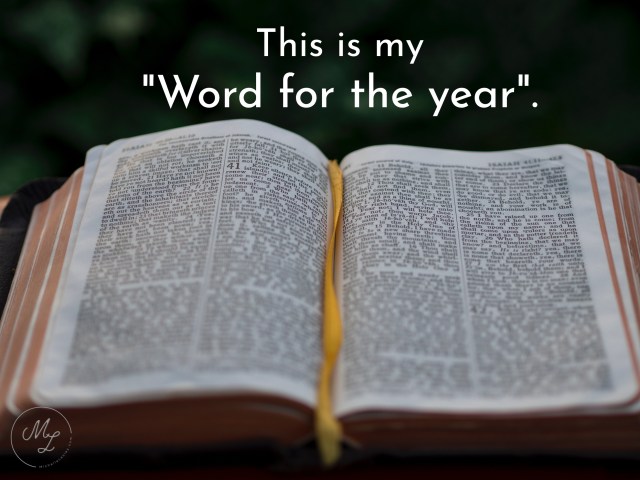
This “word for the year” thing is not necessary or biblical. When someone asks you what your word for the year is, just hold up your Bible and tell her, “All of these.”

This “word for the year” thing is not necessary, it’s not biblical, and it kicks God out of His rightful place of authority in sanctification and attempts to put self in the driver’s seat. You’re on the right track with your thinking. When someone asks you what your word for the year is, just hold up your Bible and tell her, “All of these.” After all, Christ gives us abundant life. Why would we limit ourselves to one measly little word when we can study all of God’s words?

If you have a question about: a Bible passage, an aspect of theology, a current issue in Christianity, or how to biblically handle a family, life, or church situation, comment below (Iโ€™ll hold all questions in queue {unpublished} for a future edition of The Mailbag) or send me an e-mail or private message. If your question is chosen for publication, your anonymity will be protected.
Faith, Prayer

Throwback Thursday ~ Hamartiology Hits the Homefront

Originally published March 1, 2013

I admit it. I struggle against sin. A lot of sin. Often.

Sometimes itโ€™s a small, easily won skirmish. Sometimes itโ€™s a hard fought, bloody battle. Yesterday, God helped me take a hill.

For a couple of weeks, Iโ€™d been feeding on this sort of casserole of worry, doubt, fear, unbelief, distrust, and frustration with the Lord. I needed Him to act, and He wasnโ€™t acting. Every time I tried to pray about the issues that were tempting me into this mรฉlange of anxiety, I ended up feeling even more anxious.

So I quit praying about it. Smart and spiritually mature, huh?

โ€œLord, You know what all these issues are. Please, just handle it.โ€

From time to time, it can be helpful to pray like that. But not when youโ€™re using it as a semi-spiritual cover for avoidance, which is what I was doing.

Yesterday, I finally heard the bugle sound the call to arms. I felt God pushing me toward the battle line. The urgency to pray through this mess was absolutely compelling.

So I laid it all out before God. Every last bit of it.

And as I did, conviction of sin rolled in.

Sometimes we think of conviction as a negative thing. It makes us feel bad. Guilty. Humiliated.

But conviction of sin by the Holy Spirit is really a good thing for the Christian. It gives us pinpoint accuracy and clarity on exactly how weโ€™re offending God. It gets everything out in the open and brings things to a head so that we can repent, be made right with Him, and start fresh. None of us are so weak that we canโ€™t deal with a little guilt if it pushes us up and over the wall of repentance to reconciliation. Buck up, soldier.

As I continued to pray, God began bringing all manner of applicable Scripture to my mind (this is how God speaks to usโ€”through His written word). I remembered how God dealt with the ungrateful, complaining Israelites in the wilderness. I also remembered what David said in Psalm 103:2-3

Bless the Lord, O my soul,
and forget not all his benefits,
who forgives all your iniquity,
who heals all your diseases,

I realized my sin was a double edged sword of commission and omission. It wasnโ€™t just what I was doingโ€”doubting and worryingโ€”it was also what I wasnโ€™t doingโ€”being thankful and remembering how God had been faithful to me in the past.

convection_weather2

It reminded me of the way wind is formed. Warm air rises into the atmosphere, and cold air rushes in to fill the void left by the warm air. Voids donโ€™t last long in our spiritual lives. Something is always rushing in to fill them.

At the end of a long day of fighting, my doubt, fear, unbelief, worry, distrust, and frustration lay on the battlefield as bloody casualties, replaced by fresh, mighty warriors of faith, gratitude, love, and remembrance.

Sin. Itโ€™s the only battle you can win by surrendering.

Bless the Lord, O my soul,
and all that is within me,
bless his holy name!
2 Bless the Lord, O my soul,
and forget not all his benefits,
3 who forgives all your iniquity,
who heals all your diseases,
4 who redeems your life from the pit,
who crowns you with steadfast love and mercy,
5 who satisfies you with good
so that your youth is renewed like the eagle’s.

6 The Lord works righteousness
and justice for all who are oppressed.
7 He made known his ways to Moses,
his acts to the people of Israel.
8 The Lord is merciful and gracious,
slow to anger and abounding in steadfast love.
9 He will not always chide,
nor will he keep his anger forever.
10 He does not deal with us according to our sins,
nor repay us according to our iniquities.
11 For as high as the heavens are above the earth,
so great is his steadfast love toward those who fear him;
12 as far as the east is from the west,
so far does he remove our transgressions from us.
13 As a father shows compassion to his children,
so the Lord shows compassion to those who fear him.
14 For he knows our frame;
he remembers that we are dust.

15 As for man, his days are like grass;
he flourishes like a flower of the field;
16 for the wind passes over it, and it is gone,
and its place knows it no more.
17 But the steadfast love of the Lord is from
everlasting to everlasting on those who fear him,
and his righteousness to children’s children,
18 to those who keep his covenant
and remember to do his commandments.
19 The Lord has established his throne in the heavens,
and his kingdom rules over all.

20 Bless the Lord, O you his angels,
you mighty ones who do his word,
obeying the voice of his word!
21 Bless the Lord, all his hosts,
his ministers, who do his will!
22 Bless the Lord, all his works,
in all places of his dominion.
Bless the Lord, O my soul!

Psalm 103

Sin. Itโ€™s the only battle you can win by surrendering.

Mailbag

The Mailbag: Potpourri (Budgeting… Abuse and Submission… DIY Sanctification… Prayer)

Welcome to another โ€œpotpourriโ€ edition of The Mailbag, where I give short(er) answers to several questions rather than a long answer to one question.

I like to take the opportunity in these potpourri editions to let new readers know about my comments/e-mail/messages policy. Iโ€™m not able to respond individually to most e-mails and messages, so here are some helpful hints for getting your questions answered more quickly. Remember, the search bar (at the very bottom of each page) can be a helpful tool!

Or maybe I answered your question already? Check out my article The Mailbag: Top 10 FAQs to see if your question has been answered and to get some helpful resources.


Before I get to this week’s questions, I wanted to say – I love getting questions from my readers! Here’s a helpful hint for increasing your chances of getting your question answered in The Mailbag

Your best shot at your question being selected for The Mailbag is to email me, or – if you have a question pertaining to a particular blog article – to comment on that article. Those are the two main sources I draw Mailbag questions from because they’re the most user friendly for that purpose. I also try to grab questions from Facebook private messages whenever I think about it.

I’m rarely able to grab questions from social media comments (on posts) and DMs, especially on Instagram and Twitter. Comments and Instagram DMs move down the notification queue too quickly, and Twitter DMs from people I don’t follow are hidden.

That being said, sending me the same question multiple times or on multiple platforms (emailing and leaving a blog comment and messaging me on Facebook) will not increase your chances of your question being selected. If you send it to me once, I’ve got it. :0)

Thanks for all your questions. Keep sending them in! We wouldn’t have a Mailbag without them!


I was wondering if you can do a video on how a Christian housewife should budget money. I want to learn and trust in God’s will as well.

Great question! I’m much better in writing than on video, so I hope this format is OK.

Every household is unique, with a unique income, unique needs, unique bills and expenses, etc., so I can’t tell you, “Budget X% for this and Y% for that.” The best I can do is give you a few general guidelines:

  • Sit down with your husband with all your numbers: income, bills, expenses, etc. Prayerfully and thoughtfully consider how much you’re bringing in and how much you’re paying out. Do you need to earn more? Spend less? Cut out some expenditures? Save more?
  • Don’t forget to pray about and consider how much you need to set aside for your offerings at church. Christians are not under the Old Testament law of the tithe, but we are to give as generously to the church as we’re able according to what we’ve prayerfully determined in our hearts.
  • If money is tight and bringing in more income isn’t an option, a great way to be a helper to your husband would be to research ways you can reduce your bills, cut expenses, etc. Can you renegotiate your mortgage? Buy generic instead of name brands? Use coupons and shop the sales at the grocery store? Get your clothes at a thrift store instead of a boutique? Turn off the cable? Sell one of your cars?
  • If your husband doesn’t mind you discussing this with someone else, ask one of the godly older women in your church for advice. You can share the specific details with her and perhaps she can offer you some suggestions specific to your particular household.

This is just one of those things every couple has to work on together and figure out for themselves.


I read your article The Mailbag: I โ€œfeel ledโ€ in a different direction from my husband. In that article, you said:

Unless your husband is abusing you or encouraging you to do something sinful, Godโ€™s will is for you to graciously submit to his decisions.

I have always wondered why this circumstance is almost universally accepted as an exception to the principle of submission.

I don’t want to try to answer for the rest of the universe, but let me just explain my position. If a woman is being abused, priority number one is to get her to safety. And that’s going to mean getting away from her husband to a different place to live (until or unless he radically repents and gets saved, bears a lot of fruit in keeping with repentance, the two of them get extensive pastoral counseling, and so on).

What do you think an abusive husband’s immediate response to that is going to be? He’s going to be angry and demand that she come back home. That would be the first thing she would have to submit to before she submits to anything else. As a Christian, should she submit to that first demand? Of course not. He’s requiring her do a variety of ungodly things:

  • We are to be good stewards of our bodies and glorify God with our bodies. It is neither glorifying to God nor good stewardship to put your body in a situation in which you’re virtually certain it’s going to be damaged for no good reason. Putting your body in the hands of an unrepentant abuser is no more glorifying or good stewardship than jumping out of a third story window.
  • If you have children and you go back to an unrepentant abuser, you’re knowingly and intentionally putting them in danger. Godly mothers protect their children by keeping them away from danger as much as it’s within their power.
  • If you go back to an unrepentant abuser, you’re indirectly lying to him about his sin. By going back to him, you’re saying that his sin of abuse is OK, that he doesn’t need to repent or suffer any consequences for it, that you, as a Christian, approve of it, and that, by extension, God must approve of it, too.
  • Going back to an unrepentant abuser puts temptation in his way. When you’re in the home with him, he’s tempted to abuse you. When you’re not, he doesn’t have the opportunity to commit the sin of abusing you. We don’t put stumbling blocks in the paths of sinners.

These are all good, biblical reasons not to stay in an abusive situation, either. You can’t submit to someone who is sinning against you and requiring you to act in an ungodly way.


My question is how do you get out of yourself and your feelings? Yes, turn them over to God, I know this and I have but here I am still hurting and unable to find my way back to being content in all situations. Thank you for your wise words.

How do you cultivate die-to-self love and love God and others more?

Two great questions from different readers, but with the same answer: You can’t. This is something God has to work in you. You can’t sanctify yourself.

When it comes to sanctification and spiritual growth, we often cast about for a plan we can implement to start making things happen, kind of the same way that, when we want to lose weight, we reach for a diet book, join a gym, or call Jenny Craig.

Sanctification doesn’t work that way. There’s no such thing as a “get holy quick” scheme. There’s no program you can implement, book you can read, or specific behavior regimen you can initiate that will help you shed those unsightly sins and lose those pounds of character flaws. There’s nothing you can do to create growth and get the guaranteed results you’re looking for. That’s God’s job. It’s His job to grow you, and it’s His job to grow you in a way that guarantees He’ll get the results He’s looking for.

Your job is to get up every day, trust Him to do His job, and walk faithfully with Him by…

  • Studying your Bible
  • Praying- for help, for wisdom, for guidance, for strength
  • Being faithful to your church
  • Obeying the Word
  • Faith, trust, and utter dependence on God
  • Getting good counsel when you need it from godly friends and loved ones, your pastor, or spiritually mature women in your church

That’s God’s plan. His method. And it works every time it’s tried.

You might find some of the principles in my article You Donโ€™t Need *A* Book, You Need *THE* Book to be helpful on this.


I often donโ€™t know what to pray. Can you give me guidance and whether pre-printed prayers are a good idea or not and if so how they should be used. 

I’ve got tons of resources on prayer here at the blog. I hope you’ve been able to find them (using the search bar, tabs in the blue menu bar at the top of this page, or category cloud in the right or bottom sidebar) in the time since you originally asked this question.

I would recommend starting off with…

Basic Training: 8 Things You Need to Know about Prayer

After this Manner, Therefore Pray

Can We Talk?

Sweet Hour of Prayer: Learning to Pray from the People of Scripture (my Bible study on prayer)

And then you can just start plowing through all of my other articles of interest about Prayer.

There’s nothing sinful about praying a biblical, doctrinally sound pre-printed prayer back to God. The best way to do that is to pray Scripture back to God, because you know Scripture is biblical, doctrinally sound, and pleasing to God since He breathed it out. The Psalms are especially well suited for this (in fact, praying the psalms back to God is one of the components in our current Bible study, Psalm 119: The Glory of God’s Word). You might want to take a look at my article Praying Scripture, to get a feel for it.

Outside of the Bible, the only prayer book I’m familiar enough with to feel comfortable recommending is The Valley of Vision. What I would recommend it for is reading through it for an example of the things we should be praying for and about, rather than using it for reciting or actually praying the prayers in it (although, like I said, it’s not sinful if you do). Your prayers should be personal, between you and God.


If you have a question about: a Bible passage, an aspect of theology, a current issue in Christianity, or how to biblically handle a family, life, or church situation, comment below (Iโ€™ll hold all questions in queue {unpublished} for a future edition of The Mailbag) or send me an e-mail or private message. If your question is chosen for publication, your anonymity will be protected.
Sanctification

You Don’t Need *A* Book, You Need *THE* Book

โ€œCan you recommend a book on how to submit to my husband?โ€

“What’s a good book on biblical womanhood?”

“I’m going through [difficult life circumstance]. Can you suggest a good book on how I can cope with that?”

I’ll bet if someone did a study to find out which demographic of people reads the most books, it would be Christians. Christians are readers – there’s no denying that – and that’s a good thing.

It always makes my heart smile when a reader asks if I can recommend a good (read: biblical, and by a doctrinally sound author) book on a particular area of sanctification or a life issue she’s struggling with. That tells me she wants to learn what the Bible says and obey it. And that is no small thing in evangelicalism today.

Hear me: Reading good, doctrinally sound books is a good thing.

But – just as with any other good thing – too much of a good thing isn’t the best thing. And letting a good thing veer out of its lane isn’t the best thing.

If you dedicate twelve hours every day to prayer, you’ll never get to the laundry, the bills, the cooking, and the cleaning. If the baby is running a fever and you exegete a chapter of the Bible instead of giving her some medicine or taking her to the doctor, you’re misapplying your Bible study time.

And, while it may not be quite as obvious, we can sometimes face the same challenge with good books.

In my experience there are two general dilemmas that motivate today’s Christian to seek out a good book.

The first is: “I don’t know what the Bible says about _____ topic. I need a book that will teach me so I can correctly understand what Scripture says about it.” For example, a few weeks ago in a Mailbag article, I answered a lady who wanted to know about the eternal destiny of unborn babies who die. Among other resources, I recommended John MacArthur’s book which explains the Scriptures and theology related to that topic.

The second dilemma is: “I know Scripture teaches that Christians are supposed to _____. How do I carry that out in my day to day life?” Or, “I have this difficult situation in my life. What specific things do I do to navigate or handle it in a godly way?” For example, “How do I submit to my husband?” or, the lady from the aforementioned Mailbag article might have asked, “What should walking through the grief of losing a child look like in my daily life?”

The first dilemma is easy and appropriate to plug a book into. The second? Not so much.

Why? Because in the second dilemma we’re asking good books to get out of their lane and perform a task they’re not suited to perform: sanctification. When you’re trying to drive a nail into a board, a hammer is the proper tool for the job, not a screwdriver. You can bang on the nail with the screwdriver, and you might even drive the nail into the wood a millimeter or two, but the bottom line is, you need a hammer. That doesn’t make hammers good and screwdrivers bad, it just means you use the appropriate tool for the job at hand.

And in cases of, “Where does the rubber of Scripture meet the road of my unique, individual life?” the right tool for the job at hand – the method God has prescribed in His Word – is not reaching for a book written by man, it’s God’s sanctifying work in your heart and life. And that’s a big pot of gumbo with a lot of different ingredients in it:

  • Studying your Bible
  • Prayer- for help, for wisdom, for guidance, for strength
  • Obedience to the Word
  • Faith, trust, and utter dependence on God
  • Getting good counsel from godly friends and loved ones, your pastor, or spiritually mature women in your church

And the final ingredient that goes into the pot? Action. Step out on faith in God and His Word to help you and guide you, and just do it. Try. Figure it out as you go.

If you want to learn how to ride a bicycle, you’re eventually going to have to stop reading books about bicycles and get on one and ride. Feel that balance and coordination of muscle movements in your own body. Learn by doing.

And, guess what? You’re going to fall down a few times. You’re going to try things that don’t work. You’re going to sin (and repent and be forgiven). And youโ€™ll learn and grow from that. Falling is part of the learning and growing process of sanctification.

for the righteous falls seven times and rises again,
Proverbs 24:16a

The steps of a man are established by the Lord,
when he delights in his way;
though he fall, he shall not be cast headlong,
for the Lord upholds his hand.
Psalm 37:23-24

I think we believe that success is in not falling. Itโ€™s not. Itโ€™s in getting back up and learning mastery of the skill.

The Bible never says we won’t fall. It says that when we do, God is holding our hand, and He’ll help us get back up.

But learning and growing and falling can be a messy, frustrating process that takes a long time. And what we want is a fast, streamlined formula that bypasses the mess and gives us guaranteed results. And, without even realizing it, we can fall into the mindset of thinking that the right book will be the magic bullet to solve our problem. We want a book to tell us what to do to keep from falling – and we think thatโ€™s mastery or success. But it isn’t. Mastery and success come from doing, from going through the process. We want a book to tell us how to get the right answer to our problem, but while the right answer is important, the growth, maturing, and mastery of going through the process is more important to our spiritual growth.

…work out your own salvation with fear and trembling, for it is God who works in you, both to will and to work for his good pleasure.

Philippians 2:12b-13

And it’s not just that walking through the process of working out your own salvation with the Lord and His Word rather than reaching for a book is the way God has prescribed, it’s that God’s way is far superior to reaching for a book, because God’s way is divinely powered by the Holy Spirit.

When you pick up a book written by a human being, it can give you practical tips and good advice and maybe even point you to some passages of Scripture you should study. But the Bible doesnโ€™t just tell us what to do and give us some good ideas, it is actually, literally transformative as we are reading it.

For the word of God is living and active, sharper than any two-edged sword, piercing to the division of soul and of spirit, of joints and of marrow, and discerning the thoughts and intentions of the heart.

Hebrews 4:12

The Holy Spirit moves in and around and through His Word as you’re reading it to supernaturally work to conform your heart and mind to the image of Christ. That’s something you can’t get from any other book, no matter who wrote it or how doctrinally sound it is.

And one of the most amazing things about the Holy Spirit’s supernatural work through His Word is that it’s personal. Books, by definition, have to be “one size fits all” – generally applicable to a wide audience. They can’t tell you what submitting to your husband in your marriage in your life circumstances is going to look like at 10:17 a.m. next Tuesday. But Scripture can, as God uses it to sanctify you.

But there’s one other aspect of the knee jerk, “I need a book” mindset that we need to be really careful about.

If, every time there’s an issue in our lives, our reflex reaction is to get on social media and ask for book recommendations instead of turning to the Word, prayer, and godly counsel, is that not a subtle, functional denial of the sufficiency of Scripture?

All Scripture is breathed out by God and profitable for teaching, for reproof, for correction, and for training in righteousness, that the man of God may be complete, equipped for every good work.
2 Timothy 3:16-17

His divine power has granted to us all things that pertain to life and godliness, through the knowledge of him who called us…
2 Peter 1:3a

When the Bible says it will make us complete, equipped for every good work and all things that pertain to life and godliness, that’s exactly what it means: Every. All. We do not need other books in order to handle life’s situations in a godly way. And every Believer who came along before Christian books were a thing is proof of that. Good books aren’t a bad thing, and they can be helpful, but the Bible says it is sufficient – all we need – for anything that comes our way.

But when we reach for a book before we reach for the Bible, aren’t we saying with our actions, “The Bible’s not enough. I need more. I need something better.”?

I can’t answer that for you and you can’t answer that for me, but it’s a good thing to ask ourselves and answer honestly before God.

Good, solid, doctrinally sound books aren’t the bad guy. They can be wonderfully helpful and encouraging. But let’s make sure we’re submitting to God’s prescribed methods of sanctification, esteeming and depending on God’s supernatural work in our hearts through His Word, and not accidentally eroding the sufficiency of Scripture.

Let’s be people of the Book, before we’re people of the books.