Discernment, False Doctrine, False Teachers, Mailbag

The Mailbag: What did you think of Beth Moore’s “A Letter to My Brothers”?

Readers- Before commenting on this article, please familiarize yourself with my comments/e-mail/social media policies and my responses to objections about warning against false teachers. I will not be publishing any comments or responding to any e-mails that are covered by said policies or article.


Did you see Beth Moore’s recent blog post “A Letter to My Brothers“? What do you think about what she said?

The first thing you need to know about Beth Moore, if you don’t already, is that she is a false teacher who is living in current, unrepentant sin. She teaches false doctrine and twists Scripture to scratch the itching earsย of her followers. She sinfully and rebelliously preaches to men, and she yokes in “ministry” with false teachers. These are not my personal opinions, these are verifiable facts. (See my articleย Five Reasons It’s Time to Exercise Moore Discernmentย for the evidence. You don’t have to take my word for it. Compare the things she says and does with Scripture (rightly handled and in context) and it will quickly become crystal clear.)

For years, I have repeatedly heard people try to brush these things aside as “everybody makes mistakes” or “no big deal.” These are not mistakes. These areย sins that she not only has not repented of and stopped, she actually tries to justify. Sinย is a big deal. It’s such a big deal to God that He sent His Son to be tortured to death for it.

Woe toย those who call evil good
and good evil,
who put darkness for light
and light for darkness,
who put bitter for sweet
and sweet for bitter!
Isaiah 5:20

We would not say, “It’s no big deal,” if we knew a pastor who was proudly open about his serial adultery or joyfully endorsed homosexuality. Beth Moore’s open, proud, and unrepentant sin is just as inherently sinful. Why Christians continue to support her is both grievous and a mystery to me.

The reason it’s important you understand, for the purposes of this article, that Beth is a false teacher, is that you should view any theological statements she makes with a high degree of suspicion and discernment. Whatever theology Beth espouses is a house built on aย foundation of sandย because she is not hearing and obeying the (written) Word of Christ. Yes, she may, at times, say things that are perfectly biblical. That is by design. But you cannot have a sound structure when your foundation is faulty.

It brings me absolutely no joy to have to say such things. I would much rather joyfully point my readers to Beth as a doctrinally sound resource as I have done on many other occasions with many other doctrinally sound teachers. But in order to be obedient to Scripture, these things must be said in loving warning to Beth herself and to her followers.

Now, on to her article…

First, I’d like to give my overall impressions, and then move on to a few particular statements.

If I had to sum up this article in one word, it would be “vague.” I have more questions than answers after reading it. How, exactly, does Beth Moore define misogyny? Who is this large swath of men committing this misogyny? What, precisely, are they doing that constitutes misogyny? What sector of women are they performing these misogynistic acts against? What does she want these men to do instead of whatever it is they are doing? What, specifically, is the church supposed to do in response to this nebulous accusation of misogyny?

How is anyone supposed to agree with or refute the facts of what Beth is saying unless she gives clear explanations and details? What Beth has done in her blog post is to throw out unsubstantiated, generalized accusations against a wide swath of nameless Christian men and churches and she expects us to take her word for it that there’s some epidemic of misogyny across the board in the church.

There’s noย thereย there. And I think there are several reasons for that.

Certainly, there are individual Christian men, even pastors, of every theological stripe who have had moments, like the ones Beth cites from her personal experience, in which they’ve acted like pigs toward women, or might even have a chauvinistic attitude toward women in general. Let me be clear- that’s sin, and they absolutely need to be rebuked individually for thoseย sins and repent.

But among Bible believing, doctrinally sound churches and genuinely regenerated Christian men, there isn’t this widespread, large scale, general attitude of condescension toward and disdain for Christian women (that’s my guess as to what she means by “misogyny”, since she didn’t define it) who are obedient to the roles God lays out for us in Scripture and who don’t teach false doctrine. There just isn’t. (This general attitude might be more pervasive among men who claim to be Christians and/or subscribe to false doctrine, but Beth Moore herself has helped build that category of “Christians” with her false doctrine and unbiblical behavior. You can’t build a shoddy wall and then complain when it falls on you.)

Get LifeWay on the phone and commission them to survey a thousand genuinely regenerated, doctrinally sound women who aren’t preaching to men or partnering with false teachers, and who attend generally doctrinally sound churches, and ask them if they normally feel oppressed, patronized, or diminished by their churches or Christian men as a whole. I can practically guarantee that the answer will be a resounding “no.”

I believe that’s one of the reasons Beth’s article is so vague. She thinksย her personal experience is common to all Christian women. But it’s not, because she and her poor theology and behavior don’t represent all Christian women, or even most of us.

I think another reason her article is so vague is that she can’t clearly state what she really means because she knows it’s unbiblical. Over the last few years, more and more people – high profile pastors, “regular Joe” pastors, average Christian menย and women – have begun to realize and to speak out about the fact that Beth is a false teacher, preaches to men, and yokes with other false teachers. And though some small segment of those folks might qualify as “hyper-fundamentalists” (whatever that means – another vague, undefined, and, this time, intentionally pejorative term), all the ones I’m familiar with who have warned against Beth are reasonable, humble, credible, doctrinally sound Christians, not a tiny bunch of wild-eyed crazies with pitchforks at a Beth Moore book burning.

And, interestingly, while the rebukes that have actually reached Beth’s ears have probably come mostly from men (because men are pastors and have larger platforms and a louder voice), at the grassroots, non-celebrity, average person in the pew level, the vast majority of people warning against Beth areย women. Generally speaking, most pastors and Christian husbands have no clue about the problems with Beth Moore. They assume that because she claims to be a Christian and a Southern Baptist, and because LifeWay endorses her and has helped build her empire, she must be doctrinally sound. I know because I hear from women all the time asking how to approach their pastors about the fact that their church is using Beth Moore “Bible” studies. Does Beth consider the discerning women who warn against her to be misogynistic?

I would suggest that the majority of any “misogyny” Beth has received or thinks is pervasive in evangelicalism is largely the result of Christians who know their Bibles speaking and acting upon that knowledge. Men ignored her in elevators and at “team meetings”? She’s “the elephant in the room with a skirt on”? The Bible says:

If anyone comes to you and does not bring this teaching,ย do not receive him into your house or give him any greeting,ย for whoever greets himย takes part in his wicked works. 2 John 9-11

I appeal to you, brothers, to watch out for those who cause divisions and create obstaclesย contrary to the doctrine that you have been taught;ย avoid them.ย For such persons do not serve our Lord Christ, butย their own appetites,ย andย by smooth talk and flattery they deceive the hearts of the naive.ย Romans 16:17-18

As for a person who stirs up division,ย after warning him once and then twice,ย have nothing more to do with him,ย knowing that such a person is warped and sinful; he is self-condemned. Titus 3:10-11

I do not permit a woman to teach or to exercise authority over a man; rather, she is to remain quiet. 1 Timothy 2:12

And in this day when the “Pence rule” is ridiculed and men’s lives are being destroyed with accusations of sexual harassment right and left for the most minor of real or imagined infractions, is it any wonder that any Christian man might keep his distance from any woman who’s not his wife?

I suspect Beth has been feeling the pressure – both in her “ministry” and financially – as more people become aware of the theological problems with her, and the sentiment behind her veiled accusations of misogyny is along the lines of, “I don’t like discerning Christians speaking out about my false doctrine, preaching to men, and yoking with false teachers. It hurts my feelings and is detrimental to my career. I want them to be quiet and let me continue to do these things in peace.” But she can’t come right out and say those things clearly because she knows what she’s doing is unbiblical, she’d be publicly admitting to it, and she’d lose even more followers and support.

Finally, I think a significant factor at play in the posting of her article is the popularity factor. Beth is riding the ebbing wave of the #MeToo and #ChurchToo movements and using that platform to gain more supporters to replace the ones she’s lost. Over the last few weeks, I’ve watched her do the same thing with the issue of racism on Twitter and by being a last minute addition to the MLK50 Conference. Racism and abuse/misogyny are both hot-topic, trending issues right now. Getting on board that train as a celebrity is a cheap and easy way to get your name in the headlines, your face in the spotlight, boost your social media analytics, gain more followers, and, thus, more customers to buy your materials and attend your conferences.

Want to know how I know this? Because even someone with as small a platform as I have has experienced it. I know what topics to write about that will get me the most clicks and re-tweets (and I usually avoid those topics for that very reason – it’s too tempting). I know the kinds of things you have to do to market yourself and your books successfully to Christian women (which is why I don’t have any books on the market or a larger following – I’m not willing to do some of those things). Beth Moore is a savvy businesswoman with plenty of smart people to advise her. She knows about these things, too. With Christians waking up in droves to the fact that she’s a false teacher, and with the fact that Beth is getting older and a fresh new generation of young female “Bible” teachers is gaining traction and a share of her audience, she’s got to do something to build her following. Everybody with even the smallest parachurch ministry knows how the game is played.

In closing I’d like to interact with a few particular statements Beth made.

I had no personal aspirations to preach nor was it my aim to teach men. If men showed up in my class, I did not throw them out. I taught.

I had no personal aspirations, nor was it my aim to snap at my husband the other day or tell a lie last month. That doesn’t change the fact that I did those thingsย and that they are sins Christ calls me to repent of and stop.ย Beth acts like teaching men is something that was thrust upon her and that she had no control over so it wasn’t her fault. She also suggests that the only way to handle men showing up in a women’s class is to rudely “throw them out”, implying that if a female teacher restricts her class to women, she must be acting horribly rudely to any man who shows up.ย Baloney. I’ve explained in this articleย (#10)ย how women can kindly and graciously prevent men from coming to their women’s class in the first place and keep them from staying if they do show up. If men rebelliously decide to show up and stay in a women’s class or at a women’s conference, Beth or any other woman can certainly sit down and refuse to teach until they leave. That’s not even resisting sin to the point of shedding blood, it’s just calmly refusing to participate in it. Frankly, doing so would teach both the men and women in the room an extremely important lesson.

The fact of the matter is that Beth is just fine with preaching to men in defiance of Scripture. If she were really trying to obey Scripture she wouldn’t attempt to justify her sin, accept numerous speaking engagements to preach at conferences and churches whose audiences sheย knows ahead of time will contain men, or preach to pastors.

male leaders/fellow leaders…serve alongside themย 

Once again, these are very vague terms. What does Beth mean by “serve alongside” these male “leaders”? Is she talking about preaching alongside them at a conference or that she ought to be able to “serve” in the same capacities men can biblically serve in? Does she consider pastors to be “fellow” leaders because she views herself as equal to pastors?

Anyone out in the public eye gets pelted with criticism.

Anyone who becomes a Christian preacher or teacher gets biblically judged – by God and by people – with a stricter judgment, and Christians are called to reject false doctrine.

Not many of you should become teachers, my brothers, for you know that we who teach will be judged with greater strictness. James 3:1

Beloved,ย do not believe every spirit, butย test the spirits to see whether they are from God, forย manyย false prophetsย have gone out into the world. 1 John 4:1

He can put us out there and pull us back as He pleases.

Yes, He can, and the fact that He “puts Beth out there” and has allowed her to have a large following in no way indicates that He approves of her behavior or her doctrine. The size of a person’s platform or the number of followers she has doesn’t mean God is blessing her because she’s biblical. In fact, it can mean exactly the opposite.

Ours is to keep our heads down and seek Him earnestly and serve Him humbly

If Beth Moore were keeping her head down and seeking God earnestly and serving Him humbly, she would almost certainly not be the celebrity she is, just like the myriad of Christian women whoย are doing those things and aren’t celebrities. Her article is indicative of the fact that she’s not “keeping her head down” – she’s making a big splashy statement and reprimanding good churches and Christian men and women to elevate herself. She’s doing what she can to keep the wheels of her celebrity turning. And if she were “earnestly” and “humbly” seeking and serving God, the very first thing she would do is repent of her sin and stop it.

opposition and difficulties are norms for servants of Christ

Especially when you’re not serving Christ because you’re intentionally disobeying Him. Of course people who stand on the truth of God’s Word will oppose you. You should expect that. And if you’re truly a servant of Christ, you should also expect God to discipline you when you sin. These are basic biblical principles a Bible teacher should know.

An athlete is not crowned unless he competes according to the rules.
2 Timothy 2:5

It is for discipline that you have to endure. God is treating you as sons. For what son is there whom his father does not discipline? If you are left without discipline, in which all have participated, then
you are illegitimate children and not sons. Hebrews 12:7-8

Even criticism, as much as we all hate it, is used by God to bring correction, endurance and humility and to curb our deadly addictions to the approval of man.

This is true! So may I suggest, Beth, that you humble yourself, and be corrected from your addictions to the approval of man? Step down, repent, take a seat under some good biblical instruction from a doctrinally sound pastor, and learn and obey the truth of God’s Word.

Scripture was not the reason for the colossal disregard and disrespect of women among many of these [key Christian leaders]. It was only the excuse. Sin was the reason. Ungodliness.

Do not admit a charge against an elder except on the evidence of two or three witnesses. 1 Timothy 5:19

What leaders? Where are your witnesses? What, specifically, were their sins? How were they being ungodly? This is just one more example of vagueness and unsubstantiated accusations.

The dignity with which Christ treated women in the Gospels is fiercely beautiful and it was not conditional upon their understanding their place.

This is a fallacious argument that, as a Bible teacher, Beth should know is fallacious, because we don’t see Christ interacting in the gospels with any women who “don’t understand their place.” Every woman we see that Christ interacts with in the gospels is either already living in obedience to God’s Word, or is at the point of repentance, or Christ instructs her to “go and sin no more.” We never see Him interacting with a woman who is in-your-face defiantly, continually, and unrepentantly persisting in disobedience to Scripture. If we had seen Him interact with a woman like that, I’m sure He would have treated her with the same “dignity” He treated the “brood of vipers, blind guides, whitewashed tombs” false teaching Pharisees who acted like that.

Furthermore, this sounds uncomfortably close to the popular erroneous argument, “Jesus never said anything about homosexuality, so it must have been OK with Him.” All Scripture is breathed out by God. That means when 1 Timothy 2:12 explains and commands women’s “place” in the church, that’s just as much the words of Jesus as the ones He speaks in the gospels.

I am…deeply committed to the authority of the Word of God and to the imitation of Christ.

Then imitate Him by obeying His written Word. Be under the authority of the Word of God by humbling yourself and submitting to it.

For this is the love of God, that we keep his commandments. And his commandments are not burdensome. 1 John 5:3

Whoever says โ€œI know himโ€ but does not keep his commandments is a liar, and the truth is not in him, but whoever keeps his word, in him truly the love of God is perfected. By this we may know that we are in him: whoever says he abides in him ought to walk in the same way in which he walked. 1 John 2:4-6


Beth Moore may have experienced some terrible personal treatment at the hands of individual men. I hope all of them were rebuked for their sin and repented of it. But the truth of the matter is that any generalized opposition or difficulty Beth is experiencing is not because she’s a woman, or because Christian men and complementarian churches are misogynistic, or because she doesn’t have a seminary degree. It’s because she’s in sin.

And I dearly wish she would repent. I spent quite a bit of time in prayer for Beth, weeping over her situation before writing this article. Beth is a beautiful, kind-hearted woman made in God’s image who is in angst because she’s persisting in sin and resisting the discipline of the Lord. My heart breaks to see her or any other professing Christian go through something like that. The answer to all her difficulties is so close, yet she pushes away the hands that lovingly hold it out to her, reaching instead for something that will never satisfy.

Beth, I love you and I long to see you truly flourish in Christ. Consider that the pressure and anxiety you’re calling “misogyny” might actually be the grace of God disciplining you, calling you lovingly to repentance. Today, if you hear His voice, please do not harden your heart. Won’t you repent and be reconciled to Him in obedience today?


If you have a question about: a Bible passage, an aspect of theology, a current issue in Christianity, or how to biblically handle a family, life, or church situation, comment below (Iโ€™ll hold all questions in queue {unpublished} for a future edition ofย The Mailbag) or send me anย e-mail or private message. If your question is chosen for publication, your anonymity will be protected.


Before commenting, please familiarize yourself with my comments/e-mail/social media policies and my responses to objections about warning against false teachers. I will not be publishing any comments or responding to any e-mails that are covered by said policies or article.

Calvinism/Arminianism, Mailbag

The Mailbag: Should I leave a Wesleyan church?

Readers, please note:
Comments attempting to debate Calvinism vs. Arminianism, or questioning the salvation of Calvinists or Arminians, will not be published.

A few years ago, we had to leave our church. In the area we live in, church teaching is mostly fluffy and there’s a lot of worldliness. We “settled” for a church in which we know the pastor and his wife personally. The pastor lives the Word he preaches.

The problem I have with the church is the doctrine of the denomination. They are a Wesleyan holiness background – Arminian. This past year I’ve done some doctrine study on my own to understand the differences in the Calvinism / Arminian camps more fully. I do not agree with some of the doctrinal stances of the church. Are these big enough issues to leave? Am I being too critical?

Finding a doctrinally sound church is probably the number one problem I hear about from readers, and it just breaks my heart. I dearly wish every church out there taught sound doctrine so this would no longer be an issue for Christians. If your pastor preaches sound doctrine and makes sure it’s taught in your church, be sure to give him a hug and tell him thank you.

I needed a quick brush up on Wesleyan theology, and some of my readers may not be too familiar with it, so let me start off with recommending two brief articles: Wesleyan-Holiness Theology and Who are the Wesleyans, and what are the beliefs of the Wesleyan Church?

Though much of what Wesley originally taught was biblical and doctrinally sound, two major doctrines were not: sinless perfection (also known as entire sanctification) and the idea that a genuinely regenerated Christian can lose her salvation.

Wesley recorded the experiences of others whom he had no doubt were delivered from all sin and filled entirely with the pure love of God.”

Whether one defines “perfection” as “completely without sin” or “growth and maturity in Christ,” the idea that either can be achieved in a human lifespan in this fallen world should be a no-brainer for anyone who’s truly born again and who takes a few minutes for introspection and logical thought – no prooftext needed.

The fallenness of this world will never stop providing temptations for Christians to sin. Those temptations will be there, and you will continue to give in to them until the moment you die, regardless of how long you live. Furthermore, the longer you grow in holiness, the more God opens your eyes to sins of the heart that you didn’t even realize you were committing. Bitterness, complaining, jealousy, idolatry, pride… The longer you live, the more sinful you realize you are. Ask the finest Christian you know, on his death bed, if he no longer gives in to temptation, if he no longer sins, if he has reached the point of complete spiritual maturity, and he will say to you, with Paul, “Wretched man that I am! Who will deliver me fromย the body of thisย death?”.

Christian, you know your heart and your walk with the Lord – can you imagine ever getting to any point in your life at which you could say you were as perfectly sinless and mature as Jesus was?

The belief that someone who has been genuinely born again in Christ can lose her salvation is directly refuted by multiple passages of Scripture. The reason it can look to us as though someone has lost or forfeited her salvation – “deconstructed” or “left the faith,” if you will – is because, although many can fake it pretty well, that person was never genuinely saved in the first place. I’ve discussed the Scriptures dealing with the false doctrine of losing one’s salvation in my article The Mailbag: Can unforgiveness cause you to you lose yourย salvation?.

Let me also clarify that, while Wesleyans who hold to the tenets outlined in the articles on Wesleyism linked above areย Arminians*, not all Arminians would agree with all of the tenets of Wesleyan theology. (Kind of an “All Wesleyans are Arminians, but not all Arminians are Wesleyans,” thing.)

*Just a little FYI for Christians who find themselves in discussions about Arminianism. ArmInian is spelled with an “I” in the middle. An ArmEnian (with an “E” in the middle) is a citizen of the Asian nation of ArmEnia. It is quite possible to be either a Calvinist Armenian or an Arminian Armenian :0)

To illustrate, I know a great many Southern Baptists whose beliefs could technically be classified as Arminian, but they would reject the Wesleyan notions of sinless perfection and the idea that a genuinely regenerated Christian can lose his salvation.

There’s a broad spectrum of Arminianism. Some Arminian churches are so biblical and handle God’s Word so well that a Calvinist could joyfully join one and find minimal disagreement with the preaching and teaching. I am Reformed and I happen to be a member of just such a church.

Finally, in addition to the formal doctrines of sinless perfection, losing one’s salvation, and Arminianism taught by Wesley, a lot can happen in 250+ years, and while I’m sure there are some small pockets of sound doctrine in individual Weseleyan churches somewhere out there, Wesleyism is now fraught with false doctrine of all sorts. This false doctrine mostly manifests itself as progressivisim (wokeness, egalitarianism, social justice, affirmation of perversion, etc.), but there are also examples of New Apostolic Reformation false doctrine as we saw a few years ago in the Asbury “Revival”.

You don’t state which Wesleyan doctrine(s) you find troublesome, so I’m not comfortable saying whether or not you’re being too picky and whether or not you should leave this church.

Another factor at play is how hard this pastor hammers the doctrines you’re uncomfortable with. A pastor who, for example, reluctantly keeps sinless perfection in the back closet because the church sign says “Wesleyan” but never talks about it from the pulpit is a different situation from a pastor who regularly preaches on sinless perfection and says you can’t be saved if you don’t believe this doctrine.

You also need to consider what your other options for churches are if you leave this one. Are there any churches within achievable driving distance that are more doctrinally sound than the one you’re attending? (You might find the resources in the “Searching for a new church?” tab at the top of this page to be helpful.)

The final piece of the puzzle, and probably the determining factor, is your husband. What does he think about all of this, and how is he leading your family? Is he saved? Generally doctrinally sound? I’m surmising the two of you are at least somewhat on the same theological page since you left the last church together and settled on this one together. If he is not leading you to sin, you will need to submit to his decision on this matter.

My counsel would be for you and your husband to make an appointment with your current pastor to ask questions and find out where he stands on all the Wesleyan doctrines. Then, you and your husband should take some time (a few weeks, a few months, whatever it takes) to search the Scriptures and pray about it together, as well as look at your options for other churches. Give your husband your input and let him know you’ll support whatever decision he makes.


Additional Resources

What is Arminianism, and is it biblical? at Got Questions

Calvinism vs. Arminianism – which view is correct? at Got Questions

Arminianism and Calvinism at Theopedia


If you have a question about: a Bible passage, an aspect of theology, a current issue in Christianity, or how to biblically handle a family, life, or church situation, comment below (Iโ€™ll hold all questions in queue {unpublished} for a future edition of The Mailbag) or send me an e-mail or private message. If your question is chosen for publication, your anonymity will be protected.
 

Discernment, False Doctrine

A Naked Emperor in the Southern Baptist Convention

Think back to your childhood. Remember the story, The Emperor’s New Clothes?

Once upon a time, there lived an emperor. One day two swindlers came to his palace and told him they could weave cloth for his royal robes that was magical: to those who were foolish or unfit for their jobs, it would appear invisible. Only the wise and worthy would be able to see this fine fabric. The emperor hastily agreed to pay the “weavers” an exorbitant amount of money to make him such an amazing garment, thinking he would use it to weed out anyone unfit for royal service.

The weavers set about pretending to weave. From time to time, the emperor sent various folk to check on the progress the weavers were making, and – though in reality, none of them could see the non-existent fabric – all reported back that the garments were coming along nicely and the cloth was beautiful. But strangely enough, when the emperor himself looked in on the weavers, they held up the magnificent fabric, and he could not see it. Not wanting word to leak out that he was unfit to serve as emperor, he pretended to examine the cloth and complimented the weavers lavishly on their fine work.

Finally, the weavers informed the emperor that the garments were finished. They had the emperor strip down to his skivvies and pretended to help him on with his fine new “garments”. Word had spread among the emperor’s subjects about the magical properties of the fabric, and as the royal procession made its way through town, all shouted out praise for the emperor’s fine new clothes.

All. Except for one little boy.

“But he hasn’t got anything on!” the boy shouted.

It took the innocent honesty of a simple child to shock the emperor’s subjects back to their senses. The truth spread like wildfire, and the crowd began to cry out: “The emperor is naked!” “The emperor has no clothes on!” “He’s not wearing anything!”

But did the emperor admit to his foolishness, return to the palace, and get dressed? No. Sadly the story ends this way:

“The Emperor shivered, for he suspected they were right. But he thought, ‘This procession has got to go on.’ So he walked more proudly than ever, as his noblemen held high the train that wasn’t there at all.”ยน

And so the “emperor” of leadership in the Southern Baptist Convention and those who carry its train march proudly on, despite the cries of simple peasants and innocent little children crying at the top of our lungs, “The emperor is naked!” “There are issues that need to be addressed, here!” “Listen to us!”

You’ll note that the story doesn’t say that the emperor was a cruel man, that he overtaxed the people, oppressed them into slavery, was a warmonger, or was in any other way an evil leader. In fact, one could argue that he had good intentions of making sure the people who served at various posts in his empire were of the finest caliber.

And while there are many issues that need to be addressed in my denomination, I think this could generally be said of the leadership of the Southern Baptist Convention as well. Call me a Pollyanna, but I have no reason to believe our denominational leadership – as a whole – is evil or has anything less than the best of intentions for the SBC.

There are many good and praiseworthy things going on in SBC life. We have hundreds of doctrinally sound pastors faithfully preaching the gospel week in and week out. Discernment and biblical literacy among Southern Baptist church members is slowly but steadily growing. The SBC takes a public, biblical stand on abortion and homosexuality while many other denominations do not. Our organizational structure for funding and sending out missionaries, while sometimes flawed in its execution, is without peer. Southern Baptist Disaster Relief is one of the finest relief organizations in the world. And there’s so much more. Find a godly Kingdom effort going on somewhere, and you’ll probably find a Southern Baptist involved in it. By the grace of God, while we’re far from perfect, we’re getting a lot of things right.

But even benevolent emperors get things wrong sometimes, and, Southern Baptist leadership, your drawers are flapping in the breeze on this oneยฒ:

Sin. The public sin our leaders commit that we excuse and the public sin our leaders commit that we discipline, and the fact that there’s a discrepancy between the two.

Recently, Frank Page, president and chief executive officer of the Executive Committee of the Southern Baptist Convention (one of the top positions of SBC leadership at the national level) resigned his position due to “a morally inappropriate relationship in the recent past,” which, we are left with little choice but to assume means “adultery”. (As an aside, Christians, when confessing sin, let’s knock off the the terminological hem-hawing and call a spade a spade. “I had a six month extra-marital romantic and sexual relationship with a married woman in my church,” or whatever. You don’t have to give all the gory details or name names, but, for crying out loud, if you’re going to confess, confess- don’t finesse.)

It was right and biblical for Dr. Page to publicly confess and express sorrow over his sin as well as to resign (it would also have been right and biblical for the SBC to remove him had he refused to resign, which, undoubtedly would have happened). He sinned against God, his family, the woman and her family, his church, his co-workers, and the entire denomination. He publicly embarrassed the Southern Baptist Convention and gave unbelievers fodder for scoffing when the report of his sin made the national news. This was a case of a well known Southern Baptist leader whose public, observable sin was handled biblically by SBC leadership. I am thankful for this witness to Christians and to the world that sin is not to be swept under the rug, but that sinners are to repent, be disciplined, and then be restored to fellowship (although, in cases like this, not leadership).

But we don’t handle all cases of public sin that way. Some public sin we reward by making the sinner into a wealthy, lauded celebrity.

“Impossible!” you say?

Check the shelves at LifeWay. Select twenty average SBC churches with women’s ministries and see whose books, DVDs, and simulcasts are being used again and again. Peruse the speakers at popular SBC conferences.

You’ll find names like Beth Moore, Priscilla Shirer, Lysa TerKeurst, Christine Caine, Ann Voskamp, Sarah Young, Andy Stanley, Steven Furtick, Rick Warren, and T.D. Jakes, just to name a few.

Have they committed adultery? Voiced approval of of homosexuality? Committed theft, abused their spouses, or promoted pornography? No. But those aren’t the only types of sins the Bible prohibits.

Every single one of them teaches false doctrine, from Sarah Young’s blasphemous “channeling” of Jesus, to T.D. Jakes’ denial of the Trinity, to Christine Caine’s Word of Faith heresy, to Lysa TerKeurst’s teaching of contemplative prayer.

All of these women who do speaking engagements unashamedly and unrepentantly preach to co-ed audiences. All of these men allow women to preach to co-ed audiences from their pulpits.

All of them who join in ministry with others have yoked or affiliated themselves with false teachers. Beth Moore and Joyce Meyer. Priscilla Shirer and T.D. Jakes. Steven Furtick and Joyce Meyer and T.D. Jakes. Rick Warren and the Pope.

Scripture plainly prohibits the teaching of false doctrine. It’s a major theme of the New Testament, for goodness sake. The Bible tells us that women are not to preach to men or exercise authority over them in the gathered body of Believers. And God’s Word makes very clear that we are to have nothing to do with false teachers, especially not partnering with them in “ministry”.

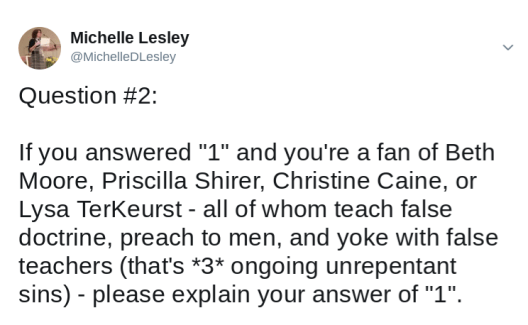
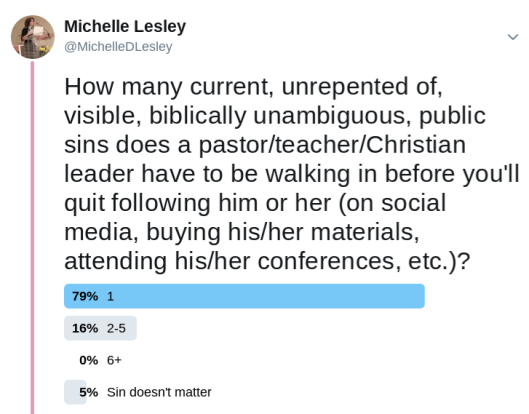
In the wake of Frank Page’s resignation, I asked this poll question on Twitter

followed by this one

Why are Southern Baptists leaders so quick to – rightly and biblically – oust Frank Page for, as far as we know, one isolated sin which he publicly confessed to and repented of, and yet overlook three major – and much more publicly observable and harmful to Southern Baptists – ongoing sins from pastors and teachers who have been rebuked and refuse to repent? Why, instead of disciplining them for their sin, do those in leadership give them fat book deals, invite them to speak at all the cool conferences, fawn over them on social media, and make them into celebrities?

How many sins will it take to disqualify and discipline these people? Four? Eleven? Ninety-six? Is there any amount of sin these pastors and teachers, and those like them, can commit that will cause those in SBC leadership to pull their materials off the shelves of LifeWay, deny them a seat at the table, and urge them to repent and step down from their positions?

I’ve been a Southern Baptist from the day I was born. I’ve been taught since the cradle roll that if God’s Word says not to do something and you do it anyway, that’s a sin. If God’s Word says to do something and you don’t do it, that’s a sin. And that sin is sin in the eyes of God.

Well is it, or isn’t it, Emperor?

If sin is sin in God’s eyes, why aren’t you treating Beth Moore’s sin like Frank Page’s sin? Why are you rewarding her for her sin and disciplining him for his?

The Bible says in James 3:1:

Not many of you should become teachers, my brothers, for you know that we who teach will be judged with greater strictness.

Those who teach and lead bear more responsibility to teach sound doctrine and walk worthy because they are teaching and leading us by example.

Why are all the aforementioned pastors and teachers better examples to us in their rebellion and unrepentant sin than Frank Page was in his repentance of sin?

Why?

Southern Baptist peasants and little children see right through your foolishness on parade on this issue and we want answers. Biblical answers.

Don’t just stand there shivering, suspecting we are right, but thinking, “This procession has got to go on,” and walking more proudly than ever. Go back to the palace. Repent. Clothe yourselves with humility and obedience to Scripture, and come back and lead us rightly. Biblically.

Because the Emperor of Southern Baptist leadership has been naked for far too long.


ยนH.C. Andersen Centret (The Hans Christian Andersen Centre). The Emperor’s New ClothesAccessed April 5, 2018.

ยฒI am well aware that this is not the only problem in the SBC that needs to be addressed. It would be impossible to address every issue in one article, so this time I’ve chosen to focus on this one particular issue.
Share Your Testimony

Testimony Tuesday: Addie’s Story

Addie’s Story

My name is Addie and I was born in 1956 into a 100% Catholic community to Cajun French speaking parents in a very small secluded town located on the banks of the Bayou Teche. Not unlike most children, in my younger years, my whole world encompassed what I was familiar with, the Cajun French culture and Catholicism.

In retrospect, my first memories are of a highly volatile dysfunctional family unit of physical and verbal abuse with vague intermittent blurbs of minimal peace and happiness. I do not reveal this personal part of my life to disparage my parents, who simply did the best they could with what they knew, but rather to establish the reason for the inquisitive search I had for the God, which I always acknowledged existed even from my earliest recollections.

As the 3rd daughter of 4 children, I was the naturally more religious of all the siblings and enthusiastically participated in all the religious rituals of the denomination of my German and French ancestors. The local Catholic Church and cemetery, located directly across the road from our residence, became a constant refuge from the upheavals that were a weekly occurrence within our home. Although, it was by my early teens that I began questioning “the what’s and the whys” of the religion of my birth while slowly becoming aware that though I faithfully practiced all the required rituals, I had yet to come to know the true personal God I knew was my Creator, and who had sent His Only Son to die for me, a sinner!

For the next 4 to 5 years my spiritual questions multiplied while very few answers were forthcoming, and, eventually, much to my mother’s disapproval, resulted in my decision to discontinue participating in all the rituals of Catholicism. I did continue to attend Mass periodically to appease my mother but had lost my desire to know God and Jesus Christ, His Son through what I had come to realize was a vicious cycle of man made rituals and religion with no finality. Is this who God is and can no true truth be found? Believing the answers to be unknowable, I then gave up on my search for the One True God of my childhood and turned to the world for answers.

By the time I was 24, I was divorced and steeped in many of the superficial self destructive beliefs the world had to offer. I had, sadly, become a very selfish, enraged, self destructive, pro-abortion women’s-libber with many talents but no sense and even less direction. Going through life riding on monstrous waves of emotional highs and lows living on the very edge of self destruction, my life was literally out of control and all of my own making. It was at this deepest, darkest period in my life, I met my “love at first hearing”, singer/songwriter husband, Prentiss of, at present, 32 years, and providentially, I met his mother, a born again Christian, who as the Lord would have it, was a former Catholic! During the following 4 years of living through a severe accident nearly taking Prentiss’s life and the continuing highs and lows of my personal emotional turmoil, Prentiss’s mom took me into her home, and loved me when I was the most unlovable, as she patiently answered all my questions by opening…THE BIBLE!

In the Lord’s time, my coming in brokenness, with “the” true biblical understanding of salvation by grace alone, through faith alone, in Christ alone, I was born again in 1985, at the age of 28. I followed immediately in believer’s baptism and married, Prentiss, the perfect man “for me!” I can not express in words the joy that filled my heart, as it remains so to this very day.

I have since followed my husband to Nashville, and back home again, all the while consciously placing myself under biblical teachers and preachers. As my hunger grew to know more of the contextual understanding of God’s Word, I also set out to learn more about the Catholicism of my Cajun culture including finding the answers to my many long held questions. As I dove head long into research, availing myself to several foundational seminary courses and reading related books on Catholicism, Catholic Mystics, as well as, other diverse forms of religion, I also found myself investigating other various beliefs and movements, especially those with questionable and controversial teachings “claiming” to be Christian.

It was at the onset of the 1990s when I developed concerns about some pseudo-Christian beliefs and teachings, of which I had uncovered in my years of research, coming into once solid biblical churches, one of them being my very own little Baptist church. It was then I became aware of a purpose driven, emergent, postmodern, mystical infiltration which simply caused me to investigate that much deeper and wider covering more than 25 years of study.

Once again, in the Lord’s time and in His providence, this unquenchable drive has given birth to Discerning the Drift Teaching Ministry. God has, also, graciously brought fellow believers of like mind into my life, who are of great emotional and spiritual support. In this continuing life of sanctification, I finally have all my “necessary” questions answered and am looking forward to what the Lord has in store for my pilgrimage here and in eternity future.

All because of the Jesus Christ of Scripture, Addie


Ladies, God is still at work in the hearts and lives of His people, including yours! Would you like to share a testimony of how God saved you, how He has blessed you, convicted you, taught you something from His word, brought you out from under false doctrine, placed you in a good church or done something otherwise awesome in your life? Private/direct message me on social media, e-mail me (MichelleLesley1@yahoo.com), or comment below. Try to be brief (3-4 paragraphs or less) if possible. Iโ€™ll select a few to share on the blog another time. Letโ€™s encourage one another with Godโ€™s work in our lives!

Mailbag

The Mailbag: Potpourri (Orange Curriculum, Jesus went to hell?, 1 Tim. 2:12 only for Ephesus?…)

Welcome to another โ€œpotpourriโ€ edition ofย The Mailbag, where I give short(er) answers to several questions rather than a long answer to one question. I also like to take the opportunity in these potpourrri editions to let new readers know about my comments/e-mail/messages policy. Iโ€™m not able to respond individually to most e-mails and messages, so here are someย helpful hintsย for getting your questions answered more quickly.ย Remember, the search bar can be a helpful tool!


In the Apostles Creed, there is a section that states Christ descended into hell and was resurrected. Isnโ€™t that what Joyce Meyer teaches? What about the part about the “holy catholic church: the communion of the saints”? Is that talking about Catholicism and the mass?

These are very common questions (I threw in the second part about Catholicism and the mass, since that’s also commonly asked.), and it’s good to ask, because if you’re confused, other people probably are, too.

The Apostles’ Creed says:

I believe in God, the Father Almighty,
the Creator of heaven and earth,
and in Jesus Christ, His only Son, our Lord:
Who was conceived of the Holy Spirit,
born of the Virgin Mary,
suffered under Pontius Pilate,
was crucified, died, and was buried.
He descended into hell.
The third day He arose again from the dead.
He ascended into heaven
and sits at the right hand of God the Father Almighty,
whence He shall come to judge the living and the dead.
I believe in the Holy Spirit, the holy catholic church,
theย communion of saints,
the forgiveness of sins,
the resurrection of the body,
and life everlasting.
Amen.

It’s a beautiful, basic reiteration of the gospel which many churches and ministries use as part of their official statement of faith. Some churches even recite the Apostles’ Creed during their worship services.

The earliest written record of the creed is from AD 390, in Greek, so you can imagine that some of the terminology used had different connotations back then than those terms have in 21st century America.

Providentially, my friend, Pastor Gabe Hughes, was also recently asked this same question and addressed it both on his podcast and in a WWUTT video, so I’m going to let him do the “heavy lifting” of Scripture and history in the resources below and just give you the short and sweet version:

๐Ÿ“œย You’re quite right in saying that Joyce Meyer teaches that Jesus went to hell between His death on the cross and His resurrection. The Bible doesn’t say this anywhere, and this is a heretical teaching. Just one of the multiple reasons no Christian should follow Joyce Meyer.

๐Ÿ“œย The word “hell” in the Apostles’ creed is based on a mistranslation or confusing translation. The literal meaning of the phrase is that he descended into theย grave or was buried.

๐Ÿ“œย You might have noticed that the word “catholic” in the creed starts with a lowercase “c” rather than a capital “C”. The noun “catholic” with a lowercase “c” simply means the universal church – all genuinely regenerated Believers across the globe, past, present, and future. Roman Catholicism is (or at least by rules of grammar is supposed to be) denoted by a capital “C”.

๐Ÿ“œย “Communion” in the creed does not refer to the Roman Catholic mass or even to the Protestant Lord’s Supper. A clearer word to us today would be “fellowship” or “unity”. The sense is that Believers commune with on another.ย 

Some churches have modernized and clarified the creed by replacing these phrases with “He descended into the grave” or “He descended to the dead” and “the holy Christian church.”

Additional Resources:

WWUTT Podcast #645– Gabe expands on the above video at the 30:15 mark

The Apostlesโ€™ Creed: Its History and Origins at Faithlife Blog


I was wondering if you could post your articles in a larger font. I have an old computer that messes up when I try to make the font bigger. My old eyes are a real struggle.

At first, I thought I was the only one having this problem, but I’ve gotten this question a couple of times, so I know it’s not just my own aging eyes :0)

I’m going to play around with the font a little bit and see if I can find one that’s bigger. Just a few things to understand as I’m working on it: WordPress gives me a limited number of fonts to choose from, and the sizes of those fonts are pre-set. In other words, I can’t set it to 12 point or 18 point, I can only choose from tiny, small, normal, large, and huge. (Right now it’s set on “normal” if you can believe that. “Tiny” is virtually invisible.)

Additionally, when I change the font size, it doesn’t just change the size of the font in the body of my articles, it also changes the size of things like the tags (to the immediate upper left of every article), the sidebar (far left of the page), and the tab titles (top of the page), which, as you can see, are already much larger than the font in the article body. When the font of those texts gets larger, it throws the layout of the whole page out of whack. You might not notice it on a desktop computer with a large monitor, but it can be problematic for people who are viewing the blog on a phone or tablet.

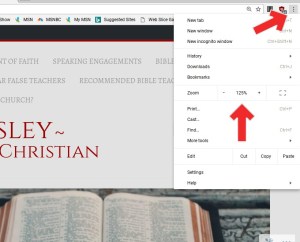
Like I said, I’ll play around with it and see what I can do, but if I’m not able to enlarge the font, there are two workarounds that may help:

1. The reader said she’s unable to change her screen magnification, but it works for me and might work for others. Here’s what it looks like on my computer. Maybe yours is similar:

2. If worse comes to worst, you can highlight and copy the body of the article, paste it into your word processing program, and enlarge the font accordingly.


I have been leading a womenโ€™s small group at our church for a couple of years now. My husband and I have decided to leave the church because, even after confronting leadership about the direction the church is being led doctrinally, they continue to espouse unsound doctrine. What do you think is a wise way to tell the ladies I will no longer be teaching? Do I tell them we are leaving? If so, do I tell them why? What do you think you would do?

It’s hard to say exactly what I would do because every situation and every church is different. But I can tell you that the first thing I would do is talk it through with my husband and ask his advice. There have been many times when he has had very good ideas about how to address (or not address) certain issues, and he will sometimes bring out an aspect of the situation that I hadn’t thought of before. I would encourage you to do that first, and also to make sure you’re submitting to your husband in whatever ways might be applicable in this situation.

My inclination is to advise you to take the “the less said, the better” route with regard to the whole class. (There may be other venues, such as you and your husband meeting with the elder board, in which you’ll need to clearly spell out all the problems, but let’s just focus on the class right now.)

I would probably wait until the end of the very last class and say something generic, like, “I’ve really enjoyed leading this class, but I wanted to let you know I won’t be teaching any more. I encourage you to continue studying God’s Word and growing in Christ. Class dismissed.” Then, go home fairly quickly.

The next level is going to be women coming up to you individually and asking why you won’t be teaching any more. Unless she’s a very close friend, I’d still keep it pretty generic: “We love our brothers and sisters at this church, but we’re finding we disagree with some of the doctrine that’s being taught here, and we’ll be going to a new church.”

For very close friends, you might wish to disclose more about the doctrinal problems, but do so wisely, making sure your focus is on doctrine, not on personal conflicts with the pastor or others. You don’t want people jumping to the wrong conclusion about why you’re leaving.

I really would not talk to people about leaving other than discreetly informing those who need to know. If you give details or talk about it a lot there could be an ugly blow up, and most people will make wrong assumptions about why you’re leaving.


Do you have any information on the Orange Curriculum for children’s Sunday School?

The main thing I know about the Orange Curriculum (or Orange Strategy) is that it is put out by Andy Stanley’s “church”. That’s enough for me to warn people to stay far, far away from it. Andy Stanley is a Scripture-twisting false teacher. You don’t want your children being taught by him or his disciples.

My friend Amy Spreeman over at Berean Research was asked the same question by a reader. I refer you to her article,ย Parents: If your church is โ€œTurning Orangeโ€ฆโ€ย for more details.


How would you respond to someoneโ€™s who says that [1 Timothy 2:12] was meant only for that time and culture?

It’s one of the most common arguments made by people who are looking for an acceptable way to rebel against God’s clear command, “I do not permit a woman to teach or to exercise authority over a man; rather, she is to remain quiet.” I have never had a woman who was humbly seeking to deny herself and obey Scripture make this argument, only those who stubbornly want to have their own way despite what the Bible says, yet simultaneously want to cloak themselves in the appearance of obeying Scripture.

God gave us His exact reasons for this command in verses 13 and 14 (almost as if He somehow knew this argument was coming!), and those reasons weren’t restricted to the women in the first century Ephesian church. The first reason was the Creative order – Adam was formed first, then Eve. The second reason is that Eve was deceived. Both of those reasons are universal (applying to all women and churches everywhere regardless of era or culture). It makes no sense that these two reasons related to Eve would apply only to first century Ephesus any more than it would make sense for them to apply only to tenth century Damascus or seventeenth century Paris.

Next, examine the context of 1 Timothy 2. There are all sorts of instructions to the church in that chapter. Was the instruction to pray for governmental leaders (1-2) limited to the first century Ephesian church? Were only the men of the first century Ephesian church to pray without quarreling (8)? Was modesty (9-10) only required of women in the first century Ephesian church? Then why pick out this one instruction in verse 12 and claim it was limited to that time and culture?

Finally, look at the overall general pattern of male headship and leadership in Scripture. First human created? A man. The Patriarchs? As the word implies – all men. Priests, Levites, Scribes? Men. Heads of the twelve tribes of Israel? Men. Major and minor prophets? Men. All kings of Israel and Judah? Men. Noahic, Abrahamic, Mosaic, and Davidic Covenants? All established between God and men. Authors of Scripture? Men. The forerunner of Christ? John the Baptist – a man. Messiah? A man. All of the apostles? Men. All of the pastors, elders, and deacons of churches in the New Testament? Men. Founder and head of the church? Christ – a man. Leader and head of the family? Men. Now which fits better with this pattern, women preaching to, teaching, and exercising authority over men in the church, or womenย notย preaching to, teaching, and exercising authority over men in the church?

But the truth is, you can have all the biblical evidence in the world, and it’s not going to convince someone who’s in rebellion against Scripture because self is reigning on the throne of her heart. She’s not concerned withย actuallyย obeying God’s Word, she just wants to be able toย claimย that Scripture supports whatย she wants to do, either to look good to others or to attempt to drown out the Holy Spirit’s conviction of her sin.

Additional Resources:

Jill in the Pulpitย 

Ten Things You Should Know About 1 Timothy 2:11-15 and the Relationship Between Men and Women in the Local Churchย atย The Council on Biblical Manhood and Womanhoodย (CBMW) This is a refutation of the most common egalitarian arguments against the plain meaning of 1 Timothy 2:11-15.


If you have a question about: a Bible passage, an aspect of theology, a current issue in Christianity, or how to biblically handle a family, life, or church situation, comment below (Iโ€™ll hold all questions in queue {unpublished} for a future edition ofย The Mailbag) or send me anย e-mail or private message. If your question is chosen for publication, your anonymity will be protected.