Sanctification, Sin

Throwback Thursday ~ Performing a Sin-ectomy

Originally published November 3, 2008

Have you ever faced an issue of obedience in your walk that seemed so difficult you felt like you’d never get it right? Maybe it’s something most would consider a “biggie”, like pornography, gambling, or alcoholism. Maybe it’s one of those heart issues that nobody sees except you and God, like racism, a critical spirit, pessimism, or bitterness.

Sometimes the sins we would consider to be “big” are, in a way, easier to deal with than the “small” ones. After all, it’s a lot easier to put an adult content filter on your computer than it is to prevent critical thoughts from jumping into your mind. You can take a different route home from work so you don’t even have to drive past your favorite bar, but we take our minds with us everywhere we go (although looking at the behavior of some people these days, you have to wonder!)

I’m working through not one, but two heart issues right now that are both really tough. (I’m not sure if God is piling on or being efficient!) I’m glad, though, that both issues finally came to a head in my spirit and that God is gradually working them out of me to make me more like Him. As I began the battle against these two sins, God sat me down and showed me some things I needed to know and do as I moved forward:

When God reveals sin in our lives, we can’t just ignore it. We must face it and fight it no matter how difficult it seems. If we don’t, the distance between us and God that was created by that sin won’t just remain, it will grow. This is because we’re now committing two sins, the sin itself, and the sin of refusing to deal with it and get it out of our lives.(James 4:17)

Only God can remove sin. We can try, through our own strength, to fix the problem ourselves, and we might even look successful temporarily, but ultimately, without His power, help, and strength, we wil fail. (Romans 7:14-25)

Prayer is absolutely imperative. Because we need God’s strength and power, we’ve got to ask Him for it at least daily, and preferably continuously throughout the day. I have found that if I don’t stay on top of these two obedience issues in my life by praying for God’s help every single day, I start slipping back into my old ways. (Matthew 26:41 )

Commit consciously and completely. Remember the scene in the movie The Karate Kid in which Mr. Miyagi is talking to Daniel about committing to karate? He says something to the effect of, “You do karate “yes”, safe. You do karate “no”, safe. You do karate “guess so”, get squashed, just like grape.” It’s much the same way with issues of obedience, except that the only safe choice is to “do obedience, ‘yes'”. It’s important to make a firm and definitive decision to give ourselves completely to obeying what God has revealed to us, otherwise we’ll be sure to waver when the going gets tough. Sometimes it is helpful to stand in front of the mirror and watch ourselves making a verbal pledge to God to obey, or write out our commitment on a piece of paper. (Psalm 119:57)

Take all the prayer you can get. While we should be discerning with regard to discretion, it’s helpful to enlist others to pray for us. Not only will we have more prayers going up on our behalf, but we will find that being accountable to those who are praying for us helps us stay on track. (Colossians 1:9-10)

Be ready for the enemy’s attack. If there’s one thing Satan hates, it’s a Christian who desires to be obedient to God. We have to realize that when we determine to set our feet on the road to obedience, he will attack. The obedience issue will suddenly become much more difficult; other things will pop up in our lives that have to be dealt with so we’ll feel like putting the obedience issue on the back burner; depression or discouragement may come. Those things are all designed to deter us and keep us in sin, but we have to stand firm and keep moving forward in obedience. (Ephesians 6:12-13)

Get plenty of rest, eat right, and stay healthy. This is war. We can’t fight off the enemy of the flesh when we’re tired and weak. Being in top physical condition when doing spiritual battle helps immensely. (Mark 12:30)

Stumbling here and there is inevitable, but don’t give up! When babies first start to walk, they don’t just get up in the middle of the floor and walk perfectly from that day forward. They take a few steps and fall, then a few more steps and another fall. But, they keep on getting up and trying again. We’re going to mess up when we try to obey, but we can’t give up. We’ve got to keep at it. Eventually we’ll get the hang of it. (Proverbs 24:16, Galatians 6:9)

Be vigilant and always on the alert for opportunities to practice obedience. The main hurdle I’ve been facing with my obedience issues is that I react automatically, quickly, and without thinking, to the stimuli that trigger my disobedience. It’s almost Pavlovian in nature. I literally need God to change my mind and my thoughts. This has prompted me to pray two things: One, that God will help me to stop for a few seconds after a stimulus presents itself so I can think about my response before I give it; two, that every time I enter the presence of the stimuli, God will help me to be focused and alert to opportunities that arise to practice obeying Him. God has answered those prayers, and it has been immensely helpful. Looking for opportunities to obey has now become almost fun, like an Easter egg hunt. It is exciting to find that opportunity and know I’m doing the right thing for a change. (Romans 12:2, II Corinthians 10:5)

Be patient. If the sin we’re battling is entrenched, it’s likely gotten to that point over a long period of time (decades, in my case). It is probably going to take a while to eradicate it and replace it with Godly behavior. Although God sometimes sets us free from things immediately, usually with behavioral and thought issues He has us roll up our sleeves and do the hard work it requires to change. We just have to keep plugging away and remember that even if we only move an inch forward, we’re still moving forward. (Romans 5:3-5, James 1:2-4)

Keep score. Something I’ve found debilitating in the battle against disobedience is that at the end of the day I seem to remember only my failures and none of my successes. This is extremely discouraging and demotivating, so one of the things I have been praying is that God will help me remember what I’ve done right during the day. It has helped me to see my forward progress and reminded me to thank God for His help and give Him the glory for my successes. Additionally, as God has reviewed my successes with me, He has reminded me that He is cheering me on. He is always pleased when we get it right. (I Corinthians 15:56-57)

Eyes on the prize. “His master said to him, ‘Well done, good and faithful slave You were faithful with a few things, I will put you in charge of many things; enter into the joy of your master.'” Matthew 25:21 “Blessed is a man who perseveres under trial; for once he has been approved, he will receive the crown of life which the Lord has promised to those who love Him.” James 1:12 We do what we do for God’s glory and the applause of Heaven.

Hang in there with God. It is worth it!

Christian women, Complementarianism, Ministry, Sin

Women Preaching: It’s Not a Secondary Doctrinal Issue

When it comes to Christianity, are the specifics of what people believe important?

I think most of us would answer a resounding “yes” to that question. Of course, the various concepts we believe are important. You can’t just believe anything you like and still be a Christian. There are certain things you must believe in order to become a Christian at all, and there are certain things you will come to believe because you are a genuinely regenerated Christian. But what are those things, and how do we know which is which?

You can’t just believe anything you like and still be a Christian.

Maybe you’ve heard the terms “essential doctrines” or “primary, secondary, and tertiary theological issues” or “first, second, and third tier levels of doctrine”? For years, theologians have been attempting to organize beliefs of the Christian faith – all drawn from the Bible, naturally – into nice neat categories in order to make things a little simpler. As someone who thrives on organization and categories, I’m grateful for their efforts. But if you begin to study this categorization of beliefs, you’ll find that we haven’t reached an across the board consensus yet.

Generally speaking, “essential”, “primary”, or “first tier” doctrines are those which you, biblically, have to believe in order to become a Christian and/or be considered a Christian. For example:

โœข Sin is a thing, and I am a sinner.

โœข God exists and is the supreme authority of the universe.

โœข Jesus was God in human flesh.

โœข Jesus rose bodily from the grave.

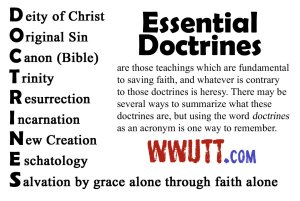
See how this works? If you don’t believe you’re a sinner, you’re not saved. If you don’t believe in the bodily resurrection of Christ, you’re not saved. Here’s how our friend, Pastor Gabriel Hughes, briefly outlines essential doctrines:

(Gabe later tweaked the acrostic a little and added an “S”, which I think is helpful.)

The vast majority of brand new Christians have only the most basic understanding of most of these tenets at the moment of salvation. But it’s not an issue of fully understanding – or else we’d all have to be theologians in order to get saved – it’s an issue of believing. Someone who is genuinely regenerated may not completely understand how the Trinity works (honestly, no one does), but when she’s introduced to the biblical idea of the Trinity, she believes it, learns more about it, and does not reject it.

There is typically agreement among most reputable theologians regarding what constitutes first tier doctrine. Scripture is clear about these things, and several of these issues were settled long ago by the church fathers in assorted church councils (Nicea, Chalcedon, etc.)

Secondary issues are routinely defined as non-salvific but still extremely biblically important, if not quite as biblically clear-cut as primary issues. Doctrines surrounding baptism (credo versus paedo, affusion versus immersion), for example, are usually cited as a secondary issue. A disagreement on a secondary issue doesn’t mean one person is saved and another isn’t, but it normally prevents close partnership in ministry activities involving these issues. For example, my Presbyterian friends and I can join together in pro-life ministry, but we would most likely not plant a church together.

Tertiary issues are non-salvific, less immediately urgent, biblical issues in which the Bible is even less clear-cut and open to wider (yet still biblical) interpretation. These are issues over which Christians can disagree and still maintain close doctrinal fellowship, even in the same church, if they’re in agreement on first and second tier doctrine. Eschatology – the order and timing of events at Jesus’ second coming – is a doctrine that’s often considered third tier. Someone can hold a different eschatological view than mine, yet, for the most part, it shouldn’t affect our ability to worship together, work together, or participate in the ordinances together in the same church.

Some theologians add a fourth category – issues of adiaphora, conscience, or Christian liberty. Usually these are issues of much less importance that the Bible either doesn’t specifically address, or doesn’t give commands about one way or the other. Individual Christians may use biblical principles to inform their consciences and decide for themselves. These would be things like whether or not to take your child trick-or-treating or deciding whether to dress formally or casually for church.

While theologians are largely in agreement about primary doctrines, there is wider spread disagreement on which doctrines are secondary and tertiary (many consider eschatology to be a second tier doctrine, for example) and whether or not there is a need for a category of adiaphora, since such issues are normally not considered to be “doctrinal” issues. In fact, there’s enough space for disagreement that pastors and theologians often wisely refrain from making concrete lists of secondary and tertiary doctrines.

But when we’re talking about the different levels of doctrine, what you won’t find is questions like these: Is murder a first, second, or third tier doctrine? What about gossip? Rape? Adultery? Lying? Gluttony? Pride?

And it’s not because these issues aren’t important or because the Bible doesn’t address them. It’s because they’re in a different category from the other issues: the category of sin. They aren’t doctrines upon which salvation hinges, they aren’t open to interpretation, and the Bible is clear that we are absolutely not to do these things.

The category of doctrine deals with beliefs. The category of sin deals with behavior.

In 2005, Dr. Albert Mohler wrote an excellent article about the different levels of doctrine entitled A Call for Theological Triage and Christian Maturity. He carefully explains the importance of each level of doctrine and what it covers in a plea to keep each level’s urgency in its proper place of significance during discussion, debate, and decision-making.

It was a helpful article to which I always refer people who have questions about tiers of doctrine, and I agree with Dr. Mohler’s thoughts in the article wholeheartedly1 …except on one point:

“In recent years, the issue of women serving as pastors has emerged as another second-order issue.”

Women serving as pastors, women preaching, women teaching men Scripture, and women exercising authority over men in the gathering of the Body is not a secondary issue. Nor is it a primary or tertiary issue. It does not belong in the category of “doctrine” in the same way baptism and eschatology do. It belongs in the category of sin in the same way murder, gossip, and adultery do. Let’s take a look at the reasons for this.

Women serving as pastors, preaching, teaching men Scripture, and exercising authority over men in the gathering of the Body is *not* a secondary issue. Nor is it a primary or tertiary issue. It is a sin.

I do not permit a woman to teach or to exercise authority over a man; rather, she is to remain quiet. 1 Timothy 2:12

(The preponderance of Scripture supports and affirms this concept, so to keep things simple, we’ll use this verse as an exemplar.)

โœข The prohibition in 1 Timothy 2:12 is a clear command against a certain behavior. And when we behave in a way God has prohibited, that is called “sin”. All of the tenets in the three levels of doctrine are affirmative statements regarding beliefs (you must believe in the resurrection of Christ, we believe in baptism by immersion, etc.). None of them are commands, in the negative, against sinful behavior (Thou shalt not murder, I do not permit a woman to teach… etc.)

โœข Secondary and tertiary doctrines can be open – to varying degrees – to biblical interpretation. Every stripe of non-heretical eschatological thought can provide you with chapter and verse passages that can, depending on the angle from which you approach the subject, be biblically plausible and scripturally supported. There is no biblical support for anything God prohibits. No one can cite a properly handled, in context Bible verse in which God says, “It’s OK to commit adultery,” or “Women are allowed to preach.” There can be multiple views on a secondary or tertiary issue that can all be considered biblical, but there can only be one view of sin that is biblical.

โœข Differing beliefs on true secondary and tertiary issues are not sin. My Presbyterian friends have a different view of baptism than I do. That doesn’t mean either of us is sinning. I may think their interpretations of the verses they believe support paedo baptism are incorrect, but they are not breaking any of God’s commands. Differing behavior (again, we see the distinction between doctrinal belief and sinful behavior) on issues of sin is sin. If someone behaves differently from God’s command about lying, she is sinning. If a woman behaves differently from God’s command in 1 Timothy 2:12, she is sinning.

โœข Differing beliefs on secondary and tertiary issues are not born of disobedience and rebellion toward God. Usually, it’s quite the opposite. When someone has studied a theological issue enough to hold a particular position on it, it’s usually because she is striving to please God and to be biblical in her beliefs. Differing behavior on issues of sin is born out of disobedience and rebellion toward God. Someone who steals has already decided in her heart that her desires are better than God’s command. A woman who knowingly holds improper authority over men in her church is doing so because she has already decided to defy God’s clear command against such.

โœข Because different beliefs on secondary and tertiary issues are not born of rebellion and are not sin, they do not require church discipline. Sin does require church discipline. If someone in your church is openly dishonoring her parents, she is sinning and should be subject to church discipline. If a woman is pursuing a career as a pastor, she is sinning and should be subject to church discipline. 

Since the publication of Dr. Mohler’s article (and perhaps as a result of others teaching the same thing) the idea of the violation of 1 Timothy 2:12 being a “secondary doctrine” has spread in a most unhelpful way, leading many Christians to treat the issue in a c’est la vie, “We can just agree to disagree on this,” manner.

No, we cannot.

The idea of the violation of 1 Timothy 2:12 being a “secondary doctrine” has spread in a most unhelpful way, leading many Christians to think “We can just agree to disagree on this.”. No, we cannot.

We would not say, “We can agree to disagree,” on lying or adultery or homosexuality or abortion, and we cannot say it about women preaching, teaching men, or holding unbiblical authority, either. We disciple and teach a sister in Christ who is unaware of what the Bible says on these matters, and if she is committing any of these sins, we begin the process of church discipline. But it would not be loving toward her, or honoring God, to allow her to continue in biblical ignorance or in willful sin.

Furthermore, the violation of 1 Timothy 2:12 brings with it dangers to the church that true secondary and tertiary issues, and even many sins, do not…

The violation of 1 Timothy 2:12 brings with it dangers to the church that true secondary and tertiary issues, and even many sins, do notโ€ฆ

She may not say it with her lips, but when a woman preaches to men in defiance of Scripture, sheโ€™s teaching false doctrine through her behavior. What is the false doctrine sheโ€™s teaching? โ€œI donโ€™t have to obey Godโ€™s Word, and neither do you. If thereโ€™s a part of the Bible you donโ€™t like, youโ€™re free to disregard it.โ€ If your pastor stood up in the pulpit on Sunday morning and said that in words, youโ€™d run him out of town on a rail, and rightly so. Neither should a woman be able to teach that same false doctrine via her actions.

Additionally, I have mentioned several times when dealing with this issue that women preaching to men is highly correlated with women teaching other forms of false doctrine. I have researched scores of women teachers. Every single one of them who unrepentantly teaches men also teaches false doctrine in some other aspect of her theology (usually progressivism, Word of Faith, or New Apostolic Reformation). In other words, if a woman teaches men, you can just about take it to the bank that she also teaches additional false doctrine. False doctrine and heresy are infecting the church – via female preachers – at an alarming rate.

We dare not simply “agree to disagree” on this.

The violation of God’s command that women are not to instruct men in the Scriptures nor hold improper authority over men is a sin like any other. It is not a doctrinal issue in the same sense that other second and third tier doctrines are. If left undisciplined, however, it can lead to first tier doctrinal issues infiltrating a church and eventually destroying it. It is detrimental to the church to label and treat any sin as a secondary doctrinal issue.

Additional Resources

Is Women Preaching a Secondary Issue? on A Word Fitly Spoken

What Are Essentials and Non-Essentials? on A Word Fitly Spoken

Christian Liberty on A Word Fitly Spoken

The importance of Primary and Secondary Doctrines on the Truth Be Known Podcast


1In the years since 2018, when this article was originally written, Dr. Mohler has said, done, and supported various biblically questionable things, leading some to question whether or not he has “gone woke”. While I don’t support his stance on those questionable things, I also don’t believe he has reached the point at which I need to warn against him (although I don’t proactively recommend him, either). To my knowledge, at this time, he is still generally doctrinally sound.

Apologetics

Throwback Thursday ~ There’s No Such Thing as an Atheist ~ The Final Chapter

Originally published March 20, 2009

There’s No Such Thing as an Atheistย  Part 1ย  Part 2

So, if our minds know God exists, and our hearts know God exists, where does that leave the so-called atheist or agnostic?

Well, like I said before, there’s no such thing as an atheist, only a rebellious human being.

If a person knows God exists, as we all do, and yet refuses to acknowledge Him or submit to His authority, he is by definition, rebelling against God. The Bible describes it this way:

For the wrath of God is revealed from heaven against all ungodliness and unrighteousness of men who suppress the truth in unrighteousness…….For even though they knew God, they did not honor Him as God or give thanks, but they became futile in their speculations, and their foolish heart was darkened…….For they exchanged the truth of God for a lie, and worshiped and served the creature rather than the Creator, who is blessed forever. Amen. Romans 1:18, 21, 25

This refusal to acknowledge the truth about God will not last forever, though. As my husband puts it, everyone is either a member of the “Believers club” or the “future believers club”.

so that at the name of Jesus every knee will bow, of those who are in heaven and on earth and under the earth, and that every tongue will confess that Jesus Christ is Lord, to the glory of God the Father. Philippians 2:10-11

The fool has said in his heart, “There is no God ” Psalm 14:1a

Considering that we know God exists and that we will all have to acknowledge that one day anyway, atheism and agnosticism are foolish belief systems.

Obedience, Prayer, Sanctification, Sin

When God Answers the “Wrong” Prayer

“Lord, I’m just so frustrated!” I fussed, as I approached the time I had set aside for prayer this morning. Once again, the “I don’t want to” of my flesh was pulling against the “I know I need to” of my spirit like a heavy duty tow truck tugging on a kitten.

So I just ditched it. Well…sort of.

Prayer is pouring out your heart to God, right? Well, I turned on the water cannon. Reverently, of course…but with passion.

I told God how sick I was of this all-too-frequent stumbling block my flesh presented when it was time to pray, especially when I knew from experience that the feeling was fleeting and would go away after I had been praying for a few minutes. I told Him I was tired of a million other things I’d rather be doing, that I needed to do, coming to mind and further crowding out my desire to pray. I told Him I was sorry for all the times I had given in to the flesh and skipped my prayer time. I told Him I wanted Him to make this feeling go away and never come back.

As I poured out my complaint before Him, the Holy Spirit began leading me to examine theย whyย of this whole situation. What was bringing about this pull of the flesh against prayer?

And that’s when it happened. God answered the “wrongยน” prayer.

You see, one of the things I pray every day is that God will reveal to me any sins I’m unaware I’m committing and lead me to repent of and forsake them.

And in that moment,ย that’s the prayer He chose to answer.

Not the prayer for the provision of an item my family needs. Not the prayer for healing of a loved one. Not the prayer that He would save all the lost people on my list.

Not the prayerย I really wanted Him to answer.

God chose to reveal my sin to me.

You know why my flesh so often balks at prayer? Because in the dark, unsanctified recesses of my heart, I’m frustrated with God for not doing what I ask Him to do –ย now. I come to Him day after day, month after month, sometimes year after year, confessing the same sins, asking for the same provisions, and presenting the same requests, andย I don’t see Him doing whatย I want Him to do whenย I want Him to do it.

Never mind that I could list hundreds of my prayers that He actually has answered, many of them in amazing ways. Never mind that Iย know what the Bible says about prayer well enough to teach on it and write articles about it. Never mind that I really do believeย that God will answer my prayers for His glory and my good.

Uh uh. My flesh throws all of that right out the window and wants God to be my cosmic errand boy, delivering the goods on my timetable. I am selfish. I want everything to go my way immediately.

So that was pretty humiliating…but God didn’t stop there. No, there was more.

He opened my eyes to the fact that this sin problem I have relating to Him vertically is basically the same sin problem I have relating to people horizontally.

I yell at people in traffic to get out of my way. I get annoyed with my husband, irritated with my children, and impatient with fellow church members because I want them to do whatย I want, and I want them to do itย now.ย I am selfish. I want everything to go my way immediately.

Oh, wretched man that I am! Who will deliver me from this body of death?ย 

Paul was really onto something there.ย Fortunately, he answers his own question in his very next sentence:

Thanks be to God through Jesus Christ our Lord!
Romans 7:25a

Jesus. Jesus can help me to mortify this sin. And I can obey Him as He does His good work in me. How?

assuming that you have heard about [Jesus] and were taught in him, as the truth is in Jesus, to put off your old self, which belongs to your former manner of life and is corrupt through deceitful desires, and to be renewed in the spirit of your minds, and to put on the new self, created after the likeness of God in true righteousness and holiness.
Ephesians 4:21-24

I stop doing the sin (put off the old self). I remember what God’s Word says about that sin and about the righteousness I’m supposed to do instead (be renewed in mind). I do the righteous thing instead of the sin (put on the new self).

Ephesians 4 goes on to give some examples of what this looks like when dealing with real life sin:

Therefore, having put away falsehood, let each one of you speak the truth with his neighbor, for we are members one of another. Be angry and do not sin; do not let the sun go down on your anger, and give no opportunity to the devil. Let the thief no longer steal, but rather let him labor, doing honest work with his own hands, so that he may have something to share with anyone in need. Let no corrupting talk come out of your mouths, but only such as is good for building up, as fits the occasion, that it may give grace to those who hear. And do not grieve the Holy Spirit of God, by whom you were sealed for the day of redemption. Let all bitterness and wrath and anger and clamor and slander be put away from you, along with all malice. Be kind to one another, tenderhearted, forgiving one another, as God in Christ forgave you.
Ephesians 4:25-32

See how that works?

Stop lying. Remember what God’s Word says about lying and truth. Speak truth instead of lying.

Stop stealing. Remember what God’s Word says about stealing and the godly way to acquire and steward material things. Work an honest job and share with others instead of stealing.

Seems pretty simple and logical, right? It’s pretty clear cut when we’re talking about sinfulย actions. I can keep my mouth shut so lies and corrupting talk don’t come out and choose kind and truthful words to speak instead. I can keep my hands in my pockets or avoid that tempting store so I won’t steal, and get a job and share with others instead. But how in the world do I “put off” a sinfulย attitudeย likeย bitterness, wrath, anger and malice (and in my case, selfishness) when it’s just a feeling that pops up in my heart unbidden?

The world will tell you that you can’t control your feelings. And for the world, that’s true. It’s part of the sin nature of a lost person, the “old self”, to live your life by your feelings, even to be controlled by them. But that’s not the case for someone who has been genuinely born again and is indwelt by the Holy Spirit.

Part of the Fruit of the Spiritย (the evidence that the Spirit is indwelling you) isย self-control. That doesn’t just mean saying no to that second piece of cake. It’s the idea that sin is not our master anymore. We do not have to listen to and be controlled by sin, we can say no to itย because we want to say yes to our new Master – Christ – and be controlled by Him.

Let not sin therefore reign in your mortal body, to make you obey its passions. Do not present your members to sin as instruments for unrighteousness, but present yourselves to God as those who have been brought from death to life, and your members to God as instruments for righteousness. For sin will have no dominion over you, since you are not under law but under grace.
Romans 6:12-14

Notice the wording here. It’s not “do your best” or “try” not to let your old master control you. It’s an authoritative, weighty, no-nonsense command: “Let not sin reign…sin will have no dominion”. God would not command us to do something that we’re incapable of doing, or that the Holy Spirit will not empower us to do. Weย can control and put off sinful thoughts, feelings, and attitudes.

Martin Luther once helpfully said:

“You cannot keep birds from flying over your head, but you can keep them from building a nest in your hair.”

I think about that quote often when it comes to putting off ungodly thoughts that pop into my brain. Here’s how it works:

First, preemptively pray the “wrong” prayer – the one your flesh won’t want God to answer – that He will make you aware of and convict you of sinful thoughts, feelings, and attitudes.

Next, when one of those thoughts rears its ugly head, stop what you’re doing, repent, and kick that rotten vulture right out of your hair. Make a definitive, proactive, Holy Spirit empowered decision of the will that you areย not going to think that way. It helps me to say it out loud: “No. That thought is wrong. The Bible says ____ about that. I amย not going to think that.” You might get some weird looks if you’re in public, but, hey, mortifying sin is worth it, right?

I tend to combine the “put off” (stop it) and “renew your mind” (What does the Bible say?) steps because pulling the Sword out of its sheath is a good way to kill sin. It’s the way Jesus modeled for us.

But how can I “put on” a right thought, feeling, or attitude? I mean, you can’t just conjure up godly feelings, can you? No. But what youย canย do is gather up nest-building materials for that “sweet Heavenly doveยฒ”, the Holy Spirit, so He can shape your thoughts, feelings, and attitudes in a godly way:

Finally, brothers, whatever is true, whatever is honorable, whatever is just, whatever is pure, whatever is lovely, whatever is commendable, if there is any excellence, if there is anything worthy of praise, think about these things. What you have learned and received and heard and seen in meโ€”practice these things, and the God of peace will be with you.
Philippians 4:8-9

There are godly things we canย think about and godly things we canย do (“practice”) that cooperate with the work the Holy Spirit is doing in our hearts.

Instead of thinking about that prayer that God isn’t answering right now, I can think about the prayers Heย has answered. And I canย do something too. I can thank Him for those answered prayers and all of His good attributes in answering prayer.

Instead ofย thinking aboutย how and whenย I want God to do things, I can think about His sovereignty and how good that is for me and everyone else. I can alsoย do something: I can recite Bible verses I’ve memorized about the situation and sing songs of praise to Him.

Instead ofย thinking about how someone else is frustrating me by not doing whatย I want her to do, I canย think about how she is made in the image of God, valuable to Him, and precious in His sight. What can I do? I can stop and pray for her. I can speak a word of encouragement to her. I can bless her with a gift or by serving her.

Thinking and practicing ungodly things feeds and grows your ungodly thoughts, feelings, and attitudes. But thinking and practicing godly things feeds and develops your godly thoughts, feelings, and attitudes.

Back in the Stone Age when dinosaurs roamed the earth and computers were brand new, programmers used to have a saying: “Garbage in, garbage out.” In other words, if you fed faulty commands into the computer, the performance you got out of the computer was going to be faulty, too.

The Christian heart is very much the same. “Godly in, godly out.” If you feed godliness into your heart, godliness will start coming out in your thoughts, words, and actions.

We don’t have to be mastered by sinful thoughts, feelings, and attitudes. Through the power of the Holy Spirit and by putting off the old self, renewing our minds through God’s Word, and putting on the new self by thinking and practicing godly things, we can grow more and more obedient to our Lord and Master, Jesus Christ, in our thoughts, words, and actions.

I don’t know about you, but I’m going to try to remember that the next time God answers the “wrong” prayer.


ยนPlease note that the word “wrong” as it refers to God answering prayer refers toย myย having the wrong attitude or perspective. God is perfect and has never, and will never, do anything wrong.
ยฒFrom the hymnย Sweet, Sweet Spirit by Doris Akers
Women of Genesis Bible Study

The Women of Genesis: Lesson 30- Potiphar’s Wife

Previous Lessons: 1, 2, 3, 4, 5, 6, 7, 8,ย 9, 10, 11, 12, 13, 14, 15, 16, 17, 18, 19, 20, 21, 22, 23, 24, 25, 26, 27, 28, 29

๐Ÿ“–๐Ÿ“–๐Ÿ“–๐Ÿ“–๐Ÿ“–

Read Genesis 39

๐Ÿ“–๐Ÿ“–๐Ÿ“–๐Ÿ“–๐Ÿ“–


Questions to Consider

1. Briefly review lesson 28 (link above) to refresh your memory on the storyline of Joseph, then read today’s passage. Why do you think Joseph’s story starts in chapter 37, is “interrupted” by the story about Judah, his sons, and Tamar in chapter 38, and then picks back up in chapter 39?

2. How did Potiphar (1) come to acquire Joseph?

3. Carefully examine the description of Potiphar in verses 1-2 and Potiphar’s house, status, and living conditions in verses 1-6. Make a list of the things we can infer about “Mrs. Potiphar” from this information- where and how she lived, her social status, socioeconomic level, etc. Was it likely that Mrs. Potiphar was a Believer in the one true God?

4. Read verses 6-19, closely examining Mrs. Potiphar’s words and actions.ย Write a character sketch of Mrs. Potiphar, adding in the information from your list from question 3. What adjectives would you use to describe Mrs. Potiphar?

5. Describe Mrs. Potiphar’s outward sins. Outward sin can always be traced back to an inward sinful thought or attitude of heart. What was Mrs. Potiphar’s inward sin? How is lust a form of coveting? When a person covets or lusts after something or someone that doesn’t belong to her, what does that tell us about her attitude toward what sheย already has and the God who blessed her with those things?

6. The New Testament equates coveting with idolatry. Why?

7. Imagine you are a biblical counselor, and a modern day, recently born again Mrs. Potiphar comes to you for help with her struggle against lust and coveting. Considering questions 5 and 6, what sinful heart attitude would you help her to identify as the cause of her lust and coveting?

In previous lessons, we have explored the biblical model of repentance: putting off the old self (stop doing the sin), renewing your mind (learn what the Bible says about this sin), and putting on the new self (replacing sinful actions with godly actions). How could you apply these passages, using the put off/renew/put on model, to Mrs. Potiphar’s root sin of discontentment? How could thankfulness to God and serving others be the godly opposite of coveting and lust?

8. In what ways was Joseph’s righteous behavior a testimony to the one true God? How could 2 Timothy 3:12-13 apply to his situation in this chapter? Does God guarantee us that things will always go smoothly if we’re obedient to Him? If not, why should we obey Him?

9. Consider this chapter in light of current events of apparently godly men being accused of sexual harassment, abuse, and misogyny. Apply Proverbs 18:17 to both situations: “The first to plead his case seems right, Until another comes and examines him.” Why is it important to carefully and biblically examine those making accusations as well as the accused, so that the guilty are punished and the innocent are not? What were the consequences of a false accusation for Joseph, and how did God care for him? (19-23)


Homework

Do you struggle against the sin of a discontent heart like Mrs. Potiphar did, causing you to lust for and covet things, people, or life circumstances that God has not chosen to give you? Examine and repent of your sin using the put off/renew/put on model. List one Bible verse to memorize that will help you with the “renew” stage. List three specific godly actions you can do (put on) to replace sinful actions (put off). This week, memorize your verse and carry your list with you to remind you of the godly action you can take when you’re tempted to sin. Pray daily, asking God to strengthen you to resist temptation and obey Him.


Suggested Memory Verse

But the Lord was with Joseph and showed him steadfast love and gave him favor in the sight of the keeper of the prison.
Genesis 39:21