Mailbag

The Mailbag: How can the problems in the SBC (or any denomination/church) be fixed?

I read your article,ย Itโ€™s Time for a Reformation in the SBC โ€“ 3 Issues We Need to Set Right. In that article you only covered the issues needing correction, not the solutions. How would you suggest the Southern Baptist Convention, or any other church or denomination with similar problems, address those issues?

One of the reasons I addressed only the issues in that article is that a discussion of the issuesย and the solutions would have made the article extremely long. Another reason is that I know most of my readers are probably not Southern Baptist. Some of the solutions that first came to my mind would have been very “in house” to the SBC and would not have been of interest – nor made sense, without a lot of explanation (making the article even longer), of Southern Baptist polity – to those outside the SBC. However, the more I thought about the spiritual side of the issues, the more my perspective on the solutions changed. And addressing spiritual issues is relevant to every church and denomination.

As I mentioned in the previous article, the three most pressing issues I see facing the SBC are the sufficiency and authority of Scripture, false teachers/false doctrine, and disfellowshipping errant churches.

Because of the SBC’s commitment to the autonomy of the local church, I donโ€™t think any of these things are going to be corrected from the top down with resolutions and studies and committees and appointed/elected leaders. I can only speak from my own perspective, and others may disagree, but I donโ€™t see those things making any of these issues better, and in some cases theyโ€™re making things worse. I think turning the ship around is going to have to be a โ€œbottom upโ€ thing, starting at the church level.

So, what are some grassroots steps we can take?

โœขย Weโ€™re going to have to stop giving lip service to prayer and actually startย doing it. Individual prayer, yes, but what Iโ€™m really talking about is corporate prayer. Not โ€œorgan recitalsโ€, not Bible studies or worship services that we call โ€œprayer meetingsโ€, but actual, protracted corporate prayer meetings where we concentrate on praying for the spiritual health of our own church, other churches, and our denomination at large. The problems weโ€™re facing are, at their root, spiritual problems, and only God can change peopleโ€™s hearts. Itโ€™s high time we started crying out to Him to do so.

I know itโ€™s hard to get people to show up for actual prayer meetings. I used to be the Associational Prayer Coordinator for my local SBC association. Believe me, I get that itโ€™s like pulling teeth. Pastors are going to have to get as many of their teachers and leaders as possible on board and start by praying with them. Next, we need our pastors to spend some weeks and months training their people in how to pray, why we pray, what we pray for, the importance of prayer, and what the Bible says about prayer. And then weโ€™ll need pastors to proactively encourage people to be there. In my experience, corporate prayerย has to be pastor initiated and led. If itโ€™s delegated to a lay person or even an associate pastor, the rest of the church will see it as just one more optional program.

โœขย We have to emphasize the authority of Scripture over every aspect of church life. Is the church considering buying a new piece of property? Sending messengers to the annual meeting? Joining with another church in a particular endeavor? Planning a mission trip? Receiving a new member? Having a potluck? Whatever is going on in the life of the church, the very first thing that needs to be brought to the table at committee meetings, business meetings, even just casual discussions or brainstorming sessions, is an open Bible and the question, โ€œWhat does Scripture say about this?โ€ I think many times weโ€™re either assuming that most people already know what the Bible says about it, or weโ€™re doing what we think is best without consulting Godโ€™s Word, neither of which is healthy. We need to make sure weโ€™re doing what we do because the Bible says to do it, but approaching church decisions this way also trains individual members to think and act the same โ€œWhat does Scripture say about this?โ€ way in their own lives. That grows a healthier and more mature church body.

This helps drive home the concept of the sufficiency of Scripture, too. If your church is laser focused on โ€œWhat does the Bible say?โ€, itโ€™s going to biblically train your people how to find the answers they need for their own lives, and church life, in the Bible. Instead of โ€œGod told meโ€ extra-biblical revelation, instead of taking polls and surveys, sometimes even instead of forming a committee or having one more meeting, the Body will begin to depend on Godโ€™s Word as its sufficient source for making decisions.

โœขย Another way to emphasize the sufficiency of Scripture is to stop being so dependent on โ€œcannedโ€ Sunday School curricula and Bible study books, workbooks, DVDs etc., and simply teach straight from the Bible expositionally (itโ€™s cheaper too).

This scenario has played itself out in hundreds of SBC churches over the years: The womenโ€™s ministry committee gets together to decide what the next womenโ€™s Bible study will be. This author is suggested. That DVD series is suggested. Finally one brave soul pipes up and says, โ€œWhy donโ€™t we just study Ephesians?โ€. The looks on the other womenโ€™s faces demonstrate that studying straight from the Bible is a totally foreign concept.

My husband is a minister of music. He was on staff at a small church many years ago that was in a budget crunch. Something was going to have to be cut. I suggested cutting out Sunday School literature and just teaching the Bible. They opted instead to slash my husbandโ€™s salary (which was pretty paltry to begin with).

When weโ€™ve become so dependent on materials other than the Bible that church members have never heard of simply studying from the Bible or that the church would rather hurt one of its pastors than give up its literature, weโ€™ve become too dependent on outside resources and weโ€™re not viewing the Bible as sufficient.

โœขย If and when we do decide to use a curriculum or a study, weย must vet the study itself and the author(s). I know this is an unpopular thing to say among Southern Baptists, but I was asked for solutions, so Iโ€™m going to say it: LifeWay sells some materials authored by false teachers and some materials that contain false doctrine. You canโ€™t just assume that because LifeWay sells it, itโ€™s doctrinally sound. Get some discerning church members and put them to work reading the materials and comparing them to Scripture, and examining the fruit of the authorโ€™s life.

โœขย Weโ€™re going to have to be good Bereans and stop being so flippant and laissez-faire about false teachers and false doctrine. Eradicating false doctrine and false teachers from the house of God is a major theme of the Bible. If itโ€™s that serious to God, it should be that serious to us.

If somebody mentions that a certain Christian author, pastor, or teacher is a false teacher, donโ€™t mock, insult, and blow that person off as โ€œone of those crazy discernment people.โ€ We donโ€™t have to (and shouldnโ€™t) just blindly believe her, but we shouldnโ€™t just dismiss the allegation out of hand, either. Look into it. Do the research. Examine the evidence. Compare that teacherโ€™s life and teaching to rightly handled Scripture, and if she’s not walking blamelessly and teaching what accords with sound doctrine, stop allowing her and her materials into your church.

โœขย [Note:ย This part is more SBC-ish. Most other denominations have a process and governing body for dismissing errant churches. But because the SBC is technically not a denomination but a group of cooperating churches, the leadership of the SBC has very little ecclesiastical authority, including the authority to disfellowship churches.]ย As far as disfellowshipping errant churches goes, first, we need to make sure our church isnโ€™t one of them. We need our pastors to exposit the Word, not entertain. We need to make sure we equip our membership in rightly handling Godโ€™s Word, prayer, evangelism, worship, and caring for one another. We need to make sure our church is biblically healthy.

Next, get involved with the local association and, whatever the procedure is, formulate a set of criteria for disfellowshipping errant churches, employ it when necessary, and pursue it to the state and national convention levels when possible. There are a variety of doctrinal issues that could be included (A couple I would suggest: disfellowshipping churches that violate tenets of the Baptist Faith and Message 2000 and/or teach any of the historic heresies {Arianism, Modalism, etc.}), but as I mentioned in the above linked article thereโ€™s got to be a higher standard than just giving money and being on the right side of homosexuality. We should be holding up the highest standards of biblical doctrine for churches who want the right to be called Southern Baptist, not minimizing and reducing our requirements to the least common denominator.

Pray long and pray hard. Build spiritually healthy and mature churches and church members. Get them involved at the associational and state convention level. Then send them to represent your church at the annual meeting. If God is pleased to change hearts, and if we get enough healthy churches and church members working together, thatโ€™s what will bring change at the national level.


If you have a question about: a Bible passage, an aspect of theology, a current issue in Christianity, or how to biblically handle a family, life, or church situation, comment below (Iโ€™ll hold all questions in queue {unpublished} for a future edition ofย The Mailbag) or send me anย e-mail or private message. If your question is chosen for publication, your anonymity will be protected.
Church

It’s Time for a Reformation in the SBC – 3 Issues We Need to Set Right

I don’t know the brother who said it, but I saw a remark the other day from a Presbyterian gentleman who said something to the effect of, “It’s time for all doctrinally sound Southern Baptists to leave the SBC.”

I get that.

When you have an organization as large, open, and widespread as the Southern Baptist Convention, problems – even major ones – are inevitable. At this point, there are many things the SBC is still getting right, biblically speaking…

There are many good and praiseworthy things going on in SBC life. We have hundreds of doctrinally sound pastors faithfully preaching the gospel week in and week out. Discernment and biblical literacy among Southern Baptist church members is slowly but steadily growing. The SBC takes a public, biblical stand on abortion and homosexuality while many other denominations do not. Our organizational structure for funding and sending out missionaries, while sometimes flawed in its execution, is without peer.ย Southern Baptist Disaster Reliefย is one of the finest relief organizations in the world. And thereโ€™s so much more. Find a godly Kingdom effort going on somewhere, and youโ€™ll probably find a Southern Baptist involved in it. By the grace of God, while weโ€™re far from perfect, weโ€™re getting a lot of thingsย right.ยน

…But for some individual Southern Baptists and Southern Baptist churches, the biblical error and other problems pervading the SBC have become too much to bear, and they have deemed it time to walk away from what they see as a system damaged beyond repair, seeking refuge in ARBCA, Bible, Independent, or non-denominational churches and networks instead.

Like I said, I get that, and I don’t blame them one little bit. Believe me, I’ve had leaving on my mind more than once. And if the SBC continues its downward spiral, it’s an inevitability for nearly all of us who hold to sound doctrine.

But there are still plenty of us crazy, “glass half full” doctrinally sound optimists out there who, like Luther, don’t want to abandon the SBC to the rubbish heap if it can be avoided, but would rather see it reformed (little “r”), renewed, and restored to the glory of God.

If you’ve ever labored through the entirety of the Old Testament (and if you haven’t, stop denying yourself that blessing, and study it), you know that God exercised patience with Israel throughย centuries of idolatry, rebellion, and paganism of the vilest sorts, sending them prophet after prophet, warning after warning, discipline after discipline, lovingly calling, urging, and commanding them to repent and be reconciled to Him before finally executing judgment on them.

I’m just not sure we’re quite at the point of exiling the SBC… yet. I think maybe these are the days of Elijah. And Jeremiah. And Isaiah. And even Luther. A time for godly Southern Baptist men and women to stand firmly on the written Word of God and speak prophetically, chapter and verse, into their beloved churches and denomination, “Thus saith the Lord.”

And in that same spirit of the prophets of old, we don’t speak from a position of “I’m right and I’m here to prove it,” or because we’re haters, or because we’re power-hungry. It’s because we’re cut to the heart over the sin and idolatry we see among our brothers and sisters. We’re grieved that those things dishonor our precious Savior and bring His judgment and discipline upon those who participate in and propagate them.ย We deeply desire that our denomination and our churches experience the joy that comes with being spiritually healthy and biblically submitted to Christ.

So, while there are probably at least ninety-five theses that could be nailed to the doors of the Executive Committee in Nashville, here are three that would be a good start.

1.
The Authority and Sufficiency of Scripture

Nearly forty years ago, Southern Baptist movers and shakers in the conservative resurgence went to war for the inerrancy of Scripture. It was a long, hard battle, but they won.ย Now it’s time to fight for the authority and sufficiency of Scripture in the SBC.

The Bible is our authority as Christians, not the ideas, opinions, and traditions of denominational leaders, SBC celebrities, pastors, or any other person. The Bible. If the Bible commands us to do something, we do it. If the Bible commands us not to do something, we don’t do it. We don’t formulate our own programs and methods and try to squish the Bible in to make it fit. We start with the Bible. We stay with the Bible. We end with the Bible.

Because the SBC does not always submit to the authority of the Bible, we have leaders, celebrities, and pastors looking to, and promoting, sources outside the Bible for direction instead of simply trusting and obeying God’s written Word. We have influential “Bible” teachers who stand on stages in front of thousands and dare to proclaim, “God told me…”, functionally denying the sufficiency of Scripture by relying on supposed extra-biblical revelation (and teaching their followers to do the same). We have pastors and denominational leaders who look to polls and surveys to decide how to conduct their worship services or which social issues need to be addressed and how to address them. We have church growth gurus teaching our pastors to adopt all manner of worldliness that “works” to get sinners in the doors of their churches.

If the Southern Baptist Convention is to survive as an entity of biblical Christianity, the authority and sufficiency of Scripture is the number one issue that must be dealt with.ย  If this issue is properly addressed and corrected, it will alleviate or minimize nearly all other problems facing the SBC.ย We must submit to God’s written Word and give Scripture its proper place – first place – in our denomination, our individual churches, and our personal lives.

Basic Training: The Bible Is Our Authority

Basic Training: The Bible Is Sufficient

2.
False Doctrine and False Teachers

If the SBC truly regarded the Bible as authoritative and sufficient, the cancer of false doctrine and false teachers that is slowly killing us would be cured or in remission. Indeed, the aforementioned false teaching of extra-biblical (God told me, showed me in a dream, spoke to me, etc.) revelation is probably the most pervasive false doctrine accepted among Southern Baptists.

When Hilkiah found the Book of the Law in the temple (Imagine a house of God in such a shambles of idolatry that people had to dig and search for the actual Scriptures. Selah.), and Shaphan read it to Josiah, Josiah tore his clothes in grief and began to set God’s house and God’s people in order. After covenanting together with the people to obey God’s Word, the very first thing Josiah did was to have the altars and vessels of false gods carried out of God’s house and destroyed. If the SBC would follow in Josiah’s footsteps we would see things like:

LifeWay would immediately remove and destroy any and all materials by Beth Moore, Andy Stanley, Priscilla Shirer, TD Jakes, Lysa TerKeurst, Sarah Young, Christine Caine, Bethel Music, Jesus Culture, Hillsong, and all other false teachers and promulgators of false doctrine.

There would be no more conferences, simulcasts, or leadership training seminars featuring false teachers, and false teachers would certainly not be invited to speak in any capacity at the annual Southern Baptist Convention.

Pastors, authors, and speakers who attempted to build a career inside the SBC by teaching false doctrine would be subject to church discipline for their sin, not turned into celebrities or appointed or elected to denominational leadership positions.

Messenger voting privileges at the Convention would be revoked for churches which habitually and unrepentantly welcome false teachers.

If the Bible were to become our sufficient authority for both orthodoxy and orthopraxy, our eyes would quickly be opened to the enormity of the hold false doctrine has on our denomination, churches, and individuals, and we would actย accordingly and biblically.

A Naked Emperor in the Southern Baptist Convention

10 Things I Wish Southern Baptists Knew About Southern Baptists

The Peterson Predicament and LifeWayโ€™s Peculiar Policies

3.
Disfellowshipping Errant Churches

Earlier this week, the Southern Baptist Convention severed ties with the District of Columbia Baptist Convention (DCBC- an association of Southern Baptist churches in the Washington, D.C. area) for refusing to disfellowship one of its member churches, Calvary Baptist, which had called a legally “married” lesbian couple to serve as its co-“pastors” over a year ago.

It was absolutely the right thing to do (the SBC has disfellowshipped several churches that embrace homosexuality), and I’m glad that this standard remains in tact, but…lesbian co-pastors…? That’s how bad it has to get before the SBC can, or will, act to remove a church? What about churches that are embracing sins other than homosexuality?

There are plenty of apostate Southern Baptist churches, and we have no mechanism in place for kicking them out of the SBC.

This is a verbatim quote from the FAQ section (5th question from the top) of the SBCโ€™sย web site:

โ€œAccording to our constitution, if a church no longer makes a bona fide contribution to the Conventionโ€™s work, or if it acts to โ€˜affirm, approve, or endorse homosexual behavior,โ€™ it no longer complies with the Constitution of the Southern Baptist Convention and is not permitted to send messengers to the annual meeting. These, however, are the only explicitly stated instances in which the SBC has the prerogative to take action.โ€

What does that mean? As long as your church doesnโ€™t affirm homosexuality and gives to the Cooperative Program, youโ€™re in. Never mind if your pastor twists Godโ€™s word until itโ€™s unrecognizable. Or lets women and false teachers get behind the pulpit like Steven Furtick does. Or plays AC/DCโ€™s โ€œHighway to Hellโ€ on Easter Sunday and says heย probably wouldnโ€™t have strippers on stage like Perry Noble does. Or any of the other ridiculous and blasphemous shenanigans so many of the seeker sensitive types in our denomination pull. Nope, as long as you give your money and stand on the right side of homosexuality, youโ€™re good to go.ยฒ ยณ

I’ll be the first to admit, it would be a difficult standard to set and implement, but look at the standards the New Testament required of churches. We’ve got to set the bar higher than a homosexuality litmus test and an offering for a church to be in good standing with the SBC. Doctrine and practices simply have to be a factor.


Can there be another conservative resurgence that brings reform to the SBC? I believe there can.

The Bible says “nothing will be impossible with God.” I believe that. I believe that the God who spoke the universe into existence from nothing, who opened sealed tombs and barren wombs, who parted seas and walked on water and turned water into wine can change the hearts of Southern Baptists and the trajectory of the Southern Baptist Convention.

By His grace. For His glory. For our good.


ยนA Naked Emperor in the Southern Baptist Convention
ยฒ10 Things I Wish Southern Baptists Knew About Southern Baptists
ยณAs of 2019, this verbiage has been removed from the FAQ section of the SBC website. Conceptually similar language can be found here (see Article III: Composition).

Discernment, False Doctrine

A Naked Emperor in the Southern Baptist Convention

Think back to your childhood. Remember the story, The Emperor’s New Clothes?

Once upon a time, there lived an emperor. One day two swindlers came to his palace and told him they could weave cloth for his royal robes that was magical: to those who were foolish or unfit for their jobs, it would appear invisible. Only the wise and worthy would be able to see this fine fabric. The emperor hastily agreed to pay the “weavers” an exorbitant amount of money to make him such an amazing garment, thinking he would use it to weed out anyone unfit for royal service.

The weavers set about pretending to weave. From time to time, the emperor sent various folk to check on the progress the weavers were making, and – though in reality, none of them could see the non-existent fabric – all reported back that the garments were coming along nicely and the cloth was beautiful. But strangely enough, when the emperor himself looked in on the weavers, they held up the magnificent fabric, and he could not see it. Not wanting word to leak out that he was unfit to serve as emperor, he pretended to examine the cloth and complimented the weavers lavishly on their fine work.

Finally, the weavers informed the emperor that the garments were finished. They had the emperor strip down to his skivvies and pretended to help him on with his fine new “garments”. Word had spread among the emperor’s subjects about the magical properties of the fabric, and as the royal procession made its way through town, all shouted out praise for the emperor’s fine new clothes.

All. Except for one little boy.

“But he hasn’t got anything on!” the boy shouted.

It took the innocent honesty of a simple child to shock the emperor’s subjects back to their senses. The truth spread like wildfire, and the crowd began to cry out: “The emperor is naked!” “The emperor has no clothes on!” “He’s not wearing anything!”

But did the emperor admit to his foolishness, return to the palace, and get dressed? No. Sadly the story ends this way:

“The Emperor shivered, for he suspected they were right. But he thought, ‘This procession has got to go on.’ So he walked more proudly than ever, as his noblemen held high the train that wasn’t there at all.”ยน

And so the “emperor” of leadership in the Southern Baptist Convention and those who carry its train march proudly on, despite the cries of simple peasants and innocent little children crying at the top of our lungs, “The emperor is naked!” “There are issues that need to be addressed, here!” “Listen to us!”

You’ll note that the story doesn’t say that the emperor was a cruel man, that he overtaxed the people, oppressed them into slavery, was a warmonger, or was in any other way an evil leader. In fact, one could argue that he had good intentions of making sure the people who served at various posts in his empire were of the finest caliber.

And while there are many issues that need to be addressed in my denomination, I think this could generally be said of the leadership of the Southern Baptist Convention as well. Call me a Pollyanna, but I have no reason to believe our denominational leadership – as a whole – is evil or has anything less than the best of intentions for the SBC.

There are many good and praiseworthy things going on in SBC life. We have hundreds of doctrinally sound pastors faithfully preaching the gospel week in and week out. Discernment and biblical literacy among Southern Baptist church members is slowly but steadily growing. The SBC takes a public, biblical stand on abortion and homosexuality while many other denominations do not. Our organizational structure for funding and sending out missionaries, while sometimes flawed in its execution, is without peer. Southern Baptist Disaster Relief is one of the finest relief organizations in the world. And there’s so much more. Find a godly Kingdom effort going on somewhere, and you’ll probably find a Southern Baptist involved in it. By the grace of God, while we’re far from perfect, we’re getting a lot of things right.

But even benevolent emperors get things wrong sometimes, and, Southern Baptist leadership, your drawers are flapping in the breeze on this oneยฒ:

Sin. The public sin our leaders commit that we excuse and the public sin our leaders commit that we discipline, and the fact that there’s a discrepancy between the two.

Recently, Frank Page, president and chief executive officer of the Executive Committee of the Southern Baptist Convention (one of the top positions of SBC leadership at the national level) resigned his position due to “a morally inappropriate relationship in the recent past,” which, we are left with little choice but to assume means “adultery”. (As an aside, Christians, when confessing sin, let’s knock off the the terminological hem-hawing and call a spade a spade. “I had a six month extra-marital romantic and sexual relationship with a married woman in my church,” or whatever. You don’t have to give all the gory details or name names, but, for crying out loud, if you’re going to confess, confess- don’t finesse.)

It was right and biblical for Dr. Page to publicly confess and express sorrow over his sin as well as to resign (it would also have been right and biblical for the SBC to remove him had he refused to resign, which, undoubtedly would have happened). He sinned against God, his family, the woman and her family, his church, his co-workers, and the entire denomination. He publicly embarrassed the Southern Baptist Convention and gave unbelievers fodder for scoffing when the report of his sin made the national news. This was a case of a well known Southern Baptist leader whose public, observable sin was handled biblically by SBC leadership. I am thankful for this witness to Christians and to the world that sin is not to be swept under the rug, but that sinners are to repent, be disciplined, and then be restored to fellowship (although, in cases like this, not leadership).

But we don’t handle all cases of public sin that way. Some public sin we reward by making the sinner into a wealthy, lauded celebrity.

“Impossible!” you say?

Check the shelves at LifeWay. Select twenty average SBC churches with women’s ministries and see whose books, DVDs, and simulcasts are being used again and again. Peruse the speakers at popular SBC conferences.

You’ll find names like Beth Moore, Priscilla Shirer, Lysa TerKeurst, Christine Caine, Ann Voskamp, Sarah Young, Andy Stanley, Steven Furtick, Rick Warren, and T.D. Jakes, just to name a few.

Have they committed adultery? Voiced approval of of homosexuality? Committed theft, abused their spouses, or promoted pornography? No. But those aren’t the only types of sins the Bible prohibits.

Every single one of them teaches false doctrine, from Sarah Young’s blasphemous “channeling” of Jesus, to T.D. Jakes’ denial of the Trinity, to Christine Caine’s Word of Faith heresy, to Lysa TerKeurst’s teaching of contemplative prayer.

All of these women who do speaking engagements unashamedly and unrepentantly preach to co-ed audiences. All of these men allow women to preach to co-ed audiences from their pulpits.

All of them who join in ministry with others have yoked or affiliated themselves with false teachers. Beth Moore and Joyce Meyer. Priscilla Shirer and T.D. Jakes. Steven Furtick and Joyce Meyer and T.D. Jakes. Rick Warren and the Pope.

Scripture plainly prohibits the teaching of false doctrine. It’s a major theme of the New Testament, for goodness sake. The Bible tells us that women are not to preach to men or exercise authority over them in the gathered body of Believers. And God’s Word makes very clear that we are to have nothing to do with false teachers, especially not partnering with them in “ministry”.

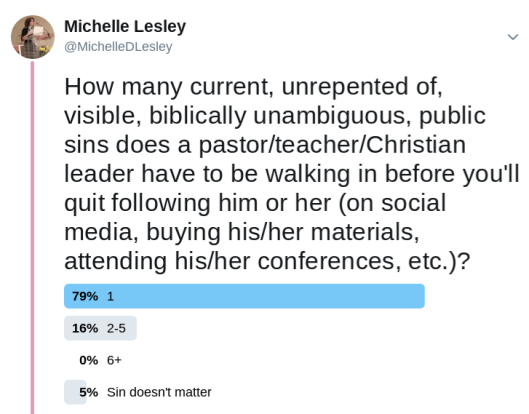
In the wake of Frank Page’s resignation, I asked this poll question on Twitter

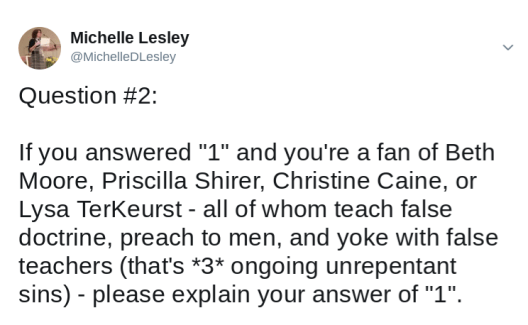
followed by this one

Why are Southern Baptists leaders so quick to – rightly and biblically – oust Frank Page for, as far as we know, one isolated sin which he publicly confessed to and repented of, and yet overlook three major – and much more publicly observable and harmful to Southern Baptists – ongoing sins from pastors and teachers who have been rebuked and refuse to repent? Why, instead of disciplining them for their sin, do those in leadership give them fat book deals, invite them to speak at all the cool conferences, fawn over them on social media, and make them into celebrities?

How many sins will it take to disqualify and discipline these people? Four? Eleven? Ninety-six? Is there any amount of sin these pastors and teachers, and those like them, can commit that will cause those in SBC leadership to pull their materials off the shelves of LifeWay, deny them a seat at the table, and urge them to repent and step down from their positions?

I’ve been a Southern Baptist from the day I was born. I’ve been taught since the cradle roll that if God’s Word says not to do something and you do it anyway, that’s a sin. If God’s Word says to do something and you don’t do it, that’s a sin. And that sin is sin in the eyes of God.

Well is it, or isn’t it, Emperor?

If sin is sin in God’s eyes, why aren’t you treating Beth Moore’s sin like Frank Page’s sin? Why are you rewarding her for her sin and disciplining him for his?

The Bible says in James 3:1:

Not many of you should become teachers, my brothers, for you know that we who teach will be judged with greater strictness.

Those who teach and lead bear more responsibility to teach sound doctrine and walk worthy because they are teaching and leading us by example.

Why are all the aforementioned pastors and teachers better examples to us in their rebellion and unrepentant sin than Frank Page was in his repentance of sin?

Why?

Southern Baptist peasants and little children see right through your foolishness on parade on this issue and we want answers. Biblical answers.

Don’t just stand there shivering, suspecting we are right, but thinking, “This procession has got to go on,” and walking more proudly than ever. Go back to the palace. Repent. Clothe yourselves with humility and obedience to Scripture, and come back and lead us rightly. Biblically.

Because the Emperor of Southern Baptist leadership has been naked for far too long.


ยนH.C. Andersen Centret (The Hans Christian Andersen Centre). The Emperor’s New ClothesAccessed April 5, 2018.

ยฒI am well aware that this is not the only problem in the SBC that needs to be addressed. It would be impossible to address every issue in one article, so this time I’ve chosen to focus on this one particular issue.
Church, Throwback Thursday

Throwback Thursday ~ Prideful and Prejudiced: Racism, Diversity, and Southern Baptists

Originally published April 1, 2016prideful prejudiced


Racism. The word practically emits the hum of electrical voltage. No decent person wants to be accused of being a racist, and no one wants to be mistreated on the basis of race. If thereโ€™s a more powerful word in the American vernacular right now, Iโ€™m not sure what it is.

Racism isnโ€™t something I normally think about or have to deal with on a daily basis even though it would seem to be swirling all around me here in the Deep South. Iโ€™m white. The majority of my friends are white. Either I donโ€™t know anyone whoโ€™s racist or those who are racist are wise enough, polite enough, or ashamed enough to keep it to themselves. But despite the fact that I donโ€™t have much one on one experience with it, race isย an issue that gets a lot of attention, and the main place Iโ€™m encountering racial issues of late is in my denomination, the Southern Baptist Convention.

Whether you see it as โ€œtoo little, too late,โ€ or โ€œitโ€™s about time,โ€ the upper echelons of the SBC have been talking a good game (and, in many instances, making progress) about diversity for the last couple of decades. It started in 1995 with the Resolution On Racial Reconciliation, in which the SBC confessed, apologized for, and sought forgiveness for past involvement with and support of slavery, racism, segregation, and other civil rights issues. Next came the task force that studied changing the name of the SBC to โ€œGreat Commission Baptistsโ€ due to the negative perceptions and racial implications of the word โ€œSouthern.โ€ This was followed by the election of Fred Luter, the first black president of the Southern Baptist Convention.

Fast forward to 2016. So far this year, three well-known pastors have declared their candidacy for president of the SBC, and each has indicated that diversity is an issue he will give attention to.

J.D. Greear: “I want to see minority leaders take places of real prominence in the SBC, such that diversity might become a hallmark of our denomination.”

Steve Gaines: At Bellevue, we donโ€™t just talk about racial reconciliation โ€“ we actually experience it and live in it as a reality. It works in our church because we focus on Jesus-centered racial reconciliation.

David Crosby (who will be nominated by Fred Luter): I hope to make [diversity] a matter of consideration from the very first as we seek to structure in the present for a future gospel strategy that is ever wider in its reach.

OK, great. More people of diverse racial backgrounds appointed to executive offices in the SBC. More books and resources about diversity. More seminars, conferences, panel discussions, and breakout sessions about race. Super. All of those things are wonderful and well intentioned, and will hopefully have some sort of positive impact at the administrative level.

But I really donโ€™t think itโ€™s going to make much of a dent in the actual problem.

I have a friend whose seminary graduate husband has been searching for a senior pastor position in an SBC church for about a year now. Heโ€™s a great guy who loves Godโ€™s people and rightly handles Godโ€™s word. And heโ€™s been turned down by church after church. Why? Iโ€™m sure the churches who have rejected him would list a variety of factors, but one of the reasons is that heโ€™s black and his wife is white.

Several years ago, my husband was on staff at an SBC church that was located across the street from a lower income housing project inhabited mostly by black, single parent families. The vast majority of our members were retired and I was a stay at home mom. We had a lot of people with a lot of free time on their hands. I suggested we start an after school tutoring program for the kids who lived in the housing project to minister to and reach out to our neighbors. The idea was quickly dismissed by a vocal few because โ€œwe donโ€™t want those people in our church.โ€

That’sย where realย racism lives in the SBC, not at the national, upper management level, but in the hearts of some of our individual church members.

  • Church members who excuse their sin by saying, โ€œWell, thatโ€™s just the way I was raised,โ€ or โ€œIโ€™m too old to change.โ€
  • Deacons, elders, and search committees who โ€“ instead of dealing with sin in the camp – make provision for the flesh of their churches by quietly pushing aside the resumes of minority pastors because they donโ€™t want to deal with the hassle of racist congregants making a stink or risk losing the money they contribute.
  • Churches who sell their buildings and move to a whiter part of town when the surrounding neighborhood โ€œgoes black.โ€
  • Christians whose offerings go around the world to share the gospel with people of all colors but who wonโ€™t go across the sanctuary to share a pew with people of another race.

Racism is an issue of the heart. Itโ€™s sin.

And sin canโ€™t be solved by appointments based on skin color or some sort of โ€œtrickle downโ€ diversity. It can only be solved by individuals repenting before a holy God, receiving His forgiveness, and growing in Christlikeness.

Godโ€™s way in the body of Christ is not โ€œtop down,โ€ with administrators creating programs, holding meetings and conferences, and strategically moving people into various positions like pawns on a chess board. Godโ€™s way is โ€œbottom up,โ€ with local pastors preaching the truth of Godโ€™s word to their people and calling them to repent. It begins with Christ working in peopleโ€™s hearts, one by one, convicting them of their arrogance and self-righteousness, their pride and their prejudice, their failure to see others through Godโ€™s eyes, and their failure to love one another the way God has commanded.

1 pet 1 22

The solution to racism and diversity in the SBC?
Itโ€™s right there in black and white.

Church

Prideful and Prejudiced: Racism, Diversity, and Southern Baptists

prideful prejudiced


Racism. The word practically emits the hum of electrical voltage. No decent person wants to be accused of being a racist, and no one wants to be mistreated on the basis of race. If thereโ€™s a more powerful word in the American vernacular right now, Iโ€™m not sure what it is.

Racism isnโ€™t something I normally think about or have to deal with on a daily basis even though it would seem to be swirling all around me here in the Deep South. Iโ€™m white. The majority of my friends are white. Either I donโ€™t know anyone whoโ€™s racist or those who are racist are wise enough, polite enough, or ashamed enough to keep it to themselves. But despite the fact that I donโ€™t have much one on one experience with it, race isย an issue that gets a lot of attention, and the main place Iโ€™m encountering racial issues of late is in my denomination, the Southern Baptist Convention.

Whether you see it as โ€œtoo little, too late,โ€ or โ€œitโ€™s about time,โ€ the upper echelons of the SBC have been talking a good game (and, in many instances, making progress) about diversity for the last couple of decades. It started in 1995 with the Resolution On Racial Reconciliation, in which the SBC confessed, apologized for, and sought forgiveness for past involvement with and support of slavery, racism, segregation, and other civil rights issues. Next came the task force that studied changing the name of the SBC to โ€œGreat Commission Baptistsโ€ due to the negative perceptions and racial implications of the word โ€œSouthern.โ€ This was followed by the election of Fred Luter, the first black president of the Southern Baptist Convention.

Fast forward to 2016. So far this year, three well-known pastors have declared their candidacy for president of the SBC, and each has indicated that diversity is an issue he will give attention to.

J.D. Greear: “I want to see minority leaders take places of real prominence in the SBC, such that diversity might become a hallmark of our denomination.”

Steve Gaines: At Bellevue, we donโ€™t just talk about racial reconciliation โ€“ we actually experience it and live in it as a reality. It works in our church because we focus on Jesus-centered racial reconciliation.

David Crosby (who will be nominated by Fred Luter): I hope to make [diversity] a matter of consideration from the very first as we seek to structure in the present for a future gospel strategy that is ever wider in its reach.

OK, great. More people of diverse racial backgrounds appointed to executive offices in the SBC. More books and resources about diversity. More seminars, conferences, panel discussions, and breakout sessions about race. Super. All of those things are wonderful and well intentioned, and will hopefully have some sort of positive impact at the administrative level.

But I really donโ€™t think itโ€™s going to make much of a dent in the actual problem.

I have a friend whose seminary graduate husband has been searching for a senior pastor position in an SBC church for about a year now. Heโ€™s a great guy who loves Godโ€™s people and rightly handles Godโ€™s word. And heโ€™s been turned down by church after church. Why? Iโ€™m sure the churches who have rejected him would list a variety of factors, but one of the reasons is that heโ€™s black and his wife is white.

Several years ago, my husband was on staff at an SBC church that was located across the street from a lower income housing project inhabited mostly by black, single parent families. The vast majority of our members were retired and I was a stay at home mom. We had a lot of people with a lot of free time on their hands. I suggested we start an after school tutoring program for the kids who lived in the housing project to minister to and reach out to our neighbors. The idea was quickly dismissed by a vocal few because โ€œwe donโ€™t want those people in our church.โ€

That’sย where realย racism lives in the SBC, not at the national, upper management level, but in the hearts of some of our individual church members.

  • Church members who excuse their sin by saying, โ€œWell, thatโ€™s just the way I was raised,โ€ or โ€œIโ€™m too old to change.โ€
  • Deacons, elders, and search committees who โ€“ instead of dealing with sin in the camp – make provision for the flesh of their churches by quietly pushing aside the resumes of minority pastors because they donโ€™t want to deal with the hassle of racist congregants making a stink or risk losing the money they contribute.
  • Churches who sell their buildings and move to a whiter part of town when the surrounding neighborhood โ€œgoes black.โ€
  • Christians whose offerings go around the world to share the gospel with people of all colors but who wonโ€™t go across the sanctuary to share a pew with people of another race.

Racism is an issue of the heart. Itโ€™s sin.

And sin canโ€™t be solved by appointments based on skin color or some sort of โ€œtrickle downโ€ diversity. It can only be solved by individuals repenting before a holy God, receiving His forgiveness, and growing in Christlikeness.

Godโ€™s way in the body of Christ is not โ€œtop down,โ€ with administrators creating programs, holding meetings and conferences, and strategically moving people into various positions like pawns on a chess board. Godโ€™s way is โ€œbottom up,โ€ with local pastors preaching the truth of Godโ€™s word to their people and calling them to repent. It begins with Christ working in peopleโ€™s hearts, one by one, convicting them of their arrogance and self-righteousness, their pride and their prejudice, their failure to see others through Godโ€™s eyes, and their failure to love one another the way God has commanded.

1 pet 1 22

The solution to racism and diversity in the SBC?
Itโ€™s right there in black and white.