False Doctrine, False Teachers, Suffering

Band-Aids vs. Chemotherapy: Why Suffering Women are Drawn to False Doctrine and 7 Things We Can do to Help

Joyce Meyer. Beth Moore. Paula White. Lysa TerKeurst. Christine Caine. Lisa Harper. What do all of these women have in common?

Yes, they’re all false teachers, but they’re also all victims of sexual abuse.

I haven’t conducted a scientific poll, survey, or longitudinal study, so my observations could be way off base, but I’ve been noticing lately – from hearing these women’s testimonies, reading comments on their blog articles, and talking to women who follow them – that women who have been sexually abused seem to be particularly vulnerable to “feel good” false doctrine.

And it’s not just victims of sexual abuse. It’s women who are suffering from the death of a child or spouse, divorce, infertility, illness, spousal abuse- all of those agonies that strike right at the core of women’s hearts. You’ll find them in droves at the conferences, book signings, and blogs of false teachers.

Why is that?

Women who are suffering. You’ll find them in droves at the conferences, book signings, and blogs of false teachers. Why is that?

Because those things hurt. I mean, “I want to crawl under the covers and die,” hurt. “My life is over,” hurt. “An elephant is sitting on my chest and I can’t breathe,” hurt. These precious, beautiful souls God created for joy are walking through something no human being should ever have to experience.

And Satan, that evil beast, is right there to exploit their pain and make things worse by molesting them spiritually. He sends false teachers to whisper sweetly in their ears, “It hurts, doesn’t it? But I can make all that pain go away, now.

Let’s just be honest for a minute. That’s what we all want. I don’t care how doctrinally sound and spiritually mature you are- when excruciating pain explodes into your life, you don’t skip through the tulips to meet it with a smile on your face and a giddy tune on your lips. You just want it to go away. And like a confidence man with a wagon full of snake oil, false teachers are at the ready to offer a magic elixir that will miraculously cure what ails you. Instantly.

I don’t care how doctrinally sound and spiritually mature you are- when excruciating pain explodes into your life, you don’t skip through the tulips to meet it with a smile on your face and a giddy tune on your lips. You just want it to go away.

“You’re God’s masterpiece- His princess!”

“It’s never God’s will for you to suffer.”

“Just declare the things that are not as though they are!”

“God will give you back what you lost a hundredfold.”

“Sow a seed into my ministry and God will open up the windows of heaven and pour out His blessings!”

“Your words create reality. Just speak out what you want and you can have it!”

“No weapon formed against you shall prosper!”

“God wants to do the impossible in your life, so dream big dreams!”

In other words, “Just do or believe X. You’ll feel better and your situation will turn around. I suffered just like you did, and look what God did for me!” The only problem with that kind of teaching is…well…the Bible. The Bible doesn’t make that sort of promise to anyone, in fact it says just the opposite. Jesus promised us tribulationJames, various trialsPaul, persecutionPeter, suffering.

The truth is, since the Fall, we live in a broken, sinful world. We’re going to suffer. It’s often going to be long, painful, and messy. Sometimes, there won’t be a cure this side of Glory. God’s promise to followers of Christ is not that He will eradicate our suffering, but that He will walk through it with us.

God’s promise to followers of Christ is not that He will eradicate our suffering, but that He will walk through it with us.

So how do we provide chemotherapy for the soul to an anguished woman who just wants a pretty Hello Kitty Band-Aid for her emotions or life circumstances? How do we impart hard, healing truth when she’s being seduced by an easy, deadly lie?

How do we provide chemotherapy for the soul to an anguished woman who just wants a pretty Hello Kitty Band-Aid for her emotions or life circumstances?

1. Be honest.
Don’t be tempted to “compete” with false teachers by telling her God’s going to fix everything the way she wants it. She might die from the cancer she was just diagnosed with. She might never be able to get pregnant. Her estranged husband might not come back. Things might not get better. They might get worse.

2. Walk with her.
Joyce Meyer isn’t going to be there at three in the morning when she can’t stop crying. Beth Moore isn’t going to go to court with her and hold her hand when the verdict is handed down. Christine Caine isn’t going to pull her hair back when she’s vomiting from chemo. You be there. You comfort her. That’s why God put you in her life.

3. Set her mind on things above, not on earthly things.
Help her keep her eyes focused on Christ, not her situation. Pray with her. Sing songs of praise with her. Remind her of the gospel. Lead her to be thankful. Take her to church. Recite Scripture together.

4. Shut up.
Some of us are fixers. We want to make people feel better or fix their situation by doing something, saying something, teaching something. And a lot of times that’s not what a suffering woman needs. She just needs a hug. Someone to sit and cry with. Someone to eat raw cookie dough with. Hush. We don’t have to talk things to death all the time, and we’re probably not going to be able to fix the situation anyway.

5. Rehearse God’s real promises.
The false teachers are throwing sparkly fake promises at her. You give her the real ones. They’re so much better.

6. Suffer well.
Suffering is going to come your way, too, or maybe it already has. Set an example by being real about your own struggles and failures, yet testifying to God’s faithfulness during tribulation. What did you learn from your suffering? How did it build your trust in God and draw you closer to Him?

7. Pray.
Ask God to give you wisdom about what to say or do to help and comfort her. And intercede for her and her situation, as well, because, ultimately, regardless of your words or actions, it is the Holy Spirit’s job to comfort her heart and give her peace and trust in God. (Hmmm…maybe that’s why He’s called the Comforter?)

The desire to escape from suffering is normal and in no way an indication of a lack of faith. Even Jesus prayed in the garden that if there were some other way than the cross, God would “let this cup pass” from Him. But sometimes, as difficult as it is to understand, suffering is part of God’s plan for our lives. It’s not His desire that we escape it but that we depend on Him, rest in Him, trust Him, and obey Him as He carries us through it. When we love our sisters in Christ, this is the truth we will impart to them, not the heal-all salve of improved life circumstances and feel good-ism the used car salesmen of evangelicalism are hawking.

When we love our sisters in Christ, this is the truth we will impart to them, not the heal-all salve of improved life circumstances and feel good-ism the used car salesmen of evangelicalism are hawking.

Sanctification

Discipleship Requires Relationship

discipleship-relationship

Go therefore and make disciples of all nations, baptizing them in the name of the Father and of the Son and of the Holy Spirit, teaching them to observe all that I have commanded you. And behold, I am with you always, to the end of the age.
Matthew 28:19-20

You probably know the verses above as the “Great Commission.” Jesus spoke these words to His disciples after His resurrection and before ascending back into Heaven, and they are still our marching orders as Christians today. It’s an action-packed passage, wouldn’t you say? Go. Make. Baptize. Teach. We are to be about the Lord’s business, not sitting around doing nothing or busying ourselves with other things to the exclusion or neglect of the task to which Christ has called us: sharing the gospel with the lost and training the saved to follow Christ.

But how do we put shoes on the Great Commission? What does it look like to “Go ye therefore” and carry out this action plan of making and teaching disciples of Christ in our day to day lives? Like so many other aspects of working out our own salvation with fear and trembling, there is no one size fits all checklist of specific, “do it this way” tasks to choose from. Why? Because God created you as a unique individual with a particular background and placed you in a certain life venue. Yours doesn’t look like mine, and mine doesn’t look like yours. And that’s a good thing. God has woven all of those elements together in our lives to place us in the exact spot He wants us in to glorify Him, grow in our own faith, and make the disciples He has specifically assigned us to reach in the way He wants us to reach them.

But while you may be counseling a fellow church member about her marriage and I might be teaching my children the book of Colossians and another sister might be praying with a hospitalized co-worker, there’s one thing that’s foundational to all these divergent discipling situations: relationship. You can’t disciple someone unless you have a relationship with her.

Now let me stop and clarify something here. I’m not saying you have to have a relationship with someone before you can evangelize her. We should absolutely be sharing the gospel with lost friends, family, and others we already have relationships with, but we can (and should) share the gospel with complete strangers we’ll never see again as well. When Jesus first called His disciples and said, “Come follow Me,” He didn’t, humanly speaking, know any of them, as far as we know.

But Jesus didn’t stop with the call, just like we’re not to stop with the conversion. He gathered those twelve guys to Himself and they literally did life together for the next three years. They lived together, ate together, traveled together, went to the temple together. Everything. Together. For three years. That’s what turned them into disciples- true followers: time spent together with Christ, learning from Him.

There were three main ways Christ discipled the Twelve: formal teaching (as with the Sermon on the Mount), situational teaching and correction (as when James and John wanted to sit on His right and left in the Kingdom), and setting an example (as when the disciples watched Jesus minister to Zacchaeus), and all of those methods required Jesus to spend time with and bond with the disciples. These weren’t mere acquaintances of His, they were brothers.

Is that what God is calling us to do today? Should we quit our jobs, gather up a dozen ladies, move in together, and disciple them? (Goodness, it almost sounds like a reality TV show, doesn’t it?) Probably not (Especially if you’re married and have children. In that case, your family members are your live in disciples.). But we do need to make sure we’re clearing time in our busy schedules to bond with women or children who need a “big sister” in Christ. Time to disciple them in the same ways Jesus did: formal teaching, situational teaching and correction, and setting an example. Work through a book of the Bible together, be a shoulder to cry on, pray with her when she’s had a bad day, go to the movies together, let her watch while you share the gospel with someone, have a cup of coffee. Develop that close, trusting relationship that creates a safe haven for confession of sin, sharing fears and inadequacies, instruction, rebuke, encouragement, grief, and rejoicing.

And it’s important that we do this, not only at the individual level, but at the church level as well. My church is somewhat large, with a few hundred or so in attendance each week. A few months ago, I hosted a fellowship for the ladies of my class, just so we could have some fun and get to know each other better. During the evening, I asked if anyone would be interested in a weekly women’s Bible study. Most indicated that it wouldn’t work out with their schedules, and we went on with the evening, sharing various things that were going on in our lives, and even stopping to pray for a few of the ladies who were struggling. Later, one of the ladies pulled me aside, told me how much she had enjoyed the evening, and said something so wise I’ll never forget it: “A weekly Bible study would be nice, but this evening is the kind of thing we need. We get good teaching in church and in Sunday School, but we never get to just sit around and talk and share our joys and struggles- our lives.” And she was right.

Yes, sometimes churches can go overboard on fellowship, but we’ve got to be careful not to swing too far the other direction to the point that we’re a group of isolated individuals who happen to be in the same place at the same time each week to receive good teaching and all go our separate ways when it’s over. Good, biblical, corporate teaching and worship are only one aspect of discipleship- the “theory” aspect of discipleship, if you will.

But what about the “applied” aspect of discipleship, where the rubber of the sermon meets the road of life’s circumstances? That’s where relationship comes in. There are women and children in your church who are fairly starving for someone to reach out to them, listen to them, help bear their burdens, explain how the Scriptures apply to what they’re going through today, give them a hug and an encouraging word. Is your church creating space for this to happen between individuals and in small groups? Are you encouraged to get involved in one another’s lives and walk through joys and sorrows together on a personal level?

Making disciples. Teaching them to observe all that I have commanded you. It takes time. It takes effort. It takes intentionality. It takes relationship. Jesus was willing to invest those precious resources into the lives of His disciples. Are we?

world-991082_1280

Poetry, Sanctification

How a Little Acorn Helped Reassure a Nut Like Me

acorn-1030819_1280

There are two kinds of people in this world, throwers and savers (or hoarders, if your saving has breached the clinical level). I’m a thrower married to a saver, which means I have thrown out some stuff I later wished I’d kept, and my husband has saved a lot of stuff we haven’t used in ages and probably never will. But, recently, I came across something I’m really glad I kept all these years.

I was going through a box of old papers, happily doing my “thrower” thing, when I discovered a manilla folder marked, in my handwriting, “Michelle’s Misc. Creative Writing.” Whatever it was, I didn’t remember saving the folder, nor what it might contain. I opened it up to find a two inch thick sheaf of, well…my miscellaneous writings from years gone by. Sermon notes, creative writing assignments and essays for English classes, poems, song lyrics, short stories, even what looked like the manuscript to a devotional I’d started on.

Fortunately, I had dated most of the papers, so I could see that the bulk of them were written when I was between the ages of about 14 to 21. As I leafed through pages of adolescent script alternating with dot matrix printing, I started noticing a common thread. Nearly all of this writing was about God, faith, the Bible, worship, wanting to know Him more. To be sure, the faith was childlike (if not downright childish), and the theology was often immature and somewhat unbiblical.

But it was there. And all these years I’d wondered whether or not that faith had existed back then at all.

You see, I was raised in a Christian home, and, although I was most definitely a depraved little wretch, my outward behavior was fairly decent compared with some of the other kids my age. I got good grades, never had behavior problems in school, was at church every time the doors were open, never tried sex, drugs, cigarettes, crime, or anything else teens sometimes get into. Overall, I was your basic goodie two shoes. So, when I prayed a prayer for salvation at age 12, there was no great big radical lightning bolt change in my life. Things continued pretty much as usual. Had my heart changed? Looking back all those years later as an adult with terrible recollective abilities, I couldn’t really remember.

But as I skimmed through page after page of longing for God, love for God, wanting to please God, something I told a reader not long ago -who was concerned she might not be saved – hit me like a ton of bricks:

Lost people don’t have that kind of “want to.”

I didn’t have all my doctrine straight or walk in Christian maturity, and I wouldn’t have known an apologetic from an apostate, but I wanted God. I loved Him as best I knew how at the time. I had that “want to.” I was saved. God had used a dusty box of old papers to reassure me and put those doubts to rest. It was one of those precious moments alone with the Lord that you never forget.

So to sort of celebrate that little moment in my walk with the Lord, I wanted to share with you one of the poems I found in that folder. It was undated, but I think I wrote it when I was in high school or college. Now, I’m just going to warn you up front, it’s long and it’s lame and it’s (a)corny, and some of the cadence is off and so is the doctrine, and it just plain needs a lot of editing. But I had a good laugh over it, and I thought you might, too. (Hint- it’s funnier if you read it out loud.)

I Am a Little Acorn

I am a little acorn,
A fact that’s plain to see,
But remember that the might oak
Was once a nut like me.

When I was a baby bud,
I burst forth from a limb,
I grew a little every day,
Out from my little stem.

As I grew older day by day,
An identity crisis hit me.
I searched my heart and searched my soul
To find out just what I should be.

I did not want to be a nut.
I cried, “I cant! I won’t!”
Because sometimes you feel like a nut,
Sometimes you don’t.

I tried to be a button,
And a rolling tumbleweed.
I tried to be a jelly bean,
But still did not succeed.

Oprah, Geraldo, Sally, and Phil*
All let me spill my guts.
“Something other than an acorn?” they asked,
“You can’t! You must be nuts!”

My fame and fortune quickly spread,
I was known both far and wide.
But no one knew my secret dark,
I was lost and scared inside.

Then finally, one day, I turned to the Lord,
And cried out with all my might,
“Why, oh why, do I continue to fail?
Why won’t something go right?”

“Remember to whom you are speaking,” said He,
“I am the Great I Am,
But I’m also the root of David,
And the seed of Abraham.”

“From small beginnings come great things,
This fact is tried and true,
The mighty oak could never be,
Without an acorn like you.”

“All are given different gifts,
And must do as best they can,
To find a way to channel them
According to God’s plan.”

“So cheer up little acorn,
And learn the secret known by few:
Be content with what you’re given,
And let God work through you.”

“I’ll be the best acorn ever!” said he.
“I’ll do as God has led.”
Then standing bold and brave and tall,
The acorn proudly said:

“I am a little acorn,
A fact that’s plain to see,
But remember that the mighty oak
Was once a nut like me.”

(*You’ve probably heard of Oprah. Geraldo Rivera, Sally Jessie Raphael, and Phil Donohue all used to host talk shows, too.)

Don’t despair if you’re still a little acorn in your faith. You keep pursuing that “want to” for God, and He’ll grow you into a mighty oak in Christ.

How do I know? Because He’s doing just that for a nut like me. 🌰


Sanctification, Throwback Thursday

Throwback Thursday ~ Abiding in the Vine

Originally published July 30, 2015

abiding-in-the-vine

Ah, the good old summertime! Which, sadly, is rapidly drawing to a close. Summertime brings with it a lot of simple pleasures- a more relaxed schedule, vacations, family reunions, pool parties, and barbecues. But one of the simplest pleasures my husband and I enjoy during the summer is stopping at produce stands to stock up on locally grown fruits and veggies.

In our area, farmers often just fill up the beds of their pick up trucks with watermelons, okra, tomatoes, peaches, or whatever they grow, park on the side of a well-traveled road and sell their wares. As small business owners ourselves, my husband and I like to support other small business owners, plus there’s just something about eating produce that was freshly picked down the road this morning rather than shipped in from across the country a week ago.

Recently, my husband was on his way home from work and ran across a farmer selling cantaloupes. The farmer made him a good deal, so he brought home three of them. Now, my husband loves cantaloupe, but, unfortunately, he forgot that he’s the only one in the family who does. And these were big cantaloupes.

I cut up the first one for him and he finished it in a few days. By the next week he had finished the second one. But by the time I went to cut up the third one for him, there was a soft, mushy spot about the size of a dollar bill along one side.

Nothing untoward had happened to this cantaloupe. It hadn’t been dropped, knocked around, or exposed to extremes of temperature or moisture. The only thing wrong with this cantaloupe was that it had been cut from the vine it was growing on quite some time ago. And the moment it was severed, it started dying.

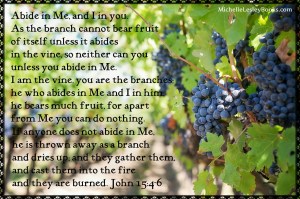
As I carefully cut away the spoiled area to salvage the rest of the fruit, I was reminded of what Jesus said in John 15:4-6:

purple-grapes-553462_1280

In the first half of John 15, Jesus talks a lot about vines and branches and fruit. The main application of this passage is that Jesus is the vine and we are the branches. The living, fruit-bearing branches are those who have truly been born again. The dried up branches who don’t bear fruit are people who appear to be or claim to be Christians, but aren’t actually saved. But there’s a second layer to this story for those who are genuinely regenerate Christians: obedience. Walking with the Lord day by day and producing healthy fruit.

I looked over at the little stump of cantaloupe branch I had cut off and thrown away. Because it hadn’t been abiding in the main vine, it had dried up. It was no longer bearing new fruit nor was it carrying nutrients from the vine to its already existing fruit, namely, the cantaloupe sitting on my counter, turning to mush.

The same thing happens to Christians when we disobey God by neglecting our relationship with Him. When we go days without picking up our Bibles or praying or gathering for worship with other Believers, we begin to dry out and shrivel up, spiritually. There’s no biblical nutrition flowing from Christ through us, so we’re not bearing any new fruit, and any already existing fruit we’ve produced starts showing signs of rot.

Galatians 5:22-23 tells us:

pineapples-1606852_1280_kindlephoto-18964258

I don’t know about you, but when I’ve skipped my Bible study and prayer time for even a few days, I can tell that I’m not bearing any new spiritual fruit and that I’m less patient, less loving, less self-controlled- more rotten in all of these areas than I normally am. I can tell if my husband is neglecting his time with the Lord, and when my children aren’t having their daily quiet times. I’m surrounded by slowly rotting fruit.

As daughters of Christ, it is imperative that we receive the nourishment He has provided for us in His word, in prayer, through the church, and through obedience to Him so that we can bear good, strong, growing fruit. Because the longer we walk through life at a distance from Christ, the rottener we’ll become. Just ask a cantaloupe.


THIS ARTICLE WAS ORIGINALLY PUBLISHED AT SATISFACTION THROUGH CHRIST.

Sanctification, Throwback Thursday

Throwback Thursday ~ Fight Like a Woman, Not a Little Girl

Originally published September 26, 2014

fight like a woman

Beloved, while I was making every effort to write you about our common salvation, I felt the necessity to write to you appealing that you contend earnestly for the faith which was once for all handed down to the saints. Jude 3

What does the Bible say is the role of women in the church?

Is Jesus the only way to Heaven? Why?

Why is a literal, historical Adam and Eve crucial to the gospel?

What does God say about homosexuality?

Ladies, do you know the answers to these questions? Do you know and understand the Bible well enough to provide accurate scriptural support for your answers?

If not, you are not alone. Sadly, many Christian women are lacking in fundamental apologetics skills, the ability to defend even the basics of what they believe.

And part of the problem is that we often settle for being little girls in the faith instead of striving to become strong Christian women.

We pick churches where the pastor spends most of his time telling jokes or regaling us with personal stories because it makes us feel good instead of finding a pastor who is dedicated to rightly handling God’s word, sticking closely to Scripture, and feeding us copious amounts of it.

We pick women’s devotional books and Bible study groups that center around our emotions and building up our self esteem instead of building our esteem for Christ by leading us deeper into His word.

We build women’s ministries that focus on fluff instead of the Father, fun instead of faith, and where older women are left out instead of taking the lead and becoming spiritual mentors to younger women (Titus 2:3-5).

Now don’t get me wrong, there’s nothing wrong with a little joke from the pastor from time to time, or an occasional feel-good story, or fun ladies’ activity. It’s when these things make up the bulk of what we call “church,” “Bible study,” or “edification” that our sanctification can be stunted and we can end up as spiritual Peter Pans, refusing to grow up in Christ and remaining children in the faith perpetually.

And when we’re children in the faith, we fight for the faith like children.

When someone challenges our beliefs, emotional outbursts, name calling, unsubstantiated opinions, and personal preferences can take center stage because we don’t know our Bibles well enough to plant our feet firmly on the word and confidently and correctly declare, “Thus saith the Lord.”

Can you imagine Jesus’ temptation in the wilderness (Matthew 4:1-11) going like this:

And the tempter came and said to him, “If you are the Son of God, command these stones to become loaves of bread.”

What?! How dare you question who I am! You’re just a divisive hater!”

Then the devil took him to the holy city and set him on the pinnacle of the temple and said to him, “If you are the Son of God, throw yourself down, for it is written,
“‘He will command his angels concerning you,’ and
“‘On their hands they will bear you up, lest you strike your foot against a stone.’”

Well, that’s your interpretation. That’s not what those verses mean to me.”

Again, the devil took him to a very high mountain and showed him all the kingdoms of the world and their glory. And he said to him, “All these I will give you, if you will fall down and worship me.”

Hmmm, I know God wants me to be happy and successful. Maybe it wouldn’t hurt, just this once…

No, time and again, here and throughout the gospels, Jesus answered, “It is written.” No ruffled feathers, no indignation. He calmly and firmly appealed to Scripture when God and His word were being maligned.

Jesus fought like the God-man, and we must follow in His footsteps and fight temptation and false doctrine like godly women. How?

  • We recognize and embrace the fact that, as Christians, the Bible -not our preferences, what’s convenient, or the world’s mores- is the final authority for our every thought, word, and deed.
  • We compare all things -even things that carry the label “Christian”- to God’s word and reject anything that conflicts with it.
  • We study our Bibles to learn about God- His nature and character, His plan of redemption, His requirements for us- not as a self-help book.
  • We learn from Scripture- not from our own or others’ opinions- what the role of godly women is, inside and outside the church.
  • We stand firm on God’s word when “the faith once for all handed down to the saints” is challenged, understanding that this will take humility, meekness, love, and boldness.
  • We warn and help our friends and loved ones who are being seduced by unbiblical teachings and personalities.

Every strong, godly Christian woman starts off as a little girl in Christ. There’s no shame in being there. There’s only shame in staying there.


THIS ARTICLE WAS ORIGINALLY PUBLISHED AT SATISFACTION THROUGH CHRIST.