Want to share your testimony? Scroll down to the end of this article to find out how!
Note from Michelle: Cathy shared her testimony, addressed to me, in a comment on my article It’s OK to Be Ordinary.
Cathy’s Story:
I read this post today, January 15, 2025, and was again so thankful to the Lord for His faithfulness to me.
My first introduction to your blog was reading an article where you laid out the problems with Beth Moore.
At the time, I had been hearing and reading rumblings about how she wasn’t sound and had been wondering the same myself. I had been a follower of hers for years. I wondered if the comments were fair or not. Similarly, after Ravi Zacharias passed away and articles about his credibility came out, at first I didn’t read or believe them.
Your article was a wake-up call to me. Thank you!
My husband and I were in a charismatic church for 42 years. (Feel free to question our discernment!) Many of those years, my husband disagreed with and questioned practices, and would not participate in most. Tongues, deliverance, and prophecy to name a few.
Most of this time was pre-internet. There just wasn’t a lot of information about this movement or the people leaving it and why.
Then our oldest son introduced us to Reformed theology. John MacArthur, R.C. Sproul, the Puritans, and many others were our food as we realized more and more that we weren’t getting our food from the sermons at church.
Fast forward to today and we have been in a solid church for three and a half years and continue to be thankful for God’s mercy to us. Your ministry, Chris Rosebrough, Steven Kozar, Costi Hinn, Dawn Hill, Doreen Virtue, along with many others helped us immensely to understand what we came out of.
As I read your post on X this morning about it being okay to be ordinary, I wanted to write and thank you for what you do. It made a difference in my life and helped me make the final break from Beth Moore.
We have nine children who grew up in the charismatic church that we left after so long, three of whom are not walking with the Lord. As so many like ourselves understand, bad theology affects lives! We continue to pray for all of our children and grandchildren.
Just our story here. I know there are so many others.
I’m so thankful for the discernment ministries and the internet that has enabled these platforms. It would have made a huge difference in the early eighties!!
Again, thank you. I am so thankful to be ordinary and to be content in the good works that He prepared in advance for my life.
Ladies, God is still at work in the hearts and lives of His people, including yours! Would you like to share (anonymously, if you like) a testimony of how God saved you, how He has blessed you, convicted you, taught you something from His Word, brought you out from under false doctrine, placed you in a good church or done something otherwise awesome in your life? Drop me an email, and I’ll send you the particulars for sharing your story. Let’s encourage one another with God’s work in our lives!
I mean, I can read and follow a map, but if I make some wrong turns or get distracted, I tend to get disoriented. And don’t even try to tell me to “go north” or “turn south” when you’re giving me directions. I just don’t have that internal compass some people have. Heck, our church has had an “east campus” and a “west campus” for over a year, and I still can’t figure out which one is which. Thank goodness for map apps. Without those step by step directions, I’d probably still be wandering around out there somewhere.
But, you know what? I did really well in geography when I was in school.
When I can see the big picture, the whole map at once, the beginning, middle, and end of the journey, it’s a piece of cake. I never get confused about which direction is southeast or northwest. I don’t get distracted by twists or turns in the road. If I could just have this perspective when I’m trying to get somewhere, I’d never get lost again.
But life isn’t like that.
We live inside the road trip where it’s easy to get confused and go the wrong way. Where we can get distracted by the twists and turns of circumstances. Where we sometimes deliberately choose to turn off the right road and take a side trip that takes us farther than we wanted to go.
We can’t step “outside the map” and see the big picture of our life’s journey from beginning to end.
But God can. That’s where He lives.
…in your book were written, every one of them, the days that were formed for me, when as yet there was none of them. Psalm 139:19
And since He alone can see the big picture, He’s the only One who’s really qualified to give us direction. And that perfect direction can only be found in His Word.
Just like my map app, He tells us our starting point:
And you were dead in the trespasses and sins in which you once walked, following the course of this world, following the prince of the power of the air, the spirit that is now at work in the sons of disobedience—among whom we all once lived in the passions of our flesh, carrying out the desires of the body and the mind, and were by nature children of wrath, like the rest of mankind. Ephesians 2:1-3
He tells us the detour we need to take:
…repent and believe in the gospel. Mark 1:15b
He shows us the right direction to go:
…what sort of people ought you to be in lives of holiness and godliness… 2 Peter 3:11
And he reveals our ultimate destination:
Then we who are alive and remain will be caught up together with them in the clouds to meet the Lord in the air, and so we shall always be with the Lord. 1 Thessalonians 4:17
Not using “God’s Positioning System”?
Recalculate.
(Don’t groan and roll your eyes. You should have seen that one coming :0)
And one of the synagogue officials named Jairus came up, and on seeing Him, fell at His feet and pleaded with Him earnestly, saying, “My little daughter is at the point of death; please come, that by coming, You may lay Your hands on her, so that she will be saved and live.” And He went off with him; and a large crowd was following Him and pressing in on Him.
While He was still speaking, they came from the house of the synagogue official, saying, “Your daughter has died; why trouble the Teacher anymore?” But Jesus, overhearing what had been spoken, said to the synagogue official, “Do not be afraid, only believe.” And He allowed no one to accompany Him, except Peter and James and John the brother of James. And they came to the house of the synagogue official; and He saw a commotion, and people loudly crying and wailing. And entering in, He said to them, “Why are you making a commotion and crying? The child has not died, but is asleep.” And they began laughing at Him. But putting them all out, He took along the child’s father and mother and His own companions, and entered the room where the child was. And taking the child by the hand, He said to her, “Talitha kum!” (which translated means, “Little girl, I say to you, arise!”). And immediately the little girl stood up and began to walk, for she was twelve years old. And immediately they were completely astounded. And He gave them strict orders that no one should know about this, and He said that some food should be given to her to eat.
Mark 5:22-24, 35-43
Did you see it?
The wall in my bedroom isn’t painted very well. It’s obvious that someone rolled on a dusty rose color, but I can also see through that layer of paint to an underlying cream color. I have to take a moment and really look at it, but it’s there. Two distinct, yet bonded, layers of paint.
Do you see the two layers to this story? Take a moment. Really look at it.
Do you see the two layers to this story? Take a moment. Really look at it.
Here is a daddy who loves his little girl. She’s dying. He’s in anguish.
Here is a Savior who has compassion on both father and daughter. He raises her back to life, and there is great rejoicing in their home.
Jesus, our Messiah, has the power to heal. Power over death. He is exactly who He claims to be: God in human flesh.
But look more closely. Do you see it?
This isn’t just a story about a nameless little girl in first century Israel. It’s about us and the strikingly beautiful story of salvation.
Here is a little girl. Not a son, so highly prized among the Israelites in that day and age, but a daughter. Virtually valueless, except to her father.
There was nothing intrinsically worthy in her to earn Christ’s favor or attention. She had no wealth, no position, no power, nothing to offer anyone. And on top of that, she was dead.
But her father loved her for no other reason than that she was his, and he was willing to lay down everything he had to save her. He sacrificed his dignity. He risked His reputation and laid aside His position of authority. All for the love of this child—a child whose past had offered him nothing but childishness and disobedience. A child whose future promised the same.
Do you see it?
We are that little girl. Valueless. Unworthy. Childish. Disobedient. Dead.
And for no other reason than our Father’s love for us, Christ comes to us when we cannot come to Him, and raises us from the dead.
And you were dead in your transgressions and sins… But God, being rich in mercy because of His great love with which He loved us, even when we were dead in our transgressions, made us alive together with Christ—by grace you have been saved— and raised us up with Him, and seated us with Him in the heavenly places in Christ Jesus, so that in the ages to come He might show the surpassing riches of His grace in kindness toward us in Christ Jesus.
Ephesians 2:1, 4-7
For no other reason than our Father’s love for us, Christ comes to us when we cannot come to Him, and raises us from the dead.
Want to share your testimony? Scroll down to the end of this article to find out how!
Allie’s Story:
I was not raised in a Christian home. However, my mom and dad were, and are, very loving parents. Without knowing the Lord, they cared about godly values and taught us the importance of virtue and wholesomeness. I see this as God’s grace protecting me from a lot of sin that I could easily have gotten involved in. They wanted to raise my siblings and me to be familiar with lots of different religions and belief systems, and so the “church” that we attended growing up was quite a melting pot of those things. We were introduced to some of the Bible, but it was presented right alongside many other religious scriptures and teachings, each of them being presented as equal paths to God. We prided ourselves on being tolerant, but the irony is that the main thing that we were intolerant of was true biblical Christianity.
Jesus clearly said in John 14:6, “I am the way and the truth and the life. No one comes to the Father except through Me.”. Sadly, I didn’t believe that the Bible was the entirely true and infallible Word of God growing up. The dangers of New Age religion is that you firmly believe that you have the most enlightened viewpoint and that everyone else, especially fundamentalist Christians, are close minded and not truly understanding the Bible or why Jesus came. Any concept of sin, atonement, or God’s judgment is viewed as harsh and man-made and instead, everyone is seen as ultimately good and connected with the Divine. I was completely into this “spiritual but not religious” movement and we worshiped the idol of self and whatever felt good and sounded comfortable. I had a completely backwards view on everything– I loved what God hates and hated what He loves– and was headed towards hell and God’s righteous judgment.
Toward the end of high school, I began to be interested in more things of a Christian nature, through books and music and such. In my senior year, we moved from Wisconsin to Michigan, another aspect where I see God’s grace being very present, as we left our old church and life behind with the move. In Michigan, not only did we have a new friend group that was mainly made up of Christian families, but we also started attending a church that taught the Bible as the Word of God for the first time. It was not a church that I would attend today since they mainly sought to be relevant and preached a very watered-down, seeker-sensitive gospel, but God graciously used that time to open my heart to His Word.
At this point I was reading my Bible daily and wrestling with so many questions. Outwardly, I was already this “good, Christian, homeschooled girl” to my new friends but inwardly I doubted my salvation, and for a good reason. I had never repented of my sins and trusted in Jesus alone to save me. I was trusting in my own works and believing a mashed up version of some Bible verses and a lot of made up things that I wanted to be true.
God used a year of some Bible teaching at that church, lots of individual study of the Word, and some very humbling events to show me my desperate need for a Savior. One day at church, it all came to a head for me and I recognized my pride and facade for what it was. The Holy Spirit’s conviction was strong and I was clearly aware that I was not adopted into God’s family of believers. And I needed to be. Immediately.
That morning after the service I repented of my sins and trusted in Christ alone for salvation! I got baptized that day and submitted fully to God’s Word and ways, trusting in Him alone and not my good works. I cannot convey the freedom and joy that welled up in my heart that day as my greatest problem was taken care of and I was set free from sin to live for Christ. By God’s grace, my mom and sister both got saved within a month of me and we had the sweetest fellowship time reading our Bibles and growing in submission to the Lord. We found a new church that preached the full, beautiful gospel and taught expositionally from the Word each week.
A week after being born again, I began to experience anxiety and panic attacks, something that I had as a child but was again resurfacing. Satan seems to capitalize on the naivety of new believers and God was allowing me to see more of my weakness and my need for Him. My pride would like to tell you that this is something that I quickly conquered, but in truth, I still battle anxiety to this day. I have learned much from the apostle Paul in 2 Corinthians 12 when he talks about his “thorn in the flesh.”
Of course, anxiety is not my only area of weakness, and I have become more and more aware, throughout the years, of my sinful flesh and its constant opposition to the things of God. But, I praise God that His Spirit lives in me to conquer the flesh as I am called to daily take up my cross and follow Him. In Christ, I have been set free from slavery to sin and have become a slave of righteousness, as Romans 6 explains. I’m so thankful that sanctification is both a one time event at justification but also a continual process.
I want to point out three areas of God’s work in my life that I pray will be applicable for you.
The first is this: Christ is not needed only by those whose lives have hit rock bottom. I greatly enjoyed my childhood and was walking with the assumption that I was a good person who cared about spiritual things and inclusivity and so that was enough. The truth is that my rebellious heart towards the exclusivity of Christ was just as vile to God as the heart of anyone in history has ever been. I was separated from God by my sins and headed toward hell for eternity. Christ offers the free gift of salvation for anyone at any time and today is the day of salvation! I urge you not to wait as long as I did to be right with Him.
The second point has to do with my pride. I was in a place right before I got saved where I struggled with the fact that I already was identifying as a Christian and most of my friends probably thought that I was a believer. I thought if I truly got saved at that point, those around me would think I was faking it before then, which I was. I beg you not to let this keep you from being saved. Being identified with Christ in His death means also experiencing the death of our pride, and we should feel the sting of denying ourselves and being crucified with Christ as Galatians 2:20 says.
My third point is that coming to Christ does not make all of our problems go away. This is a dangerous misunderstanding of the gospel. As Christians, we are told by Jesus that in this life we will have trouble. We will experience persecution, criticism, opposition from Satan and from the world, perhaps even those very dear to us. However, I cannot convey to you the surpassing worth of knowing Christ. We can receive complete forgiveness of sins as well as abundant life now and for eternity!
Please don’t stop praying earnestly for your unsaved friends and family. If you had known me 10 years ago, I was that person that drove you crazy on Facebook and in person with my prideful resistance to the gospel. I am still amazed at the 180º turn that has come from being saved. I truly became a new creation, as 2 Corinthians 5:17 speaks of.
Therefore if anyone is in Christ, he is a new creation; the old things passed away; behold, new things have come.
2 Corinthians 5:17
I went from trusting in myself and making God to be who I wanted Him to be, to fully submitting to Christ and delighting that God’s ways are higher than mine. That is the amazing thing about regeneration! Any time God chooses and saves a sinner it is a miracle and worthy of our constant remembrance and praise. Christ is a treasure far greater than anything this world could offer and I pray that you may also know Him as Savior and Lord!
If you are in the New Age movement, or were saved out of the New Age movement and need a little help and encouragement from someone who’s been there, I highly recommend my friend Doreen Virtue and her YouTube channel as a wonderful resource.
Ladies, God is still at work in the hearts and lives of His people, including yours! Would you like to share (anonymously, if you like) a testimony of how God saved you, how He has blessed you, convicted you, taught you something from His Word, brought you out from under false doctrine, placed you in a good church or done something otherwise awesome in your life? Drop me an email, and I’ll send you the particulars for sharing your story. Let’s encourage one another with God’s work in our lives!
Everybody seems to be walking around scared these days. I’m a little scared, myself. It’s understandable. There’s a lot of scary stuff happening. Boko Haram. Ebola. ISIS. The persecution of Christians abroad, and, increasingly, here at home.
Terrorism, suicide bombers, the seemingly daily acts of violence that take the lives of innocent bystanders– that all used to happen over there. Thousands of miles across the ocean. And all we had to do to make it go away was turn off the TV, click over to Farmville, or put down the paper. Problem solved. It was unfortunate, but didn’t really touch our lives in any meaningful way.
Until now.
Now we know that there are terrorists living among us right here in the United States, as well as those trying to infiltrate our country by stealthily crossing our borders. When will the next beheading or 9-11 take place on U.S. soil? Who will the next victim be? Will it be you? Will it be me? Will it be thousands of us in one fell swoop?
Any reasonable person would be afraid of that.
Don’t.
That’s what Jesus said. Just don’t.
We’ve got bigger fish to fry in the fear department. Even though it would be awful, the worst thing that could happen to someone is not being killed or even tortured by a terrorist. The worst thing that could happen is for someone to spend an eternity in Hell because she has rejected Christ (which should tell you something about how horrific Hell is).
If you have never turned from your sin and placed your faith in Christ’s death, burial and resurrection as payment for the penalty for your sin, how you’re going to die is the least of your worries compared to what’s going to happen to you after you die. That should scare the living daylights out of you.
If you have never turned from your sin and placed your faith in Christ, how you’re going to die is the least of your worries compared to what’s going to happen to you after you die.
The good news is, Christ offers to forgive you today. His goodness for your badness. His purity for your sinfulness. His grace for your gross. He will set you free from your sin so you’ll no longer fear standing before Him on the day of judgment.
Christ offers to forgive you today. His goodness for your badness. His purity for your sinfulness. His grace for your gross. He will set you free from your sin.
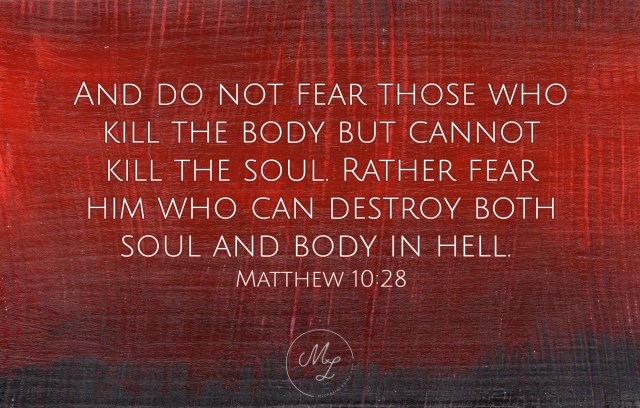
And, if you belong to Christ, you have nothing to fear in this life or the next. Take a look back at that verse. It says to “fear him who can destroy both soul and body in hell.” But if you’re in Christ, you no longer have to be afraid of Him. And the first part of the verse says not to be afraid of people who can kill your body but not your soul. Nothing to fear now. Nothing to fear later.