Mailbag

The Mailbag: Potpourri (Was John a prophet? … Christianese … Kendrick brothers movies … Confronting immodest nursing…)

Welcome to another โ€œpotpourriโ€ edition of The Mailbag, where I give short(er) answers to several questions rather than a long answer to one question.

I like to take the opportunity in these potpourri editions to let new readers know about my comments/e-mail/messages policy. Iโ€™m not able to respond individually to most e-mails and messages, so here are some helpful hints for getting your questions answered more quickly. Remember, the search bar (at the very bottom of each page) can be a helpful tool!

Or maybe I answered your question already? Check out my article The Mailbag: Top 10 FAQs to see if your question has been answered and to get some helpful resources.


In response to the question about Simeon [in this article], would you consider John (the John that wrote Revelation) to be a prophet? I know he was an apostle but I was just wondering if he would also be considered a prophet due to all the Lord showed him regarding Revelation.

Great question! I love it when women are thinking deeply about the things of God. Since you’re asking my opinion, I didn’t delve into any scholarly works on the subject, I’m just going to give you my take on it based on what I know of Scripture.

As you probably know, in the Old Testament, there were two different types of people who prophesied:

  • Men who held the office of prophet – what we might think of as a “professional prophet,” so to speak – like Isaiah, Jeremiah, Elijah, Elisha, and so on.
  • People to whom God gave a “one and done” (or maybe twice or thrice) word of prophecy for a particular reason or moment in time, like Eldad, Medad, and the 70 elders, Saul, Eliezer, and others.

Jesus was, and is, the final, permanent occupant of the offices of prophet, priest, and king. This is why we don’t see the office of prophet or priest in the New Testament church or anyone installed as “king” over New Testament Christians.

Until the canon of Scripture was complete, however, and foretelling prophecy become obsolete, we do see occasional references to the second type of prophecy in the New Testament church. It seems to me that second category is the category John’s prophecy in Revelation would fall into. He held the office of Apostle, but not the office of prophet (since that position was filled), and God gave Him a “one and done” prophecy to communicate to us.


I’m learning so much from your articles, and I think my husband would benefit from and enjoy hearing what I’m learning. Can I share your posts with him? I donโ€™t want YOU to be teaching my husband and break that command.

It’s always important to be obedient to God’s commands, but it’s equally important that we understand exactly what the command does and doesn’t prohibit so we can obey it properly.

For example, the sixth Commandments says, “You shall not murder,” but this Commandment doesn’t preclude self defense, capital punishment, fighting in a war, or vehemently annihilating an uppity rat or snake with a shovel (I hate rats and snakes. :0)

In the same way, the New Testament’s prohibition on women instructing men in the Scriptures doesn’t mean no male can ever learn anything – even biblical things – from a woman. For example, we see Lois and Eunice instructing Timothy in the Scriptures when he was a boy, and Priscilla, along with her husband Aquila, privately correcting and instructing Apollos.

The biblical prohibition against women teaching men in 1 Timothy 2:11-3:7 has a very specific context. Women are prohibited from preaching to or instructing men (not boys, girls, or other women), in the Scriptures (not in other subjects), or holding authority over men, in the context of the gathering of the body of Believers (the church). Women are also prohibited from holding the office of pastor or elder.

Long story short, yes, you can feel free to show your husband my articles and discuss them with him. Showing your husband one of my articles and having a private discussion with him about what you’ve learned from it doesn’t meet the criteria of the biblical prohibition against women instructing men. A blog is not the gathering of the church body, and as you can tell from the title of it, “Discipleship for Christian Women” I’m teaching you as a woman, not him as a man. The principles in these Scriptures are the applicable ones for sharing with your husband in this way, not 1 Timothy 2:12.

Additional Resources:

Rock Your Role: Jill in the Pulpit (1 Timothy 2:11-12)

Rock Your Role FAQs

Rock Your Role article series


What do you think about Teacher X? She preaches to men…he partners with a bunch of false teachers…his church seems to hold New Apostolic Reformation beliefs…she teaches evolution…

While I’m always honored when y’all ask for my thoughts on a particular teacher, if you already know a teacher is sinning by preaching to (or allowing a woman to preach to) men, yoking with false teachers, teaching false doctrine, or unrepentantly doing something else unbiblical, you don’t need my – or anyone else’s – input or approval to stop following that teacher, refuse to use that teacher’s materials, etc. You’ve done what you’re supposed to do – you’ve compared that teacher’s behavior and teaching to Scripture and found it to be contradictory. You’ve been a good Berean. Go ahead and stay away from that teacher.

You might also find my article Is She a False Teacher? 7 Steps to Figuring it Out on Your Own to be helpful.


This week two separate women from different churches and ministry settings have used the words โ€œToo Christianeseโ€ to describe words in a song or tract that were being considered for ministry with children. I wonder where this term has come from and why this has become a catchphrase. To me it felt critical and condescending at the same time as well as limiting to the church ministry to have to feel around for words so they are not labeled in this way. I should note we live in New Zealand so Iโ€™m not sure if this line of thinking is solely a problem for here or if it is an issue elsewhere.

I think that the foundational issue here is not the word “Christianese” itself, but the underlying paradigm that’s at play.

Sometimes, as might be the case in your situation, when people say, “This has too much Christianese in it,” they’re saying, “People don’t understand biblical terms like ‘sin,’ so we should ditch those terms in favor of other words most people understand, like ‘mistakes’.”

In other words: dumb the Bible down for people. That’s not a biblical paradigm. (And yes, that’s just as much a thing in the U.S. as it apparently is in New Zealand.) The biblical approach is to use biblical terms and teach people what they mean, especially when you’re dealing with children.

On the other hand there’s a lot of churchy “inside language” we use, often without even realizing it, that can make new Christians and people who don’t have a church background feel left out because they don’t know what we’re talking about. For example: “Unspoken prayer request,” “the right hand of fellowship,” “extend grace,” “backslider,” “altar call,” “rededication.” With these sorts of non-theological terms, it might be appropriate to find a clearer way to say things, or it might be appropriate to just explain what they mean.

As to where the term “Christianese” came from and why it has become a catchphrase, I plead ignorance. :0)


We used to regularly follow and enjoy the Sherwood people/movies (i.e. the Kendrick brothers and their crowd)…Weโ€™ve pretty much moved away from them due to some theology & discernment concerns (working with/fellowships with Beth Moore, Priscilla Shirer, as well some muted undertones of the prosperity gospel) and was hoping to hear your opinion on where youโ€™d classify them.

I guess I’d stick those movies in the same category as “Christian fiction” books, meaning that I don’t hold works of fiction to the same high standard as, say, Bible study or theology books, but that doesn’t mean anything goes, either. (I’ve explained more about that here.)

Here’s where I’d land on those movies, or any other work of Christian fiction:

  • Don’t get your theology from works of fiction. This includes any “Bible” studies, devotionals, journals, curricula, programs, or any other materials based on a novel or movie. Get your theology from the Bible, from good teaching and preaching at your church, and from theological books from trustworthy authors/teachers.
  • Think about the financial angle. Will your conscience allow you to financially support the people who made the movie, the actors in the movie, and any false teachers or false doctrine in, or associated with, the movie?
  • Evaluate your spiritual maturity and level of discernment. If you’re spiritually mature and skilled in discernment, you may be able to step around a few doctrinal “cow pies” in a novel or movie that’s otherwise generally in compliance with Scripture. If you’re a new Christian or have not honed your discernment skills, you might want to forego certain novels and movies, or at least watch or discuss them with a spiritually mature, discerning friend.

Thank you thank you for the article on being discreet when breastfeeding. There was a lady at the ballpark yesterday, walking around, and sitting down with it popped out in front of everyone!!!!! I just about lost it and donโ€™t want to. But I need to know how to approach her nicely. I hope and pray I can.

Hang on just a sec, there. I think you might be misunderstanding something. That article was addressed to Christian women about policing their own personal behavior. It was not written to anyone about addressing other people’s behavior.

If you have a personal discipling relationship with a Christian young woman for whom this is an issue, and she’s open to it, you may want to share that article with her and disciple her in the area of modesty.

But don’t go up to random strangers and address this issue. It doesn’t matter how nicely you approach her, it’s not going to go well. And, assuming she’s lost, she’s not going to care about biblical reasons for modesty. Please trust me, and the massive number of emails and comments I got from professing Christian women who were offended by that article, on this. Avert your eyes, mind your business, and look for an opportunity to share the gospel with her instead.


If you have a question about: a Bible passage, an aspect of theology, a current issue in Christianity, or how to biblically handle a family, life, or church situation, comment below (Iโ€™ll hold all questions in queue {unpublished} for a future edition of The Mailbag) or send me an e-mail or private message. If your question is chosen for publication, your anonymity will be protected.

Mailbag

The Mailbag: Potpourri (Imprecatory prayers, Woman leading co-ed small group, LifeWay litmus test…)

Welcome to another โ€œpotpourriโ€ edition of The Mailbag, where I give short(er) answers to several questions rather than a long answer to one question.

I like to take the opportunity in these potpourri editions to let new readers know about my comments/e-mail/messages policy. Iโ€™m not able to respond individually to most e-mails and messages, so here are some helpful hints for getting your questions answered more quickly. Remember, the search bar (at the very bottom of each page) can be a helpful tool!

Or maybe I answered your question already? Check out my article The Mailbag: Top 10 FAQs to see if your question has been answered and to get some helpful resources.


I tried subscribing to your blog using the email subscription box, but I wasn’t able to. Here’s my email address. Can you do it for me?

First of all, thank you so much to all of you who subscribe (or are trying to) to the blog via email. I really appreciate it.

I’ve received this question from two or three of y’all over the past couple of weeks, so I reached out to WordPress (my blog host) just to make sure there wasn’t anything technologically wrong. They checked things on their end and said everything seemed to be working fine, and indicated that a number of people had been successful in subscribing to the blog via email in recent days. So, after chatting with the customer service guy for a few minutes here are some suggestions we came up with if you’re having trouble subscribing via email:

  • Unfortunately, I cannot subscribe to the blog for you. You have to do it yourself, so sending me your email address and asking me to subscribe for you won’t work.
  • Try using a different device. For example, if you’re trying to subscribe on your phone, switch to your computer, or try using a friend’s phone.
  • Try clearing your browser cache
  • Make sure you’re typing in your email address correctly- no typos – and into the correct box (the one that says “enter your email address”).
  • If all else fails, ask a friend who’s there with you to help.
  • If nothing works, you can always follow me on social media. I post my blog articles on my social media accounts every day.

Is it OK for Christians to pray imprecatory prayers against evil people?

I’m going to say “yes,” but with some New Testament provisos:

Examine your heart first. What is motivating you to want to pray an imprecatory prayer against this person? Do you hate her? Want revenge? Are you jealous of her? If the motive of your heart is ungodly, you need to deal with that first. You should not enter into any sort of prayer about anything if your motives are sinful (unless, of course, you’re praying that God will change your motives!)

Just as God’s greatest desire for you was for you to repent and be forgiven in Christ, that should be your greatest desire for others. Do you desire, from the heart, that God would save this person, or do you find yourself hoping God will hurt her or send her to Hell? Again, examine the motives of your heart.

It’s never wrong to ask God to stop someone from sinning or to protect you or others from that person’s sin. (Which is not the same as an imprecatory prayer).

Is the person you want to pray the imprecatory prayer against someone you know personally? If so, a better prayer would be to ask God to help you love her, forgive her, and give you opportunities to be a godly influence on her.

Is the person you want to pray the imprecatory prayer against someone you don’t know and have virtually no access to such as a well known false teacher or an evil governmental leader? This is probably the best fit for praying what we would think of as an imprecatory prayer. When I pray for false teachers, here’s what that prayer generally sounds like:

Dear Lord- I pray for Teacher X. Would you please pour out your grace and mercy on her, give her the gift of repentance, and graciously save her? However, You know all things, and you know whether or not she will be saved. If You know she will not bow the knee to Christ, I am asking You to please remove her from all positions and relationships of influence she has. Even though I know that You may be using her as an instrument of judgment against those who want their itching ears scratched, I am asking you to show mercy – to her, to them, and to the visible church – by sitting her down and shutting her up. But whatever You decide, I trust You.

Some people would probably say that’s not really an imprecatory prayer, and I might agree with them, but, to me, that’s what an imprecatory prayer sounds like when run through a New Testament filter.


We have a co-ed small group in our home which my husband leads, however due to work, sometimes he is gone. There isnโ€™t another person who feels comfortable enough to lead so I usually just keep us on track by getting us through our questions which are based on Sundayโ€™s sermon. So, does this mean that when my husband is gone, we should cancel our Small Group?

Though it is very servant-hearted and loving toward your husband and church for you to be willing, you should not be leading the group when your husband is gone. There would be nothing wrong with reading aloud some questions you’ve been provided if that’s all it was, but I would assume the leader has to at least provide some biblical guidance. What if someone answers a question with false doctrine that needs to be biblically corrected? What if no one can answer the question and answering it yourself requires you to teach Scripture to the group? That’s going to put you in the position of possibly violating Scripture and/or your conscience by teaching the Bible to a mixed group. That’s not fair to you or to the group.

Here are some things I would suggest:

  • If your husband can change his work schedule around or change the date or time of the small group meeting so he doesn’t have to be absent (at all or as much), that would be helpful.
  • Your husband should talk things over with your pastor and ask him for suggestions of other men (outside the group) who can lead when he has to be gone.
  • I’m sorry, but there’s no other way to say this (and please understand, this is not directed at you, personally, but a general statement about so many churches these days). The men in your group need to man up. I’m sorry they feel uncomfortable, but that has never been a biblical excuse for men failing to do what God has called them to do – lead. Barak felt uncomfortable doing what God had called him to do, and look how that turned out. Godly men manage to find a way to do things that make them uncomfortable all the time out of obedience to Christ. Your husband can mentor them, the pastor can train them, whatever. They all need to get together, figure it out, and step up. This shouldn’t be something you even need to worry about. It’s not your burden to carry, it’s theirs.

    And besides that, you’re uncomfortable too, aren’t you? At least uncomfortable enough to write and ask me whether or not you should be doing this or if the meeting should be canceled. So you – a woman – feel uncomfortable about doing something you shouldn’t be doing but you have to do it anyway, but these men feel uncomfortable about doing something they should be doing – leading – and they don’t have to do it because they feel uncomfortable? Does that sound biblical? Or even fair?

Perhaps it’s time for evangelical pastors and elders to start giving some thought to what is going on in the culture of their churches that makes men comfortable slacking off and shoving their God-given responsibilities off onto the shoulders of women.

So no, it shouldn’t come down to you leading or canceling the meeting all together. The best and healthiest thing that could happen here is for the men to step up and lead.

Additional Resources:

Adam 3.0: Meanwhile, Back in the Garden, Itโ€™s Deja Vu All Over Again

The Mailbag: I Have to Preach Because No Man Will Step Up


Iโ€™ve discovered your podcast and started listening to the one on how to study the Bible. You speak of LifeWay in it. Am I to avoid ANY and all books and authors they sell/endorse on their website? Like Mr. X Preacher and Mr. Y Author? I have a library full of books listed on LifeWay!

Thank you so much for listening in to A Word Fitly Spoken!

I’m sorry, but I think you may have misunderstood what I said on our How to Study the Bible – And How Not To! episode.

We started off the episode by discussing how not to study the Bible, and one of our first points was that you should not use “Bible” studies authored by false teachers. I gave a list of some of the best selling women’s “Bible” study authors to avoid (Beth Moore, Lysa TerKeurst, Priscilla Shirer, Christine Caine, etc.), and then I followed that up by saying this:

And Iโ€™m going to add one more. This is actually the first time Iโ€™m publicly saying this, and as a Southern Baptist, it pains me to say it, but if you need a quick way to rule someone out without doing hours of research on an author youโ€™re not familiar with, I would avoid any author or conference speaker promoted by LifeWay Women – thatโ€™s the womenโ€™s division of LifeWay.

Now hear me, Iโ€™m not saying that every woman in LifeWay Womenโ€™s stable of womenโ€™s Bible study authors is necessarily unbiblical or a false teacher, but the majority of them are – certainly enough that I feel comfortable saying you could use their endorsement as a litmus test of who to avoid.

I was specifically talking about authors and conference speakers endorsed and promoted by LifeWay Women (the women’s division of LifeWay). I wasn’t talking about LifeWay in general, and I wasn’t saying that every single author you can find in LifeWay’s online store is a false teacher.

What I was trying to get across is this: Say you’ve heard of a new women’s Bible study by Jane Doe. You’ve never heard of her and don’t know anything about her, but you’ve heard other women raving about her. You’re wondering, “Is Jane Doe doctrinally sound?”.

I’m saying if you go to the LifeWay Women website and you see Jane’s picture plastered all over the place as their latest and greatest author and conference speaker, she’s probably not doctrinally sound, and if you don’t have time to read the book and compare all of her teachings to Scripture, you can take their endorsement of her as a signal that you should probably avoid her.

A brief note on the two particular men you mentioned. I would not recommend either of them – not because their materials are sold by LifeWay, but because there are theological issues with both of them. If you want to listen to or read some godly pastors and authors who rightly handle Scripture and will help you grow properly in Christ, please check out the Recommended Bible Teachers tab in the blue menu bar at the top of this page. (If you need the list narrowed down a little, I would recommend starting with John MacArthur, Steve Lawson, Gabriel Hughes, or Josh Buice).


Iโ€™m trying to remember the name of a recent release book that warns of singing the Hillsong/Bethel songs in church but Iโ€™m drawing a blank! Can you help me? I thought Costi Hinn wrote it but he just helped promote it maybe?

I personally haven’t read any recent books that I recall mentioning this (lots of blog articles, videos, podcasts, etc., but not books).

It is possible that Costi mentioned this in one or both of his books, Defining Deception or God, Greed, and the Prosperity Gospel (both of which I would highly recommend). I’ve read both, but it’s been a couple of years, so I don’t remember whether or not he specifically mentioned churches using Hillsong, Bethel, etc., music in either of them. I know he has mentioned it several times on his blog and podcast.

The only other book that keeps coming to mind is Blessed: A History of the American Prosperity Gospel by Kate Bowler. It’s not really recent, and I only read part of it when it first came out (2013), so I don’t know if she deals with that subject or not. But it keeps coming to mind, so I thought I’d mention it. (And if nothing else, it’s a very good reference book.)

Readers, any ideas which book (not online articles, podcasts, videos, etc. – BOOK) this sister might be thinking about?
Comment below.


If you have a question about: a Bible passage, an aspect of theology, a current issue in Christianity, or how to biblically handle a family, life, or church situation, comment below (Iโ€™ll hold all questions in queue {unpublished} for a future edition of The Mailbag) or send me an e-mail or private message. If your question is chosen for publication, your anonymity will be protected.

Discernment

Anne Graham Lotz

If you are considering commenting or sending me an e-mail objecting to the fact that I warn against certain teachers, please click here and read this article first. Your objection is most likely answered here. I won’t be publishing comments or answering emails that are answered by this article.


This article is kept continuously updated as needed.

I get lots of questions about particular authors, pastors, and Bible teachers, and whether or not I recommend them. Some of the best known can be found above at my Popular False Teachers tab. The teacher below is someone I’ve been asked about recently, so I’ve done a quick check (this is brief research, not exhaustive) on her.

Generally speaking, in order for me to recommend a teacher, speaker, or author, he or she has to meet three criteria:

a) A female teacher cannot currently and unrepentantly preach to or teach men in violation of 1 Timothy 2:12. A male teacher or pastor cannot allow women to carry out this violation of Scripture in his ministry. The pastor or teacher cannot currently and unrepentantly be living in any other sin (for example, cohabiting with her boyfriend or living as a homosexual).

b) The pastor or teacher cannot currently and unrepentantly be partnering with or frequently appearing with false teachers. This is a violation of Scripture.

c) The pastor or teacher cannot currently and unrepentantly be teaching false doctrine.

I am not very familiar with most of the teachers I’m asked about (there are so many out there!) and have not had the opportunity to examine their writings or hear them speak, so most of the “quick checking” I do involves items a and b (although in order to partner with false teachers (b) it is reasonable to assume their doctrine is acceptable to the false teacher and that they are not teaching anything that would conflict with the false teacher’s doctrine). Partnering with false teachers and women preaching to men are each sufficient biblical reasons not to follow a pastor, teacher, or author, or use his/her materials.

Just to be clear, “not recommended” is a spectrum. On one end of this spectrum are people like Nancy Leigh DeMoss Wolgemuth and Kay Arthur. These are people I would not label as false teachers because their doctrine is generally sound, but because of some red flags I’m seeing with them, you won’t find me proactively endorsing them or suggesting them as a good resource, either. There are better people you could be listening to. On the other end of the spectrum are people like Joyce Meyer and Rachel Held Evans- complete heretics whose teachings, if believed, might lead you to an eternity in Hell. Most of the teachers I review fall somewhere in the middle of this spectrum (leaning toward the latter).

If you’d like to check out some pastors and teachers I heartily recommend, click the Recommended Bible Teachers tab at the top of this page.


Anne Graham Lotz
Not Recommended

Perhaps best known for being Billy Graham’s daughter, Anne Graham Lotz “speaks around the globe…Her Just Give Me Jesus revivals have been held in more than 30 cities in 12 different countries, to hundreds of thousands of attendees.” She is the founder and president of AnGeL Ministries, her speaking, publishing, events, etc., organization.

While the core of Anne Graham Lotzโ€™s teaching historically hasn’t been radically off base, biblically, (i.e. sheโ€™s not blatantly teaching Word of Faith, NAR, or other heretical doctrine), she handles Scripture poorly, and there are too many red flags about her teaching and behavior to regard her as a trustworthy teacher of Godโ€™s word.

“Called ‘the best preacher in the family’ by her father, Billy Graham…” This opening sentence of her website is how Anne Graham Lotz has chosen to introduce herself to the world: as a female “preacher.” We could take this as a cute, antiquated father-daughter endearment if Anne did not, in fact, preach to men. However, she has no qualms about doing so herself and encouraging other women to do so, habitually violating this prohibition of Scripture. Just a few brief examples of the myriad available:

I Saw the Lord (Men clearly present in the audience at 7:29)

Vision of His Glory (Men clearly present in the audience at 3:36)

Preaching the Sunday sermon at Maranatha Chapel, 2/9/20. At 1:04, Anne says, “I’m very grateful for Pastor Ray giving me this opportunity…and for a pastor to give up his pulpit…I want to say thank you to him for that, and also for the statement that he makes concerning women in ministry…the fact that he would allow me to stand in his pulpit on a Sunday morning and speak to his congregation…so if you’re a woman in ministry, be encouraged.”

Preaching the Sunday sermon at Bridgeway Community Church, 2/16/20. At 0:40, Anne says: “I want to thank Pastor Anderson for his affirmation, his support, his encouragement, of women in ministry…To be in a church, on a Sunday morning, and for a pastor to give up his pulpit to me is a rare privilege.”. Two Sundays in a row. A nearly verbatim spiel. Not that “rare,” apparently.

Anne also yokes with numerous false teachers.

Priscilla Shirer and New Apostolic Reformation “pastor” Samuel Rodriguez have both written endorsements for one of Anne’s books. Rick Warren and Beth Moore have each written forewords for Anneโ€™s books.

Anne has written several devotions for Lysa TerKeurst’s Proverbs 31 website.

Anne calls false prophet and rabbi Jonathan Cahn her “friend” and publicly allies with him, spiritually.

Anne also participated in The Return, a September 2020 prayer and revival event organized by Cahn. Additionally, Anne sits on the board of advisors of The Return with Cahn and false teachers Pat Robertson, “Bishop” Harry Jackson, Robert Morris, Marcus Lamb, and John Kilpatrick, as well as Steve Strang– publisher/founder of Charisma Magazine, and Gordon Robertson- CEO of CBN.

Also participating in The Return1 were Che Ahn and Cindy Jacobs – “apostles” and major players in the New Apostolic Reformation, and Michael Brown, who often functions as an apologist for NAR (and other) false teachers on his radio program.

Again, Anne sits on the board of advisors for this event / organization. She cannot be ignorant as to who these people are and what they teach.

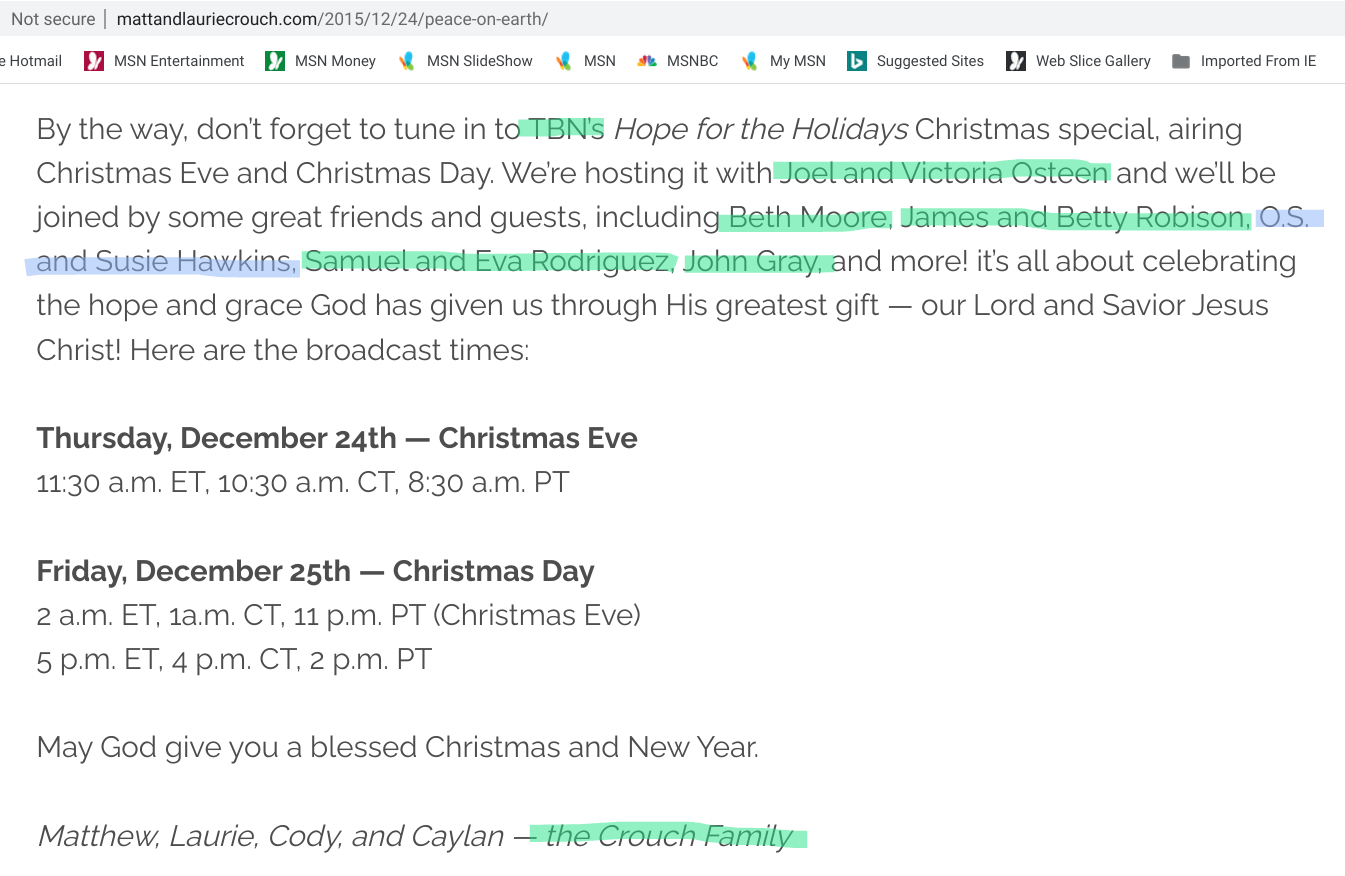
On the same day as The Return, Anne also delivered one of the featured prayers at her brother, Franklin Graham’s, Prayer March 2020. (It is unclear to me if, or how, these two events were connected.) Also featured at this event were numerous heretics and false teachers, including TBN (Trinity Broadcasting Network), Matt and Laurie Crouch (heads of TBN), Jonathan CahnJentzen FranklinRobert Morris, and Paula White.

Anne has appeared on disgraced televangelist and false prophet Jim Bakker’s show:

Anne participated in, promoted, and was a featured speaker at the 2020 Jerusalem Prayer Breakfast, an ecumenical event touted as a time for Jews and Christians to pray together in unity. (Christians are not to yoke with any unbeliever who denies Christ as the Messiah, including Jews.)

Anne has poor hermeneutics and often mishandles Scripture. In her excellent analysis, Anne Graham Lotz and Her Narcissistic Interpretation of the Transfiguration, Erin Benziger carefully and biblically walks us through Anne’s eisegesis and allegorization of the story of the Transfiguration.

In a video tease for her book, The Daniel Prayer, Anne completely ignores the context of 2 Chronicles 7:14 and claims it as God’s promise to America. 

The following year, as chair of the 2017 National Day of Prayer Task Force, Anne mishandled the same passage the same way, combined it with a mishandling of Daniel’s prayer in Daniel 9, and claimed that these passages are God’s promise to “heal” America’s moral ills if we will just pray hard enough. Neither of these passages are about, nor apply to the secular nation of America. They both pertain to God’s covenant people, Old Testament Israel, at a very specific point in history.

This is indicative of Anne’s general hermeneutic when it comes to anything having to do with politics, America, social issues, foreign relations, etc. Her standard practice is to eisegete all of those things into Old Testament Scripture, taking God’s warnings to Israel as though they were literal warnings to America, and claiming God’s promises to Israel as literal promises to America. This is not rightly handling God’s Word.

Anne’s teaching on extra-biblical revelation (i.e. “hearing God’s voice”) is muddled at best. At times, such as in this excerpt from her teaching video Journey to Jesus Part 1: How to Study the Bible

…she correctly emphasizes that God speaks through His Word, yet in this same video (and other venues such as this article at Decision Magazine, How to Know God’s Voice) she also seems to teach extra-biblical revelation by saying we can mistake other peopleโ€™s voices for the voice of God, that some people aren’t hearing God speak, and continually using phrases like โ€œlistening for Godโ€™s voice.โ€

In her article, Preprayer 2016 Anne explains and endorses unbiblical โ€œcircle-makingโ€ prayer. Similar to Mark Batterson’s book, The Circle Maker, Anne re-tells the story of Honi the circle-maker, then says:

As I look ahead into 2016, I feel compelled to draw a circle around this city, this state, this nationโ€ฆ and pray!  Until God answers. Do the same. Please.  On this first day of the New Year, draw your own circle.  Then pray for everything thatโ€™s inside of it.

As we might expect, with her numerous ties to false prophets and New Apostolic Reformation heretics, Ann has begun to dabble in NAR-esque prophesying.

In his July 7, 2014 episode of Fighting for the Faith, Chris Rosebrough deftly analyzes a message Anne says God gave her for the United States.

In the Charisma News article Anne Graham Lotz Gives Prophetic Warning About 2016, Anne predicts “As I look ahead into 2016, I believe our national and global situation will get worse,” and “I have been repeatedly warned in my spirit that the enemy is advancing. It’s something that I know.”

Anne seems to be a lovely and caring person, not to mention very patriotic. I know she’s a sentimental favorite to many because of her father. Those are all endearing qualities. But we must put feelings and nostalgia aside when we evaluate whether or not someone is qualified to teach. James 3:1 is clear that teachers will be judged more strictly, not given a pass because they’re nice people or related to a beloved spiritual figure. Anne consistently mishandles Scripture, yokes in ministry with heretics and false teachers, and preaches to men, encouraging other women to do the same. She is not a trustworthy teacher, and I recommend that you not follow or receive teaching from her.


Additional Resources:

Anne Graham Lotz at Berean Research


1If you closely follow conservative politics, you may wish to examine the list of names of the participants in The Return.

Mailbag

The Mailbag: Church Roles and Ambiguous Anatomy


Iโ€™m curious to know if someone who is medically intersex should be considered a man or a woman for the purposes of appropriate church roles. Iโ€™m not sure if the Bible addresses that or not.ย 

According to the National Institutes of Health, “Intersex is a group of conditions where there is a discrepancy between the external genitals and the internal genitals (the testes and ovaries). The older term for this condition is hermaphroditism.” In other words, a person could have XX chromosomes (genetically female) and ovaries, yet the external genitalia appears male (i.e. penis instead of vagina), or vice versa for a genetic (XY) male. There are also some other genetic anomalies that result in intersex, and a wide variety of genital anomalies not related to sexual identity that fall under the category of “intersex”.

(And just so we’re all on the same page here, “medically intersex” refers to a congenital abnormality– a birth defect. It does not mean, nor does the reader who sent in this question mean, a physically/genetically normal man or woman who has decided to mutilate his/her body with surgery to appear to be the opposite sex. That’s different. Also, the reader who sent in the question is not asking whether or not a medically intersex person may be saved or may be a church member. She is only asking how the biblical roles for men and women in the church {i.e. preaching/teaching/leadership roles} apply to a medically intersex person, so that is the question I’m answering.)

But because “intersex” has become something of a catch-all term for a so many genetic defects related to chromosomal abnormalities and/or internal reproductive organ abnormalities and/or external genital abnormalities, it’s nearly impossible to answer a question like, “How common is medical intersex?”. But even the (now defunct) Intersex Society of North America (an advocacy group, which we can probably safely surmise would be fairly liberal/over-generalized in its statistics) estimates that only .05-.07% (half of 1%) of babies at birth have genitalia so ambiguous that they require a consult by a sex specialist, and far fewer end up needing surgery to correct these anomalies.

Now, keep in mind that, as I said, that .05-.07% is the total estimate for a wide variety of reproductive and genital anomalies, many of which do not affect sexual identity. So the number of people who are genetically female with male genitals or genetically male with female genitals (what the reader who sent in this question is referring to) is only a fraction of that .05-.07%. In other words, it’s an extremely rare condition.

So, take that very tiny number of people and add on the qualifiers for this reader’s question. The medically intersex person has to get through the narrow gate of salvation (because unsaved people don’t have “church roles,” as they’re not part of the church, and, naturally, shouldn’t be serving or leading in the church in any way whatsoever). Now your numbers have gone from tiny to tinier. Now, whittle those numbers down even further: the person not only has to be saved, but has to have a doctrinally sound understanding of the roles of men and women in the church, the person has to desire a position of leadership or servanthood in which the biblical role of men/women is an issue (for most positions in the church, it generally isn’t), the person has to be otherwise biblically qualified to serve in that role (e.g. above reproach, sober-minded, etc.), and the person has to find and become a member of a doctrinally sound church that actually follows the Bible’s teachings on the roles of men and women in the church.

Now your numbers have gone from “tinier” to, “Get me the strongest electron microscope in existence.” Statistically speaking, this is never going to be an issue in any doctrinally sound church.

But it’s interesting to think about.

There isn’t a Bible passage that describes medical intersex and whether or not a person so afflicted may or may not serve in the role of pastor, elder, deacon, preaching to/teaching Scripture to men, holding authority over men, or older women teaching the younger women (the church roles assigned to either only males or only females).

The closest the Bible comes to addressing this issue is in Leviticus 21:16-23, which says that a man with crushed testicles may not serve as a priest in the temple. However, this passage does not apply to the question at hand for a couple of reasons, which are abundantly clear if you read the passage in context.

First of all, “crushed testicles” is only one condition in a litany of other physical abnormalities which disqualified a man (only men could serve as priests) from the priesthood. And the reason for this had nothing to do with sexual identity. The reason men with physical “blemishes” couldn’t be priests was basically the same reason that when you brought an animal for sacrifice, it had to be perfect, free of any physical defect: It symbolically pointed ahead to the perfection of Christ. Christ was not only the unblemished Lamb of God, our perfect sacrifice, He is also our perfect high priest. That’s why both the Old Testament sacrifice and priest had to be “without blemish”.

Second, although there are some similarities between the Old Testament temple and the New Testament church, they are two distinctly different entities with different qualifications for leadership. This is easy to see if you compare some of the requirements for the Old Testament priesthood with the requirements for pastors of New Testament churches. Other than the fact that the pastorate is restricted to men, there are no physical requirements for pastors. Certainly we would not say that a man who is blind or has psoriasis is disqualified from being a pastor strictly on the basis of those conditions, would we? Yet these men (and others with all types of physical “blemishes,” including crushed testicles) were disqualified from the priesthood.

So, having no direct biblical passages to go on, here are a few thoughts…

  • Such a unique situation that isn’t directly addressed by Scripture will need to dealt with on a case by case basis by the pastor, elders, and church leadership.
  • The medically intersex person who meets all of the qualifiers I outlined above should set up an appointment with his/her pastor, explain the medical condition, explain whether he/she has been living as a man or a woman, and why, and get pastoral counsel on which positions of service or leadership would be appropriate.
  • I would think it would be helpful for the medically intersex person’s current pastor to contact his/her former pastor for insight on how the situation was handled at his/her previous church. The current pastor might end up making different decisions than the previous pastor, but getting the benefit of the previous pastor’s experience would seem to me to be beneficial.
  • The medically intersex person seeking to serve the church has probably already established an identity (dressing, behaving, considers him/herself as, presenting as) as a man or a woman in his/her daily life. Taking that into consideration and weighing all of the other factors and details, church leadership may prayerfully consider it appropriate to let this person function in the church as the sex he/she identifies as. In other words, if the person has established an identity as a woman (she considers herself a woman, dresses/acts like a woman, her family, friends, and others consider her to be a woman, etc.), it could be an appropriate decision to allow her to function as a woman in the church, following the Bible’s role for women in the church.
  • Another appropriate decision the church leadership might make would be to err on the side of caution and help the medically intersex person find a place of service that is not impacted by the Bible’s parameters for men and women in the church. Here and here are a couple of good jumping off points.

If the medically intersex person and his/her church leadership prayerfully come together seeking wisdom from the Lord, and trying to discern what is pleasing to the Lord, there is one biblical certainty about this situation: they can trust Him to direct their path.


If you have a question about: a Bible passage, an aspect of theology, a current issue in Christianity, or how to biblically handle a family, life, or church situation, comment below (Iโ€™ll hold all questions in queue {unpublished} for a future edition of The Mailbag) or send me an e-mail or private message. If your question is chosen for publication, your anonymity will be protected.