
Mailbag

The Mailbag: Regrets…I Still Have a Few

Originally published March 16, 2020

I know regret should lead us to repentance. My question is: After repentance and salvation what do we do with regret? Is it sinful to continually experience regret? Is it just a consequence we must live with? I feel like I’m being swallowed up by it the more I read the Bible, which is not the end of the world, but I just want to handle it correctly.

Great question. I think correct context and semantics can help us out a lot here.

The verse you’re referring to is 2 Corinthians 7:10 (which I have linked in context in your question above):

For godly grief produces a repentance that leads to salvation without regret, whereas worldly grief produces death.

There are several concepts at play here between your question and the verse, and we need to be sure we’re not conflating them: regret, godly sorrow or grief, shame, and guilt.

When we American English speakers say, Frank Sinatra-style, “Regrets….I’ve had a few….,” what we mean is that there are things we’ve done in the past that we wish we hadn’t done, and that if we had it to do over again, we would do things differently. Every Christian has had incidents we feel this way about, whether they took place before or after we got saved. If your love for Christ and your growing understanding of the blackness of sin have led you to regret rebelling against Him, that’s not a bad thing. What would be bad is if you had no regrets. When we look back on past sins, we should always do so with an attitude of regret for having committed them.

But doesn’t this verse say repentance leads to salvation “without regret”? Yes. But that phrase doesn’t mean we’ll never look back at our past sins and wish we had obeyed God instead. Read the verse in context. Paul had written his “severe letter” rebuking the Corinthian church for their sin. It cut them to the heart in godly sorrow over their transgressions and they joyfully repented, never once looking back and wishing for their old way of life. Even with the hardships and persecution many first century Christians faced, they never, for a single moment, regretted turning from their life of sin and following Jesus. (I think we could all say a hearty “Amen!” to that!) That’s what “salvation without regret” means- we don’t regret casting our lot with Christ.

Another aspect of this verse and question we need to address is this: The verse doesn’t say our regrets produce repentance that leads to salvation. It says “godly grief”, or “sorrow,” or “sorrow that is according to the will of God,” is what produces repentance that leads to salvation. There’s a big difference.

Regrets are more in line with the “worldly grief” mentioned at the end of the verse, which produces death. Even lost people like Ol’ Blue Eyes can look back over their lives and recall their embarrassing or jerky behavior and the choices they made that hurt others or themselves, and they can wish they hadn’t done those things. Why? Because of the natural consequences of sin. He got caught. He lost his job or his wife or a friend.

He had to pay the piper, and he didn’t like the looks of the bill.

Not a thought to the Lord whose laws he broke. Not a twinge of guilt and shame for committing sins that crucified the Savior who loves him. No fear and trembling at the feet of a thrice holy God of wrath who has the power to cast him into Hell for all eternity.

That is godly grief. It’s a grief that goes vertical first…

I have offended a high and holy God.

Woe unto me, for I am a man of unclean lips!

Against Thee, and Thee only, have I sinned.

Father, I am no longer worthy to be called your son.

Oh, wretched man that I am! Who will deliver me from this body of death?

…and then, springing from that godly grief, seeks horizontal forgiveness from and reconciliation with others.

When godly grief over sin produces repentance, repentance leads to salvation. And when Christ saves you, a transaction takes place in God’s legal system in which Christ absorbs the shame, guilt, and penalty for your sin, and God, the righteous Judge, rules you not guilty.

But what can you do when you’ve been genuinely saved and you look back at your past sin not only with regret, but also feeling the weight of guilt and shame? I think maybe that’s the heart of what you’re asking.

You have to hold on to what you know to be true according to God’s Word over and above what you feel. God’s Word is objectively trustworthy. Our feelings are not. Our feelings can be fickle and fleshly. Subjective and deceptive. We have to tame those feelings like wild horses with the bit, bridle, and spurs of Scripture, and rein them in or turn them in the direction God wants them to go.

So what do we know to be true about feeling guilt and shame for our past sin?

• Whatever we may feel, the fact is that, in Christ, we are not guilty, and our shame has been removed:

I give thanks to my God always for you because of the grace of God that was given you in Christ Jesus…who will sustain you to the end, guiltless in the day of our Lord Jesus Christ. 1 Corinthians 1:4,8

“Fear not, for you will not be ashamed; be not confounded, for you will not be disgraced; for you will forget the shame of your youth, and the reproach of your widowhood you will remember no more. For your Maker is your husband, the Lord of hosts is his name; and the Holy One of Israel is your Redeemer, the God of the whole earth he is called. Isaiah 54:4-5

• It isn’t God who is leading us to feel a way that doesn’t line up with His Word. Satan is the only one who makes false accusations against Christians:

And I heard a loud voice in heaven, saying, “Now the salvation and the power and the kingdom of our God and the authority of his Christ have come, for the accuser of our brothers has been thrown down, who accuses them day and night before our God. Revelation 12:10

• It is not God’s will for us to focus on the past, but to move forward like the Christians we are, keeping our eyes on Jesus:

But one thing I do: forgetting what lies behind and straining forward to what lies ahead, I press on toward the goal for the prize of the upward call of God in Christ Jesus. Let those of us who are mature think this way, and if in anything you think otherwise, God will reveal that also to you. Only let us hold true to what we have attained. Philippians 3:13b-16

Therefore, since we are surrounded by so great a cloud of witnesses, let us also lay aside every weight, and sin which clings so closely, and let us run with endurance the race that is set before us, looking to Jesus, the founder and perfecter of our faith, who for the joy that was set before him endured the cross, despising the shame, and is seated at the right hand of the throne of God. Hebrews 12:1-2

When you look back on your former life and are overwhelmed by guilt and shame, remember the words above are from the very lips of God Himself. Remember that you were guilty and covered with shame, and let that knowledge lead you to thank, praise, and worship the One who took your sin and wretchedness upon His own shoulders. Who absorbed your punishment, your blame – and set you free. Free to honor and obey Him. Free to glorify Him and enjoy Him forever.

Additional Resources

The Mailbag: Regrets, I’ve had a few…more.

Guilt and Shame- Burden or Blessing?


If you have a question about: a Bible passage, an aspect of theology, a current issue in Christianity, or how to biblically handle a family, life, or church situation, comment below (I’ll hold all questions in queue {unpublished} for a future edition of The Mailbag) or send me an e-mail or private message. If your question is chosen for publication, your anonymity will be protected.
Mailbag

The Mailbag: Regrets…I Still Have a Few

I know regret should lead us to repentance. My question is: After repentance and salvation what do we do with regret? Is it sinful to continually experience regret? Is it just a consequence we must live with? I feel like I’m being swallowed up by it the more I read the Bible, which is not the end of the world, but I just want to handle it correctly.

Great question. I think correct context and semantics can help us out a lot here.

The verse you’re referring to is 2 Corinthians 7:10 (which I have linked in context in your question above):

For godly grief produces a repentance that leads to salvation without regret, whereas worldly grief produces death.

There are several concepts at play here between your question and the verse, and we need to be sure we’re not conflating them: regret, godly sorrow or grief, shame, and guilt.

When we American English speakers say, Frank Sinatra-style, “Regrets….I’ve had a few….,” what we mean is that there are things we’ve done in the past that we wish we hadn’t done, and that if we had it to do over again, we would do things differently. Every Christian has had incidents we feel this way about, whether they took place before or after we got saved. If your love for Christ and your growing understanding of the blackness of sin have led you to regret rebelling against Him, that’s not a bad thing. What would be bad is if you had no regrets. When we look back on past sins, we should always do so with an attitude of regret for having committed them.

But doesn’t this verse say repentance leads to salvation “without regret”? Yes. But that phrase doesn’t mean we’ll never look back at our past sins and wish we had obeyed God instead. Read the verse in context. Paul had written his “severe letter” rebuking the Corinthian church for their sin. It cut them to the heart in godly sorrow over their transgressions and they joyfully repented, never once looking back and wishing for their old way of life. Even with the hardships and persecution many first century Christians faced, they never, for a single moment, regretted turning from their life of sin and following Jesus. (I think we could all say a hearty “Amen!” to that!) That’s what “salvation without regret” means- we don’t regret casting our lot with Christ.

Another aspect of this verse and question we need to address is this: The verse doesn’t say our regrets produce repentance that leads to salvation. It says “godly grief”, or “sorrow,” or “sorrow that is according to the will of God,” is what produces repentance that leads to salvation. There’s a big difference.

Regrets are more in line with the “worldly grief” mentioned at the end of the verse, which produces death. Even lost people like Ol’ Blue Eyes can look back over their lives and recall their embarrassing or jerky behavior and the choices they made that hurt others or themselves, and they can wish they hadn’t done those things. Why? Because of the natural consequences of sin. He got caught. He lost his job or his wife or a friend.

He had to pay the piper, and he didn’t like the looks of the bill.

Not a thought to the Lord whose laws he broke. Not a twinge of guilt and shame for committing sins that crucified the Savior who loves him. No fear and trembling at the feet of a thrice holy God of wrath who has the power to cast him into Hell for all eternity.

That is godly grief. It’s a grief that goes vertical first…

I have offended a high and holy God.

Woe unto me, for I am a man of unclean lips!

Against Thee, and Thee only, have I sinned.

Father, I am no longer worthy to be called your son.

Oh, wretched man that I am! Who will deliver me from this body of death?

…and then, springing from that godly grief, seeks horizontal forgiveness from and reconciliation with others.

When godly grief over sin produces repentance, repentance leads to salvation. And when Christ saves you, a transaction takes place in God’s legal system in which Christ absorbs the shame, guilt, and penalty for your sin, and God, the righteous Judge, rules you not guilty.

But what can you do when you’ve been genuinely saved and you look back at your past sin not only with regret, but also feeling the weight of guilt and shame? I think maybe that’s the heart of what you’re asking.

You have to hold on to what you know to be true according to God’s Word over and above what you feel. God’s Word is objectively trustworthy. Our feelings are not. Our feelings can be fickle and fleshly. Subjective and deceptive. We have to tame those feelings like wild horses with the bit, bridle, and spurs of Scripture, and rein them in or turn them in the direction God wants them to go.

So what do we know to be true about feeling guilt and shame for our past sin?

• Whatever we may feel, the fact is that, in Christ, we are not guilty, and our shame has been removed:

I give thanks to my God always for you because of the grace of God that was given you in Christ Jesus…who will sustain you to the end, guiltless in the day of our Lord Jesus Christ. 1 Corinthians 1:4,8

“Fear not, for you will not be ashamed; be not confounded, for you will not be disgraced; for you will forget the shame of your youth, and the reproach of your widowhood you will remember no more. For your Maker is your husband, the Lord of hosts is his name; and the Holy One of Israel is your Redeemer, the God of the whole earth he is called. Isaiah 54:4-5

• It isn’t God who is leading us to feel a way that doesn’t line up with His Word. Satan is the only one who makes false accusations against Christians:

And I heard a loud voice in heaven, saying, “Now the salvation and the power and the kingdom of our God and the authority of his Christ have come, for the accuser of our brothers has been thrown down, who accuses them day and night before our God. Revelation 12:10

• It is not God’s will for us to focus on the past, but to move forward like the Christians we are, keeping our eyes on Jesus:

But one thing I do: forgetting what lies behind and straining forward to what lies ahead, I press on toward the goal for the prize of the upward call of God in Christ Jesus. Let those of us who are mature think this way, and if in anything you think otherwise, God will reveal that also to you. Only let us hold true to what we have attained. Philippians 3:13b-16

Therefore, since we are surrounded by so great a cloud of witnesses, let us also lay aside every weight, and sin which clings so closely, and let us run with endurance the race that is set before us, looking to Jesus, the founder and perfecter of our faith, who for the joy that was set before him endured the cross, despising the shame, and is seated at the right hand of the throne of God. Hebrews 12:1-2

When you look back on your former life and are overwhelmed by guilt and shame, remember the words above are from the very lips of God Himself. Remember that you were guilty and covered with shame, and let that knowledge lead you to thank, praise, and worship the One who took your sin and wretchedness upon His own shoulders. Who absorbed your punishment, your blame – and set you free. Free to honor and obey Him. Free to glorify Him and enjoy Him forever.

Additional Resources

The Mailbag: Regrets, I’ve had a few…more.

Guilt and Shame- Burden or Blessing?


If you have a question about: a Bible passage, an aspect of theology, a current issue in Christianity, or how to biblically handle a family, life, or church situation, comment below (I’ll hold all questions in queue {unpublished} for a future edition of The Mailbag) or send me an e-mail or private message. If your question is chosen for publication, your anonymity will be protected.

Wednesday's Word

Wednesday’s Word ~ Ezekiel 18

For further study on the book of Ezekiel, try my study, Ezekiel.

ez 18 23

Ezekiel 18

The word of the Lord came to me: “What do you mean by repeating this proverb concerning the land of Israel, ‘The fathers have eaten sour grapes, and the children’s teeth are set on edge’? As I live, declares the Lord God, this proverb shall no more be used by you in Israel. Behold, all souls are mine; the soul of the father as well as the soul of the son is mine: the soul who sins shall die.

“If a man is righteous and does what is just and right— if he does not eat upon the mountains or lift up his eyes to the idols of the house of Israel, does not defile his neighbor’s wife or approach a woman in her time of menstrual impurity, does not oppress anyone, but restores to the debtor his pledge, commits no robbery, gives his bread to the hungry and covers the naked with a garment, does not lend at interest or take any profit, withholds his hand from injustice, executes true justice between man and man, walks in my statutes, and keeps my rules by acting faithfully—he is righteous; he shall surely live, declares the Lord God.

10 “If he fathers a son who is violent, a shedder of blood, who does any of these things 11 (though he himself did none of these things), who even eats upon the mountains, defiles his neighbor’s wife, 12 oppresses the poor and needy, commits robbery, does not restore the pledge, lifts up his eyes to the idols, commits abomination, 13 lends at interest, and takes profit; shall he then live? He shall not live. He has done all these abominations; he shall surely die; his blood shall be upon himself.

14 “Now suppose this man fathers a son who sees all the sins that his father has done; he sees, and does not do likewise: 15 he does not eat upon the mountains or lift up his eyes to the idols of the house of Israel, does not defile his neighbor’s wife, 16 does not oppress anyone, exacts no pledge, commits no robbery, but gives his bread to the hungry and covers the naked with a garment, 17 withholds his hand from iniquity, takes no interest or profit, obeys my rules, and walks in my statutes; he shall not die for his father’s iniquity; he shall surely live. 18 As for his father, because he practiced extortion, robbed his brother, and did what is not good among his people, behold, he shall die for his iniquity.

19 “Yet you say, ‘Why should not the son suffer for the iniquity of the father?’ When the son has done what is just and right, and has been careful to observe all my statutes, he shall surely live. 20 The soul who sins shall die. The son shall not suffer for the iniquity of the father, nor the father suffer for the iniquity of the son. The righteousness of the righteous shall be upon himself, and the wickedness of the wicked shall be upon himself.

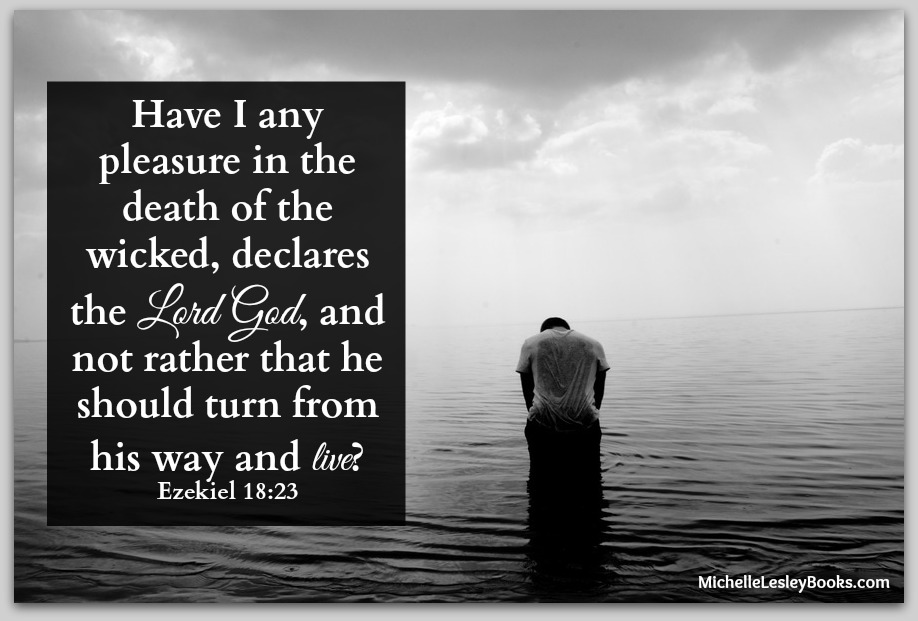
21 “But if a wicked person turns away from all his sins that he has committed and keeps all my statutes and does what is just and right, he shall surely live; he shall not die. 22 None of the transgressions that he has committed shall be remembered against him; for the righteousness that he has done he shall live. 23 Have I any pleasure in the death of the wicked, declares the Lord God, and not rather that he should turn from his way and live? 24 But when a righteous person turns away from his righteousness and does injustice and does the same abominations that the wicked person does, shall he live? None of the righteous deeds that he has done shall be remembered; for the treachery of which he is guilty and the sin he has committed, for them he shall die.

25 “Yet you say, ‘The way of the Lord is not just.’ Hear now, O house of Israel: Is my way not just? Is it not your ways that are not just? 26 When a righteous person turns away from his righteousness and does injustice, he shall die for it; for the injustice that he has done he shall die. 27 Again, when a wicked person turns away from the wickedness he has committed and does what is just and right, he shall save his life.28 Because he considered and turned away from all the transgressions that he had committed, he shall surely live; he shall not die. 29 Yet the house of Israel says, ‘The way of the Lord is not just.’ O house of Israel, are my ways not just? Is it not your ways that are not just?

30 “Therefore I will judge you, O house of Israel, every one according to his ways, declares the Lord God. Repent and turn from all your transgressions, lest iniquity be your ruin. 31 Cast away from you all the transgressions that you have committed, and make yourselves a new heart and a new spirit! Why will you die, O house of Israel? 32 For I have no pleasure in the death of anyone, declares the Lord God; so turn, and live.”


The Holy Bible, English Standard Version Copyright © 2001 by Crossway Bibles, a publishing ministry of Good News Publishers.


Questions to Consider:

1. What is the book of Ezekiel about? Which genre (history, poetry, wisdom, etc.) is the book of Ezekiel? What is the overall theme of chapter 18?

2. How do verses 5-9 describe a righteous man? What kind of heart would such a man have to have in order to consistently live this way? (9)

3. Who is the “he” in verses 11 and 12 referring to? Is this man to be punished for the sins of his son? (13) If the sinful man (14) fathers a righteous son (14-17) is the righteous son to be punished for his father’s sin? (17-18) Which verse(s) in this chapter sum up the principle of individual responsibility for sin? How does this chapter refute the false teaching of generational curses?

4. What can we learn about repentance from verses 21-32? In which does God take delight, pouring out His wrath on the wicked or pouring out His forgiveness on the repentant? (23, 32) How does this passage compare to 2 Peter 3:9?

5. Consider this chapter in light of the gospel. Is any person truly righteous? Where does the Christian’s righteousness come from? How does the New Testament describe Jesus, the righteous Son, being punished for our sin? What effect does this have on verse 4 (“the soul who sins shall die”)?