Discernment

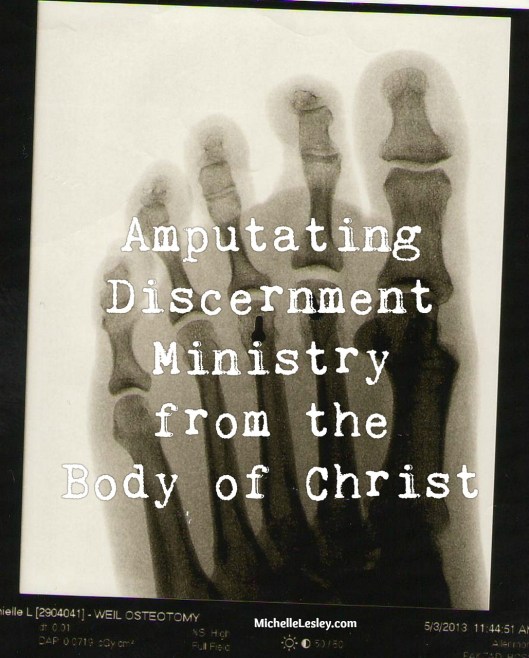
Throwback Thursday ~ Amputating Discernment Ministry from the Body of Christ

Originally published February 2, 2018
“There’s no place for Christian blogs and podcasts. Preaching, teaching, and encouragement should only be done by pastors and teachers in the local church.”

“Open air preaching ministry needs to go the way of the dinosaur.”

“Pro-life ministry organizations just cause too much strife. Lost people are going to reject the gospel because of them.”

“The Bible nowhere mentions Christian legal defense organizations.”

You’ve probably never heard someone give one of these statements as a reason for doing away with podcasts or street preaching or the ADF, but these days it seems like everybody – including doctrinally sound, discerning Christians – is screaming, “Off with its head!” about parachurch discernment ministries for these supposed reasons, and others. It’s become the bandwagon du jour. The popular whipping boy for Christian social media. The here-today-gone-tomorrow zeitgeist of online evangelicalism.

Among those who wish to amputate discernment ministry from the Body are good, solid, loving, godly brothers and sisters in Christ. I just wish they realized that there are many of us on this side of the discernment fence who are also good, solid, loving, godly brothers and sisters in Christ.

Among those who wish to amputate discernment ministry from the Body are good, solid Believers. I just wish they realized that there are many of us on this side of the discernment fence who are *also* good, solid Believers.

It is a sad irony that the genuinely good guys who are clamoring for the death of discernment ministry are, in some cases themselves doing the very things they accuse discernment ministries of doing. While they may give a brief hat tip to “some discernment ministries aren’t so bad”, in calling for the disbanding of discernment ministry across the board, they effectively lump everyone who does any sort of discernment work – regardless of how infrequently or how biblically it’s done – into the same category as those who indiscriminately lob a constant barrage of truth-bending, vitriolic grenades at everyone from the rankest heretic to the reputable, doctrinally sound brother who has a slightly different take on their eschatological view. And in the same way it wouldn’t be fair to throw these brothers and sisters who speak from biblical love and concern for the church into the same bin as “Christians” who scream like banshees about discernment ministry because they just want to worship their idols in peace without their consciences being pricked, it’s not fair to unilaterally declare that discernment ministry should be banned, either.

Rebuke those doing discernment work whose character, behavior, and handling of Scripture is so egregious it disqualifies them from any ministry whatsoever (and, unfortunately, they do exist) but encourage those who do discernment ministry right.

Just like you would with any other ministry.

Rebuke those doing discernment work whose egregious character, behavior, and handling of Scripture disqualifies them from ministry, but encourage those who do discernment ministry right. Just like you would with any other ministry.

Because if there were ever a dire need for discernment ministry done right and biblically, it’s now. Banishing the discerning altogether would be neither biblical nor beneficial to the Body.

Discernment: A Major Theme of the New Testament

The Old Testament is rife with idolatry, syncretism, and false prophets. Every book of the New Testament except Philemon deals in some way with false doctrine or false teachers and the importance of keeping them out of the church and away from Christians. It is a major issue throughout the Bible, but particularly in New Testament theology and ecclesiology. Jesus dealt with it. Paul dealt with it. So did Peter, Jude, John, and other New Testament figures.  Part of the reason the 21st century church is so steeped in false doctrine and enamored with false teachers now is that we have been brushing discernment aside for so long instead of bringing it front and center like the Bible does. If the Holy Spirit – the author of Scripture – considers discernment to be so vital, shouldn’t we?

If the Holy Spirit – the author of Scripture – considers discernment to be so vital, shouldn’t we?

Amputating Body Parts

Now there are varieties of gifts, but the same Spirit; and there are varieties of service, but the same Lord; and there are varieties of activities, but it is the same God who empowers them all in everyone. To each is given the manifestation of the Spirit for the common good. For to one is given through the Spirit…the ability to distinguish between spiritsAll these are empowered by one and the same Spirit, who apportions to each one individually as he wills…But as it is, God arranged the members in the body, each one of them, as he chose. If all were a single member, where would the body be? As it is, there are many parts, yet one body. The eye cannot say to the hand, โ€œI have no need of you,โ€ nor again the head to the feet, โ€œI have no need of you.โ€
1 Corinthians 12:4-8a, 10b, 11, 18-21 (emphasis mine)

Discernment (distinguishing spirits) is just as ontologically valid a spiritual gift – a manifestation of the Holy Spirit – as any of the others listed in 1 Corinthians 12. It is a biblically legitimate gift, service, and activity given for the common good of the church and empowered by the same Spirit, Lord, and God who gives and empowers the spiritual gifts of those who would do away with discernment ministry. Spiritual gifts are given by God and arranged in the Body as He sees fit. It is not for one individual body part to say to another, “I have no need of you.” Selah.

Discernment is a biblically legitimate gift given for the common good of the church and empowered by the same Spirit who gives and empowers the spiritual gifts of those who would do away with discernment ministry.

Check Your Privilege

If you’re a discerning person who goes to a discerning church, has a discerning pastor and elders, and hangs out with discerning friends maybe you don’t see that there’s much of a need for discernment ministry.

And if you lived in Hawaii, you wouldn’t see much of a need for snow shovels, either.

But if you lived in Alaska, you would.

We each exist in our own little bubble of personal experience. And if your bubble is one where pretty much everybody is discerning, make sure you thank God profusely for that every day, because you are extremely blessed. You’re also an extremely rare anomaly, because the vast majority of the rest of Christianity has no clue what that’s like. The 99 per cent-ers live in a bubble that looks like the shelves of your local Christian retailer – some good stuff (if you know where to look) and a whole lot of skubalon. And most of them don’t know the difference because they’ve never been taught. Don’t assume your experience is the norm for everyone.

Maybe you don’t see that there’s much of a need for discernment ministry. And if you lived in Hawaii, you wouldn’t see much of a need for snow shovels, either. But if you lived in Alaska, you would.

Of Course Pastors Should Be Leading the Way

One of the most common arguments I hear against discernment ministry is that it’s the job of the pastor, not discernment ministries, to teach discernment. And with that statement, I could not more heartily agree! Discernment work is half of a pastor’s job description:

He must hold firm to the trustworthy word as taught, so that he may be able to give instruction in sound doctrine and also to rebuke those who contradict it.
Titus 1:9 (emphasis mine)

So let me ask you 99 per cent-ers: when was the last time you heard a pastor rebuke someone who contradicts sound doctrine? Or call a false teacher by name? Or teach about a currently popular false doctrine and warn against it? I am honored to know several pastors who aren’t afraid to faithfully perform this part of their job, and God bless them for it. We need far more pastors like them. Yes, pastors should be spearheading the work of discernment in their local churches. But by and large, they’re not. And the Bible doesn’t say that only pastors have the gift and responsibility of discernment. It is insanity to tell ready, able, and willing laymen with garden hoses to stand down and watch a building burn to the ground while they wait…and wait…and wait…for the professional firemen who may never show up.

Yes, pastors should be spearheading the work of discernment in their local churches. But by and large, they’re not.

But Lost People Will Reject the Gospel!

Lost people already reject the gospel. That’s why they’re lost. They don’t get any lost-er by seeing a discernment ministry critique a false teacher. In fact, I’ve known of lost people who have expressed their thanks to discernment ministries for denouncing the blasphemies of false teachers. Even in their spiritually blind state many unbelievers know a wolf when they see one. Sometimes – to our shame – even better than those who call themselves Christians. When someone rejects the gospel, it is no more the fault of a discernment ministry than it is the fault of a pro-life ministry, a ministry that disciples newly saved homosexuals, or any other type of biblical ministry. God is sovereign in salvation. He will save who He means to save, and no mere mortal is going to prevent Him from doing so.

When someone rejects the gospel, it is no more the fault of a discernment ministry than it is the fault of a pro-life ministry, a ministry that disciples newly saved homosexuals, or any other type of biblical ministry.

Your Comfort Versus Their Souls

Whatever it is that bothers you about discernment ministries, is your state of botheration as important as the spiritual condition of the person that discernment ministry is reaching? Maybe you’re worried about those lost people out there who might reject the gospel because of discernment ministry conflict. Are you just as concerned about the lady in the pew next to you at church who’s every bit as lost as those people “out there” because she listens to false teachers who preach a false gospel that’s made her a false convert? What if a discernment ministry could help her understand the truth of the gospel? It’s happened. I’ve heard many stories of false converts Providentially “stumbling upon” a discernment ministry, hearing the unadulterated gospel for the first time, and getting saved.

What about the Christian woman who spends her quiet time in tears every day because she’s been falsely taught that God will talk to her if she just listens hard enough and has enough faith, and she’s in despair because she’s not hearing from God? What if a discernment ministry could set her free from that burden by teaching her what the Bible really says and steering her away from those who have deceived her? It’s happened. I know it has, because something similar happened to me. Is your annoyance at discernment ministries more important than her spiritual health?

Whatever it is that bothers you about discernment ministries, is your state of botheration as important as the spiritual condition of the person that discernment ministry is reaching?

There is absolutely a place – a good, God-ordained, nobody-puts-Baby-in-a-corner place – for discernment ministry in the Body of Christ. Inside the church, online, in parachurch ministry, from pastors, elders, and laymen alike. Yes, those who abuse their position of ministry – in any ministry – should be rebuked and removed. But we don’t do away with entire spiritual gifts and areas of ministry because of a few bad apples. Instead of amputating, maybe we should be excising gangrenous tissue instead. Otherwise we’ll just be shooting ourselves – the Body – in the foot.

There is absolutely a place – a good, God-ordained, nobody-puts-Baby-in-a-corner place – for discernment ministry in the Body of Christ.

Guest Posts

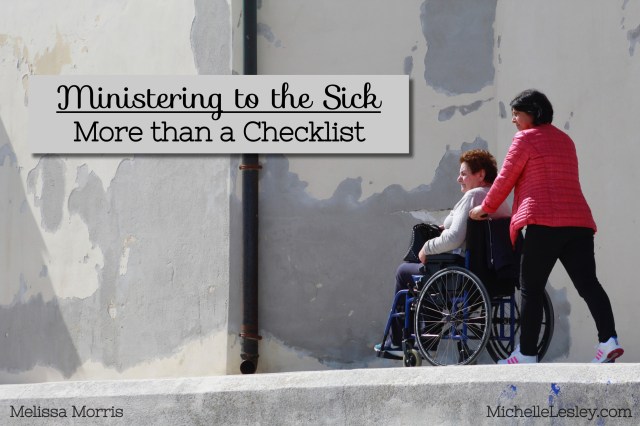
Guest Post: Ministering to the Sick: More than a Checklist

If your theology pretty much matches up with mine (as outlined in my โ€œWelcomeโ€ and โ€œStatement of Faithโ€ tabs in the blue menu bar at the top of this page) and youโ€™d like to contribute a guest post, drop me an e-mail, and letโ€™s chat about it.

Note from Michelle: (Update: 2024) At the time Melissa wrote this article for my blog, her theology was doctrinally sound. Unfortunately, since that time, she has has adopted some unbiblical beliefs which I cannot endorse. However, because this article is practical advice, rather than biblical/theological in nature, I have chosen to leave it up on the blog. I hope it will help you as you minister to family, friends, and church members.


Ministering to the Sick: More than a Checklist
by: Melissa Morris

Someone gets sick. Someone has surgery. Someone is going through cancer treatments. Until ten years ago when I had my own life threatening/life changing illness, I was guilty (unintentionally) of treating these opportunities as a checklist to be done and not really considering the person. Make a meal, give them a call, drop them off at the doctor โ€“ I mean, what’s wrong with that? People should be thankful that we care enough to be involved, right?

As the body of Christ, we have a huge responsibility to help out when illnesses occur. In the midst of all of the chaos, there is a person who has had his or her world turned upside down by a diagnosis or a surgery. People are individuals and so are diagnoses and treatment plans. There’s not only the physical side of sickness, there are also the emotional, mental and spiritual aspects to consider. It shouldn’t be a โ€œfill in the blankโ€ approach, it should be based on the individual.

Instead of treating our ministry as โ€œone size fits allโ€, what are some things we need to consider to effectively and practically minister to someone experiencing an illness?

Cancer treatments and doctor’s appointments

It’s more than giving someone a ride.

When my mom found out she had cancer, we needed help getting her to and from the cancer center. We live 45 minutes from the hospital where she would be receiving  her treatments. She had radiation treatments five days a week for six weeks. 

We had several people volunteer to take her, and it soon became evident that not everyone fully comprehends that it’s more than a ride.

When providing cancer patients with a ride to treatments, it’s important to understand several things. They are weak, before and after the treatments. Whatever the extent of the disease they are fighting, it is wreaking havoc on their bodies. They may be experiencing pain, nausea, vomiting, bathroom issues, and more. Therefore, they may need physical assistance walking, going to the bathroom, carrying their things and staying hydrated. When you offer to give someone a ride to treatments and you are the only one with them, they are expecting some things from you. Please understand that it’s more than dropping them off at the door of the hospital, coming back to pick them up, and dropping them off at the door when you get them home, especially if you are leaving them alone.

What can you do?

  • Remember that it’s not about you. You may be tempted to take the opportunity, especially if you are making a long trip, to do some shopping or errands while you wait. While this is not entirely wrong, there are some things you need to consider.
  • Walk with them to the office where they are receiving their treatments. Make sure they don’t need a wheelchair or some sort of assistive device to get them there.ย 
  • Check with them and see if they would be more comfortable if you waited for them in the waiting room before you go off to run errands. Sometimes it makes a patient feel better if they know someone is close by. The staff there might also need you to be available if there is an emergency or the patient needs something.
  • If you do leave the patient, make sure you arrive back in a timely manner so that they don’t have to wait for you when they are done.ย 
  • When you arrive back at their home, make sure they get inside safely and have everything they need before you leave them. Help them get comfortable, get something to eat or drink, go to the bathroom, etc. It might be awhile before someone gets home to be with them.
  • Don’t plan anything else that day โ€“ there will be times when the person receiving the treatments might need extra care. For example, there were times when my mom went for radiation and she was dehydrated. This required her to go to the medication oncology lab and receive fluids before they would send her home. This could take a couple of hours.

Taking Food/Other Items

I live in the South, and I’m a Baptist. We treat any and every illness with food. There’s a special joy in preparing someone a dish and delivering it to them. There’s also the comfort you feel in receiving a meal from someone and you know that they prepared it with love. You sure don’t feel like cooking when you’re going through an illness. 

It seems like an easy thing to do, but when I experienced surgery and a colostomy, my diet completely changed. We received so many wonderful, heartfelt meals, but to my dismay, there were many things that I wasn’t allowed to eat anymore. Some people come home with a new diagnosis of diabetes. Some have food allergies. Cancer patients might be experiencing nausea and vomiting/diarrhea. So, what can we do to make our meal ministry more effective?

  • I know we like the element of surprise, but to make it easier on everyone, it would be best to call and ask if the person has any dietary restrictions. It doesn’t do much good to take someone a meal they can’t eat, no matter how good it might taste.
  • If they can’t have certain things, consider taking prepackaged food items that they can easily put together themselves, but still ask for preferences and restrictions. Some examples:

    Crackers

    Canned meat/soups/fruits/vegetables (I know that fresh fruits and vegetables are ideal, however, when someone is recovering from an illness, they may not feel like eating a lot at one time. The fresh food might spoil before they can eat it.ย  Prepackaged and canned allows for the person to use the food when it benefits them).

    Sandwich meats and bread

    If you live in an area that provides meal delivery from restaurants, offer to pay for their orders for a specified amount of time.

    Offer to grocery shop for them and help put items away when you deliver the groceries.

    Offer to prepare and refrigerate simple items that can be microwaved or warmed up easily.

There are other items that might be needed that we might not think about. 

  • Cleaning supplies.
  • Toilet paper, napkins, paper towels.
  • Hygiene items (deodorant, soap, feminine products, etc.)
  • Medications (over the counter and prescription)

They also might need you to run errands for them, to the post office or to pick up prescriptions. Whatever the need may be, communicate with the person so that your efforts can be beneficial to them.

Visits

I love to talk. In fact, after I had major surgery, the nurses told my mom that I would sleep all night from the anesthesia. I woke up at midnight and talked all night long!

But as much as I love to talk, when I was recovering, I wanted to rest. I had been in the hospital for ten days, not knowing if I was going to make it back home or not. I was discharged home with IV antibiotics around the clock for seven more days. I had nurses coming in daily for wound care and colostomy training. I didn’t get much sleep in the hospital, and, for a while, I wasn’t getting much sleep at home.

Before visiting, call the person and see what a good time might be to show up. As I was talking with Michelle about this article, we discussed that the old theory is to โ€œjust show upโ€. I had people show up to see me that I would have enjoyed visiting with, but I was either sleeping or having a visit from the nurse. If the person recovering has a caregiver, that caregiver might be taking an opportunity to rest while the patient is resting. 

What do I say? (or NOT say)

Some people said some crazy things to me and to my mom while we were dealing with recovery/cancer treatments.

  • My mom had a pastor who she thought a lot of visit her the day after she found out her initial diagnosis but before we found out the extent of the disease process. He seemed in a bad mood when he got there, preoccupied and distracted. My mom shared with him that she wasn’t afraid, that she had lived 67 years (at the time) and if the diagnosis was not good, she’d had a wonderful life and she was ready to meet Jesus. He looked up at her and rudely said, โ€œWell, you might only have 67 more days, have you ever thought about that?โ€
  • A friend of my mom’s from church came to see her and pray with her. As they talked, this โ€œfriendโ€ said, โ€œWell, Pat, you know you have this cancer because you have sin in your life.”.
  • I woke up extremely depressed one day, so I actually reached out to someone I thought was a close friend via text and said I needed someone to talk to. Five days later, I got a text back that said, โ€œHope you found someone to talk to.โ€.

Don’t be that person โ€“ if you’re in a bad mood, visit another day, and as I was taught, if you can’t say something nice (or encouraging), don’t say anything at all. When I worked in healthcare, we were taught to leave our personal lives outside the door when we came to work, because they would be there for us to pick up when we went home. 

What else?

I never realized until I became disabled how many things there are around the house that need to be done.

  • Cleaning
  • Laundry
  • Yard work/mowing
  • Errands
  • Taking care of the kids

There might be adaptations that need to be made to the home, or adaptive equipment put in place (grab bars, a handicap toilet, etc.)

The person might need help with bathing and dressing for a while, and this might not be something insurance covers. I needed daily wound care and my insurance only covered three days a week. I was blessed to have nurses in my life that covered the other four days. If you are a nurse or a C.N.A., you could offer your time and services. Even if you’re not, you can be trained in some instances to help with certain medical issues.

One of the biggest issues many deal with is the financial strain not working can put on a person. If the illness ends up being a permanent disability, it can take years (it took 3ยฝ for me) to receive benefits through Social Security. I would hate to think where I would have been had the Lord not given me a wonderful mother and a few anonymous donors to make it through. Even with those things, I had to sell my car, and some of my instruments and sound equipment just to get medication and colostomy supplies. People may also need help filling out applications for assistance, disability, or in-home services. 

Some of the things from our previous lists can carry over if the illness becomes a permanent disability.

Whatever the situation, keep this one thing in mind: be available. If you can’t meet the need of the person, help seek out someone who can.

It is my prayer that this will assist you in more effectively serving those in your community.  And remember, somebody can’t do everything, but everybody can do something.


Melissa is a retired long term care/hospice social worker/bereavement counselor. Compelled to give up her career due to illness, she now spends her time raising her two cousins, singing and writing songs, and traveling to different churches and organizations sharing music and laughter.

Christian women, Discernment

Throwback Thursday ~ Women In Combat

Originally published March 18, 2016

Over the last few months, thereโ€™s been a lot of talk about the possibility of future U.S. military drafts including young women in addition to young men. Iโ€™ve admired godly male friends who have spoken out vehemently against this and expressed concern about the government trying to press their daughters or wives into service. Some even vowed to lay their lives down protecting their women from having to face the horrors and dangers of war.

But I wonder if these men โ€“ husbands, fathers, pastors, elders – know that many of their wives, daughters, and sisters in Christ are already in the trenches fighting off the enemy with every ounce of our strength and every weapon at our disposal.

Itโ€™s not a war for territory or political control or freedom from dictatorial tyranny.

Itโ€™s a battle for the purity of the Bride. And the souls of our sisters.

Daily. Weekly. At church. On line. In our families. We strap on our Swords, march out to the front and engage in hand to hand combat with the Enemy.

His troops: false teachers.

His weapon of mass destruction: false doctrine.

Sometimes we stand as a shield between grenade-lobbing grunts and weak sisters who donโ€™t know how to fight, or even that theyโ€™re in a war. Who want nothing more than to knock us down into the mud as they desert our King and join our foes.

Sometimes we infiltrate the enemy camp to bring back intelligence on his troops to our commanders and generals, only to be ignored, reprimanded, or dishonorably discharged from the unit.

Sometimes we stand as guards at the walls of our churches, watching the adversary advance, sounding the alarm, and standing in stunned disbelief as our commanding officers smilingly welcome the enemy troops through the gate.

Why? Why, in a field of pink, are there so few Green Berets? Why is it that so many women are out on the front lines battling this insidious rival while most of our brothers in arms seem to be AWOL?

men1

As Steve Lawson famously said a few years ago, “Give us some men who know the truth!”

And to that I respond with a hearty amen. But with much love and respect to Brother Steve, I would add:

Give us some men who will DEFEND the truth.

And the weak women the enemy seeks to capture.

And the strong women who should be protected, working safely away from the line of fire to support the troops and nurse the casualties back to health.

Give us men who willโ€ฆ

โ€ฆthoroughly vet any curricula, books, or materials used by their churchโ€™s Bible study classes.

โ€ฆtrain all of their churchโ€™s teachers to properly handle and exegete the word of God.

โ€ฆtake a close look at the authors of the books and blogs their wives or church members are reading and the speakers at the conferences and retreats theyโ€™re attending.

โ€ฆexamine the doctrine of the singers their daughters or youth listen to and the leaders of the youth camps they attend.

โ€ฆspeak out with godly boldness (not jerkiness- godly boldness) against false doctrine and false teachers on social media, in Sunday School, in the sanctuary, in their homes, and in every arena in which they have influence.

โ€ฆjoin the few brave brothers who are already standing in the gap to present a united front to ward off the enemy.

Godly men on active duty in their churches, homes, and in the public square are out there. Iโ€™m privileged to know several. But they need a bigger band of brothers to join them in fighting the good fight.

We need men who will gird up, gear up, and stand up. Because some women in combat are wounded, battle fatigued, and in need of some R&R. And we canโ€™t keep fighting this battle without a few more good men.

1 cor 16 13
Guest Posts, Ministry, Prayer

Guest Post: 7 Ways You Might Not Know You Need to Pray for Your Pastor ~ Part 2

If your theology pretty much matches up with mine (as outlined in the โ€œWelcomeโ€ and โ€œStatement of Faithโ€ tabs) and youโ€™d like to contribute a guest post, drop me an e-mail at MichelleLesley1@yahoo.com,
and letโ€™s chat about it.

7 Ways You Might Not Know
You Need to Pray for Your Pastor
Part 2

by Pastor John Chester

This is Part 2 of the article. You can read Part 1 here.

He is affected by counseling

It is a great privilege and joy to counsel Godโ€™s people. It is an absolute joy to point them to the cross and the sure hope we have in Christ. It is a wonderful privilege to see people change in response to Godโ€™s word and the work of the Holy Spirit in their lives. I love counseling and Iโ€™m sure your pastor does too. I donโ€™t want anyone to reach the wrong conclusion that your pastor would be served by your not coming to him or that you can serve him by keeping your trouble to yourself. We need to and should rejoice in bearing one anotherโ€™s burdens (Galatians 6:2). Yet the fact is it can take a toll. A true shepherd loves the sheep, and he hates to see them hurting. Your pastor knows the pain in your church family in ways you do not. He knows who has trouble in their marriage, who is struggling with a rebellious teen, who is living with acute chronic physical pain, who has a besetting sin, who is on the verge of hopelessness and so much more. And his heart breaks over all of that. I donโ€™t know a single pastor who hasnโ€™t wept after a counseling session, and I donโ€™t know a single pastor who hasnโ€™t had some version of the conversation with their wife where their wife notices right away they are obviously down and sorrowful and asks why and they respond, โ€œItโ€™s a counseling thing, I shouldnโ€™t talk about it.โ€.

And it can be even harder when he has to rapidly shift gears from weeping with those who weep to rejoicing with those who rejoice (Romans 12:15). Counseling is my absolute favorite thing to do in ministry, it brings me great joy, but one hour of counseling wears me out as much as ten hours of studying or four hours of administrative work.

How you can pray for your pastor: Pray for the empowering of the Holy Spirit during counseling sessions, pray that counseling would make him long more intensely for heaven, and pray that he would be able to sleep at night.

He lives on wartime footing

Once, when I was fly fishing at a small hike-in lake in the reassuringly-named Bear Tooth Mountains in Montana, I was having such good luck I fished the entire evening rise. As I packed up my gear in the gloaming for the 3ยฝ mile hike down single track to the trail head and my car, I realized that I smiled like fish, and my wader, wading boots, net, and the rest of the gear I was about to strap to my back smelled like fish too. ย So, to any bears that happened to live in the Bear Tooth Mountains, it would smell like a giant trout was walking through the woods.

As I hustled down the two foot hide trail that wound through dense woods, I was hyper-vigilant knowing that an attack could come from the right, left, front, or back, and that if it came it would be sudden and savage. Not only was I an the lookout for the attack to come, I was expecting it. So, as I made my way down the trail yelling, โ€œHey Bear!โ€ I was thinking about how to respond to the various ways the attack could come.

Thankfully the attack never did come, but the memory of that dark jog through the woods is etched upon my mind. Iโ€™ll never forget that feeling. And it is the closest thing to the feeling of being faithfully vigilant in ministry I can think of. Paul told the Ephesian elders that ravenous wolves would rise up from among them and that they needed to be alert and to follow his example of persistent vigilance and purposeful teaching (Acts 20:29-31). Vicious, violent attacks against the church can come from anywhere and at anytime.

Lest you think I am exaggerating, let me tell you that every man I know in the ministry who has served for ten years or more has faced at least one serious existential attack against the church he serves. And truthfully it averages about once every 2.5 years. Let me tell you about the two serious existential threats we have fought off in our five years here at Piedmont Bible Church.

One that I saw coming was that we had a number of families (a large enough number to alter the complexion of our small church) who came with the intention to take directional control of the church and steer it toward the Family Integrated Church movement. I saw this coming because I am friends with a pastor in a neighboring town whose church had been attacked by this group of marauders. I was able to recognize them and drive them off before they could cause any mischief.

One attack took me entirely by surprise. A man who had been vetted for years, who had been examined by the church and appointed to the office of elder, within sixty days of becoming an elder demanded that the church functionally abandon sola scriptura in favor of making the traditions of men binding for the church. He sought to elevate the traditions of the church he grew up in – regarding music, dress, and the exercise of Christian freedom in a myriad of areas – to be on par with the authority of Scripture. He went so far as to say that there were no categories of preference or wisdom in the Christian life or the life of the church and that if you were truly sanctified, the Bible gave you a definitive (yes or no) answer to every question. Although he would angrily say his position was scriptural, he saw things as diverse as VBS, singing Amazing Grace accompanied by any instrument other than the piano, and people wearing the wrong colored shirt when teaching or leading in any capacity in a corporate setting as fitting into the phrase โ€œand things like theseโ€ in Galatians 5:19-21.

And here is the remarkable thing, when I confided in a mentor that in the midst of this crisis I was so stressed and worn out that I hadnโ€™t slept in weeks and that I had been vomiting blood, he didnโ€™t say that was the worst thing he had ever heard (as I expected), he said, โ€œWelcome to ministry. You need to learn to take care of yourself.โ€ Itโ€™s not that he was unsympathetic or compassionate – without his advice, comfort, compassion, and actual practical help I donโ€™t know if I would have made it through – it was that out of love he wanted me to know that this is what it is like. Ministry is a battle. It is no accident that Paul uses so much military language and imagery when he wrote to Timothy and Titus.

The kicker is that while this conflict was raging I worked hard to protect the church from it and from the knowledge of it. Although the battle raged for eight months, until the final week of the conflict (by which time other pastors and counselors were deeply involved), no one in the church outside of leadership knew that this battle for the life of the church was going on. A good shepherd doesnโ€™t alarm the sheep, he protects them. If you have been at your church for five years and you have never heard of anything like this happening, it is more likely that you have a very good shepherd than a church that has never come under attack.

Additionally, pastors (and their wives) are often subjected to personal attacks. Iโ€™ve been told angrily that I am a liar who is disqualified from ministry because I turned over a cushion without telling anyone. Iโ€™ve been told I dress too nice/not nice enough for a pastor. And Iโ€™ve been led away from the church in handcuffs for removing political signs placed on church property without permission.

Every day when pastors go to work they are in a fight. Itโ€™s not hyperbole and there is no other way to put it. That in no way eliminates or even dampens the joy of pastoral ministry, but it is true. And living that way can take a toll. One of the risks is exhaustion, fatigue, and burnout. Find someone who boxed growing up and also played a sport in college and then ask them, “What took more out of you, three minutes of fighting or sixty minutes of lacrosse/football/hockey/basketball or whatever sport you played?”. They will all say the three minutes of fighting. Fighting and being ready to fight just takes a lot out of you.

And it can make you cynical. There is a fine line between learning to have a thick skin and building up callouses. After my battle with the false elder, my wife said to me, โ€œWell, you learned a lot.โ€ย  I replied, โ€œI learned that Iโ€™ll never again trust a man who didnโ€™t play Little League.โ€ I was only half kidding (probably down to 12% by now).

[Special note: It is always enormously sad when a pastor fails morally. ย I am convinced that many more are casualties of war, than double agents who were exposed. A pastor who falls into sexual sin is permanently disqualified (Proverbs 6:32-33), but he should be treated according to Galatians 6:1.]

How to pray for your pastor: Pray that the Lord would protect him as he protects you. Pray that he would not become jaded and would love as described in 1 Corinthians 13:4-7. Pray that no matter what is going on that his time of study would be a refuge and a refreshment to him.

He gets discouraged

If there is one thing I can say with 100% certainty of all pastors it is that they are all human. And because they are human sometimes they get discouraged. Some are more prone to discouragement than others, and it is not a weakness or a flaw. God uses all kinds of men. Spurgeon famously called his depressive, discouraged mood “the black dog” and said sometime he was on the verge of tears for no apparent reason.

While some pastors are more prone to melancholy moods that others, every pastor I know has experienced this acutely, sharply and often enough to talk about it. In fact, there is a kind of gallows humor among pastors about how bad Mondays are and how you should never resign on a Monday. ย 

Most faithful pastors I know are estranged from at least some of their extended family because of ministry and fidelity to Scripture. My wife once overheard my older brother (who I looked up to and adored growing up) say he wouldnโ€™t come to a family gathering if I was there because he couldnโ€™t take my โ€œJesus ‘stuff’โ€ (he didnโ€™t say “stuff”). I know a man whose parents wonโ€™t speak to him because he left a lucrative, high prestige career to become a pastor. I know another who is told to just stay in the basement after dinner on holidays by his wifeโ€™s family.

Every faithful pastor has known the pain and disappointment of having someone he has poured into, discipled, and taught walk away from the faith (or at least the church), not to mention the pain that comes when people you love, have invested in, and count on as key contributors to the ministry of the church simply move away. The day after he was confirmed into the office of elder, our first elder as a new church plant was downsized and had to move away. I wouldnโ€™t be human if I didnโ€™t find that discouraging.

Every faithful pastor has been deeply wounded by someone he thought of as a friend and ally. In fact, this is so common that a proverbial saying among seminary professors that all seminary students roll their eyes at is, โ€œThe man who brought you in will be the man who tries to take you out.โ€ While that may not always be true, it is true often enough that no pastor five years in would roll his eyes.

Add to all of that how in pastoral ministry you can do everything โ€œrightโ€ and not be โ€œsuccessful.โ€ No other vocation that I have experienced is like that in any way. There is a popular preacher and conference speaker who often says to pastors (and those training for the ministry) that if you take care of the depth of your ministry, God will take care of he breadth. But what no one says is that sometimes the breadth is 40 people. The median size of an evangelical church in the U.S. is 184 but more than half have less than 75 regular attenders. The very best pastor I know has been faithfully preaching, teaching, and discipling for over thirty years at a Reformed Baptist church that has never cracked the 100 member mark. He has missed probably 500 weeks’ pay over that time as he always allowed his salary to be cut out of the budget when there wasnโ€™t enough financial support to do the work of the ministry.

Oh, and everything that is common to believers and can drive them to discouragement, pastors also experience. They get sick and injured, they get flat tires, they experience the loss of loved ones, they have unexpected financial expenses, their dogs die. And they sin too. Even Paul was overcome at this, saying that he didnโ€™t do the good he wanted to, that he did the wrong he despised, and called himself wretched (Romans 7:15-24).

You hear a lot about pastoral burnout, depression and how few ordained men actually retire from or die in pastoral ministry, but I donโ€™t think it is really a matter of burnout or depression. More often than not I think it is profound, prolonged and unaddressed discouragement. Even in churches that are great at the “one anothers”, the pastor(s) are often viewed as “other”, not “another”. No one thinks to encourage them (other than in preaching), and their burdens are not borne (Galatians 6:2).

How to pray for your pastor: Pray that he would see enough of the Lord working that he would be encouraged that the Lord is at work through his ministry. Pray that the Lordโ€™s grace would always be sufficient for him. Pray that the Lord would guard his heart from discouragement and pastoral jealousy. Pray that the Lord would strengthen him when he is weak and lift him up when he is down.

When Michelle asked me to write this post some months ago she said I could write it and she could publish it anonymously. I appreciated that. But the more I thought about it, the less attractive that option was. Here is why: I want everyone to know this isnโ€™t a list of gripes written by someone who regrets being in ministry. I love pastoral ministry I love preaching, I love teaching, I love counseling, I love praying for the people of the church, and all of these things are absolutely true. Pastors are immensely blessed and privileged to do what we do, but we all (even your favorite radio preacher and your pastor) have feet of clay. And we are part of the body of Christ, just like you. But pastors have a unique role in the body, and by pulling back the curtain I hope I made it a little easier to understand and pray for your pastor.

And if you think of it say a prayer for me too. I need it.


John Chester is the pastorย of Piedmont Bible Church, a Grace Advance church plant in Haymarket, Virginia. Prior to ministry John worked as a lacrosse coach, a pizza maker, a writer, a marketing executive, and just about everything in between. He hails from The City of Champions: Pittsburgh, Pennsylvania, and is blessed to be married to his wife Cassandra. Read Johnโ€™s blog articles atย ParkingSpace23, and read more of John’s excellent posts for Michelle Lesley here.


Pastors and pastor’s wives-
What would you add to this list of things that church members
may not know to pray for their pastors about?

Guest Posts, Ministry, Prayer

Guest Post: 7 Ways You Might Not Know You Need to Pray for Your Pastor ~ Part 1

If your theology pretty much matches up with mine (as outlined in the โ€œWelcomeโ€ and โ€œStatement of Faithโ€ tabs) and youโ€™d like to contribute a guest post, drop me an e-mail at MichelleLesley1@yahoo.com,
and letโ€™s chat about it.

7 Ways You Might Not Know
You Need to Pray for Your Pastor
Part 1

by Pastor John Chester

Being a pastor is odd. There is no other way to put it. It is entirely unique. No other profession or vocation or calling is like pastoral ministry. That is not to say it is better or more noble. It isnโ€™t, itโ€™s just different. Really different. (And it is certainly not to say that I am somehow superior, better, more valuable to the Kingdom, or holier. As one of my favorite seminary professors said to a class of future pastors, โ€œYou know why God calls men like you to pastoral ministry? Because you were the worst available.โ€) ย 

But pastoral ministry is unique, it is a unique job, it is a unique calling, and it is a unique lifestyle. And every pastor needs prayer, desperately. Most believers pray for their pastors (Thank you!). One of the questions I am often asked is, โ€œHow can I pray for you?โ€ I am always happy to answer, but frankly I donโ€™t think I have ever thought to ask for prayer related to the uniqueness of pastoral ministry. I know that you want to pray effectively and specifically for your pastor, so I am going to let you in on some inside baseball. Here are seven things you may not know about pastoral ministry and your pastor.

He is often under deep conviction

You know that sermon on that hard text that had you squirming in your seat about eight minutes in because the Word of God was so clear and strong in saying that you are in sin? Well your pastor has lived in that passage all week and has probably been thinking about it for weeks or even months. I remember after I had preached James 3:1-12 a dear saint coming up to me after the worship service and saying how hard it was to sit through that message because of how convicting it, and that text was. I said something along the lines of, โ€œI know, we all fail to control our tongue as we should,โ€ but what I was thinking was, โ€œI know and if you think it was hard to listen to for 45 minutes, imagine studying for 45 hours for those 45 minutes.โ€

Donโ€™t get me wrong, it is a great blessing to spend so much time and to be able to spend so much time studying Godโ€™s Word, even and especially the deeply convicting passage. Full stop. Yet is also true that it is emotionally draining to spend so much time in those passages. A few years ago I received an angry email from a visitor to the church (the time stamp on the email indicated that he must have written it on his phone in the parking lot), and his complaint was he didnโ€™t feel uplifted by the sermon. Of course he didnโ€™t feel uplifted by the sermon, no one did. Like everyone else, he was deeply convicted by it, the text was Mark 9:42-50, where Jesus says if your hand causes you to sin cut it off. I was preaching that sermon to myself when I was walking the dog on Thursday morning. Of the many things that I didnโ€™t expect in pastoral ministry this is probably the most significant one.

How to pray for your pastor: Pray that when he is under powerful conviction of his own sinfulness the Lord would use it to conform him to the image of Christ, that he would feel the power and weight of forgiveness in Christ and that the Lord would bring passages like Colossians 2:13-15 and Psalm 103:10-13 to his mind.

He works a lot

Iโ€™ll not beat around the bush, I donโ€™t know a single pastor that works less than 55 hours a week. Most of them work 60+ hours a week. Most church member know their pastor works a lot, but here is what you might not realize – the smaller the church, as a rule, the more hours the pastor works. It is very easy to think (or not to think about it at all) that your pastor doesnโ€™t have the workload and responsibility of that famous pastor with a huge church, but he does, and probably much more to boot. It goes without saying that small church pastors spend as much time laboring in prayer and study as pastors with big churches (at least they should).

But small church pastors do something (often everything) else too; they are often the chief maintenance man, the church secretary, the webmaster, the youth pastor, the counseling pastor, the director of Christian education, etc., as well as the preaching pastor. Maybe you think, “Sure, but our church has three staff pastors and a secretary.”. To put that into perspective, the large church associated with my seminary has 14 staff pastors, staff elders who oversee non-pastoral areas of responsibility, and a veritable army of support staff and compensated interns. And that is in no way a criticism of that church. I rejoice that there are so many hands to make the work lighter, but the thing is that huge church has no more kinds of ministry going on that your small church. Your church probably doesnโ€™t have a thousand kids in Sunday School, but it has Sunday School. Your church may not have hundreds of people in counseling at a time, but your pastors counsel people. You get the idea.

How to pray for your pastor: Pray that he would find refreshment in his work, that the Lord would move in the hearts of the saints to motivate them to do the work of the ministry (Ephesians 4:12), that the Lord would provide him with the rest and respite he needs (remember everyone is different), and the Lord would protect him from the deleterious health effects of overwork.(Bonus tip: encourage him to take actual vacations and days off and respect them.)

He is a man apart

I donโ€™t mean that pastors are somehow different or better than other Christians, what I mean is that other Christians as well as non-Christians act like it. One of the strangest things to me when I moved from seminary to ministry – a move that entailed a cross country move to a place where no one knew me – was that everyone acted as if my first name was โ€œpastor.โ€ And the first 7,367,489 times someone called me โ€œpastorโ€ in conversation, I said, โ€œCall me John.โ€ But as the years have gone by Iโ€™ve learned to stop saying that, not because Iโ€™ve come to think of my self as different, but because no one has listened. And I get it. I never thought of my pastor, especially before I went to seminary, as just โ€œRon,โ€ and, truth be told, I still think of him more as “Pastor Ron” than “Ron.” I think it is good for people to love and esteem their pastor – after all they are worthy of double honor (1 Tim 5:17) – but it is strange to be that person.

And if itโ€™s odd being treated that way in the church it is even stranger being treated as a man apart outside of the church. Iโ€™ve had a handyman (who I learned was Hindu) sent by my landlord to paint an outside railing tell me he was going to do an extra good job because I was a holy man. My neighbors all are very stiff and formal with me. When I went to a gym in the smaller town I drove through on the way to the church, a hush would fall over the locker-room whenever I walked in because word had gotten around the gym that I was a pastor. The pharmacy tech at the drug store (who is also Hindu) asks me for marital advice, and I could go on.

Putting it all together it adds up to, functionally, a man apart, and that can be tough. (And this applies to your pastorโ€™s wife too. A dear saint in the church one introduced my wife to one of her friends as โ€œthe First Lady of the church.โ€ Often pastorโ€™s wives experience profound loneliness. Donโ€™t forget to pray for them too.)

How to pray for your pastor: Pray that he would be satisfied in the Lord, that his marriage would be a sweet friendship (Proverbs 5:18), that the Lord would bless him with friendships with local likeminded pastors, and that he would maintain the friendships he forged before pastoral ministry.

He is not always hungry

This one may seem trivial, but trust me it is important, especially if you love your pastor. Ask yourself this, when was the last time your pastor visited that you didnโ€™t offer him something (probably a baked good) to eat. ย I can count on one finger the times Iโ€™ve been in someoneโ€™s house when someone hasnโ€™t offered me something to eat. And every time it is offered I accept, because I know it has been prepared with love and the last thing I would want to do is make someone feel unloved or rejected because I refused what they had prepared for me. Yet, often, I eat it knowing I shouldnโ€™t. I love desert – one look at me would confirm it – but I really donโ€™t need it on Wednesday afternoon at 2:00 p.m. It can really be an act of love not to offer it.

A few weeks ago was the one time I was in someoneโ€™s home where they didnโ€™t offer me something to eat. This family was relatively new to the church and wanted to talk about how they could serve, so we set a time for me to come over. And make no mistake, this is the kind of home visit every pastor loves and looks forward to. But I try to eat clean, and I was dreading the pastry I was sure was going to be offered. When I came over and it was suggested that we sit at the dining room table, I was sure that there was going to be a coffee cake on it, but there wasnโ€™t. ย I was grateful and greatly blessed when I was simply offered something to drink. I donโ€™t think it is a coincidence that both the husband and wife had long personal histories of formal ministry in local churches.

And as a corollary let me say this (and I realize I am about to step on some toes), your pastor may not like Chik-Fil-A. ย I would estimate that at least 75% of the time someone asks me to meet them for lunch they suggest CFA. I know that it is approaching heresy to say it, but CFA is just fast food, it is not an especially spiritual place to eat. If your pastor is not someone who eats at Taco Bell or Wendyโ€™s regularly, he probably is not someone who wants to eat at CFA all the time.

How to pray for your pastor: Pray that he would eat a healthy diet and get adequate exercise.


John Chester is the pastorย of Piedmont Bible Church, a Grace Advance church plant in Haymarket, Virginia. Prior to ministry John worked as a lacrosse coach, a pizza maker, a writer, a marketing executive, and just about everything in between. He hails from The City of Champions: Pittsburgh, Pennsylvania, and is blessed to be married to his wife Cassandra. Read Johnโ€™s blog articles atย ParkingSpace23, and read more of John’s excellent posts for Michelle Lesley here.


This concludes part 1 of John’s article.
Be sure to come back next Tuesday for Part 2.


Pastors and pastor’s wives-
What would you add to this list of things that church members
may not know to pray for their pastors about?