Book Reviews, Guest Posts

Guest Post: A Review of “Wait and See”

If your theology pretty much matches up with mine (as outlined in the “Welcome” and “Statement of Faith” tabs) and you’d like to contribute a guest post, drop me an e-mail at MichelleLesley1@yahoo.com,
and let’s chat about it.

A Review of Wait and See by Wendy Pope

by Kirstin


The Author

Wendy Pope writes that she was minding her business in the early 2000s when God called her to teach the Bible and be active in women’s ministry. She then attended a She Speaks conference hosted by Proverbs 31 Ministries, and God confirmed her calling in “ways only God could arrange.”

For weeks after the She Speaks conference, Pope “lived and breathed nothing but bio sheets, messages, headshots, and marketing.” Her related expenses went over her family’s budget. But there was no demand for her as a speaker, and she ended up working for 12 years at the offices of Proverbs 31 Ministries (“God moved me to an office chair in a gray cubicle . . .). She served in her church and honed her writing skills. Today she is on the team of speakers at Proverbs 31 Ministries.

Wait and See: Finding Peace in God’s Pauses and Plans

The publisher’s overview of Wait and See states, “Every woman struggles with times of waiting – for a spouse, a child, a job. In Wait and See, Wendy Pope guides readers to focus on the person of their faith rather than the object of their wait. Pope draws on the story of King David, who was anointed king nearly twenty years before he took his throne.”

Pope seems to have written this book for the same audience of “Jesus girls” that has made Lysa TerKeurst of Proverbs 31 Ministries a popular author and speaker. Her writing style is informal and confidential, and the book is sprinkled with statements like these: “This is stinkin’ thinkin’, and it has got to go!” and, “Instead of the depressing turning dramatic, she was determined to find laughter in the yuck, and, “Whoa! I just blew my own mind.”

The book includes stories of seasons of waiting in the lives of ordinary Christians, including Pope and her family, and questions for reflection. Each chapter concludes with a “Digging Deeper with David” section based on a Davidic psalm. Pope writes, “David is an excellent example of how to prepare while we wait for what God has planned for our lives.”

Proverbs 31 Ministries offered an online Bible study based on the book in 2016. Dozens of readers have posted five-star reviews of Wait and See on Amazon and Goodreads. The book is encouraging, and its “bloom where you’re planted” message is good.

For me, however, the Bible exposition in Wait and See was unhelpful. Pope quotes from nine Bible translations, including The Message. Like TerKeurst and Beth Moore, she sometimes explains a verse by choosing a particular word in it, stating the word in the original language, and then stating its dictionary definition. In one instance, she simply writes, “Fret is the Hebrew word charah.” So what?

In addition, Pope seems to expect believers to hear from God apart from the Bible. Throughout Wait and See, she refers to the Holy Spirit calling, confirming, leading, nudging, prompting, tugging on the heart, and whispering in a still, small voice in the present day. She writes that young David “spent his days learning to recognize and obey God’s voice, two traits that would serve him greatly as king.” But where does the Bible state or even imply that David had to learn to recognize God’s voice? At the same time, Pope seems to be saying that personal revelation from God cannot be misunderstood. “I must not have heard God correctly” is “Misconception #1,” she writes.

Unfortunately, one of my main takeaways from Wait and See was that an unknown number of women are desperate to become famous Christian speakers and authors, the next Beth Moore or Lysa TerKeurst. “I believed saying yes to God would put me center stage in an arena filled with thousands of women who had just read my bestseller,” Pope writes.

As I sat in my gray cubicle, a severe case of the mines” attacked my heart. Near the same time, many of my friends in ministry enjoyed success. Publishing opportunities, consistent speaking engagements, and individual ministries seemed to fall into their laps, but not mine. I pasted on a halfhearted smile when they shared about their ministry growth, but inwardly I pouted and argued with God. What about me? I’ve been speaking longer than she has. When will my ministry grow? Why can’t my book be published?

That was then. “Neither center stage nor a bestseller matters to me any longer,” Pope assures us. But I wonder who these ministries really are for.

Final note: Seasons of Waiting by Betsy Childs Howard, who works with The Gospel Coalition, appears to be a better and deeper book on this topic, based on my reading of an excerpt available online and Aimee Byrd’s review.


Additional Resource:

Leaving Lysa: Why You Shouldn’t Be Following Lysa TerKeurst or Proverbs 31 Ministries


Kirstin lives in Southern California and works in the legal field. She has participated in women’s Bible studies for 20 years. “The fear of the LORD is the beginning of wisdom, and the knowledge of the Holy One is insight.” Proverbs 9:10 ESV


ALTHOUGH I DO MY BEST TO THOROUGHLY VET THE THEOLOGY OF THE BLOGGERS WHO SUBMIT GUEST POSTS, IT IS ALWAYS POSSIBLE FOR THINGS TO SLIP THROUGH THE CRACKS. PLEASE MAKE SURE ANY BLOGGER YOU FOLLOW, INCLUDING ME, RIGHTLY AND FAITHFULLY HANDLES GOD’S WORD AND HOLDS TO SOUND BIBLICAL DOCTRINE.
Ruth Bible Study

Ruth: Lesson 3

Previous Lessons: 1, 2

Ruth 2

Now Naomi had a relative of her husband’s, a worthy man of the clan of Elimelech, whose name was Boaz. And Ruth the Moabite said to Naomi, “Let me go to the field and glean among the ears of grain after him in whose sight I shall find favor.” And she said to her, “Go, my daughter.” So she set out and went and gleaned in the field after the reapers, and she happened to come to the part of the field belonging to Boaz, who was of the clan of Elimelech. And behold, Boaz came from Bethlehem. And he said to the reapers, “The Lord be with you!” And they answered, “The Lord bless you.” Then Boaz said to his young man who was in charge of the reapers, “Whose young woman is this?” And the servant who was in charge of the reapers answered, “She is the young Moabite woman, who came back with Naomi from the country of Moab. She said, ‘Please let me glean and gather among the sheaves after the reapers.’ So she came, and she has continued from early morning until now, except for a short rest.”

Then Boaz said to Ruth, “Now, listen, my daughter, do not go to glean in another field or leave this one, but keep close to my young women. Let your eyes be on the field that they are reaping, and go after them. Have I not charged the young men not to touch you? And when you are thirsty, go to the vessels and drink what the young men have drawn.” 10 Then she fell on her face, bowing to the ground, and said to him, “Why have I found favor in your eyes, that you should take notice of me, since I am a foreigner?” 11 But Boaz answered her, “All that you have done for your mother-in-law since the death of your husband has been fully told to me, and how you left your father and mother and your native land and came to a people that you did not know before. 12 The Lord repay you for what you have done, and a full reward be given you by the Lord, the God of Israel, under whose wings you have come to take refuge!” 13 Then she said, “I have found favor in your eyes, my lord, for you have comforted me and spoken kindly to your servant, though I am not one of your servants.”

14 And at mealtime Boaz said to her, “Come here and eat some bread and dip your morsel in the wine.” So she sat beside the reapers, and he passed to her roasted grain. And she ate until she was satisfied, and she had some left over. 15 When she rose to glean, Boaz instructed his young men, saying, “Let her glean even among the sheaves, and do not reproach her. 16 And also pull out some from the bundles for her and leave it for her to glean, and do not rebuke her.”

17 So she gleaned in the field until evening. Then she beat out what she had gleaned, and it was about an ephah of barley. 18 And she took it up and went into the city. Her mother-in-law saw what she had gleaned. She also brought out and gave her what food she had left over after being satisfied. 19 And her mother-in-law said to her, “Where did you glean today? And where have you worked? Blessed be the man who took notice of you.” So she told her mother-in-law with whom she had worked and said, “The man’s name with whom I worked today is Boaz.” 20 And Naomi said to her daughter-in-law, “May he be blessed by the Lord, whose kindness has not forsaken the living or the dead!” Naomi also said to her, “The man is a close relative of ours, one of our redeemers.” 21 And Ruth the Moabite said, “Besides, he said to me, ‘You shall keep close by my young men until they have finished all my harvest.’” 22 And Naomi said to Ruth, her daughter-in-law, “It is good, my daughter, that you go out with his young women, lest in another field you be assaulted.” 23 So she kept close to the young women of Boaz, gleaning until the end of the barley and wheat harvests. And she lived with her mother-in-law.


The Holy Bible, English Standard Version. ESV® Permanent Text Edition® (2016). Copyright © 2001 by Crossway Bibles, a publishing ministry of Good News Publishers.


Questions to Consider

1. What is the backdrop of activity/time of year (23) as this chapter opens?

2. What is gleaning? Who was gleaning to provide for according to Levitical law? Where did Ruth and Naomi fit into this law? What sorts of things would Boaz have done to obey this law? (cf. 15,16) How is gleaning an example of God’s love and care for all of His people? How can the gleaning laws serve as an example to the church today?

3. Did Ruth know who Boaz was before she got home and Naomi told her? (19-20) Did Boaz know who Ruth was? How does this demonstrate God’s sovereignty, providence (2-3- Did Ruth really just “happen” to come to Boaz’s field?), the infallibility of His plans, and the truth of verses such as Proverbs 3:5-6?

4. Examine verses 1, 4, 8-16. Write a brief character sketch or description of Boaz. Boaz is a type of Christ. What are some aspects of Boaz’s character that point ahead to the character of Christ? How does Boaz’s (an Israelite) open arms welcome of Ruth (a non-Israelite foreigner) point ahead to God’s inclusion of Gentiles in salvation?

5. Since the story of Ruth and Boaz points so strongly to Christ and to the inclusion of Gentiles in salvation, may we assume that verses 10-12 mean that we will find favor with God, and that He will save us, on the basis of our own good works? Why not?

6. Compare verse 20 with Naomi’s outlook and attitude in chapter 1. How has her focus and perspective changed? How can thankfulness and recognizing how God has blessed us change us from bitter “Maras” to pleasant “Naomis”?

7. Which fruit of the Spirit is most prominently displayed by Ruth to Naomi and Boaz to Ruth? Ask God to grow you in this area and help you find ways to display it to others.


Homework

Boaz’s kindness toward Ruth gave Him an opportunity to “share the gospel” (12-13) – so to speak – with her. This week, look for opportunities to take the time to show kindness to others. Be ready to share the gospel, or even just a tract, with anyone who is receptive.

Ruth Bible Study

Ruth: Lesson 2

Previous Lessons: 1

Ruth 1

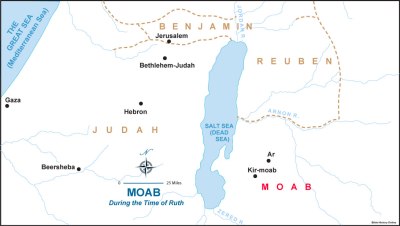
Photo courtesy of bible-history.com

In the days when the judges ruled there was a famine in the land, and a man of Bethlehem in Judah went to sojourn in the country of Moab, he and his wife and his two sons. 2 The name of the man was Elimelech and the name of his wife Naomi, and the names of his two sons were Mahlon and Chilion. They were Ephrathites from Bethlehem in Judah. They went into the country of Moab and remained there. 3 But Elimelech, the husband of Naomi, died, and she was left with her two sons. 4 These took Moabite wives; the name of the one was Orpah and the name of the other Ruth. They lived there about ten years, 5 and both Mahlon and Chilion died, so that the woman was left without her two sons and her husband.

6 Then she arose with her daughters-in-law to return from the country of Moab, for she had heard in the fields of Moab that the Lord had visited his people and given them food. 7 So she set out from the place where she was with her two daughters-in-law, and they went on the way to return to the land of Judah. 8 But Naomi said to her two daughters-in-law, “Go, return each of you to her mother’s house. May the Lord deal kindly with you, as you have dealt with the dead and with me. 9 The Lord grant that you may find rest, each of you in the house of her husband!” Then she kissed them, and they lifted up their voices and wept. 10 And they said to her, “No, we will return with you to your people.” 11 But Naomi said, “Turn back, my daughters; why will you go with me? Have I yet sons in my womb that they may become your husbands? 12 Turn back, my daughters; go your way, for I am too old to have a husband. If I should say I have hope, even if I should have a husband this night and should bear sons, 13 would you therefore wait till they were grown? Would you therefore refrain from marrying? No, my daughters, for it is exceedingly bitter to me for your sake that the hand of the Lord has gone out against me.” 14 Then they lifted up their voices and wept again. And Orpah kissed her mother-in-law, but Ruth clung to her.

15 And she said, “See, your sister-in-law has gone back to her people and to her gods; return after your sister-in-law.” 16 But Ruth said, “Do not urge me to leave you or to return from following you. For where you go I will go, and where you lodge I will lodge. Your people shall be my people, and your God my God. 17 Where you die I will die, and there will I be buried. May the Lord do so to me and more also if anything but death parts me from you.” 18 And when Naomi saw that she was determined to go with her, she said no more.

19 So the two of them went on until they came to Bethlehem. And when they came to Bethlehem, the whole town was stirred because of them. And the women said, “Is this Naomi?” 20 She said to them, “Do not call me Naomi; call me Mara, for the Almighty has dealt very bitterly with me. 21 I went away full, and the Lord has brought me back empty. Why call me Naomi, when the Lord has testified against me and the Almighty has brought calamity upon me?”

22 So Naomi returned, and Ruth the Moabite her daughter-in-law with her, who returned from the country of Moab. And they came to Bethlehem at the beginning of barley harvest.


The Holy Bible, English Standard Version. ESV® Permanent Text Edition® (2016). Copyright © 2001 by Crossway Bibles, a publishing ministry of Good News Publishers.


Questions to Consider

1.  Briefly review the background and setting of the book of Ruth from lesson 1 (link above).

2. What does verse 1 tell us about the period of Israel’s history in which the events of the book of Ruth take place? As we learned in lesson 1, Jair was most likely judging Israel at this time. What else does verse 1 tell us was happening in Israel as the story opens?

3. Describe the sequence of events in verses 1-5 in your own words. Who are each of the people in this passage, and how are they related to one another? What is an Ephrathite?

4. On the map, trace Naomi’s family’s journey to and from Moab. What does the Old Testament tell us about Moab and the Moabites? Were they enemies or allies of Israel? Were they worshipers of God or of idols? What had happened the last time Israel joined with Moab? Did God want His people mingling with the Moabites?

5. Compare Naomi and Ruth’s journey (6) from the pagan land of Moab back to Israel, the Promised Land of God’s people, with the prodigal son’s journey from the pig pen back to his father’s house. How can both of these stories symbolize passing from death in sin to life in Christ?

6. In verses 8-13, what is Naomi’s main concern for Ruth and Orpah? Considering the culture and socio-economic status of women at that time, was this a valid concern? But considering the fact that Ruth and Orpah would be returning to a life of idolatry (15) if they stayed in Moab, why didn’t Naomi concern herself more with their spiritual state and urge them to come back to Bethlehem with her? Is it possible Ruth was already a believer and didn’t want to stay in a land of idolatry? Could this have been one of the things on Ruth’s mind in verses 16-17? (Note Ruth’s mention of “God” in 16 and her invoking of “the Lord” in her vow in 17).

7. Look at the footnotes on verse 20. What do the names “Naomi” and “Mara” mean? Describe Naomi’s outlook and attitude in verses 20-21. The Bible tells us to give thanks in all circumstances. Naomi had certainly been through some sad and difficult times, but she had many things to be thankful for. What were some of those things? What impact might it have had on the women of Bethlehem (19) if Naomi had testified to God’s love, care, and faithfulness in her adversity instead of spewing bitterness?

8. Which of God’s attributes do we see displayed in this chapter? Point to examples in the text of God’s sovereignty, provision, guidance, and other attributes you see.


Homework

Like Naomi, sometimes we can get so wrapped up in our own problems and suffering that we don’t think about what our attitude, words, and demeanor are saying to others about God. Think about a difficult time you’ve experienced in the past (or may be experiencing now). How did you talk about it to others? With bitterness and complaints? What were some things you could have been thankful to God for in that situation? What impact might it have had on those around you if you had testified to God’s love, care and faithfulness instead? Might your testimony about God’s goodness during your suffering have led to an opportunity to share the gospel with someone?

Ruth Bible Study

Ruth: Lesson 1

Welcome to our new study of Ruth! There are so many captivating facets to the book of Ruth: it’s a snippet of Old Testament history, a beautiful romance, a demonstration of God’s love and value of women, a foreshadowing of Christ- our Redeemer. Over the next several weeks, we’ll be taking a look at all these treasures – and more – that God has for us to discover through Ruth’s story.

Let’s get started!

Introduction to the book of Ruth:

Before we begin studying a book of the Bible, it’s very important that we understand some things about that book. We need to know…

Who the author was and anything we might be able to find out about him or his background.

Who the audience of the book is: Jews or Gentiles? Old Testament Israelites or New Testament Christians? This will help us understand the author’s purpose and approach to what he’s writing.

What kind of biblical literature we’re looking at. We approach books of history differently than books of wisdom, books of wisdom differently than books of prophecy, etc.

What the purpose of the book is. Was it written to encourage? Rebuke? Warn?

What the historical backdrop is for the book. Is Israel at war? At peace? In exile? Under a bad king? Good king? Understanding the historical events surrounding a piece of writing help us understand what was written and why it was written.

When the book was written. Where does the book fall on the timeline of biblical history? This is especially important for Old Testament books which are not always arranged in chronological order.

So this week, before we start studying the actual text of the book of Ruth, we need to lay the foundation to understanding the book by finding the answers to these questions.

Read the following overviews of the book of Ruth, taking notes on anything that might aid your understanding of the book, and answer the questions below:

Bible Introductions: Ruth at Grace to You

Overview of the Book of Ruth at Reformed Answers

Book of Ruth at Got Questions

1. Who wrote the book of Ruth? Does the fact that we don’t definitively know the author’s name mean we can’t trust the biblicality of this book?

2. What is the approximate date Ruth was written? During what period of Israel’s history (kings, exile, judges, antediluvian, etc.) was Ruth written?

3. Considering the period of Israel’s history during which Ruth was written, who do you think is the intended audience of the book of Ruth? Why?

4. Which genre of biblical literature is the book of Ruth: law, history, wisdom, poetry, narrative, epistles, or prophecy/apocalyptic? What does this this tell us about the approach we should take when studying this book versus our approach to books of other genres?

5. What is the theme or purpose of the book of Ruth?

6. Who are the main characters in the book of Ruth?

7. Where do the events in the book of Ruth take place? (Sometimes, a good Bible map like this one or this one can be helpful.)

8. What else did you learn about Ruth or the setting of this book that might help you understand the text of the book better?

The Ten (10 Commandments Bible Study)

The Ten: Lesson 13

Previous Lessons: 1, 2, 3, 4, 5, 6, 7, 8, 9, 10, 11, 12

Exodus 20:18-20

Now when all the people saw the thunder and the flashes of lightning and the sound of the trumpet and the mountain smoking, the people were afraid and trembled, and they stood far off 19 and said to Moses, “You speak to us, and we will listen; but do not let God speak to us, lest we die.” 20 Moses said to the people, “Do not fear, for God has come to test you, that the fear of him may be before you, that you may not sin.”

Exodus 24:3-8

Moses came and told the people all the words of the Lord and all the rules. And all the people answered with one voice and said, “All the words that the Lord has spoken we will do.” And Moses wrote down all the words of the Lord. He rose early in the morning and built an altar at the foot of the mountain, and twelve pillars, according to the twelve tribes of Israel. And he sent young men of the people of Israel, who offered burnt offerings and sacrificed peace offerings of oxen to the Lord. And Moses took half of the blood and put it in basins, and half of the blood he threw against the altar. Then he took the Book of the Covenant and read it in the hearing of the people. And they said, “All that the Lord has spoken we will do, and we will be obedient.” And Moses took the blood and threw it on the people and said, “Behold the blood of the covenant that the Lord has made with you in accordance with all these words.”


Romans 3:19-20

Now we know that whatever the law says it speaks to those who are under the law, so that every mouth may be stopped, and the whole world may be held accountable to God. 20 For by works of the law no human being will be justified in his sight, since through the law comes knowledge of sin.

Romans 7:1-12

Or do you not know, brothers—for I am speaking to those who know the law—that the law is binding on a person only as long as he lives? For a married woman is bound by law to her husband while he lives, but if her husband dies she is released from the law of marriage. Accordingly, she will be called an adulteress if she lives with another man while her husband is alive. But if her husband dies, she is free from that law, and if she marries another man she is not an adulteress.

Likewise, my brothers, you also have died to the law through the body of Christ, so that you may belong to another, to him who has been raised from the dead, in order that we may bear fruit for God.For while we were living in the flesh, our sinful passions, aroused by the law, were at work in our members to bear fruit for death. But now we are released from the law, having died to that which held us captive, so that we serve in the new way of the Spirit and not in the old way of the written code.

What then shall we say? That the law is sin? By no means! Yet if it had not been for the law, I would not have known sin. For I would not have known what it is to covet if the law had not said, “You shall not covet.” But sin, seizing an opportunity through the commandment, produced in me all kinds of covetousness. For apart from the law, sin lies dead. I was once alive apart from the law, but when the commandment came, sin came alive and I died. 10 The very commandment that promised life proved to be death to me. 11 For sin, seizing an opportunity through the commandment, deceived me and through it killed me. 12 So the law is holy, and the commandment is holy and righteous and good.

Galatians 3:23-26

Now before faith came, we were held captive under the law, imprisoned until the coming faith would be revealed. 24 So then, the law was our guardian until Christ came, in order that we might be justified by faith. 25 But now that faith has come, we are no longer under a guardian, 26 for in Christ Jesus you are all sons of God, through faith.


Romans 13:8-10

Owe no one anything, except to love each other, for the one who loves another has fulfilled the law.For the commandments, “You shall not commit adultery, You shall not murder, You shall not steal, You shall not covet,” and any other commandment, are summed up in this word: “You shall love your neighbor as yourself.” 10 Love does no wrong to a neighbor; therefore love is the fulfilling of the law.

1 John 5:2-3

By this we know that we love the children of God, when we love God and obey his commandments. For this is the love of God, that we keep his commandments. And his commandments are not burdensome.


The Holy Bible, English Standard Version. ESV® Permanent Text Edition® (2016). Copyright © 2001 by Crossway Bibles, a publishing ministry of Good News Publishers.


Questions to Consider:

1. In Exodus 20:18-19, how did the Israelites react to God’s appearance to Moses? What was Moses’ response to them? (20) What did Moses say would be two results of God testing the people? (20) How many times does the word “fear” appear in verse 20? What is the difference in meaning between the first “fear” and the second one?

2. Briefly skim Exodus 20:21-23:33. In addition to the Ten Commandments, what are some of the other laws, or categories of laws, God gave Moses? In the Exodus 24 passage above, what was the people’s response to hearing all of these laws? (3) Describe the sequence of events taking place in Exodus 24:3-8. Why did the people respond twice? (3,7) Was there any difference between these two responses? Compare the people’s response in this passage with their response in Exodus 19:5-8. What events transpired between the response in chapter 19 and the response in chapter 24?

3. In Exodus 24:6,8, why did Moses sprinkle the altar and the people with blood? How did this formalize Israel’s agreement to the Mosaic covenant? How does the Mosaic covenant point ahead to the new covenant in Christ? Are Christians still bound by the Mosaic covenant?

4. In what ways did the giving of the law and Israel’s agreement to the Mosaic covenant help officially establish Israel as a nation and set Israel apart from the surrounding pagan nations?

5. Examine the Romans 3 and 7 passages. What does it mean that the law makes us “accountable” to God? (3:19) Why can’t we be made righteous in God’s eyes by simply striving to keep His laws? (3:20) Read Romans 3:20 and 7:7-8 together. What do these verses tell us about the connection between knowing the law and sin?

6. Explain the analogy of dying to works of the law that Paul is trying to convey in Romans 7:1-6. Compare verse 6 to Galatians 3:23-26. What does Galatians say was the purpose of the law, and what is our obligation to it now? What does the latter part of verse 6 – “we serve in the new way of the Spirit and not in the old way of the written code” – mean? Does this mean we no longer have to obey God’s moral laws such as the ones in the 10 Commandments? (12)

7. Study the Romans 13 and 1 John 5 passages. What is the theme of these two passages? What does Paul mean when he says, “the one who loves another has fulfilled the law”? (13:8) Who are the two parties we demonstrate love for when we keep God’s commands? How does loving God and keeping His commands automatically translate into loving others? (5:2) How does loving God and our neighbors, thus keeping God’s commands, demonstrate to others that we belong to Christ?


Homework:

This week, view your sin or obedience through the lenses of love. Examine the sins you commit. How do they demonstrate your failure to love God and love your neighbor? Examine instances of your obedience to God’s commandments and think about how they demonstrate your love for Him and for your neighbor. As you pray, ask God to increase your love for Him. Increased love leads to increased obedience.