
Mailbag, Worship

The Mailbag: Potpourri (Judas in Hell?… Dementia & submission… Supporting Israel… Replace the sermon with ___?)

Welcome to another “potpourri” edition of The Mailbag, where I give short(er) answers to several questions rather than a long answer to one question.

I like to take the opportunity in these potpourri editions to let new readers know about my comments/e-mail/messages policy. I’m not able to respond individually to most e-mails and messages, so here are some helpful hints for getting your questions answered more quickly. Remember, the search bar (at the very bottom of each page) can be a helpful tool!

Or maybe I answered your question already? Check out my article The Mailbag: Top 10 FAQs to see if your question has been answered and to get some helpful resources.


Did Judas go to Hell when he died?

Although there is no Bible verse that says verbatim, “Judas died and went to Hell,” and we always have to be very careful with speculating, I believe we can safely infer from two passages (and their surrounding contexts) that Judas is, indeed in Hell.

The first passage is Matthew 26:20-25. This is the scene at the Last Supper when Jesus has just told the disciples that one of them (Judas) will betray Him. He says about His betrayer in verse 24, “woe to that man by whom the Son of Man is betrayed! It would have been better for that man if he had not been born.” “Woe,” and “better if he had not been born,” are not phraseology anyone, let alone omniscient Jesus, would use to describe someone who would be entering Heaven mere hours later.

The second passage is John 17, Jesus’ high priestly prayer for His disciples just prior to His crucifixion. In verse 12, Jesus says, “not one of them perished but the son of perdition,” referring to Judas. Again, Jesus knows Judas’ death is only hours away. He also knows whether Judas will be in Heaven or Hell afterward. If Jesus knew Judas would be in Heaven, why would He call him “the son of perdition”? Furthermore, the Greek word translated “perdition” or in other Bible translations, “destruction,” is apoleia. This word can carry the connotation, “damnable,” and “the destruction which consists of eternal misery in Hell” (Strongs, G684).

So, yes, Scripture indicates that Judas is spending eternity in hell.

Additional Resources:

Was Judas Iscariot forgiven / saved? at Got Questions?

Did Judas repent? by John MacArthur


This question was submitted in response to my article The Mailbag: What Is Submission?

My cousin’s (a professing Christian) husband has Alzheimer’s, and his mental state has gone downhill very quickly (she is 59 and he is 77.) At one point in the conversation, she mentioned all the responsibilities she’s taken on that he used to handle, and said that she was now the head of the household. I’m wondering if any Biblical texts address a wife’s role in that situation.

My heart goes out to your cousin. Alzheimer’s Disease and other forms of dementia are such cruel conditions, both for the patient and his or her loved ones.

There is nothing in the Bible that specifically addresses caring for a spouse with dementia or any other mental incapacitation, or what a wife’s submission to her husband might look like in that situation.

I think what your cousin probably meant by her remark about being “head of the household” is that she now has to take over all of the family “business” responsibilities her husband used to handle: paying the bills, getting things around the house fixed, handling legal paperwork and taxes, making decisions, and so on. And, sadly, her husband is also not able to lead her in Bible study, prayer, and spiritual matters, so she’s having to handle that as well.

These are all things she would immediately have to take over and handle if her husband suddenly dropped dead of a heart attack, and we wouldn’t think a thing of it.

What’s happening to your cousin’s husband is a slow death. His body isn’t dying all at once, but day by day, bit by bit. So, she’s gradually taking over the things his body has died to and is unable to handle any more. And, biblically, that’s not just OK, that is being a faithful, godly helper.

If she came to me for counsel, I’d advise her to keep doing what she’s doing. If her husband has moments of lucidity in which she can tell he’s making a reasonable decision or request, she should certainly submit to that. If her husband made non-sinful decisions before he became ill, she should continue to submit to and carry out those decisions*. But otherwise, she should continue to love and serve him the best she can, and that includes gradually taking over what he can no longer do.

*(Thank you to “hiltonjp5c174e0fe6” for her comment below on 10/8/25, which reminded me of this.)


Are Christian Americans ALWAYS supposed to back Israel? The people of Israel now may not even be Jesus believing Christians or even God believing Jews. Should we support everything they say and do, just because they live in the country? I’m not implying anything, one way or another, but it seems a lot of Christians say, “we back Israel so we will be blessed” and it sometimes seems like a blind backing.

Much has been written and said in the last hundred years or so about Israel, eschatology, end times prophecy, and so on, but sometimes it gets a little complicated and convoluted. I think there might be a simpler way to look at things.

First, I would have to ask: What does it mean for a Christian individual in 2025, who’s not a politician or a pastor, to “back Israel”? What does that look like in your daily life? Posting supportive things about Israel on social media? Voting for politicians who promise to create legislation and policies that are favorable to Israel? Those are really the only things I can think of. You and I have no power to do anything substantive to “back Israel” in our day to day lives, so this question is mostly moot for the majority of us as individuals.

Second, Christians handle and evaluate situations according to Scripture as they come up. If an issue comes up with Israel, we look at it biblically:

Did Israel’s government make a decision that the Bible clearly says is sin? Christians can’t support that. God certainly has never supported Israel’s sin just because they’re Israel. Just take a gander at how He responded to Israel’s sin in the Old Testament. He sent diseases, natural disasters, the armies of pagan nations to attack them, and finally exiled them for 70 years. In Jeremiah 7, God essentially tells them they can’t go out and commit a bunch of abominations and then expect Him to deliver them.

Did Israel’s government make a decision that doesn’t conflict with God’s commands or biblical principles? Then we evaluate the wisdom of it according to Scripture, and we have the freedom in Christ to support or not support that decision (whatever that might mean) accordingly.


I’m curious if replacing the preaching of God’s Word on the Lord’s Day during the morning worship service with a gospel music concert or a VBS commencement is biblically appropriate and/or considered to be our worship of Him? I am seeing a doctrinal shift toward the progressive left in some areas of my local church, and I’m burdened and heartbroken as I pray for God to make clear what I perceive as concerns and how I can glorify Him in this matter.

I’m so sorry. I know firsthand what it’s like to be in a good church that goes bad. It is heartbreaking and stressful.

Scripture doesn’t give us a line by line order of service to follow for the worship service, but that doesn’t mean anything goes, either. Typically, churches follow either the regulative principle of worship (RPW) or the normative principle of worship (NPW). The NPW is the idea that we can do anything in the worship service that isn’t prohibited in Scripture. The RPW basically says that we are only to do things in the worship service that are prescribed in Scripture: preaching the Word, worshiping God through song, praying, giving offerings, and so on.

Now, you’ll notice that God commands both the preaching of the Word and singing in His church, but He doesn’t specify how much time we’re to devote to each. However, when we look at the overall picture of the church that the New Testament presents, it’s easy to see that the preaching and teaching of the Word should be central as a general rule.

That being said, it is my opinion that it’s perfectly OK for a doctrinally sound church to occasionally (maybe a couple of times a year) have a service in which the music portion of the worship service is longer than the preaching portion, as long as the Word is being proclaimed through the music.

For example, my church usually holds a worship service a couple of weeks before Christmas called “Lessons and Carols”. Scriptures pertaining to Christ’s incarnation are alternated with Christmas carols and hymns that echo those Scriptures. That takes up most of the service. At the end, my pastor gives a briefer than normal gospel presentation / sermon.

I think something like that or a Christmas or Easter cantata is fine.

I would not agree that it would be appropriate to replace the sermon with a “gospel music concert” (if, by that, you mean a singer/group comes in and gives a performance) or a VBS commencement, to the exclusion of the sermon. Neither a concert-style performance nor a commencement program are elements of worship prescribed in Scripture. And if you’re seeing other doctrinal problems alongside these things, it’s probably indicative of the overall declining spiritual health of your church. Time to make an appointment with the pastor, and kindly and lovingly express your concerns.

I pray your pastor will listen, and I hope you won’t need this, but just in case you do, you can always find the Searching for a new church? tab in the blue menu bar at the top of this page.


If you have a question about: a Bible passage, an aspect of theology, a current issue in Christianity, or how to biblically handle a family, life, or church situation, comment below (I’ll hold all questions in queue {unpublished} for a future edition of The Mailbag) or send me an e-mail or private message. If your question is chosen for publication, your anonymity will be protected.

Mark Bible Study

Mark: Lesson 21

Previous Lessons: 1, 2, 3, 4, 5, 6, 7, 8, 9, 10, 11, 12, 13, 14, 15, 16, 17, 18, 19, 20

Mark 14:26-52

And when they had sung a hymn, they went out to the Mount of Olives. 27 And Jesus said to them, “You will all fall away, for it is written, ‘I will strike the shepherd, and the sheep will be scattered.’ 28 But after I am raised up, I will go before you to Galilee.” 29 Peter said to him, “Even though they all fall away, I will not.” 30 And Jesus said to him, “Truly, I tell you, this very night, before the rooster crows twice, you will deny me three times.” 31 But he said emphatically, “If I must die with you, I will not deny you.” And they all said the same.

32 And they went to a place called Gethsemane. And he said to his disciples, “Sit here while I pray.” 33 And he took with him Peter and James and John, and began to be greatly distressed and troubled. 34 And he said to them, “My soul is very sorrowful, even to death. Remain here and watch.” 35 And going a little farther, he fell on the ground and prayed that, if it were possible, the hour might pass from him. 36 And he said, “Abba, Father, all things are possible for you. Remove this cup from me. Yet not what I will, but what you will.”37 And he came and found them sleeping, and he said to Peter, “Simon, are you asleep? Could you not watch one hour? 38 Watch and pray that you may not enter into temptation. The spirit indeed is willing, but the flesh is weak.” 39 And again he went away and prayed, saying the same words. 40 And again he came and found them sleeping, for their eyes were very heavy, and they did not know what to answer him. 41 And he came the third time and said to them, “Are you still sleeping and taking your rest? It is enough; the hour has come. The Son of Man is betrayed into the hands of sinners. 42 Rise, let us be going; see, my betrayer is at hand.”

43 And immediately, while he was still speaking, Judas came, one of the twelve, and with him a crowd with swords and clubs, from the chief priests and the scribes and the elders. 44 Now the betrayer had given them a sign, saying, “The one I will kiss is the man. Seize him and lead him away under guard.” 45 And when he came, he went up to him at once and said, “Rabbi!” And he kissed him. 46 And they laid hands on him and seized him. 47 But one of those who stood by drew his sword and struck the servant of the high priest and cut off his ear. 48 And Jesus said to them, “Have you come out as against a robber, with swords and clubs to capture me? 49 Day after day I was with you in the temple teaching, and you did not seize me. But let the Scriptures be fulfilled.” 50 And they all left him and fled.

51 And a young man followed him, with nothing but a linen cloth about his body. And they seized him, 52 but he left the linen cloth and ran away naked.


The Holy Bible, English Standard Version. ESV® Permanent Text Edition® (2016). Copyright © 2001 by Crossway Bibles, a publishing ministry of Good News Publishers.


Questions to Consider

1. Briefly review lesson 20 (link above) for context.

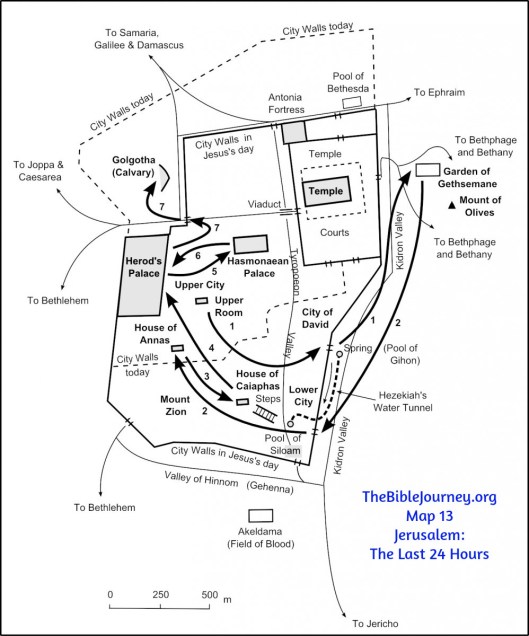
2. Examine the map below. Trace Jesus’ movements from lesson 20 (the upper room, #1) to the locales in today’s lesson. Where did Jesus and the disciples go first? (26) Next? (32) (Please note: I do not endorse anything on the website cited below that conflicts with my theology as outlined in my Welcome and Statement of Faith tabs above.)

3. Study verses 26-31. How, in this passage, does Jesus demonstrate that He is both a prophet (27,28,30) and the fulfillment of prophecy? (27,49) As you’ll recall from previous lessons, Christ has told the disciples about His impending death many times. Do you get the sense from this passage that they have grasped what is about to happen to Jesus? Compare and contrast the way the disciples believed Jesus’ prophecy of His betrayal (18-19) with their disbelief of His prophecy that they would abandon Him. 

4. Read verses 32-42. If Jesus was God, why did He need to pray? How do Jesus’ desire to pray and the words He prayed demonstrate the Trinity – and the agreement within the Trinity – to us? Compare verse 37 to verses 29 and 31. What do you observe about Peter, and why might Jesus have called him “Simon” instead of Peter? In what ways would it have been better in verses 29-31 for Peter and the others to heed Jesus’ admonition of verse 38 than to make the bold pronouncements they made?

5. What was Jesus’ will, or preference, regarding His impending suffering and crucifixion? (36) Was there any way in which Jesus was lacking faith in God as He prayed (or at any moment of His earthly life)? How did God answer Jesus’ prayer? The Word of Faith heresy teaches a) that it is never God’s will for us to suffer and b) that if God does not answer our prayers the way we want Him to it’s because we don’t have enough faith in Him. How does this passage refute these unbiblical teachings? What can we learn from Jesus’ prayer about the right way to pray?

6. Read Philippians 2:8 and Hebrews 12:4 with verse 36. How far was Jesus willing to go to be obedient to God? How does your willingness to obey God stack up to Jesus’ willingness to go even to a torturous death rather than to disobey God? Is your obedience more like the disciples’ willingness to obey but failure to follow through? (29,31,37,40,41) Do you obey God when it’s painful? Inconvenient? Embarrassing? Expensive? Difficult? When it’s not your will?

7. Go over verses 43-52. Why might the posse that came to arrest Jesus have felt the need to be armed (43) and to place Jesus under guard (44)? If the chief priests, scribes, and elders thought Jesus was so dangerous or blasphemous that they needed to put Him to death, how is it that they needed Judas to point Him out to them? (44) Why would they not have recognized Him on sight? (48-49) How is verse 50 the fulfillment of Jesus’ prophecy in verse 27?

8. Look at verses 51-52 through the lenses of 2 Timothy 3:16-17. God must have thought these details were important enough to include in Scripture, because they’re there. Why do you think God wanted us to know this about the young man? How can we learn, be reproved, corrected, trained for righteousness, made complete, or equipped for every good work by these two verses?

9. Which aspects of spiritual character (ex: obedience, humility, etc.) does Jesus display in today’s passage? What are some specific ways you can emulate Jesus’ spiritual character in your current life circumstances?


Homework

In question 3, we saw that the disciples unquestioningly believed Jesus when He said one of them would betray Him, but didn’t believe Him when He said they would all abandon Him. Why is it so easy to believe some parts of God’s Word and so hard to believe other parts? Identify a verse, passage, or promise of Scripture you struggle to truly believe. Study that passage and its cross references this week, and pray that God will help you to trust Him and believe that part of His Word.


Suggested Memory Verse

Watch and pray that you may not enter into temptation. The spirit indeed is willing, but the flesh is weak. Mark 14:38

Mark Bible Study

Mark: Lesson 20

Previous Lessons: 1, 2, 3, 4, 5, 6, 7, 8, 9, 10, 11, 12, 13, 14, 15, 16, 17, 18, 19

Mark 14:1-26

It was now two days before the Passover and the Feast of Unleavened Bread. And the chief priests and the scribes were seeking how to arrest him by stealth and kill him, for they said, “Not during the feast, lest there be an uproar from the people.”

And while he was at Bethany in the house of Simon the leper, as he was reclining at table, a woman came with an alabaster flask of ointment of pure nard, very costly, and she broke the flask and poured it over his head. There were some who said to themselves indignantly, “Why was the ointment wasted like that? For this ointment could have been sold for more than three hundred denarii and given to the poor.” And they scolded her. But Jesus said, “Leave her alone. Why do you trouble her? She has done a beautiful thing to me. For you always have the poor with you, and whenever you want, you can do good for them. But you will not always have me. She has done what she could; she has anointed my body beforehand for burial.And truly, I say to you, wherever the gospel is proclaimed in the whole world, what she has done will be told in memory of her.”

10 Then Judas Iscariot, who was one of the twelve, went to the chief priests in order to betray him to them.11 And when they heard it, they were glad and promised to give him money. And he sought an opportunity to betray him.

12 And on the first day of Unleavened Bread, when they sacrificed the Passover lamb, his disciples said to him, “Where will you have us go and prepare for you to eat the Passover?” 13 And he sent two of his disciples and said to them, “Go into the city, and a man carrying a jar of water will meet you. Follow him,14 and wherever he enters, say to the master of the house, ‘The Teacher says, Where is my guest room, where I may eat the Passover with my disciples?’ 15 And he will show you a large upper room furnished and ready; there prepare for us.” 16 And the disciples set out and went to the city and found it just as he had told them, and they prepared the Passover.

17 And when it was evening, he came with the twelve. 18 And as they were reclining at table and eating, Jesus said, “Truly, I say to you, one of you will betray me, one who is eating with me.” 19 They began to be sorrowful and to say to him one after another, “Is it I?” 20 He said to them, “It is one of the twelve, one who is dipping bread into the dish with me. 21 For the Son of Man goes as it is written of him, but woe to that man by whom the Son of Man is betrayed! It would have been better for that man if he had not been born.”

22 And as they were eating, he took bread, and after blessing it broke it and gave it to them, and said, “Take; this is my body.” 23 And he took a cup, and when he had given thanks he gave it to them, and they all drank of it. 24 And he said to them, “This is my blood of the covenant, which is poured out for many.25 Truly, I say to you, I will not drink again of the fruit of the vine until that day when I drink it new in the kingdom of God.”

26 And when they had sung a hymn, they went out to the Mount of Olives.


The Holy Bible, English Standard Version. ESV® Permanent Text Edition® (2016). Copyright © 2001 by Crossway Bibles, a publishing ministry of Good News Publishers.


Questions to Consider

1. Briefly review lesson 16 (link above) for the timing of chapter 14. During what time period or “era” of Jesus’ life did the events of chapter 14 take place?

2. Examine verses 1-2. What was the Passover? The Feast of Unleavened Bread? Many aspects of the Passover are types or foreshadowings of the events of Mark 14-16. Is that simply a coincidence? Click the above hyperlink (Exodus 12). How do each of the items below point ahead to Christ and His crucifixion?

♦The male lamb without blemish (3-5, see also)
♦”The whole assembly of the congregation of Israel shall kill their lambs at twilight” (6, see also)
♦The blood of the lamb (7, Mark 14:24, see also)
♦The doorposts and lintel covered with blood (7, see also)
♦The death of the firstborn for the deliverance of God’s people from slavery (12, see also)
♦God eliminating judgment for those “under the blood” (13,23, see also)

3. Read verses 3-9. Lepers were, according to Levitical law, unclean, and had to live alone, outside the city. How is it that Simon had a home in the city with invited guests? How could Jesus have entered the house of a leper, without breaking the law, and remained clean Himself?

4. What did the woman’s outward actions (3) demonstrate about her heart attitude toward Jesus? What did the objectors’ outward words and actions (4-5) demonstrate about their heart attitude toward Jesus? Was Jesus being self-centered or uncaring about the poor? (6-7) Why was the woman’s anointing of Jesus the right and godly thing to do?

5. Compare and contrast the woman’s honoring of Jesus (3-9) with Judas’ betrayal of Jesus (10-11, 18-21). How did each of them demonstrate the truth of Luke 6:45? What did Jesus say about each of them?

6. What do verses 12-16 and 17-21 teach us about Christ’s deity and omniscience? What does the two disciples’ unquestioning obedience (16), and the disciples’ unquestioning belief (19) tell us about their faith and trust in Christ? Consider your own obedience to Christ and whether or not you believe His Word. What does this tell you, and others, about your faith and trust in Christ? Why do you think Jesus told the disciples that He was about to be betrayed and who would do it? What does Jesus’ statement in verse 21 mean?

7. What was Jesus trying to convey to the disciples in verses 22-26? What was the significance of Jesus giving the bread (22) and the wine (23) to the disciples? Roman Catholic doctrine teaches that when Jesus said “this is My body” and “this is My blood” He meant it literally, and that when Mass is celebrated today, the bread and wine are supernaturally transformed into the literal flesh and blood of Jesus. This is a false teaching called transubstantiation. Were the disciples literally eating Jesus’ flesh and drinking His blood in this passage? How does this (as well as Scripture) demonstrate that Jesus was speaking metaphorically? Can you think of other instances in which Jesus spoke about Himself metaphorically that we do not take literally? If someone were to ask you if you “take the Bible literally,” how would you answer?

8. What was the significance of Jesus saying “this is my blood of the covenant“? (24) Which covenants would the disciples have been familiar with which were sealed with blood? What was this new covenant Jesus was referring to?


Homework

Reflect on the past 24 hours of your life. List three things you said or did and what these outward words and actions demonstrate about your heart attitude toward Jesus.


Suggested Memory Verse

Watch and pray that you may not enter into temptation. The spirit indeed is willing, but the flesh is weak. Mark 14:38

Wednesday's Word

Wednesday’s Word ~ Acts 1

10624842_773638779349560_23824209767270553_n

Acts 1

In the first book, O Theophilus, I have dealt with all that Jesus began to do and teach, 2 until the day when he was taken up, after he had given commands through the Holy Spirit to the apostles whom he had chosen. 3 He presented himself alive to them after his suffering by many proofs, appearing to them during forty days and speaking about the kingdom of God.

4 And while staying with them he ordered them not to depart from Jerusalem, but to wait for the promise of the Father, which, he said, “you heard from me; 5 for John baptized with water, but you will be baptized with the Holy Spirit not many days from now.”

6 So when they had come together, they asked him, “Lord, will you at this time restore the kingdom to Israel?” 7 He said to them, “It is not for you to know times or seasons that the Father has fixed by his own authority. 8 But you will receive power when the Holy Spirit has come upon you, and you will be my witnesses in Jerusalem and in all Judea and Samaria, and to the end of the earth.” 9 And when he had said these things, as they were looking on, he was lifted up, and a cloud took him out of their sight. 10 And while they were gazing into heaven as he went, behold, two men stood by them in white robes, 11 and said, “Men of Galilee, why do you stand looking into heaven? This Jesus, who was taken up from you into heaven, will come in the same way as you saw him go into heaven.”

12 Then they returned to Jerusalem from the mount called Olivet, which is near Jerusalem, a Sabbath day’s journey away. 13 And when they had entered, they went up to the upper room, where they were staying, Peter and John and James and Andrew, Philip and Thomas, Bartholomew and Matthew, James the son of Alphaeus and Simon the Zealot and Judas the son of James. 14 All these with one accord were devoting themselves to prayer, together with the women and Mary the mother of Jesus, and his brothers.

15 In those days Peter stood up among the brothers (the company of persons was in all about 120) and said, 16 “Brothers, the Scripture had to be fulfilled, which the Holy Spirit spoke beforehand by the mouth of David concerning Judas, who became a guide to those who arrested Jesus. 17 For he was numbered among us and was allotted his share in this ministry.” 18 (Now this man acquired a field with the reward of his wickedness, and falling headlong he burst open in the middle and all his bowels gushed out. 19 And it became known to all the inhabitants of Jerusalem, so that the field was called in their own language Akeldama, that is, Field of Blood.) 20 “For it is written in the Book of Psalms,

“‘May his camp become desolate,
and let there be no one to dwell in it’;

and

“‘Let another take his office.’

21 So one of the men who have accompanied us during all the time that the Lord Jesus went in and out among us, 22 beginning from the baptism of John until the day when he was taken up from us—one of these men must become with us a witness to his resurrection.” 23 And they put forward two, Joseph called Barsabbas, who was also called Justus, and Matthias. 24 And they prayed and said, “You, Lord, who know the hearts of all, show which one of these two you have chosen 25 to take the place in this ministry and apostleship from which Judas turned aside to go to his own place.” 26 And they cast lots for them, and the lot fell on Matthias, and he was numbered with the eleven apostles.


The Holy Bible, English Standard Version Copyright © 2001 by Crossway Bibles, a division of Good News Publisher


Questions to Consider

1. What is the purpose of the book of Acts? Which genre(s) of biblical literature (prophecy, epistle, narrative, wisdom, etc.) is the book of Acts? What is the historical backdrop for this book?

2. What is the “first book” referred to in verse 1? Who is the author of both books? How do these two books fit together? How does the book of Acts, especially chapter 1, show us the transitional period between Jesus’ earthly ministry and the church era?

3. Why did the apostles ask Jesus the question in verse 6? (Hint: Use your cross-references.) Why were they expecting the Messiah to build an earthly kingdom? What was Jesus building instead? (7-8). When will Jesus build His earthly Kingdom? (6-7,11)

4. How do verses 12-14 demonstrate the apostles’ obedience to Jesus’ command in verse 4? To Jesus’ admonition in Matthew 26:41? Why do you think the main activity they were engaged in was prayer? Jesus is about to set up His church through this little group. Explain why it was crucial for the church to be born out of a) obedience to the word of Christ, and b) prayer. Why are these still crucial for the church, and Christian individuals, today?

5. Explain how Peter and the apostles followed Scripture as they went about replacing Judas with Matthias. (15-26) Were they following Old Testament or New Testament Scripture? Why is it important, when making decisions in the church today (or as individuals), to search the Scriptures and find out how they apply to the situation? Why don’t we still cast lots (26) to make decisions in the church, or as individuals, today?