New Testament, Sanctification, Sunday School

Persecution 101 ~ Sunday School Lesson ~ 10-19-14

persecution101

These are my notes from my ladies’ Sunday School class this morning. I’ll be posting the notes from my class here each week. Click here for last week’s lesson.

Through the Bible in 2014 ~ Week 42 ~ Oct. 12-18
Matthew 8:14-11:30, 12:22-14:36, Luke 8:1-9:17, 11, Mark 4-6, John 6
Persecution 101

Last week we took a look at this pattern:

God—>God calls and trains His people—>God’s people minister the gospel to others

We saw it across various contexts of the Bible: the “macro,” or overall theme from Old Testament to New, the “micro,” or the way God works in our personal lives, and the “messianic,” or the way this pattern applied to Jesus’ own life. This week’s reading was another example of this pattern, the “ministerial,” or the way it applied to Jesus’ and the disciples’ ministry.

In this week’s reading we saw that Jesus’ ministry started with Jesus, Himself. Next He called out and trained His disciples through many parables and healings. Today, we will be looking at the passage where He sends them out to minister the gospel to others. In His final training session before Jesus sends out the twelve, He wants to make sure they’re ready for what they’re about to face.

Matthew 10:16-39

Go Ye Therefore- 5-13 (10:7-8, 5-6, Mark 1:14-15, Isaiah 35:5-6)
Jesus is sending out the disciples. What is He sending them out to do? Verses 7-8 tell us that their ministry was two-fold: first, they were to preach, just as Jesus did (Mark 1):

the kingdom of God is at hand; repent and believe in the gospel.

Second, they were to perform various signs and wonders. Notice that the signs and wonders are secondary to the message of the gospel. Wasn’t the gospel enough? What was the purpose of the miracles? When Jesus perfomed miracles, the miracles were both a fulfillment of prophecy (Is.) to help the Jews to understand that He was the promised Messiah, and they also authenticated His message of the gospel to the gentiles and others who weren’t familiar with the prophecies. Street cred, in other words– if He can do that, what He says must be true, and we’d better listen. The miracles the disciples were to perform were to serve the same purpose– to point to Jesus as the Messiah and to give credibility to the gospel message.

Who were the disciples sent to? Jesus told them not to go to the Samaritans (half Jew, half gentile, as we studied last week) or the gentiles, but “rather to the lost sheep of the house of Israel.” Why? Because He didn’t love gentiles and want them to hear the gospel? Not at all. We saw last week that He had already been to a Samaritan village to preach the gospel. And, of a Roman centurion (a gentile) whose servant He healed, Jesus said, “Truly, I tell you, with no one in Israel have I found such faith,” and went on to say- to an audience of Jews- that there were many gentiles who would make it to Heaven while many Jews would not.

Jesus sent the disciples to the Jews because that was the order God had ordained- first the Jews, then the gentiles. Why?

1. His promise was to the Jews, not the gentiles. God had promised that the Messiah would come through the Jews and to the Jews. All of Jewish history and ceremony had been pointing to this moment in time. God had been laying the ground work through types and shadows and prophecy for millenia. It was only right that Messiah should be revealed to them first.

Imagine if you’ve been promising your child since the day he was born that when he turned 16 you’d buy him a car. Over the years you talked about it together, looked at pictures, visited car lots, and finally picked out the perfect one. Then, on the day of your son’s 16th birthday, you run into a random 16 year old on the street and buy him a car first. Even if you immediately thereafter drove your son to the car lot to buy him his car, would that be the right way to do things?

2. At this point in history -Jesus’ earthly ministry through the birth and spread of the church- we’re looking at very rapid Kingdom growth. Teachers and preachers are going to be needed, like, fast, to shepherd these thousands of new Christians, most of whom are clueless gentiles.

If you work at a computer company and you’re launching a completely new type of software that you want to make accessible to as many people as possible as fast as possible, are you going to hire field representatives who have a professional background in computers or someone who’s never used a computer before?

Same idea here. The Jewish people already had a background in “messiah-ology.” Once saved, they could be up and running as teachers and pastors much faster than your average gentile.

Good News, Bad News- 14-25 (John 3:19)
God is sending out His people (the disciples) to tell His people (the Jews) that He has kept His promise and sent Jesus, the long awaited Messiah. Plus, they’re going to heal a bunch of people and do other miracles. What Jew in his right mind wouln’t be overjoyed at this awesome news, right?

So, what’s all this stuff about the disciples being hated and persecuted and charged with criminal activity? That’s not the way people usually respond to someone who’s bringing them good news. But God’s news isn’t good news when you don’t love God, and these Jews didn’t. That’s why Jesus referred to the people He was sending the disciples to as “lost sheep.” They were just as lost as any gentile.

1. They loved darkness rather than light (Jn.). The good news of the gospel is bad news when you love your sin and don’t want to give it up, because the gospel requires us to forsake our sin -all of it- actually admit that we’re scum, and fling ourselves on the mercy of Christ for forgiveness. It’s only by the gift of God’s grace that we’re able to do that.

2. They wanted the idol-messiah they had fashioned in their minds, not the Messiah of Scripture. Many in Israel were expecting and/or hoping for a messiah who would come in, conquer Rome, sit on David’s throne, re-establish the theocracy of Israel, and bring them back to prominence and prosperity. In other words, just like the woman at the well from last week, they wanted the temporal stuff, not the eternal. A Christ who would set them free from Rome and poverty, not a Christ who would set them free from sin.

That’s why, to many people the disciples preached to, the good news was bad news.

Fear Not- 26-39
Jesus is delivering a pretty sobering message here. When the disciples preach the gospel (now, and in the early church era), they’re going to be: shunned (14), turned over to the courts (17), flogged (17- and they’re not too far from seeing this happen to Jesus), dragged in front of kings and governors (17), betrayed to the enemy by family members (21), hated by all (22), fleeing for their lives (23), slandered (25), executed (28), and alienated from their closest family members (35-36). That’s a tough row to hoe, but Jesus wants them to understand that what many of the Jews are expecting -Messiah will re-establish the kingdom of Israel and bring peace (34)- isn’t reality, and when they tell people that, things are going to get ugly. He hasn’t come to bring earthly peace, instead, standing with Christ will be the hardest thing they’ve ever done.

But what is their response to this persecution supposed to be? Are they to give up, retaliate, cower? No, Jesus tells them to do two things:

1. Don’t be afraid of them (26). The worst thing they can do is kill you. If you’re going to be afraid of something, fear God and fear denying Him (28).

2. As long as you’ve got breath in your body, you preach the gospel. You preach it loud and you preach it long (27). Do. not. stop. no matter what.

Why? Because God loves you. He values you. He’s going to take care of you. And He’s in control.

The Demands of Discipleship Today
There are Christians today in countries like North Korea, Syria, Iraq, Nigeria, and other areas, who understand all too well what Jesus was warning the disciples about. They experience the same things on a daily basis. Those of us born in America have very little grasp of just how blessed we are to be able to worship God openly, freely, and without much real persecution.

But the times, they are a-changin’. Fast.

If you’ve been paying attention to the news over the last couple of years, you’ve seen stories about the Bible, prayer, and Christianity being systematically removed from and prohibited in public places. We’ve seen Christian bakers, photographers, and t-shirt company owners sued for declining to provide their services for homosexual “weddings,” rallies, and other events. Just last week, we saw Houston officials subpoena sermons and other materials from pastors in an effort to bully them into silence about their homosexual agenda.

Real persecution is coming to America at breakneck speed. And in the same way that the disciples were persecuted by both gentiles and the “lost sheep of Israel”, we will face persecution by both the world and those who claim the name of Christ, but actually follow a messiah-idol of their own making. Those of us who stand with the true Christ of Scripture and His word will be shunned and rejected by our closest family members- even those who claim to be Christians. We will be hated and slandered. We will be arrested, prosecuted, and even executed by both lost people and church people.

But Christ’s message to us is the same as it was to the twelve. Keep preaching the gospel. Preach it loud, preach it long, and preach it with your dying breath. Love Me more than your family, more than your reputation, more than your very life, because I care for you. How could we fail to stay true to Him after all He has done for us?

Faith

Being Slaughtered by Terrorists Isn’t the Worst Thing that Can Happen to You

Everybody seems to be walking around scared these days. I’m a little scared, myself. It’s understandable. There’s a lot of scary stuff happening. Boko Haram. Ebola. ISIS. The persecution of Christians abroad, and, increasingly, here at home.

Terrorism, suicide bombers, the seemingly daily acts of violence that take the lives of innocent bystanders– that all used to happen over there. Thousands of miles across the ocean. And all we had to do to make it go away was turn off the TV, click over to Farmville, or put down the paper. Problem solved. It was unfortunate, but didn’t really touch our lives in any meaningful way.

Until now.

Now we know that there are terrorists living among us right here in the United States, as well as those trying to infiltrate our country by stealthily crossing our borders. When will the next beheading or 9-11 take place on U.S. soil? Who will the next victim be? Will it be you? Will it be me? Will it be thousands of us in one fell swoop?

Any reasonable person would be afraid of that.

Don’t.

That’s what Jesus said. Just don’t.

We’ve got bigger fish to fry in the fear department. Even though it would be awful, the worst thing that could happen to someone is not being killed or even tortured by a terrorist. The worst thing that could happen is for someone to spend an eternity in Hell because she has rejected Christ (which should tell you something about how horrific Hell is).

If you have never turned from your sin and placed your faith in Christ’s death, burial and resurrection as payment for the penalty for your sin, how you’re going to die is the least of your worries compared to what’s going to happen to you after you die. That should scare the living daylights out of you.

If you have never turned from your sin and placed your faith in Christ, how you’re going to die is the least of your worries compared to what’s going to happen to you after you die.

The good news is, Christ offers to forgive you today. His goodness for your badness. His purity for your sinfulness. His grace for your gross. He will set you free from your sin so you’ll no longer fear standing before Him on the day of judgment.

Christ offers to forgive you today. His goodness for your badness. His purity for your sinfulness. His grace for your gross. He will set you free from your sin.

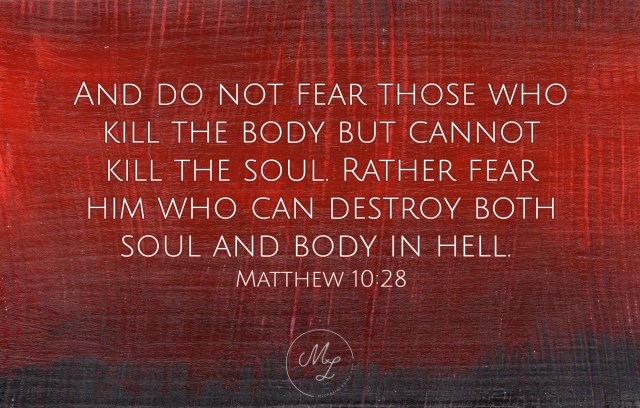
And, if you belong to Christ, you have nothing to fear in this life or the next. Take a look back at that verse. It says to “fear him who can destroy both soul and body in hell.”  But if you’re in Christ, you no longer have to be afraid of Him. And the first part of the verse says not to be afraid of people who can kill your body but not your soul. Nothing to fear now. Nothing to fear later.

So what’s left to fear? Nothing.

What must I do to be saved?

Christian women, New Testament, Sunday School

Well Aware ~ Sunday School Lesson ~ 10-12-14

well aware

These are my notes from my ladies’ Sunday School class this morning. I’ll be posting the notes from my class here each week. Click here for last week’s lesson.

Through the Bible in 2014 ~ Week 41 ~ Oct. 5-11
Matthew 4-8:13, 12:1-21, Luke 4-7, John 1:15-John 5, Mark 2-3
Well Aware

This week, we looked at the beginning of Jesus’ ministry. First, with Jesus’ baptism and temptation in the wilderness, we saw God prepare Jesus for ministry. Next, we saw Jesus call his disciples -all good Jewish boys- and train them for ministry. And, finally, we saw the disciples assisting Jesus as He minstered to both Jews and gentiles. This pattern:

God—>God calls and trains His people—>God’s people minister the gospel to others

was a great picture of where we’ve been (the Old Testament) and where we’re going (the church era). 

Where We’ve Been– In the same way Jesus’ ministry started with Jesus himself, the Old Testament starts with, “In the beginning, God…” (Genesis 1:1) Next, God makes Himself known to His chosen people (Israel), and trains them in His ways. In the New Testament, He uses His chosen people to minister the gospel to the gentiles.

Where We’re Going– As we get further into the New Testament, we’ll see that the way God deals with us is mirrored in the structure of the passages we read this week about Jesus’ early ministry. It all starts with God, who calls each of us out, saves us and prepares us for ministry. We then minister to both God’s people -through our service in the church- and to those who are outside of God’s family -through evangelism.

All of which brings us to where we are, a story that follows this same pattern. We are all on one side of today’s story or another: the people of God, or the people God is calling out to. The woman at the well, or the well woman. And, of course, everything starts with Jesus.

John 4:1-42

It All Starts with Jesus
1-3 (John 3:30)- Although John had just said, “He [Jesus] must increase, but I must decrease,” John’s ministry was still going pretty strong at this point, and Jesus’ brand new ministry was exploding. Two large and growing groups with unconventional ideas did not escape the notice of both the Jewish and the Roman officials, who would have been all too familiar with the Maccabean Revolt (as well as lesser uprisings). In order to ward off any official attempt to clamp down on either John’s or Jesus’ ministries to preclude a perceived impending revolution, Jesus took some of the heat off by traveling north to Galilee.

4-5 (2 Kings 17)– This is where knowing your Old Testament comes in handy. Do you remember anything about Samaria from the Old Testament?

When the nation of Israel split into the northern kingdom (Israel) and the southern kingdom (Judah), Samaria became the capital of the northern kingdom. Second Kings 17 describes how, due to Israel’s idolatry, God allowed the northern kingdom to be overthrown by Assyria, and most of Israel to be taken into captivity. Afterwards, “the king of Assyria brought people from Babylon, Cuthah, Avva, Hamath, and Sepharvaim, and placed them in the cities of Samaria instead of the people of Israel.” (2 Kings 17:24) Eventually, some of the exiled Jews (as well as some Jews who had been left behind in northern Samaria at the time of the exile) returned and intermarried with these gentiles. The “pure” Jews of the southern kingdom (Judah/Judea) considered the Samaritans unclean half-breeds. Judeans hated Samaritans, wouldn’t have anything to do with them, and even went out of their way, when traveling north, to go around Samaria instead of through it, even though that was a much longer route.

So, Jesus’ simple act of passing through Samaria on His way north was actually a fairly weighty statement that would have raised some eyebrows even among His disciples. He didn’t hate the Samaritans and didn’t consider Himself unclean for passing through their area.

6-7– “The sixth hour” was noon. Jesus and the disciples had likely been traveling -on foot, of course- since early morning when it was cooler, and stopped during the heat of the day to rest and eat. John indicates Jesus’ humanity here by telling us that He was physically tired.

7– Drawing water was woman’s work, but noon was an unusual time to draw. All of the women usually came out around the same time in the morning and/or early evening (when it was cooler), so it was a time to socialize as well as get a chore done. Maybe this woman was so ashamed of her lifestyle that she wanted to avoid the other women, or maybe she just needed some extra water that day. Whatever the reason, it was God’s perfect timing.

The Woman at the Well
7-27– This was a woman who knew which rung she occupied on the social ladder, and it wasn’t anywhere near the top. Not only did the Jews hate the Samaritans, and would sooner have died of thirst than drink water their dirty hands had handled, but Jewish men did not speak to women of any sort in public. Furthermore, a rabbi (or teacher of Scripture, which Jesus was considered to be) would never have defiled himself by conversing with an adulterous woman (which Jesus already knew her to be). So this woman probably jumped out of her skin when Jesus asked her for a drink. He didn’t hate her. He didn’t look down on her. He didn’t think she was untouchable. How many people in this woman’s life do you think treated her that way? Do we treat people the way Jesus treated her?

Never one to waste time on chit chat, Jesus immediately transitions (10) from His temporal, physical need, to her spiritual need. He might be thirsty, but she needs a Savior, and that’s more important to Him. Can we say the same as we interact with lost people from day to day?

Jesus begins to talk about spiritual things, but she’s still focused on the physical. “How can I get this magic water so I won’t be physically thirsty or have to come haul water anymore?” (15) She doesn’t get it. All she wants is for Jesus to make her earthly life better. She wants her physical needs taken care of and she doesn’t want to have to work. And that’s all many people today want, too, and what they’re promised by hucksters masquerading as Christian pastors and teachers. “Come to Jesus and you’ll be wealthy and everything will go your way,” they promise.

But that’s too small for Jesus. Does He provide for our needs? Yes. But, all too often, that’s where our desire stops. He wants infinitely more for us, just like He wanted for this woman.

There was one thing standing in the way of that, though. Her sin. Since she wasn’t grasping the water metaphor, Jesus goes for the direct approach and calls her on the carpet. She’s had five husbands, and it’s not because she’s been widowed five times. Now, she’s cohabiting with someone. Jesus just lays it out there and lets it hang in the air. Her secret from this stranger is out in the open. She’s convicted. She doesn’t know what to say. Why not change the subject to a religious debate? That doesn’t hit quite so close to home. But Jesus puts her questions in perspective and brings her back around to the real question at hand. Forget all these unimportant questions about which mountain is the right one to worship on. God wants true worshipers, and if you want to be one of them, you have to worship Him in your spirit -not just with outward actions- and in truth -in agreement with Scripture. (24) And what was the truth? She needed forgiveness and only He could offer it. She was a sinner, and He was the Savior. She got it.

The Well Woman
28-42– The woman at the well had been transformed. No longer sin sick, she was now a well woman. One of God’s chosen people. And what do God’s people do when Jesus makes them well? They go out and tell others so those people can be made well too. And that’s exactly what this woman did. She told them about Jesus.

And what did she tell them? Jesus made all my dreams come true? Everything in my life is going to be great now? No, she said, “Come, see a man who told me all that I ever did.” (29) What had He told her? He had told her about her sin, and here she was, boldly and shamelessly telling others about it. There’s only one way that sin has no more power to shame us, and that’s when Jesus sets us free from it. When we turn from our sin and trust that the death, burial and resurrection of Christ paid the penalty for our sin, we are clean before God, and there is no more reason to be ashamed. She had been set free, and she wanted others to be set free, too.

And this is exactly what Jesus was trying to tell the disciples. (31-38) Quit worring so much about food and other temporal things, guys! Open your eyes! Don’t you see that there’s a field full of souls out there -just like this woman- ready to receive the gospel and be harvested into the Kingdom? Let’s get to work!

So they did. The woman told the people about Jesus and brought them to him. For two days, He taught the people, assisted by the disciples. Many of them believed and were saved. And now we’ve come full circle, because, for these people, too, it all started with Jesus.

Well, Women?
This week we’ve seen Jesus minister to a number of people who were outcasts: a leper, the man with the withered hand, the paralytic, the demoniac, and the prostitute would all have been considered unclean people to avoid in Jewish society. The centurion was a hated Roman, a gentile. And here is an adulterous Samaritan woman. What is Scripture telling us as Jesus ministers to these people? Jesus loves the unloveable. He will touch the defiled, the untouchable. We don’t have to be clean before we come to Jesus. He cleanses us. We don’t have to be good before we come to Jesus. He gives us His righteousness if we repent and trust in Him. This is Scripture’s message to all the women at the well.

To the well women, the disciples, those who have trusted Christ and been forgiven, the message is GO. Boldly, unashamedly, tell everyone of the Savior who has the power to set them free from the shame of sin. Look around, the fields are white unto harvest. Go out and bring them in, that they, too, might be set free. GO.

Christian women, New Testament, Obedience, Sunday School, Women

Miraculous Inceptions: Elizabeth and Mary ~ Sunday School Lesson ~ 10-5-14

inceptions

These are my notes from my ladies’ Sunday School class this morning. I’ll be posting the notes from my class here each week. Click here for last week’s lesson.

Through the Bible in 2014 ~ Week 40 ~ Sep. 28- Oct. 4
Nehemiah 8-13, Psalm 126, Malachi, Luke 1-3, John 1, Matthew 1-3, Mark 1
Miraculous Inceptions: Elizabeth and Mary

Background/Timeline
1. 424 – 6 B.C. The Intertestamental Period- Nehemiah 13 and the book of Malachi record the last historical events and the last prophecy, respectively, of the Old Testament. Over 400 years would pass between those events and and the opening of the New Testament. Although God was still at work in the world and in the lives of His people, Scripture does not record anything from this time period. There was no prophetic word from God during the Intertestamental Period, thus, it is often called the 400 years of silence.

2. 424-334 B.C.- Israel remained a Persian territory for about 100 years after the last recorded events in the Old Testament

3. 334-331 B.C.- Alexander the Great conquers Persia and gains control of all Persian holdings, including Israel. Greek rule is established by 332 B.C.

4. 301-198 B.C.- After the death of Alexander the Great, his generals vie for control. General Ptolemy I Soter sets up the Greek Ptolemaic dynasty in Egypt (later demanding to be made Pharaoh). Ptolemaic rule of Israel begins.

5. 198 B.C.- Another Greek, Antiochus the Great defeats the Ptolemaic dynasties and takes over. He persecutes Israel to the extreme, not allowing them to keep the Sabbath, forcing them to offer unclean sacrifices, and eat unlawful foods.

6. 166-142 B.C.- Mattathias, a Jewish priest, and his five sons lead the 24 year Maccabean (named for Judas Maccabeus, the oldest son and leader) Revolt against Antiochus. The Jews eventually won their independence (though they still retained many Greek ways), and Mattathias set up the Hasmonean dynasty of priests (unbiblical since priests could only come from the family line of Zadok, and his family did not) to govern Israel.

7. 63 B.C.- Rome takes over the known world, including Israel.

8. 37-4 B.C.- Rome sets up Herod the Great as king of Israel. He is still king when Jesus is born.

The stage was set. After four hundred years of silence God was about to speak again, act mightily on behalf of His people again. And it all started with two godly women.

Luke 1:5-24

Elizabeth
It’s helpful to remind ourselves right from the start that, although we know something amazing is about to happen, Elizabeth and Zechariah had no idea. They were just regular people going about their daily lives.

5- Zechariah was a priest, but Elizabeth was also from the priestly tribe. (And what did the priests do? They minister before the Lord; just what John would do.) They were likely respected in their community and what we would consider “upper middle class,” at the least.

6 (John 9:3, Romans 9:10-16)- Both Zechariah and Elizabeth were godly people. “Blameless” doesn’t mean “sinless,” it just means that they loved the Lord, desired to obey Him, and kept His commands and statues the best they could, repenting when they sinned. It’s important this fact was mentioned before Luke went on to say that she was barren. Barrenness was often seen as a punishment from God for sin. Sometimes it was, but that wasn’t the case here. As Jesus would later say as he healed the man born blind, Elizabeth wasn’t being punished for sin, “but this happened so that the works of God might be displayed in” her.

But by the same token, Elizabeth did not earn this honor God was about to bestow on her by living blamelessly. There were probably thousands of other godly Israelite women living at that time. Why Elizabeth and not one of them? That answer is found in the mind of God alone. It is, as Hebrews says, “not because of works but because of him who calls.”

8-13- The angel appears and begins telling Zechariah what’s about to happen. This is an answer to prayer (13) for Zechariah and Elizabeth. Scripture doesn’t say this, I am only speculating, but it would not surprise me if they had stopped praying for a child long ago. Elizabeth was not only barren, both of them were “advanced in years” (7). Maybe they thought God had said “no” when He had really said “not yet.” But now was God’s perfect timing. Can you think of any other Bible characters who conceived when they were old and/or had been barren for years? Several of our Old Testament heroes came into the world this way: Hannah (Samuel), Rebekah (Jacob), Rachel (Joseph), and Mrs. Manoah (Samson) were all barren until God opened their wombs. But Elizabeth’s pregnancy in old age after years of barrenness would probably have reminded her community most of Sarah (Isaac). All of these miraculous Old Testament births after barrenness would certainly have alerted Israel that John would be one to watch.

Also notable is that, while the angel may have appeared and spoken to Zechariah, it was Elizabeth that God would use to bring John into the world. God is God. He could have dropped John out of the sky or grown him out of the ground like a tree. But He didn’t. He chose a woman to work through. It’s just another example of the way God values and uses women as He accomplishes His purposes.

24-25- When amazing things happen to godly people, godly people respond in godly ways. There’s no doubt Elizabeth was overjoyed that her prayer for a child was finally being answered in such a miraculous way and with such a child. But she responded humbly and modestly, staying in seclusion -possibly as an act of gratitude or to ensure a safe pregnancy- for five months. She also responded with thanks and acknowledgement of God’s grace and power in answering her prayer.

Luke 1:25-38

Mary
Mary and Elizabeth were cousins of some degree, but their lives were very different from one another. Mary was young, probably in her teens, while Elizabeth was older. Elizabeth was from a priestly lineage (Aaron). Mary was from a kingly lineage (David). Elizabeth had been married many years. Mary was only engaged. Elizabeth was not a virgin. Mary was. Elizabeth and Zechariah were financially comfortable. Mary’s family was poor. Elizabeth had been praying for a child for years. The last thing Mary would have wanted at that point in her life was a baby.

26-30- There was nothing special about Mary. She was a regular girl from a regular family growing up and about to get married.

“O favored one” literally means “full of grace.” It is an expression used elsewhere in Scripture as a general reference to a Believer. Luke called Elizabeth blameless and righteous and simply called Mary a Believer. Likely this difference was to drive home the point that Elizabeth was not barren due to sin. Also, Elizabeth would probably have been more mature in the faith since she was older and had access to a live-in priest.

As with Elizabeth, we see that God chooses whom He will for His own reasons. Mary was a godly young woman, and God was pleased with this, but she was a sinner just like everyone else. She had not “found favor with God” or earned her position as Jesus’ mother because she was somehow holier than other young women like her. God’s favor rested on Mary because He chose her, not because she earned it.

34-37- Both Mary and Zechariah were confused and questioning when an angel showed up and announced an unplanned pregnancy. So why was Zechariah rebuked while Mary was merely given an explanation? First, Zechariah was a priest, and knew the Scriptures intimately. He knew there was precedent for his situation (Sarah, Rebekah, Rachel, etc.), had even prayed for a child, and should have known that God was capable of doing the same thing in his own family. There was zero precedent for Mary’s situation. She hadn’t prayed for a child, wasn’t married, and a virgin birth was unheard of. Though she undoubtedly knew some of the Scriptures, she certainly wouldn’t have known them as well as a priest. God knows the heart, and He knew that Zechariah’s question was born of doubt, and Mary’s was born of confusion, ignorance, and a desire to understand.

38- Once again, a godly woman responds in a godly way. She didn’t express what was probably a very real fear– that she would be accused of adultery and possibly stoned, or that Joseph would divorce her (which he nearly did). She simply trusted that the God who was about to do this amazing thing was big enough to protect her from whatever might come her way. Whatever God wanted to do with her was fine. She was His servant.

Elizabeth, Mary, and Me (2 Corinthians 12:9)
The God who said “My power is made perfect in weakness,” (2 Cor.) has always delighted to show Himself glorious through weak, sinful, ordinary people from all walks of life like Elizabeth, Mary, and each of us. Though God will probably not do something as major in my life or yours as He did in Elizabeth’s and Mary’s lives, He is still at work in our lives, accomplishing His Kingdom purposes. And that is what is important.

Too many Christians these days wear themselves out running around asking, “What’s my purpose? What’s my purpose?” when what we should really be asking is, “What is God’s purpose for His Kingdom, and how can I be obedient to Him so He can accomplish His purposes through me?” Mary and Elizabeth both considered themselves nothing more than God’s slaves, and humbly submitted to whatever God wanted to do in their lives, whether it would bring joy or hardship. Will we do the same?

Evangelism, Old Testament, Sunday School, Types and Shadows

Dem Bones ~ Sunday School Lesson ~ 9-14-14

Dem BonesThese are my notes from my ladies’ Sunday School class this morning. I’ll be posting the notes from my class here each week. Click here for last week’s lesson.

Through the Bible in 2014 ~ Week 37 ~ Sep. 7-13
Ezekiel 35-48, Joel
Dem Bones

And beginning with Moses and all the Prophets, [Jesus] interpreted to them in all the Scriptures the things concerning himself. Luke 24:27

The most beautiful thing about the Old Testament is that Jesus’ fingerprints are all over it. The imagery and symbolism displaying His life and the gospel pop out from the least expected places to surprise and delight us. And at the same time we see the “far,” New Testament application, of Old Testament passages, we can also see the “near,” or immediate application the passage has for the Bible characters the story is literally happening to. It’s like getting two lessons in one.

Ezekiel 37:1-14

Something Old
God sent this vision to Ezekiel the night before the messenger came with word of the fall of Jerusalem. The people of Israel were devastated and fearful, and this vision was meant to comfort and reassure them.

The valley (1) represented the areas of the world to which Israel and Judah had been (or would shortly be) exiled. As the skeletons were scattered all over the valley, so God’s people were scattered in various parts of the world.

The bones (2-3, 11) are a picture of death. With exile impending, Israel felt that all hope was dead and gone. The fact that the bones in the valley were “very dry” means that they had been there for quite a while, just as Israel would be in exile for seventy long years. It was the death of life as they knew it.

The prophecy (4-10, 12-14, Jeremiah 3:12, Isaiah 54:8, Psalm 30:5) this time, after so many prophecies of God’s coming wrath, was a prophecy of hope and restoration. God would breathe the breath of life and hope back into Israel. He would raise them up out of the grave of those pagan lands and resurrect them to a new life back in the Promised Land.

Go, and proclaim these words toward the north, and say, “‘Return, faithless Israel, declares the Lord. I will not look on you in anger, for I am merciful, declares the Lord; I will not be angry forever. (Jer.)

In overflowing anger for a moment I hid my face from you, but with everlasting love I will have compassion on you,” says the Lord, your Redeemer. (Is.)

For his anger is but for a moment, and his favor is for a lifetime. Weeping may tarry for the night, but joy comes with the morning. (Ps.)

What a kind and compassionate God! He justly executes judgment, but graciously forgives sin when His people repent.

Something New
The first layer of our lesson today was the “near” application– the literal, immediate application to Israel. From that, we’ve learned that God will not tolerate idolatry, that He is patient with His children, but does discipline them, and that He is merciful and forgiving towards Israel.

The second layer of the story is the “far,” or New Testament layer. It takes those attributes of God and redemption that we’ve just learned about in Israel’s story and shows us how Jesus “fleshed them out.”

The valley (1) could be anywhere. People are scattered over the whole earth just the way the bones were scattered across the valley.

The bones (2-3, 11, Ephesians 2:1-2a, John 15:16; 6:44, Hebrews 11:6, Romans 6:23) are people who are still dead in sin and have never come to repentant faith in Jesus Christ.

Let’s take a look at Ephesians 2:

And you were dead in the trespasses and sins in which you once walked.

Prior to salvation, we are spiritually dead. Just like a corpse can’t move, act, think, or decide, we can’t do anything to choose God (Jn. 15), or please Him (Heb.), or decide on our own to get saved (Jn. 6).

And not only are we spiritually dead during our time on earth, but eternal death awaits us when our earthly lives are over (Rom.). Without Christ, we are born dead, live dead, and die unto eternal death.

Gives you kind of a hopeless feeling (like the Israelites had) doesn’t it?

The prophecy (4-10, 12-14, Matthew 13:57, John 11:25-26; 3:6-7; 16:7; 20:22, 2 Timothy 3:16, Romans 6:4, Ephesians 2:4-7, 2 Corinthians 1:22)
Just like God sent the prophet Ezekiel -“Son of Man” (God calls him this 93 times)- to his people with the good news of the hope of new life, He sent His Son -also called the “Son of Man” (87 times in the New Testament)- the greatest prophet (Matt.), not just to proclaim the good news of new life, but to become that good news by giving His life on the cross so that we might not die, but live.

Verse 6 says: And I will lay sinews upon you, and will cause flesh to come upon you, and cover you with skin, and put breath in you, and you shall live, and you shall know that I am the Lord.”

At Lazarus’ tomb, “Jesus said to her, “I am the resurrection and the life. Whoever believes in me, though he die, yet shall he live, and everyone who lives and believes in me shall never die. Do you believe this?” (Jn. 11)

Just as Ezekiel prophesied to the bones (7-10) and they were born again from the dead, Jesus preached, “You must be born again.” (Jn. 3:7). And just as the bodies in verse 8 were fully fleshed out but had no spirit in them, Jesus said, “That which is born of the flesh is flesh, and that which is born of the Spirit is spirit.” (Jn. 3:6)

Ezekiel prophesied to the breath and it entered the dead bodies and brought them to life. You may have a footnote in your Bible on the word “breath” in verse 5, 6, 9, or 10 that says “or spirit.” The Hebrew (the Old Testament was written in Hebrew) word ruah is the same for “breath” or “spirit.”

In John 16, Jesus prophesied to His disciples that the Holy Spirit would come and fill them: “Nevertheless, I tell you the truth: it is to your advantage that I go away, for if I do not go away, the Helper will not come to you. But if I go, I will send him to you.”

And in John 20: “…he [Jesus] breathed on them [the disciples] and said to them, “Receive the Holy Spirit.”

Interestingly, the Greek (the New Testament was written in Greek) word pneuma means both “spirit” and “breath.” You probably recognize this Greek word as the root of our English word “pneumonia,” a disease of the lungs, or “breath.” The branch of theology that deals with the study of the Holy Spirit is called pneumatology. When 2 Timothy 3:16 says, “All Scripture is inspired by God…” the word translated “inspired” is theopneustos, or God (theo) breathed (pneustos). It is not until the Holy Spirit, the breath of life, enters us that we are “raised to walk in newness of life.” (Rom.)

As God said to Israel in verses 13-14, “And you shall know that I am the Lord, when I open your graves, and raise you from your graves, O my people. And I will put my Spirit within you, and you shall live, and I will place you in your own land. Then you shall know that I am the Lord; I have spoken, and I will do it, declares the Lord.”

so He says to us in Ephesians 2, “But God, being rich in mercy, because of the great love with which he loved us, even when we were dead in our trespasses, made us alive together with Christ—by grace you have been saved— and raised us up with him and seated us with him in the heavenly places in Christ Jesus, so that in the coming ages he might show the immeasurable riches of his grace in kindness toward us in Christ Jesus.”

“and who has also put his seal on us and given us his Spirit in our hearts as a guarantee.” (2 Cor.)

Something Borrowed, Just for You
We have seen the “near” application to the Israelites, and the “far” application to the gospel, so what is the “now” application for us? What can we “borrow” from this passage to do in our own walk with the Lord?

We are to follow in the footsteps of Ezekiel and Jesus and preach (share) the gospel of the resurrection to new life to dry, dead bones, and pray God to do His mighty work of raising sinners from the dead.

Can these bones live? Oh, Lord God, You know.