Christian women, Church

The 5 Church Ladies You Don’t Want to Be

It’s just as easy to fall into a ditch on the right side of the road as it is to fall into a ditch on the left side of the road.

The longer I walk with the Lord, the more I see how true this is in the Christian life. We can be legalistic or antinomian. Crushed by guilt over our sin, or hard-hearted about our sin. Extending too much grace to unrepentant sinners, or not extending enough grace to repentant sinners.

Abandoning the church altogether, or taking ownership of the church and using it for our own purposes.

The purpose of the local church is to glorify God through worship and discipling the saints. Proper, biblical church membership is not optional for Christians. It is not to be treated as unnecessary by “Lone Ranger” Christians, nor is it to be used as a means toward our own ends. We are to be faithful, invested church members, but we’re to do so in a humble, loving, serving, “others first” way.

I’ve talked about the “left ditch” of abandoning the church:

Basic Training: 7 Reasons Church is Not Optional and Non-Negotiable for Christians

Six Ways Not to Forsake the Assembly

You Don’t Need the Internet, You Need a Pastor

Today, let’s talk about avoiding the “right ditch” of doing church the wrong way. Here are five church ladies who use the church for their own purposes- to build their own little empires, to impress others, or to make themselves feel better. Church ladies you don’t want to be, and the Scriptures they need to embrace and obey:

Part-time Paula– Paula is involved in lots of different pursuits: travel, hobbies, volunteer work, her kids’ sports/activities/clubs, social events, political events, family gatherings, civic projects…and church is just one more activity on the list. And it’s not even at the top of the list. Paula comes to church when she has time, when she feels like it, and when church doesn’t conflict with one of her other activities, but she doesn’t have any leftover time, energy, or desire to get plugged in, commit to a place of service, or fellowship with her brothers and sisters in Christ. Paula keeps just enough of a foot in the door at church to assuage any guilt she would feel for quitting altogether, or to be able to keep it on her “resume” of activities to impress others.

Paula’s Scripture: And let us consider how to stir up one another to love and good works, not neglecting to meet together, as is the habit of some, but encouraging one another, and all the more as you see the Day drawing near. Hebrews 10:24-25

Screechy Sheila– Sheila knows how this church ought to be run: her way. And if you step out of line – not with Scripture, but with her personal preferences and methods – she’ll let you know. Sometimes she’s loud and vehement. Sometimes she’s quiet and threatening. Sometimes she’s nicey-nice and just educates you on the “right” way to handle things. But you’d better get with the program – her program – or else. Sheila uses the church as a platform for being bossy and exercising control.

Sheila’s Scripture: Do nothing from selfish ambition or conceit, but in humility count others more significant than yourselves. Let each of you look not only to his own interests, but also to the interests of others.
Philippians 2:3-4

Cotton Candy– Forget the meat and potatoes of church – sound doctrine and theology, studying the Bible, serving others, and giving sacrificially – Candy is only there for the fluff. She’ll be there for every fellowship, day trip, and fun-filled women’s ministry event, but she wants her “sermons” chock-full of jokes and stories, and her “Bible” studies to be positive, encouraging, self-esteem builders. Candy uses the church as entertainment or to make herself feel good.

Candy’s Scripture: But I, brothers, could not address you as spiritual people, but as people of the flesh, as infants in Christ. I fed you with milk, not solid food, for you were not ready for it. And even now you are not yet ready, for you are still of the flesh. 1 Corinthians 3:1-3a

Que Será Katie– Katie is a founding member of this church, doggone it, and she’s not going anywhere. Some Katies have been known to say to their less-favorite pastors, “I’ve been here for fifty years, and I’ll be here long after you’re gone.”. Others are more placid, unfazed by unbiblical pastors, faulty doctrine, or spiritually unhealthy practices in the church. They just go with the flow. There’s a lot to be said for a faithful church member who doesn’t cut and run at the least little problem and works hard to help the church become healthier. But that’s not why Katie sticks around. There are biblical reasons Katie should have left this church in the past, but her friends are here, her memories are here, she’s comfortable in these surroundings, and those things are more important to her than whether or not the church is operating biblically. So she stays, loving the church for sentimental reasons.

Katie’s Scripture: Christ loved the church and gave himself up for her, that he might sanctify her, having cleansed her by the washing of water with the word, so that he might present the church to himself in splendor, without spot or wrinkle or any such thing, that she might be holy and without blemish. Ephesians 5:25b-27

Ulterior-Motive Ursula– Ursula has an agenda and the church seems like a convenient gathering of good-hearted people to use for reaching her goal. Maybe she needs volunteers for a community project. Or she’s trying to get out the vote for the candidate she’s campaigning for. Or she needs a client base for multi-level marketing. Or she’s trying to become the next American Idol and needs a pre-fab audience. Whatever the end game, coming to church where a crowd of people is already assembled is easier than staging a rally or phone-blitzing or setting up a free concert. Maybe Ursula is a faithful member of the church. Maybe she isn’t. But she’s using the church to further her own goals.

Ursula’s Scripture: And Jesus entered the temple and drove out all who sold and bought in the temple, and he overturned the tables of the money-changers and the seats of those who sold pigeons. He said to them, “It is written, ‘My house shall be called a house of prayer,’ but you make it a den of robbers.” Matthew 21:12-13


The purpose of the local church is not to salve our emotional wounds, or to fill a void in our lives, or to further our own agenda. The purpose of the church is to focus our attention on Christ – how He gave His life for us, forgave us, and made us His disciples. It’s where we come together to praise Him, honor Him, worship Him, serve Him, serve our brothers and sisters, and get equipped in His Word. We’ve probably all been guilty of being Paula, Sheila, Candy, Katie, or Ursula at times. I know I have. But let’s strive to be the godly women at church – and everywhere else – Christ commands us to be.

Sanctification, Sin

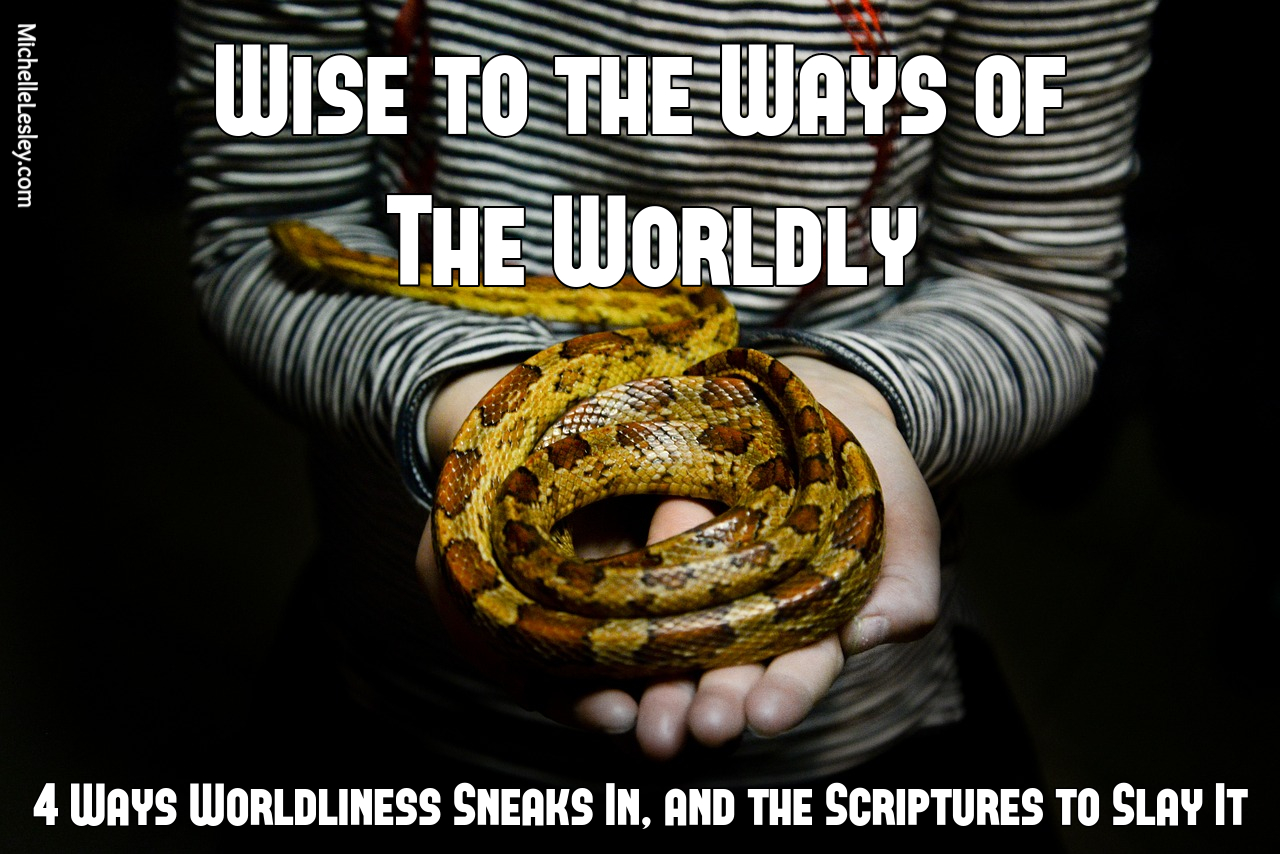
Wise to the Ways of the Worldly: 4 Ways Worldliness Sneaks In, and the Scriptures to Slay It

Lately, every time I turn around, I keep bumping up against the same biblical concept. It’s showing up in my personal Bible study time. In Sunday School. In sermons. Even in a revival my husband and I served at this week.

Worldliness, and the need for Christians to be set apart.

What is worldliness? It’s thinking, acting, and “attituding” the way lost people think, act, and attitude. It’s taking everything in through a fleshly filter instead of a biblical one and putting yourself out there through a fleshly filter instead of a biblical one. It’s dealing with the world around you in any way Jesus wouldn’t.

God has called His people to be set apart from the world from day one. (OK, day six, if you want to get all technical about it.) You can’t be more set apart than living at an address God personally designed for you and plopped you down in the middle of.

The whole purpose of the Promised Land, the Law, driving out the pagan nations and destroying them, depending on God to miraculously win wars and conquer the enemy, was for God to set apart a people for Himself. To raise up a nation that the rest of the world could look at and say, “Hey, those Israelite folks are different, and their God is different, too. What’s their one God got that our pantheon doesn’t?”.

Jesus reminded God’s people what it looked like to be different and set apart from the world. So did His disciples. And the New Testament is chock full of passages in which the apostles exhort Christians and the church to be holy and distinct from the world in heart, mind, and behavior.

Why? Because being different, and holy, and counter-cultural is weird, and counter-intuitive, and attention-grabbing to the world. And once we’ve got their attention, we’ve got an opportunity to share the gospel with them.

Yes, sister, God has called you to be a weirdo for Jesus.

And you’re going to have to fight the flesh to do it, because worldliness is insidious and subtle. Just like that sneaky, slimy serpent slithered in to paradise with no alarm bells ringing, we modern day Eves often don’t even notice worldliness has slipped in and tempted us to think and act in ways it has never even occurred to us aren’t godly. Sure, we don’t drink, and we don’t chew, and we don’t go with boys who do. And we don’t rob banks or murder people. But is that all there is to it? Avoiding the big, bad, behavioral no-no’s?

Before Eve ever extended her hand to pluck the fruit off the tree, Satan had already won several skirmishes with her heart. He had gotten her to doubt God’s character, disbelieve God’s word, and disregard God’s desires in favor of her own. And isn’t he still doing that with us today? Jesus warned us:

The good person out of the good treasure of his heart produces good, and the evil person out of his evil treasure produces evil, for out of the abundance of the heart his mouth speaks. Luke 6:45

As we look at these four ways worldliness can tiptoe into our actions unannounced and unnoticed, let’s also think about how our actions are merely the fruit of what’s going on in our hearts.

What are some of those sneaky snakes of worldliness, and how can we mortify those sins and respond in a godly way?

1.
Being quick to take offense

It’s getting to the point where you can hardly carry on a mundane, “Nice weather we’re having,” conversation any more without being accused of racism, gender bias, or having some sort of “privilege”. Even compliments and positive comments are likely to be twisted and heard by the easily offended as insults or condescension.

Think of the way Jesus endured and responded to the verbal abuse and false accusations intentionally and maliciously hurled at Him. Can you imagine Him freaking out at an innocent, offhand remark, someone’s tone of voice, or somebody unintentionally sticking her foot in her mouth?

Neither can I, yet this form of worldliness is probably my biggest area of weakness. It’s just the pride of life, pure and simple. (Well, not pure, I guess.) How dare anyone ruffle my feathers!

And how do I respond? Maybe the same way you do. I get my back up and strike back, fighting fire with fire. I rarely take a moment to step back and think that maybe this person didn’t intend for her tone to sound like that, or maybe to her that word means something different than what it means to me, or maybe she’s just PMS-ing today, or maybe I misheard or misinterpreted what she actually said. I don’t think, “How can I respond in godly love to this person?”. I don’t think at all. I just vomit my fleshly emotions all over her. Instead, I’m to respond in patience, kindness, and love, even if the situation calls for standing firm on Scripture without budging.

The Serpent Slayer:

Do not repay evil for evil or reviling for reviling, but on the contrary, bless, for to this you were called, that you may obtain a blessing. 1 Peter 3:9

Live in harmony with one another. Do not be haughty, but associate with the lowly. Never be wise in your own sight. Repay no one evil for evil, but give thought to do what is honorable in the sight of all. If possible, so far as it depends on you, live peaceably with all. Romans 12:16-18

2.
Being “Tolerant”

The world has been torturing this poor word “tolerant” for at least a few decades now. The definition has morphed from its actual meaning of “peacefully putting up with something that bothers you” to “embracing and celebrating any and every behavior and ideology (except biblical Christianity) as worthy and valid.” You’re not even allowed to think someone else’s worldview or behavior is wrong. You have to think it’s good or you’re a terrible person.

Now, of course, most Christians would not go around blatantly proclaiming that any old religion is just fine or that sexual immorality and perversion are perfectly acceptable or that abortion is a valid health care choice. But what about shying away from sharing the gospel with our Muslim neighbor for fear of appearing to be an Islamophobe? What about attending the homosexual “wedding” of a friend or loved one in order not to offend him and to maintain the relationship? What about failing to stand up for what’s right at work when unethical practices are the industry standard?

The Bible is very clear that following Christ and loyalty to His Word divides people. It divides family members from one another. It divides friends from one another, and it divides God’s people from those who claim to be God’s people and from the rest of the world. Jesus came to unite repentant sinners to God, not to unite unrepentant sinners to saved people. We must do what is right and biblical, refusing to participate in sinful and worldly activities, and lovingly, yet firmly, calling sinners to repentance and faith in Christ, even if it costs us family members, friends, our reputations, our churches, or our jobs.

The Serpent Slayer:

“Do not think that I have come to bring peace to the earth. I have not come to bring peace, but a sword. For I have come to set a man against his father, and a daughter against her mother, and a daughter-in-law against her mother-in-law. And a person’s enemies will be those of his own household. Whoever loves father or mother more than me is not worthy of me, and whoever loves son or daughter more than me is not worthy of me. And whoever does not take his cross and follow me is not worthy of me. Whoever finds his life will lose it, and whoever loses his life for my sake will find it.” Matthew 10:34-39

You adulterous people! Do you not know that friendship with the world is enmity with God? Therefore whoever wishes to be a friend of the world makes himself an enemy of God…Submit yourselves therefore to God. James 4:4,7a

3.
Being Flippant or Consumeristic about Church

The world has no reason to think going to church is important. Why would they? They’re lost. And if they do darken the door of a church, it’s not because they love Christ and want to worship Him, it’s ultimately for self-centered reasons. To assuage their guilt, to get Mom or the wife off their back, to feel better about themselves, to satisfy their curiosity.

Gathering to worship God is what genuinely regenerated Christians do. We have a God-given craving for fellowship with brothers and sisters in Christ and approaching His throne in prayer, praise, and the study of His Word together. Skipping church at the drop of a hat, shopping around for a church with all the slappy happy bells and whistles that make you comfortable, demanding that your church cater to your feelings, opinions, and preferences, strolling in with a “what’s in it for me” attitude? Uh uh. Those are worldly, self-centered attitudes, and might even indicate that you’re not saved.

Christians see faithfully attending and serving at church as vital to their relationship with Christ and other Christians. It’s not, “What’s in it for me?” but “How can I serve you?”. It’s not, “What did I get out of the worship service?” but “How can I wholeheartedly throw myself into the worship of Christ?”.

The Serpent Slayer:

And let us consider how to stir up one another to love and good works, not neglecting to meet together, as is the habit of some, but encouraging one another, and all the more as you see the Day drawing near. Hebrews 10:24-25

even as the Son of Man came not to be served but to serve, and to give his life as a ransom for many. Matthew 20:28

So then, as we have opportunity, let us do good to everyone, and especially to those who are of the household of faith. Galatians 6:10

Therefore let us be grateful for receiving a kingdom that cannot be shaken, and thus let us offer to God acceptable worship, with reverence and awe, Hebrews 12:28

4.
Being Defiant

If ever there were a generation of Americans who treated defying authority as the national pastime, this is it. Have you seen all the videos of people pulled over by the police who refuse to comply with their every request, sometimes even turning violent? How about the way wives these days run their marriages and treat their husbands like children? And the way children are allowed to rebel at school and at home? What about the rioting in the streets we’ve seen over the last few years?

The more I study the New Testament, the more passages I find instructing Christians to submit to the authorities in our lives. I’m not sure if I’d call it a major theme of the New Testament, but it sure isn’t a minor one. We’re to submit to the government, governing officials, earthly “masters” (literally if we’re slaves, figuratively – bosses, supervisors, etc. – if we’re not), wives are to submit to our husbands, children are to submit to their parents, and church members are to submit to our pastors and elders. Every human institution.

God’s people are a submitting people. Submitting to the authorities in our lives paints a picture for the watching world that one day every knee will bow in submission to the ultimate authority – God. And because God is our ultimate authority, the only time we disobey the human authorities in our lives is when what they’re asking us to do would cause us to disobey or dishonor God. Otherwise, we humble ourselves and joyfully and graciously submit.

The Serpent Slayer:

Therefore God has highly exalted him and bestowed on him the name that is above every name, so that at the name of Jesus every knee should bow, in heaven and on earth and under the earth, and every tongue confess that Jesus Christ is Lord, to the glory of God the Father. Philippians 2:9-11

Be subject for the Lord’s sake to every human institution. 1 Peter 2:13a

But Peter and the apostles answered, “We must obey God rather than men.” Acts 5:29


There are so many more ways Satan tempts Christians to act like the world. We put our faith in politicians to fix things rather than in God. We approach the world with a posture of entitlement and demand our rights instead of laying them down to serve others. We lash out in bitterness at those who have hurt us, holding grudges and cutting them out of our lives instead of forgiving as Christ has forgiven us. The list could go on and on.

But however worldliness manifests itself, it all has the same serpentine root in the heart: doubting God’s character, disbelieving God’s Word, and disregarding God’s desires. And when our hearts become ambivalent about God, and we push His desires and directives aside, the void that’s left has to be filled with something.

That “something” is the idol of self. I want to do what I want to do and I don’t want anybody standing in my way. This thing, or person, or idea makes me happy and comfortable, and keeping it is more important to me than what God says about it. That’s ultimately what’s going on in our hearts when we think, speak, and act in worldly ways.

out of the abundance of the heart his mouth speaks

Submit to the Scriptures. Be subject to the Savior. Slay the serpent of worldliness.


What are some other forms of worldliness that can sneak into our lives,
and what Scriptures can we use to combat them?

Sanctification, Sin

Throwback Thursday ~ The Garden of Weedin’

Originally published March 31, 2009

It’s that time again. Spring. Time to survey the damage winter did to the yard and get it back in shape. Sandwiched in between last week’s several days of rain and the multiple days of thunderstorms predicted for this week, were a few beautiful days that were just perfect for tackling the jungle that once was my back yard. Yikes. I could have lost a kid in all that grass.

Much to my dismay, when I got up close and personal with the overgrowth, I discovered that, once again, the army of weeds I spend every spring and summer fighting off had made significant advances into the yard. It also seemed to have secured the perimeter of my fencerow with a tall and nearly impregnable line of defense.

Heaving a sigh, I remembered what one gardener friend told me last year. The best way to fight off weeds is to get the grass really healthy and growing so it will choke out the weeds and reclaim the yard. Sounded reasonable to me. And familiar, too. Where had I heard something similar to that before? The idea tickled my brain as I hauled out the mower.

As I began shoving my trusty mower through that mess, it hit me. Weeds….choking something out. There was something about that in the Bible.

Ever notice how many of Jesus’ parables and illustrations include references to farming, plants, and other aspects of agriculture? The “Lord of the Harvest” gave us wheat and tares, fig trees, mustard seeds, vineyards, and of course, the parable of the sower scattering his seed.

Ah, that’s what it was. The parable of the sower. Remember him? He went out to seed his land, and the seed ended up finding its way not only to the good soil he had prepared, but also to some rocky soil, the roadside, and a patch of thorns (which the New Century Version translates as “weeds”):

Some other seed fell among thorny weeds, which grew and choked the good plants. Matthew 13:7 (NCV)

That’s exactly what was going on in my yard! The grass wasn’t yet strong enough to choke out all the weeds, the weeds were choking out my good crop of grass. They were also making my fencerow look awful, so I finished up the mowing, and, mentally assessing our temperamental edger, decided to clean off the fencerow by hand.

As I began yanking at those pesky plants, God reminded me that we all have weeds in our lives that need to be pulled up. So just what constitutes a “weed” in our spiritual lives? Well, Jesus was kind enough to explain that in Matthew 13:22:

And what is the seed that fell among the thorny weeds? That seed is like the person who hears the teaching but lets worries about this life and the temptation of wealth stop that teaching from growing. So the teaching does not produce fruit in that person’s life. (NCV)

Jesus compares the weeds to two things: “the worries about this life” and “the temptation of wealth”.

“The worries about this life” could cover just about anything. It could be a financial struggle, a wayward child, a difficult marriage, a hostile work environment, or even a painful past that we’re striving to put behind us. Any situation we deal with that looms so large, it blocks out our view of Christ and prevents us from trusting Him to handle it. Anything that takes our eyes off Him, tempts us to focus only on our circumstances, and derails the teaching God is trying to manifest in our lives.

“The temptation of wealth” could also cover a lot of areas in our lives. First Timothy 6:10 tells us that “the love of money is a root of all sorts of evil…”. Evil. In other words, sin.

“A root”. Hmmm…interesting.

Well, I was certainly dealing with plenty of roots. When it comes to weeds, it doesn’t do much good to simply pull the leaves off or snap the stem in half. For some reason, weeds– at least the ones in my yard –seem to take this as a challenge to grow back. You have to pull weeds up by the roots in order to get rid of them.

Likewise, if there is something in our lives which “stops [God’s] teachings from growing” or prevents God’s teachings from producing fruit in our lives (see Matthew 13:22 above) we need to have the Master Gardener root out the instigating problem rather than plucking at its leaves ourselves.

For example, if you’re struggling with being a workaholic, you can break off part of the stem of that problem by cutting back on work a few hours a week, but the root of the problem may be that you have made work an idol in place of God, that you don’t trust Him to provide for your needs, or that you are loving yourself and your work more than your family. If those root problems aren’t dealt with you will likely fail in your efforts to cut back on work, or something else, such as a hobby, may spring up to take the place of those hours you would have spent at work.

As I continued to work, I noticed that some weeds were very easy to pull up and some were quite difficult. The easiest to pull seemed to be the weeds that had taken root in the decaying leaf matter on top of the soil rather than in the soil itself. The difficult ones were the ones that had been growing for a long period of time. Some of their roots were over a foot long. These roots had made their way far from the visible plant and into another part of the yard, which meant they were affecting much more than just the immediate area around the plant itself.

And so it is with our spiritual weeds. The best time to deal with sin or turn a troubling situation over to God is early, before it has a chance to take root, because once it does, it’s going to be much harder to deal with and it’s going to begin to affect more and more areas of our lives.

Dealing with sin or difficult situations pre-emptively is even better. Flee temptation before you have a chance to give in to it. Determine to commit your works to the Lord and acknowledge Him in all your ways, and you will avoid some of the heartbreaking circumstances that might otherwise come your way.

As I struggled with one particularly stubborn weed, I noticed that its roots were intertwined with those of a couple of other totally different weeds. As I pulled at the one I was working on, the others were coming up as well.

When God pulls up those really difficult weeds in our lives, we will often find that He is simultaneously uprooting other sins and situations that have become enmeshed with the primary one. Sometimes when this happens to me, I feels like God is “piling on” and wish He would just work on one thing at a time in my life!

By the time I reached the end of the fencerow, I was sweating, my back was killing me, and I had broken two nails, despite the gardening gloves I was wearing. Pulling weeds is not a day at Disney World. It’s tough work!

But as I stood back and surveyed the results of my efforts, I saw that the fencerow no longer looked trashy. It looked clean and neat. Something any gardener would be pleased with. And, something else had happened that I hadn’t even noticed until that moment. As the roots of those weeds came up, they naturally tilled the soil.

It was moist,

loose,

rich;

the perfect condition for good seed to be sown by the Master Gardener.

Favorite Finds

Favorite Finds ~ June 12, 2018

Here are a few of my favorite recent online finds…

I honestly teared up a couple of times listening to the Get Up and Eat! with Rachel Jankovic episode of Sheologians. Sometimes I feel like the lone voice in the wilderness crying out for women to ditch the canned Bible studies and simply pick up the Bible and study it for themselves. It was nice to hear somebody else saying it.


I love the designs Scripture Type creates for Bible verses and Christian quotes. They have lots of lovely items you can purchase, and they also have a Freely Given page where they post designs that are free to download for use as wallpapers, lock screens, and printable coloring pages. It’s a great way to help you memorize verses!


If you found helpful the put off – renew your mind – put on concept for changing behavior from my recent article The Christian Introvert: Putting Off Social Anxiety, Putting On Serving Others, then you’re really going to like Clint Archer’s recent article series over at The Cripplegate. In his Just Stop It articles, he applies the same biblical concept to various sins you might be struggling with:

Just Stop It: Instructions on how to repent

Just Stop it, Part 2: How To Repent Of Lying

Just Stop it, Part 3: How To Repent Of Anger

Just Stop it, Part 4: How to Repent of Stealing

Be sure to subscribe to or follow The Cripplegate for any future installments Clint might write.


Are you a Southern Baptist (or a curious onlooker) who couldn’t make it to the annual meeting in Dallas this year? Keep up with what’s going on via live stream or at your convenience on demand. And please don’t forget to fervently pray for the SBC. We are facing some serious issues in these days. The Southern Baptist Convention annual meeting is being held today and tomorrow (June 12-13).


One of those serious issues we’re currently dealing with in the SBC is that a vocal few are pushing the idea of electing a female president (Beth Moore’s name has been floated). Pastor Tom Buck has written a phenomenal series of articles dealing with this issue from Scripture. Even if you’re not Southern Baptist, you will find Pastor Buck’s careful exposition of 1 Timothy 2:11-15 extremely helpful in his articles Will the Next SBC Resurgence Include a Redefining of Complementarianism?

Part 1     Part 2     Part 3     Part 4 

Sanctification

10 Pet Peeves (with Providential Purpose!)

One of the podcasts I’m enjoying listening to right now is Mike Abendroth’s No Compromise Radio. Recently he posted a series of episodes about his pet peeves with the church, false teachers, and other ministry issues, and used those pet peeves as an opportunity for teaching and exhortation.

It seemed to be a thought-provoking way to address the issues, so I’m shamelessly emulating Mike’s idea today and discussing a few pet peeves of my own:

1. Mispronouncing or misspelling the names of false teachers being critiqued. The names that seem to give people the most trouble are Joel Osteen and Joyce Meyer. There is no “L” in Osteen. It is not OLsteen or OLDsteen. It is pronounced OH’-steen (also note the emphasis on the first syllable). Joyce Meyer does not have an “S” on the end of her last name. It is Meyer, not MeyerS. When you mispronounce or misspell the name, it diminishes your credibility with followers of that teacher. People tend to think, “This person doesn’t know what she’s talking about. She hasn’t even done enough research to know what my favorite teacher’s actual name is.” Hearing Scriptural truth about your idol is hard enough. Let’s be merciful and not make it any harder for people than we have to.

2. Women who try to manipulate ministries which take a firm stance on biblical doctrine into apologizing or changing said stance by saying how “sad” or “grieved” or “depressed” or “sorrowful” they are that this ministry isn’t nicer to false teachers, more compassionate as to why women can’t submit to their husbands, etc. It reminds me of three year old little girls who have learned that if they turn on the tears and the puppy dog eyes, and burble with quivering lip, “That huwt my feewings!” when Mom disciplines them, that Mom will quickly change her mind about the punishment.

Ladies, godly women do not manipulate by saying things like this (And, as an aside, if you’re using this tactic with your husband, stop now. You’re going to destroy your marriage). If you’re not genuinely sad or grieved, what you’re saying is a lie. If something a ministry says or does genuinely offends you, the first thing you need to do is find out – from correctly handled Scripture, not your opinions – if they’re being biblical. If they are, you need to adjust your feelings so that they line up with Scripture. If they’re not, you need to speak the truth to them kindly, openly, honestly, in love, and with no hidden agenda.

3. People who comment on articles, social media posts, and so on without reading them first, especially when their comment is clearly addressed, answered, or refuted in the text. Have we really become this intellectually lazy? God gave us brains, intelligence, and literacy. We need to exercise those good gifts. The headline isn’t the extent of the writer’s thoughts. Read the article.

4. Mature Christians who positively quote, share, or re-tweet people they know (or should know) are false teachers. I don’t care if the quote itself is OK-ish. When you share something from a false teacher, others see that as your stamp of approval on that teacher, or question your discernment, or both. You’re pointing people who may be weaker brothers and sisters to false teachers. Knock it off.

5. Christian writers who consistently fail to capitalize the word Bible. I expect a surgeon to know how to handle a scalpel, a plumber to know how to use a wrench, and writers to know the rules of grammar. As Christians we should be striving for excellence in our vocations as a way to glorify God.

6. When people try to negate a general rule or biblical principle by pleading the exceptions to the rule. People point to the tiny percentage of pregnancies by rape and incest and say “See? Abortion should be legal!”. Christian women point to the exception of abusive men as though their existence exempts all godly women from the Bible’s instruction to submit to their husbands. There are always going to be exceptional circumstances like the tragedies of abuse and pregnancy due to rape or incest (and there are biblical principles for handling these special circumstances), but those exceptions do not cancel out the general rule or biblical principle that applies to the vast majority of people.

7. Women who confuse their feelings, personal preferences, and opinions with biblical truth and then attempt to use that “biblical truth” to correct others who disagree with them. You may be offended and strongly disagree with someone for calling your favorite preacher a false teacher, but your feelings and disagreement don’t mean that person is wrong. It could be that your opinion is what is unbiblical and that the other person is completely bibilically right in what she is saying. Or it could be another type of situation in which neither of you are wrong but that you’re coming at the issue from two different (yet biblical) perspectives, for example: grief over someone’s sin versus righteous anger over someone’s sin. As Christians, our feelings and opinions about things don’t really matter. We are slaves of Christ, so only our Master’s opinion matters. And His opinions are found in God’s written Word, not in our emotions. We must go to Scripture to determine what is right, godly, and good, and what is not.

8. I could write a whole article on things podcasters do during broadcasts that annoy me, but I’m working on not being annoyed by those things (plus, if I ever have my own podcast, I’m sure I’ll do all of them myself), so I’ll just mention one: repetitive linguistic idiosyncrasies and jokes. Yes, “that’s the way the cookie crumbles” but you don’t need to say it every five minutes. And, it was mildly amusing the first few times you intentionally pronounced that word wrong, but now it’s been several dozen times, and it’s just annoying. And nobody’s buying your shtick about feigning confusion over people’s names (“As Jimmy Carter once said…” “No, that was Jimmy Dean.” “I thought it was Dean Martin!”) anymore. The same linguistic joke or idiosyncrasy over and over and over again grates on my nerves. The spiritual application here? I need to be more patient and overlook things that annoy me out of love for the person doing them. I get that. I’m trying.

9. Making every event into a huge, over the top experience. When I was a kid, Vacation Bible School was a Bible story and a few songs, a modest craft, and some cookies and Kool-Aid. No theme, no decorations, no ordering hundreds of dollars worth of junk from LifeWay. Now VBS is more like Six Flags over Jesus. For centuries, worship services took place without an elaborate set, theatrical lighting, and flashing everything up on a screen. Pastors somehow managed to preach without props, costumes, or references to the latest movie. Bible studies required only (gasp!) a Bible, not a workbook, a DVD, a web site, YouTube videos, four jillion different colored highlighters, a bachelor’s degree in hieroglyphics for margin markings, and the talent of Monet for Bible art journaling.

I once saw a picture of a church in Africa. Not a church building – because they didn’t have one – but the actual church: the people. They met under a certain tree on Sundays to sing, pray, and be taught by their pastor. No programs, no flash, no bling, yet this was a successful church because it built up and trained Christians in the faith. There’s nothing intrinsically sinful about decorations, lights, or a plethora of pens, but sometimes all the hoopla and accessories distract us from our main purpose- the unfettered pursuit of Christ. When we feel like we have to do all that extra stuff – to attract people or to have some sort of feeling or experience – we’re losing sight of our purpose. Simple is good and doable and not displeasing to God.

10. My biggest pet peeve – the one that affects me the most, personally; the one that frustrates and irritates and angers me more than all the others – is my own sin. I know exactly how Paul felt, and I can’t say it better than he did, when he said:

For I do not understand my own actions. For I do not do what I want, but I do the very thing I hate. 18 For I know that nothing good dwells in me, that is, in my flesh. For I have the desire to do what is right, but not the ability to carry it out. 19 For I do not do the good I want, but the evil I do not want is what I keep on doing. 22 For I delight in the law of God, in my inner being, 23 but I see in my members another law waging war against the law of my mind and making me captive to the law of sin that dwells in my members. 24 Wretched man that I am! Who will deliver me from this body of death?
Romans 7:15,18-19, 22-24

Can’t you just see Paul throwing up his hands in frustration, tearing out his hair, banging his head on his desk? I drive through that neighborhood a lot. “Ugh! I gave into temptation AGAIN!” “I just repented of coveting yesterday, and here I am doing it again today!” “Why did I react to that situation with pride instead of humility? I know what Scripture says about that!” I see the goal – Christlikeness. I want to get there, but I know that’s not going to come to completion this side of Glory. And it drives me absolutely nuts.

But then I see the cross. The grace. The kindness of my Savior to forgive me. And I’m reminded to keep moving forward, to “press on toward the goal for the prize of the upward call of God in Christ Jesus.” That it’s His work in my heart that makes me holy and enables me to obey, not my straining and striving. What a merciful and loving and gracious God!

Life is full of little (and big) pet peeves. But if we’ll submit ourselves to God, study His word, and seek to obey Him, they can have a sanctifying purpose. God can use even the most annoying irritation to sand off some of our rough edges, show us our sin, and lead us to become more like Christ.

Do you have any pet peeves?
How could God use them as tools to sanctify you?