Abortion, Gospel

Planned Parenthood: There, But for the Grace of God…

 You walk into your doctor’s office for your annual check up—flu shot, cancer, cholesterol and blood sugar screening, blood pressure check—you know, routine maintenance on the ol’ bod. You’ve chosen this doctor because you don’t have health insurance and he’s kind enough to lower his prices and work with you on a payment plan. His office is clean and bright, beautifully decorated, and the staff is always friendly. You even get a lollipop at the end of each visit.

But this year, as you’re walking down the hall to exam room four, you happen to notice that in exam room three, there’s a playpen in the corner with an adorable baby girl in it, cooing away and playing with a toy.

“Odd,” you think, since this is not a pediatrician’s office. You continue to your own room, don that scratchy paper gown, and wait for the doctor. By the time he comes in and begins the exam, you can no longer contain your curiosity. Whose baby is it? Why is there even a baby in the office?

“Oh, yes,” the doctor says matter of factly, “that baby was abandoned by her parents. Nobody wants her, so when I get finished with your check up, I’m going to torture her to death and then sell her organs to medical researchers.”

Your jaw hits the floor. Your stomach turns. You can’t believe the monstrous words you’ve just heard.

“How could you do such a horrible thing?” you scream over your revulsion. The doctor looks surprised that you should ask.

“It’s really no big deal,” he says. “We only do a few of those a week. The vast majority of my practice is providing health care and counseling for patients like you.”

Let me ask you something—would you use that doctor and think that the care he provides you mitigates his atrocious behavior? I hope not. Yet I have heard people defend Planned Parenthood (an organization which has been torturing babies to death for decades, and, we recently learned, profits from the sale of their organs) because Planned Parenthood ostensibly performs a minimum number of abortions and mainly provides health services, such as the ones mentioned above, to women who need them. Somehow, in these people’s minds, the health care Planned Parenthood provides makes up for the heinous murders they commit day after day.

Does it really all balance out? Of course not.

In fact, let’s say, Planned Parenthood had only ever tortured fifty babies to death (instead of the millions they’ve actually killed). And let’s say they provided free health care to everyone on the planet, cured cancer, and brought about world peace. Those are some wonderful things, but does it erase the fact that they brutally ended fifty innocent lives? Do all those good deeds make up for even one murder?

No. They don’t. Good deeds can never make up for heinous crimes. Planned Parenthood’s hands are drenched in blood that all the free health care in the world can’t wash away.

They’re hopelessly guilty. Just like we are.

Apart from Christ, we are Planned Parenthood. We come before God with blood on our hands. Not the blood of millions of babies, but the blood of one child. God’s child. Jesus. We are responsible for His death. It was our sin that caused Him to be tortured to death. Our sin that brutally murdered Him.

“Oh, but it’s no big deal. I’m mainly a good person. The vast majority of my life is spent doing good things and helping people. That totally makes up for those few sins I’ve committed. My good deeds outweigh the bad.”

No. They don’t. Good deeds can never make up for heinous crimes.

But, grace… But, mercy… But the goodness and loving kindness of God our Savior intervenes and wipes away the guilt. Washes our hands of Christ’s blood. Cleanses us from all unrighteousness, if we only turn to Him in the repentance and faith that He is gracious enough to give us.

Good deeds can never make up for heinous crimes, but the grace of God can.

But when the goodness and loving kindness of God our Savior appeared, he saved us, not because of works done by us in righteousness, but according to his own mercy, by the washing of regeneration and renewal of the Holy Spirit, whom he poured out on us richly through Jesus Christ our Savior, so that being justified by his grace we might become heirs according to the hope of eternal life. Titus 3:4-7

Church

Six Ways Not to Forsake the Assembly

not forsake assembly

“We’ve been looking for a biblically sound church for seven years.”

“There isn’t a church that preaches sound doctrine within a 90 minute drive of our house.”

“My husband and I have given up on church.”

It was heartbreaking to read these and scores of similar comments responding to my recent article “Nine Reasons Discerning Women Are Leaving Your Church.” On the other hand, it was encouraging to hear from so many women (and even a few brave men!) whose love for Christ and fidelity to His word have moved them out of apostate churches and set them on the hunt for a body of believers which worships Him in spirit and in truth.

Even though most commenters already seemed to know this, I wanted to go back and clarify for everyone that leaving an apostate church is not the end of the story. God is quite clear in His word that we are not to abandon meeting together with other Christians for fellowship, worship, and the preaching and teaching of God’s word:

And let us consider how to stir up one another to love and good works, NOT neglecting to meet together, as is the habit of some, but encouraging one another, and all the more as you see the Day drawing near. Hebrews 10:24-25

Look around. Read the paper. Watch the news. Do “you see the Day [of Christ’s return] drawing near”? I do. God says that makes it even more important for Christians to stick together, meeting regularly to encourage each other and stir one another up to love and good works. We need each other. But how can we meet together, when it’s so hard to find a church that teaches and preaches sound doctrine?

1. Make sure you’re only leaving a church for essential reasons.
There are biblical issues and then there are issues of preference. You may not like the genre of music at your church, but is it theologically sound? Perhaps you’d prefer that your pastor wear a suit instead of jeans, but does he rightly handle God’s word?

If you’re a member of a church that is, generally speaking, doctrinally sound, you should probably stay, even if – or maybe especially if – you see some areas that seem slightly “off,” biblically. It may be that God has placed you in that church to shed some light on the situation and to be a catalyst for bringing things back in line with Scripture. Sometimes when a church member or leader bobbles a little it’s simply because they don’t know that what they’re doing conflicts with Scripture. See if you can come along side the person and help out. Remember, there was a time when you didn’t know any better, either.

2. Leave no stone unturned.
If your church is apostate and you do have to leave, you should immediately begin looking for a doctrinally sound church to join. Staying home from church for a while just makes it that much easier not to go back. Ask trusted Christian friends about their churches, look on line, drive around town, but look. Don’t give up your search until you’ve checked out every single church you can possibly get to.

Keep in mind that you may have to make some sacrifices to find a church that adheres to God’s word. It might not be very close to your house. They might meet earlier or later or be bigger or smaller than you prefer. You may have to choose a church of a different denomination than you grew up in. That’s OK. Keep looking.

3. Think outside the steeple.
It seems impossible, but some people, even in populous areas, leave no stone unturned and still can’t find a church that rightly handles God’s word. (Unfortunately, we are going to see more and more of that “as the Day draws near.”) If you absolutely cannot find a doctrinally sound established church you may need to begin meeting with other Christians outside of the established church: in homes, community centers, after work, etc.

I want to be clear that I advise this only as a last resort after exhausting every possibility of joining a biblical established church. I have known of people who withdrew from established churches because of doctrinal problems, and instead of searching for a sound, established church, decided to form a house church, which then fell into other doctrinal problems of its own. House churches can be very vulnerable to doctrinal error.

If you must meet with other believers outside of an established church, make sure whoever is pastoring the group is biblically qualified to do so, and that your home church carries out all of the components of a biblical church: Bible teaching, worship, prayer, care for members, the Lord’s Supper, baptism, and church discipline. There are many wonderful, trustworthy resources such as sermons, Bible teaching, and Bible study lessons available on line for free. Take advantage of them. You may also wish to contact your denomination’s headquarters, a reputable missions organization (such as NAMB or IMB), or a doctrinally sound church planting organization and ask about the possibility of a missionary or church planter coming to plant a new church in your area.

4. Can’t find other Christians to meet with? Make them.
I say that somewhat jokingly. Of course you should not evangelize for the sole purpose of having other Christians to meet with. You should already be sharing the gospel with others simply because you are a Christian. Every Christian, regardless of her own church situation, is called to take the good news of Christ to those around her. However, whereas you might previously have shared the gospel with someone and then invited her to church with you, now you might invite her to your home church.

5. Move.
Yep, it’s a pretty radical idea, but we still have the freedom in the U.S. to move to any area of the country we want. If you absolutely cannot find a way to meet together with other Christians, you might want to prayerfully consider moving somewhere else. Desperate times call for desperate measures, and obeying Scripture is worth any sacrifice. Yes, it’s that important.

6. Pray.
God’s word says we’re not to forsake meeting together with our brothers and sisters in Christ. God wants you to obey His word. If you want to obey His word and you ask Him to make a way for you to do that, He will answer that prayer. It might not be in the way you’re hoping or expecting, but He will provide a way for you to obey Him.


God wants you to be in fellowship with other believers. I know it can be hard to find a biblical church, but where there’s a will, there’s a way. God’s will. God’s way. It’s my prayer that each of you reading this will find that biblical place of worship, fellowship, and teaching so that each time you get ready for assembly you can say with David:

I was glad when they said to me,
“Let us go to the house of the Lord!”
Psalm 122:1
Church

Persecution in the Pew

persecution in the pewBeheadings of Christians by ISIS. Crosses forcibly torn off churches by the Chinese government. Pastors imprisoned. Believers tortured for leaving Islam or sharing the gospel.

The treatment our brothers and sisters across the globe receive at the hands of pagans is nearly unfathomable. They are made to suffer – simply for claiming the name of Christ – by those who openly hate God and want nothing more than to stamp out Christianity.

This is how we, as the American church, have come to define persecution. Outsiders, non-Christians, and the government, all on the attack against the Bible, our faith, our practices, and other beliefs we have long held dear. It’s a correct definition, but it’s not a complete definition.

While we already see a “light” form of this type of persecution in the U.S. – mainly over the issue of homosexuality – there’s another kind of Christian persecution that is mushrooming right under our noses, which most church members either seem oblivious to, or are actually participating in. It’s the persecution in the pew.

If you’re a Christian who has ever dared to vocally take a stand on the truth of God’s word against the false teaching so prevalent in today’s pop Christianity, you’ve almost certainly experienced this type of persecution at the hands of people who call themselves “Christians.”

Don’t believe me?

Try posting a Facebook status that says the Bible prohibits women from being pastors or teaching men.

Demonstrate from Scripture to a Beth Moore, Joyce Meyer, or Joel Osteen groupie that she’s following a false teacher.

Talk to a church member who supports Planned Parenthood because they provide health care.

Explain why Christians ought not attend same sex weddings.

Discuss the Bible’s account of Creation with someone from your church who has embraced Darwinian evolution.

Certainly, there are new and immature Christians who simply don’t know these things are unbiblical and are still struggling to embrace God’s word in these areas. And there are those who know what God’s word says, but rebel against it in these areas, who silently ignore Christians who espouse biblical truth, or can politely discuss why their “Christian” views differ from Scripture. However, the willfully biblically ignorant, “screaming banshee” contingent is growing, both in volume and in number.

Surprised? Me too. I’ve been on the receiving end of verbal abuse (and I do mean abuse – name calling, swearing, mocking, the questioning of my salvation, and any number of other nasty and condescending remarks) from “Christians” defending these and other unbiblical views numerous times and I still can’t get over my shock every time it happens.

Call me crazy, I guess I just expect people who claim to be Christians to believe and defend the Bible, not attack those who uphold it.

But this kind of thing really shouldn’t be cause for wonder and amazement. We should expect it. Persecution of God’s people by those who claim to be God’s people has been happening since the Old Testament.

Jeremiah:
Now Pashhur the priest, the son of Immer, who was chief officer in the house of the Lord, heard Jeremiah prophesying these things. 2 Then Pashhur beat Jeremiah the prophet, and put him in the stocks that were in the upper Benjamin Gate of the house of the Lord. Jeremiah 20:1-2

Amos:
Then Amaziah the priest of Bethel sent to Jeroboam king of Israel, saying, “Amos has conspired against you in the midst of the house of Israel. The land is not able to bear all his words…12 And Amaziah said to Amos, “O seer, go, flee away to the land of Judah, and eat bread there, and prophesy there, 13 but never again prophesy at Bethel, for it is the king’s sanctuary, and it is a temple of the kingdom.” Amos 7:10, 12-13

Isaiah:
For they are a rebellious people, lying children, children unwilling to hear the instruction of the Lord; 10 who say to the seers, “Do not see,” and to the prophets, “Do not prophesy to us what is right; speak to us smooth things, prophesy illusions, 11 leave the way, turn aside from the path, let us hear no more about the Holy One of Israel.” Isaiah 30:9-11

Perhaps Jesus had in mind some of these instances of Israel’s persecution of the prophets when He said in the Sermon on the Mount:

Blessed are those who are persecuted for righteousness’ sake, for theirs is the kingdom of heaven. 11 “Blessed are you when others revile you and persecute you and utter all kinds of evil against you falsely on my account. 12 Rejoice and be glad, for your reward is great in heaven, for so they persecuted the prophets who were before you. Matthew 5:10-12

The balance of the New Testament is rife with examples of Christians, and even Jesus Himself, being persecuted by those who claim to be God’s people:

Stephen was martyred by “the people and the elders and the scribes,” while Paul, “circumcised on the eighth day, of the people of Israel, of the tribe of Benjamin, a Hebrew of Hebrews; as to the law, a Pharisee;” who went on to be a zealous “persecutor of the church” held their coats.

It was the “high priest, the senate of the people of Israel, and the Pharisees” who imprisoned and flogged the apostles and “charged them not to speak in the name of Jesus” in Acts 5:17-42.

Peter and John were arrested by “the priests and the captain of the temple and the Sadducees” and threatened by “Annas the high priest and Caiaphas and John and Alexander, and all who were of the high-priestly family.”

Even Jesus “came to his own, and his own people did not receive him.” He was nearly stoned twice by Jewish leaders. And, even though it was the Romans who actually carried out the crucifixion, it was only because it was illegal, under current Roman law, for the temple authorities to execute their own criminals.

It was one of Jesus’ own followers who betrayed him to the chief priests. It was the “chief priests and the elders” who arrested Jesus. It was “the high priest…scribes and the elders” who presided over the kangaroo court that condemned Jesus to death. And it was “all the chief priests and the elders of the people” who finally handed Jesus over to Rome.

We may think of these people as Jews, scribes, and Pharisees, but they were the “church people” of their day. It was these “church people” – as much, if not, at times, more so than pagans – who were the ones shouting down, threatening, persecuting, and murdering Jesus and Christians who upheld the truth of His word.

Jesus knew this would happen. In John 16:2-4 He warned the disciples:

They will put you out of the synagogues. Indeed, the hour is coming when whoever kills you will think he is offering service to God. 3 And they will do these things because they have not known the Father, nor me. 4 But I have said these things to you, that when their hour comes you may remember that I told them to you.

And so it goes today. Deceived, self-proclaimed “Christians”, those inside the church who are often just as unsaved as the pagans outside the church, those who prove that they don’t belong to Christ by fighting against His word instead of loving and obeying it, these “church people” are the ones viciously attacking Christians who dare to stand on and for the truth of Scripture. And they think they’re doing God a favor by acting this way.

Continue to cling to Christ and His word and you’ll be one of their victims. It’s inevitable. Jesus said, “If they persecuted me, they will also persecute you.” But keep your eyes on Jesus, not on your circumstances, and remember He also said, “Blessed are those who are persecuted…theirs is the kingdom of heaven.” When you’re persecuted, even by “Christians” you can “rejoice and be glad, for your reward is great in heaven!”

Evangelism, Missions

Missions Monday: Buy a Book ~ Be a Missionary

I’m just going to come right out and say it:

I want you to buy my book. I want you and your church and any other Christian organization you’re a member of to buy as many copies of my book as you possibly can.

Why?

Well, it’s certainly not because I want to become rich and famous and have a monopoly on Bible study sales at your local Christian bookstore. I really couldn’t care less about that.

And it’s not because I want to make a lot of money for my publishing house, or feed my ego, or prove myself to people, or score some sort of brownie points with God.

I want to be a missionary. And I want you to come with me.

How can buying my book turn you into a missionary?

Be a missionary to yourself:
If you’ve never turned from your sin and trusted in Christ’s death on the cross to pay the penalty for your sin, you’ll find out all about that in my book (and FYI– you do NOT have to buy the book for that. E-mail me at michellelesley1@yahoo.com, and we’ll chat, or click on the video “Good News!” on the side bar.) YOU are your first mission field.

If you have been born again, buy this book and use it to study God’s word so that He can build you up into an even mightier woman of God than you already are. Let Him turn you into a praying, studying, praising, worshiping, Gospel-sharing machine!

Be a missionary to those closest to you:
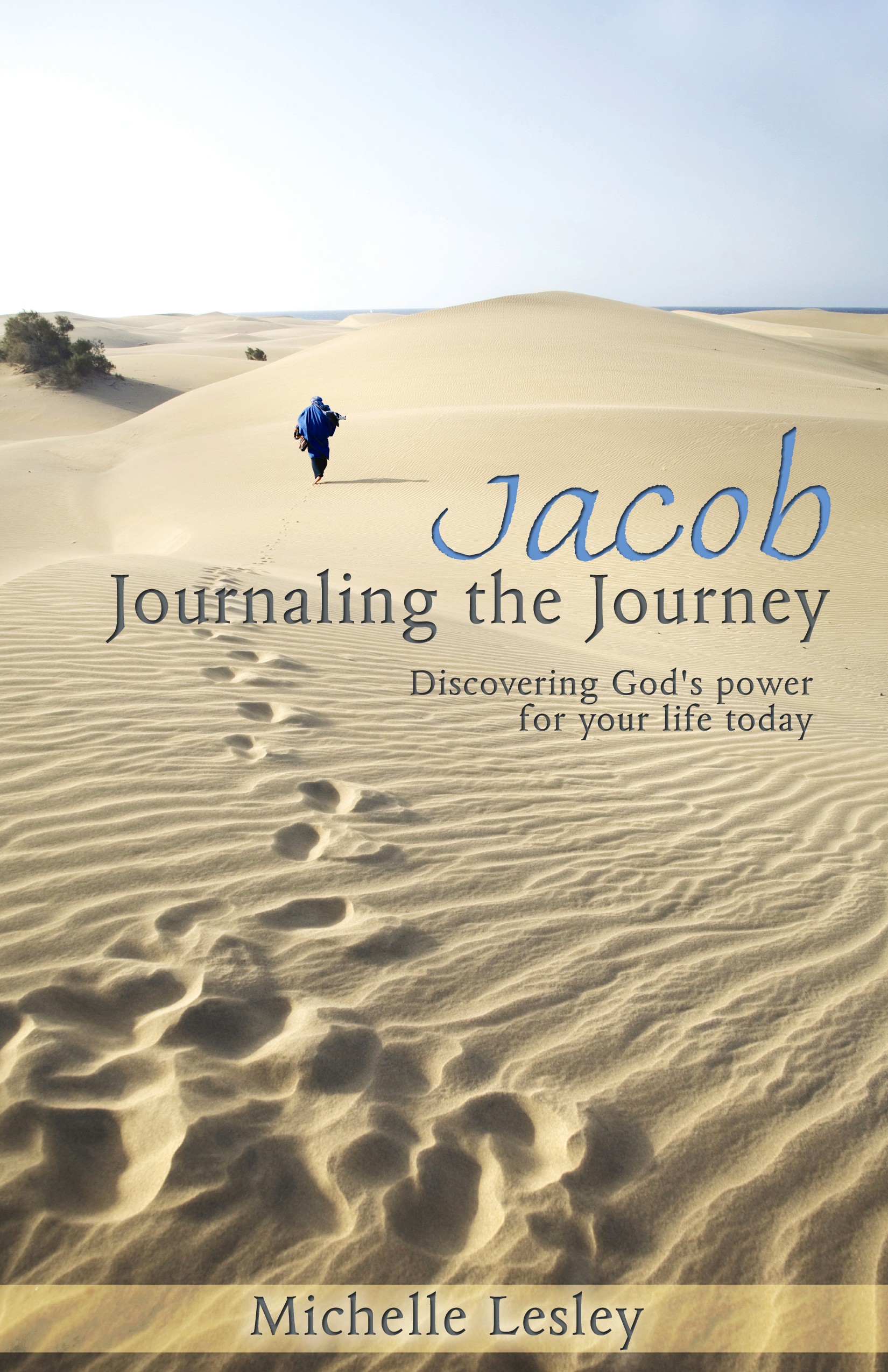
Give Jacob as a gift to someone who needs to know Jesus as Savior–a friend, your child’s teacher, your beautician… Give it to a Christian friend or loved one to help her grow in her faith. Give copies to your local battered women’s shelter. Start a lunchtime ladies’ Bible study at work. Invite the women of your neighborhood to study Jacob in a small group in your home.

Be a missionary to those far away:
All of my profits from the sale of this book–ALL of them- I am personally not making a penny from book sales– are going to the International Mission Board to reach an Unreached People Group in the Middle East with the Gospel of Jesus Christ. These are people who have never heard the name of Jesus or that He is the only way they can be forgiven of their sin and escape an eternity in hell. (Find out more by clicking the UPG tab at the top of this page.)

You can also buy copies to send with missions teams from your church to distribute to the people they’ll be ministering to, or ship them to an overseas church that your church supports.


And all you have to do is buy a book.


1 John Bible Study

Am I Really Saved?: A First John Check Up ~ Lesson 1: Introduction

1 John Study

Today, we’re taking a brief break from our regular Wednesday’s Word format. For the next (approximately) six to eight weeks, we’ll be studying the book of 1 John.

If you’ve ever wondered whether or not you’re really saved, think a loved one might be a false convert (someone who thinks she’s saved but isn’t), or are wondering about that “Christian” author who keeps promoting unbiblical ideas, you’ll find that 1 John has the answers to a lot of your questions.

So let’s dig in and get those questions answered. There’s just one ground rule- you must read the entire text of the chapter of 1 John we’re dealing with in each lesson. (Don’t freak out, though, the longest of the five chapters is chapter two, weighing in at a lightweight 29 verses.) This isn’t going to be a line by line study. We’re going to focus on the “Am I Really Saved?” check points in each chapter. So, you’ll need the entire chapter for context, plus, it’s a phenomenal book and I don’t want you to miss any of it. Ready?

Am I Really Saved? A First John Check Up
Lesson 1: Introduction
Please Read: 2 Corinthians 13:5; Matthew 7:21-23;
1 John 1:1-4, 5:13

Our relationship with Christ can be a hard one to quantify. It’s not like a big red “C” for “Christian” appears on our foreheads when we repent of our sin and trust Christ for salvation. We look the same, we talk the same, we live in the same place. We can’t even trust our feelings to validate that we’ve truly been born again.

So sometimes, we’re left wondering, “Am I really a Christian? How can I know for sure?” Those kinds of thoughts can produce a lot of anxiety. But God doesn’t want us to worry or live in constant fear that we don’t belong to Him. He’s very clear that He wants us to know for sure, one way or the other.

How can we know? Second Corinthians 13:5 tells us that we need to examine our hearts, test ourselves, to see whether we’re in the faith. As Christians, we use God’s word as a measuring stick for our salvation, not a prayer we once prayed, an emotional or spiritual “experience” we once had, baptism, church membership, being a “good person,” or external “Christiany” behavior, activities, or knowledge. Remember, Jesus said that there will be many people who claim to be Christians and look like Christians on the outside whom He will turn away from Heaven on the day of judgment because He does not know them as His own. So, maybe the people John was writing to had some of the same questions and anxieties about their salvation that we have about ours.

Background:

First John is the first and longest of three brief epistles, or letters, written by the apostle, John. You might remember John – along with his brother James – as one of the “sons of thunder,”or “the disciple whom Jesus loved.” Originally a fisherman, John became one of Jesus’ “inner circle” (with his brother James and Peter) of disciples. John was the longest living of the original twelve disciples, and is believed to be the only one of the twelve who was not martyred for his faith in Christ (though he was eventually exiled). John also wrote the gospel of John and the book of Revalation.

First John is classified as a “general epistle” and was probably written circa 90-95 A.D., toward the end of John’s life, to the churches he shepherded in Asia Minor. It is likely that these churches were encountering the heresy of gnosticism, which may have been why they needed a little refresher course in salvation, and which John seems to combat in this epistle. In 1 John 1:4 and 5:13, John personally explains two of his reasons for writing the epistle.

Questions to Consider:

1. In 1 John 1:1-3, which words and phrases indicate that John knew Jesus and was an eyewitness to His ministry? Why would his eyewitness testimony have been important to the churches he was writing to?

2. What were some of the things John witnessed and learned from Jesus that transformed Him from “Son of Thunder” fisherman to “John the Revelator” over the course of his life? (see the gospel of John)

3. Why was it important for John (and other New Testament writers) to actively combat false teaching rather than take a more passive approach such as simply praying for the false teachers?

4. Think back to your salvation experience. Do you believe you’re saved because you prayed a prayer, got baptized, or because you’re a good person? Reflect on Matthew 7:21-23. What impact does this passage have on you?

5. List some specific ways your relationship with Christ has, over time, changed the way you think, speak, act, regard others, and regard the Bible. Do you see evidence of your growth in Christlikeness?

6. If you prayerfully examine your heart (2 Corinthians 13:5) during this study and suspect that you might not truly be born again, what will you do? What Scriptures can you turn to for help?

Additional Resources:

1 John Summary at Blue Letter Bible

Book of 1 John at Got Questions

We Know: The Things Christians are Certain Of– A sermon series on 1 John by Dr. Hershael York

True or False? A Study in 1 John (Lessons 1-5) at Naomi’s Table