
Gratitude, Prayer

25 Things I Forgot to Thank God For

I’ve just been in a funk, lately. Nothing out of the ordinary is wrong, but it’s been raining for eleventy two days in a row, and the constant darkness and dreariness seems to have wormed its way into my psyche and, I noticed recently, even into my prayer life.

A couple of days ago, I started out my prayer time with a huge sigh followed by a bunch of wimpering and whining about nothing of consequence. I was just moody. And I didn’t feel like praying.

And then God graciously brought a lovely little snippet of Scripture to my mind:

give thanks in all circumstances;
for this is the will of God in Christ Jesus for you.

1 Thessalonians 5:18

Want to know God’s will for your life? There it is: give thanks in all circumstances. When you get a new car. When you catch your spouse cheating on you. When you’re on a glorious vacation. When you get laid off from work. When you’re happy. When you’re sad. When you’re in the mood, and when you’re not in the mood.

Give thanks in – not necessarily for, but in – all circumstances.

Well, this was certainly a circumstance. Why not give gratitude a try? I was in the car headed to pick up my boys from school, and I decided to spend the entire twenty minute drive just thanking God for things.

I started with the big stuff: salvation, forgiveness for my sin, times when God has miraculously provided, specific answers to prayer…

I was starting to slow down and I still had about half the drive left. Surely there was more to be thankful for! And that’s when it struck me. How often do we forget to thank God for all the (in our eyes) tiny little unnoticed things He does for us every day? We thank Him for the miracles, but what about the mundane? What “little things” had I forgotten to thank God for?

1. Air conditioning. I live in the South. Enough said.

2. I know where my next meal is coming from.

3. Social media and e-mail. I can keep up with far off loved ones, and I’ve “met” some awfully nice people.

4. I can see. I can hear. I can think clearly. I can walk.

5. I live in a country where Christianity is not yet against the law.

6. Sunsets.

7. Cute baby animals.

8. I can read and write. That’s not the case for women, globally.

9. I was able to conceive and carry my children to term.

10. Warm quilts on cold nights.

11. The Bible is available in my native language, and I have several copies of it.

12. I have no fear of suicide bombers in my community.

13. The beach.

14. A crawfish boil with friends.

15. Reliable electricity.

16. Hearing my children sing when they think no one is listening.

17. My husband is a believer and is good to me.

18. Mountains. I miss mountains.

19. Indoor plumbing and clean drinking water.

20. Laughing hysterically with my family.

21. Level-headed discernment ministries.

22. Peanut butter and chocolate ice cream.

23. A roof over my head.

24. Home schooling.

25. People who are kind (or crazy) enough to read my blog articles all the way to the end.

Well, that was my list, and I think I’ll keep looking for things to add to it. Thanking God for the “little things,” realizing they might be big things to others, and recognizing the pervasiveness of God’s blessings and provision cheered me up and was truly a worship experience.

What kinds of things would you put on your list?
Wednesday's Word

Wednesday’s Word ~ Exodus 32

16197_944058255635109_3890365116545367373_n

Exodus 32

When the people saw that Moses delayed to come down from the mountain, the people gathered themselves together to Aaron and said to him, “Up, make us gods who shall go before us. As for this Moses, the man who brought us up out of the land of Egypt, we do not know what has become of him.”2 So Aaron said to them, “Take off the rings of gold that are in the ears of your wives, your sons, and your daughters, and bring them to me.” 3 So all the people took off the rings of gold that were in their ears and brought them to Aaron. 4 And he received the gold from their hand and fashioned it with a graving tool and made a golden calf. And they said, “These are your gods, O Israel, who brought you up out of the land of Egypt!” 5 When Aaron saw this, he built an altar before it. And Aaron made a proclamation and said, “Tomorrow shall be a feast to the Lord.” 6 And they rose up early the next day and offered burnt offerings and brought peace offerings. And the people sat down to eat and drink and rose up to play.

7 And the Lord said to Moses, “Go down, for your people, whom you brought up out of the land of Egypt, have corrupted themselves. 8 They have turned aside quickly out of the way that I commanded them. They have made for themselves a golden calf and have worshiped it and sacrificed to it and said, ‘These are your gods, O Israel, who brought you up out of the land of Egypt!’” 9 And the Lord said to Moses, “I have seen this people, and behold, it is a stiff-necked people. 10 Now therefore let me alone, that my wrath may burn hot against them and I may consume them, in order that I may make a great nation of you.”

11 But Moses implored the Lord his God and said, “O Lord, why does your wrath burn hot against your people, whom you have brought out of the land of Egypt with great power and with a mighty hand? 12 Why should the Egyptians say, ‘With evil intent did he bring them out, to kill them in the mountains and to consume them from the face of the earth’? Turn from your burning anger and relent from this disaster against your people. 13 Remember Abraham, Isaac, and Israel, your servants, to whom you swore by your own self, and said to them, ‘I will multiply your offspring as the stars of heaven, and all this land that I have promised I will give to your offspring, and they shall inherit it forever.’” 14 And the Lord relented from the disaster that he had spoken of bringing on his people.

15 Then Moses turned and went down from the mountain with the two tablets of the testimony in his hand, tablets that were written on both sides; on the front and on the back they were written. 16 The tablets were the work of God, and the writing was the writing of God, engraved on the tablets. 17 When Joshua heard the noise of the people as they shouted, he said to Moses, “There is a noise of war in the camp.” 18 But he said, “It is not the sound of shouting for victory, or the sound of the cry of defeat, but the sound of singing that I hear.” 19 And as soon as he came near the camp and saw the calf and the dancing, Moses’ anger burned hot, and he threw the tablets out of his hands and broke them at the foot of the mountain. 20 He took the calf that they had made and burned it with fire and ground it to powder and scattered it on the water and made the people of Israel drink it.

21 And Moses said to Aaron, “What did this people do to you that you have brought such a great sin upon them?” 22 And Aaron said, “Let not the anger of my lord burn hot. You know the people, that they are set on evil. 23 For they said to me, ‘Make us gods who shall go before us. As for this Moses, the man who brought us up out of the land of Egypt, we do not know what has become of him.’ 24 So I said to them, ‘Let any who have gold take it off.’ So they gave it to me, and I threw it into the fire, and out came this calf.”

25 And when Moses saw that the people had broken loose (for Aaron had let them break loose, to the derision of their enemies), 26 then Moses stood in the gate of the camp and said, “Who is on the Lord‘s side? Come to me.” And all the sons of Levi gathered around him. 27 And he said to them, “Thus says the Lord God of Israel, ‘Put your sword on your side each of you, and go to and fro from gate to gate throughout the camp, and each of you kill his brother and his companion and his neighbor.’” 28 And the sons of Levi did according to the word of Moses. And that day about three thousand men of the people fell. 29 And Moses said, “Today you have been ordained for the service of the Lord, each one at the cost of his son and of his brother, so that he might bestow a blessing upon you this day.”

30 The next day Moses said to the people, “You have sinned a great sin. And now I will go up to the Lord; perhaps I can make atonement for your sin.” 31 So Moses returned to the Lord and said, “Alas, this people has sinned a great sin. They have made for themselves gods of gold. 32 But now, if you will forgive their sin—but if not, please blot me out of your book that you have written.” 33 But the Lord said to Moses, “Whoever has sinned against me, I will blot out of my book. 34 But now go, lead the people to the place about which I have spoken to you; behold, my angel shall go before you. Nevertheless, in the day when I visit, I will visit their sin upon them.”

35 Then the Lord sent a plague on the people, because they made the calf, the one that Aaron made.


The Holy Bible, English Standard Version Copyright © 2001 by Crossway Bibles, a division of Good News Publishers.


Questions to Consider:

1. What is the main issue between God and Israel in this passage? How do Christians face this issue today?

2. According to verse 4, what accomplishment did the people ascribe to the golden calf? Who actually accomplished this? How does Psalm 29:2 relate to what the people did?

3. What was God’s reaction (v. 7-10) to the people’s sin? What did He want to do with Moses? (10)

4. What two reasons did Moses give in verses 12-13 for asking God to relent from His anger?

5. According to verse 25, what sort of impact did the people’s sin have on the surrounding nations? Why? What kind of impact does sin by Christians or the church have on lost people today?

Wednesday's Word

Wednesday’s Word ~ Genesis 1

For further study on the book of Genesis, try my study, The Women of Genesis.

genesis 1

Genesis 1

In the beginning, God created the heavens and the earth. 2 The earth was without form and void, and darkness was over the face of the deep. And the Spirit of God was hovering over the face of the waters.

3 And God said, “Let there be light,” and there was light. 4 And God saw that the light was good. And God separated the light from the darkness. 5 God called the light Day, and the darkness he called Night. And there was evening and there was morning, the first day.

6 And God said, “Let there be an expanse in the midst of the waters, and let it separate the waters from the waters.” 7 And God made the expanse and separated the waters that were under the expanse from the waters that were above the expanse. And it was so. 8 And God called the expanse Heaven. And there was evening and there was morning, the second day.

9 And God said, “Let the waters under the heavens be gathered together into one place, and let the dry land appear.” And it was so. 10 God called the dry land Earth, and the waters that were gathered together he called Seas. And God saw that it was good.

11 And God said, “Let the earth sprout vegetation, plants yielding seed, and fruit trees bearing fruit in which is their seed, each according to its kind, on the earth.” And it was so. 12 The earth brought forth vegetation, plants yielding seed according to their own kinds, and trees bearing fruit in which is their seed, each according to its kind. And God saw that it was good. 13 And there was evening and there was morning, the third day.

14 And God said, “Let there be lights in the expanse of the heavens to separate the day from the night. And let them be for signs and for seasons, and for days and years, 15 and let them be lights in the expanse of the heavens to give light upon the earth.” And it was so. 16 And God made the two great lights—the greater light to rule the day and the lesser light to rule the night—and the stars. 17 And God set them in the expanse of the heavens to give light on the earth, 18 to rule over the day and over the night, and to separate the light from the darkness. And God saw that it was good. 19 And there was evening and there was morning, the fourth day.

20 And God said, “Let the waters swarm with swarms of living creatures, and let birds fly above the earth across the expanse of the heavens.” 21 So God created the great sea creatures and every living creature that moves, with which the waters swarm, according to their kinds, and every winged bird according to its kind. And God saw that it was good. 22 And God blessed them, saying, “Be fruitful and multiply and fill the waters in the seas, and let birds multiply on the earth.” 23 And there was evening and there was morning, the fifth day.

24 And God said, “Let the earth bring forth living creatures according to their kinds—livestock and creeping things and beasts of the earth according to their kinds.” And it was so. 25 And God made the beasts of the earth according to their kinds and the livestock according to their kinds, and everything that creeps on the ground according to its kind. And God saw that it was good.

26 Then God said, “Let us make man in our image, after our likeness. And let them have dominion over the fish of the sea and over the birds of the heavens and over the livestock and over all the earth and over every creeping thing that creeps on the earth.”

27 So God created man in his own image,
    in the image of God he created him;
    male and female he created them.

28 And God blessed them. And God said to them, “Be fruitful and multiply and fill the earth and subdue it, and have dominion over the fish of the sea and over the birds of the heavens and over every living thing that moves on the earth.” 29 And God said, “Behold, I have given you every plant yielding seed that is on the face of all the earth, and every tree with seed in its fruit. You shall have them for food. 30 And to every beast of the earth and to every bird of the heavens and to everything that creeps on the earth, everything that has the breath of life, I have given every green plant for food.” And it was so. 31 And God saw everything that he had made, and behold, it was very good. And there was evening and there was morning, the sixth day.

The Holy Bible, English Standard Version Copyright © 2001 by Crossway Bibles, a division of Good News Publishers.

Questions to Consider:

1. Who created the world?

2. How many times is the phrase “according to its/their kind(s)” used? What does this phrase mean?

3. What was different about the means by which God created man compared to the means by which He created everything else? (Hint: Check out the first three words of each day of Creation and compare to Genesis 2:7 & 22)

4. What is the significance of the words “us” and “our” in verse 26? (See also verse 2 and John 1:1-14.)

5. Why does it matter whether or not Christians believe the Genesis 1 account of Creation?

Faith, Hell, Salvation, Sin, Throwback Thursday

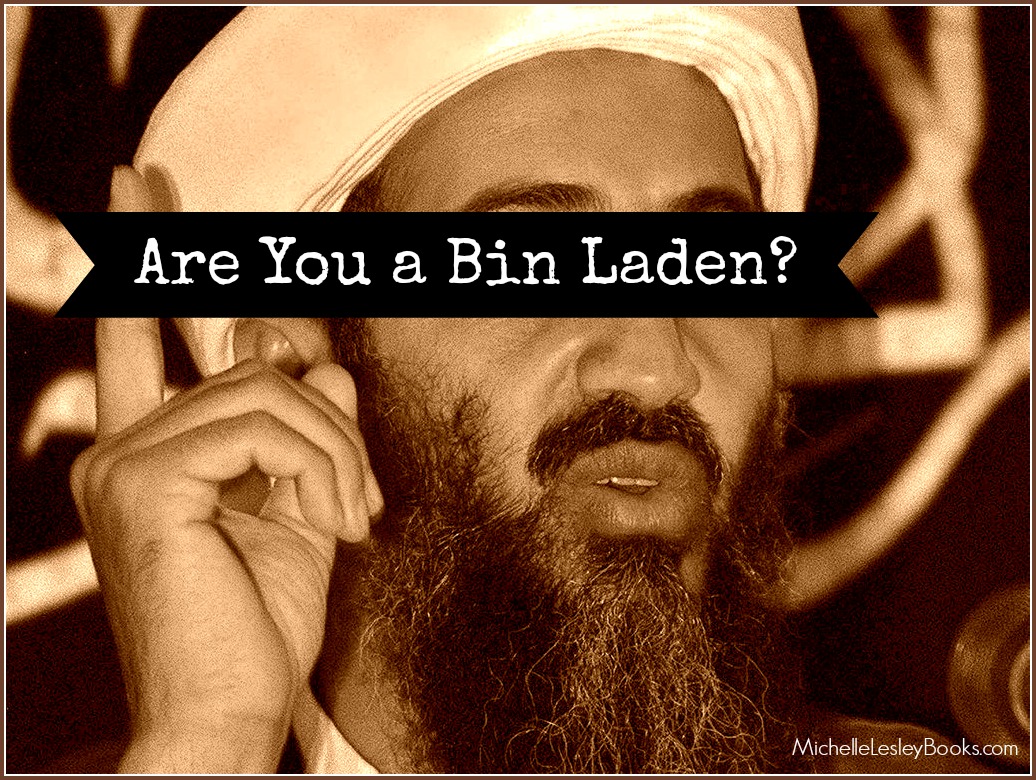
Throwback Thursday ~ Are you a Bin Laden?

Originally published March 2, 2011bin laden

Osama Bin Laden is dead.  Across the globe, people are celebrating.  There’s a general sentiment, even among non-Christians, that he is in hell, because that’s what he deserves.

I’m guessing that, some of those people, if you had shared the Gospel with them two days ago, would have said they didn’t believe in hell.  Or that a loving God wouldn’t send people to hell.  Or that God just forgives everybody when they die, and everybody goes to heaven.

If you hold any of those beliefs, the law of non-contradiction requires that they be applied across the board to everybody.  In other words, you can’t say you don’t believe in hell and at the same time believe that Bin Laden is in hell.  If it doesn’t exist, he can’t be there.

So I’d like to pose two questions to people who hold the aforementioned beliefs:

1. If God decided not to send Bin Laden to hell, but rather allowed him into heaven, has justice been done?

2. Do you think it’s fair that you will have to spend your own eternity in heaven with Bin Laden?  And Hitler, and Nero, and Mussolini, and Caligula, and Jack the Ripper?

As broken and messed up as we are, even we humans demand that there be justice –punishment– for people who have committed such heinous crimes.  If God doesn’t punish these awful people, what does that make Him?  How could He be perfect in every way and let such people off scot free?

I can tell you how.  Because I used to be Bin Laden.  And Hitler, and all of those other people rolled into one.  Me.  A good little Sunday School girl.  Guilty.  James 2:10 tells us:

For whoever keeps the whole law and yet stumbles in one point, he has become guilty of all.

In God’s eyes, when I broke curfew to stay at Bible study just a little bit longer, I was as guilty as a serial murderer.  When I said, “Oh my G-d!” I was on par with a child molester.  When I refused to forgive someone, I might as well have flown one of those planes into the Twin Towers myself.  And I deserved the same punishment as all of those horrible people.  Hell.

God is perfect.  He’s perfectly holy and perfectly just.  And that’s why He can’t let any sin slide, no matter how small.  But He’s also perfectly loving and compassionate.  He knew none of us would measure up to his standard for us –perfection, no sin whatsoever– so He made a way for us to escape punishment, yet still serve justice: Jesus.

God Himself came here and lived out His perfection as a human being.  And when it was time, on the cross, He took the punishment for our crimes against God.  He got our sin and our punishment, and because of His death and resurrection, we can get His sinless perfection.

We can get it, but it’s not an automatic thing that just happens to everybody when they die.  As I said in a previous post, you can’t have it both ways.  If you decide to get married, you give up the single life.  If you decide to become a star athlete, you give up being a couch potato.  And when God enables you to turn from your sin to faith in Christ, He empowers you to give up a life of embracing sin, and, instead, embrace Christ and the new life He has for you.  Here.  Now.

Is Bin Laden in hell?  I can tell you with certainty that if he did not, in the last moments of his life, sorrowfully turn from his sin and bow his knee to the Lordship of Jesus Christ, yes, he is indeed in hell.

And there, but for the grace of God, go I.  And you.

Wednesday's Word

Wednesday’s Word ~ Isaiah 64

is 64

Isaiah 64

Oh that you would rend the heavens and come down,
    that the mountains might quake at your presence—
2 as when fire kindles brushwood
    and the fire causes water to boil—
to make your name known to your adversaries,
    and that the nations might tremble at your presence!
3 When you did awesome things that we did not look for,
    you came down, the mountains quaked at your presence.
4 From of old no one has heard
    or perceived by the ear,
no eye has seen a God besides you,
    who acts for those who wait for him.
5 You meet him who joyfully works righteousness,
    those who remember you in your ways.
Behold, you were angry, and we sinned;
    in our sins we have been a long time, and shall we be saved?
6 We have all become like one who is unclean,
    and all our righteous deeds are like a polluted garment.
We all fade like a leaf,
    and our iniquities, like the wind, take us away.
7 There is no one who calls upon your name,
    who rouses himself to take hold of you;
for you have hidden your face from us,
    and have made us melt in the hand of our iniquities.

8 But now, O Lord, you are our Father;
    we are the clay, and you are our potter;
    we are all the work of your hand.
9 Be not so terribly angry, O Lord,
    and remember not iniquity forever.
    Behold, please look, we are all your people.
10 Your holy cities have become a wilderness;
    Zion has become a wilderness,
    Jerusalem a desolation.
11 Our holy and beautiful house,
    where our fathers praised you,
has been burned by fire,
    and all our pleasant places have become ruins.
12 Will you restrain yourself at these things, O Lord?
    Will you keep silent, and afflict us so terribly?

The Holy Bible, English Standard Version Copyright © 2001 by Crossway Bibles, a division of Good News Publishers.

Questions to Consider:

1. Who is speaking, and who is being spoken to in this chapter? Summarize in a sentence or two the thrust of what is being said.

2. What type of discourse is this chapter? Is it a historical narrative? A hymn of praise? A prayer? A genealogy? A lament?

3. What is the reason, given in verses 5 & 9, that God is angry?

4. What are some of the things verses 10-12 say that Israel has suffered as a result of her sin? What is God’s ultimate goal in allowing Israel to suffer?

5. Is God still angered over sin today? (Romans 1:18) What solution to God’s wrath over our sin does He offer us? (John 3:36, Romans 5:9, 1 John 1:9)