Or maybe I answered your question already? Check out my article The Mailbag: Top 10 FAQs to see if your question has been answered and to get some helpful resources.
Hey just curious why when I click on Sean Feucht it just sends me to a Justin Peters video on him from 2 months ago? Is that a glitch?
It’s not a glitch. The link is taking you right where I meant for it to take you. I’m not sure if you’re asking because you expected all of the links to go an article I had written or if there was another reason, but not all of the links on that page go to an article I wrote.
The main reason for this is that I usually don’t have on hand the 10-20ish hours it takes to write a thorough discernment article on everybody. But I know y’all need information on these teachers now, so if I come across a good resource from someone else, I’ll go ahead and link it up for you. Also, most of those outside resources I’ve linked are so thorough and well done that I don’t feel the need to re-invent the wheel. I’m very thankful for the handful of brothers and sisters out there who are doing a great job of exposing false teachers and false doctrine. It lightens the load for all of us who do discernment work.
In addition to Sean Feucht, over the last few months I’ve also added resources for baptismal regeneration, Shawn Bolz, Core Group/Jenny Weaver, Eastern Orthodox, Kathryn Krick, Greg Laurie, Rebecca McLaughlin, Kristi McLelland, the New Apostolic Reformation, Right Now Media, Heidi St. John, and Wesleyanism. Check it out if you haven’t stopped by recently!
Other than yours, are there any podcasts you can recommend for women? Age wise 40-50’s. Thank you!
Thank you so much for listening to A Word Fitly Spoken! Yes, I would recommend, regardless of age, the podcast of anyone listed at the Recommended Bible Teachers, Authors, etc. tab in the blue menu bar at the top of this page. (Don’t limit yourself to female podcasters, teachers, etc. There are a lot more doctrinally sound men out there than women.)
A few more that aren’t listed there (only because I haven’t had time to update that page in a while) that I listen to are:
The Studio Revue with Sam Reid (This one isn’t Christian content, it’s just wholesome fun. I got hooked on it earlier this year.)
I’m wondering what/how would be the best way to approach my pastor about Jennie Allen and other doctrinally weak/unsound women whose studies are currently being taught at the church I’m a member of. At the risk of appearing obtuse or haughty, I’m hesitant to share these insights with the women (who I esteem more spiritually mature than I) who are overseeing the women’s Bible studies, especially as they continue to choose these authors who clearly are unsound or weak in theology and doctrine.
I’m so sorry this is happening at your church. I hope it will help you to know that you’re not alone. I’ve been in the same situation myself, and I’ve heard from hundreds of other women over the years who have also been in this situation. Sadly, my article The Mailbag: How should I approach my church leaders about a false teacher they’re introducing? is the one I most often have to share with readers.
And listen, if these women are following false teachers, they are not the spiritually mature ones, no matter how they seem or how they present themselves. If you’re discerning enough to understand from Scripture that they’re following false teachers, and you love them and your church enough to try to help, you are the spiritually mature one in this situation. That’s not haughty, that’s simple, objective, biblical fact.
I have taken a moment to pray for you, and I wish you well.
I’ve heard that Christians shouldn’t read horoscopes or get involved with astrology, but weren’t the wise men who came to see Jesus astrologers? Maybe there’s something to astrology.
Well, if we were to say that, then we could also say maybe there’s something to stealing, too. Because, after all, that’s what got the thief on the cross to Jesus, and Jesus said that he would be with Him in Paradise that day. And maybe there’s something to persecuting and murdering Christians, too, because that’s how Paul came to encounter Jesus. But we don’t say those things because that’s not the way we rightly handle and apply Scripture.
There are two broad categories of Scripture: descriptive passages and prescriptive passages. Descriptive passages are descriptions of something that happened, like the story of the wise men visiting Jesus, or Noah and the ark, or David and Goliath. Prescriptive passages could also be called commands or direct instructions, “thou shalts” and “thou shalt nots.”
When we have a question about whether or not it’s OK with God for us to do something, say, consulting horoscopes and astrologers, we look first at the relevant prescriptive passages, like this one:
When you come into the land that the Lord your God is giving you, you shall not learn to follow the abominable practices of those nations. There shall not be found among you anyone who burns his son or his daughter as an offering, anyone who practices divination or tells fortunes or interprets omens, or a sorcerer or a charmer or a medium or a necromancer or one who inquires of the dead, for whoever does these things is an abomination to the Lord. And because of these abominations the Lord your God is driving them out before you. You shall be blameless before the Lord your God, for these nations, which you are about to dispossess, listen to fortune-tellers and to diviners. But as for you, the Lord your God has not allowed you to do this.
Deuteronomy 18:9-14
While this passage was obviously written as a command to Old Testament Israel, we can still draw out some applicable principles for today by asking ourselves why “the Lord your God has not allowed you to do this.” God calls these practices an “abomination” several times and links them to paganism. Verse 14 is reminiscent of 2 Corinthians 6:14-18 and 1 John 2:15-17, which tell us not to love or partner with the dark things of the world and to separate ourselves from such things.
This is a clear, prescriptive passage that answers our questions about following horoscopes and astrology, so this is where we get our instruction, not from a descriptive passage about someone who was an astrologer.
Additionally, there’s good reason to believe that the wise men who went to see Jesus were not astrologers in the same horoscope/tarot card/palm reading/fortune teller sense in which we use the word “astrology” today. The Greek word translated as “wise men” is magos (magi). Its primary meaning is “Oriental scientist,” a term which was also applied to teachers, priests, and physicians, among others. It would seem that the wise men were much more akin to astronomers than astrologers, and were learned in the Old Testament messianic prophecies as well.
Will a Believer who commits suicide still go to Heaven?
Yes. The key word here is “Believer.” People who are genuinely born again Christians spend eternity in Heaven when they die. It is not a particular sin that sends people to Hell, but rather that they die in a state of lostness and unbelief. If you think about it, because sin is so sneaky and pervasive most Christians will have some unconfessed sin in our lives at the moment of our death, whether that sin is suicide, unforgiveness, lust, a lie, or whatever. At the moment of salvation, Christ’s death, burial, and resurrection pays for ALL of a Believer’s sins, from cradle to grave. While we should always strive to repent of any known sin in our lives, we must also trust in God’s grace, mercy, and forgiveness towards His children.
Is it OK if I email you/private message you on social media about…
Yes. You do not need to ask my permission before emailing or DM-ing me. Just go ahead and send me the email/DM. The only thing is, you need to understand that I will probably not answer your email or DM personally (unless it’s related to a speaking engagement). I answer readers’ questions via The Mailbag. I’ve explained why at the Contact and Social Media tab (All together, class: “…in the blue menu bar at the top of this page.”).
If you have a question about: a Bible passage, an aspect of theology, a current issue in Christianity, or how to biblically handle a family, life, or church situation, comment below (I’ll hold all questions in queue {unpublished} for a future edition of The Mailbag) or send me an e-mail or private message. If your question is chosen for publication, your anonymity will be protected.
Welcome to another “potpourri” edition of The Mailbag, where I give short(er) answers to several questions rather than a long answer to one question. I also like to take the opportunity in these potpourrri editions to let new readers know about my comments/e-mail/messages policy. I’m not able to respond individually to most e-mails and messages, so here are some helpful hints for getting your questions answered more quickly. Remember, the search bar can be a helpful tool!
I was wondering what your views were on “ungodly soul ties”, in reference to past relationships? If I was in a previous relationship with someone who I was involved with physically, mentally, spiritually and emotionally, how would I loose myself from that?
The concept of “soul ties” is not biblical. It is not mentioned or even hinted at in the Bible. Proponents of this heretical doctrine, as you can see in this article, Basic Introduction to Soul Ties,¹ will try to convince you that soul ties are biblical by taking all manner of Bible verses out of context and stretching and twisting them like Silly Putty to try get them to mean what they want them to mean. All you have to do is look up the verses they cite, and read them in context to see that none of these passages say that one person’s soul can be literally bound to another person’s soul.
I find it especially laughable that many of the verses they cite in support of soul ties are the “one flesh” verses, such as Ephesians 5:31 (which is actually a quote of Genesis 2:24). Don’t you think that if God, the creator of language, meant to convey in these verses that two people’s souls were tied together, that He would have said “one soul” instead of “one flesh“? Or that He would have clearly said: “In this type of close relationship, the two people’s souls are bound together.”? This is God we’re talking about, here. He’s perfectly capable of explaining Himself clearly. He knows what words mean, and He never makes a mistake and chooses the wrong word. And yet, time and time again in Scripture, He uses the words “one flesh” to describe the intimacy of marriage and sexuality, and He never, anywherein Scripture, even suggests that the souls of two people are bound together under any circumstances.
Soul ties are just one more piece of false doctrine usually taught by those in the heretical New Apostolic Reformation camp. (When I Googled “soul ties”, articles by Kris Vallotton {Bethel}, Terri Savelle Foy, and Paula White – all among the worst of the worst of the NAR and prosperity preaching – were on the first page of results. That should tell you something.) There is no way your spirit can be tied or bound to someone else’s spirit.
I’m not sure what you mean by being involved with someone “mentally” and “spiritually”, but I’m assuming you don’t mean that you were in Mensa together or that you had long talks about theology and frequently prayed together. Those might be fond memories that make you wistful, but no mental or spiritual activity you participate in with someone else binds your soul to his or is something you need to be “loosed” from.
What you need to do is read your Bible, understand what it says about sin, and if you sinned in any way in this relationship (for example, sex outside of wedlock, putting your love for this person ahead of your love for the Lord, being influenced by this person to lie, etc.) you need to repent, not “be loosed” (because you’re not bound to this person, and because repentance from sin is the biblical way of thinking about this situation). You may also need to avoid spending time with or talking to this person for a while. And if you’re really having trouble getting over the relationship, you might want to seek counsel from a doctrinally sound pastor (one who understands that soul ties are unbiblical) or an ACBC certified Biblical Counselor.
That’s truly all there is to it. The spirit-realm mumbo jumbo of “soul ties” is a bunch of mystical malarkey. Your spirit isn’t tied to anyone else’s spirit, you’re just sad that the relationship is over, having difficulty moving on with your life, and, perhaps missing the person. And it’s OK if that sounds earthly and pedestrian. Because it is. But if Christ is your Savior, you can trust Him to carry you through it.
¹Just in case it isn’t abundantly obvious, this is a heretical New Apostolic Reformation article/website, and I certainly don’t recommend it.
We recently moved and have been attending a Southern Baptist church. They have not had communion for over two months. Isn’t it the norm to have communion at least once a month?
Also there is no women’s ministry that I can be involved with which is very disappointing to me. I would even be willing to teach/lead a women’s study but since we are new to this church we are still waiting and learning our place. We hesitate to make ourselves known as possibly unsubmissive or question why they do things the way they do.
Why no communion or women’s Bible study? Your thoughts would be enlightening.
These are such great questions because they help me, as a Southern Baptist, think about the way we do things and how those practices might be perceived by visitors or new members.
Communion/Lord’s Supper: Every Southern Baptist church is autonomous, so each church has its own policy or practice about how often the Lord’s Supper is observed. There are some SBC churches who hold the Lord’s Supper every week and probably others who hold it only once or twice a year, although I don’t personally know of any who hold it that infrequently.
In my experience, most Southern Baptist churches observe the Lord’s Supper several times a year, usually on a schedule like the first Sunday of the month, once a quarter, or every “fifth Sunday” (in months that have five Sundays). In addition to these scheduled observances, many churches also observe the Lord’s Supper at their Christmas Eve, Good Friday, or Easter service.
Women’s Ministry:I understand your disappointment in the lack of women’s ministry at the church. I would be somewhat disappointed too. There could be a variety of reasons for this. Maybe they had a women’s ministry that veered off into error or personality conflicts, so the pastor put it on hiatus for a while. Maybe no one stepped up to volunteer to lead it. Or, maybe the pastor wants everyone’s focus to be on the worship service and Sunday School with no distractions. But even if there isn’t a formal women’s ministry, you can still invite women over to your home, go out for coffee or dinner together, or study God’s word and pray together with a few others. I found this article – Ministry to Women When There’s No “Women’s Ministry” – really helpful.
Asking Questions: I would encourage you and your husband to set up an appointment with the pastor and ask away! It is certainly not unsubmissive to sit in his office and politely say, “We’re new here and we were just wondering about…” Most pastors I know would love for potential members to do this. (In fact at my church, once a month my pastor holds a sort of “orientation”/Q&A class for potential members during the Sunday School hour.) You need to know where he and the church stand on various doctrinal issues and practices so you won’t be unpleasantly surprised after you’re already members. This is especially important if you’re new to being a Southern Baptist as well as being new to the church. If the pastor in any way discourages you from asking genuine, courteous questions or sees your questions as a threat to his authority, that’s a red flag telling you that you should not join this church.
In the past I purchased books and “studies” by authors I now know are false teachers- an embarrassing amount of them really. I am wondering now what do with all of them…I don’t feel I am mature enough in my walk with Christ yet to read any of them and test them against Scripture myself, but I also don’t feel like passing them on to someone else is right either. Just wondering your thoughts on this.
You’re correct, you should not pass on books containing false doctrine to others, donate them to libraries (especially church libraries), Goodwill, or thrift stores, or sell them in a garage sale. The only scenario I can think of in which passing along a book authored by a false teacher would be OK is if it is to someone you know is a mature, doctrinally sound Christian who needs it for research purposes or to write a review of it warning people away from it.
I would also suggest that you not simply throw throw the books in the trash or recycling unless you render them unreadable (ex: scribbling on or tearing up the pages) first. People have been known to take “freebies” out of the trash.
Here are two ways I’ve handled heretical books I’ve been given:
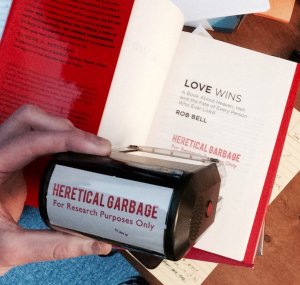
1. Keep them for research purposes. (If you think you might be tempted to read them and you don’t feel like you’re spiritually mature enough to handle that yet, maybe box them up and put them in storage for a later date.) You might want to mark them in some sort of way – in case you lose the book and someone else finds it or something like that – indicating that the book is false doctrine. My friend, Pastor Nate Pickowicz, has an awesome stamp for his “research only” books:
2. Burn them. I know it reeks of Nazism and censorship by wild-eyed preachers of yesteryear, but it’s biblical, it keeps false doctrine out of the hands of others, and these books can actually have a positive use for kindling if you have a fireplace or chiminea. (Please use all fire safety precautions. Also, it is not necessary to burn the books publicly.)
Is it Biblical for a woman to be in charge of the children’s ministry? Especially one who is not doctrinally sound?
It isn’t biblical for anyone who’s unrepentantly and unteachably doctrinally unsound to be in charge of anything in the church.
If it’s a case like Apollos, in which the person in question simply doesn’t know any better, but changes her ways and embraces sound doctrine when corrected, that’s cause for giving glory to God. (Also, she might need more training in the Scriptures before she resumes her position of service.)
But if it’s a case in which the person persists in teaching false doctrine or acting sinfully, that’s cause for church discipline. And if she steadfastly refuses to repent despite biblical rebuke, she needs to be disfellowshipped from membership in the church. Of course, it should go without saying (unfortunately, it doesn’t these days) that people who aren’t church members and/or aren’t saved should not be given any position of service or leadership in the church.
It couldbe OK for a doctrinally sound woman to be in charge of the children’s ministry, depending what you mean by “in charge”, and depending on whether or not she can do so without violating Scripture:
1. She should not be considered as, or bear the professional title of, “pastor”. It is unbiblical for a woman to be a pastor, and if she’s not a pastor, then bearing the professional title of “pastor” is lying.
2. In her leadership duties, she should not teach adult men (for example, men who teach children’s Sunday School classes, if she oversees children’s Sunday School) the Scriptures or exercise authority over them.
3. The pastor, or an appropriate elder, should vet and approve any curricula and materials, guest speakers, activities, etc., she wishes to use.
If a pastor or elder oversees her leadership so that she is acting under his authority and at his direction, and she is not violating Scripture by preaching to men, teaching men Scripture, or exercising authority over men, I don’t see why it would be a problem for a woman to lead the children’s ministry. In fact, Christian women and churches who handle this properly could be a superb example and model for other Christian women and churches.
If you have a question about: a Bible passage, an aspect of theology, a current issue in Christianity, or how to biblically handle a family, life, or church situation, comment below (I’ll hold all questions in queue {unpublished} for a future edition of The Mailbag) or send me an e-mail or private message. If your question is chosen for publication, your anonymity will be protected.
This was a reader’s recent response to one of my articles warning about a false teacher, and I thought I’d share and expand on my response to her here, because I know many of you, when you’ve said or posted things about false doctrine or false teachers, have had someone pridefully and self-righteously attempt to shame you and shut you up with a worldly twisting of these precious words of our Lord Jesus…
Some pridefully and self-righteously attempt to shame Christians and shut us up with a worldly twisting of these precious words of our Lord Jesus: “Judge not.”
You know, Matthew 7:1 is a great verse, but it’s currently probably the most twisted and abused Bible verse there is. And this is one common abuse of it – defending false teachers.
If you weren’t sitting under false teachers like the one you’re defending, you might have an accurate and biblical understanding of what that verse actually means. Instead, you’re believing and using the world’s twisted version of it.
Matthew 7:1 does not mean Christians shouldn’t warn against false teachers.
Matthew 7:1 does not mean Christians shouldn’t warn against false teachers.
If that’s what Jesus meant when He said that, He would have been contradicting Scripture, because there are many, many passages of Scripture that command us – and pastors in particular – to warn against false teachers and eradicate them from the church.
He must hold firm to the trustworthy word as taught, so that he may be able to give instruction in sound doctrine and also to rebuke those who contradict it.
Titus 1:9
Titus 1:9 is the final requirement in the list of qualifications for pastors/elders in Titus 1. If a pastor does not rebuke and warn against those who contradict sound doctrine (i.e. false teachers) he is biblically disqualified from the pastorate.
But now I am writing to you not to associate with any so-called brother if he is a sexually immoral person, or greedy, or an idolater, or a reviler, or a drunkard, or a swindler—not even to eat with such a one. 12 For what have I to do with judging outsiders? Are you not to judge those who are within the church? 13 But those who are outside, God will judge. Remove the wicked man from among yourselves.
1 Corinthians 5:11-13
False teachers – who claim to be brothers and sisters in Christ – are idolators (some of them are sexually immoral, greedy, revilers, drunkards, and swindlers as well) because they create a god according to their own liking, steal biblical names (like God or Jesus) for it, and teach people to worship their false god instead of the one true God Scripture reveals to us. Scripture clearly commands us to judge them and remove them from the church.
And the idea that Jesus would have contradicted Scripture is just silly and ridiculous. We know God doesn’t contradict Himself, or He would be a liar and would cease to be God.
The idea that Jesus would have contradicted Scripture is just silly and ridiculous.
in the hope of eternal life, which the God who cannot lie promised from all eternity,
Titus 1:2
Furthermore, the Jesus who said “Do not judge,” in Matthew 7 is the same Jesus who tells us that we are to “judge with righteous judgment” in John 7.
Do not judge according to appearance, but judge with righteous judgment.
John 7:24
In Matthew 7:1, as you can plainly see by reading verses 1-5,…
“Do not judge, so that you will not be judged. 2 For with what judgment you judge, you will be judged; and with what measure you measure, it will be measured to you. 3 And why do you look at the speck that is in your brother’s eye, but do not notice the log that is in your own eye? 4 Or how can you say to your brother, ‘Let me take the speck out of your eye,’ and behold, the log is in your own eye? 5 You hypocrite, first take the log out of your own eye, and then you will see clearly to take the speck out of your brother’s eye.”
Matthew 7:1-5
…Jesus is telling us not to judge unrighteously (in juxtaposition to his admonition in John’s account to judge righteously) or hypocritically – in other words…
We’re not to judge others when we’re equally guilty of unrepentant sin.
We’re not to judge others for doing something we’re currently guilty of ourselves.
We’re not to judge others for doing something that’s actually biblical just because it offends our worldly, fleshly sensibilities.
Kind of like what you’re doing by unrighteously, unbiblically, and hypocritically judging me for warning against false teachers, which, again, is actually commanded and demonstrated by God in Scripture. How could I be doing something wrong when I’m doing what Scripture tells me to do?
When you chide a doctrinally sound Christian for warning against false teachers, you are the one who is unrighteously, unbiblically, and hypocritically judging.
You might also notice that in the same chapter (Matthew 7) in which Jesus says “Do not judge,” in verse 1, He goes on to warn against – and judge – false teachers:
Beware of the false prophets, who come to you in sheep’s clothing, but inwardly are ravenous wolves. 16 You will know them by their fruits. Are grapes gathered from thorn bushes or figs from thistles? 17 Even so, every good tree bears good fruit, but the bad tree bears bad fruit. 18 A good tree cannot bear bad fruit, nor can a bad tree bear good fruit. 19 Every tree that does not bear good fruit is cut down and thrown into the fire. 20 So then, you will know them by their fruits. 21 “Not everyone who says to Me, ‘Lord, Lord,’ will enter the kingdom of heaven, but he who does the will of My Father who is in heaven will enter. 22 Many will say to Me on that day, ‘Lord, Lord, in Your name did we not prophesy, and in Your name cast out demons, and in Your name do many miracles?’ 23 And then I will declare to them, ‘I never knew you; depart from Me, you who practice lawlessness.’
Matthew 7:15-23
And that’s not the only time Jesus warned against, rebuked, or judged false teachers…
…beware of the leaven of the Pharisees and Sadducees.” 12 Then they understood that He did not say to beware of the leaven of bread, but of the teaching of the Pharisees and Sadducees.
Matthew 16:11b-12
And perhaps Jesus’ lengthiest, most scathing warning about and rebuke of false teachers is found in Matthew 23:1-36. Just a few choice excerpts since this is a long passage – here’s the warning to the hearers:
Then Jesus spoke to the crowds and to His disciples, 2 saying: “The scribes and the Pharisees have seated themselves in the chair of Moses; 3 therefore all that they tell you, do and keep, but do not do according to their deeds; for they say things and do not do them. 4 And they tie up heavy burdens and lay them on men’s shoulders, but they themselves are unwilling to move them with so much as a finger. 5 But they do all their deeds to be noticed by men;
Matthew 23:1-5a
“They say things and do not do them…they do all their deeds to be noticed by men…” Huh. There’s that hypocrisy Jesus was talking about back in chapter 7.
Here’s the rebuke to the false teachers themselves:
“But woe to you, scribes and Pharisees, hypocrites, because you shut off the kingdom of heaven from people; for you do not enter in yourselves, nor do you allow those who are entering to go in…you travel around on sea and land to make one proselyte; and when he becomes one, you make him twice as much a son of hell as yourselves…You blind guides…For you clean the outside of the cup and of the dish, but inside they are full of robbery and self-indulgence….you are like whitewashed tombs which on the outside appear beautiful, but inside they are full of dead men’s bones and all uncleanness. In this way, you also outwardly appear righteous to men, but inwardly you are full of hypocrisy and lawlessness…You serpents, you brood of vipers, how will you escape the sentence of hell?…I am sending you prophets and wise men and scribes; some of them you will kill and crucify, and some of them you will flog in your synagogues, and persecute from city to city, so that upon you may fall the guilt of all the righteous blood shed on earth…
Excerpted from Matthew 23:13-35
I’ve never warned against or rebuked a false teacher this sharply, but Jesus did. And we know He was right in doing so. But if you’re going to judge, criticize, and condemn someone like me who merely points out, in a matter of fact tone, how false teachers deviate from Scripture, and urges you, therefore, to obey God’s commands to have nothing to do with them, my goodness, what in the world are you going to say to Jesus about the way He warned against and rebuked false teachers?
If I’m wrong for saying, Teacher X is a false teacher because she preaches to men, teaches false doctrine, and yokes with other false teachers, and, therefore, I would not recommend you follow her, is Jesus wrong for calling false teachers “blind guides,” “whitewashed tombs,” and “brood of vipers”?
You’d best think on that lest you be hypocritical in your judgment.
The world has taken Matthew 7:1 and blasphemously twisted it into a club with which to pummel Christians who stand unwaveringly on the truth of God’s Word and, with Spirit-empowered courage, love sinners enough to call them to repent and believe the gospel, and love God, the church, and professing Christians enough to warn them against harmful false teachers and false doctrine.
The world has taken Matthew 7:1 and blasphemously twisted it into a club with which to pummel Christians, and, sadly, many professing Christians have followed the world’s example.
To the world, “Judge not,” means, “Don’t you ever dare say anything that’s not 100% affirming of me, my beliefs, or my sin of choice. Always be nice. Never say anything that could, in any way, be construed as negative. If you do, you’ll suffer the consequences.”. And, sadly, professing Christians discipled by the world and false teachers have adopted this worldly definition of “judging” and wield it like a weapon to shame and shut up Christians who are obeying Scripture.
But as genuinely regenerated Believers, accurately handling the Word of truth and having it illumined to us by the indwelling Holy Spirit, we know that Matthew 7:1 cannot possibly mean that we are not to warn against false teachers, because…
Jesus didn’t contradict Scripture, and Scripture commands us to warn against, rebuke, and judge false doctrine and false teachers.
Jesus didn’t contradict Himself during His earthly ministry, saying “Don’t judge,” in Matthew and “Do judge,” in John and other passages.
Jesus Himself warned against, rebuked, and judged false doctrine and false teachers.
We know that Matthew 7:1 doesn’t mean, “Don’t warn against false teachers,” because: Jesus didn’t contradict Scripture, Jesus didn’t contradict Himself, and Jesus Himself warned against, rebuked, and judged false teachers.
If you have a question about: a Bible passage, an aspect of theology, a current issue in Christianity, or how to biblically handle a family, life, or church situation, comment below (I’ll hold all questions in queue {unpublished} for a future edition of The Mailbag) or send me an e-mail or private message. If your question is chosen for publication, your anonymity will be protected.
Death comes for us all, including false teachers and heretics.
And how do we find out, and express our feelings about, the deaths of evangelical celebrities? It used to be via the newspaper and around the water cooler. Now it’s on social media.
There are three typical social media responses when a false teacher dies: Her fans laud her and turn her into a virtual saint. A few who claim to be Christians dance on her grave in celebration. And doctrinally sound Christians are kind of left groping for how to respond, biblically. There’s a feeling of wanting to have compassion for the family who has lost a loved one while not appearing to endorse or approve of the deceased’s false teaching and sin merely because she has died.
So how can we respond biblically to the death of a false teacher?
1. Distinguish the Biblical Response from the Cultural Response
“Don’t speak ill of the dead.” Where is this idea taught in Scripture? I can’t find it anywhere, can you? Does that mean we should speak ill of the dead? Of course not, because we don’t find a command to do that in Scripture either. I’m just trying to point out that a lot of the notions we have about death and other issues in life don’t come from the Bible, they come from our culture, etiquette, tradition, etc. If we truly want to respond to a false teacher’s death – or do anything else, really – in a biblical way, we need to be able to separate what the Bible tells us to do from what culture and society tell us is the right thing to do. In all aspects of life, that ability has never been more crucial than it is now.
2. To Respond or Not to Respond; That Is the Question
There’s absolutely no biblical requirement for anyone to proffer an unsolicited public comment on the death of a false teacher. Or anyone else for that matter. Other than mentioning her name in this article, I have not publicly commented on the death of Rachel Held Evans for several reasons, though I found out about her passing shortly after it happened. My friends Gabe and Elizabethdid decide to comment on her death, and, in my opinion, both did a lovely job. Commenting or deciding not to comment can both be perfectly biblical.
The only time it’s really incumbent upon a Christian to speak to the issue of a false teacher’s death is when someone you know asks you about it directly. And even then, if the person seems to be overwrought with emotion, it might be wisest to simply postpone your comment until after a “cooling off” period has taken place.
3. How to Respond
Briefly. Because the longer your comment, the greater chance you will either slip into eulogizing the false teacher or, conversely, making unnecessarily inflammatory remarks that will only serve to stir the ire of her family and followers and will make you look like a jerk.
Gently. Because even the gentlest remark is going to pour salt into the wound of someone who’s grieving if you’re not outright praising the deceased. And though “Don’t speak ill of the dead” isn’t a biblical concept, if you’re addressing the followers of a false teacher, you’re probably not dealing with people who are going to split that biblical/cultural hair. If they were overly concerned about distinguishing biblical concepts from worldly concepts, they wouldn’t be following a false teacher in the first place. Be sensitive to their cultural mores of gentle speech in this instance or you surely won’t get a hearing.
Non-speculatively. Because you do not have God’s omniscience, and speculation can serve no helpful purpose. Is it possible God ended the false teacher’s life as judgment for her unbiblical teachings? Yes. It is also possible He ended her life for a completely different reason known only to Him. Is it likely she will be spending an eternity in Hell? Yes. But unless you were at her bedside listening to her blaspheme the name of the Lord with her final breath, you don’t know that for certain.
Evangelistically. Because the greatest thing that could come out of the false teacher’s death, or anyone’s really, is for someone whose ultimate hope was in the hopelessness of false doctrine to find her ultimate hope in Christ.
4. Prepare for Backlash
One of the reasons I intentionally chose not to comment on Rachel Held Evans’ death is that I knew I would receive tons of vitriolic, possibly even threatening, backlash from her disciples if I said anything about Rachel that wasn’t pure praise of her. At that moment in my week, due to various things going on in my life, I had neither the time nor the spiritual strength to deal with an onslaught like that. It’s not that I was afraid or didn’t know how to answer the barbs I’m sure I would have received, it’s just that it would have been a distraction from other things that were a higher priority in my life than responding to strangers about the death of another stranger.
If you choose to make a non-laudatory statement about the death of a false teacher, even if it’s gentle, compassionate, completely biblical, and annotated with Scripture, you must be prepared to be attacked by her followers. No matter how much the teacher claimed to be a Christian or how much her followers claim she helped them grow in the Lord, the fact of the matter is that the overwhelming majority of people who steadfastly follow, love, and defend false teachers over a long period of time are very likely not saved and will respond to your biblical remarks in the angry, emotional, often abusive way that can be characteristic of lost people.
This, in fact, happened to a Facebook friend of mine who has a growing platform. She made just such a gentle, compassionate, completely biblical statement on Facebook about Rachel Held Evans’ death. I would link to it except that she had to delete the statement because some of Rachel’s followers found pictures my friend had posted of her child and proceeded to make vile remarks and threats against her child.
This is the kind of thing you can expect if you comment with anything but praise for the deceased, so keep it in mind when you’re deciding whether or not to say anything.
5. Weep
Romans 12:15b tells us to “weep with those who weep.” It is absolutely good and kind to be compassionate toward someone – anyone – who has lost a loved one, whether it’s your brother or sister in Christ, the widow of your atheist nephew, or even the family of a false teacher. Take a look at what Jesus said in Matthew 5:43-45:
“You have heard that it was said, ‘You shall love your neighbor and hate your enemy.’ But I say to you, Love your enemies and pray for those who persecute you, so that you may be sons of your Father who is in heaven. For he makes his sun rise on the evil and on the good, and sends rain on the just and on the unjust.”
Christians showing compassion to the “evil” and the “unjust” is part of God’s common grace to the world. It is an opportunity to reflect the kindness of God that led us to repentance.
But another reason to be grieved by the death of a false teacher is that she is most likely beginning her eternity of death in Hell. Because people who continually and unrepentantly harden their hearts against God’s Word and godly rebuke and correction are displaying the fruit of an unsaved soul. And that is no reason to celebrate. As Ezekiel tells us:
Have I any pleasure in the death of the wicked, declares the Lord God, and not rather that he should turn from his way and live? Ezekiel 18:23
God does not giddily damn people. His heart is for all to come to repentance and faith in Christ. And that should be our heart as well. Could it be that, in His infinite mercy and grace, God gave that false teacher a final opportunity to repent and trust Him moments before her death? It could, and that is what we should hope for, not only for the false teacher and her eternity, but for the glory it brings to God every time He washes a sinner in the blood of Christ.
6. Rejoice
But while we demonstrate compassion for the family and grieve the likely condemnation of the false teacher, there is also a righteous, Kingdom-focused, and biblical reason to rejoice: one more voice of blasphemy, lies, and deception has been silenced. At least in the sphere of influence of that particular teacher, no one will be led astray from Christ any longer.
But the wicked will perish; the enemies of the Lord are like the glory of the pastures; they vanish—like smoke they vanish away. Psalm 37:20
God shall arise, his enemies shall be scattered; and those who hate him shall flee before him! Psalm 68:1
Will another false teacher step up to take her place? Almost certainly. Where there are those who clamor to have their itching ears scratched, a wicked confidence man will arise to peddle his ungodly snake oil. But for today, for a short time, perhaps, no wares will be sold to this crowd of customers. And that is reason enough to rejoice.
Commenting on the death of a false teacher can be a tricky needle to thread. When we choose to do so, let us exercise the common grace of compassion, reflect the kindness of a merciful God, and always be ready to give a reason for the hope that lies within us with gentleness and respect.
Good news: book nerd is in. And these days, that doesn’t just mean you have your nose stuck in a book all the time. No, you’ve really got your nerd on – you’ve got a reading goal for the year.
Whether it’s merely a certain number of books you want to read, total, or you’ve got it broken down into goals for various genres of literature, feeding your mind by reading is a worthy pursuit, especially if you’re feeding it good theology. (You might even want to join other Christians in a reading challenge such as this one from G3 or this one from Tim Challies.)
Finally, brothers, whatever is true, whatever is honorable, whatever is just, whatever is pure, whatever is lovely, whatever is commendable, if there is any excellence, if there is anything worthy of praise, think about these things.
Philippians 4:8
But, as always, you’ve got to be discerning about the books you choose. In years past, I’ve seen some of my friends posting about book reading goals for the new year and asking for suggestions of Christian books. And I’ve seen some of the suggestions that have been made. Yikes. Some of those “Christian” books your friends are suggesting are written by false teachers.
Yikes. Some of those “Christian” books your friends are suggesting for your reading goals are written by false teachers. Here are 5 ways to exercise discernment about the books you choose.
May I offer some help for being discerning about the books you choose?
1.
Stay immersed in your Bible. That way, if you come across false doctrine in a book you’re reading, you’ll know it conflicts with Scripture. Need help? Check out my Bible reading plans and Bible studies.
2.
If you’re not already a faithful member of a doctrinally sound local church, find one, join it, and sit under good preaching and teaching every chance you get. This will also help you detect false doctrine when you’re reading. (Use my Searching for a new church?resource if you need help locating a good church in your area.)
3.
Vet the author of every book you read prior to reading it. Here are some quick and easy resources that can help: