Guest Posts

Guest Post: Itching Ears

Since I’ve had to temporarily cut back on blogging I’ve asked some friends to contribute guest posts. If your theology pretty much matches up with mine (as outlined in the “Welcome” and “Statement of Faith” tabs) and you’d like to contribute a guest post, drop me an e-mail at MichelleLesley1@yahoo.com, and let’s chat about it.michael coughlin itching ears

Itching Ears
by Michael Coughlin

Itching ears abound in 2016. If you are reading this blog, you likely value discernment to a great deal. Consider a section of Scripture such as 2 Timothy 4:3-4:

For the time is coming when people will not endure sound teaching, but having itching ears they will accumulate for themselves teachers to suit their own passions, and will turn away from listening to the truth and wander off into myths.

What we see here is the contrast between those who will desire sound teaching and those who will not. False teachers will be propped up by people with ‘itching ears’ to satisfy their own lusts.

The picture painted is striking. As I write this, I am imagining if my ears were itchy how I’d be unable to avoid scratching them. In fact, just thinking about it made my ear tingle, and I had to satisfy the itch! The analogy extends to other activities as well. There is a nearly unavoidable response by unregenerate man to his or her lust to attempt to satisfy those passions. The only mode of satisfaction which must be avoided is that of repentance toward sin and faith in Christ. Anything else goes.

In comes your friendly neighborhood spiritual leader/false teacher. You know the type. He or she is likable in some important way, speaking in a way which boosts self-esteems, smiling a lot, and using the word “God” or the phrase “God’s Word” like they were called to it! This false teacher may even proclaim the name of Jesus unashamedly. These folks are like a fingernail on the itch…they possess exactly what is needed to temporarily satisfy the longing!

So, good, discerning people like you and I investigate them. We watch a few sermons, read some of their websites or publications, and we write a post on a blog warning the brethren of the insidiousness of the false teacher. Maybe we throw out a tweet or two reminding people we love that this teacher will lead them away from God. Who knows, a Facebook group could ensue…and even be warranted. We use phrases like, “love rejoices in truth!” And we really believe that and mean it.

But I have noticed something which occurs once in a while which I think is ungodly and detracts from our real message. It seems to occur in media where shorter quips are thrown out, like Twitter, but can happen everywhere. Now I’m going to say something that to some people will be difficult to swallow:

Not every time a bad or false teacher says something are they wrong.

Yes, you read that right. Joel Osteen, Joyce Meyer, TD Jakes, Benny Hinn and Paula White are all right sometimes. Each of the examples above are folks who, made in God’s image, cannot help but agree with at least some things God has said. Just like the atheist who actually lives according to God’s precepts which are written on his heart…these people have an understanding of some of the things of God. Think about it…when they actually do quote Scripture they are saying something true.

I know, I know…”but they twist it,” you say! Yes, often they do. But not EVERY TIME, to be sure. The trend that most concerns me is the trend I see which is to take a single sentence or two out of the context that was given and absolutely lambaste a false teacher for their heretical beliefs. If anyone did that with the theologians you like and I look up to as well, we’d be annoyed. Good men (including Jesus, John, Paul) have made statements that, out of the context the statement was uttered, would be terribly evil or at least inane.

How many times has someone reminded you Jesus said “Judge not?” It would be easy to make a case for sinless perfection being taught by the Apostle John from 1 John, if you take a few verses out of context. And Paul? I don’t know how many times I’ve heard the ‘Paul was a misogynist’ argument based on a handful of instructions concerning women. And honestly, I can see how it would sound like it out of context.

My point is this – we ought to give the most ardent false teacher the same treatment as we give the Bible and good teachers in regard to judging the things they say in context. Not because they deserve it, but because it is the right thing to do. When we attack something that someone didn’t exactly say, we commit an error which is easily refuted by those who are being led astray by these folks, and we come out looking like the fools who can’t even be honest about what the person we are attacking really meant.

We owe it to our great God and Savior Jesus Christ to honestly present and assess opposing teachings to His wonderful doctrines. It is scholarly to make cases for biblical teaching against the best possible arguments against it. It is immature and dishonest to mischaracterize your opposition’s argument, and no honor is given to God in that process.

Application: So what do we do with this knowledge? Commit with me to ensure that you will treat false teachers’ statements like we would treat our favorite preacher’s statement, evaluating them in context. It may take a little effort, but it will be worth it. Most of the world’s false teachers say enough wicked, contradictory-to-Scripture things that you don’t have to reach too hard to find something to expose them for what they are!


Michael Coughlin is a street evangelist from Ohio. He and his wife, Erin have 5 children. You can find him on Twitter, at his blog, or on Sermon Audio.


ALTHOUGH I DO MY BEST TO THOROUGHLY VET THE THEOLOGY OF THE BLOGGERS WHO SUBMIT GUEST POSTS, IT IS ALWAYS POSSIBLE FOR THINGS TO SLIP THROUGH THE CRACKS. PLEASE MAKE SURE ANY BLOGGER YOU FOLLOW, INCLUDING ME, RIGHTLY AND FAITHFULLY HANDLES GOD’S WORD AND HOLDS TO SOUND BIBLICAL DOCTRINE.

 

Discernment

Discernment: What’s Love Got to Do with It?

…so that we may no longer be children, tossed to and fro by the waves and carried about by every wind of doctrine, by human cunning, by craftiness in deceitful schemes. Rather, speaking the truth in love, we are to grow up in every way into him who is the head, into Christ…

Ephesians 4:14-15

Christians who know what discernment is have a variety of perspectives about how it should be practiced. Should we teach about false doctrine at all or just make sure our church is teaching sound doctrine? Should we name the names of false teachers or speak about them anonymously? Should we warn people away from false teachers or just pray for them privately? What’s the biblical precedent for using a stringent tone when speaking of those who teach false doctrine?

Recently, I’ve been thinking a lot about the phrase “speaking the truth in love” from Ephesians 4:15 as it pertains to speaking and writing about false doctrine and false teachers.

Many Christian women have the mistaken idea that “speaking the truth in love” equals being “nice.” We’re always smilingly sweet and never say anything that might hurt someone’s feelings or could rock the boat at church.

Many Christian women have the mistaken idea that “speaking the truth in love” equals being “nice.”

Are we to be kind? Yes. Are we to do our best not to hurt others? Of course. Should we be making waves over every little thing that rubs us the wrong way? Absolutely not. We are to deny ourselves, setting aside our personal preferences and, in many cases, even our own rights, to the point of laying down our lives for others.

We need to understand the distinction between personal preferences and biblical doctrine. We die *to* personal preferences. We die *for* the purity of biblical doctrine.

But we need to understand the distinction between personal preferences and biblical doctrine. And that’s where I think a lot of people get confused. We die to personal preferences. We die for the purity of biblical doctrine. The enemy is stealthily infiltrating and conquering church after church with false doctrine. We are at war. And that’s going to mean ruffling feathers, rocking the boat, and hurting feelings sometimes. Because the full armor of God doesn’t come with a white flag or a pen for signing peace treaties.

The full armor of God doesn’t come with a white flag or a pen for signing peace treaties.

But how do we war for the truth “in love”?

Well, think about the concept and practice of “love.” Love always has an object. We don’t just say, “I love.” We say, “I love my children,” or “I love peanut butter and chocolate ice cream.” Speaking the truth “in love” is not as much about our demeanor or tone of voice as it is about the object of our love. It’s our love for others that compels us to speak biblical truth. And it’s that same love for others that should drive the manner in which we speak the truth.

So when it comes to speaking the truth about false doctrine, how should we be motivated by love? And love for whom?

We love Christ– As Christians, our love for Christ should motivate everything we do. If we’re speaking truth from fleshly motives such as pride, the desire to make a name for ourselves, or the competitive drive to win an argument, everything we say can be 100% factually right and we can still be spiritually in the wrong because the motive of our heart is wrong. God isn’t a debate judge awarding us points for compelling arguments. God weighs the heart.

We love God’s Word– To love Christ is to love the Bible because Scripture is literally God Himself speaking to us. Besides the cleansing of the temple, the passage in which we see Jesus’ righteous anger displayed most clearly is Matthew 23. Here, Jesus delivers a scorching rebuke to the scribes and Pharisees for twisting God’s Word and, in doing so, leading people away from the truth of Scripture. It is only natural for those of us who have the mind of Christ and are indwelt by the Holy Spirit to have that same love for God’s word and feel righteous anger over the maligning of it.

We love the church– To love Christ is also to love His bride, the church. Christ gave his life to cleanse the church “so that he might present the church to himself in splendor, without spot or wrinkle or any such thing, that she might be holy and without blemish.” Seeing Christ’s bride blemished and corrupted by false doctrine should grieve us deeply and motivate us to call the church to be cleansed “by the washing of water with the Word.”

We love the captives– Paul speaks of false teachers “who creep into households and capture weak women.” Often, the women who follow false teachers simply don’t know any better. Though Scripture is clear that they’re complicit in their own captivity, they are casualties and prisoners of war held hostage by the enemy. We are to love them enough to show them the truth of God’s word so that “they may come to their senses and escape from the snare of the devil, after being captured by him to do his will.”

We love the enemyEvery Christian was at one time an enemy of the cross. Every last one of us. Until someone loved us enough to intervene with the truth of the gospel. False teachers – those who, despite biblical correction, unrepentantly teach doctrine which is plainly refuted by Scripture – have made themselves enemies of the cross, even if they call themselves “Christian,” even if they wear the title of “pastor,” even if they’re holding a Bible in their hands and refer to it occasionally as they “teach” us.

In the same way that a loving sister would not turn a blind eye and hope for the best if her sibling began using drugs and became increasingly addicted, it is not loving to stand idly by and allow false teachers to continue to sink deeper and deeper into Satan’s clutches by doing his bidding without making every effort to stop them in order to rescue them.

*It is not loving* to stand idly by and allow false teachers to continue to sink deeper and deeper into Satan’s clutches by doing his bidding without making every effort to stop them in order to rescue them.

Sometimes – just as with the drug abuser – this can be accomplished early on with a private word of correction. And sometimes – as with the addict – more extreme measures of “tough love” and intervention must be employed. But we always love them enough to desire that they come to repentance and embrace the truth.


Our love for these also drives the manner in which we speak truth to them. A good soldier would never deal with a civilian casualty in the same way he would fight off an enemy bent on waging war. Likewise, part of discernment is knowing who the enemy is (and is not) and dealing with people in a biblically appropriate way. This requires humility, wisdom, thorough proficiency with our tools and weapons, unceasing prayer, and complete dependence on and self-crucifying love for our King. We trust in Him and His Word to guide us in the wise and loving way to humbly speak His truth.

Discernment. Speaking truth. What’s love got to do with it?

Everything.

Wednesday's Word

Wednesday’s Word ~ 1 Timothy 1

For further study on the books of 1-2 Timothy, try my study 1 & 2 Timothy: The Structure and Spirit of the Church.

1 tim 1 15

1 Timothy 1

Paul, an apostle of Christ Jesus by command of God our Savior and of Christ Jesus our hope,

To Timothy, my true child in the faith:

Grace, mercy, and peace from God the Father and Christ Jesus our Lord.

As I urged you when I was going to Macedonia, remain at Ephesus so that you may charge certain persons not to teach any different doctrine, nor to devote themselves to myths and endless genealogies, which promote speculations rather than the stewardship from God that is by faith. The aim of our charge is love that issues from a pure heart and a good conscience and a sincere faith. Certain persons, by swerving from these, have wandered away into vain discussion, desiring to be teachers of the law, without understanding either what they are saying or the things about which they make confident assertions.

Now we know that the law is good, if one uses it lawfully, understanding this, that the law is not laid down for the just but for the lawless and disobedient, for the ungodly and sinners, for the unholy and profane, for those who strike their fathers and mothers, for murderers, 10 the sexually immoral, men who practice homosexuality, enslavers, liars, perjurers, and whatever else is contrary to sound doctrine, 11 in accordance with the gospel of the glory of the blessed God with which I have been entrusted.

12 I thank him who has given me strength, Christ Jesus our Lord, because he judged me faithful, appointing me to his service, 13 though formerly I was a blasphemer, persecutor, and insolent opponent. But I received mercy because I had acted ignorantly in unbelief, 14 and the grace of our Lord overflowed for me with the faith and love that are in Christ Jesus. 15 The saying is trustworthy and deserving of full acceptance, that Christ Jesus came into the world to save sinners, of whom I am the foremost. 16 But I received mercy for this reason, that in me, as the foremost, Jesus Christ might display his perfect patience as an example to those who were to believe in him for eternal life. 17 To the King of the ages, immortal, invisible, the only God, be honor and glory forever and ever. Amen.

18 This charge I entrust to you, Timothy, my child, in accordance with the prophecies previously made about you, that by them you may wage the good warfare, 19 holding faith and a good conscience. By rejecting this, some have made shipwreck of their faith, 20 among whom are Hymenaeus and Alexander, whom I have handed over to Satan that they may learn not to blaspheme.


The Holy Bible, English Standard Version Copyright © 2001 by Crossway Bibles, a publishing ministry of Good News Publishers.


Questions to Consider:

1. Who wrote this epistle, and to whom did he write it? (1-2) What was their relationship? (1-2, 18)

2. What two instructions did Paul give Timothy in verse 3? What was the problem occurring in the church which was in need of correction? (3-7) What are the words and phrases in verse 5 which describe the motivation and the method for delivering the charge?

3. For what group of people is the law “laid down”? (9-10) In light of this, what does it mean to use the law “lawfully“? (8) How is this a step towards saving faith for sinners?

4. How does Paul describe himself prior to his salvation? (13) How does Paul describe his salvation experience? (14) How would you describe yourself prior to salvation? How would you describe God’s grace and mercy in your salvation experience? How did Paul’s salvation glorify God and serve as an example to others who would believe? (15-16)

5. How does Paul’s discussion of the lawful use of the law (8-11) and his description of his salvation experience and the gospel (12-17) relate to his instruction to Timothy to deal with false teaching in the church (3-7)? How is the relationship between the law, gospel, and false teaching relevant today?

Discernment

I Can’t Sit Down, Shut Up, and Play Nice

“She’s at it again, going off the deep end about some church or Christian celebrity who does things just a little differently. She’s so nit picky, judgmental, and divisive. Why doesn’t she just shut up and be nice?”

That’s what I imagine most of my friends on my (personal) Facebook page are thinking whenever I post something about the latest false doctrine or false teacher. Maybe that’s what you think, too. “Ugh. One of those dreaded discernment bloggers.”

I don’t consider myself a discernment blogger, but rather a discipleship blogger. Discernment (warning against false teachers and false doctrine) is part of discipleship, but so is missions and evangelism, Bible study, and assorted “Christian living” topics, all of which I try to cover in balance.

Nobody seems to mind those latter topics, but a lot of people get their noses out of joint when I call attention to a false teacher, an unbiblical doctrine or practice, or an apostate “church.” I have been asked why I hate women. I’ve been told I’m what’s wrong with Christianity. And, I’ve been called every name in between for pointing out “Christian” teachers, doctrines, and “churches” that behave and teach in ways which directly contradict Scripture.

Who needs that? Who needs the hassle and emotional stress of being attacked, especially when you’re not even getting paid for it? Why don’t I just drop the discernment portion of my blog and social media and blow rainbows and unicorns up everybody’s skirt? It’s certainly a formula that works for other bloggers who choose to go that route, and everybody would be happier.

Well, let me tell you a little story.

I recently shared the gospel with someone who claimed to be a Christian. Why would I do that? If she says she’s a Christian, she must be one, right? Wrong. Before I shared the gospel with her, I asked her to explain her understanding of the gospel to me. Instead of talking about repenting of her sin and placing her faith in Christ’s death, burial, and resurrection to save her from her sin, she gave me a laundry list of ways she was a good church member and all the activities she had ever participated in at her church. The name of Jesus did not come up once, nor did the cross, sin, nor repentance.

In case she had misunderstood my question, I then gave a very simple, biblical explanation of the gospel. She proceeded to tell me how wrong that was according to the teachings of her church. You see, all her life, this lady has belonged to an apostate church that teaches a false gospel of works righteousness (your own good works make you righteous before God, instead of Christ’s work on the cross).

This is a very real lady who really believes she’s a Christian who’s going to spend a very real eternity in Hell unless she repents and believes what the Bible says about salvation. Which is not what her so-called church is teaching her.

That’s why I do discernment work. Because real people’s eternities are at stake. False doctrine is not some trivial little difference of opinion over nothing issues in the church like pews versus chairs or what color the sanctuary carpet is. I’m not being judgmental or hateful over unimportant preferences.

People are dying and going to Hell forever
because they’ve been taught false doctrine. 

And sometimes I wonder if anybody gets that.

So, if that’s what’s so important, why don’t I limit myself to writing about “first tier” issues like works righteousness or the deity of Christ which directly affect a person’s salvation? Does it really matter if churches allow practicing homosexuals to be church leaders or allow women to preach to, teach, and exercise authority over men?

Yeah, it does. Because if you take a look at churches that have their first tier issues wrong, they took their initial steps down the road to that destination by compromising and disobeying Scripture on issues, such as homosexuality and female usurpation, which are indirectly related to salvation. In other words, by the time the cancer has metastasized, it’s too late. Early detection, early cure.

Galatians 5 and 1 Corinthians 5 put it like this:

A little leaven leavens the whole lump.

In the same way that a couple of teaspoons of yeast leaven my entire batch of dough and a few cancer cells will grow and spread throughout the whole body, so, a little false doctrine, if left unchecked, will spread throughout the local Body of Christ and eventually kill it.

I care about y’all. I care about your churches. I don’t want to see a single person damned or church turn apostate. It absolutely breaks my heart when I encounter women who don’t know the gospel or have a complete misunderstanding of Scripture simply because that’s what they’ve been taught by a so-called church or a “Christian” celebrity that they trusted. These things should not be. Christ loves you and wants you to have a right relationship with Him and a right understanding of Him and His word. And I couldn’t live with myself – or Him – if I didn’t tell you that.

My voice and my platform are small. I don’t reach the millions of people the false teachers on the shelf at your local Christian bookstore reach. I am flawed and far from perfect. But I will continue to do everything I can, as biblically as I can, where I am and with what God has given me, to reach the women God places in my path in real life an on line with the glorious truth of His word.

Eternities are at stake. The church is at stake. I can’t sit down, shut up, and play nice.

Wednesday's Word

Wednesday’s Word ~ Colossians 2

For further study on the book of Colossians, try my study, Colossians.

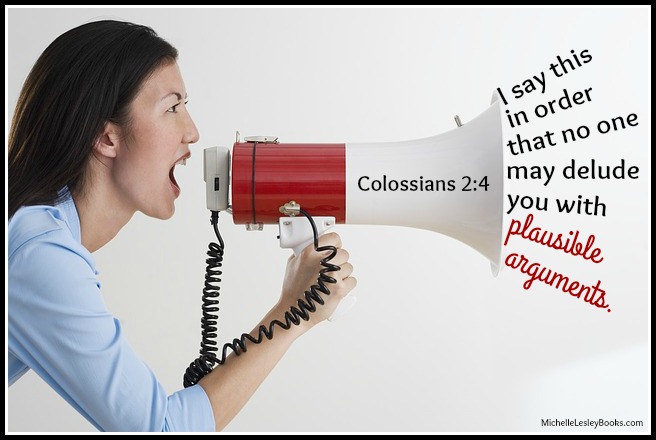
col 2 4

Colossians 2

For I want you to know how great a struggle I have for you and for those at Laodicea and for all who have not seen me face to face, that their hearts may be encouraged, being knit together in love, to reach all the riches of full assurance of understanding and the knowledge of God’s mystery, which is Christ, in whom are hidden all the treasures of wisdom and knowledge. I say this in order that no one may delude you with plausible arguments. For though I am absent in body, yet I am with you in spirit, rejoicing to see your good order and the firmness of your faith in Christ.

Therefore, as you received Christ Jesus the Lord, so walk in him, rooted and built up in him and established in the faith, just as you were taught, abounding in thanksgiving.

See to it that no one takes you captive by philosophy and empty deceit, according to human tradition, according to the elemental spirits of the world, and not according to Christ. For in him the whole fullness of deity dwells bodily, 10 and you have been filled in him, who is the head of all rule and authority. 11 In him also you were circumcised with a circumcision made without hands, by putting off the body of the flesh, by the circumcision of Christ, 12 having been buried with him in baptism, in which you were also raised with him through faith in the powerful working of God, who raised him from the dead. 13 And you, who were dead in your trespasses and the uncircumcision of your flesh, God made alive together with him, having forgiven us all our trespasses, 14 by canceling the record of debt that stood against us with its legal demands. This he set aside, nailing it to the cross. 15 He disarmed the rulers and authorities and put them to open shame, by triumphing over them in him.

16 Therefore let no one pass judgment on you in questions of food and drink, or with regard to a festival or a new moon or a Sabbath. 17 These are a shadow of the things to come, but the substance belongs to Christ.18 Let no one disqualify you, insisting on asceticism and worship of angels, going on in detail about visions, puffed up without reason by his sensuous mind, 19 and not holding fast to the Head, from whom the whole body, nourished and knit together through its joints and ligaments, grows with a growth that is from God.

20 If with Christ you died to the elemental spirits of the world, why, as if you were still alive in the world, do you submit to regulations— 21 “Do not handle, Do not taste, Do not touch” 22 (referring to things that all perish as they are used)—according to human precepts and teachings? 23 These have indeed an appearance of wisdom in promoting self-made religion and asceticism and severity to the body, but they are of no value in stopping the indulgence of the flesh.


The Holy Bible, English Standard Version Copyright © 2001 by Crossway Bibles, a publishing ministry of Good News Publishers.


Questions to Consider:

1. What “plausible arguments” was Paul afraid the Colossian Christians would be “deluded” (4) by? (see 8, 11, 13, 16) How could the things Paul said in verses 2-3 prevent this? Had they already been led astray by false teaching? (5)

2. One of the major false teachings of Paul’s day was gnosticism. Which words/phrases in verse 8 might be speaking of gnosticism? Of the Judaizers? How does Paul refute the major tenets of gnosticism in verses 9-10? How can Christians apply verse 8 today?

3. In verses 11-13, which New Testament rite does Paul compare with the Old Testament rite of circumcision? How are these two rites similar? How are they different? Do these verses mean that Christians should not circumcise their baby boys? Did Paul think baptism was important?

4. What does verse 16 mean in light of the agenda the Judaizers were pushing? What does verse 17 tell us about the Old Testament feasts, ceremonies, sacrifices, etc.? How did they point to Christ, and how did Christ fulfill them? What does this tell us about the Hebrew Roots Movement and other “Christian” pastors or churches who say we must observe Old Testament ceremonies, calendars, or holidays?

5. What is the overall point Paul is trying to make in this chapter about Christianity versus false teachings such as gnosticism and the teachings of the Judaizers? (4, 10, 13-15, 19, 23) How can we apply this point today?