Mailbag

The Mailbag: Potpourri (Tithing, Beth Moore on abortion, wife earning more than husband…)

Welcome to another “potpourri” edition of The Mailbag, where I give short(er) answers to several questions rather than a long answer to one question. I also like to take the opportunity in these potpourri editions to let new readers know about my comments/e-mail/messages policy. I’m not able to respond individually to most e-mails and messages, so here are some helpful hints for getting your questions answered more quickly. Remember, the search bar can be a helpful tool!

In these potpourri editions of The Mailbag, I’d also like to address the three questions I’m most commonly asked:

“Do you know anything about [Christian pastor/teacher/author] or his/her materials? Is he/she doctrinally sound?”

Try these links: 
Popular False Teachers /
 Recommended Bible Teachers / search bar
Is She a False Teacher? 7 Steps to Figuring It Out on Your Own
(Do keep bringing me names, though. If I get enough questions about a particular teacher, I’ll probably write an article on her.)

“Can you recommend a good women’s Bible study?”

No. Here’s why:
The Mailbag: Can you recommend a good Bible study for women/teens/kids?
The Mailbag: “We need to stop relying on canned studies,” doesn’t mean, “We need to rely on doctrinally sound canned studies.”.

“You shouldn’t be warning against [popular false teacher] for [X,Y,Z] reason!”

Answering the Opposition- Responses to the Most Frequently Raised Discernment Objections


Any good info you can send in about tithing? Is it for NT believer? Are we in sin if we don’t?

Great question – and it’s one that a lot of Believers probably wonder about. For the long answer, check out my article To Tithe or Not to Tithe… (and don’t forget to click on the links in that article to the helpful resources I’ve included).

The short answer is no. Christians are not required by Scripture to tithe. The main Scripture that covers the principles for New Testament giving is 2 Corinthians 9:7:

Each one must give as he has decided in his heart, not reluctantly or under compulsion, for God loves a cheerful giver.

We are to give thoughtfully, decisively, generously, willingly, and gladly. Now, if you consider your finances and the needs of your church, you and ask God to help you make a wise decision about how much to give, and ten per cent is the prayerful conclusion you come to, then by all means, give ten per cent. If it’s fifty per cent or two per cent or 97 per cent or some other amount, give that. New Testament giving is about glad generosity of heart and godly decision-making, not rote fulfillment of a non-applicable Mosaic Covenant law.

Are you in sin if you don’t tithe? It depends on the reason you’re not tithing. If you’re not tithing (or giving) because you’re selfish and greedy and you don’t want to give anything to the church, then, yes, you’re sinning. If you’re not tithing because you’re barely scraping by and can only afford to give five per cent to the church, which you give with a joyful and generous heart, no, you’re not sinning. But for sure, if your pastor or someone else is attempting to coerce or compel you to tithe, he is putting you under the yoke of the law, he is violating 2 Corinthians 9:7, and he is in sin.


What is Beth Moore’s position on abortion?

I received this question from several readers in connection with the publication of An Open Letter to Beth Moore (which you can still sign if you haven’t yet, ladies).

I don’t know what Beth’s position on abortion is. I Googled “Beth Moore abortion” and the closest thing I came up with was a tweet thread from 2016 that had something to do with the presidential election and whether or not Beth supported Hillary Clinton (it wasn’t 100% clear since some of the tweets have since been deleted or made private). Some questioned Beth in that thread about her stance on abortion since they believed she supported Clinton, but while Beth clearly said she did not support either candidate, unless I missed a tweet or it was deleted, she did not state what her position on abortion was.

If you want to know Beth’s position on abortion, you will have to ask her. Since she is Southern Baptist, you may wish to ask her if she agrees with the portion of Article XV of the Baptist Faith and Message (BFM2000– the SBC’s statement of faith) which states,

“We should speak on behalf of the unborn and contend for the sanctity of all human life from conception to natural death.”

It is possible Beth would be willing to give a pro-life answer since it is likely much more acceptable among her followers for her to stand against abortion than to stand against homosexuality. But since she has already demonstrated that she is unwilling to take a firm biblical stand on an issue when doing so might diminish her popularity, I imagine she will respond to questions about abortion the same way she responded to our questions about homosexuality: ignore the questions as much as possible, or answer them in an obfuscatory or cryptic manner when pressed.


As a woman, am I sinning by witnessing to a man?

Nope. Not under the auspices of 1 Timothy 2:12, anyway. What you’re doing is carrying out the Great Commission, Jesus’ mandate to all Christians. A couple of articles that explain more and that you might find helpful:

Rock Your Role FAQs (#11)

The Mailbag: Is it biblical for women to carry out The Great Commission?


One of my loved ones says she hears God’s voice, still small voice, a new revelation from Him and so on. How can I search your website to get information on this?

May God bless you for wanting to help your loved one! I think these articles will help:

Basic Training: The Bible Is Sufficient

Basic Training: The Bible Is Our Authority

The Mailbag: Potpourri (Michelle’s a money-grubber, Still small voice, Husband of one wife…)


Wondering what kind of instruction you received to teach what [you] have on your website. I have studied the Scriptures for many years, but am disappointed that I did not spot some of the false and lacking “teachers” you have written about. I found you, thankfully, by following a rabbit trail regarding false teachers. Thanks.

Thanks for asking! The biblical instruction I’ve received:

•Sitting under good preaching and teaching at my own church

•Studying straight from the Bible itself (not workbook/DVD studies, etc.) during my daily Bible study time

•Listening to good sermons and Bible teaching online

•Reading good, solid theological books by doctrinally sound authors.

I have audited one or two online seminary classes, but I’ve never been enrolled in a seminary, nor do I have a seminary degree.

I’ve explained a bit more about how I got started learning discernment here. Many of the authors, pastors, and teachers I’ve listened to can be found in the sidebar to your left (Blogs and Podcasts I Follow and Links I Love) and at the Recommended Bible Teachers tab at the top of this page.

This is part of the reason I’m forever hounding women to put aside the “canned” studies and systematically study straight from the Bible for themselves and to get faithfully invested in a doctrinally sound church – it’s not only biblical, it works.


Biblical views on a wife making more than her husband financially?

To my knowledge, there is no passage in the Bible that explicitly prohibits a woman from having a larger salary than her husband’s, assuming that they are both employed in a manner that doesn’t violate biblical standards. (Readers- For the purposes of this question, let’s assume that neither spouse is neglecting his/her biblical duties to the marriage, children, or home by being employed in this season of his/her life.)

In other words, if they’re both employed full time and her position or field just happens to pay more than his position or field, that doesn’t violate any Scripture I’m aware of. Or there could be situations such as: a husband is ill or disabled and unable to work full time (or at all), or the husband has had to reduce his workload temporarily to care for an ill family member, go back to school, etc. However, if it’s a situation like the wife is making more money because the husband is a lazy bum who refuses to work enough hours (or at all) to support his family, that would be sinful on his part.

If there’s nothing unbiblical about the wife’s or the husband’s employment situation but it bothers one or both of them that her salary is larger, they should sit down, talk it out, and pray through the issue to discover and resolve the problem. I would also recommend setting up an appointment with their pastor or a biblical counselor for counseling (see Biblical Counseling Resources tab at the top of this page).


If you have a question about: a Bible passage, an aspect of theology, a current issue in Christianity, or how to biblically handle a family, life, or church situation, comment below (I’ll hold all questions in queue {unpublished} for a future edition of The Mailbag) or send me an e-mail or private message. If your question is chosen for publication, your anonymity will be protected.


Mailbag

The Mailbag: Potpourri (Quickievangelism, the CRCNA, JMac on the mark of the beast…)

Welcome to another “potpourri” edition of The Mailbag, where I give short(er) answers to several questions rather than a long answer to one question. I also like to take the opportunity in these potpourri editions to let new readers know about my comments/e-mail/messages policy. I’m not able to respond individually to most e-mails and messages, so here are some helpful hints for getting your questions answered more quickly. Remember, the search bar can be a helpful tool!

In these potpourri editions of The Mailbag, I’d also like to address the three questions I’m most commonly asked:

“Do you know anything about [Christian pastor/teacher/author] or his/her materials? Is he/she doctrinally sound?”

Try these links: 
Popular False Teachers /
 Recommended Bible Teachers / search bar
Is She a False Teacher? 7 Steps to Figuring It Out on Your Own
(Do keep bringing me names, though. If I get enough questions about a particular teacher, I’ll probably write an article on her.)

“Can you recommend a good women’s Bible study?”

No. Here’s why:
The Mailbag: Can you recommend a good Bible study for women/teens/kids?
The Mailbag: “We need to stop relying on canned studies,” doesn’t mean, “We need to rely on doctrinally sound canned studies.”.

“You shouldn’t be warning against [popular false teacher] for [X,Y,Z] reason!”

Answering the Opposition- Responses to the Most Frequently Raised Discernment Objections


Yesterday at the store I had a hard time with witnessing to someone. I’m pretty sure it’s because I was only there for a total of 3 minutes. My question is, how do I witness to someone in such a short time?

It brings me so much joy to hear that you are out there sharing the gospel!

I would recommend using tracts. That way if your time with the person gets cut short, you can give them the gospel “to go”.

I use Bezeugen Tract Club tracts. If you join their “tract club”, they will send you 30 free tracts a month. They are the size of a business card, so they’re really convenient to carry in your purse.

Living Waters also has a great selection of tracts. And, while they’re not exactly tracts, Wretched has some very good online evangelism resources and is currently offering a free evangelistic booklet (you pay only shipping/handling) for giveaways at outreach events.

Keep up the great work of sharing the good news of the gospel!


Is the Christian Reformed Church a church that teaches sound doctrine?

It’s always good to do our due diligence when considering a new church or denomination, so this is a super question.

The Christian Reformed Church in North America is a rather small denomination (230,000 people in membership) that I’m not very familiar with, so I went poking around their website.

There are a lot of things that look very encouraging, doctrinally about the CRCNA. They affirm the Apostles’, Nicene, and Athanasian Creeds as well as the Belgic Confession, the Heidelberg Catechism, and the Canons of Dort. The plan of salvation presented on the website is biblical. In fact, most of what I read at the CRCNA website seemed solid.

However, a few red flags jumped out at me as I explored the site:

🚩 The heavy emphasis on “justice”. There’s something about “justice” on nearly every page of the site. Certainly Christians should uphold biblical justice, but many churches and denominations today have bought into the secular social justice movement, which is decidedly unbiblical, as it promotes feminism, normalization of sexual perversion, and unbiblical methods of addressing issues like racism, immigration, poverty, etc. It appears that the CRCNA at least leans in the direction of the social justice movement.

🚩 The role of women in the church. The CRCNA’s position reads: 

All congregations in the Christian Reformed Church in North America may allow women to serve in the office of minister, elder, deacon, or commissioned pastor. The CRC recognizes that there are two different perspectives and convictions on this issue, both of which honor the Scriptures as the infallible Word of God…

This is unbiblical, not to mention self-contradictory. Either Scripture allows women to serve in these capacities or it does not. (And it clearly does not.) Both positions cannot be true at the same time. If a church adopts the unbiblical position, it is not “honoring the Scriptures as the infallible Word of God.”

🚩 Some of the CRCNA’s position statements have a “squishy”, progressive, or blatantly unbiblical tilt rather than an unflagging commitment to Scripture. For example:

Creation care (environmentalism): “We are compelled to address human-induced climate change as an ethical, social justice, and religious issue…”

Ecumenicity (unity with other churches): “[The CRCNA] also wishes to engage churches of other traditions such as…the Roman Catholic Church, and Orthodox churches.” (Catholicism and the major Orthodox traditions hold many unbiblical views including an unbiblical soteriology. Scripture forbids Christians from unifying with such organizations.)

Homosexuality: “Homosexuality [is] a condition of personal identity in which a person is sexually oriented toward persons of the same sex…for which the person may bear only a minimal responsibility…The church should do everything in its power to help persons with same-sex orientation and give them support toward healing and wholeness.” (Homosexuality is not a “condition of personal identity” any more than adultery or thievery is. It is a sin that the person is just as responsible for as the adulterer or thief is for his sin. We would not speak in terms of “support toward healing and wholeness” for an adulterer or a thief, we would speak in terms of repentance and mortification of sin, just as we should speak when someone’s sin of choice is homosexuality.)

Pentecostalism (charismaticism, sign gifts, etc.): “Acknowledge the gift of prophecy today…Think of prayer as a dialogue, not a monologue, and be attentive to what God is saying as you pray…be willing to engage in scripturally sound deliverance ministry against demonic powers…”

If you are considering attending or joining one of the CRCNA churches which does not allow women to serve in unbiblical roles, I would recommend setting up an appointment with the pastor to carefully and seriously discuss these issues at length, along with any other questions you may have. If you have the option of joining with a non-CRCNA church that has a more solidly biblical stance on these issues than your local CRCNA church, I would encourage you to go with the non-CRCNA church.


John MacArthur has said, that it’s possible to take the mark of the beast and still be saved? I notice that you endorse him, do you believe this is correct? 

I think a lot of people have stretched what Dr. MacArthur said wildly out of context and out of proportion. So the first issue here is to make sure you have a clear understanding of what he actually said and meant from Dr. MacArthur himself, not from random bloggers or people on YouTube. You can read Dr. MacArthur’s position statement on this issue (written by spokesman Phil Johnson) here.

As for my opinion on Dr. MacArthur’s position, I think it’s biblical and well-reasoned, but this particular issue – as with most detail-oriented eschatological issues – is not something I feel compelled to expend much time and energy on. When Christ returns, events will unfold as laid out in Scripture. Until then, we have a limited understanding of what will transpire and the order in which things will transpire, and much of what constitutes eschatology today is educated guessing. I think it is much more fruitful to spend our time evangelizing the lost and discipling the saved so that the church will be spiritually ready for the return of Christ. Whatever may happen in the days surrounding His return, we know that none of His sheep will be lost.


Since my last “potpourri” edition of The Mailbag, I’ve heard back from two of the readers whose questions I addressed, and I wanted to share their responses with you:

From the discouraged husband I asked you to pray for:

I am extremely encouraged by the people who are stepping forward and praying for me…Thank you for your encouragement and prayers. They reach into the darkest places and are invaluable.

From the lady needing help with her nursing home ministry:

Thank you Michelle for answering, I’ve been thinking of finding a church. I have to be truthful, it wasn’t the answer I was hoping for, but it is the answer I think I needed.


If you have a question about: a Bible passage, an aspect of theology, a current issue in Christianity, or how to biblically handle a family, life, or church situation, comment below (I’ll hold all questions in queue {unpublished} for a future edition of The Mailbag) or send me an e-mail or private message. If your question is chosen for publication, your anonymity will be protected.

Christmas, Favorite Finds

Favorite Finds ~ December 11, 2018

Here are a few of my favorite recent online Christmas finds…

Christmas might be the easiest time of the year to get a foot in the door to share the gospel with unsaved friends, loved ones and strangers. That’s why I love this article by Allen Nelson over at Things Above Us called A Christmas Gift for You. You can share it around on your social media pages to help others understand what Christ did to save us. And if you’d like to use it as a devotion at a Christmas party, tuck it into your Christmas cards, use it as a bulletin insert at church, or something like that, you can contact Allen for permission to reprint it.

 

If you love Handel’s Messiah, check out Messiah: The Podcast Series Advent Calendar. “It took George Frideric Handel 24 days to complete the musical score of Messiah – the most famous oratorio ever written. This podcast advent calendar tells all the stories about the people, the places, the music, the drama and the gossip that is connected to the maiden performance in Dublin 275 years ago.” (I think this is more of a history website than a Christian website.)

 

Wonder why some Christmas songs are so ear-catchingly popular? Music nerds can tell you, and here’s one to do just that. Vox gives us Adam Ragusea explaining The Secret Chord that Makes Christmas Music Sound So Christmasy. 


And speaking of Christmas music…need some to listen to? Amazon has several Christmas songs and albums you can download for free! (Listen discerningly.) And if you’re shopping at Amazon, be sure to check out Amazon Smile and donate part of your purchase to the Christian ministry, organization, or church of your choice!

 

When Christians think “Christmas” we usually think Luke 2, and maybe Matthew 1-2. But…John? My friend and fellow LSU alum, Nicholas Maricle, shares this lovely article on the Incarnation: John 1, the Word, and Jesus over at his blog Thinking Theologically. Do yourself a favor and give him a follow!

 

Josh Buice has another awesome quiz for us at his blog, Delivered by Grace. Test your knowledge with: Christmas Quiz: How much do you know?
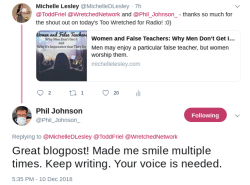
 

And last of all, an early Christmas present for me (thanks to reader and contributor, Laura!). Phil Johnson and Todd Friel discussed part of my article Women and False Teachers: Why Men Don’t Get It, and Why It’s Imperative That They Do on the December 10 episode of the Too Wretched for Radio podcast (around the 15:42 mark). I’ve mentioned that Todd was the first to introduce me to the idea of biblical discernment when I “accidentally stumbled across” the Wretched TV show one night while flipping through the channels. And I listen to Phil often, love his preaching, and have a great deal of respect for him on a number of different levels. So while this brief mention on a podcast that the majority of the world has never heard of wouldn’t mean much to most people, it was a real honor for me.

Biblical Womanhood Bible Study

Imperishable Beauty: Lesson 9- Beautiful Feet (Evangelism)

Previous Lessons: 1, 2, 3, 4, 5, 6, 7, 8

Read These Selected Scriptures

Lesson 8 was all about obeying, and being “doers” of, God’s Word. Today, we’re taking a look at one way of “doing” the Word: having beautiful feet that take the good news of the gospel to a lost and dying world.

Questions to Consider

1. What is evangelism? In your own words, give a brief definition of what evangelism involves and why we evangelize. Briefly review lessons 7-8 (links above). Describe how knowing and loving God’s Word (lesson 7) leads to obeying God’s Word (lesson 8), which leads to sharing the gospel with others.

2. If evangelism is sharing the gospel with others, we want to be certain we’re sharing the complete and true gospel. Briefly review my article: Basic Training: The Gospel and the Scriptures it contains.

3. Study the Matthew 28 passage. This passage of Scripture is often called The Great Commission. Break the passage down into three parts, and exposit each part:

The Preamble (18): Describe Jesus’ authority, motivation, and reasons for giving the instructions and promise that follow.

The Prescription (19-20a): What are the four verbs (action words) in this passage that Christ instructs us to do? Explain how Christians in general, and you personally, can carry out each of these actions.

The Promise (20b): What promise does Christ make to us as we carry out The Great Commission? What are some of the things He does not promise us? Explain why His promise to be with us is the perfect promise – the one we need the most – as we share the gospel with others.

4. Examine Acts 1:8 (and read verses 1-7 for context) and Romans 10:13-15. In your own words, set the scene for Jesus speaking the words in Acts 1:8. How is verse 8 an explanation of the word “go” in Jesus’ instructions to the disciples in The Great Commission? Who will empower them to carry out The Great Commission? Relate this empowerment to the authority Jesus spoke of in Matthew 28:18. How are they to make disciples? Think of a witness in a courtroom. How were the disciples witnesses of Christ? Where are they to “go therefore” to find these people to witness Christ to and make into disciples? How does Romans 10:13-15 also explain the “how to” of The Great Commission? Why are the feet of those who bring the gospel “beautiful”?

5. Look at a 1st century map containing Jerusalem, Judea, and Samaria. Think about what you know (or search a concordance) about the disciples’ relationship to each of these places. Was Jesus just naming random places for them to go preach the gospel? What was the meaning the disciples would have mentally attached to each of these places that told them about the people they would be reaching in each of these places? Explain the expanding geography of the gospel: Jerusalem→Judea→Samaria→ends of the earth.

How can you make application of both of these points (the meaning of each place and the expanding geography of the gospel) to your own life and to your church? How can you take the gospel to:

“Jerusalem”– The people and physical location closest to you: members of your own household, family, closest friends. Your neighborhood, community, town.

“Judea”– People who aren’t quite as close, literally or figuratively: acquaintances, co-workers, extended family, cashiers/bank tellers/service people/your child’s teacher. People who live in farther away areas of your state or country.

“Samaria”– Remember the Jews’ and Samaritans’ attitudes toward each other? Explain how The Great Commission involves going out of your way to take the gospel, not just to the people you like and have much in common with, but to our enemies, or to people who look, talk, and act differently than we do, and are from different backgrounds and cultures.

“The Ends of the Earth”– How can we reach “the ends of the earth”? Have you ever seriously considered working in full-time, vocational missions, either as a field missionary or on staff with a support organization? Give it some thought. But even if God has not called us to vocational missions, we can still “hold the rope” for those who go. What are some ways you and your church can support missionaries, missions organizations, Bible translators, indigenous pastor training programs, etc.?

6. Study the 2 Corinthians passage. What is the message Christ has entrusted to us? What does it mean that we have been given the ministry of reconciliation, that we are ambassadors for Christ, and that God makes His appeal through us?

7. “Put flesh on” The Great Commission by reading the story of Philip (Acts 8) and/or the story of the woman at the well (John 4, especially v. 28-30, 39-42). What catches your eye about the way s/he shared the good news of Jesus? In what way did s/he set a good example for Christians today of sharing the gospel? What was the effect on the person(s) being shared with? How do these two stories demonstrate that God can use our circumstances, skills, and personalities as tools for sharing the gospel?


Homework

Read one of the articles below, choose one of the resources or practical suggestions for sharing the gospel, and implement it this week.

10 Fun, Practically Effortless, and Free Ways to Do Missions and Evangelism

10 Ways to Share the Gospel During the Holidays

Share the Gospel Like a Twelve Year Old

Street Preaching: A Call to Arms


Suggested Memory Verse

And Jesus came and said to them, “All authority in heaven and on earth has been given to me. Go therefore and make disciples of all nations, baptizing them in the name of the Father and of the Son and of the Holy Spirit, teaching them to observe all that I have commanded you. And behold, I am with you always, to the end of the age.”
Matthew 28:18-20

Evangelism, Obedience

6 Unworldly Ways to Make the World Wonder Why You’re Weird

A dark, hazy room, colored lights flashing, filled with people swaying to chart-topping music, their drink of choice in hand, just there to have a good time with friends.

Is it a club? A concert? A party?

Or church?

With our coffee bars, cutting edge music from the latest and greatest Christian bands, and come hither atmosphere of smoke machines, light shows, and fun, fun, fun, sometimes it’s hard to tell.

And just as we import worldliness into the church, we’re exporting worldly Christians to our local communities. “Christians” who lie, cheat, carouse, defy authority, use profanity, angrily explode, and are sexually immoral. It’s getting more and more difficult to distinguish God’s people from worldlings, and the worldlings are growing disillusioned. Not just with us, but with God.

It’s getting more and more difficult to distinguish God’s people from worldlings, and the worldlings are growing disillusioned. Not just with us, but with God.

“What’s the point of believing in a God who produces people who look exactly like I do?” the world wonders. “What kind of impotent God is this, anyway?”

God gets that. He has gotten that from time immemorial.

He is different. He is other. He is in a class by Himself.

And as His people, we’re supposed to reflect that otherly set apart-ness by being otherly and set apart ourselves.

God didn’t command His people not to wear garments of mixed fibers because He was trying to support the Egyptian cotton market, and He didn’t forbid His people to eat crustaceans to ruin date night at the Red Lobster. He wanted His people to be unique among the pagan nations as He was unique among the pagan gods. He wanted those pagan people to point their fingers at the Israelites and say, “Those people are different, and I want to know why.”

God wants pagan people to point their fingers at God’s people and say, “Those people are different, and I want to know *why*.”

As God’s people living among pagans today, we have the same unique opportunity to point them to the one, true God. How? By unhitching from the Old Testament, as some would have us believe? No. I tell you, we need to look back to our forefathers in the faith and take a page out of their Book. Not by wearing dietary laws on our sleeves of 100% cotton, because we’re not Jews. But by simply obeying God’s commands to His people today.

It ain’t rocket surgery, folks. We don’t need to take surveys to find out what pagan people want. We don’t need gimmicks and tricks. We don’t need to scour Christian industry catalogs hoping against hope that we can find some thing to order that will attract lost people to Jesus.

The most jaw-dropping, astounding, attention-grabbing thing in this world is simple Christians living in simple obedience to God’s simple commands. Isn’t it amazing that something so simple is simply amazing to the world?

The most jaw-dropping, astounding, attention-grabbing thing in this world is simple Christians living in simple obedience to God’s simple commands. Isn’t it amazing that something so simple is simply amazing to the world?

Want to be wonderfully, wildly weird to the world so they’ll wonder why? Try these six things.

1.
Submit to your husband

There’s nothing more “against the grain” right now than God’s design for marriage. Feminists have brainwashed many women (and men) into thinking there’s a better way, but we have only to look back across the last several decades to see a landscape littered with unhappy marriages, divorce, abuse, abortion, cohabitation, and single parenting (or…you know…we could look in our Bibles), to know that’s not true.

Ephesians 5:22-33 explains that obeying God’s instructions for being godly wives and husbands isn’t just good for our marriage and home life. It’s a picture of Christ and His church that we get to act out before a watching world.

So when your friend from work catches a glimpse of your “backwards” marriage that seems to be working a lot better than hers and asks you about it, walk through that open door, talk to her, listen to her, and introduce her to the Bridegroom who came to redeem His bride.

2.
Discipline your children

Hardly a week goes by that someone doesn’t compliment me or my husband on how well-behaved our children are. I’m always appreciative of their kindness, and God has truly blessed us with wonderful children, but there’s nothing exceptional about them in the behavioral department, and there’s nothing exceptional about us as parents. My kids are normal. When I was a kid, the majority of kids acted the way my kids act – respectful and obedient – because the majority of parents raised and disciplined their children.

Now, it’s practically an aberration to encounter normal, well-behaved children (even in church – Christian parents, I’m looking at you.). Yes, everybody’s kid acts up from time to time. Yes, some children are naturally more stubborn than others. Yes, some children have legitmate disabilities that can look like misbehavior. I know all the “but’s” and exceptions. But if you obediently bring your children up in the nurture and admonition of the Lord, the overwhelming majority of them are going to be reasonably well-behaved most of the time, and you’re going to have people stop you at the store, the library, their school, and marvel about it. What are you doing as a parent that makes your kid different? And that’s when you get to tell them about your heavenly Father and His one and only Son.

3.
Be kind

It seems like everyone you run into these days is hurting. Even the people who mistreat you in a rude, angry way are probably acting that way because they’re hurting inside. They don’t know how to handle it, they have no peace, and they’re without hope. All because they’re without Christ.

I used to watch the TV show Undercover Boss fairly regularly. The head of a major company dons a disguise and goes to work among his employees to see how his company is really running and what he can do to improve it. In every episode, the boss gets to know good employees who are going through a difficult time – his mother is dying, her child is sick, he can’t afford a car, she’s trying to work her way through school. And at the end of every episode, the boss reveals himself to the employees and gives each of them thousands of dollars to help with their problems. And at the end of every episode, the employees (and I) are in tears. Yes, the money was helpful and a relief to these folks, but I could see in most of their eyes that it wasn’t just about the money. They were overcome that someone actually cared enough about them to be kind to them.

We live in a cruel, heartless, impatient, unforgiving world. When you take a moment to speak a kind word to someone, provide for a person who’s in need, help a total  stranger, offer cheerful encouragement, just to take a moment to obey Scripture’s admonition to care for someone, it knocks people completely off guard. “Why? Why would you be so kind to me?” a young lady once tearfully asked me after I had done a very small thing for her. It was such a joy to wrap my arms around her and explain, “Because Jesus has been so kind to me.”

“Why would you be so kind to me?” a young lady once tearfully asked me after I had done a very small thing for her. It was such a joy to wrap my arms around her and explain, “Because Jesus has been so kind to me.”

4.
Turn the other cheek

If someone steals “your” parking place and you stomp over to her and bless her out, is that going to open a door for you to share the gospel with her? Would she even listen to you if you tried?

In the same way that hurt people expect others to hurt them, people who lash out in anger or do something they know is unfair or unkind expect an angry response from others.

Don’t give it to them. Just don’t. You don’t have to, if you’re a Believer. You have the Fruit of the Spirit of self control.

Obey Jesus’ teaching to turn the other cheek and go the extra mile, and watch as a gentle answer turns away wrath, and, hopefully, leads to a conversation about the Prince of Peace.

5.
Say, “I was wrong.”

The heaviest artillery in a lost person’s arsenal is to accuse or prove someone of being wrong. The reason that even exists as a weapon is because everyone’s natural instinct is to dig our heels in, make excuses, and insist we were actually right.

It can be almost comical to watch someone process from self-righteous victory to “What just happened here?” confusion when you unabashedly admit you were wrong, graciously apologize, and offer to make things right. And, of course, if you realize you were wrong about something before anyone else does, you don’t have to wait to be confronted. You can march in and throw yourself on the “I was wrong,” grenade before anybody realizes what’s going on.

It’s hard to admit we were wrong about something, because, even as Christians, we struggle with pride. Pride is all lost people have to hold on to, so it doesn’t compute when Christians willingly lay down their pride and take up humility by admitting and apologizing for wrongdoing. “It took guts to own up to that,” your neighbor thinks, “I wonder what motivated her to do that?”. Because, dear friend, I have a Savior who, in humility, laid everything down for me. How could I not lay down something so small in obedience to Him?

6.
Forgive

What is a worldly person’s response when someone wrongs her? Anger. Bitterness. A grudge as high and long and thick as a brick wall. “I will never forgive you!” screamed as she slams out the door and out of that person’s life forever.

The kind of response Christ has every right to extend to us for our sin…but chooses not to.

Think back to when Christ saved you. Do you remember how heavy your sin was and how hopeless you felt? And then, that glorious moment that took your breath away when, for no other reason but grace and mercy, He cleansed you of all your rebellion and wrongdoing and pronounced you forgiven?

When we forgive someone who has sinned against us, we have the honor of pulling back the veil and giving a sinner a peek at the forgiveness Christ offers. It might be the kind of forgiveness He asked for the unrepentant who were crucifying Him. Or it might be the forgiveness He extended to a repentant woman whose sins were many.

“Why would you forgive me? I would never forgive someone who hurt me like that.” It’s the perfect moment to tell her about the One we have all sinned against, who delights to extend forgiveness to each of us.

The people around us, watching us every day, need Jesus. As His servants and ambassadors, we have the privilege, the honor, and the responsibility to represent Him well to them by simply obeying His Word. The world doesn’t need “Christians” who look just like them. The world needs Christians who look just like Jesus.