Bible Study, Church

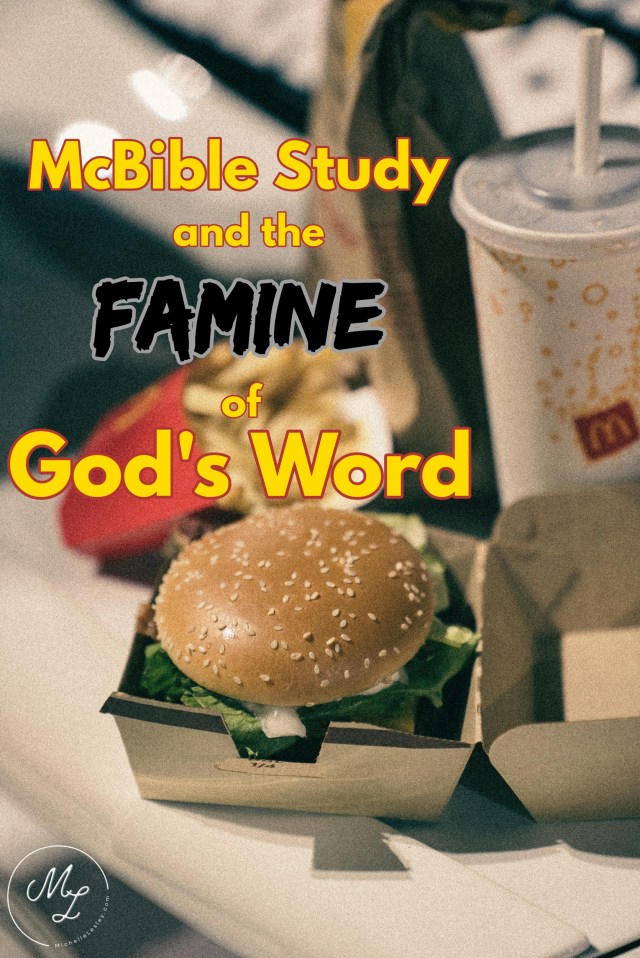
McBible Study and the Famine of God’s Word

“Why can’t we just be taught a book of the Bible?” I heard this again today from a Christian woman hungry for her church to teach her the truth of God’s word. It’s a cry being raised by women from all over, scrounging through the dumpster of “Bible” teaching their church currently offers, searching for something – anything – that will nourish their hearts, minds, and souls with biblical truth so that they might actually be able to grow in Christ.

What’s going on here, church? Pastors? Women’s ministries? Why are godly women starving for the word of God at their own churches? This is a problem. And it’s not a small one. And it’s not going away. It’s getting worse.

My family is a one income family. My husband works hard to provide for us, and we’ve made a lot of (completely worthwhile) sacrifices so I can stay home and raise and home school our children. One of those sacrifices is that we rarely get to eat out, even at a fast food restaurant. That means I cook. A lot. Fortunately, I happen to enjoy cooking, but it does take several hours of work a week. And sometimes, at the end of a long day, I’m tired and not particularly in the mood to spend a couple of hours on my feet chopping and mixing and sautéeing and stirring and roasting. I’d much rather chuck it and have my husband pick up McDonald’s on his way home. In fact, if we could afford it, and I couldn’t cook, and I thought it was healthy, my family would probably eat fast food for supper three or four times a week. I like fast food. My kids LOVE fast food. And why do all that work if you don’t have to and there’s an easier option, right?

But that’s no way to feed a family. It makes people obese and can lead to all kinds of other physical problems like heart disease, hypertension, and digestive ailments because the majority of fast food is high in the bad stuff (cholesterol, sodium, fat) and low in the good stuff (fiber, vitamins, minerals). Not to mention that having other people do the work God has assigned me is the lazy way out.

Yet while it’s easy to see how detrimental and unhealthy it is to feed a family a regular fare of fast food in the physical realm, this is exactly what most churches are doing in the spiritual realm when it comes to their Bible study menu.

“My pastor asked me to teach a women’s Bible study class. What’s a good book to use?”
“Why don’t you just teach them a book of the Bible?”
“Oh, I don’t feel equipped to do that.”

“Our Sunday School class is looking for a new curriculum. Any suggestions?”
“How about just working through a book of the Bible?”
“Our teacher works a lot of hours and doesn’t really have the time to study and prepare like that.”
screenshot-2016-11-10-at-12-31-44-pm-edited

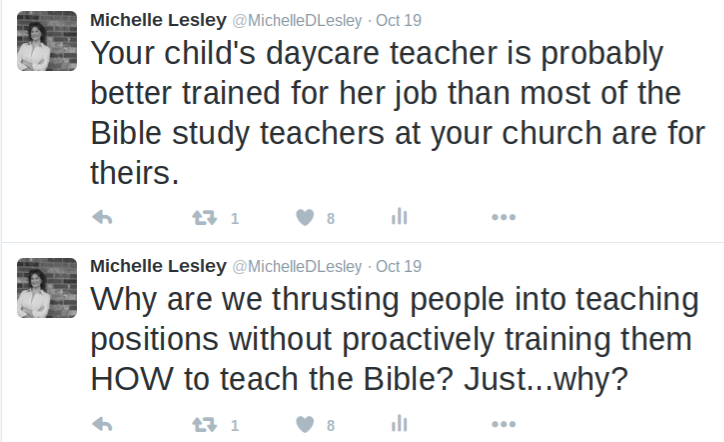
I hear this kind of thing over and over and over again. Churches aren’t even attempting to train people to properly teach the Bible, and Bible study “teachers,” (often through no fault of their own) either don’t know they need to be trained, or don’t have training available to them, or they’re unwilling or unable to put in the time and effort to be trained and to prepare lessons.

We have classes that need teachers, so we take whoever is available and willing, and we stick them in front of a group of people, hand them a take out bag of McBible Studies written by the celebrity Christian du jour and say, “Here. Feed the church family.”

That’s a problem in and of itself, first and foremost, because relying solely on pre-fab studies due to the fact that no one is trained to instruct the people of your church in the word of God isn’t biblical. The Bible says that pastors, elders, and teachers in the local church body should be “able to teach.” Not facilitate. Not read aloud what someone else wrote. Not “able to work a DVD player.” Teach.

But recruiting “teachers” who are unskilled in handling God’s word to lead a pre-packaged study often morphs into another dangerous problem, especially in the area of women’s Bible study: importing false doctrine into your church. Here’s a list of LifeWay’s top selling books for 2015. Every single non-fiction book on this list that’s likely to be used for a women’s group or individual Bible study (seven of the twelve by my count- which is a staggering proportion considering LifeWay also sells men’s studies, theology books, training manuals, “Christian living” books, and a wide variety of other non-fiction topics, but I digress) is written by a false teacher. Every. single.one.

screenshot-2016-11-10-at-12-31-31-pm

In my research of women’s Bible study authors and teachers, I estimate that approximately ninety-five per cent of the the female authors and teachers on the shelves at your local Christian retailer are false teachers. That goes way beyond a biblical “diet” laden with cholesterol and fat. Now, we’re talking about spiritual food tainted with E.coli. If you’ve got a woman in your church who’s facilitating a class using materials by one of these false teachers because she’s not competent enough in God’s word to teach the Bible, how in the world is she going to be able to catch and correct the false doctrine these Christian celebrities are teaching her class?

The answer is: she’s not. In fact, her awareness of her own incompetence in Scripture and her assumption that the Christian celebrity knows what she’s talking about (Because, after all, she’s a celebrity and LifeWay sells her materials, so she must know what she’s talking about, right?) will have the exact opposite effect. She will downplay and keep quiet about any nagging doubts – assuming she knows her Bible well enough to even have those doubts – in her own mind that the Christian celebrity is teaching things contrary to sound doctrine, and she will affirm the false doctrine that’s being taught. Then, this harmful bacteria of false doctrine will spread from woman to woman and class to class, and discerning women, knowing that the kitchen is contaminated, will grow emaciated from a lack of clean cuisine to feed on. We end up with a church full of “Bible” study and Sunday School classes that teach fluff and false doctrine instead of the unadulterated word of God. To borrow from Coleridge: “Food, food, every where, nor any bite to eat.” We’ve got a famine of God’s word, right in His very own house.

Church, pastors, women’s ministries- we’ve got to put a stop to this. People teaching Sunday School, Bible study classes, and, particularly, women’s Bible study classes must be trained in basic hermeneutics, the competent handling of God’s word in context, and the ability to teach sound doctrine as well as to refute the false. Do we not believe Scripture, or somehow think our church is exempt from it, when it says:

Do your best to present yourself to God as one approved, a worker who has no need to be ashamed, rightly handling the word of truth. 2 Timothy 2:15

or

Not many of you should become teachers, my brothers, for you know that we who teach will be judged with greater strictness. James 3:1

Where is our fear of God and our obedience to His word? We would never think of letting an untrained, incompetent teacher teach our children math or science in school when all that’s at stake is their academic education. Why are we satisfied to let untrained people teach the Bible at church when people’s eternities are at stake?

It doesn’t take years of seminary training. I never went to culinary school, but I’m still able to cook and feed my family a healthy diet because of what I’ve learned from others. Pastors can train teachers. Skilled Bible teachers can train others to teach. There are even great books and materials that can help as you teach people how to teach the Bible.

A doctrinally sound book study can be a fun, interesting, or useful supplement to the regular, straight teaching of Scripture in a Bible study class, but even these shouldn’t be used in place of training teachers. The best theologian out there isn’t a living and active member of that class. He doesn’t know the strengths and weaknesses of the class’s theology. He can’t address their current struggles and questions. He doesn’t love them, care about them, pray for them, and labor in the Word for them.

Only real life, trained, biblically competent teachers can do those things. They are vital and they are irreplaceable.

So let’s quit shoving Happy Meals into the hands of women who are starving for the pure milk and meat of God’s word. Let’s offer some cooking classes and set the table so the members of our churches can sit down to a healthy, home cooked diet of nourishing food that will help them grow to spiritual maturity in the grace and knowledge of the Lord Jesus Christ.

And, now, if you’ll excuse me, I’ve got to go start supper.

Sanctification

Discipleship Requires Relationship

discipleship-relationship

Go therefore and make disciples of all nations, baptizing them in the name of the Father and of the Son and of the Holy Spirit, teaching them to observe all that I have commanded you. And behold, I am with you always, to the end of the age.
Matthew 28:19-20

You probably know the verses above as the “Great Commission.” Jesus spoke these words to His disciples after His resurrection and before ascending back into Heaven, and they are still our marching orders as Christians today. It’s an action-packed passage, wouldn’t you say? Go. Make. Baptize. Teach. We are to be about the Lord’s business, not sitting around doing nothing or busying ourselves with other things to the exclusion or neglect of the task to which Christ has called us: sharing the gospel with the lost and training the saved to follow Christ.

But how do we put shoes on the Great Commission? What does it look like to “Go ye therefore” and carry out this action plan of making and teaching disciples of Christ in our day to day lives? Like so many other aspects of working out our own salvation with fear and trembling, there is no one size fits all checklist of specific, “do it this way” tasks to choose from. Why? Because God created you as a unique individual with a particular background and placed you in a certain life venue. Yours doesn’t look like mine, and mine doesn’t look like yours. And that’s a good thing. God has woven all of those elements together in our lives to place us in the exact spot He wants us in to glorify Him, grow in our own faith, and make the disciples He has specifically assigned us to reach in the way He wants us to reach them.

But while you may be counseling a fellow church member about her marriage and I might be teaching my children the book of Colossians and another sister might be praying with a hospitalized co-worker, there’s one thing that’s foundational to all these divergent discipling situations: relationship. You can’t disciple someone unless you have a relationship with her.

Now let me stop and clarify something here. I’m not saying you have to have a relationship with someone before you can evangelize her. We should absolutely be sharing the gospel with lost friends, family, and others we already have relationships with, but we can (and should) share the gospel with complete strangers we’ll never see again as well. When Jesus first called His disciples and said, “Come follow Me,” He didn’t, humanly speaking, know any of them, as far as we know.

But Jesus didn’t stop with the call, just like we’re not to stop with the conversion. He gathered those twelve guys to Himself and they literally did life together for the next three years. They lived together, ate together, traveled together, went to the temple together. Everything. Together. For three years. That’s what turned them into disciples- true followers: time spent together with Christ, learning from Him.

There were three main ways Christ discipled the Twelve: formal teaching (as with the Sermon on the Mount), situational teaching and correction (as when James and John wanted to sit on His right and left in the Kingdom), and setting an example (as when the disciples watched Jesus minister to Zacchaeus), and all of those methods required Jesus to spend time with and bond with the disciples. These weren’t mere acquaintances of His, they were brothers.

Is that what God is calling us to do today? Should we quit our jobs, gather up a dozen ladies, move in together, and disciple them? (Goodness, it almost sounds like a reality TV show, doesn’t it?) Probably not (Especially if you’re married and have children. In that case, your family members are your live in disciples.). But we do need to make sure we’re clearing time in our busy schedules to bond with women or children who need a “big sister” in Christ. Time to disciple them in the same ways Jesus did: formal teaching, situational teaching and correction, and setting an example. Work through a book of the Bible together, be a shoulder to cry on, pray with her when she’s had a bad day, go to the movies together, let her watch while you share the gospel with someone, have a cup of coffee. Develop that close, trusting relationship that creates a safe haven for confession of sin, sharing fears and inadequacies, instruction, rebuke, encouragement, grief, and rejoicing.

And it’s important that we do this, not only at the individual level, but at the church level as well. My church is somewhat large, with a few hundred or so in attendance each week. A few months ago, I hosted a fellowship for the ladies of my class, just so we could have some fun and get to know each other better. During the evening, I asked if anyone would be interested in a weekly women’s Bible study. Most indicated that it wouldn’t work out with their schedules, and we went on with the evening, sharing various things that were going on in our lives, and even stopping to pray for a few of the ladies who were struggling. Later, one of the ladies pulled me aside, told me how much she had enjoyed the evening, and said something so wise I’ll never forget it: “A weekly Bible study would be nice, but this evening is the kind of thing we need. We get good teaching in church and in Sunday School, but we never get to just sit around and talk and share our joys and struggles- our lives.” And she was right.

Yes, sometimes churches can go overboard on fellowship, but we’ve got to be careful not to swing too far the other direction to the point that we’re a group of isolated individuals who happen to be in the same place at the same time each week to receive good teaching and all go our separate ways when it’s over. Good, biblical, corporate teaching and worship are only one aspect of discipleship- the “theory” aspect of discipleship, if you will.

But what about the “applied” aspect of discipleship, where the rubber of the sermon meets the road of life’s circumstances? That’s where relationship comes in. There are women and children in your church who are fairly starving for someone to reach out to them, listen to them, help bear their burdens, explain how the Scriptures apply to what they’re going through today, give them a hug and an encouraging word. Is your church creating space for this to happen between individuals and in small groups? Are you encouraged to get involved in one another’s lives and walk through joys and sorrows together on a personal level?

Making disciples. Teaching them to observe all that I have commanded you. It takes time. It takes effort. It takes intentionality. It takes relationship. Jesus was willing to invest those precious resources into the lives of His disciples. Are we?

world-991082_1280

Church

Is It Really All Our Fault?

all our fault

“If the church would just _________,
the world would flock to us.”

“The world is in the state it’s in because
the church has fallen down on the job.”

Over the past few years, I’ve been hearing and reading statements like these more and more frequently. But are they true? Is the world really in such sad shape as a result of the failings of the church?

Yes!…and…no.

It is absolutely true that the visible church – everything that wears the label “church” or “Christian,” whether or not it’s biblical Christianity – has a lot to be ashamed of. Westboro. TBN. Homosexual church leaders and members. Pastors caught in adultery. Child molestation scandals. Female “pastors.” All manner of demonic behavior masquerading as “worship,” blasphemously attributed to the “Holy Spirit.”

Even churches with an orthodox statement of faith – which, to onlookers, seem to be doing fine, biblically – water down the gospel in the name of being seeker sensitive, use materials produced by false teachers, invite false teachers to speak at their conferences, fail to evangelize, place women in unbiblical positions of leadership, have pastors and teachers whose main form of teaching is eisegesis and pandering to felt needs, fail to provide for the needs of their members and their surrounding community, focus on fun and silliness in their youth and children’s ministries instead of Scripture and holiness, allow members to gossip, backbite, and exercise selfishness, fail to practice church discipline, make their worship services into irreverent entertainment-fests, have “pastors” who are little more than stand up comedians, and have largely biblically ignorant congregations.

Some churches are spiritually healthier than others, but nobody’s getting out of this one with clean hands. Even the healthiest church is doing something wrong in some little nook or cranny. And as Christ’s bride, it is incumbent upon us, whenever we discover those nooks and crannies, to repent, set things right, and do things biblically as we move forward.

Christ loved the church and gave himself up for her, that he might sanctify her, having cleansed her by the washing of water with the word, so that he might present the church to himself in splendor, without spot or wrinkle or any such thing, that she might be holy and without blemish. Ephesians 5:25b-27

That’s Christ’s vision of the church. A vision all churches fall woefully short of. And when the church fails in any area, it does contribute to the downhill slide of the world, because it is not being the city on the hill Christ wants it to be, and it is producing individual Christians (or false converts) who aren’t being the salt and light Christ wants them to be.

But is it fair to lay all the world’s woes and sinfulness at the doorstep of the church? Is it really true that if we would just clean up our act in this area or on that issue that we’d magically see an influx of pagans begging, “Sirs, what must I do to be saved?”

No, it isn’t.

The world isn’t steeped in sin because of the failings of the church. The world is steeped in sin because of the Fall.

Look back over history. The world was vicious and depraved long before the church ever came on the scene. And, for that matter, long before God set apart and established Israel as His chosen people. (Hello? The ante-diluvian world? Sodom and Gomorrah? Ancient Egypt? Baal and Molech worship?)

Examine any era in the last two millenia when you think the church was doing a better job than it is now and take a look at the society that church was situated in. The New Testament church? It was surrounded by a world of war, oppression, torture, debauchery, sexual deviance, slavery, misogyny, poverty, famine, and child abuse.

The head of the church, Jesus Christ, spent over thirty years physically present on this earth. We know He conducted His ministry perfectly. Not once did He fail to preach the gospel or provide for people’s needs or fall short in any other way. He even went so far as to lay His life down for the sin of the world. And what impact did that have on His immediate society? Did all the Pharisees repent and temple worship was restored to godliness? No. Did Rome stop ruling the world with an iron fist? No. Did acts of sedition and perversion and persecution suddenly disappear? No. In fact, some of those things actually got worse during and after Jesus’ time.

Just like He prophesied.

You see, Jesus didn’t say, “Be more like Me and the world will come running,” or “The church can solve the ills of the world.” He said:

If you were of the world, the world would love you as its own; but because you are not of the world, but I chose you out of the world, therefore the world hates you. John 15:19

Indeed, all who desire to live a godly life in Christ Jesus will be persecuted, while evil people and impostors will go on from bad to worse, deceiving and being deceived. 2 Timothy 3:12-13

The more the church and individual Christians look and act like Christ, the more world will hate, persecute, and ostracize us.

The church is not going to fix all the evils of society. And it’s not fair to lay that burden of responsibility – one that even Jesus’ earthly ministry didn’t accomplish – on believers who genuinely love their Savior and want to serve Him. Holding out the stick and carrot of a utopian world to the church – if only we’ll get our act together – does nothing but breed hopelessness, despair, and futility in the pews.

Does the church have a lot of repenting to do? Yes. Are there right hands we need to chop off and right eyes we need to gouge out in order to facilitate obedience to Christ? You bet. Should we be exponentially more proactive and passionate about preaching the gospel and meeting the needs of a lost and dying world? Absolutely.

But we do not do those things because we’re failing the world. We do those things out of love for and faithfulness to Christ. Christ is our goal, not a changed world. Christ is the prize we’re to fix our eyes on, not a society that behaves itself. Christ is the finish line we press toward, not domestic tranquility and morality.

Christ.

Because if it’s the church’s job to set the world right, we’re doomed. The world sins because the world is made up of sinners. And the world will continue to sin – even if every church on the planet suddenly becomes perfect – because the world is made up of sinners. But if the church’s highest attainment is love for Christ, faithfulness to Christ, and obedience to Christ, then we are successful in God’s eyes regardless of what the world around us looks like.

Let’s be faithful and trust God to handle changing the world.

Mailbag

The Mailbag: What Are DNA Discipleship Groups?

mailbag


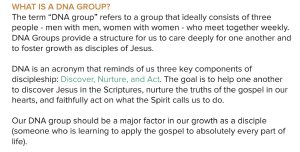
Do you have any information on DNA (Discover, Nurture, Act) groups?

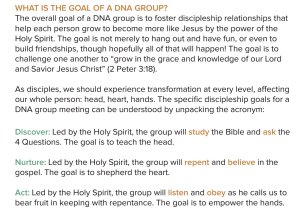
DNA groups are an accountability partner discipleship program for church members developed by Soma, a nationwide network of Reformed, gospel-centered churches. The groups usually consist of three women or three men. Groups normally meet weekly for ninety minutes to discuss the events of life and how Scripture and the gospel apply, what they’ve been learning in their personal Bible study time, and any incidents requiring repentance. The groups study Scripture together and pray with, and for, one another.

You can download and read the DNA program manual here. A couple of excerpts that help explain the program:

Screenshot_2016-05-28-22-19-55_kindlephoto-13502875

Screenshot_2016-05-28-22-16-33_kindlephoto-13561799

The DNA group concept seems like a doctrinally solid discipleship program. It demonstrates intentionality in building disciples. It is centered on the gospel, Scripture, prayer, and repentance. It encourages church members to sharpen one another and bear one another’s burdens.

A few minor things jumped out at me that I think it would be helpful for Soma to tweak and clarify just a bit.

  • Several times, the phrase “listen to the Holy Spirit,” or something similar, is used. At first, this concerned me because this is the type of language used in contemplative prayer and New Apostolic Reformation false doctrine. Reading the document in context, however, it is clear that this is not what Soma is referring to, but, rather, being led by the Holy Spirit and hearing Him speak through Scripture.
  • “Pubs” (in addition to other venues) are mentioned a couple of times as meeting places for DNA groups. I’m not aware of any definition of the word “pub” other than “bar.” If “pub” is a new slang word for coffee house, or something, it would be helpful to clarify that. If by “pub” they actually mean a bar, I would personally not endorse a discipleship group (or any individual Christian or group of Christians) meeting in a bar.
  • Evangelism is presented as “telling your story with Jesus as the hero.” It can sometimes be helpful when evangelizing to share your story of salvation, and the manual describes a way to do this which is biblically correct (emphasis on your sin and your need for a Savior, etc.). However, I think Scripture bears out that a law/gospel presentation is the primary way the gospel should be proclaimed and that “our story” should mainly be used as a supplement or addendum. That being said, every Christian should be able to verbally and cogently explain how she was saved, and the manual does show the biblical way to do this.
  • One of the steps in forming a DNA group is to “read and discuss The Story of God Summary.” The Story of God Summary (included in the manual) is basically an overview of the narrative of Scripture from Creation through the establishment of the church, and the promise of Christ’s return. I understand it would be impossible to read the entire Bible and discuss it in one or two sessions as a step in setting up a DNA group (thus, the summary), but I’m uncomfortable with the fact that – while the summary is biblically accurate – no actual Scripture is cited. I think it would be beneficial to add in some acutal passages of Scripture to flesh out the main points of the summary.

Overall, from what I’ve seen “on paper” this looks like a discipleship model that I would have no trouble recommending. I would encourage anyone interested to read the manual for further details.


If you have a question about: a well known Christian author/leader, a Bible passage, an aspect of theology, a current issue in Christianity, or how to biblically handle a family, life, or church situation, comment below (I’ll hold all questions in queue {unpublished} for a future edition of The Mailbag) or send me an e-mail or private message. If your question is chosen for publication, your anonymity will be protected.

Discernment

I Can’t Sit Down, Shut Up, and Play Nice

“She’s at it again, going off the deep end about some church or Christian celebrity who does things just a little differently. She’s so nit picky, judgmental, and divisive. Why doesn’t she just shut up and be nice?”

That’s what I imagine most of my friends on my (personal) Facebook page are thinking whenever I post something about the latest false doctrine or false teacher. Maybe that’s what you think, too. “Ugh. One of those dreaded discernment bloggers.”

I don’t consider myself a discernment blogger, but rather a discipleship blogger. Discernment (warning against false teachers and false doctrine) is part of discipleship, but so is missions and evangelism, Bible study, and assorted “Christian living” topics, all of which I try to cover in balance.

Nobody seems to mind those latter topics, but a lot of people get their noses out of joint when I call attention to a false teacher, an unbiblical doctrine or practice, or an apostate “church.” I have been asked why I hate women. I’ve been told I’m what’s wrong with Christianity. And, I’ve been called every name in between for pointing out “Christian” teachers, doctrines, and “churches” that behave and teach in ways which directly contradict Scripture.

Who needs that? Who needs the hassle and emotional stress of being attacked, especially when you’re not even getting paid for it? Why don’t I just drop the discernment portion of my blog and social media and blow rainbows and unicorns up everybody’s skirt? It’s certainly a formula that works for other bloggers who choose to go that route, and everybody would be happier.

Well, let me tell you a little story.

I recently shared the gospel with someone who claimed to be a Christian. Why would I do that? If she says she’s a Christian, she must be one, right? Wrong. Before I shared the gospel with her, I asked her to explain her understanding of the gospel to me. Instead of talking about repenting of her sin and placing her faith in Christ’s death, burial, and resurrection to save her from her sin, she gave me a laundry list of ways she was a good church member and all the activities she had ever participated in at her church. The name of Jesus did not come up once, nor did the cross, sin, nor repentance.

In case she had misunderstood my question, I then gave a very simple, biblical explanation of the gospel. She proceeded to tell me how wrong that was according to the teachings of her church. You see, all her life, this lady has belonged to an apostate church that teaches a false gospel of works righteousness (your own good works make you righteous before God, instead of Christ’s work on the cross).

This is a very real lady who really believes she’s a Christian who’s going to spend a very real eternity in Hell unless she repents and believes what the Bible says about salvation. Which is not what her so-called church is teaching her.

That’s why I do discernment work. Because real people’s eternities are at stake. False doctrine is not some trivial little difference of opinion over nothing issues in the church like pews versus chairs or what color the sanctuary carpet is. I’m not being judgmental or hateful over unimportant preferences.

People are dying and going to Hell forever
because they’ve been taught false doctrine. 

And sometimes I wonder if anybody gets that.

So, if that’s what’s so important, why don’t I limit myself to writing about “first tier” issues like works righteousness or the deity of Christ which directly affect a person’s salvation? Does it really matter if churches allow practicing homosexuals to be church leaders or allow women to preach to, teach, and exercise authority over men?

Yeah, it does. Because if you take a look at churches that have their first tier issues wrong, they took their initial steps down the road to that destination by compromising and disobeying Scripture on issues, such as homosexuality and female usurpation, which are indirectly related to salvation. In other words, by the time the cancer has metastasized, it’s too late. Early detection, early cure.

Galatians 5 and 1 Corinthians 5 put it like this:

A little leaven leavens the whole lump.

In the same way that a couple of teaspoons of yeast leaven my entire batch of dough and a few cancer cells will grow and spread throughout the whole body, so, a little false doctrine, if left unchecked, will spread throughout the local Body of Christ and eventually kill it.

I care about y’all. I care about your churches. I don’t want to see a single person damned or church turn apostate. It absolutely breaks my heart when I encounter women who don’t know the gospel or have a complete misunderstanding of Scripture simply because that’s what they’ve been taught by a so-called church or a “Christian” celebrity that they trusted. These things should not be. Christ loves you and wants you to have a right relationship with Him and a right understanding of Him and His word. And I couldn’t live with myself – or Him – if I didn’t tell you that.

My voice and my platform are small. I don’t reach the millions of people the false teachers on the shelf at your local Christian bookstore reach. I am flawed and far from perfect. But I will continue to do everything I can, as biblically as I can, where I am and with what God has given me, to reach the women God places in my path in real life an on line with the glorious truth of His word.

Eternities are at stake. The church is at stake. I can’t sit down, shut up, and play nice.