Discernment Bible Study

Choose What Is Right: A Study in Discernment- Lesson 5


Previous Lessons: 1, 2, 3, 4,


False Teachers, God’s View, Our Response

Read These Passages


Questions to Consider

Throughout this study we will be looking at various passages of Scripture rather than working our way through a book of the Bible verse by verse. Because of that, we will need to be extra vigilant to rightly handle these passages in context. I will always attempt to provide the context you need for understanding these passages correctly, but if you need more clarity please feel free to read as much of the surrounding text as you need to – even the whole book, if necessary – in order to properly understand the passage presented.

1. Examine today’s passages and answer these four questions about each (if applicable):

  • How does God describe false teachers in this passage?
  • What is God’s opinion of false teachers in this passage, and what consequences will they face?
  • How does this passage describe the way people respond to and/or should respond to false teachers?
  • What is God’s opinion of people who follow false teachers, and what consequences will they face?

Using your answers to the first two questions, write a character sketch of a typical false teacher.

Using your answers to the last two questions, write out a description of the way God is generally disposed toward those who follow false teachers and how He wants us to regard and respond to false teachers instead.

2. Considering the Isaiah passage alongside 2 Timothy 4:3-4, are people who follow false teachers innocent victims of these teachers? Why or why not, according to these passages? How do these passages describe people’s disposition toward God before they start following false teachers?

3. Examine the 2 Corinthians passage. Who do false teachers disguise themselves as? (13,15) Instead of “apostles,” “workmen,” and “servants,” what words or titles do we generally use for these people today? (Hint: Think of a popular false teacher. What position or title does s/he hold?) How do false teachers characterize their work or “ministry”? (12) Rather than serving Christ, who do false teachers really serve? (15) How does verse 14 connect to Genesis 3:1-5?

4. Compare the light/darkness, and the fruit/unfruitful motifs of the Ephesians passage to verses 17-19 of the Matthew 7 passage.

How does verse 11 of the Ephesians passage refute these ideas held by some professing Christians?

  • “I know Teacher X teaches some things that are false, but I just chew up the meat and spit out the bones.” (11a)
  • “You shouldn’t warn against false teachers, you should just pray for them.” (11b)
  • “I don’t name the names of false teachers in my sermons, I only preach sound doctrine. That’s the way people learn to recognize false teachers. After all, that’s how bank tellers learn the difference between counterfeit and real money, by only familiarizing themselves with real money.” (11b, see also verse 9 of the Titus passage- Consider this: If there were counterfeiters running around your town passing fake money, what do you think the police and news media would do to alert the banks and the public so they could catch these criminals, stop them, and mete out justice to them?)

5. In the Matthew 7 passage- explain in your own words what the sheep and wolves metaphor in verse 15 means. How do the examples in verse 16 relate to the sheep and wolves metaphor in verse 15, and also to the concept of false teachers disguising themselves in the 2 Corinthians passage?

In 17-19, who are the healthy and unhealthy trees? What is the good and bad fruit of these trees? Who is the fruit of a false teacher’s ministry, and how would you characterize them? Who is the fruit of a sound teacher’s ministry, and how would you characterize them?

Think about people you know who loyally and diligently follow false teachers. Are they growing in holiness as the Bible describes it? Forsaking sin more? Growing in spiritual maturity? Increasingly exhibiting fruit of the Spirit? Studying their Bibles (not the teacher’s books and materials, but the Bible) and praying better and more frequently? Increasing in their love for and service at a doctrinally sound church? Becoming more skilled at rightly handling, understanding, and obeying God’s Word in context? These things are the fruit of a teacher’s ministry.

Christians often wonder whether false teachers knowingly teach false doctrine and deceive people, or if they’re so deceived that they actually think they’re genuine Christians teaching biblical truth. Compare 21-23 with the 2 Corinthians passage. What do you think? Could there be some of each?

6. Think back to lesson 3 (link above) and the difference between antinomianism and legalism. In the Matthew 23 passage, is Jesus rebuking the Pharisees for being antinomians or legalists?

If your pastor preached Matthew 23 to or about a specific false teacher or group of false teachers and posted the video of it on social media, what do you think non-Christians would say about him? What do you think most professing Christians would say about him? Some professing Christians think it is mean, hateful, unloving, unkind, even unChristlike to call out a false teacher or even suggest that people shouldn’t follow a certain false teacher, no matter how gently and kindly it is done. Is that true? How do you know, based solely upon Matthew 23?

7. Examine the Titus passage. Who is “he” in verse 9 (see verses 5-8)? What two things does God require of pastors and elders in verse 9? If a pastor only preaches sound doctrine and never rebukes, preaches against, or warns against false doctrine and false teachers, is it fair to say he’s only doing half his job? Why or why not? (Support your answer from rightly handled Scripture, not emotion or personal opinion.)

Consider verse 11 alongside 2 Timothy 3:6-7. What is the impact on the family when women follow false teachers and bring their false doctrine into the home?

Note the word “rebuke” in verses 9 and 13? Why are pastors to rebuke false teachers and those who follow them?

8. Sometimes Christians wonder whether or not false teachers (at least some of them) are truly born again. In today’s passages, carefully examine together 2 Corinthians 11:15, Ephesians 5:6, Matthew 7:15, 19, 21, 23, Matthew 23:15, 33, Titus 1:15-16. What do these verses indicate is the answer to that question? Think about the way Scripture describes and characterizes the life and eternity of Christians. Do these verses about false teachers match Scripture’s description and characterization of Christians?


Homework

Read my article Answering the Opposition- Responses to the Most Frequently Raised Discernment Objections. Which of the Scriptures you studied today answer some of these objections? How? Are there other objections to discernment that you’ve heard that are not on the list, but are answered by today’s passages? Which objections would you add to the list, and how would you answer them from today’s passages (and others)?


Suggested Memory Verse

Discernment Bible Study

Choose What Is Right: A Study in Discernment- Lesson 4


Previous Lessons: 1, 2, 3,


False Teachers, God’s View, Our Response

Read These Passages


Questions to Consider

Throughout this study we will be looking at various passages of Scripture rather than working our way through a book of the Bible verse by verse. Because of that, we will need to be extra vigilant to rightly handle these passages in context. I will always attempt to provide the context you need for understanding these passages correctly, but if you need more clarity please feel free to read as much of the surrounding text as you need to – even the whole book, if necessary – in order to properly understand the passage presented.

1. Do you notice the similarities between 2 Peter 2 and Jude? Click here and read the second paragraph under “Author and Date”. What might be the reason for some of the similarities?

Make a two column chart. Examine Jude and 2 Peter 2 side by side, verse by verse. (You may want to do this with two Bibles, two devices, or a split screen on your Bible app or device.) List the verses or phrases that are strikingly similar in wording and concept. What does each mean? Why might God have emphasized a particular verse or phrase by placing it in Scripture twice?

2. To what general group of people are Jude’s (v.1) and Peter’s (1:1) letters addressed? What is Jude’s (3) appeal to the church? Why is he urging them to contend for the faith (Jude 4, 2 Peter 2:1-3)? What are some of the things that happen to a church when false teachers gain a foothold?

Do these epistles apply to you as a Christian, and to the church, today? Why? Have you (or your church) ever been urged by a pastor or teacher to contend for the faith? Why do you think that admonition is so lacking in the church and from Christian teachers today?

2. How does Jude (4a) describe false teachers entering the church? How does Peter (1) say false teachers will bring in destructive heresies? Compare this characterization to the way these passages say false teachers infiltrate the church and the home. What does this characteristic of sneakiness tell you about false teachers? Why aren’t they just open and honest with Christians and the church about what they want to teach?

3. What do Jude (4, 13) and Peter (3, 17) say is the final destiny of false teachers?

Examine 2 Peter 2:4-10. Who are the godly people mentioned in this passage and how did God deal with them? Who are the ungodly who are listed, and how did God deal with each of them? Do these ungodly people include false teachers (10, Jude 8)?

What does this tell you about how God views false teachers? How He views and protects His faithful children?

4. What are Jude (8-9) and Peter (10b-11) telling us about angels, blasphemy and the glorious ones? How does this reflect the pride and arrogance of false teachers?

What are Jude (10) and Peter (12) telling us about the ignorance of false teachers? Think about how the indwelling Holy Spirit illumines Scripture to the Christian. What might be one reason false teachers do not understand Scripture or how to properly handle it?

What is the significance of Jude’s (11) comparison of false teachers to Cain? Of Jude’s (11) and Peter’s (15-16) comparison to Balaam?

Consider the imagery in Jude’s (12-13) and Peter’s (17) comparative metaphors to false teachers. What are the characteristics of each metaphor mentioned, and how do they apply to false teachers?

5. In your own words, write a brief summary of the character of false teachers according to Peter and Jude. Do you know of any pastors or teachers who could be described this way? Who, and why?

6. What does Jude (17-23) say about how we should respond to the types of teachers he and Peter are describing?


Homework

If you’d like a little extra study on these passages, check out:

Wednesdayโ€™s Word ~ Jude

Living Stones: A Study of 1 & 2 Peter ~ Lesson 11


Suggested Memory Verse

Discernment, False Doctrine

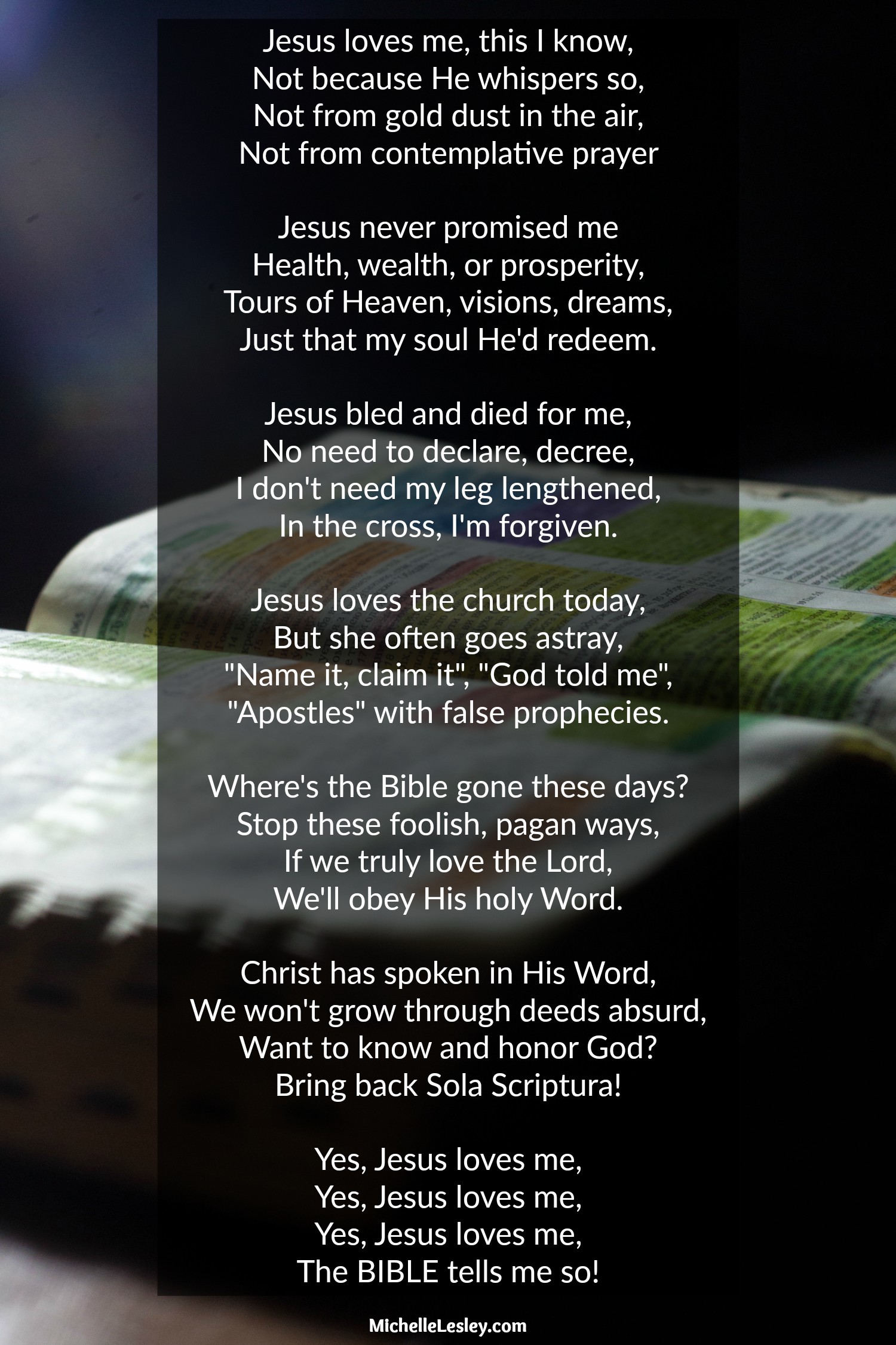
Throwback Thursday ~ Jesus Loves Me: The “Contending for the Faith” Version

Originally published March 6, 2018

Every now and then I do a little creative writing… :0)

Discernment Bible Study

Choose What Is Right: A Study in Discernment- Lesson 3


Previous Lessons: 1, 2,


What Is False Doctrine?

Today’s Scripture passages are embedded in the body of the study. Please click the links in each question.


Questions to Consider

Throughout this study we will be looking at various passages of Scripture rather than working our way through a book of the Bible verse by verse. Because of that, we will need to be extra vigilant to rightly handle these passages in context. I will always attempt to provide the context you need for understanding these passages correctly, but if you need more clarity please feel free to read as much of the surrounding text as you need to – even the whole book, if necessary – in order to properly understand the passage presented.

1. Have you ever studied the book of Judges? If you have, you know this book has a very clear theme which can be found in Judges 17:6b and 21:25b. What is that theme? What does it mean to do what is right in your own eyes? Is believing what is right in your own eyes part of doing what is right in your own eyes? How and why? As Christians, how are we supposed to live and believe? What are some ways Christians (or those who claim to be Christians) today do and believe what is right in their own eyes rather than doing and believing what is right in God’s eyes?

How do we know the difference between what is right in our own eyes and what is right in God’s eyes? What is our standard for answering that question? Our authority for life and doctrine? If this is how we’re to live and believe – submitting to the truth of God’s written Word as our authority in life and our measuring stick for evaluating right actions from wrong actions, right beliefs from wrong beliefs – is it biblical to say that this is also how teachers are to teach?

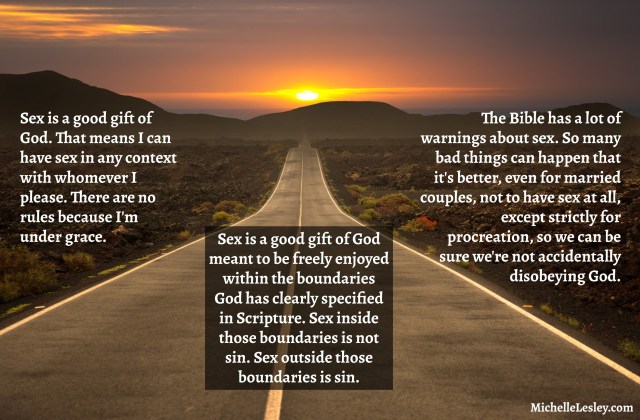
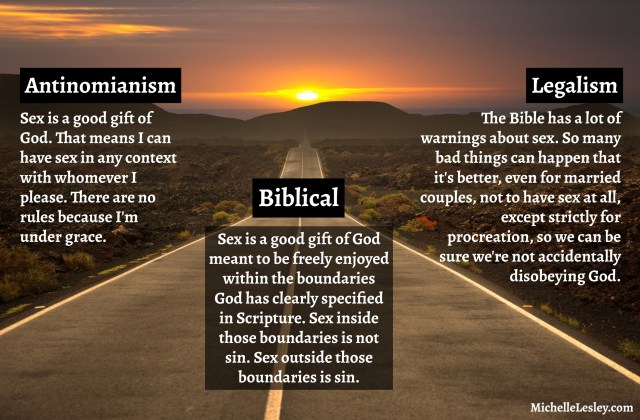
2. When you get right down to the bottom line, there are two basic ways of doing and believing what’s right in your own eyes – failing to rise to the standard of God’s Word, and going above and beyond the standard of God’s Word. Not being as restrictive as God’s Word is, or being more restrictive than God’s Word is. Too much “grace” or too much “law”.

Consider this concept as applied to sex, and what the Bible says about it:

Which side of the road is the “too much ‘grace'” side? “Too much ‘law'”? Which view is the biblical view? (Notice that the biblical view is a “middle of the road” balance between the extremes of man-made “law” and “grace”. If you wander off the road you’re wandering off into darkness. The biblical view is the only one which leads to the sun (Son).)

The theological term for “too much ‘grace'” is antinomianism (also sometimes called “license” – as in, “a license to sin” – or “licentiousness”). The theological term for “too much ‘law'” is legalism (showcased in the Pharisees of Jesus’ day).

3. Antinomianism often fleshes itself out today as:

  • “I’m saved and all my sins – past, present, and future – are forgiven, so why not sin as much as I want?”
  • An “It’s no big deal!” approach to sin
  • The idea that the sin in question is actually biblical (or loving / loving your neighbor, tolerant, compassionate, “what ‘Jesus’ would do”)
  • Obeying what the Bible actually is says is legalism (“Pharisaism”).

What does the Bible say about antinomianism? What does God say about people who claim to be Believers but don’t obey Him?

What are some specific examples of antinomianism that you’ve observed in evangelicalism, in your denomination or church, in your own heart and life?

5. Legalism is most often seen today in churches or individuals who make issues of preference, conscience, or Christian liberty – which are neither prescribed nor prohibited in rightly handled Scripture – into “law”. They consider these “laws” equal to Scripture and believe that anyone who violates them is in sin. A few (generalized) examples:

What does the Bible say about legalism? What are some specific examples of legalism that you’ve observed in evangelicalism, in your denomination or church, in your own heart and life?

Would you say that antinomianism or legalism is the false doctrine most people tend towards today…

  • …in evangelicalism in general?
  • …in your denomination and / or your church?
  • …in your own heart?

6. If you believe falsely about God, sin, the gospel, etc., what impact will that have on your life and your worship?

Let’s look at some examples of unbiblical worship in Scripture. In each of these instances:

  • What was the false belief or doctrine that led these people to worship unbiblically?
  • Was this an expression of legalism or antinomianism?
  • What was God’s response to their false doctrine / false worship? How does God’s response demonstrate how seriously He takes false doctrine / false worship?

Syncretism and idolatry in the temple

Ananias and Sapphira

Nadab and Abihu

The people worship Herod

Taking the Lord’s Supper in an unworthy manner

The Pharisees’ beliefs and practices

7. Since God takes false doctrine / false worship so seriously, what is His posture toward those who teach false doctrine?

8. Some Christians believe that only aberrant soteriology – a false gospel, unbiblical teaching about how to be saved – is false doctrine. Consider these Scriptures. Is this idea biblically accurate?

9. What is false doctrine? Carefully and biblically define this term in your own words.


Homework

Today’s study includes passages from Judges and Ezekiel. You may wish to peruse the relevant parts of my Bible studies on Judges and Ezekiel. How is the state of the church today similar to the state of God’s people and the temple in Judges and Ezekiel?


Suggested Memory Verse

Discernment

Fighting Off the Wolves

Originally published March 20, 2018

12974352_1075682862478482_4420640709694072913_n
Photo and quote courtesy ofย The Patriot.ย ยฉ2000, Columbia Pictures, Inc.

I love pastors. I really do. As a minister of music’s wife, church member, and through involvement in other ministries, I’ve known a lot of them. They have a tough job that most of us wouldn’t take on in a million years. I pray for and encourage my own pastor and my pastor buddies regularly, and try to remind y’all to do the same from time to time. All this to say, I’m not a preacher-basher. Far from it.

But sometimes there’s a bit of a veering in a dangerous direction, like a vehicle heading towards the center line, among (some, not all) pastors who are momentarily distracted and might need a friendly “Hey, did you see that truck we’re about to crash into?” from their terrified, front seat passenger.

Color me terrified.

There are pastors out there who treat false teachers with kid gloves. They refuse to label anyone as a false teacher, or only vaguely allude to certain false teachers without naming names. I’d like to encourage those pastors to pull the steering wheel to the right and call a spade a spade. Yes, they need to use the label of false teacher soberly, sadly, and only after making sure, with hard evidence, that it is warranted, but enough with grown men of God tiptoeing around under the guise of “we don’t know what’s in that person’s heart” or “I’m afraid to be painted with the ‘mean old discernment blogger’ brush.”

Enough with grown men of God tiptoeing around under the guise of “we don’t know what’s in that person’s heart” or “I’m afraid to be painted with the ‘mean old discernment blogger’ brush.”

The Bible doesn’t say anywhere that a pastor shouldn’t call someone a false teacher and warn the flock about him just because the pastor doesn’t know for sure what’s in the person’s heart or because he’s afraid of what others might think. We are all to look at their words and their behavior and judge (that’s right, I said “judge“) whether or not they are teaching what accords with sound doctrine. And if they’re not, they need to be denounced. Not in a wild-eyed, foaming at the mouth, wingnut way, but certainly loudly and decisively as a mature man of God.

We never see Paul or Jesus or Peter or Jude or any other godly man in the Bible being over-cautious about firmly calling out those who had proved themselves to be false teachers.

We never see Paul or Jesus or Peter or Jude or any other godly man in the Bible being over-cautious about firmly calling out those who had proved themselves to be false teachers.

“Beware of the leaven of the Pharisees and Sadducees.” – Jesus, Matthew 16:11

“Woe to you, Scribes and Pharisees, hypocrites…blind guides…fools…serpents…brood of vipers.” – Jesus, Matthew 23

“For such men are false apostles, deceitful workmen, disguising themselves as apostles of Christ. And no wonder, for even Satan disguises himself as an angel of light. So it is no surprise if his servants, also, disguise themselves as servants of righteousness. Their end will correspond to their deeds.” – Paul, 2 Corinthians 11:13-15

“For certain people have crept in unnoticed who long ago were designated for this condemnation, ungodly people, who pervert the grace of our God into sensuality and deny our only Master and Lord, Jesus Christ.” – Jude, Jude 4

“They count it pleasure to revel in the daytime. They are blots and blemishes, reveling in their deceptions, while they feast with you. They have eyes full of adultery, insatiable for sin. They entice unsteady souls. They have hearts trained in greed. Accursed children! Forsaking the right way, they have gone astray.” – Peter, 2 Peter 2:13b-15a

“But even if we or an angel from heaven should preach to you a gospel contrary to the one we preached to you, let him be accursed. As we have said before, so now I say again: If anyone is preaching to you a gospel contrary to the one you received, let him be accursed.”
Paul, Galatians 1:8-9

Would pastors today be wise to use this same kind of verbiage? Maybe. Maybe not. These godly men spoke and wrote in a way that was appropriate for their time, culture, and context. Our time, culture, and context are different and may call for a different approach. But the point is, none of them were afraid to speak the truth boldly about false teachers in order to protect the sheep God had entrusted to them. And we sheep today desperately need courageous shepherds who will do the same.

Pastors, if you speak out against false teachers, there are people who will get mad at you. It’s unavoidable. But there are others who know the truth and will be cheering you on and supporting you. And there are still others you will turn back from false doctrine who will learn the truth of God’s word and love you for warning them. And their souls are worth any risk or trial.

Be encouraged, dear pastors. Be strong in the Lord. Be faithful to Him. You can do this!

Be encouraged, dear pastors. Be strong in the Lord. Be faithful to Him. You can do this!

Remember the words of your brother and fellow laborer Paul, who, after condemning false teachers in Galatians 1:6-9, may have anticipated the same backlash you might receive:

For am I now seeking the approval of man, or of God? Or am I trying to please man? If I were still trying to please man, I would not be a servant of Christ.
Galatians 1:10