Podcast Appearances

The Everyday Ministry Podcast Guest Appearance: Women in Ministry

It was so fun to appear as a guest on The Everyday Ministry Podcast last week! Listen in as James, Krist, and I discuss complementarianism, how pastors can help women minister effectively in their churches, and more!

You can also subscribe to The Everyday Ministry Podcast on iTunes and Google Play, and be sure to follow them on Facebook and Twitter!

Here are a few articles I’ve written about some of the topics we covered in the podcast:

How a Little Acorn Helped Reassure a Nut Like Me
Testify
Rock Your Role: Jill in the Pulpit
Let Me Count the Ways: 75 Ways Women Can Biblically Minister to Others
Deaconesses and Female Deacons
Servanthood
Bible Studies
Rock Your Role FAQs


Got a podcast of your own or have a podcasting friend who needs a guest? Need a speaker for a women’s conference or church event? Click the “Speaking Engagements” tab at the top of this page, drop me an e-mail, and let’s chat!

1&2 Timothy Bible Study

1 & 2 Timothy: Lesson 12

Previous Lessons: 1, 2, 3, 4, 5, 6, 7, 8, 9, 10, 11

Read 2 Timothy 4

Questions to Consider

1. Recalling that 2 Timothy was written as a letter, no chapter and verse markings, notice how chapter three flows into chapter four. Read 3:15-4:2a. What is the focal point of these verses?

2. We’ve seen charges in previous chapters, and chapter 4 starts off with a charge. Break down the charge in verses 1-2,5 into three sections:

1. The seriousness and grave responsibility of the charge– Describe the gravity and weightiness of this charge to Timothy and all other pastors. How does this type of charge compare to others you’re familiar with, such as the swearing in of a witness in court or the President taking the oath of office?

2a. What are pastors being charged to do?– Think about some of the shenanigans you may have seen in the church- pastors preaching about movies, conducting interviews with Christian (or not) celebrities during the sermon time instead of preaching, pastors who preach “God told me” extra-biblical revelation, sermons that consist mainly of jokes and personal stories, etc. Considering the seriousness of the charge to “preach the Word” do pastors have the leeway – before God – to do such things?

2b,5. In what manner are pastors to carry out this charge?- What does it mean to “be ready in season and out of season”? What do the words reprove, rebuke, and exhort mean? What would that look like in your church, from your pastor? Why would a pastor need to exercise “complete patience”? If a pastor shies away from preaching about certain biblical issues, is he correctly carrying out the charge to give “complete teaching”? What do each of the points in verse 5 mean, and how should pastors carry them out as they preach the Word?

3. Keeping this serious charge to pastors in mind, examine 3-4 light of 1-2,5. Notice that verse 3 starts with a pivot point, “for,” which, in this context, means “because.” Why does the Holy Spirit, via Paul, hammer so hard on preaching the Word in 1-2? Because 3-4. Explain what verses 3-4 mean.

If “people will not endure sound teaching” (3) and will “turn away from listening to the truth” (4), what is the point of pastors preaching the Word (2)? If people are just going to turn away anyway, why bother? Think about this in light of these passages. Who is the church for? How does preaching the Word benefit the sheep (Believers) a) by nourishing them with Scripture and b) by drawing a line of distinction between true Believers and false converts who only want their itching ears scratched? How does this line of distinction help us with evangelism? How does it help the spiritual health of the church?

4. Examine verses 6-8. Notice that verse 6 starts with “for” (because). Why (6-8) is Paul passing down all these instructions in 1-2 Timothy to Timothy especially, and to all pastors?

5. Put yourself in Paul’s shoes as you read 6-22. Recall where Paul is as he’s writing this (go back to the introduction in lesson 8 {link above} if necessary), and what is transpiring (16). Notice the theme of being deserted by others. How many times does Paul mention others deserting him? Does he seem to want revenge for this? Who is Paul’s comfort when deserted by others? (17-18) Do you get the impression Paul feels sorry for himself? Does he focus on His circumstances or does he choose to focus on spiritual truths? Make a list of the spiritual truths he focuses on in these verses. How could you apply and focus on these comforting spiritual truths the next time you’re in a difficult or lonely situation?

Compare the “faithful to the finish” life of Paul to other Bible characters (Solomon, Uzziah, etc.) you’re familiar with who started the race well, but turned from God later in life. Ask God to help you run the race well and finish faithful.


Homework

Do you think the “time has come” (3)? What is one way you have personally seen verses 3-4 fleshed out in the church today? How would this situation have been helped or changed if the pastor had taken seriously his charge in verses 1-2? Take some time to pray for those involved in that situation.

Have you ever seen a “verse 3-4 situation” in which the pastor did take seriously his charge to preach the Word, reprove, rebuke, etc., and the story had a happy ending with repentance and restoration to the truth of the gospel? Consider dropping a note to the pastor thanking him for obeying God in that situation.


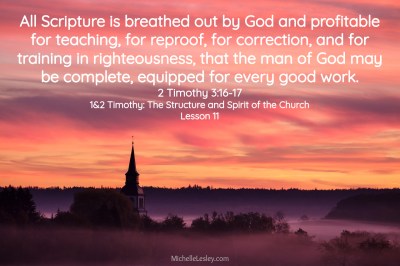
Suggested Memory Verse

1&2 Timothy Bible Study

1 & 2 Timothy: Lesson 11

Previous Lessons: 1, 2, 3, 4, 5, 6, 7, 8, 9, 10

Read 2 Timothy 3

Questions to Consider

1. Recalling that 2 Timothy was written as a letter, no chapter and verse markings, read how chapter two flows into chapter three (start around 2:22). What has Paul been discussing in chapter two and how does he transition into a new, yet related, line of thought in chapter three? Notice how 3:1 functions as a pivot point between the two trains of thought.

2. When are the “last days“? (1) What word does Paul use to describe the last days? (1)

3. Study 1-9, taking care to read 2-5 as one (long) complete sentence. Notice the set and subset of people Paul describes in this passage. What is the set described in 2-5 (notice the first two words of 2)? Are these verses generally speaking of Christians or non-Christians? Which words and phrases in these verses lead you to this conclusion? What is the subset (“For among them…”) of people described in 6-9? If Paul speaks of false teachers as being a subset of non-Christians, what does this imply about the spiritual condition of most false teachers?

4. How does verse 5(b) tell us to deal with the types of people described in 2-5? Does this include false teachers? Which words and phrases in verses 4b-6a lead us to this conclusion?

5. What do the phrases “lovers of pleasure rather than lovers of God” and “having the appearance of godliness, but denying its power” mean? Are these phrases describing lost people in general, or false teachers, or both?

6. Carefully examine verses 6-7. Why do you think the Holy Spirit intentionally specifies women in verse 6? Think about the women you know who have been “captured” by false teachers and how verses 6-7 describe them.

7. Look closely at 6-9. Who were Jannes and Jambres? (8- use your cross references, click here for more help). Who do the words “these men” (8) and “they” (9) refer back to (6)? Why do you think the Holy Spirit brought Jannes and Jambres to Paul’s mind when he was writing about false teachers? What are the similarities between these two men and the false teachers Paul is describing?

8. Keeping in mind that this is a letter written to a pastor, and to pastors today, why is it important for pastors to be aware of these things, and what sorts of practical actions should they take in response to these instructions and warnings?

9. Notice how verse 10 serves as another pivot point to a new line of thought. Describe the compare and contrast element Paul uses here between 1-9 and 10-17. Who/what is being compared?

10. Imagine you’re Timothy reading this letter. Make a list of the things in 10-17 that you would find encouraging as a pastor.

11. What can we learn about persecution from verses 11-13? Does God always “rescue” Christians from persecution?

12. Read verse 15 in light of 1:5, and explain the impact godly mothers and grandmothers can have on their children and grandchildren when they train them in the Scriptures.

13. Study verses 16-17. How do these verses refute the unbiblical idea that the words Jesus spoke during His earthly ministry (“red letters”) somehow carry more weight than the rest of Scripture? (Ex: “Jesus never mentioned homosexuality, so it must have been OK with Him.”) How do these verses refute the unbiblical argument people sometimes make about 1 Timothy 2:12 that, “That’s not God giving that command, that’s just Paul’s personal, human opinion.”?

14. Peek ahead to the first few verses of chapter 4, and notice how chapter 3, especially verses 16-17, feed into the the thoughts in chapter 4.


Homework

Review verses 4b-9, and consider a) how the Holy Spirit describes false teachers and the spiritual damage they do to the church, and b) how the Holy Spirit instructs us to “avoid such people”. Think about how this applies to individual Believers and the church today – the music we use in worship service or listen to on Christian radio, the materials we use in Bible study and Sunday School classes and for our own personal Bible study time, the evangelical celebrities we follow and share on social media and the ones quoted by our pastors and shared by our church’s social media pages, the conferences we attend or that our church hosts, etc.

Make a list of practical ways you and/or your church can obey verse 5’s instruction to “avoid such people” and pray for God to give you and/or your church leaders wisdom in this area.


Suggested Memory Verse
1&2 Timothy Bible Study

1 & 2 Timothy: Lesson 10

Previous Lessons: 1, 2, 3, 4, 5, 6, 7, 8, 9

Read 2 Timothy 2

Questions to Consider

1 . Examine the phrase, “You, then, my child…” in verse 1. Who is “you/my child”? Notice how the word “then” in this phrase makes it very similar to phrases like, “Therefore…,” “So then…,” or “Because of this…”. What is our rule of hermeneutics when a chapter or verse starts with this kind of transitional phrase? (Hint: see question 6 in lesson 9, link above). Where should you look next?

How do the themes of suffering for the gospel, not being ashamed of the gospel, and guarding the deposit from chapter 1 relate to what Paul is about to tell Timothy? Trace the line of entrusting the deposit of the gospel, beginning with Christ entrusting it to Paul. To whom did Paul entrust it? To whom is Timothy to entrust it? (2)

2. “Think over what [Paul] says” (7) in the illustrations he uses in verses 3-6, asking the Lord to “give you understanding in everything.” Who do the soldier, the athlete, and the farmer represent? (1-2) What is Paul’s admonition to Timothy and these men in each of these illustrations? Do these admonitions apply only to pastors and elders? How might they apply to the average Christian today?

3. In verses 8-13, we have our repeated motif of Paul summarizing the gospel in the middle of instructing Timothy. What impact has it had on you to see the Holy Spirit continually driving home the gospel in these epistles regardless of what instruction He’s giving pastors and the church? Does your pastor help your church to center on the gospel in everything – sermons, music, worship service, Bible study classes, fellowship, church business, programs, evangelism, missions, and the church member’s daily life? What is the significance of the word “remember” at the beginning of verse 8 and “remind them of these things” at the beginning of verse 14?

4. Explain the significance of the themes of “suffering” (as carried over from chapter 1) in 1-13 and “quarreling” in 14-26.

5. Examine each of the times a form of the word “quarrel” is used in 14-26. (14,23,24) Does this mean that disagreement, controversy, and confrontation are always to be avoided in the church regardless of the issue? Recall the examples of controversy we have already seen in 1 Timothy. What issues did these controversies have to do with? Do they seem to be the same issues of “quarreling” Paul is talking about in this passage? What do “quarrel about words” (14, 1 Tim. 6:4) and “foolish, ignorant controversies” (23) mean? What is the difference between these types of controversies and quarrels and the necessary factions Paul describes in 1 Corinthians? Considering how Paul has already warned Timothy about quelling false doctrine in the church, is rebuking false teachers taking part in “quarrels about words” and “foolish, ignorant controversies” or being “quarrelsome”?

6. Examine verses 15-19. List the things in verses 16-18 that can bring chaos and disorder to the church. Explain the instructions and precepts in verses 15 and 19. Notice how these instructions and precepts bring stability and unity to the church, and how these two verses “bookend” or contain the chaos in verses 16-18. What does this tell you about the church, and you as an individual, walking in obedience to God?

7. Examine verses 20-21 in light of verses 22-25a (note the “So” at the beginning of verse 22). How do verses 22-25a describe how someone may “cleanse himself from what is dishonorable”? What are the characteristics of someone who is “a vessel for honorable use”?

8. Who is “the Lord’s servant” in verse 24? Compare verses 24-25a with the qualifications for pastors and deacons we saw in 1 Timothy 3. What are the similarities and differences? How could you walk out the instructions in 24-25a as a mother, leader, Bible teacher, while evangelizing, or while defending the faith? Verses 25b-26 tell us why pastors, teachers, and, yes, even a mom or a woman sharing the gospel should exhibit these characteristics. What is that reason? How do verses 25b-26 point back to the gospel-centrality of the church, pastors, and individuals we looked at in #3?


Homework

How do we know which controversies are “foolish and ignorant” and which ones are important biblical issues that must be settled according to Scripture? Give 2-3 examples of each kind of controversy that you’ve experienced or witnessed in your church or with other Believers. What would have been the biblical way to handle each of these controversies? Take some time in prayer to ask God to help you avoid foolish, ignorant controversies but to stand firmly in controversies over the truth of His Word, and the wisdom to discern the difference.


Suggested Memory Verse


Podcast Appearances

The Rapp Report Podcast Guest Appearance: The Open Letter to Beth Moore and Complementarianism


A few days ago, I had the pleasure of sitting down and chatting with Andrew Rappaport on the The Rapp Report podcast, a ministry of Striving for Eternity. Listen in as Andrew and I discuss the Open Letter to Beth Moore*, complementarianism and more!


Be sure to subscribe to the The Rapp Report podcast, and don’t forget to follow Striving for Eternity on Facebook and Twitter!

*Ladies, if you’d like to add your signature to the letter, click on the link above, scroll all the way to the bottom, and add a comment in the comment box. (You will not see your signature immediately since I approve comments manually.)


Got a podcast of your own or have a podcasting friend who needs a guest? Need a speaker for a women’s conference or church event? Click the “Speaking Engagements” tab at the top of this page, drop me an e-mail, and let’s chat!