1&2 Peter Bible Study

Living Stones: A Study of 1 & 2 Peter ~ Lesson 3

Previous Lessons: 1, 2,

Read 1 Peter 2:1-12

Questions to Consider

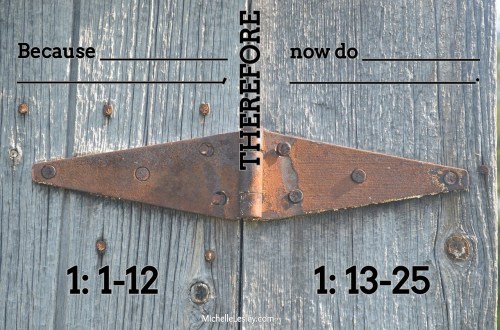
1. What word does verse 1 start with? Review lesson 2 (link above) #7. What does the pivot word “so” mean in this verse? You may find it helpful to summarize chapters 1-2 in a “hinge sentence” (chapter 1 on the left, chapter 2:1-12 on the right, and the “So” in 2:1 as the hinge).

2. Peter uses several metaphors in this chapter. Can you identify each of them and explain the point he’s trying to make with each?

3. Read verses 1-3. One of the themes of the New Testament epistles is growing from spiritual immaturity as a new Christian to spiritual maturity in Christ. Consider verses 1-3 in light of these passages. What do verses 1-3 explain to us about growing toward maturity in Christ? What do these verses tell us to do? What does Peter mean by “if indeed you have tasted…” (3)? (hint)

4. Examine verses 4-8, focusing on what these verses say about Jesus. Who is “him” in verse 4a, and how is He described in 4b? If you haven’t already done so in #2, explain the stone/rock metaphor in 4-8. Why would God choose to represent Christ as a “living stone” (4), a “cornerstone” (6,7), and “A stone of stumbling, and a rock of offense” (8)?

Now focus on what these verses say about Christians and our relationship to Christ. Why are we called living stones in v.4 as Jesus was in v.3? How does “being built up as a spiritual house” (5a) return to the theme of maturing in Christ? What is the purpose (“to be”) of this maturing? (5b)

Use your cross-references and think back to what you know about the Old Testament priesthood. Why does Peter say Believers are a “holy priesthood”? (5) What “spiritual sacrifices” do we offer, how do we offer them “through Jesus Christ,” and why are these sacrifices only acceptable to God when offered through Jesus Christ (e.g. Are things like prayer, praise, and worship acceptable to God if the person offering them isn’t a Believer? Why not?)? (5)

Explain the honor that comes with being a Believer. (7) Explain the unbeliever’s dishonor in rejecting, stumbling over, and taking offense at Christ. (7-8)

5. Study verses 9-10. Which characteristics, attitudes and actions of the Believer, and which attributes of God, would cause Peter to describe us as…

A chosen race-

A royal priesthood (And what’s the difference between a “royal” priesthood and a “holy” priesthood (5)?)-

A people for His own possession-

God’s people-

How do each of these descriptions indicate that Believers are consecrated (“set apart”)? What is the purpose (“that you may” – 9b) for which God sets us apart from the world?

6. Read verses 11-12. Why does Peter address his original audience as literal “sojourners and exiles”? In what way are all Christians spiritual sojourners and exiles?

In Scripture, the word “passion” does not always indicate sexual desire. It can simply mean strong feelings, emotions, or urges about anything, (the way someone today might say, “I am passionate about stamp collecting,” or “Hiking is my passion.”) as it does in verse 11. Bearing this in mind, how do passions of the flesh (about anything) wage war against our souls? How is abstaining from passions of the flesh a “spiritual sacrifice” (5), and why is it spiritually healthy to abstain from these passions? If we do not abstain from these passions of the flesh, but rather indulge them, what impact will that have on our ability to keep our conduct among the Gentiles (unbelievers) honorable? (12) What is the purpose (“so that” – 12) of holy living in an unbelieving world?

7. Explain how verse 1 and verse 12 are similar and serve as “bookends” for this passage (1-12).

8. Explain the connection God makes in this passage between holy living and evangelism.


Homework

Think about the various “spiritual sacrifices” you offer to God as a Christian. What is an additional sacrifice you could offer Him this week?


Suggested Memory Verse

(Every week of our study, you’ll see a suggested memory verse like the one above. You are welcome to grab the memory verse pic to use as your screensaver or wallpaper on your phone or computer, print it out and stick it somewhere you’ll see it frequently, or use it in any other way you wish to help you memorize the verse.)

Worship

“Attracting” God?

Don’t plan your worship services to attract people — plan your worship services to attract God.

I hope this quote from a while back was just a poor choice of words on the part of a former president of the Southern Baptist Convention. If not, I find this statement concerning.

Can you think of a story in the Bible in which people planned a “worship service” in order to attract their god? I can, only it wasn’t Peter or Paul or Samuel or Moses. It was the 450 prophets of Baal in 1 Kings 18:20-40 who ranted and raved and jumped around and cut themselves in an attempt to “attract” their god and get him to show up and answer them.

Christians worship an omnipresent God. That means God is everywhere. We don’t need to do anything to “attract” Him, conjure Him up, or even “welcome” Him into our worship services. He is already there.

What we need to do is plan worship services that honor God. Worship services in which we humble ourselves before Him, confess our sins, cry out to Him in prayer and praise, give our offerings to Him, and hear from Him as His word is preached. Worship services in which He is King and we bow the knee to Him. Worship services in which He must increase and we must decrease.

The idea of “attracting God” makes God small. Less than who He is. It makes His presence dependent on us and our actions. It puts us in the driver’s seat, in charge, over God.

And that is exactly the wrong place for us to be. Especially in a worship service.

Sin

Throwback Thursday ~ 9 Things that Are Still Sins Whether We Agree or Not

Originally published June 19, 20159 still sins


I do it all the time, Mother, and I’ve decided something-
it’s not a sin.

I heard this line several years ago on a popular sitcom, spoken by an adult daughter to her Christian mother about a behavior the Bible unambiguously calls a sin. I mean, it’s right smack dab in the middle of the Big 10; “thou shalt not” and everything.

It’s one thing to say, “I know it’s a sin, but I don’t care. I’m going to do it anyway,” but how depraved is the world when they think they – in God’s place – are the ones who get to define what sin is? And what’s even worse is that the church has begun to adopt this audacious depravity as well, whether approving of sin by fiat or by simply ignoring God’s word and letting sin slide without rebuke.

When it comes to what’s a sin and what’s not, God made up His mind a long time ago. And He’s not changing it, regardless of what you or I or Joe Politician or Jane Celebrity might think. Maybe we all need a remedial course in hamartiology, so let’s start with the basics. These things are all still sins whether the world and the church agree with God or not:

1. Homosexuality

Let’s just get it out of the way right up front. I don’t care how many celebrity “pastors” and “Christian” authors twist God’s word to say otherwise, or how many people declare themselves to be (unrepentant, practicing) “gay Christians,” or how many homosexuals declare that God made them that way, God’s word is clear: homosexual lust and behavior are sins.

2. Abortion

Abortion is the taking of an innocent human life. We don’t murder people because they’re small or sick or inconvenient or will hinder our sucess. God didn’t say, “You shall not murder, except when…” He said, “You shall not murder.” Period.

3. Extra-Marital (Heterosexual) Sex

Adultery, fornication, whatever form it might take, if you’re not legally married to the person you’re engaging in sexual activity – up to and including actual intercourse – with, you’re sinning.

4. Cohabitation

See #3. And don’t try to whitewash it by saying you’re living together but not sleeping together. A) The Bible says we’re to flee temptation, not move in with it, and B) we’re supposed to avoid every form of evil, even the appearance of it. If you call yourself a Christian and you’re shacking up, you’re living in sin (that’s why they call it “living in sin”). Repent and move out or marry up.

5. Divorce

Yep, still a sin, except in two cases: unfaithfulness or an unsaved spouse leaving a saved spouse. In those two cases the spouse who was wronged is not sinning and is free to marry again.

6. Swearing

The air is saturated with it. Foul language coming from our TVs, music, movies, social media, and the people we’re around all day. But expletives have no place in the vocabulary of a Christian. Is your potty mouth on Saturday the same one you praise God with on Sunday?

7. Taking God’s Name in Vain

It’s gotten to the point where we think so little of casually punctuating our sentences with, “Oh my G-d,”  or using the name of Jesus as an exclamation that pastors are even doing so from the pulpit these days. God’s name is high and holy and should be spoken only reverently and worshipfully. How can we look people in the eye and call them to repentance and faith in a Person whose name we use as a cuss word?

8. Gluttony

We have almost completely amputated gluttony from the spiritual realm by cordoning it off as merely a physical or medical issue. We’ve renamed it “overeating,” but that doesn’t change the fact that it’s a sin. God created good food for us to enjoy, but just as with all the other good gifts He gives us, He expects us to exercise Spirit-enabled self control when we receive it.

9. Female Usurpation

God makes it abundantly clear in His word that women are not to instruct men in the Scriptures or hold authority over them in the church. Women sin when they pastor churches, preach sermons in church, teach men in Sunday School classes, and hold other positions of authority over men in the church. Men, however, bear the primarily responsibility for this when they sin by failing to rebuke usurping women, or when women feel they have no other choice but to take on male responsibilities in the church because men are shirking their own duties before God.


We don’t get to decide what sin is. That’s God’s job. And all of us – whether we’ve committed one of these nine sins or not – are guilty of sinning against Him. That’s the bad news.

But, in Christianity, we never give the bad news without following it up with the good news. And, oh what wonderfully good news it is: forgiveness. Jesus paid for our sin at Calvary so that if we will only turn from it and trust Him, He will forgive us for all nine of these sins and countless others.

If we confess our sins, he is faithful and just to forgive us our sins and to cleanse us from all unrighteousness.
1 John 1:9

1&2 Peter Bible Study

Living Stones: A Study of 1 & 2 Peter ~ Lesson 2

Previous Lessons: 1

Read 1 Peter 1

Questions to Consider

1. Briefly review the housekeeping/helpful hints section and “Introduction to 1 Peter” section from lesson 1 (link above). Pull up the link to the maps for 1 Peter in that lesson, and locate the areas mentioned in verse 1. Who were “the elect exiles of the Dispersion” (1) and why were they dispersed?

2. Is the end of verse 1 the end of Peter’s sentence? (Take note of where sentences begin and end in this book to make sure you’re understanding what Peter is saying in context. Have you noticed he sometimes uses very long sentences?). Read the remainder of the sentence in verse 2, and examine the phrases “according to,” “in,” and “for”. How is each member of the Trinity (2) connected back to “the elect exiles of the Dispersion” (1)? What do the words “foreknowledge,” “sanctification,” and “sprinkling” mean or signify?

3. A word to watch for: imperishable. Peter uses this word three times in this brief letter, two of which are in chapter 1. Identify the verses in chapter 1 containing the word “imperishable”. What is being described as imperishable, and why does Peter emphasize its imperishability? As we work through 1&2 Peter, be on the lookout for the theme of imperishability.

4. Read verses 3-9. Now let’s take a closer look at verses 3-5 (which is all one sentence). What does the phrase “born again” (3) mean, and how does the rest of 3-5 revolve around this phrase? Who has caused us to be born again? (3) How would you use this verse to explain to someone that salvation is all of God? That we do not “decide” to be saved nor play even the smallest part in saving ourselves? What are we born again “to” (3)? “Through” (3)? “To” (4)?

Now focus on 6-9. What does the word “this” in verse 6 refer back to? What does this passage teach us about trials and testing? (6-7) What is the purpose of trials/testing? (7a) What is the goal or anticipated result of trials/testing? (7b)

How do verses 3-9 encourage Christians to “keep our eyes on the prize,” and what is that “prize”? How does this passage explain that our eternity in Heaven is the culmination or “outcome” (9) of our faith, the fulfillment of our salvation (5,9). What circumstances in the life of his audience would cause Peter to keep directing their focus to eternity? How could focusing on your eternity with Christ help you to endure suffering or persecution?

5. Read verses 10-12, and compare the ideas in these verses to Hebrews 1:1-2 and 2 Timothy 3:16. Who are the prophets Peter refers to in verse 10? Explain in your own words the idea this passage conveys. What does “they were serving not themselves but you” (12) mean?

6. Read verses 13-25. In two words, what is the main idea of this passage? (15)

What does it mean to “prepare your mind for action” and “be sober-minded” (13) with regard to being holy and pursuing holiness?

How are we to “be holy”? Make a list of the ways these verses mention: 13-15, 17, 22

Why are we to “be holy”? List the reasons these verses describe: 16, 18-21, 23-25

7. Verse 13 starts with the pivot word “therefore,” which means, “Because of all that stuff I just told you, here’s what you need to do.” (“So,” or “So then” at the beginning of a passage mean basically the same thing. Always watch for transitional or pivot words at the beginning of a sentence to help you tie the first part of the passage to the subsequent part of the passage.) The old adage, “Whenever you see the word ‘therefore’ in Scripture, you need to find out what it’s ‘there for’,” is a great little hermeneutical rule of thumb.

Summarize chapter 1 in a “hinge sentence”:


Homework

Think about an area of your life in which you need to “be holy.” Spending more time in prayer? Cleaning up your language? Being patient with other drivers? Write out a plan for pursuing holiness in this area of your life this week (and beyond).

1. List 2-3 specific ways you can “prepare your mind for action” and “be sober-minded” (13) to lay a foundation for holy thoughts, attitudes, and actions.

2. How can you “be holy” in this area? Review verses 13-15, 17, 22, think about how they apply to your situation, and list 2-3 specific holy thoughts, attitudes or actions you can employ.

3. Why should you “be holy” in this area? Review verses 16, 18-21, 23-25, and explain why you should pursue holiness in this area of your life.


Suggested Memory Verse

(Every week of our study, you’ll see a suggested memory verse like the one above. You are welcome to grab the memory verse pic to use as your screensaver or wallpaper on your phone or computer, print it out and stick it somewhere you’ll see it frequently, or use it in any other way you wish to help you memorize the verse.)
1&2 Peter Bible Study

Living Stones: A Study of 1 & 2 Peter ~ Lesson 1- Introduction

Welcome to our new study, Living Stones: A Study of 1 &2 Peter!

How can we live lives of holiness as the world, and even the church, become increasingly unholy? For the next several weeks we’ll work our way through the books of 1 & 2 Peter, and learn how Jesus is the Living Stone – our perfect example of holiness – that we are to build our lives and churches upon.

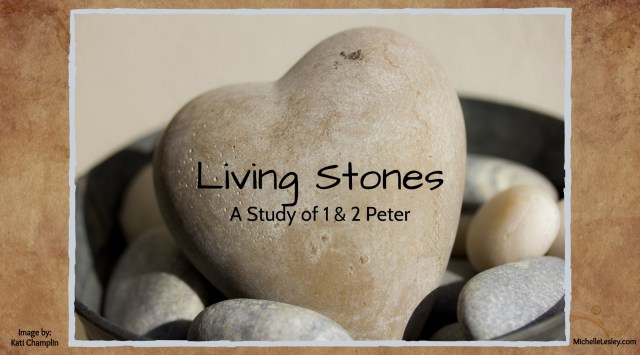
Our lovely title pic for the study was designed by Kati Champlin, who is a pastor’s wife in Montana. Many thanks to all of those who worked so hard on their entries for our title pic contest. You ladies were very creative and did some beautiful work! 

Terri Mobley


Lesley Hazen


Carey


Clare McNaul
 

(Clare pointed out the crosses etched into the rock. Can you see them?)

Debra Gartland

If you’re new to using my Bible studies, just a few housekeeping items and helpful hints:

The studies I’ve written (you can find all of them at the Bible Studies tab in the blue menu bar at the top of this page) are like “training wheels”. They’re designed to teach you how to study the Bible for yourself and what kinds of questions to ask of the text so that, when you get the hang of it, you won’t have to depend on other people’s books and materials – even mine – any more. To that end, I do not provide answers for the study questions in the studies I’ve written.

My studies are meant to be extremely flexible and self-paced so that you can use them in the way that works best for you. You can do an entire lesson in one day or work on the questions over the course of the week (or longer). You do not need to feel obligated to answer all (or any) of the questions. If the Holy Spirit parks you on one question for several days, enjoy digging deep into that one aspect of the lesson. If He shows you something I haven’t written a question about that captures your attention, dive in and study it! Those are ways the Holy Spirit speaks to us through His Word. This is your time to commune with the Lord, not a school assignment or work project you are beholden to complete in a certain way by a certain deadline.

I will post a new lesson on the blog every Wednesday, so there is nothing to sign up for or commit to. Simply stop by the blog each week, or subscribe to the blog via e-mail to have the lessons delivered to your inbox.

I use hyperlinks liberallyThe Scriptures for each lesson will be linked at the beginning of the lesson and in the lesson questions. As you’re reading the lesson, whenever you see a word in a different color text, click on it, and it will take you to a Scripture, article, or other resource that will help as you study.

All of the studies I’ve written are suitable for groups or individuals. You are welcome to use them as a Sunday school or Bible study class curriculum (for free) with proper attribution.

You are also welcome to print out any of my Bible studies (or any article I’ve written) for free and make as many copies as you’d like, again, with proper attribution. I’ve explained more about that in this article (3rd section).


Introduction to 1 Peter

Before we begin studying a book of the Bible, it’s very important that we understand some things about that book. We need to know…

Who the author was and anything we might be able to find out about him or his background.

Who the audience of the book is: Jews or Gentiles? Old Testament Israelites or New Testament Christians? This will help us understand the author’s purpose and approach to what he’s writing.

What kind of biblical literature we’re looking at. We approach books of history differently than books of wisdom, books of wisdom differently than books of prophecy, etc.

What the purpose of the book is. Was it written to encourage? Rebuke? Warn?

What the historical backdrop is for the book. Is Israel at war? At peace? In exile? Under a bad king? Good king? Understanding the historical events surrounding a piece of writing help us understand what was written and why it was written.

When the book was written. Where does the book fall on the timeline of biblical history? This is especially important for Old Testament books which are not always arranged in chronological order.

So this week, before we start studying the actual text of the book of 1 Peter, we need to lay the foundation to understanding the book by finding the answers to these questions.

Read the following overviews of the book of 1 Peter, taking notes on anything that might aid your understanding of the book, and answer the questions below:

Bible Introductions: 1 Peter at Grace to You

Overview of the Book of 1 Peter at Reformed Answers

Book of 1 Peter at Got Questions

1. Who wrote the book of 1 Peter? How do we know this?

2. Approximately when was 1 Peter written? What is the geographical setting of the book of 1 Peter? Here are some maps (scroll down to “1 Peter”) that may be helpful as you study through the book of 1 Peter.

3. Who is the original, intended audience of the book of 1 Peter? Describe the historical setting (historic events, politics, sociology of the time, etc.) of 1 Peter.

4. Which genre of biblical literature is the book of 1 Peter: law, history, wisdom, poetry, narrative, epistles, or prophecy/apocalyptic? What does this tell us about the approach we should take when studying this book versus our approach to books of other genres?

5. What is the theme or purpose of the book of 1 Peter?

6. What are some of the major topics of instruction in the book of 1 Peter? How do these topics relate to the theme of 1 Peter?

7. What are some ways 1 Peter points to and connects to Jesus?

8. What else did you learn about 1 Peter or the setting of this book that might help you understand the text of the book better?

Take some time in prayer this week to begin preparing your heart for this study. Ask God to grow you in holiness and in following the example of Christ as we study together Living Stones: A Study of 1&2 Peter.