Wednesday's Word

Wednesday’s Word ~ 1 Timothy 1

For further study on the books of 1-2 Timothy, try my study 1 & 2 Timothy: The Structure and Spirit of the Church.

1 tim 1 15

1 Timothy 1

Paul, an apostle of Christ Jesus by command of God our Savior and of Christ Jesus our hope,

2 To Timothy, my true child in the faith:

Grace, mercy, and peace from God the Father and Christ Jesus our Lord.

3 As I urged you when I was going to Macedonia, remain at Ephesus so that you may charge certain persons not to teach any different doctrine, 4 nor to devote themselves to myths and endless genealogies, which promote speculations rather than the stewardship from God that is by faith. 5 The aim of our charge is love that issues from a pure heart and a good conscience and a sincere faith. 6 Certain persons, by swerving from these, have wandered away into vain discussion, 7 desiring to be teachers of the law, without understanding either what they are saying or the things about which they make confident assertions.

8 Now we know that the law is good, if one uses it lawfully, 9 understanding this, that the law is not laid down for the just but for the lawless and disobedient, for the ungodly and sinners, for the unholy and profane, for those who strike their fathers and mothers, for murderers, 10 the sexually immoral, men who practice homosexuality, enslavers, liars, perjurers, and whatever else is contrary to sound doctrine, 11 in accordance with the gospel of the glory of the blessed God with which I have been entrusted.

12 I thank him who has given me strength, Christ Jesus our Lord, because he judged me faithful, appointing me to his service, 13 though formerly I was a blasphemer, persecutor, and insolent opponent. But I received mercy because I had acted ignorantly in unbelief, 14 and the grace of our Lord overflowed for me with the faith and love that are in Christ Jesus. 15 The saying is trustworthy and deserving of full acceptance, that Christ Jesus came into the world to save sinners, of whom I am the foremost. 16 But I received mercy for this reason, that in me, as the foremost, Jesus Christ might display his perfect patience as an example to those who were to believe in him for eternal life. 17 To the King of the ages, immortal, invisible, the only God, be honor and glory forever and ever. Amen.

18 This charge I entrust to you, Timothy, my child, in accordance with the prophecies previously made about you, that by them you may wage the good warfare, 19 holding faith and a good conscience. By rejecting this, some have made shipwreck of their faith, 20 among whom are Hymenaeus and Alexander, whom I have handed over to Satan that they may learn not to blaspheme.


The Holy Bible, English Standard Version Copyright ยฉ 2001 by Crossway Bibles, a publishing ministry of Good News Publishers.


Questions to Consider:

1. Who wrote this epistle, and to whom did he write it? (1-2) What was their relationship? (1-2, 18)

2. What two instructions did Paul give Timothy in verse 3? What was the problem occurring in the church which was in need of correction? (3-7) What are the words and phrases in verse 5 which describe the motivation and the method for delivering the charge?

3. For what group of people is the law “laid down”? (9-10) In light of this, what does it mean to use the law “lawfully“? (8) How is this a step towards saving faith for sinners?

4. How does Paul describe himself prior to his salvation? (13) How does Paul describe his salvation experience? (14) How would you describe yourself prior to salvation? How would you describe God’s grace and mercy in your salvation experience? How did Paul’s salvation glorify God and serve as an example to others who would believe? (15-16)

5. How does Paul’s discussion of the lawful use of the law (8-11) and his description of his salvation experience and the gospel (12-17) relate to his instruction to Timothy to deal with false teaching in the church (3-7)? How is the relationship between the law, gospel, and false teaching relevant today?

Gratitude, Top 10

Top Ten Bible Verses on Giving Thanks

Next to Easter and Christmas, there’s no better holiday that Christians could celebrate than Thanksgiving. Scripture reminds us over and over that we have a precious Savior and innumerable blessings to thank God for. Here are ten of my favorite Bible verses about giving thanks. Feel free to share them around on social media or print them out to use in your Thanksgiving decor…

  • As place cards at the dinner table.
  • As tags on goody bags
  • Print out two copies of each, scramble them up face down, and let the kids play “Concentration” or “Memory” with them. (Each player takes turns flipping over two at a time until they find two that match.)
  • Have one person read part of his verse and see who can finish it. Or read the whole verse and see who can guess the reference.

1.
Psalm 100:4

2.
1 Corinthians 15:57

3.
1 Chronicles 16:8

4.
Ephesians 5:20

5.
Psalm 69:30

6.
Colossians 3:17

7.
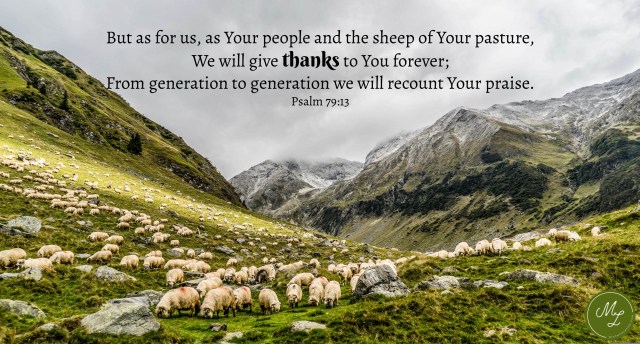
Psalm 79:13

8.
1 Thessalonians 5:18

9.
Psalm 86:12

10.
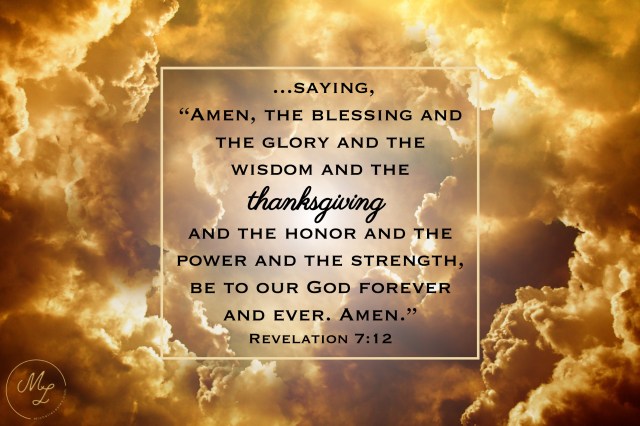
Revelation 7:12

What’s your favorite Bible verse about giving thanks?

Wednesday's Word

Wednesday’s Word ~ Job 1

job 1 21

Job 1

There was a man in the land of Uz whose name was Job, and that man was blameless and upright, one who feared God and turned away from evil. 2ย There were born to him seven sons and three daughters. 3ย He possessed 7,000 sheep, 3,000 camels, 500 yoke of oxen, and 500 female donkeys, and very many servants, so that this man was the greatest of all the people of the east. 4ย His sons used to go and hold a feast in the house of each one on his day, and they would send and invite their three sisters to eat and drink with them.5ย And when the days of the feast had run their course, Job would send and consecrate them, and he would rise early in the morning and offer burnt offerings according to the number of them all. For Job said, โ€œIt may be that my children have sinned, and cursed God in their hearts.โ€ Thus Job did continually.

6ย Now there was a day when the sons of God came to present themselves before the Lord, and Satan also came among them. 7ย The Lord said to Satan, โ€œFrom where have you come?โ€ Satan answered the Lord and said, โ€œFrom going to and fro on the earth, and from walking up and down on it.โ€ 8ย And the Lord said to Satan, โ€œHave you considered my servant Job, that there is none like him on the earth, a blameless and upright man, who fears God and turns away from evil?โ€ 9ย Then Satan answered the Lord and said, โ€œDoes Job fear God for no reason? 10ย Have you not put a hedge around him and his house and all that he has, on every side? You have blessed the work of his hands, and his possessions have increased in the land. 11ย But stretch out your hand and touch all that he has, and he will curse you to your face.โ€ 12ย And the Lord said to Satan, โ€œBehold, all that he has is in your hand. Only against him do not stretch out your hand.โ€ So Satan went out from the presence of the Lord.

13ย Now there was a day when his sons and daughters were eating and drinking wine in their oldest brother’s house, 14ย and there came a messenger to Job and said, โ€œThe oxen were plowing and the donkeys feeding beside them, 15ย and the Sabeans fell upon them and took them and struck down the servants with the edge of the sword, and I alone have escaped to tell you.โ€ 16ย While he was yet speaking, there came another and said,โ€œThe fire of God fell from heaven and burned up the sheep and the servants and consumed them, and I alone have escaped to tell you.โ€ 17ย While he was yet speaking, there came another and said, โ€œThe Chaldeans formed three groups and made a raid on the camels and took them and struck down the servants with the edge of the sword, and I alone have escaped to tell you.โ€ 18ย While he was yet speaking, there came another and said, โ€œYour sons and daughters were eating and drinking wine in their oldest brother’s house, 19ย and behold, a great wind came across the wilderness and struck the four corners of the house, and it fell upon the young people, and they are dead, and I alone have escaped to tell you.โ€

20ย Then Job arose and tore his robe and shaved his head and fell on the ground and worshiped. 21ย And he said,โ€œNaked I came from my mother’s womb, and naked shall I return. The Lord gave, and the Lord has taken away; blessed be the name of the Lord.โ€

22ย In all this Job did not sin or charge God with wrong.


The Holy Bible, English Standard Version Copyright ยฉย 2001 by Crossway Bibles, a publishing ministry of Good News Publishers.


Questions to Consider:

1. Read verses 1-5. Reflecting on this passage, what are some words you would use to describe Job, his family, and his life? Does the word “blameless” (1) mean “sinless”? How does your description of Job match up with God’s description of Job in verse 8 and what Satan says about Job in verse 10?

2. Why does Satan think Job loves and fears God? (9-11) Is he correct? (20-22)? Is it biblical to follow Godย in order to receive material or temporal blessings? Can you think of any churches or Christian celebrities whoย teach this? What should be our motivation for following Christ?

3. Was Job privy to the conversation between God and Satan (6-12)? Did he know why all these terrible things happened to him? Did he know that God would eventually restore what he had lost? How is Job’s situation similar to the blind man’s in John 9:1-3? Was Job being punished for sin? (8)

4. Make a list of all the things Job lost (13-19). Consider the repeated phrase, “while he was yet speaking.” What does this phrase tell us about the timing of these events?

5. Which three actions did Job take in verse 20? Which two indicate to us that Job was upset? Was Job’s grief sinful or an indication that he didn’t trust God? (21-22) How would you summarize Job’s response to tragedy? How do verses 20-21 correlate to Philippians 4:11-13? How are Christians to respond to suffering?

Complementarianism, Rock Your Role

Rock Your Role: Oh No She Di-int! Priscilla Didn’t Preach, Deborah Didn’t Dominate, and Esther Wasn’t an Egalitarian

Rock Your Role is a series examining the โ€œgo toโ€ and hot button Scriptures that relate to and help us understand our role as women in the church. Donโ€™t forget to prayerfully consider our three key questions
as you read.

How can you say women arenโ€™t to preach to, teach, or hold authority over men in the church? What about Deborah, Esther, Huldah, Phoebe, Priscilla, and the women at Jesusโ€™ tomb? Didnโ€™t they all preach to men, teach them, or hold authority over them?

Thatโ€™s one of the arguments often put forth by people who reject what Godโ€™s word plainly says about the biblical role of women in the church. And the short answer is very simple: Yes and no, and so what?

But maybe a longer answer would be better.

First of all, thereโ€™s a proper way and an improper way to understand Scripture. We want to make sure we understand Scripture the proper way. When we look to Scripture to find out how we should behave – what we should do and not do โ€“ we do not look first, or primarily, at the biographies of people in the Bible and what they did or didnโ€™t do, and model ourselves after them.

Broadly speaking, there are two main types of Scripture: descriptive and prescriptive. Descriptive passages describe something that happened: Noah built an ark. Esther became queen. Paul got shipwrecked. These passages simply tell us what happened to somebody. Prescriptive passages are commands or statements to obey. Donโ€™t lie. Share the gospel. Forgive others.

If we wanted to know how to have a godly marriage, for example, we would look at passages like Ephesians 5:22-33, 1 Corinthians 7, and Exodus 20:14,17. These are all passages that clearly tell us what to do and what not to do in order to have a godly marriage.

What we would not do is look at Davidโ€™s and Solomonโ€™s lives and conclude that polygamy is Godโ€™s design for marriage. We would not read about Hosea and assume that God wants Christian men to marry prostitutes. We would not read the story of the woman at the well and think that being married five times and then shacking up with number six is OK with Jesus.

When looking for instruction about the role of women in the church, we look to clear, prescriptive passages which tell us what to do and what not to do, not descriptive passages about various women in the Bible.

And when looking for instruction about the role of women in the church, we look to clear, prescriptive passages which tell us what to do and what not to do, not descriptive passages about various women in the Bible.

Descriptive passages may support, but never trump, the clear instruction of prescriptive passages.

But just for funzies, letโ€™s take a quick look at these ladies so often trotted out in defense of Christian women disobeying Scripture. (If youโ€™re unclear as to what Godโ€™s word says about womenโ€™s role in the church, you might want to check out this article and this article before reading further.)

Deborah, Huldah, and Esther:

The very first thing we need to remember about these ladies is that they were under the old (Mosaic) covenant of the Old Testament, not the new (grace) covenant of the New Testament. There are a lot of things about the old covenant that no longer apply to Christians in the New Testament because Christ fulfilled the law of the old covenant (Bacon and poly-cotton blends, anyone?). Likewise, there are things about the new covenant that did not apply under the old covenant (The church? Evangelism? Nowhere to be found in the Old Testament.), or for which there are no reasonable precedents in the Old Testament because the church is a new covenant institution.

None of these women were pastors. None taught men the Scriptures in the church (or even temple) setting. None assumed authority over men in the church (or even the temple).

Deborah was a judge. She decided disputes between Israelites and discussed with Barak battle instructions that God had already revealed to him. When Barak refused to stand up and fight like a man, God used Deborah, a woman, to show him that another woman, Jael, would get the glory for killing Sisera. In a patriarchal society a woman in leadership and a female war hero would not have been seen by men or women as a positive thing, but rather as shaming men who were too cowardly to step up, lead, and protect their women and children.

Huldah was a prophetess. She was sent for during the reign of Josiah when the temple was being repaired and the priests hadnโ€™t even been able to find the book of the law for years. Again, what does it say about the spiritual condition of the most important men in the country โ€“ the king and the high priest – when they, in a highly patriarchal society, have to humble themselves and seek out a woman to tell them what God says? Huldah repeated to them what God had told her, and that was it. Since we now have Godโ€™s written word and He no longer speaks through direct revelation this way, there is no parallel between Huldah and New Testament women preaching, teaching, and exercising authority.

Esther, under threat of death, couldnโ€™t even talk to her own husband without his permission, so Iโ€™m not really sure why people seem to think she exercised any authority over men. In fact, the writer of the book of Esther several times makes a point of saying how obedient she was to Mordecai. Esther wasnโ€™t a spiritual leader, she was a queen. The word โ€œGodโ€ isnโ€™t even mentioned in her book, and she certainly didnโ€™t instruct anybody in the Scriptures. Esther is probably one of the weakest examples you could come up with as support for women preaching, teaching, or exercising authority in the church.

The Women at Jesus’ Tomb, Priscilla, and Phoebe

The women at Jesusโ€™ tomb were sort of Old Testament-ish, too, if you think about it. The church didnโ€™t yet exist when they saw Jesus resurrected and ran back to tell the disciples about it. Still, this was not preaching, teaching, or holding authority over the disciples even in a non-church setting. This was a) giving eyewitness testimony of what they had seen and b) carrying a message from Jesus to the disciples. There was no commentary or instruction from the women to the disciples, just a report on what they had seen and a message of where Jesus and the disciples would meet up. And, really, donโ€™t people usually see โ€œmessenger boysโ€ (or girls) as subservient to the people theyโ€™re carrying messages between?

Priscilla (or Prisca) might be the best known Christian woman in the church era of the New Testament. When people try to use her as an argument for female preachers, teachers, and authority, they usually go to Acts 18:26 which says that she and her husband took Apollos aside and fully explained the gospel to him. This was a private meeting among the three of them, likely in their home over a meal or other casual circumstances, not preaching or teaching in the church. Additionally, the Bible makes absolutely no mention of how much, if any, of the actual “explaining” Priscilla did. Itโ€™s quite possible she just sat by as Aquila did the majority of the explaining and contributed only here and there or when Aquila forgot something.

Phoebe is mentioned once in the New Testament, in Romans 16:1-2. Paul commends her to the church at Rome and asks them to help her out because she has been a good servant of the church at Cenchreae. That the word โ€œservantโ€ can also be translated as โ€œdeaconessโ€ in no way indicates that Phoebe (or Priscilla or Junia or any of the other women mentioned in Romans 16) preached to or taught men or exercised authority over men, despite the fact that male deacons today might do such things. The Greek word diakonos simply means โ€œservant.โ€ Acts 6:1-6 gives us a glimpse at some of the services the early deacons likely provided- โ€œwaiting tablesโ€ and meeting the physical needs of the believers. The apostles even drew a distinction between their preaching of the word and the need for others to minister to the material needs of the people.

And one more thing about Priscilla, Phoebe, and the other women of Romans 16: Who โ€“ under the inspiration of the Holy Spirit – wrote the book of Romans? Paul. Who โ€“ under the inspiration of the Holy Spirit โ€“ wrote 1 Timothy 2:11-15? Paul. Would the Holy Spirit have led Paul in Romans 16 to praise women who were rebelling against His Word in 1 Timothy 2? Have you ever known God, anywhere in Scripture, to praise people who unrepentantly break His Word? Would it make any sense, logically, for Paul to praise in Romans 16 women who were habitually and rebelliously disobeying his instructions in 1 Timothy 2?

Would it make any sense for Paul to praise in Romans 16 women who were habitually and rebelliously disobeying his instructions in 1 Timothy 2?

God does not contradict Himself. Godโ€™s Word does not contradict itself. If He gives us an explicit command, biographical details of a Bible characterโ€™s life do not override that command, and we are to obey it.

While there are numerous, important ways God wants Christian women to serve Him in the church, the Bible is clear that we are not to preach to or teach men or exercise authority over men in the assembly of believers. We are to follow in the footsteps of godly women like Esther, Priscilla, and all the others by humbly submitting to His Word and obeying it.

We are to follow in the footsteps of godly women like Esther, Priscilla, and all the others by humbly submitting to His Word and obeying it.


Additional Resources:

Bad Examples of Women Pastors (But Great Examples of Godly Women) by Gabe Hughes

Wednesday's Word

Wednesday’s Word ~ Esther 4

esther 4 14

Esther 4

When Mordecai learned all that had been done, Mordecai tore his clothes and put on sackcloth and ashes, and went out into the midst of the city, and he cried out with a loud and bitter cry. 2ย He went up to the entrance of the king’s gate, for no one was allowed to enter the king’s gate clothed in sackcloth. 3ย And in every province, wherever the king’s command and his decree reached, there was great mourning among the Jews, with fasting and weeping and lamenting, and many of them lay in sackcloth and ashes.

4ย When Esther’s young women and her eunuchs came and told her, the queen was deeply distressed. She sent garments to clothe Mordecai, so that he might take off his sackcloth, but he would not accept them. 5ย Then Esther called for Hathach, one of the king’s eunuchs, who had been appointed to attend her, and ordered him to go to Mordecai to learn what this was and why it was. 6ย Hathach went out to Mordecai in the open square of the city in front of the king’s gate, 7ย and Mordecai told him all that had happened to him, and the exact sum of money that Haman had promised to pay into the king’s treasuries for the destruction of the Jews.8ย Mordecai also gave him a copy of the written decree issued in Susa for their destruction, that he might show it to Esther and explain it to her and command her to go to the king to beg his favor and plead with him on behalf of her people. 9ย And Hathach went and told Esther what Mordecai had said. 10ย Then Esther spoke to Hathach and commanded him to go to Mordecai and say, 11ย โ€œAll the king’s servants and the people of the king’s provinces know that if any man or woman goes to the king inside the inner court without being called, there is but one lawโ€”to be put to death, except the one to whom the king holds out the golden scepter so that he may live. But as for me, I have not been called to come in to the king these thirty days.โ€

12ย And they told Mordecai what Esther had said. 13ย Then Mordecai told them to reply to Esther, โ€œDo not think to yourself that in the king’s palace you will escape any more than all the other Jews. 14ย For if you keep silent at this time, relief and deliverance will rise for the Jews from another place, but you and your father’s house will perish. And who knows whether you have not come to the kingdom for such a time as this?โ€ 15ย Then Esther told them to reply to Mordecai, 16ย โ€œGo, gather all the Jews to be found in Susa, and hold a fast on my behalf, and do not eat or drink for three days, night or day. I and my young women will also fast as you do. Then I will go to the king, though it is against the law, and if I perish, I perish.โ€ 17ย Mordecai then went away and did everything as Esther had ordered him.


The Holy Bible, English Standard Version Copyright ยฉย 2001 by Crossway Bibles, a publishing ministry of Good News Publishers.


Questions to Consider:

1. The book of Esther is short, and chapter 4 can best be understood in its context in the middle of the story. I highly recommend reading the whole book, starting in chapter 1. Who are the main characters in this story? What are their backgrounds? What causes them to act the way they do?

2. What was the king’s decree (7-8)? Why would the decree have been cause for theย Jews’ “fasting, weeping, and lamenting” (3)?

3. Give two reasons why it would have been dangerous for Esther to go to the king and plead the cause of the Jews (8-11). Read verses 12-14 through the lenses of a loving parent like Mordecai. He was asking his “daughter” to do what was godly, even at the risk of her life. Do you raise your children to be godly, even at risk of their lives?

4. In what ways is the story of Esther a type and shadow of Christ’s redemption of His people? Whom do King Ahasuerus, Esther, Haman, and the Jews represent? The three days of fasting?

5. God will probably never call you to save a nation as He did with Esther, but He has placed each one of us right where we are “for such a time as this,” because all of us have people in our lives who need to hear about Jesus, the Savior who steps between the wrath of God and the scheming of Satan and laid His life on the line to save His people from their sin. Think of some people and situations in your life where God has placed you “for such a time as this” to share the gospel, speak the truth of God’s word, or minister His love.