Mailbag

The Mailbag: Potpourri (Pianist leading worship, hosting a women’s event, re-baptism…)

Welcome to another “potpourri” edition of The Mailbag, where I give short(er) answers to several questions rather than a long answer to one question. I also like to take the opportunity in these potpourri editions to let new readers know about my comments/e-mail/messages policy. I’m not able to respond individually to most e-mails and messages, so here are some helpful hints for getting your questions answered more quickly. Remember, the search bar can be a helpful tool!

In these potpourri editions of The Mailbag, I’d also like to address the three questions I’m most commonly asked:

“Do you know anything about [Christian pastor/teacher/author] or his/her materials? Is he/she doctrinally sound?”

Try these links: 
Popular False Teachers /
 Recommended Bible Teachers / search bar
Is She a False Teacher? 7 Steps to Figuring It Out on Your Own
(Do keep bringing me names, though. If I get enough questions about a particular teacher, I’ll probably write an article on her.)

“Can you recommend a good women’s Bible study?”

No. Here’s why:
The Mailbag: Can you recommend a good Bible study for women/teens/kids?
The Mailbag: “We need to stop relying on canned studies,” doesn’t mean, “We need to rely on doctrinally sound canned studies.”.

“You shouldn’t be warning against [popular false teacher] for [X,Y,Z] reason!”

Answering the Opposition- Responses to the Most Frequently Raised Discernment Objections


Usually The Mailbag is all about mail I’ve received from readers, but today, I want to start by sending a thank you note to you!

Thank you from the depths of my heart to each and every one of you who donated so graciously and made it possible for me to speak at the Cruciform Conference in Indianapolis this October. I was floored by your generosity and it was a great way to celebrate my birthday. I’m so honored that you would partner with me in ministry to the ladies at the conference. Thank you and God bless you.

(I tried to make sure I sent an individual thank you message/e-mail to each donor, but if you donated anonymously or I somehow missed being notified of your donation, I apologize and hope you’ll accept my thanks here.)

If you’re going to be in the area, come on out to Cruciform. It will be a blessing to you, and I’d love to meet you!


I’m the pianist at my church, and my pastor has asked me to select the hymns for our worship services because it takes a lot off him and helps him out. I select the songs from a certain hymnal and two other doctrinally sound sources. Am I in an unbiblical position of “leading” the worship service when I select these songs?

This is a great question. It’s so encouraging when Christian women want to be godly in every aspect of their ministry at church!

No, that’s not leading, that’s serving your pastor and your church. Basically what you’ve got here is a body of songs your pastor already approves of, and he has asked you to whittle it down to four or five songs each week from this pre-approved “list”.

If you choose a song he doesn’t like for some reason or that doesn’t fit with what he’s preaching that week, he always has the prerogative to say, “This song isn’t a fit this week. Could you please choose a different one?” In essence, you’re presenting him with suggestions and he makes the final decision, so he’s still the one in the position of authority. I used to do the same thing for my husband when he was a minister of music at one of our former churches.

Thank you for serving your pastor and your church!


I loved your article Women’s Events on a Shoestring Budget. The funding tips encouraged me to put on an event for our ladies, but our small church has never done anything like this before. What kind of event should we have and how should we get started?

I was so encouraged to get a couple of questions like this in response to my article. Even at a small church (and sometimes especially at a small church) a women’s event can really help refresh and build up the ladies of your church. It can be a great outreach to the ladies of your community, too.

I would recommend starting small and then growing year by year. For example, if I were in a church with an attendance of 50-150, I would start with an in-house (only ladies from your own church) mini-conference. A Saturday morning simple breakfast (coffee, doughnuts, fruit – food that’s easy to get, serve, and handle), followed by a local speaker (maybe the pastor’s wife at a sister church, or even one of the ladies in your own church) and a couple of songs. You could end there, or possibly have a time of discussion around the tables afterward, or just allow the ladies to hang around and fellowship with each other.

The next year, you could build on that. Maybe the speaker does two sessions with a break between, and you invite/publicize to other local churches. The following year, you could do an overnight retreat or you could expand the conference to an all day thing and have more than one speaker. If you start small and grow your event each year, you’ll learn things you should and shouldn’t do differently along the way, and you won’t be biting off more than you can chew the first time out.

Another thing that might be a good idea is to have a meeting with all of your ladies and ask them what kind of event they’d like. You might be thinking “conference” and they might be thinking “movie night”. It’s good to brainstorm and take the pulse of your ladies on what they’d prefer.

You could also get the men of your church involved in putting together and serving at your conference or event. I spoke at one conference where the men of the church actually put on the conference for their ladies – to honor and thank them. That was one happy bunch of ladies!

Just remember what I said in the article: Don’t try to compete with the expensive glitz, glam, and giveaways of mega-conferences. You do you, your church or host organization…And remember, it’s the caring and hospitality of the hosts that will make the greatest impact on your attendees, not the swanky food, decorations and swag bags.


I wanted to let you know I saw an inappropriate advertisement on your blog.

Thank you so much for letting me know. Rest assured, I don’t choose those ads, nor do I have any control over them. I can’t even see them from my end. I’m in the process of considering some formatting changes to the blog that may (or may not) put an end to the ads.

In the meantime, my article Advertising Redux explains what you can do to avoid those inappropriate and annoying ads on my site and on other sites as well.


I have a friend who was baptized as an infant, but since she was baptized in the name of the Trinity, she feels as though she can not be re-baptized as an adult believer. How would you speak to her?

I’ll bet that’s kind of a challenging road to navigate as her friend, isn’t it? Without a great deal more information I’m hesitant to give a definitive answer, but hopefully I can point both of you in a helpful direction.

I’m assuming if your friend is considering being baptized, she’s either a member of a local church or a candidate for membership at a local church. The first thing I would want to make sure of is that she’s in a doctrinally sound local church, because the second thing I’m going to advise is that she set up an appointment with her pastor to discuss this issue of baptism. (If the church she’s in isn’t doctrinally sound, getting her into one that is is job one, not baptism. Check out the Searching for a new church? tab at the top of this page.)

Different churches and denominations have different understandings of baptism. Her pastor can explain to her how her church views baptism, why it is requiring(?) her to be re-baptized for membership, and how it understands Trinitarian paedo (infant) baptism versus credo (Believer’s) baptism.

Once she has sat down with the pastor and had all of her questions answered, she will need to search the Scriptures, pray for wisdom, and make sure her understanding of baptism lines up with that of the church she’s considering being baptized into. If it does not, she will need to further study the Scriptures to determine whether or not her personal view of baptism is indeed biblical. If it is but does not align with her current church, she will probably need to find a new church whose view on baptism she agrees with.


If you have a question about: a Bible passage, an aspect of theology, a current issue in Christianity, or how to biblically handle a family, life, or church situation, comment below (I’ll hold all questions in queue {unpublished} for a future edition of The Mailbag) or send me an e-mail or private message. If your question is chosen for publication, your anonymity will be protected.

Speaking Engagements, Special Events

Women’s Events on a Shoestring Budget and Other Practical Tips

Like listening instead of reading?
Check out How to Host a Women’s Conference at
A Word Fitly Spoken, which was based on this article.


Have you ever wanted to host a women’s conference (or any event, really) at your church, but it just wasn’t in the budget?

My husband and I have served a lot of small churches, so those tight-knit fellowships and their pastors hold a special place in my heart – especially the ones who want to give their ladies a doctrinally sound alternative to those expensive mega-conferences whose doctrine can be questionable at best.

I’ve spoken at some absolutely wonderful conferences hosted by small churches, so I know it can be done with excellence if you’re not afraid to think creatively and work efficiently.

Here are a few suggestions to prayerfully consider if you’re putting together an event on a shoestring budget. And readers, I want to hear from you too – what has your church done to support and finance special events that has worked well? Add your comment in the comments section at the end of the article.

💰💰💰

I’m going to start with a principle that applies to anyone doing professional work for your church, from conference speakers, to the band playing a concert at your youth event, to the plumber fixing the pipes in the bathroom, to the accountant who does your church’s bookkeeping:

You must pay workers, and you must pay them a fair wage or fee in addition to their expenses (travel, lodging, etc.).

I’ve been blessed that every host church I’ve ever spoken at has understood this and has been very generous with me, but I’ve heard that there are Christians out there who expect anyone doing anything for their church to do it for free because it’s “ministry”. Some even begrudge paying their pastor a salary! This is not biblical. In fact, the Bible says just the opposite.

It often takes many hours of hard work to properly prepare for a speaking engagement, concert, etc. (And don’t get me started on how much time pastors put into their jobs compared to the salaries most of them earn.) This pre-event work as well as the event itself may take the worker away from her family or cause her to have to cancel other activities. She may even have to take time off from her regular job to work at your event. What she’s doing for you is work and she deserves to be fairly compensated for it. This is one aspect of your event that you can’t cut corners on.

Sometimes it is hard to know what a fair wage is for the worker you’re hiring. And, indeed, it will vary from worker to worker. Ask her for a number. Figure out whether or not that amount is feasible on your end. Then, be honest with her and let her know whether or not you can guarantee (not try to raise, not “take up a love offering at the conference and hope for the best” – guarantee) that amount. If you can’t, it is then up to her to decide whether or not she can afford to work at your event. Being honest and transparent from the get go helps remove a lot of the awkwardness that comes with talking about money. I know I always appreciate it.

💰💰💰

Now that you know one of the expenses for the event, it will be easier to estimate a budget to cover it and the rest of the expenditures. Sit down with your planning committee and prayerfully discuss the purchases you’ll need to make for food, decorations, and any other materials, and come up with a reasonable budget for your particular venue. Use godly wisdom and exercise good stewardship.

💰💰💰

Don’t try to compete with the expensive glitz, glam, and giveaways of mega-conferences. You do you, your church or host organization. I’ve seen many churches go with a “simple elegance” or “homestyle” or “local charm” level of theme and decor that has turned out perfectly lovely and welcoming (Check out some of the church events I’ve spoken at for some great ideas!). And remember, it’s the caring and hospitality of the hosts that will make the greatest impact on your attendees, not the swanky food, decorations and swag bags.

💰💰💰

Plan your event as far in advance as possible. Not only will this give you plenty of time to raise funds, but some expenses – plane tickets for your speaker, for example – go up as time goes by.

💰💰💰

While some speakers need to stay in a hotel for various reasons, others are perfectly willing to be fed and housed by church members, which can cut your expenses considerably. Ask your speaker which she prefers and be ready to graciously provide either type of accommodation.

💰💰💰

Go local. If you can find an appropriate speaker who lives in or near your town, it will cut down on your travel and accommodation expenses for her.

💰💰💰

Ask your pastor or elders if there is any money set aside in your church’s budget for the women’s ministry or special events. Find out whether or not you can use it and if there are any requirements for how it must or must not be spent.

💰💰💰

Put the word out to your whole church and ask for help. Make a list of the things you’ll need that people can donate or lend: fresh flowers from members’ gardens for centerpieces, table cloths, paper plates, small gift bag items like pens and notepads, snack items, etc.

You could even have some fun with it and throw a women’s conference “shower,” registering for the items you need (even WalMart and other discount stores have registries these days) and inviting the whole congregation to bring their gifts and come fellowship together. And don’t forget the “money tree” (or some other receptacle) for people who would rather give cash or a check.

💰💰💰

Take up a love offering from your congregation for conference expenses. If your conference is far enough ahead in the future, you might be able to take up two or three over time.

💰💰💰

Consider a crowdfunding campaign for event expenses such as Go Fund Me or Kickstarter (there are even Christian crowdfunding sites), or set up a PayPal account specifically for donations for the event. (Some Christians feel it is biblically inappropriate to ask non-Christians to donate to a Christian cause. You will need to find out where your church stands on this issue when deciding who to share the crowdfunding information with.)

💰💰💰

Have a good, old fashioned fundraiser at church, such as a church-wide “garage sale,” bake sale, or car wash.

💰💰💰

Consider partnering with another doctrinally sound local church (or two or three!) to co-host the event and split the expenses. (Check out their doctrine first. You can’t biblically partner with churches that teach false doctrine.)

💰💰💰

To recoup your expenses (don’t depend on these to cover expenses) and maybe set some money aside for your next event, consider selling tickets at a nominal price, suggesting a voluntary donation amount, or “pay what you can,” for tickets, and/or taking up a love offering at the event.

Most attendees could afford, say, a $5 ticket, and if you have 100 attendees, that’s $500 to start off next year’s event budget. You could also offer the option of sponsoring tickets. People who want to support the conference (even men or other church members who won’t be attending) could give enough money to cover a certain number of tickets, which could then be given away to women who would like to attend but can’t afford to.

💰💰💰

It should go without saying, but be sure to get your pastor’s, elders’, or other leadership’s approval every step of the way.

💰💰💰

With plenty of prayer, wisdom, organized planning, and good stewardship, it is possible for small churches to host an awesome event that will glorify God and be a blessing to the women of your church and community.


Here’s a question a few readers asked
in response to the article above.

I loved your article Women’s Events on a Shoestring Budget. The funding tips encouraged me to put on an event for our ladies, but our small church has never done anything like this before. What kind of event should we have and how should we get started?

I was so encouraged to get a couple of questions like this in response to my article. Even at a small church (and sometimes especially at a small church) a women’s event can really help refresh and build up the ladies of your church. It can be a great outreach to the ladies of your community, too.

I would recommend starting small and then growing year by year. For example, if I were in a church with an attendance of 50-150, I would start with an in-house (only ladies from your own church) mini-conference. A Saturday morning simple breakfast (coffee, doughnuts, fruit – food that’s easy to get, serve, and handle), followed by a local speaker (maybe the pastor’s wife at a sister church, or even one of the ladies in your own church) and a couple of songs. You could end there, or possibly have a time of discussion around the tables afterward, or just allow the ladies to hang around and fellowship with each other.

The next year, you could build on that. Maybe the speaker does two sessions with a break between, and you invite/publicize to other local churches. The following year, you could do an overnight retreat or you could expand the conference to an all day thing and have more than one speaker. If you start small and grow your event each year, you’ll learn things you should and shouldn’t do differently along the way, and you won’t be biting off more than you can chew the first time out.

Another thing that might be a good idea is to have a meeting with all of your ladies and ask them what kind of event they’d like. You might be thinking “conference” and they might be thinking “movie night”. It’s good to brainstorm and take the pulse of your ladies on what they’d prefer.

You could also get the men of your church involved in putting together and serving at your conference or event. I spoke at one conference where the men of the church actually put on the conference for their ladies – to honor and thank them. That was one happy bunch of ladies!

Just remember what I said in the article: Don’t try to compete with the expensive glitz, glam, and giveaways of mega-conferences. You do you, your church or host organization…And remember, it’s the caring and hospitality of the hosts that will make the greatest impact on your attendees, not the swanky food, decorations and swag bags.


Random Tips from My Own Event Experiences…

(These are all things my event hosts have done well that I’ve really appreciated. I’ll keep adding to this list as I think of things.)

Event Planning

There’s no need to re-invent the wheel. Check out previous events I’ve spoken at, and gather some great ideas for your own event!

When you plan an event, you need somebody who’s a good detail person to do a final “look-see” before you open the doors. There are a lot of little tiny details to attend to in order to put on a polished event. For example, if attendees need to write their own names on their name tags, you need to provide pens and ample table space for them to do so. If your event program is on a folded piece(s) of paper, it’s sweet that the 4-year-old class wants to help, but folding the programs probably isn’t the best job for them. Four-year-olds don’t tend to fold things very evenly, and they often leave 4-year-old grunge on everything they touch.

Be sure to ask your speaker what she will need while speaking. A microphone is a given, as is some sort of lectern that’s large and sturdy enough to hold her notes (I say “sturdy enough,” because I use my laptop for my speaking notes, and some music stands are notorious for sliding down if anything heavier than a sheet of paper is put on them). I don’t personally use any sort of PowerPoint or slides, but other speakers do, and they’ll need the appropriate tools and connections for that. A bottle of water is always helpful.

A few conferences I’ve spoken at have built into the conference schedule small group discussion time and/or unstructured fellowship time for attendees. It seemed like the ladies really enjoyed these times of interacting with each other.

One conference I spoke at included a craft time for attendees. The planners handled it very well, keeping the craft simple, with the materials pre-cut and laid out at each seat at the table, and allowing ample time to complete the project.

Your attendees may find a book table to be helpful. Make sure the books are doctrinally sound, by doctrinally sound authors (if I’m your speaker, I can provide a few suggestions if needed), and make it clear to attendees as to whether the books are free or for sale. If they’re for sale, clearly label the price of each book, and make sure someone is there to man the table during each break.

Food

If you’re providing lunch or dinner for your conference attendees, I’ve received some good humored input from women around the country about women’s events at their own churches that you might wish to take into consideration:

  • First, consider these ladies’ lament: “When we have a women’s event, they feed us salads and finger sandwiches, and I always leave hungry. At the men’s events, they get steak! I like steak too!”. Steak may not be the direction you want to go, but just keep in mind that salad isn’t every woman’s cup of tea, and a “light” lunch at an all day event may leave some of your attendees hungry. Soups, tea sandwiches, and salads are a great option, but consider providing something a little more substantial in addition, such as sandwich rolls and lunch meat, a couple of frozen (cooked, of course) lasagnas, pizza, or fried chicken.
  • Next, consider the type of food you offer. You may personally like beets chiffonade in a caviar reduction, but many women are not fond of fancy froo froo gourmet dishes. Keep it simple and try to offer something most people are used to and generally like (such as the aforementioned lasagnas, et al).

At one conference I spoke at, many of the dishes were labeled “gluten free,” “vegan,” etc. This could be very helpful for women with dietary restrictions.

At a few conferences I’ve spoken at, the event planner has asked me if I had any food allergies. Others (planning to take me out to eat) have asked if there are any cuisines (ex: Indian, Japanese) I don’t like so they can avoid those particular restaurants. As someone who tends to forget about little details like this, I have always found this very considerate. If you’re taking your speaker out to eat and you forget to ask about her preferences, you can always take her to a “general cuisine” type of restaurant (ex: Applebees, Chili’s, etc.) or suggest a few restaurant options for her to choose from.

Speaker Amenities

Try to anticipate any needs your speaker might have. Ask at various points throughout her stay and the event if there’s anything she needs.

If your speaker’s teaching sessions aren’t back to back, try to offer her a quiet room for resting between sessions. Although I love fellowshipping with attendees between sessions, I’ve learned that if I’m teaching multiple sessions per day, I have to be disciplined to rest my voice between sessions, or it will fizzle out toward the end of the day.

If possible, try to let your speaker know the makeup of her audience. For example: “We invited the ladies from the Catholic church down the road,” or “Several unsaved ladies will be attending the event.” I can’t speak for other speakers, but for me, having this information helps me pray better for the attendees, and reminds me to, for example, spend a little longer on my gospel presentation, explain “Christianese” lingo some attendees might not be familiar with, etc.

I don’t know about other speakers – this might be just me – but when I travel, especially to somewhere I’ve never been before, I love to experience as much of the local culture and food as I can within the limited time I’m there. Is there a certain dish that’s iconic to your area? I probably want to try it (check with me first – there are certain foods and textures I just can’t handle). I loved having authentic deep dish pizza in Chicago and clam chowder in Cape Cod. Is there a particular natural wonder or historic site your area is known for? If there’s time, and it isn’t inconvenient, it would be great to at least drive past it so I could take a few pictures. This goes for hostess gifts, too. Not that I need or expect a hostess gift, but if you’re doing one anyway and are stumped for ideas, some of my favorite gifts have been those that remind me of your area – the sunflower dish towels from my Kansas hosts, caramel corn from the boardwalk from my New Jersey hosts, local honey from my Illinois hosts, etc. (Just keep in mind that if your speaker is flying, she may have limited space for packing gifts, and there may be certain items the airline won’t allow on the plane.)

Travel

Airlines now apparently feel it’s appropriate to cancel flights and change the departure/arrival times of flights on a whim. If you’re picking up or dropping off your speaker at the airport, be sure to check the arrival/departure time of her flight periodically to see if it has changed. Because if you have a speaker who’s as lame-brained as I am, she might think the airline informed you of the time change and forget to tell you about it until the day she’s arriving (oops!).

If you’re picking up your speaker from the airport, ask if she’s going to need to eat upon arrival. There’s often no time to eat a meal when changing planes, she may not have been offered a meal on the plane, and some airlines have now even discontinued in flight drinks and snacks.

I am often met at the airport by an event planner I’ve never laid eyes on before. Recently, an event planner met me at the airport wearing her church t-shirt. That was really helpful to me in recognizing her.

If you’re booking your speaker’s flights and she has to change planes at a large airport (ex: DFW, Atlanta, O’Hare), I would suggest a minimum of a one hour (not 45 or 50 minutes- one hour, if humanly possible) layover. In my experience: the first flight is often delayed, cutting down on your speaker’s time to make her connection. She may have been forced to valet check her carry-on suitcase on the first flight, which means that, on arrival, she will have to wait for it to be unloaded – more connection time lost. The gate for her connecting flight will probably be on the other side of the airport, which could take a significant amount of time to walk/shuttle to. She will probably also need time to eat a meal during her layover, which necessitates locating and getting to an appropriate eatery (possibly not very close to her gate), standing in a long line to order, waiting for her food, and eating. And let’s not forget, she also needs time to visit the restroom. My personal preference is a 1 1/2 to 2 hour layover. Other speakers may differ.

Accommodations

Whether your speaker is staying in a hotel or a host home, she will probably need access to Wi-Fi. Be sure to provide her with any password or other info she might need.

If your budget will allow this expense, ask your speaker if she’d like to bring her husband or another companion with her. It’s not a necessity (and I’m not usually able to bring anybody with me anyway) but it’s a very gracious offer.

Promoting Your Event

First make sure you’re advertising well to your own church. Put an announcement in the bulletin every week, put fliers up around the church (inside the stalls in the ladies’ room is always a good place!), announce it in the church newsletter and church-wide email, if your church puts announcements on the screen before the service, put a slide about the event in the rotation, have the pastor announce and promote it during the announcements time of the worship service. Have your adult Sunday School teachers announce it every week. Encourage members to come and to invite friends.

Create a Facebook event on your church’s FB page, share it around a lot, ask your church members to share it around a lot, and tag any nearby churches, pastors, or women’s orgs you think would be appropriate.

Contact any local networks or associations your church is affiliated with (if you’re Southern Baptist, contact your local association) and send them a flier they can email out or put in their newsletter.

Email, mail, or hand deliver fliers / info to all churches that are physically nearby your church. (Do keep in mind that some of those churches probably don’t share your church’s theology, which could cause friction. Ask your pastor for advice.)

If you have a local Christian radio station (even if it’s not particularly doctrinally sound) consider advertising, or see if they have some sort of free “community calendar” type of thing where the DJs announce local events on the air.

Contact any Christian bookstores or Christian-owned businesses you know of and ask them if they would put up a flier.

If your local newspaper has a feature where they announce events at local churches, send in a notice. (Also – again, if you’re Southern Baptist – contact your state SBC newspaper and see what their options are for running some sort of announcement.)


Speaking Engagements

Reliance on God and His Word Conference Audio


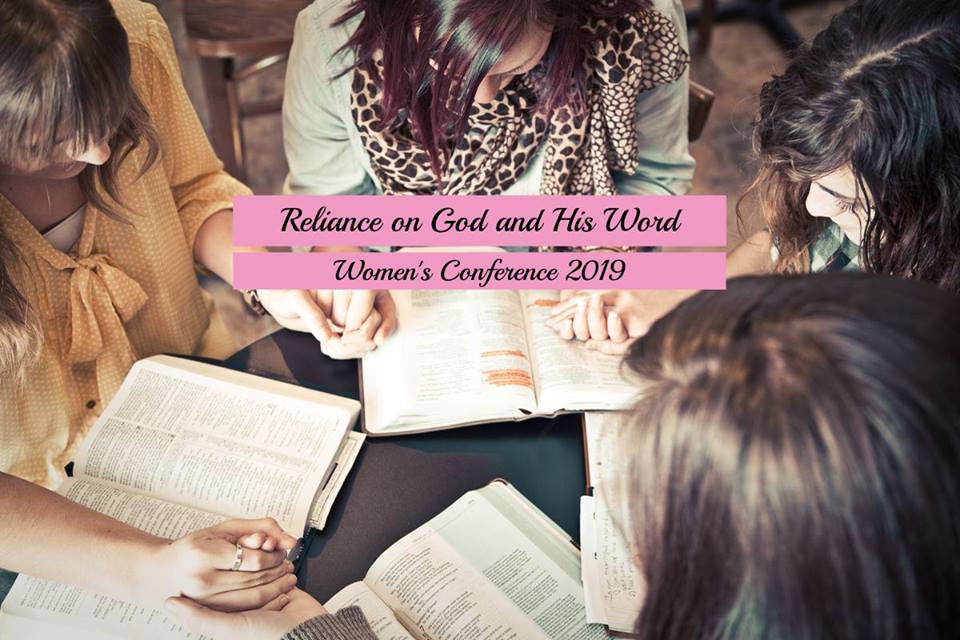
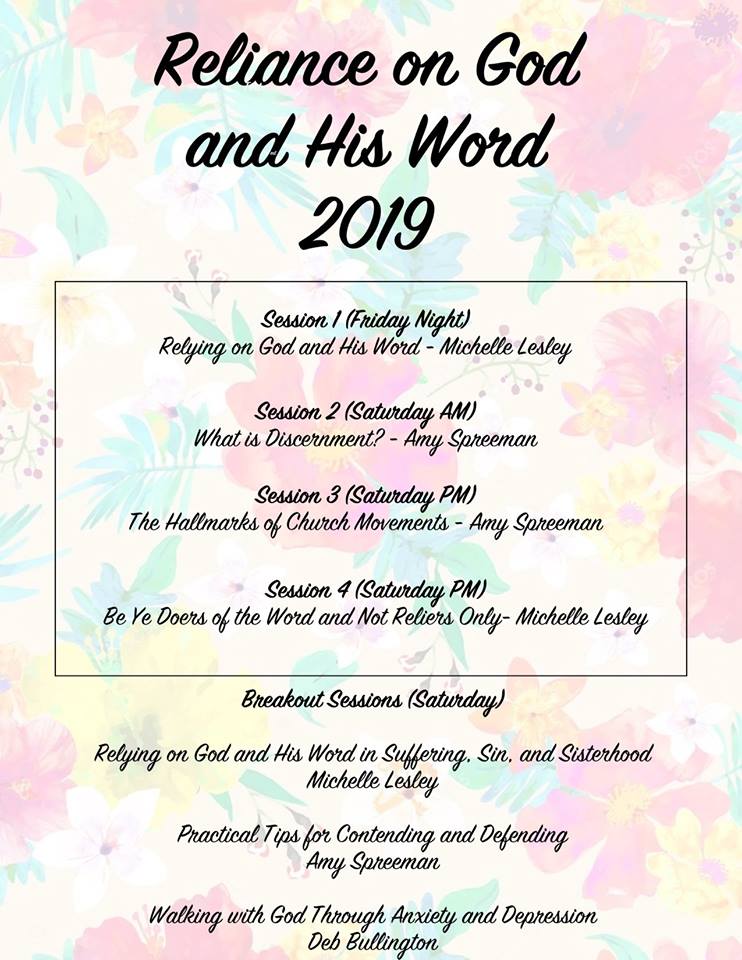
It was my joy, recently, to speak at the Reliance on God and His Word conference at Princeton Bible Church.

PBC was so kind to record audio of the main sessions of the conference:

I hope you’ll enjoy my two sessions…

Relying on God and His Word


Be Ye Doers of the Word and Not Reliers Only


You can also listen at PBC’s website and hear Amy Spreeman’s wonderful sessions as well!

If your church is ever in need of a speaker for a women’s event, I’d love to come share with your ladies as well. Click here for more information.

Random Ramblings Ruminations Resources

Random Ramblings, Ruminations, and Resources

A couple of months ago, I “beta tested” a new feature here at the blog, which I alliteratively titled Random Ramblings, Ruminations, and Resources. People seemed to like it … or … at least the majority of readers didn’t seem to hate it too much. So I decided to bring it back every once in a while when I’m feelin’ it.

I’m feelin’ it today. Buckle up, Buttercup. 

I’m Sorry…

I need to kick things off with an apology. God has graciously seen fit to convict me that my tone has been too harsh in some of my articles recently, particularly in the first part of this article. If you’ve ever been offended or hurt by the tone of that or any of my other articles or remarks I’ve made on social media, I wanted to say I’m sorry and to humbly ask your forgiveness.

And even if you weren’t offended or hurt, I know where my heart was as I was writing that article and the tweet it was based on, and I know it wasn’t right. I failed to exercise self-control and selfishly spewed my emotions in a way that was designed only to vent my own frustration and get it out of my system (which was pretty hypocritical since I was writing that we shouldn’t be slaves to our feelings!). I wasn’t even thinking about how a new Christian, someone going through a difficult time, or someone weak in the faith might have taken the tone in which I was saying those things. Romans 15:1 says:

We who are strong have an obligation to bear with the failings of the weak, and not to please ourselves.

Well, I don’t consider myself all that strong, but I guess each of us is stronger in the faith or in a stronger position of life circumstances than somebody. And for those who are weaker in the faith than I am, or walking through a time of pain or discouragement, I did the exact opposite of what this verse says to do. I pleased myself at your expense, and that’s not what someone who serves you in the name of Christ is supposed to do. So, again, my deepest apologies and I hope you’ll be able to forgive me.

If you’re so inclined, I would like to ask you to pray for me about this. Tone is an extremely difficult and confusing sea to navigate, at least for me (that’s one of the many areas in which I’m weak). It is important to speak biblical truth firmly, unequivocally, and unapologetically, but some Christians see that, in and of itself, as being harsh. It’s also important to demonstrate gentleness, kindness, and compassion, but other Christians see that as being wishy-washy or not standing firm on Scripture. I have written articles to which some have responded that I was too harsh and others have responded that I wasn’t harsh enough – to the same article! Add to that the fact that Jesus, Paul, and others in Scripture sometimes used phraseology that we would consider very harsh today…..but yet Paul says, “Imitate me as I imitate Christ.” And, add to that that there are different expectations in the evangelical mind of how women are to address things versus how men are to address things, and you can see what a fine and perplexing line it can be to walk. But I really, really want to get it right in God’s eyes, because I want to please Him.

I can’t promise my tone will never offend you again. That would be foolish. I have over 11,000 blog subscribers and over 10,000 social media followers. Everything I write is going to offend somebody, even if I don’t mean it to. Also, I know my heart, so I know I’m going to sin again by being selfish and uncontrolled. Furthermore, I can’t attempt to please everyone. That’s not only an exercise in futility, it’s unbiblical. What I can tell you is that I will do my best to think more about how I’m coming across, edit more to keep my own words, approach, and personality from becoming a stumbling block, and pray more as I write, asking God to grow me in wisdom and self-control, in order to honor, and be pleasing to, Him.

About five years ago, I wrote an article called Sacrificing Truth on the Altar of Tone. While it’s incumbent on us as readers and listeners to be able to put tone aside in order to discern whether or not what the speaker or writer is saying is true, it is also incumbent upon those of us who speak and write not to burden our hearers and readers with the necessity of doing so.

Thanks so much for your prayers as I pursue obedience to Christ in this area of my life. You are such a blessing to me, and I love and appreciate each of you.

Fill it Filled to the Rim

Didja hear? I’m doing a women’s conference with the ever-awesome Amy Spreeman at the end of March. It’s free, including a couple of meals, and it’s in Princeton, Illinois.

(In case you were wondering, that’s not where Princeton University, former home of Jonathan Edwards, is located. That’s in Princeton, New Jersey. I know this because I was wondering about it, too, and had to look it up.)

If you’re still trying to make up your mind about whether or not to come, lemme help you: come. And you need to hurry up and register too. Last week the event planners said they were already at 83% capacity (one of them must have been a math major!).

Here’s all the info. Be sure to check out the app and other links for resources on accommodations.

Illinois is too far away? Being from Louisiana, I get that. Look, plan your own conference, and I’ll come to you. “Impossible!” you say, “I go to a tiny church with an even tinier budget!”. Get together with a couple of sister churches to share expenses. Do a bake sale or a garage sale or crowdfunding. Take up a love offering and/or sell tickets at a modest fee. If you’re at all able, offer a doctrinally sound conference option to the women of your church and community. Christ’s ewe lambs are hungry for truth.

UPDATE: As I go to press, this conference is at capacity (“sold out”). If the organizers are able to open up any more spots, I’ll let you know. Also, if you’ve already registered and end up not being able to attend, please contact Princeton Bible Church and let them know so they can give your spot to someone else.

Scandal in the SBC

By now you’ve probably read the Houston Chronicle article that came out last weekend: Abuse of Faith: 20 years, 700 victims: Southern Baptist sexual abuse spreads as leaders resist reforms. If you haven’t, you should, regardless of whether or not you’re Southern Baptist. But, maybe especially if you are. It’s horrifying. And the way some have responded to victims over the years is downright disgusting.

Unless God leads me differently, it’s currently my plan to write an article about this, but I wanted to take the time to give it plenty of thought and prayer. In the meantime, I commend to you this stellar article by Tom AscolSouthern Baptists, Sexual Abuse, and a Far More Serious Problem. It covers a couple of points that I had already rough drafted into my own article before I read his. (So, when you read mine later, just know – it’s not plagiarism, it’s two like-minded Christians drawing the same conclusions.)

This also seems an appropriate time to share this vlog with you explaining how I decide which kinds of evangelical current events to write about, and when, and which I don’t, and why:

And Speaking of Scandals…

This has been in the hopper waiting for me to write about it since the last high profile pastor “fell from grace” (I actually can’t stand that expression. If you’re saved, you’re “in grace” and you can’t fall from it, and if you’re not saved, you’re not “in grace” so you can’t fall from it. It makes no biblical sense. But, I digress…). And, with the recent news of Harvest Bible Chapel firing James MacDonald after years and years of spiritual and financial abuses, I was reminded of it again.

There’s a dynamic that happens on social media that you see nearly every time something like this happens. A Christian celebrity falls and other Christians re-post the news story and/or comment about it. In the circles I run in, the comments are usually

biblically appropriate (“This is so sad,” “We need to pray for his family,” etc.). But there will always be someone who will comment to the effect of: “Why is everybody commenting and re-posting about this event? How can it possibly be fruitful or necessary to share this information?” It’s not that people are commenting unkindly, but that people are sharing this information at all that bothers this person.

There’s probably an extent to which this person is right, and you can share or not share as your conscience dictates, and I’ll admit that there have been times when an event has been so over-shared that I grew weary of the dead horse being beaten. But God has very good purposes in sinful events coming to light. And He demonstrates this Himself in Scripture.

God could have omitted from Scripture every sin, failure, and foible committed by every Bible character, and we would never have heard about them. But He graciously pulls back the veil and lets us see some of them. Why? For His glory and our good. And the same could be said about the public availability of information about the sins of today’s high-profile Christians:

💡 These stories, both in the Bible and in yesterday’s newspaper, allow us to learn, and develop a holy fear of the consequences of sin without having to go through it ourselves. “Stay home from the war and seduce my neighbor’s wife? Um, no thanks. Look how that turned out for David. I’ll just avoid that altogether.”

💡 These stories emphasize to those in leadership that they must walk circumspectly because the world, and the church, are watching them. There is a heavy price to pay for setting a bad example.

💡 These stories are a reminder that we cannot hide our sin.

💡 These stories are a call to pray for everyone involved in the situation. You cannot pray about what you do not know about.

💡 When churches and other Christian organizations properly handle a sinful situation, it is a testimony to the world that the church is not “full of hypocrites” – that there are Christians who strive for holiness and obedience to God. It sets us apart from the world, and from “CINOs” (Christians In Name Only).

💡 When the high-profile Christian repents and submits to church discipline, it paints a picture for the watching world of the way sin is supposed to be dealt with by the individual, and the way God and the church deal with sin in grace, mercy, forgiveness, and restoration. It can be a testimony of the gospel.

On “Dating” your Daughter…

There are a lot of great, godly dads out there. I love hearing them talk about leading their families in worship, talking about their love, hopes and dreams for their kids, and seeing them spend time with their children doing special activities. All of those things are absolutely awesome, and more dads should be doing them.

So maybe it’s just me (it wouldn’t be the first time), but it’s a bit disquieting when I hear men label spending time with their little girls as “daddy-daughter date night” and doing things like bringing them flowers and candy, ringing the doorbell to “pick them up” for the date, dressing up as if for the prom, etc.

Listen, it’s not a sin, and the guys I know and love who do these things are doing them for all the right reasons. And, if they want to keep on using the “dating” terminology and motif, more power to them – they won’t hear a peep from me and I will still have the utmost respect for them as godly men and godly fathers.

But if I could just throw out some food for thought…

♥ There is a difference between a father’s role and fatherly love and a (potential) husband’s role and romantic love. Are we blurring the lines and confusing our daughters when Dad mimics boyfriend? Could we, instead, make sure those lines are clearly defined and teach our daughters (and sons) the beauty and goodness of the two different roles and types of love?

♥ We want our children to be safe from predators. If we introduce and normalize the idea that it’s good and godly for an adult man to engage in behaviors with a child that are usually associated with romantic love, is it possible that we could unwittingly be making it harder for our daughters to recognize when a predator is attempting to groom them?

♥ If we have both sons and daughters, how is this affecting our sons? Are they getting the impression that their sisters are more special and loved by Dad than they are?

♥ How is this affecting the relationship between mother and daughter? Is Dad showing as much attention to Mom as he is to daughter? Is there potential for any undercurrent of rivalry or jealousy for Dad’s attention to develop between Mom and daughter? Could the daughter come to see herself as being on equal footing with Mom instead of submissive to her authority?

♥ Why is the “dating” terminology and motif necessary? Is there a biblical or practical reason why simply spending time with your daughter – whether it’s at home or even on a special outing to a restaurant, movie, etc. – without calling it a “date” or acting like it’s a “date” isn’t good enough?

♥ If the purpose of “dating” your daughter is to demonstrate how her future husband should treat her, what happens when she grows up, gets married, and her good and godly husband is just kind of inept when it comes to “date night”? Have we not created an opportunity for her to unfairly compare him to Dad, find him lacking, and resent him?

♥ If the purpose of “dating” your daughter is to demonstrate how a husband should treat his wife, couldn’t we be confusing our children by putting Dad in the role of the daughter’s “husband”? “I’m not his wife, I’m his daughter,” she could think, “so why is he acting like my ‘husband’?” Would it not make more sense to model for our children how a husband is to treat his wife by Dad treating his actual wife in a godly way?

Children are very impressionable and – if you remember back to your own childhood – highly susceptible to misunderstanding things and believing things that aren’t accurate. I’m just wondering if maybe we need to think through this whole “daddy-daughter date night” thing a bit more deeply.

Mailbag, Speaking Engagements

The Mailbag: Potpourri (Joni’s testimony, “Messy”, Female seminary profs…)

Welcome to another “potpourri” edition of The Mailbag, where I give short(er) answers to several questions rather than a long answer to one question. I also like to take the opportunity in these potpourrri editions to let new readers know about my comments/e-mail/messages policy. I’m not able to respond individually to most e-mails and messages, so here are some helpful hints for getting your questions answered more quickly. Remember, the search bar can be a helpful tool!


Our church has a ministry for the homeless where once a week, lunch is provided and a Bible Study is given usually by a woman, occasionally by a man to a mixture of both men and women. Some might be saved, probably most are not. What are your thoughts in regard to this situation from a Biblical perspective?

Great question! I’ve answered it in #11 of my article Rock Your Role FAQs.


We watched a video of Joni Eareckson Tada speaking at a recent Shepherds Conference. She gave her testimony and shared the meaning of Scripture and what some Greek words were so there was teaching going on as well as testimony. I know she is thought of highly but I was wondering about her speaking and teaching to groups of men.

Joni is not someone I follow closely, though I did read her first book, Joni, when I was a teenager. John MacArthur heads up the Shepherds Conference, which is a conference for men in church leadership, particularly pastors (“shepherds”).

Just to give a little background for anyone not familiar with him, Dr. MacArthur is a staunch complementarian and is a doctrinally sound pastor, teacher, and author I am happy to recommend to my readers. He would never invite a woman to preach at ShepCon nor invite a doctrinally unsound speaker. So I trust Dr. MacArthur’s judgment and reasons for inviting her to speak – that he was not inviting her to preach.

That foundation being laid, there are instances in which it is perfectly biblically appropriate for a woman to speak in front of a co-ed Christian group or a group of Christian men, and giving her testimony – so long as she does not veer off into preaching (instructing and/or exhorting men in the Scriptures) – is one of them. I’ve written more about that, giving examples, in these articles:

Rock Your Role FAQs (#7, 14)

The Mailbag: Should women give testimonies and reports, lead prayer and worship in church?

I have not listened to the talk Joni gave at ShepCon. It is possible that I would think her explanations of Scripture crossed the line into teaching, but it is also possible I would not. I just can’t say since I haven’t listened to it. (I would not consider giving the definition of a Greek word or two to be the type of biblical instruction prohibited by 1 Timothy 2:12.)

I would be more inclined to look at Joni’s history and intentions. Did she come to ShepCon with the intent of preaching or instructing men in the Scriptures? Does she have a track record of preaching sermons or giving Bible instruction to men at conferences? If the answer to both is no and she is normally very careful to stay within the parameters of biblical womanhood, I’d be inclined to extend grace on any bobbles she made during her testimony at ShepCon. It’s a very fine line to walk, and I’m sure I would probably make a few mistakes too if I were in that situation.

Update: Thanks to reader DebbieLynne (see comments section) for the heads up that Joni actually gave her testimony at the Strange Fire Conference (2013, also spearheaded by John MacArthur), not at the Shepherds Conference. Strange Fire was co-ed rather than men only. Whether or not women were in attendance at the conference doesn’t really change my answer to the reader, but it’s good to have the facts straight.


Is it OK for women to teach pastors-in-training at seminaries?

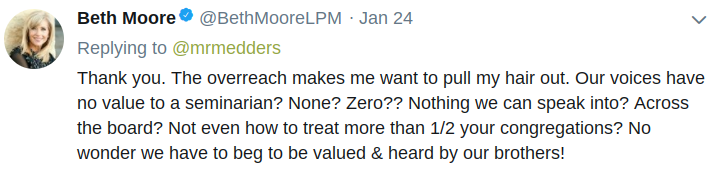
John Piper recently answered this question on an episode of Ask Pastor John. You should read his response for yourself (it’s not long), but, essentially his answer was that experienced pastor-mentors should be training up young pastors, and since it is unbiblical for women to serve as pastors themselves, they lack the experience necessary to mentor pastors-in-training. And, my word, the egalitarian world had a fit – including Beth Moore and her daughter Melissa (who helps run Beth’s ministry):

While I consider him to be a generally doctrinally sound brother in Christ, I’m not particularly a fan of John Piper, but I do want to say that I think his answer was taken wildly out of context by those pushing unbiblical agendas, that he was treated shabbily by many on social media, and that I thought his answer was very good, biblical, and just plain old made sense. Women are not qualified to serve as pastors. Why on earth would we want them training pastors? Moreover, what student wouldn’t want the most qualified and experienced professors he could get for his tuition money?

Let’s say you were the dean of the neurosurgery department at a medical school. A gentleman, totally blind from birth, comes in and applies for a position teaching surgical practicum (cutting, suturing, removing tumors, etc.). He has held positions teaching various subjects at other universities so his ability to impart information is not in question, but he has never performed surgery in his life because he’s blind. Would you hire him to train neurosurgeons to perform brain surgery?

The reason Dr. Piper’s answer caused a bit of a kerfuffle is that he limited his answer to the question he was asked. Imagine that. He was asked if women should train pastors and that’s the question he answered. The agenda-driven screaming neemies took his answer of “no” to mean that no woman should ever teach anything to anyone in any seminary anywhere ever. That is not what Dr. Piper said. He said women should not train men for the pastorate.

I would have answered the same way. However, if I were to expand on Dr. Piper’s answer, what I would further explain is that most seminaries (at least the ones I’m familiar with) do far more than simply train men for the pastorate. Take the seminary my husband attended for example, New Orleans Baptist Theological Seminary. If you’ll click on the “Academics and Admissions” tab at the top of the page and examine the various degree and non-degree programs, you’ll find that most of them are not strictly preaching programs. There are programs for women’s ministry and children’s ministry (Surely we wouldn’t say women are unqualified to teach in these areas?), college ministry, urban ministry, music ministry, missions, counseling, languages, and many more. There’s nothing wrong with women teaching things like music theory, finance, general education classes like math, history, and English, archaeology, legal issues, languages, business, etc., even in a seminary.

There are definitely some classes women shouldn’t be teaching in seminaries, but there are plenty of other classes that would be fine for them to teach.


Since we’ve become parents my husband and I have mostly attended churches that were larger and offered childcare. We were saved out of Mormonism eight years ago which has its own order of services and no childcare provided for the main service, but I don’t know what to expect from a Christian service that doesn’t offer childcare. I don’t know what will be expected of me and my family. I have a four-year-old and I worry that he will end up running around or asleep on the pew. Do we call ahead? Pack a busy bag? Are snacks alright? How do you ever get anything out of the service for yourself?

Before I answer, I want to encourage readers who are experienced church members to really let this precious sister’s question sink in and inform the way you respond to visitors and new members. Increasingly, the people who are new to your church will have very little church background. Church culture may be old hat to you, but it’s like landing on Mars to many of them. They have no idea where to go or what to do, and they don’t speak Christianese. Make sure you warmly welcome and encourage newbies and let them know that it’s OK to ask questions.

I think my article Churchmanship 101: Training Your Child to Behave in Church will help with some practical tips and expectations. You should not allow your child to run around the sanctuary during the worship service any more than you would allow him to run around a restaurant if you went out to eat, or a store if you were shopping, but I would not get overly stressed about him making a few minor noises or dropping the occasional Bible during church. If a church doesn’t offer childcare, they’re surely used to children making a little noise during the service from time to time. Sermon-time naps at four years old are not the end of the world, but you’ll want to curb those as he approaches school-age (if he can stay awake all day in school, he can stay awake for 30 minutes or an hour in church).

Until your child gets into the routine of attending worship and learns how you expect him to behave, you may not get very much out of the service. That’s just one of those parts of being a mom that we all have to accept – like stretch marks :0) But if you will be consistent and diligent as you train your child, he’ll get with the program soon enough.

When you ask if you should “call ahead”, if what you mean is calling the church office prior to Sunday and asking any questions you might have, that is a super idea! Most pastors I know would be delighted to chat on the phone or in person to welcome you to the church and help you feel at ease. That is the point at which I would ask about snacks. Different churches have different policies about food and drink in the sanctuary. I’ve never heard of one that wouldn’t allow a baby bottle, but some may not be keen on the idea of Cheerios ground into their carpet. You could also ask if they have a “cry room”. Some churches have set aside a room near the sanctuary where you can take a fussy baby or jumpy toddler. Many of them have the sermon “piped in” so you can listen until you go back into the worship service. You might also want to ask if the worship service is recorded and posted online so you can listen at home to any parts of the sermon you may have missed. Never be afraid to ask an honest and polite question.


I have been hearing the word messy a lot in reference to our lives..has this word replaced the word sin?

Well…I suppose it may have for those who are trying to sand off the sharp edges of the gospel, but the biblical term is sin, so that’s the correct word to use, despite how popular “messy”, or any other trendy word, might be.


Can you recommend any doctrinally sound female speakers for women’s events?

(I promise this is an actual question I recently received, not one I made up for promotional purposes! :0)

Yes, me. Click the “Speaking Engagements” tab at the top of this page for more information.

If I’m not really your cup of tea, or I’m too far away for your travel budget, I happily recommend any of the women listed under the “Recommended Bible Teachers” tab at the top of this page (although I’m not positive all of them do speaking engagements).


If you have a question about: a Bible passage, an aspect of theology, a current issue in Christianity, or how to biblically handle a family, life, or church situation, comment below (I’ll hold all questions in queue {unpublished} for a future edition of The Mailbag) or send me an e-mail or private message. If your question is chosen for publication, your anonymity will be protected.