Women of Genesis Bible Study

The Women of Genesis: Lesson 10

Previous Lessons: 1, 2, 3, 4, 5, 6, 7, 89

๐Ÿ“–๐Ÿ“–๐Ÿ“–๐Ÿ“–๐Ÿ“–

Read Genesis 13-15

๐Ÿ“–๐Ÿ“–๐Ÿ“–๐Ÿ“–๐Ÿ“–


Questions to Consider

1. Briefly review lesson 9 (link above) about Sarah. Other than 13:1, this week’s passage does not mention Sarah. But as you read 13-15, read it understanding that, even though she is not mentioned, Sarah is experiencing all these things in some form or fashion because she’s married to Abraham. So, we learn from 13:1 that Sarah again had to pack up and move. In 13:2-7, we learn that Sarah was wealthy and likely managed a large household. Write down what else you can – carefully and reasonably – surmise about Sarah from chapters 13-15.

2. What/where was “the Negeb“? (13:1)? Trace Abraham’s, Sarah’s, and Lot’s trip from Egypt (13:1) back to “between Bethel and Ai” (13:2) on the map below. Find the remainder of the locations mentioned in 13-15 on the map.
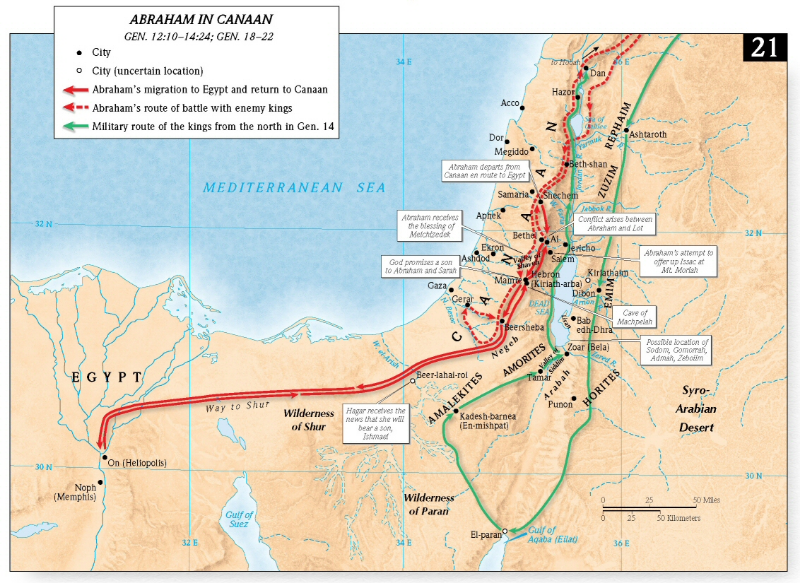
3. Read Proverbs 3:5-6. How do we see Abraham trusting God and God directing Abraham’s paths in chapter 13? Canaan, where Abraham settled (13:12), eventually became known as what? How does chapter 13 demonstrate God’s sovereignty?

4. What does chapter 13 teach us about making wise and godly decisions? Can you look back on an incident in your life where you had to trust the Lord and make the wisest, most God-honoring decision you could? How did God “direct your paths” in that situation?

5. List all of the things God promised Abraham in chapters 13-15. Can you find the passages of Scripture where these promises came true?

6. Examine the instances in chapters 13-15 where Abraham worshiped the Lord. How would you characterize his worship? What caused him to worship?

7. Compare 15:6 to Romans 4 and Galatians 3. What does the Holy Spirit want New Testament Believers to understand about faith from Abraham’s example?

8. Compare and contrast Abraham’s interaction with God in chapter 15 about what God was promising him to Zechariah’s interaction with God about what God was promising him. How were Abraham’s and Zechariah’s reactions to God’s promises similar? How were they different? How and why did God react differently to Abraham’s questions than to Zechariah’s questions?


Homework

Compare Genesis 14:17-24 with Hebrews 7. How is Melchizedek a type of Christ? Why would the writer of Hebrews (14:13) refer his audience back to Melchizedek as an illustration of Christ as eternal high priest?


Suggested Memory Verse

And [Abram] believed the Lord, and he counted it to him as righteousness.
Genesis 15:6

Women of Genesis Bible Study

The Women of Genesis: Lesson 9- Sarah

Previous Lessons: 1, 2, 3, 4, 5, 6, 7, 8

๐Ÿ“–๐Ÿ“–๐Ÿ“–๐Ÿ“–๐Ÿ“–

Read Genesis 11:27-12:20

๐Ÿ“–๐Ÿ“–๐Ÿ“–๐Ÿ“–๐Ÿ“–


Questions to Consider

1. What facts can we glean about Sarah from this passage? What was her original name? (11:29) Who were her family members? (11:27-29, 31) Where was she originally from, and where did she move to? (11:28,31) What was her physical condition (11:30) and why is this “backstory” being given to us? (12:7) What was Sarah’s physical appearance like? (12:11,14)

Click for larger view

2. We can learn more about Sarah from other passages of Scripture. What does the name Saraiย (see footnote) mean? What was Sarah’s familial relationship to Abraham? How old did Sarah live to be? How does Paul use Sarah as an allegorical example in Galatians? How does Hebrews describe Sarah’s faith? How does Peter hold Sarah up as a godly example to Christian women? Overall, how does the Holy Spirit frame and describe Sarah’s character in the New Testament? Does this mean her thoughts and behavior were always flawless?

3. Consider that Sarah, though sinful and imperfect in many ways, is spoken of by the Holy Spirit in the New Testament as a woman of faith and godly character, and an example to be looked up to by Christian women. Does this bring you comfort and reassurance as a sinful and imperfect, yet faithful, follower of Christ? What are some ways you can set a godly example for other Christian women even though you sometimes stumble into sin? How will God speak of your faith and character at the end of your life?

4. While the events in Genesis 11-12 are told from Abraham’s perspective, Sarah, his wife was right there with him, experiencing those same events. Consider the following parts of the story from Sarah’s perspective:

Barrenness (11:30):ย In a patriarchal society in which women established status largely by bearing sons, what might Sarah have thought about being barren?

Traveling and relocating (12:1-9): Examine the map above. Strange lands she’d never been to before. Strange and possibly hostile people. How far would Sarah and her family have had to travel? What might have been some of Sarah’s concerns for her family?

God’s promises and instructions (12:1-3,7): What questions might Sarah have had about her role in God’s promises to Abraham, how her barrenness would affect God’s promise for offspring, and how it would all play out once God’s promises were fulfilled?

Trusting, obeying, and worshiping God (12:1-9): In instructing Abraham, God was also instructing Sarah, as his wife, to obey and follow Him. What were some ways Sarah would have had to obey God? How could she have served as a helper to her husband? How would she have needed to trust God? How would trusting and obeying God have led to worship for Sarah, right alongside her husband? (7,8) How might Sarah’s relationship with God have grown through this experience?

5. Examine 12:10-20. Summarize the story in your own words. What did Abraham ask Sarah to tell the Egyptians in verse 13? Why? Was this true? What can we learn from this story about honesty, deception, and half truths? How did Abraham’s deception put Sarah in danger? In what way did Abraham put his own needs ahead of Sarah’s well-being? How might Abraham’s actions have damaged his relationship with his wife?

6. Compare Abraham’s trust in God in 12:1-9 with his lack of trust in God in 12:10-20.

7. In what ways did Sarah have to trust God and trust her husband in 12:1-9? In what ways did she have to trust God and trust her husband in 12:10-20? Was Abraham acting in a trustworthy way in both of these instances? Why or why not?

8. Have you ever had to trust God through a situation in which your husband, parent, or someone else you depended on, wasn’t acting trustworthy? What did this teach you about God and His trustworthiness and dependability?

9. True or false: “In some ways and at some times Sarah may have had to trust God even more than Abraham did.”? Why?


Homework

How can trusting God through a difficult time lead you to worship Him? Describe a trial you’ve been through and how you trusted God in the midst of it. Take some time to worship God for the specific ways He carried you through that trial: how He provided for you, comforted you, strengthened you, and encouraged you.


Suggested Memory Verse

Then the Lord appeared to Abram and said, โ€œTo your offspring I will give this land.โ€ So he built there an altar to the Lord, who had appeared to him.
Genesis 12:7

Women of Genesis Bible Study

The Women of Genesis: Lesson 8

Previous Lessons: 1, 2, 3, 4, 5, 6, 7

๐Ÿ“–๐Ÿ“–๐Ÿ“–๐Ÿ“–๐Ÿ“–

Read Genesis 10-11:26

๐Ÿ“–๐Ÿ“–๐Ÿ“–๐Ÿ“–๐Ÿ“–


Questions to Consider

1. Read through the names and places listed in chapters 10 and 11. Do you recognize any of them from other parts of the Bible? What roles did they play in biblical history?

2. Often, when we approach “list passages” of Scripture (such as genealogies, censuses, inventories, etc.) we do so in a very ego-centric way: “How does this help me?” “How does this apply toย my life?” “This is boring to me.” Could it be that God had a purpose for including these things in Scripture that have nothing to do with your personal life or mine? Why did God put the genealogies of Genesis 10-11 in the Bible? Examine these genealogies in light of 2 Timothy 3:16-17. How are they profitable, how do they equip, etc.?

3. Matthew 1ย traces the genealogy of Christ back to Abraham. Can you pick up where Matthew leaves off and follow Christ’s family tree from Abraham (Abram) back to Noah? (Hint: start at 11:26 and work backward)

4. Why don’t the genealogies of Genesis 10-11 list any women? (Hint: think about Israel’s societal structure, the twelve tribes of Israel, inheritance, land allotment, etc.)

5. Compare 10:5,20,31 with 11:1,6. What do these verses say about the language(s) of the peoples? Is this an example of Scripture contradicting itself or of non-linear chronology in Scripture? Briefly review Lesson 2, question 1 (link above). Are we seeing something similar in chapters 10-11 to what we saw in chapters 1-2 (the “two” Creation accounts)?

6. Read 11:2,4 with 10:8-10. Who led the people to settle in Shinar? According to God’s command in Genesis 9:1, were they supposed to settle down or spread out? (11:4) What happened as a result of God confusing their languages? (11:8-9)

7. Besides rebelling against God’s command to spread out and fill the earth, what sin were the people committing by building the tower? (11:4) What does the Bible say about those who act in pride or attempt to take God’s glory for themselves? Why is it so important to glorify God in everything we do?

8. In your job, at your church, on social media, among your friends and family, etc., do you try to “make a name for yourself” (11:4) by the way you act and speak? Do you hunger to be the center of attention, crave adulation, constantly try to impress people? How might pride and love of self be the foundation for these actions and attitudes? Is there anything you need to repent of and ask God’s forgiveness for? Nimrod’s people would have brought glory to God by obeying His command to spread out and fill the earth instead of building the tower. What are some practical ways you can glorify God by obeying Him instead of glorifying yourself?


Homework

If you’d like to read up more on biblical genealogies and their importance, here are a couple of good resources:

Why were genealogies so important to Israel?ย at Got Questions

Why the Genealogies? at Grace to You


Suggested Memory Verse

Therefore its name was calledย Babel, because there theย Lordย confusedย the language of all the earth. And from there theย Lordย dispersed them over the face of all the earth.
Genesis 11:9

Mailbag

The Mailbag: Men attending women’s Bible study class at nursing home

Note from Michelle:
This is a question some friends and I were recently discussing on Twitter,ย 
not one sent in by a reader. A few minor details have been slightly altered.

A female relative of mine teaches a women’s Bible study at a Catholic nursing home (my relative is a Protestant Christian). Sometimes, a male resident or two – none of whom are saved – will wander in and attend her class. Occasionally, one of them attempts to correct her according to Catholic doctrine. Even though she’s not technically teaching “in the church” (1 Timothy 2:12) she’s uncomfortable with men attending the class, as well as with having to biblically correct their unscriptural Catholic doctrine. On the other hand, she shares the gospel every time she teaches, and she doesn’t want to turn away anyone who might receive the good news and be saved. What should she do?

I love it when Christians think deeply about issues like this. It is encouraging to interact with godly people who want to be obedient to Christ, and it pushes me to desire to obey Him better myself.

Foreword:

Just to lay a quick foundation for my answer to this question, it needs to be understood that people who currently believe and practice Catholic doctrine as it is written in Catholic documents are not saved. There are numerous unbiblical beliefs Catholics hold to (which I will not go into right now because that’s beyond the scope of this article) but for the purposes of understanding my answer, in a nutshell, the Catholic religion does not teach salvation by grace alone through faith alone in Christ alone (in fact, Catholicismย anathematizesย {condemns to Hell} anyone who teaches this), works must be included in the salvation process. If you believe your own good works play any part in earning your salvation, you are not saved. Salvation is all of Christ, and Christ alone.

โœขโœขโœขโœขโœข

I am assuming that whoever invited this teacher to teach a Bible study in the nursing home knows that she is Protestant and will be teaching Protestant (biblical) doctrine. I am also assuming that the person who invited her to teach is OK with this. I would not advise someone to give the appearance of teaching in compliance with Catholic doctrine and then surreptitiously “sneaking in” Protestant doctrine. That’s deceitful and dishonest, and it would be understandable for the Catholic residents to be correcting her.

โœขโœขโœขโœขโœข

If you’re unclear as to why having men in her Bible study class is a dilemma for the female teacher, I’d encourage you to read these two articles before moving on to my answer:

Jill in the Pulpit

Rock Your Role FAQs (this article expands on my brief comments below)


Here are my thoughts on the issue:

1. If the people attending the study are Catholic, then the female teacher is evangelizing the lost outside of the church, not discipling (teaching) Believers whoย are the church, unless some of those attending the study have gotten saved (the question indicates none of the male “drop ins” are saved). Evangelism falls under the “do” of the Great Commission, not the “don’t” of 1 Timothy 2:12. (see #11)

2. We always have to keep the definition of “church” in mind when we’re talking about women teaching or holding authority over men “in the church.” The gathered body of Believers is the church, not the building in which they meet. The mere fact that a group meets in a nursing home, house, park, community center, or other edifice that isn’t a church building doesn’t automatically mean a woman is free to teach men (see #7). It doesn’t automatically mean she can’t teach them either.

3. If the male attendees are being disruptive and introducing false doctrine, the teacher is well within her biblical rights and wisdom to say that this a women’s only group and exclude the men. (The same would apply to excluding any women who behave the same way.)

4. If, at some point, genuinely regenerated men begin attending the class because they want to be taught the Bible, praise God! The best case scenario would be for the teacher to go to her pastor, explain the dilemma, and have him ask one of the associate pastors, elders, or another appropriate male church member to volunteer to teach the men.


If you have a question about: a Bible passage, an aspect of theology, a current issue in Christianity, or how to biblically handle a family, life, or church situation, comment below (Iโ€™ll hold all questions in queue {unpublished} for a future edition ofย The Mailbag) or send me anย e-mail or private message. If your question is chosen for publication, your anonymity will be protected.

Women of Genesis Bible Study

The Women of Genesis: Lesson 7

Previous Lessons: 1, 2, 3, 4, 5, 6

๐Ÿ“–๐Ÿ“–๐Ÿ“–๐Ÿ“–๐Ÿ“–

Read Genesis 6-9

๐Ÿ“–๐Ÿ“–๐Ÿ“–๐Ÿ“–๐Ÿ“–


Questions to Consider

1. Genesis 4:26b says, “At that time people beganย to call upon the name of theย Lord.” Compare this statement to the spiritual condition of mankind inย Genesis 6. Why did God decide to destroy the earth? (6:5-7,11-13)

2. Compare the depravity of mankind with the uprightness of Noah. Who validated Noah’s righteousness? (6:8-9) How do chapters 6-9 describe Noah’s righteousness? How did Noah demonstrate righteousness before, during, and after the flood? In God’s eyes, is righteousness outward (behavior) only, inward (heart condition) only, or both?

3. Review question 7 from lesson 6 (link above). At this point in Old Testament history (Genesis 6), had God given the Law? If not, how could He hold mankind responsible for breaking His Law – being “wicked,” “evil,” and “corrupt” – to the point of killing everyone and destroying the earth and still be a just God? What does this tell us about how seriously God views sin?

4. Compare God’s wrath for sin poured out on the earth in Genesis 6-9 to His wrath for sin poured out on Christ at the cross. How does Noah’s salvation from God’s wrath toward sin by being in the ark point ahead to our salvation from God’s wrath toward sin if we are “in” the cross? What is the type and shadow significance of God (rather than Noah) closing and sealing the door of the ark when His work of saving Noah was finished? (7:16) Do you see any other types and shadows in Genesis 6-9?

5. Examine 6:5-7, 8:21, and 9:11. An unbeliever might look at these passages and think that God realized He made a mistake by creating man, attempted to correct that mistake with the flood, and then regretfully realized that the flood was overkill. The unbeliever might even question God’s sovereignty and omniscience: “Didn’t God alreadyย know that man would become so sinful? Why create humans in the first place?” How would you answer these challenges to God’s nature and character?

6. Genesis 9:8-17 is the text of the Noahic (no-WAY-ick) Covenant. What does God promise in this covenant? What is the sign of this covenant? Is the Noahic Covenant bilateral (if people do X, then God will do Y) or unilateral (God says, “I will do X.”)

7. Compare God’s instructions to Noah for His “re-Creation” (9:1-7) with God’s instructions to Adam and Eve for His Creation. What are some similarities? Differences?

8. The Holy Spirit has spent nearly four chapters emphasizing Noah’s righteousness contrasted with the depravity of the rest of mankind. Yet 9:20-27 demonstrate that Noah and his sons were still quite capable of sin. How does this confirm that we inherited our sin nature from Adam and that even the most righteous man on earth is sinful and imperfect?


Homework

If you’d like to do more research on Noah’s story, Answers in Genesis has some great resources on their Noah page.

For even more on Noah and the flood, visit theย Ark Encounter in Williamstown, Kentucky.


Suggested Memory Verse

When the bow is in the clouds, I will see it and remember the everlasting covenant between God and every living creature of all flesh that is on the earth.
Genesis 9:16