Bible Study, Mailbag

The Mailbag: “We need to stop relying on canned studies,” doesn’t mean, “We need to rely on doctrinally sound canned studies.”.

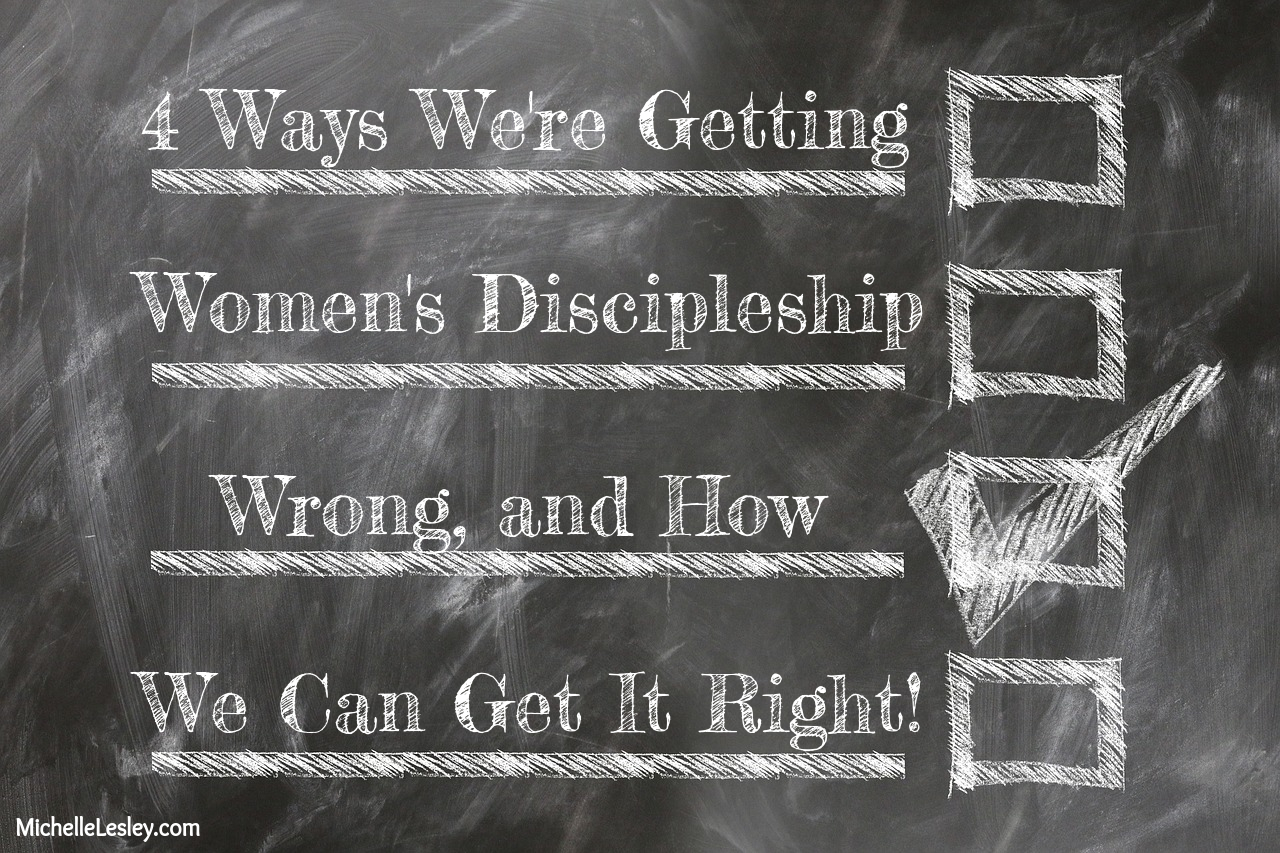
ย In my recent article,ย 4 Ways Weโ€™re Getting Womenโ€™s Discipleship Wrong, and How We Can Get it Right!, one of the points I mentioned is that we’ve equated women’s discipleship with purchasing a celebrity Bible teacher’s DVD/workbook package and parking women in front of a TV instead of training older women in the local church to teach younger women straight from the Bible.

The idea that we have to use pre-fab studies instead of teaching straight from the Bible is so deeply embedded in our evangelical DNA that nearly every time I write an article or social media post saying we need to kick this habit and get back to straight Bible teaching, what some readers seem to hear is that we need to use doctrinally sound pre-fab studies. (And they proceed to recommend materials by the handful of doctrinally sound women authors who are out there.)

That’s not what I’m saying. I know there are (a few) doctrinally sound pre-fab studies out there. I’m saying we need to totally revamp the way we do women’s Bible study and detox ourselves from our addiction to studies written by authors outside of your local church, who don’t know the women of your church, and who aren’t there for the women of your church – even if those authors are doctrinally sound.

A variation of this question came up again (from a very kind sister who genuinely cares about the ladies in her church and the teaching they receive) in response to the aforementioned article. I share it here, along with my response, to a) help continue to hammer on the idea that we do not have to use canned studies, there’s another, better way, and b) to give you a few ideas of how to stop being so dependent on canned studies in your own church.

I have found some good DVDโ€™s that have been a real encouragement and have fostered true growth in our women. [List of doctrinally sound DVD studies.] While direct teaching is wonderful sometimes the women who teach in our church find themselves in limiting life circumstances…I would love to hear of some DVDโ€™s that youโ€™d recommend, not as a daycare/babysitter for women, but that contain good teaching for times when we want to be in the Word but cannot take the time to adequately prepare.

Iโ€™m glad there have been some doctrinally sound DVDs youโ€™ve been encouraged by, and, just to clarify, Iโ€™m not saying every DVD on the market features a false teacher (but the vast majority of them do).

Iโ€™m not trying to sound harsh, but I think you might have missed the point of section 3 [of the article]. The whole point is that we need to stop relying on pre-fab studies and teach/study straight from the Bible, and youโ€™ve responded by asking me which DVDs I recommend. I donโ€™t. I recommend teaching/studying straight from the Bible. (Iโ€™ve explained more here, if it would be of interest.) Your question kind of proves my point about how deeply ingrained the โ€œcannedโ€ Bible study mindset runs. Itโ€™s not a question of whether or not there are doctrinally sound DVDs on the market, the issue is that we need to study the Bible itself, and we need teachers in the local church who are trained to teach straight from the Bible.

โ€ฆgood teaching for times when we want to be in the Word but cannot take the time to adequately prepare.

Iโ€™m not sure whom youโ€™re referring to regarding not having time to prepare. If youโ€™re talking about a teacher, she should step down if she doesnโ€™t have time to adequately prepare. Thatโ€™s part of being a teacher (I address that at length in the first article linked below section 3). If she canโ€™t commit to preparing, she shouldnโ€™t be teaching.

If youโ€™re talking about students in a Bible study class- if they have time to watch a DVD, they could spend that same time period reading and discussing a passage out of the Bible.

Again, I donโ€™t mean to sound unkind or anything like that, and I do appreciate your question, but we really need to get away from the pre-packaged studies and simply pick up the Bible itself and study it.

Thanks for your response. I guess I didnโ€™t clarify that I was wondering if there were studies that youโ€™d recommend during times when the teachers we have donโ€™t have time to properly develop a lesson. Your post just spurred that question in my mind though I know that wasnโ€™t your intent. It takes me an average of six hours to prepare to teach a lesson and if Iโ€™m in a temporary place of not having time to adequately study for a couple of months we like to continue learning even if it is just from a sound teacher via DVD. Being from a smaller church in a depressed area where women are expected to work, it can be difficult to always have an available teacher. But the women do minister to each other in a word based way.

I definitely understand that womenโ€™s ministry is not done biblically in many cases. Your posts contain lots of good info. Thanks for what you do! 

Thanks for understanding. Here are a few things Iโ€™d recommend instead of falling back on a DVD.

1. Get one or two more women trained to teach, and have a rotation of teachers. That takes the burden off of one person and is also helpful if you get sick, go out of town, have an emergency, etc. It would also give each teacher a longer time period between lessons she has to teach, so she would have more time to prepare. It might not be the easiest thing in the world to get that in place, but prioritizing Christ and His ways rarely is. He never promised us easy, but He did promise to help us. Ask for His help and have your class pray about the situation, too.

2. If thereโ€™s some sort of out of the ordinary, rare emergency that has kept you from preparing, simply go in to class, read the passage together, and discuss it verse by verse.

3. If itโ€™s been impossible to prepare, turn that class period into a prayer meeting. Frankly, it would be beneficial as we need far more small group prayer meetings in the church. You might even want to purposely schedule your class that way, say, lessons for three weeks, prayer meeting on the fourth week, or something like that.

4. Make use of my studies at the Bible Studies tab at the top of this page. If you need a โ€œone and doneโ€ type of lesson in a pinch, look under โ€œWednesdayโ€™s Wordโ€ toward the bottom of the page. Read the passage with the class and use the questions for discussion. All of my studies are free to download, print out, and distribute.

These are the kinds of things teachers have done for centuries until DVD players were invented. Thereโ€™s really no reason to ever have to fall back on a DVD. Like I said, if you can watch a DVD, you can read a passage of Scripture and discuss it.

Additional Resources

The Mailbag: Can you recommend a good Bible study for women/teens/kids?

McBible Study and the Famine of God’s Word

Bible Study

Bible Studies


If you have a question about: a Bible passage, an aspect of theology, a current issue in Christianity, or how to biblically handle a family, life, or church situation, comment below (Iโ€™ll hold all questions in queue {unpublished} for a future edition of The Mailbag) or send me an e-mail or private message. If your question is chosen for publication, your anonymity will be protected.

Biblical Womanhood Bible Study

Imperishable Beauty: Lesson 7- The Beauty of Knowing and Loving God’s Word

Previous Lessons: 1, 2, 3, 4, 5, 6

Read These Selected Scriptures

In lesson 6, we took a look at membership in the Body of Christ – both the church catholic, and the local church – and how that membership is part of our identity in Christ. Today, we’ll examine loving and being good students of God’s Word as a component of biblical womanhood.

Questions to Consider

1. Examine the Mark 12 passage. Verses 29-30 are often called what, according to the section title above the passage? What are the two main verbs (the two things we’re told to do) in The Great Commandment? (29-30) What does God command His people to “hear”? Why does the command to “hear” come before the command to “love”? How do God’s people today “hear” about the one true God and learn how to “love” Him?

What does it mean to love God with all your mind? Compare and contrast loving God with your mind to loving God with your heart, your soul, and your strength. Respond to this statement: “Pursuing God with our minds – studying the Word, learning theology, etc., – is one of the ways we love God.

2. Read the 2 Peter passage, focusing on what it says about knowledge. How has God “granted to us all things that pertain to life and godliness”ย  – “through” what? (3) How do we get this knowledge? Where do we find God’s “precious and very great promises,” and what do we receive “through” these promises? (4) How does verse 8 sum up the goal of the knowledge of God in conjunction with the characteristics in verses 5-7? What does all of this teach us about the importance of pursuing the knowledge of God through His Word?

3. Who was 2 Timothy written to? By whom? For what purpose? (Choose aย Bible Book Background, if needed, to refresh your memory.) Does that mean this passage isย onlyย applicable to pastors, orย especially to pastors, but also to all Christians? Look closely at verse 15. Explain how you can “rightly handle the word of truth” in your own daily life and context. To whom does verse 15 say we either present ourselves as approved workers, rightly handling the word of truth, or present ourselves in shame if we are not? Is rightly handling the Wordย primarilyย for the glory of God, or for the good of man? What are the consequences for ourselves and others ofย not handling God’s Word correctly, according to 14,16-18?

4. Psalm 119 might be the perfect Scriptural example of the knowledge of God’s Word leading to a greater emotional affection for God. Instead of studying each verse of this psalm individually, read it as a whole unit, noting along the way the importance the psalmist places on the Word of God and what studying Scripture led to in his heart and his relationship with God. Notice also, his expression of emotion, and his love and affection for God.

As women, we’re sometimes prone to being ruled by our feelings, and we often rightly cite Jeremiah 17:9ย as evidence that we should not trust our feelings over God’s word. What does Psalm 119 teach us about feelings, emotions, and affections that are fueled by God’s Word?

5. Explain why knowing and loving God’s Word is an integral part of biblical womanhood.


Homework

Many Christian women pit the idea of loving God with our minds (“head knowledge”) against the idea of loving God with our hearts/souls (“heart knowledge”), often leaving the impression that pursuing God intellectually is inferior to, different from, and sometimes even less feminine, than an affectionate, emotional love for God. According to the Mark 12 passage, is this a fair assessment or a false dichotomy? How can loving God with all your heart lead to loving God with all your mind, and vice versa? Evaluate your love for God in terms of how you love Him with your heart, your soul, your mind, and your strength. Write down any weaknesses in any of these areas and ask God to strengthen you. Write down any growth you’ve seen in any of these areas, and praise God for growing you.


Suggested Memory Verse

Your testimonies are my heritage forever,
for they are the joy of my heart.
Psalm 119:111

Mailbag, Politics

The Mailbag: How Should Christians Vote?


Tomorrow, Tuesday, November 6, is election day in the United States. How should Christians vote?

Voting is a privilege, and, for U.S. citizens, a right. I encourage you to use your vote as a godly influence by voting according to biblical principles. My answer to today’s Mailbag question is adapted from my 2008 article, How Should Christians Vote?


10730205_864190773621858_7293920273710529598_n

Tomorrow is election day. How can we steward our vote in a godly way?

First things first. Christians, especially Christian women, should vote. Not voting would not only be an insult to the sacrifice of the dedicated men and women who have given their lives in the cause of freedom and suffrage over the years that we might have the luxury of having a voice in our governance, but voting is a gift from God. Should we treat this gift lightly by failing to exercise it?

If you have never had the opportunity to visit a country, such as those in the Middle East, in which basic freedoms and women’s rights are limited if in existence at all, I urge you to do so if at all possible. After I returned to the U.S. from a visit to the Middle East a few years ago, I realized just how much we take for granted what an enormous blessing it is that God has seen fit to place us in a land of liberty, abundance, and opportunity. When I vote, I see it as a way of returning thanks to God for the gift of freedom, and honoring those who have made the ultimate sacrifice to secure our liberties.

For whom should Christians vote? The Bible says in 1 Corinthians 10:31 that whatever we do, we should do all things for the glory of God. “Whatever” and “all things” includes voting. Christians should vote for the person they believe will bring the most glory to God. Considering the candidate options with which we’re often presented, this, at times, seems an impossible task.

How do we know which candidate to vote for? Like all other decisions in a Christian’s life, this one should be governed by God’s leading through prayer and Biblical principles. Ask God for wisdom (James 1:5) to make a Godly decision.

Study the candidate’s platform and where he stands on each issue. Is he a proponent of anything that clearly conflicts with Scripture? Would he push to legalize or undergird things God calls sin such as abortion or sexual perversion? Does he support the persecution of Christians – denying us freedom of speech or assembly, and taking away the rights of Christians to run their businesses according to biblical principles?  Can we, as Christians– whose goal in life is supposed to be turning from sin and pursuing holiness – knowingly and intentionally disregard the fact that a candidate would stand in favor of sin rather than fighting against it, and give him our support?

Sometimes we lean towards voting for the candidate who would benefit us the most, personally. Perhaps he has promised a tax cut for our particular bracket, or said he would improve the roads we use for traveling to work. In and of themselves, those are good things, but does his platform also include favoring things which would hurt others or be detrimental to the fabric of our society in general? In other words, should a Christian vote for something or someone who will benefit herself at the expense of harming others?

I don’t believe we can do that and remain true to Biblical principles such as:

Do nothing from selfishness or empty conceit, but with humility of mind regard one another as more important than yourselves; do not merely look out for your own personal interests, but also for the interests of others. Philippians 2:3-4

Now we who are strong ought to bear the weaknesses of those without strength and not just please ourselves. Each of us is to please his neighbor for his good, to his edification. For even Christ did not please Himself;
Romans 15:1-3a

The Bible calls us to the mindset and heart attitude of placing others ahead of ourselves, laying down our lives for others, and doing what’s best for others before we consider what’s best for ourselves.

As is frequently the case these days, the person we vote for, believing he will make the most Christ-like decisions, loses the election. I don’t know about you, but I’m usually pretty disappointed when this happens.

I try to keep it in perspective, though. It’s within the realm of possibility that the person who won the election will get radically saved after taking office and make even more Godly decisions than the other candidate would have made. It’s also possible that he will unintentionally make the decisions God wants him to make for other reasons, such as political expediency or pleasing a particular special interest group. The Bible says in Proverbs 21:1, “The king’s heart is like channels of water in the hand of the LORD; He turns it wherever He wishes.

Not only should we pray before we vote, but we have a Biblical mandate to pray for the winner after the election is over:

First of all, then, I urge that entreaties and prayers, petitions and thanksgivings, be made on behalf of all men, for kings and all who are in authority, so that we may lead a tranquil and quiet life in all godliness and dignity. This is good and acceptable in the sight of God our Savior, who desires all men to be saved and to come to the knowledge of the truth.
I Timothy 2:1-4

Above all, we must remember that, while this election and future elections may determine who will sit in the White House, the Congress, or the State House, they do not, nor will they ever, determine who sits on the throne of the universe as King.

Please steward your vote in a godly way. Research the candidates, the issues, and the Scriptures, and vote for the people and proposals that are most aligned with biblical principles.

Additional Resources

The Mormon Moment: Can Christians Biblically Vote for a Mormon? (Depending on the candidates in your district, you may find the principles in this article from the 2012 Presidential election to be helpful.)

Does God expect Christians to vote? at Got Questions

Since God is totally sovereign over world leaders and events, why should we vote or be involved in politics? by John MacArthur

Christians and Politics: Part 1  Part 2  Part 3  Part 4 by John MacArthur

Principles for Votingย by R.C. Sproul


If you have a question about: a Bible passage, an aspect of theology, a current issue in Christianity, or how to biblically handle a family, life, or church situation, comment below (Iโ€™ll hold all questions in queue {unpublished} for a future edition of The Mailbag) or send me an e-mail or private message. If your question is chosen for publication, your anonymity will be protected.

Bible Study, Church

4 Ways We’re Getting Women’s Discipleship Wrong, and How We Can Get it Right!

In the days leading up to Wednesday’s observance ofย Reformation Day, I directed your attention, in part, to the brave and godly women who played a part in the Protestant Reformation. A few days ago, I shared this post on my Facebook page…

…and asked:

Is the women’s Bible study you’re attending preparing you for something like this?

Of course, when I say, “something like this,” I don’t meanย only being executed for your faith. I mean something hard. Life-shattering. Devastating. The loss of your spouse. A stillbirth. Your adult child choosing the prodigal life. A terminal diagnosis. Losing your business or your job because you won’t compromise on Scripture.

And it isn’tย justย the big, life-altering things, either. What about “smaller” issues like humility, serving without resentment, gratitude, glorifying God instead of self, submitting to your husband, patience, and prioritizing your time in a godly way? What about daily life in general?

Praise God, many women can truthfully answer, “Yes,” to my question. Their churches are training them in the Scriptures and discipling them well so that they can face big or small issues in a godly, biblical way.

But if the best sellers shelf at LifeWay is anything to go by, far more women would have to answer, “No.” Something is wrong in women’s discipleship in the vast majority of evangelical churches. I see the product it creates every day: women who run their lives by their feelings instead of the Word of God, women who believe their own opinions and experiences over Scripture, women who attend every study, every simulcast, every conference, every women’s ministry activity, yet whose lives are devoid of the Fruit of the Spirit.

Our churches have far too manyย weak women, burdened with sins and led astray by various passions, always learning and never able to arrive at a knowledge of the truth. (2 Timothy 3:6b-7)

And if you’re consistently getting a defective product, you’ve got to trace the problem back down the manufacturing line to find out what’s wrong and fix it so your product won’t be defective any more.

So what’s going wrong on our discipleship assembly line, and what can we do to fix it?

1.
We’re creating false converts instead of true Believers

This is the main reason we see women who can’t or won’t deal with life’s issues – big or small – in a biblical way. They can’t because they’ve never been truly saved, despite what they may claim. And the reason many of them think they’re saved – because they’ve prayed a prayer, walked an aisle, or made a commitment to…something – is that their churches have not taught them the biblical gospel.

The biblical gospel isย not “Jesus is a nice accessory to add to your life to make it prettier, like a new purse or bracelet,” or “Jesus will heal you, give you the money you need, or do cool signs and wonders for you,” or “Jesus will help you accomplish your dreams,” or “You’re worthy. You’re enough. Jesus loves you.”

The biblical gospelย is raw and startling and offensive: You’reย not worthy because you’ve offended a holy God with your sin and rebellion. You deserve death and Hell for your crimes against the King, and there’s nothing you can do to assuage His wrath against you. It is right and good for you to feel guilty and hopeless about that. But because God is good, and worthy, and kind, and merciful, He, in the person of Jesus Christ, took the wrath and punishment you so richly deserve by suffering humiliation and dying on the cross. He endured all of that so you wouldn’t have to. Then He rose again to conquer death so you could live. So He could give you the gift of repentance and faith and credit His righteousness to your account to forgive your sin and make you right with God. You’re not enough. Jesus is enough. And praise God for that!

The Fix:

We need our pastors and teachers to fearlessly and unashamedly proclaim the hard edges of the gospel. We need to train church members to share the gospel correctly. We need to stop reassuring people living in unrepentant sin that they’re saved. If it walks like an unsaved duck and quacks like an unsaved duck, it’s most likely an unsaved duck. And that duck needs to examine herself against Scripture, maybe with the help of a mature sister in Christ, to find out where she stands with the Lord.

Basic Training: The Gospel

Am I Really Saved?: A First John Check Up

2.
We’re dealing drugs instead of fostering joy

If you look out across the landscape of evangelicalism today, you’ll notice the dynamic between women’s ministry and Christian woman bears an eerie resemblance to the dynamic between drug dealer and addict.

Women are hurting or bored or discontent or unsaved, so they bounce from women’s Bible study to women’s ministry activity to women’s fellowship to women’s retreat to get their next hit of Christianese-laced dopamine so they’llย feel better and maybe get a little escape from their circumstances. And Christian retailers, conferences, and often even local churches are right there to peddle the latest designer drug to women who can’t get enough.

Now, don’t get me wrong. There’s nothing intrinsically bad about any of those activities. In fact, assuming they’re doctrinally sound, they can all be very good things! But if we’re usingย the emotional high we get from them as a substitute for biblical joy, or if we think those things are the source of joy because that’s the dime bag we’re being sold, that’s spiritually pathological.

The Fix:

Real, biblical, satiating joy doesn’t come from an outward activity. It comes from the inner working, shaping, and sanctification of the Holy Spiritย – a concept we’veย got to get across to Christian women. Joy comes from gazing at Creation, the cross, the communion of the saints, and remembering – celebrating – all Christ has done, and will continue to do, for us and in us. Joy comes from repentance and forgiveness from sin. Joy comes from worshiping in spirit and in truth. Joy comes from unity with the brethren. Joy isn’t a temporary injection of happiness, it’s a congenital spiritual trait.

3.
We’re parking women in evangelical daycare
instead of giving them spiritual mothers

In most churches, “women’s discipleship” means the church has purchased a divangelista’s DVD and workbook package, and provided a room set up with chairs, a DVD player and monitor, and a woman to “facilitate” the class. It’s the spiritual equivalent of glorified babysitting. The kids might have some fun, be entertained, and enjoy spending time with their friends, but it’s not the same thing as having a mom.

Mom tucks you in at night. Mom listens to your stories. Mom makes you eat your vegetables. Mom kisses your bo-bos. Mom disciplines you when you’ve disobeyed. Mom pours her life into you. Mom isย there.

That Christian celebrity on the screen doesn’t even know the women of your church exist. She doesn’t know their names. She can’t comfort them when they’re sad or rejoice with them in their blessings or advise them when they need counsel. And yet, by continually feeding women a diet of celebrity studies, we teach them to idolize and become disciples of this woman they’ll never meet. They’ll never watch her serve in their church. They’ll never observe her walk through trials. They’ll never be able to pour their heart out to her over a cup of coffee or feel her arms in a warm embrace.

Christian women don’t need evangelical daycare, they need spiritual moms.

The Fix:

I know this is going to sound like a bombshell to a lot of people, but you can have a strong, healthy, thriving women’s discipleship ecology in your church without ever setting foot in a Christian bookstore. Without DVDs. Without curricula and workbooks. Because women’s discipleship isn’t about parking them in front of a TV and hoping they get something out of it.

What we need is older women who are trained to teachย the Bible and show other women how to study it on their own.ย Real life, flesh and blood, in-your-own-church spiritual moms who don’t have perfect hair and makeup and designer clothes or sparkle with charisma. Women with a few miles on them who know what it’s like to be broke or have a rebellious child or battle cancer or fight for their marriage, and can walk day by day with other women through their trials. Women who are spiritually mature and can set an example for their spiritual daughters of repentance, evangelism, servanthood, humility, prayer, and kindness. You know, the kind of womenย Titus 2:3-5 talks about?

McBible Study and the Famine of Godโ€™s Word

Women and False Teachers: Why Men Donโ€™t Get It, and Why Itโ€™s Imperative That They Do

4.
We’re teaching idolatry of self
instead of slavery to Christ

I don’t agree with that.” “That’s justย your interpretation.” “That teacher you’re calling a heretic has helped me so much!” “I don’t care what the Bible says, I like/dislike ___.”

I,ย I,ย I.ย Me,ย me,ย me. Sometimes it’s because they’re false converts. Sometimes it’s because that’s what the divangelista on the DVD is teaching them. Often, it’s a combination of both. Somewhere down the assembly line, we’re ratcheting up women’s self-esteem with how wonderful they are, that they’re God’s masterpiece, His princess, the pinnacle of awesomeness. By making them disciples of the celebrity they’re watching on the screen, we teach them to value worldly success and fame rather than humility, suffering, and serving. We appeal to women’s fleshly emotions, coddle their self-centered feelings, and in a total misunderstanding of Christian unity, validate their unbiblical opinions and experiences to make sure there’s no controversy or hurt feelings. Is it any wonder we have an abundance of Christian women for whom self reigns supreme? Who think their truth is the truth?

The Fix:

It’s totally natural for self to sit on the throne of an unsaved woman’s heart. If that’s the cause of her self-idolatry, the only solution is the gospel and God opening her heart to receive it.

But we’re doing genuinely regenerated Christian women no favors when we inundate them with homages to self. We already love ourselves too much. We don’t need the church encouraging that, we need the church to help us fight that. And the number one way the church can do that is to stop being afraid.

Stop being afraid of controversy. Stop being afraid to call the names of false teachers who are harming women. Stop being afraid to call sin, sin. Stop being afraid of hurting women’s feelings with biblical truth. Stop being afraid to correct unbiblical theology and opinions. Stop being afraid of an unscriptural definition of disunity and learn what good Christian factions are. Stop being afraid. Fear is not a Fruit of the Spirit nor an appropriate attribute of the church.

Teach women the biblical construct of being slaves of Christ, their good, kind, and merciful Master. Teach them that they are not entitled to any opinions other than their Master’s. They may not hold beliefs contrary to their Master’s Word. They may not think, feel, speak, or act in ways that displease their Master. They are to obeyย all that their Master has commanded them in His Word.ย He is the Master.ย Heย calls the shots.ย We are the slaves.ย We obey.

Basic Training: The Bible is Our Authority

Bad Fruit, Diseased Trees, and the Authority of God’s Word


There are so many ways we’re getting women’s discipleship wrong. These four points are just the tip of the proverbial ice berg. We’ve made women’s discipleship a pretty, pink tea party instead of the hard, bloody, call to die that it actually is.

Why aren’t supposedly Christian women prepared to die for Christ? We haven’t prepared them toย live for Christ.

And yet…we can! There is hope! We can fearlessly teach women theย whole gospel, theย whole counsel of God. We can rehab spiritual euphoria addicts and reorient them to biblical joy. We can ditch the DVDs and divangelistas and give women the Christian mothers in their local churches whom they so desperately need. We can devalue self-idolatry and shape and sharpen slaves of Christ.

We can. And it’s guaranteed to work, too. All we have to do is start trusting and obeying God’s Word over man’s methods, and we’ll be getting women’s discipleship right.

Biblical Womanhood Bible Study, Reformation Day

Imperishable Beauty: RefHERmation Day Bonus Lesson

Previous Lessons: 1, 2, 3, 4, 5, 6

Happy Reformation Day!

For those of us working through this study in real time*, today is Reformation Day. I recently commended (again) to my readers Rebecca VanDoodewaard’s excellent book, Reformation Women, and I thought, “What better way to celebrate Reformation Day and biblical womanhood than to combine the two?”. So, today, we’re going to take a look at some women in Reformation history and in biblical history who exemplified biblical womanhood by influencing others toward godliness.

(*If you’re behind in your lessons, it’s OK to use this week as a catch up week and save today’s lesson for another day.

*If you’re working through this study or teaching it to a class at a later date you may want to skip this lesson, use it as supplementary or bonus material, or leave it for the end of the study.)


Choose any of the women below and read their stories (click on their names). Then consider the following questions:

1. In what ways did this woman exemplify biblical womanhood in her culture, context, circumstances, family situation, or church?

2. Which godly character traits or Fruit of the Spirit were especially obvious in her life, words, and actions?

3. Which Scripture passages come to mind as you read this woman’s story? In what ways did she live these Scriptures out (or fail to live them out)?

4. Are there any instances of sin in this woman’s story? If so, how can you learn from what she did wrong and avoid this sin in your own life?

5. How does this woman set a godly example that you can apply to your own life?

6. In what ways did this woman point someone to Jesus, serve the Kingdom, or help God’s people?

Women of the Bible

Esther

Ruth

Abigail

Deborah and Jael

Miriam

Mary

Priscilla

Lydia

Dorcas

Women of the Reformation

Catherine dโ€™Bourbon

Jeanne Dโ€™Albret

Marguerite de Navarre

Katharina Schutz Zell

Anna Adlischweiler

Anna Reinhard

Katharina von Bora Luther


Homework

Think of some ways you can bloom where God has planted you to serve your family, your church, and the Kingdom as a woman of the modern day Reformation.