Discernment, False Teachers

Is She a False Teacher? 7 Steps to Figuring it Out on Your Own

Originally published July 22, 2016

“What are your thoughts about  _____?
Is she doctrinally sound? Is she a false teacher?”

That’s probably the number one question I’m asked by readers. It gives me so much joy each time I receive that question because it’s encouraging to hear from Christian women who don’t want to be led astray and want to worship Christ in spirit and in truth.

I’m delighted to answer readers’ questions about various teachers (You can find information about many of today’s best known evangelical personalities and ministries under my “Popular False Teachers & Unbiblical Trends” tab at the top of this page.) but, unfortunately, my answers often take a while. I’ve never heard of many of the teachers I’m asked about, and, even with the ones I’m familiar with, in order to give a fair and biblically accurate answer, I have to research each of them. That frequently takes at least several days of work. The less famous the teacher is, the less information there is out there about her, and the longer it takes. And that weighs on me because I know a lot of you, when you write to me about a certain teacher, need answers now.

It also weighs on me because I don’t want you to just take my word for things. I am a fallible, sinful human being. I get things wrong. I miss things. I make mistakes. Also, I’m not going to be around forever (well, not on this planet anyway!)

For these reasons, and because the ability to vet the personalities and teachers you follow is an important spiritual skill every Christian should hone and teach others, I want you to be able to research these people for yourself. “Teach a (wo)man to fish…” and all that, you know. Here are the seven steps I take to discover whether or not a teacher is doctrinally sound.

1. Know your Bible

This. is. not. optional. Get a trustworthy translation (read: not The Message, The Passion “Translation,” a Joyce Meyer Study Bible, etc.) and study it forwards, backwards, and upside down if you have to. Find, join, and faithfully attend (also not optional) a doctrinally sound church that will immerse you in the depths of God’s Word through its preaching and teaching. Listen to good sermon podcasts or an audio Bible during the week. Memorize Scripture. Learn good hermeneutics. Every Christian should be doing these things by default anyway, and one by-product of knowing your Bible is that when you see or hear a statement by a teacher, you often won’t have to do a lick of research to determine whether or not you’re being taught biblical truth. The Scriptures will already be in your heart and mind for comparison.

2. Pray

One of the things I ask of God during my regular prayer time is that He would protect me from being deceived by false teachers, that He would continue to grow me in wisdom and discernment, and that He would develop the mind of Christ in me. It’s also a good idea to pray for wisdom and discernment, and for trustworthy information, before researching a teacher.

3. Know your criteria

One of the arguments I frequently hear when warning people away from a false teacher is “But every teacher makes mistakes!” (see #7 here) Of course every teacher makes mistakes in her teaching, and every teacher sins. A sin or a mistake doesn’t qualify someone as a false teacher. What you’re looking for is repentance and correction.

A trustworthy, biblical teacher teaches sound biblical doctrine and avoids known sin nearly without exception. When those exceptions occur and someone brings it to her attention, she listens, is teachable, repents, and corrects her error (Apollos is a great biblical example of this). False teachers, on the other hand, unrepentantly persist in sin or teaching false doctrine despite biblical correction. Often, they exhibit complete unteachability (as do their followers), deriding those biblically calling them to account as haters, divisive, slanderers, scoffers, jealous, etc.

When I research a teacher, I examine three fundamental areas of her life and teaching: a) Does she currently and unrepentantly preach to men? (Or, if the teacher is male: Does he allow women to preach to mixed audiences from his pulpit or in his stead? Is his wife co-pastor of the church? Are there any women on his church’s staff in pastoral positions?) b) Does she endorse and/or partner with known false teachers or ministries? c) Does the doctrine she teaches and practices line up with Scripture? These aren’t the only things that make someone a false teacher, but they’re three of the most prominent and important.

4. Criteria a: Women teaching men

This is a scriptural litmus test that can help give you a quick answer as to whether you should be following a certain teacher or not. The Bible tells us that women are not to preach to, teach the Bible to, or exercise authority over men in the gathered body of believers. Not in the four walls of a church, not on a simulcast, not at a Christian conference. Period. (Click here for more information.)

And it’s not a so-called secondary issue, either. It’s a sin. A preacher or teacher who unrepentantly disobeys this Scripture is no different from one who disobeys Scripture by viewing pornography, embezzling church funds, or teaching that homosexuality or abortion are OK. Scripture is Scripture. It’s all inspired by God the Holy Spirit. There aren’t any instructions to the church that it’s OK with God if you twist their context, brush them aside, or disobey them. If a female teacher currently and unrepentantly preaches to men or a male teacher allows women to do so in his church or ministry, that’s not a teacher you should be following.

Furthermore, a woman preaching to men is itself false doctrine. When a woman preaches to men, her behavior is teaching the false doctrine that itโ€™s perfectly fine to disobey Scripture if you want to. That if you donโ€™t like a certain command of Scripture, itโ€™s OK to just ignore it. If your pastor stepped into the pulpit Sunday morning and said in words that itโ€™s OK to disobey or ignore Scriptureโ€™s commands, your church would run him out of town on a rail, and rightly so. There’s no difference between your pastor saying it in words and a woman acting it out with her behavior.

Finally, women teaching men and women teaching other false doctrine are highly correlated. I have researched scores of women teachers. Every single one of them who unrepentantly teaches men also teaches false doctrine in some other aspect of her theology (usually progressivism, Word of Faith {prosperity gospel} or New Apostolic Reformation). In other words, if a woman teaches men, you can just about take it to the bank that she also teaches additional false doctrine.

How to find out if the teacher is disobeying Scripture in this area?

Check YouTube and Vimeo for videos of the female teacher speaking at various events. Are men clearly present in the audience?

Consider the events the female teacher speaks at. Does she speak exclusively at events for women, or does she also speak at co-ed events?

Examine the speaking engagement calendar on the female teacher’s web site. Is she scheduled to speak at Anytown Baptist Church at 11:00 a.m. on a Sunday? She’s probably giving the sermon that morning. (Some female teachers purposely leave these preaching engagements off their events calendars and social media to avoid biblical rebuke.)

For (male) preachers / pastors, check the sermon archives and the “meet our staff” sections of the church web site. Are women serving on staff as “pastors” or in positions of authority over men? Do the sermon archives feature female speakers who have preached to the whole congregation?

5. Criteria b: Partnering with false teachers

Scripture is abundantly clear that we are to have nothing to do with false teachers. Nothing. John tells us that even to greet them is to take part in their wicked works. To publicly praise, point people to, or partner with false teachers is even worse.

Finding out if the teacher you’re researching praises or partners with false teachers is another biblical litmus test that can help quickly determine whether you should be following her or not.

The easiest way to do this is with an internet search engine. Type the name of the teacher you’re researching into the search bar followed by the names of at least a few well known false teachers or ministries (for example: Jane Smith Joel Osteen). You may wish to try names like Joel Osteen, T.D. Jakes, Andy Stanley, Joyce Meyer, Beth Moore, Christine Caine, Hillsong, Bethel, IF: Gathering, Proverbs 31 Ministries, etc.

Examine the results. Are there a lot of connections between the teacher you’re researching and known false teachers? Does she frequently and favorably quote, comment on, or re-post false teachers on her social media pages? Does she make a habit of sharing the stage with or appearing alongside false teachers at conferences and other events? Do false teachers praise her, invite her to speak at their churches and conferences, or write endorsements of her materials?

Birds of a feather flock together. If you lie down with dogs, you get up with fleas. Bad company corrupts good morals. It’s all true. A teacher who frequently, favorably, and unrepentantly associates herself with false teachers should be avoided.

6. Criteria c: Biblical doctrine

If a teacher has failed criteria a and/or b, that’s sufficient. You should not be receiving teaching from that person. Those two criteria will quickly weed out about 90% of false teachers out there today. However, “passing” both criteria a & b, while a fair indicator that you’re probably dealing with a doctrinally sound teacher, is not sufficient. A teacher can operate biblically in those two areas and still teach or practice unbiblical doctrine. You must examine the doctrine and practices of the teacher you’re considering following to see if they’re biblical, and that can take some time and energy.

Does the teacher have a statement of faith or “what I believe” section of her web site? Examine it. Are all of the tenets biblical and backed up with chapter and verse Scripture? Are the tenets specific, detailed, and clear cut as opposed to general and nebulous? A solid statement of faith can be helpful, but keep in mind that a significant number of churches and ministries have perfectly biblical statements of faith “on paper” yet do not faithfully adhere to to those principles in teaching and practice. (Another red flag that can be helpful to look for on a teacher’s website: Does s/he go by the title “Apostle” or “Prophet/Prophetess”? If so, s/he’s a false teacher. There are no more apostles and prophets. Furthermore, people who go by those titles are New Apostolic Reformation heretics 99+% of the time. While the term “bishop” is sometimes used in doctrinally sound theological camps, most of the time this title is going to indicate Catholic or New Apostolic Reformation heresy.)

Ask doctrinally sound, trustworthy friends if they’re familiar with the teacher’s doctrine. There are also many theologically solid Facebook groups you can join and ask your fellow members their impressions of various teachers. There are a lot of Christians out there who have read a lot of books and listened to a lot of teaching. They can be very helpful resources.

What do reputable, doctrinally sound teachers and ministries have to say about the teacher, her teachings, or the Scripture or doctrine in question? I regularly use and highly recommend the following sites1:

(Some of these folks vet teachers in more than one category, so check them all if you need to. And note that many below have more than one link.)

(Mostly) Word of Faith (prosperity gospel) / New Apostolic
Reformation (NAR) Teachers & Ministries:

Berean Research (Amy Spreeman)

Dawn Hill (The Lovesick Scribe) (Website)

Steve Kozar (Website)

Justin Peters

Chris Rosebrough (Archives)

(Mostly) New Age / Mysticism Teachers & Ministries:

Christian Answers for the New Age (Website) (Marcia Montenegro)

Doreen Virtue

(Mostly) Progressive / Woke Teachers & Ministries:

Protestia

Woke Preacher Clips

(Mostly) Pop Evangelical Teachers & Ministries:

The End Time (Elizabeth Prata)

Think on These Things (Gary Gilley)

Doctrinal Questions and Issues:

Got Questions

Grace to You


Here’s what you should be looking for in preaching and teaching. Read the person’s materials or listen to her teaching. Take notes. When the teacher makes an assertion, ask yourself, “Where, in context, does the Bible say that?” When the teacher cites a passage of Scripture, look it up and see if she’s using it in context. Does the teacher primarily use one reliable translation of the Bible when teaching, or does she skip around through various translations and paraphrases while teaching to make sure the verses use certain words that fit with the theme or idea she’s teaching? Does she engage in gimmickry or does she simply teach the Word? Is the centerpiece of her teaching a correctly exegeted passage of Scripture, or does her teaching revolve around a story, movie, prop, idea, theme, topic, or illustration that comes from outside of Scripture? Does she frequently allegorize Scripture? Does she make every Scripture about you, your hopes and dreams, your experiences? Does she spend more time correctly handling and teaching Scripture or telling stories, jokes, and illustrations? These are all things to watch and listen for. If a teacher consistently mishandles, misunderstands, or misapplies Scripture, she’s not a teacher you should be following.

7. Check the date

When you’re researching a teacher, check the date on the evidence you’re examining. Is it old or fairly current? We all grow and mature over the years in our walk with the Lord. Are you seeing red flags in the teacher’s older materials? Try to find out if she has repented and corrected those unbiblical teachings or behaviors. If so, and she’s currently teaching and behaving in a way that lines up with Scripture, forgive her. It is not fair or biblical to hold past sin against someone when she has repented and Christ has forgiven her. She, and her recent materials, should only be avoided if she is currently and unrepentantly teaching and/or practicing false doctrine.


Before receiving teaching from anyone, it’s important that we examine that teacher’s doctrine and practices in light of Scripture. God commends the Bereans for receiving Paul’s word with eagerness, yet examining the Scriptures to see if what he was teaching them lined up with the Bible. May we be as vigilant and noble as they in our quest to know Christ and His word.

1These sites are run by fallen human beings. They sometimes sin or get things wrong. Do your best to double check their evidence and conclusions. If you have a question or concern, contact the ministry. I do not personally always agree with every single piece of information published by any of these ministries, but they are all generally doctrinally sound.

Psalm 119 Bible Study

Psalm 119: The Glory of God’s Word ~ Catch Up Week

Previous Lessons: 1, 2, 3, 4, 5

It’s catch up week! How’s the studying going? What is God teaching you through His Word in Psalm 119?

This week you get to catch up on any lessons you might be behind on, go back and pray through any of the passages you didn’t get a chance to pray through, review your memory verses, or if youโ€™re already caught up, you could even read ahead in Psalm 119 a little. Itโ€™s your week to use as you see fit. Happy studying!

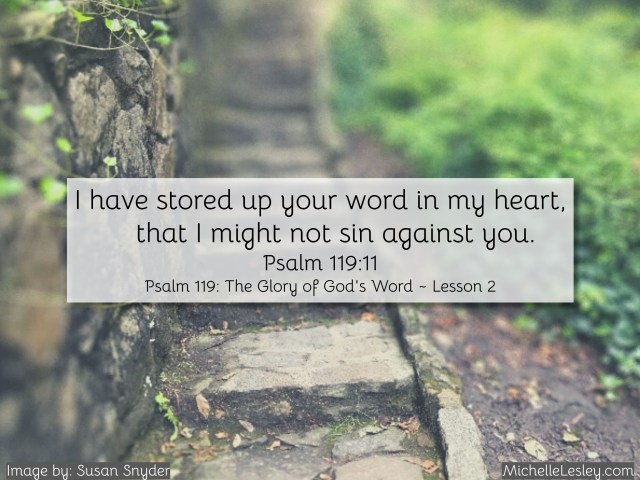
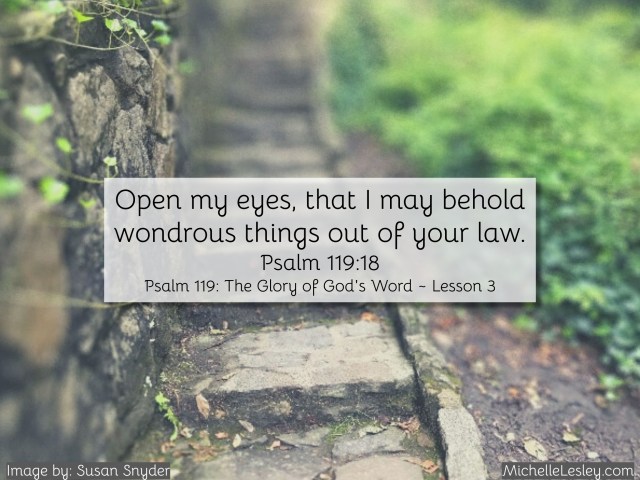
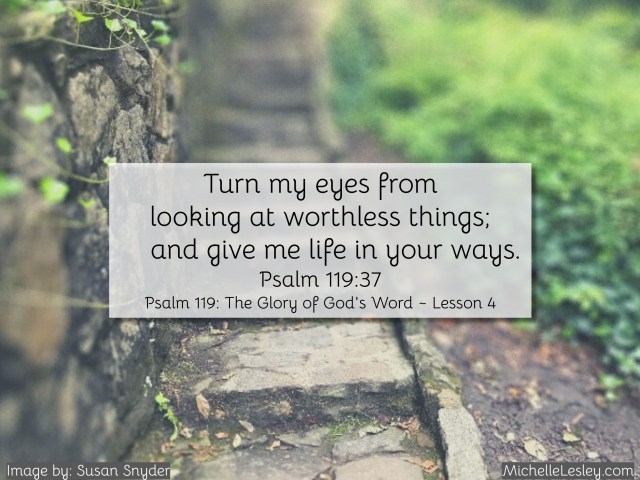
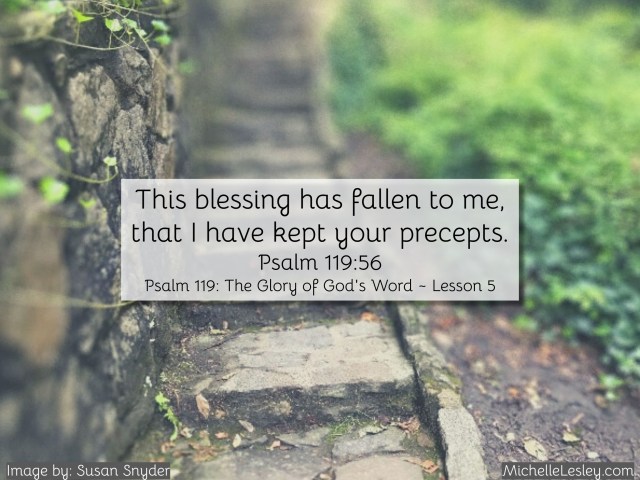
Here are all of our memory verses so far, if you’d like to review them:

Psalm 119 Bible Study

Psalm 119: The Glory of God’s Word ~ Lesson 5

Previous Lessons: 1, 2, 3, 4,

Read Psalm 119:49-64

Recall the things from the introductory lesson that you wanted to keep in mind as you study the text of Psalm 119.

Don’t forget to read in complete sentences instead of stopping at the end of each verse.

Recall the themes you’ve been noticing in Psalm 119. Watch for those themes to be repeated in today’s and future passages. You may wish to make a list of those themes to refer to throughout this study.

Questions to Consider

1. Review your notes from last week’s lesson. Does that passage relate to this week’s passage? How? Do you notice any repeated words, thoughts, or themes?

2. Do you notice a difference in tone between this first section (49-56) and most of the previous sections we’ve studied? How would you characterize the tone of this section? The previous sections? How do our life circumstances impact our perspective of how God’s Word ministers to us? (For example: When you’re joyful, which aspect of God’s Word most ministers to you? Comfort, praise, encouragement, zeal, etc.? When you’re going through hard times?) Proverbs 25:11 tells us “A word fitly spoken is like apples of gold in a setting of silver.” How is Scripture a “word fitly spoken” to each of us, personally, no matter what we’re going through?

3. Anger is often sinful, but how is verse 53 an example of righteous, godly anger?

4. Which verses in these two sections speak to God’s attribute of dependability, being a “man of His word”? How does that bring comfort and stability to the psalmist and to us?

What is the psalmist’s response to God’s dependability? (49, 50, 57) How do you, or how should you, respond to God’s dependability to you?

As God’s people, we are to reflect to others God’s attribute of dependability. How are you doing at being dependable to others – a woman of your word? Are you punctual? Fulfill your commitments? Return correspondence in a timely manner? Follow through? What’s one practical way you could reflect God’s dependability this week? When God’s people aren’t dependable, what does that say to lost people about God?

How does the psalmist “hold God to His word” in prayer in 49, 50, and 58? It is always appropriate in our prayers to recall God’s promises to us (from Scripture) and ask Him to keep or fulfill them. How can we avoid demanding things from God that He never promised us in the first place? Have you noticed any verses or themes we’ve studied so far in Psalm 119 that speak to this?

How is asking God to keep His promises simply asking Him to be who He is?

5. Does verse 56 refer to the blessings that are a consequence of obeying God’s Word, or does it mean that the ability and desire to obey God’s Word is a blessing in and of itself? (It might help to look at this verse in a few other reliable translations.) Why is it a blessing to desire and be able to obey God’s Word? How are we able and Who gives us that desire?

6. Carefully examine 59-60. What kind of “ways” is the psalmist talking about? What is the solution to temptation and sin in…

  • 57, 59-60?
  • 58, 64?
  • 61?
  • 62?
  • 63?

How can you implement each of these in your own life to combat sin?

Consider how Jesus used the weapon of memorized Scripture to combat Satan’s temptations. Why is God’s Word such an effective weapon against temptation and sin? Why doesn’t just avoiding temptation alone – apart from God’s Word – work? Do you run to God’s Word when you’re tempted? What are some verses you could memorize and obey to help you fight temptation and avoid sinning?


Praying Psalm 119

Have you ever tried praying the psalms? I want to encourage you to try praying part of Psalm 119 back to God each week of this study. (If you’re familiar with my other studies, this will take the place of the weekly “Homework” section.)

The psalms are uniquely suited for praying back to God, both verbatim and conceptually, because they are often written as prayers – as though the psalmist is talking to God. Did you notice that about today’s passage? In which verses?

What is a concept or thought for your own life that the Holy Spirit impressed on your heart or convicted you about from today’s passage? Is there a particular verse(s), or maybe the whole passage, that you would like to pray back to God verbatim? Whatever your “prayer point” from today’s lesson, pray it at least daily until we get to the next lesson.


Suggested Memory Verse

Complementarianism, Rock Your Role

Are Female Bloggers Violating Scripture by “Teaching” Men?

“You say that women shouldn’t teach men (1 Timothy 2:12), but what about men who read your blog or listen to your podcast? Aren’t you teaching them?”

It’s the canard that will not die. Complementarian women bloggers, authors, podcasters, and content creators are frequently asked this question, often by dissenters looking for a โ€œgotchaโ€ moment. Other times itโ€™s a genuine concern from Christian women who want to write, speak, or create, but still be in obedience to Godโ€™s Word as it speaks to the role of women. But, whatever the motivation for asking, itโ€™s a great question that needs to be answered. Biblically.

It is true that God has ordained different roles for Christian men and women. Both roles are needed and important, but different. Part of the role for women is outlined in 1 Timothy 2:11-15. Women are not to preach to or teach men in the gathering of the church or hold other positions of authority over men in the church body.

But notice that key phrase โ€œin the church.โ€ The context of all of the passages dealing with women refraining from teaching men refers to the teaching of Godโ€™s Word in the gathering together of the body of believers.

Thatโ€™s not the same thing as writing or speaking in the public square. The gathering of the church body might take place within the four walls of a church building, at a park for a Resurrection Day sunrise service, at a Christian conference, at a chapel service at a Christian college or seminary, at a Bible study in someone’s home, or a myriad of other venues, but it’s just that – a physical gathering together of the body of Christ for the purpose of worship, studying the Word, sitting under the preaching of the Word, observing the ordinances, prayer, practicing the “one anothers,” and other “churchy” things.

You’re reading this blog right now. Are you practicing the “one anothers” with anyone? Is anyone standing in front of you preaching the Word? Are you actively worshiping? Do you see an offering being taken up? Baptism? Communion? Prayer? Do you consider yourself to be attending church right now? Of course not. You’re staring at a screen reading an article. This is a blog. Not the gathering of the church.

The Greek word for “church” in the New Testament is แผฮบฮบฮปฮทฯƒฮฏฮฑ, or ekklesia. It literally means a gathering or assembly. No gathering, no church.1 And because of that, women bloggers and other content creators aren’t violating the Scriptures that prohibit them from teaching men in the gathering of the church. (And, by the way, this all applies to women on social media, too. That’s not the gathering of the church either, praise the Lord.)

When I explain this biblical distinction to the “gotcha” folks, the pushback (that’s a polite word for it) I often get is, “You’re just hypocritically splitting hairs and doing hermeneutical gymnastics to justify yourself!”. No, you’re just conflating things the Bible clearly distinguishes from one another.

Think of it this way: If I say that all sexual activity outside of marriage is sinful, but I joyfully fulfill my marital duty to my husband, am I a hypocrite? Am I splitting hairs or doing hermeneutical gymnastics? No. Because there are right and wrong contexts for sexual activity just like there are right and wrong contexts for women teaching the Bible, writing on biblical topics, and so on. The Bible has defined categories and contexts. The Bible draws lines of distinction. Conflating a biblical “do” with a biblical “don’t”? That’s what’s unbiblical.

But let’s consider something else, too. Even though Scripture doesn’t require it, most godly, doctrinally sound women bloggers and online content creators – including me – aim our content primarily at Christian women. I have set up parameters for my blog (and my book, when it was in print) and for my ministry to do everything I can to place myself under the umbrella of 1 Timothy 2:12. Look at the title of this page and my Facebook page. It specifically says “Discipleship for Christian Women“. My book was always labeled and marketed as a women’s Bible study. If youโ€™ll take a look at the โ€œWelcomeโ€ tab at the top of this page, youโ€™ll see I explicitly say that this blog is for Christian women and that Iโ€™m a complementarian. When I address the readers of this blog I nearly always address them as โ€œladies,โ€ both because my target audience is women, and also to remind the handful of men who follow me that they are not my audience; they are, in a sense, โ€œeavesdropping” on what I’m saying to women. My speaking engagements are for women only. I ask men not to use my Bible studies. I’m not really sure what more I need to do to make it clear that my blog and my ministry are for women, not men.

Don’t men bear any responsibility here? Why should the entire burden for women not “teaching” men fall on the shoulders of women bloggers and content creators? Why don’t the Christian men who are ostensibly so concerned about men consuming content from women address the men who are reading our blogs and following our platforms?

But sometimes these โ€œgotcha guysโ€ – who often have ulterior motives of undermining complementarianism – will visit my blog, claim to have learned something, and then turn around and attack me as a hypocrite for โ€œteachingโ€ them. This is akin to a man listening at the door of a womenโ€™s Sunday school class, then bursting in and saying, โ€œAha! You taught a man.โ€ To those men, I would ask a simple question- If a female blogger puts a fence around her blog and you jump over it and trespass on her property, how is she the one at fault?2

Along with Christian women, Christian men ought also to be obedient to 1 Timothy 2:12 by not seeking out female content creators for biblical instruction for themselves. While I welcome male readers – especially those who are vetting me for their wives and daughters or the women of their church, or to gain a better understanding of the issues affecting Christian women in order to lead and shepherd them better – I do not want men seeking me out for personal biblical instruction. All of my readers should look to the doctrinally sound teaching of their pastors and elders for biblical instruction. For women, my blog should only be a leisure time supplement to their sermons and classes at church.

Being a godly female blogger or content creator can be a tightrope walk. All of us have fallen off from time to time, and in those cases we ask that you extend us grace and forgiveness, knowing that we didnโ€™t do it intentionally or rebelliously. Praise God for the โ€œnetโ€ of Godโ€™s mercy and cleansing that catches us and puts us right back up on that tightrope so we can encourage and build up the lovely Christian ladies in our audience. You mean so much to each of us. We love you and want you to grow in the grace and knowledge of our Lord Jesus Christ. Thatโ€™s why we do what we do.


1This is why it is impossible to “attend church” by watching an online church service. You are not “attending church” online, you are watching other people attend church.

2Brothers, this “trespassing” metaphor is addressed to the aforementioned “gotcha guys,” not solid, complementarian brothers who have stopped by the blog to read something to help them minister to the women in their lives and churches. You are welcome here!

This article is an updated and revamped version of the original article by the same title, published on October 23, 2015.


Additional Resources

Rock Your Role – a series examining the Scriptures governing the biblical role of women in the church

Rock Your Role FAQs

Sisters Are Part of the Family of God, Too!

Women Preaching the Gospel? at A Word Fitly Spoken (on the issue of conflation)

Is it a sin for Christian women to blog? by Doreen Virtue and Jacob Tanner

Psalm 119 Bible Study

Psalm 119: The Glory of God’s Word ~ Lesson 4

Previous Lessons: 1, 2, 3,

Read Psalm 119:33-48

Recall the things from the introductory lesson that you wanted to keep in mind as you study the text of Psalm 119.

Don’t forget to read in complete sentences instead of stopping at the end of each verse.

Recall the themes you’ve been noticing in Psalm 119. Watch for those themes to be repeated in today’s and future passages. You may wish to make a list of those themes to refer to throughout this study.

Questions to Consider

1. Review your notes from last week’s lesson. Does that passage relate to this week’s passage? How? Do you notice any repeated words, thoughts, or themes?

2. Notice the structure of 33-39. How does each sentence start? Is it a declaration, a question, an exclamation, or an imperative (request or command)? Who is doing the requesting? To whom? For whom? (This will be easier to see if you’ll make a verse by verse list, starting with “Teach me…” in 33.) Does verse 40 start the same way? What about the end of 40? How is this passage “bookended” (beginning of 33, end of 40)? What is the main idea of these imperatives?

Now notice how each verse (33-39) concludes. We’ve seen the initial imperative (“Do this”) of each verse. The structure of the conclusion of each verse is “…so that ______.” How would you fill in that blank with a description of the conclusions of the verses? (Again, this is easier if you make a verse by verse list, starting with, “and I will keep it” in 33.) What is the main idea of these conclusions?

How does this passage demonstrate – both in content and in structure – that God must take the initiative in illuminating the psalmist’s understanding of the Word, and that, when God does this, blessings follow? How does the structure reinforce the content? Does the psalmist want God to take this initiative? Why? What are the blessings that result from God increasing the psalmist’s understanding of, love for, and obedience to His Word? What are your thoughts on God taking the initiative in illuminating your understanding of His Word? What are some blessings you’ve experienced as God has increased your understanding of, love for, and obedience to His Word?

3. In verse 37, what might the psalmist have meant by “worthless things” in his life? Could they, in general, have been some of the same worthless things in your life? Think about the things on which you spend your time. What are some worthless things you need to ask God to turn your eyes from in order that He might give you a richer life in His ways? What would He need to turn your eyes and your focus to in order to accomplish this? Connect the thought in verse 37 with these verses in John.

4. What key word do verses 41, 47, and 48 all have in common? This is the first appearance of this word in Psalm 119. Notice how it bookends this section (41-48). Who is the initiator of love (41)? What is the psalmist’s response (47-48) to God’s love coming to him (41)? How does 1 John 4:19 echo this concept?

5. Until this section (41-48) the psalmist’s main focus has been on his own personal relationship to God’s Word, and, through God’s Word, to God Himself. He has focused primarily on God, and secondarily on himself (e.g. “teach me,” “lead me,” etc.). In this passage, he brings others into the mix. Who are the others he speaks of in 42 and 46?

42- How does the content of God’s Word help us to answer scoffers and taunters? How does the Christian character that studying the Word builds help us to answer scoffers and taunters?

46- How do both the content of God’s Word and the character His Word builds in us help us to answer or testify to His goodness before those who have more power or influence than we do, or are intimidating? Why is the psalmist confident he will not ultimately be put to shame (46-47- Remember, read all the way to the end of the sentence.)? What if the “king” ridicules (or worse) the psalmist’s beliefs and testimony, or mocks God?

Explain how our confidence and security hinges on Who or what we trust in.

6. Verse 43 is the psalmist’s first use of the word “hope”. Some people believe, and some religions teach that our only hope of Heaven or being right with God is in keeping God’s rules, being a “good person,” or for our good deeds to outweigh the bad. Is that what the psalmist is saying in this verse? Why or why not, and how do you know? If an unsaved friend tried to use this verse to justify her belief that God is happy with her because she keeps His rules, how would you answer her? Consider verse 43 in light of John 6:68.

7. What is the difference between the “wide place” in 44-45 and the “wide gate” in Matthew 7:13-14? Can you walk in the “wide place” if you enter through the “wide gate”?

8. What have you learned from today’s passage about God being the initiator of illumination and love? What about other spiritual matters? Can you think of any spiritual matter in which man is the initiator rather than God?


Praying Psalm 119

Have you ever tried praying the psalms? I want to encourage you to try praying part of Psalm 119 back to God each week of this study. (If you’re familiar with my other studies, this will take the place of the weekly “Homework” section.)

The psalms are uniquely suited for praying back to God, both verbatim and conceptually, because they are often written as prayers – as though the psalmist is talking to God. Did you notice that about today’s passage? In which verses?

What is a concept or thought for your own life that the Holy Spirit impressed on your heart or convicted you about from today’s passage? Is there a particular verse(s), or maybe the whole passage, that you would like to pray back to God verbatim? Whatever your “prayer point” from today’s lesson, pray it at least daily until we get to the next lesson.


Suggested Memory Verse