Discernment Bible Study

Choose What Is Right: A Study in Discernment- Lesson 2


Previous Lessons: 1,


What Is Discernment?

Read These Passages


Questions to Consider

Throughout this study we will be looking at various passages of Scripture rather than working our way through a book of the Bible verse by verse. Because of that, we will need to be extra vigilant to rightly handle these passages in context. I will always attempt to provide the context you need for understanding these passages correctly, but if you need more clarity please feel free to read as much of the surrounding text as you need to – even the whole book, if necessary – in order to properly understand the passage presented.

1. Quickly read or skim Job 1:1-34:37, especially chapters 32-33, so you’ll have the major points of the story line fresh in your mind. Summarize the story of Job to this point in your own words in a few sentences.

2. Why does Elihu feel the need to speak his piece here (ch. 32-34)? What was the false doctrine with which Job’s three friends were counseling him? What was Job’s position in response to them (32:2)?

Meditate on Elihu’s words in 34:2-4. What does each phrase of this passage teach us about discernment? How does the passage as a whole explain discernment? In your own words, what is this passage saying to us as 21st century Christians? Be sure to explore the concepts of wisdom (2), “testing words,” (3) and the corporate nature, unity, and fellowship (4) of discernment.

3. Carefully examine the two Deuteronomy passages. Which genre of biblical literature is the book of Deuteronomy (law, history, wisdom, poetry, narrative, epistles, or prophecy/apocalyptic)? Generally speaking, were the laws of Deuteronomy laws that governed the Old Testament nation of Israel or New Testament Christians and the church?

Do these two passages in Deuteronomy center on our (vertical) relationship with God, our (horizontal) interpersonal relationships (with friends, family, neighbors, etc.), or maintaining an orderly society (similar to our modern day traffic, liability, tax, etc. laws)?

Which parts of these laws no longer apply to New Testament Christians? (13:5, 18:20) Why? Carefully explain the biblical principles underlying the remainder of these passages:

  • What is God telling His people about our relationship with Him?
  • What is God telling us about how He relates to His people?
  • Why is He telling us the things in this passage?

What do these passages teach us about the nature, character, and attributes of God, and how He desires to be worshiped? Why is it vital that our worship, beliefs, and doctrine are based on truth?

What were the two ways God’s people in the Old Testament could “test the words” of these prophets “as the palate tastes food”? (13:2-3a, 18:21-22) How does this relate to the fact that God used miraculous signs and wonders to authenticate and endorse the message of His true prophets (e.g. Moses, Elijah), Jesus, and the apostles? In what ways do false teachers of today say, “Let us go after other gods.”?

How many times could a prophet prophesy falsely before the death penalty was to be imposed? (Hint: Notice the words “sign,” “wonder,” and “word” in 13:1-2 and 18:20. Are those words singular or plural?) What does this, and the fact that false prophecy/teaching was a capital offense, tell you about how seriously God takes false prophecy/teaching? Does the absence of the death penalty for false teachers in the New Testament indicate that God has changed His mind, “gone soft” on false teaching, or no longer takes it seriously?

Explain what “God is testing you” means in 13:3b. Does God test us because He doesn’t know our hearts and needs to find out whether or not we’ll pass the test?

4. Did you notice that, as we begin to address the concepts of discernment, false doctrine, and false teachers – for Christians – that we’ve started in the Old Testament rather than the New Testament? Many theologians believe the events of the book of Job took place chronologically some time between the tower of Babel and Abraham. Can you think of any instances of false teachers and false doctrine that took place before Genesis 11? What does all of this tell you about the longevity of false doctrine and false teaching?

5. Examine the Acts 17 passage. To whom did Paul and Silas first go with their message – God’s people or the pagans? (10) Upon hearing Paul and Silas’ message, what was the Berean Jews’ initial response? (11) Their subsequent action? (11) The result of their action? (12) Which came first, believing the teachers’ message or examining the teachers’ message against Scripture? Why is this order important? How can we imitate the Bereans’ response>>action>>result when we encounter a new teacher today?

What word does God use in verse 11 to describe these Jews due to their discernment? Many professing Christians today characterize discernment and discerning Christians as “critical,” “negative,” “devoid of love,” “divisive,” and so on. How does God characterize discernment and discerning Christians?


Homework

  • Consider Job’s story. How can suffering make us vulnerable to believing false doctrine, and why is it especially important that we believe sound doctrine during times of suffering? Do you know a sister in Christ who is currently in a season of suffering? How can you help her avoid being deceived by false teachers and false doctrine? Pray for her, and how you might encourage her with the truth of God’s Word, this week.
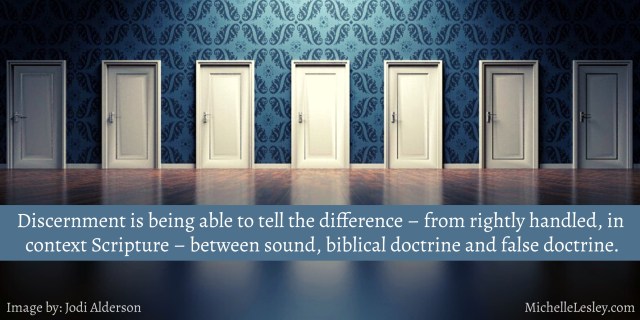
  • How do each of today’s passages fit with the definition of discernment in the image at the beginning of this lesson?

Suggested Memory Verse
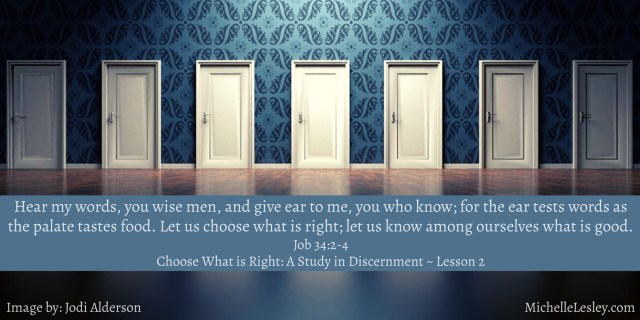
(Every week of our study, you’ll see a suggested memory verse like the one above. You are welcome to grab the memory verse pic to use as your screensaver or wallpaper on your phone or computer, print it out and stick it somewhere you’ll see it frequently, or use it in any other way you wish to help you memorize the verse.)

Discernment, False Doctrine, False Teachers

Throwback Thursday ~ Clinging to the Golden Calf: 7 Godly Responses When Someone Says You’re Following a False Teacher

Originally published January 16, 2015

Ever heard of Jeroboam? If you’ve read your Old Testament, the name probably rings a bell, but, let’s face it, it’s hard to keep all those Jeroboams, Rehoboams, Ahinoams, and Abinoams straight, right? Well, let’s read a little bit about Jeroboam:

And Jeroboam said in his heart, โ€œNow the kingdom will turn back to the house of David. 27 If this people go up to offer sacrifices in the temple of the Lord at Jerusalem, then the heart of this people will turn again to their lord, to Rehoboam king of Judah, and they will kill me and return to Rehoboam king of Judah.โ€ 28 So the king took counsel and made two calves of gold. And he said to the people, โ€œYou have gone up to Jerusalem long enough. Behold your gods, O Israel, who brought you up out of the land of Egypt.โ€ 29 And he set one in Bethel, and the other he put in Dan. 30 Then this thing became a sin, for the people went as far as Dan to be before one. 31 He also made temples on high places and appointed priests from among all the people, who were not of the Levites. 32 And Jeroboam appointed a feast on the fifteenth day of the eighth month like the feast that was in Judah, and he offered sacrifices on the altar.

1 Kings 12:26-32a

The Kingdom of Israel had just split into the southern kingdom of Judah and the Northern kingdom of Israel. Jerusalem, where the temple is located, is in Judah. Jeroboam (king of Israel) figures that if his people continue traveling to Jerusalem for feasts and sacrifices, they will eventually turn their loyalty back to the the kingly lineage of David (aka: Judah, 26-27) and heโ€™ll lose both his kingdom and his head. So, in order to keep the people inside the borders of Israel and control them, he makes a couple of golden calves (which somebody should have remembered turned out badly the last time that was tried {Exodus 32}) for them to worship at either of two convenient locations, Bethel, in the southern part of Israel, and Dan in the northern part. Jeroboam, leading the way, had the Israelites simply transfer their feasts and sacrifices that they would have offered to God to these golden calves. It’s a fascinating story that you can read more about here if you’re interested.

So why am I going on and on about Jeroboam?

Because Jeroboam’s story is so similar to something that is happening in the visible church today. He was a well known personality who led God’s people to worship an idol which he told them was God. And God’s people went along with it, transferring their worship from the one true God to the golden calf called “God.”

There are a ton of Jeroboams out there today. Some of you reading this might be following one of them and worshiping the idol their false theology tells you is the God of the Bible. And in the same way that a man of God came along and rebuked Jeroboam for his blasphemy, a man or woman of God might come along and call out the Christian celebrity you’re following, or take you aside -out of love and concern- and let you know that person is a false teacher.

I hope you won’t respond like Jeroboam did. He was so angry, he tried to kill the prophet. But sadly, I have seen this type of response (at least verbally) many times, especially from women, when faced with the fact that their favorite Bible teacher or author is preaching a false gospel.

So, what’s a godly way to respond when someone tells you you’re following a false teacher?

1. Consider the source and listen.

If you know the person who’s telling you this, think about her godliness and character. Is she generally a godly person? Does she know her Bible well? Does she show love and concern for others? Is she trustworthy? A godly person of good character has no reason to toss out wild and unfounded accusations, especially if you’re her friend and it might offend you. In fact, she’s probably scared to tell you.

But even if it’s a stranger on a blog saying Celebrity Bible Woman is a false teacher, hear her out and make sure you understand what the issues are. Remember, what she’s saying might be true, but you’ll never know if you immediately write her off.

2. Listen for content, not tone.

There are some discerning people out there who will bring you flowers and candy and hold your hand as they gently tell you the person you’re following is a false teacher, and then there are discerning people whose tone or manner might rub you the wrong way as they’re delivering the news. Don’t let the way something is said turn you off to the content of what is being said. Don’t sacrifice truth on the altar of tone.

3. Keep your emotions in check.

It’s tempting to let our feelings take charge when we’re receiving bad news, but you aren’t going to be able to evaluate the content of what the person is saying if you’re consumed by rage or hurt. It might help to remind yourself of your relationship to the teacher/author in question. Do you even know her personally? It’s not like someone is leveling accusations against your child, spouse, or best friend. Put your emotions aside and let reason and clear thinking rule the day.

4. Don’t blindly believe the messenger.

You don’t have to -nor should you- believe everything you hear just because it quotes a Bible verse or wraps itself in the label “Christian”. That applies to both the person who tells you you’re following a false teacher and the alleged false teacher herself. Listen carefully to what the person has to say, make sure you understand it, then get out your Bible and get to work. Are the issues the person has raised biblical? What does God’s word have to say about these issues? Is the person you’re following violating Scripture? If so, choose to stop following the false teacher because the Bible -not a person- tells you to do so. People are fallible. God’s word is not.

5. Don’t shoot the messenger.

It’s been my experience that women who are loyal devotees of false teachers can be some of the most vicious people in the world if you dare to question their idol. I have had women verbally rip me to shreds, threaten me, call me names, accuse me of “judging,” and tell me I’m what’s wrong with Christianity for politely pointing out from Scripture that someone is teaching false doctrine. Ladies, we give Christian women as a whole a bad name when we act like that. More importantly, that kind of behavior is a reproach to Christ, and never appropriate for someone who calls herself a Christian.

6. Defend from Scripture, not opinion,
emotion, or personal preferences.

It is downright embarrassing when a person is shown that Celebrity Bible Woman is violating a certain Scripture, and her only argument is, “But I just LOVE her! She’s such a great teacher and helps me understand the Bible so well!” If it were really true that Celebrity Bible Woman is such a great Bible teacher, her followers ought to be able to  prove -from Scripture- that what Celebrity Bible Woman is doing or teaching isn’t unbiblical. The bottom line is that Scripture is our ultimate authority, not our opinions, not our personal preferences, not how much we love a certain teacher. For a Christian, if something comes up against the Bible, the Bible wins. Period. So, if you’re going to defend Celebrity Bible Woman, defend her from Scripture. And if you can’t, why are you still following her?

7. Love Christ more than you
love your favorite teacher.

If someone shows you from Scripture that your favorite teacher, author, or pastor is teaching false doctrine and you ignore that warning because you are so enamored with that teacher, then what you’re saying is that you love that teacher more than you love Christ and His word. Jesus said:

Whoever loves father or mother more than me is not worthy of me, and whoever loves son or daughter more than me is not worthy of me.

Matthew 10:37

Your parents. Your children. They’re the people you love most in the world. If Jesus says you can’t love them more than you love Him, do you think it’s going to be OK with Him if you love your favorite Bible teacher more than you love Him? It’s not. Love Christ above all else, and cut that false teacher out of your life.

It can be difficult to hear that you’re following a false teacher. You like her. She makes you feel good. You think you’re doing great in your walk with the Lord. It’s hard to give all that up. But we must be careful that we never put our feelings for a person above Christ and His word. If someone tells you you’re following a false teacher, don’t brush her off or attack her. She’s most likely coming to you out of love and concern for you and for the body of Christ. Check out what she’s saying against the Bible. And if she turns out to be right, stop following that false teacher and thank her. Because a person who rescues you from an enemy of Christ is truly your friend.

Discernment Bible Study

Choose What Is Right: A Study in Discernment ~ Lesson 1- Introduction

Ladies, be sure you don’t skip this introductory lesson to our study!

Welcome to our new study, Choose What is Right: A Study in Discernment!

Discernment has various connotations in various contexts, but for the purposes of this study, weโ€™re going to keep the focus narrow and define discernment as being able to tell the difference – from rightly handled, in context Scripture – between sound, biblical doctrine and false doctrine.

What does the Bible say about discerning between true and false doctrine? How does God regard false teachers, and how are we to deal with them in our personal lives and families, and as the church?

Have you ever read the book of Job? When we think about Jobโ€™s story, our minds usually turn to the theme of suffering, and how to suffer well as Christians, but did you realize another major theme of the book of Job is discernment? Jobโ€™s three friends come to him in his suffering and comfort him with โ€ฆ false doctrine. Job is well on his way to believing them when his true friend, Elihu, steps in and, though heโ€™s not perfect, does his level best to correct them.

The theme verse for this topical study in discernment comes from Elihuโ€™s speech in Job 34:

Hear my words, you wise men, and give ear to me, you who know; for the ear tests words as the palate tastes food. Let usย choose what is right; let us know among ourselves what is good.

Job 34:2-4

This 11-15 lesson study will help us to be wise women who pay attention to what God says about discernment and how to avoid false doctrine. It will show us how to test words as the palate tastes food. It will teach us to know what is good, so we can choose what is right.

The striking title image for our study was designed by Jodi Alderson. To me the doors represent the idea that we are often presented with several options of teachers or doctrines that all appear, on the surface, to be equally good and biblical. We must use our discernment skills to find out which ones actually match up with Scripture.

Another aspect of the image I like is the use of light and darkness. We live in a world of darkness. Some of the doors we’re presented with are obviously dark and will only lead to more darkness. But some of the doors appear to shine forth the light of truth. (It reminds me of 2 Corinthians 11:14-15, which is a verse we’ll tackle later in this study.) Which ones really lead to truth? We have to know what is good so we can choose the ones that are right. Great job, Jodi!

Many thanks to all of those who worked so hard on your entries for our title pic contest. You ladies were very creative and did some outstanding work!ย 

There were too many entries to share all of them with you, but here are a few “honorable mentions”:

Laura Ezinga
Brenna Van Cleve
Robin Self
Cheryl Toepfer

(I need to apologize for creating some confusion in the article announcing the title pic contest about whether the title was supposed to be “Choose What is Right” or “Choose What is Good“. I think what happened is that I have a teaching session for my speaking engagements on Titus 2:3-5 entitled “Teach What Is Good” and that title kept getting mixed up in my brain with the title and key verse for this study. Thank you so much to those who brought this error to my attention. I promise my mix up did not affect the contest in any way. I was judging images and design, not wording.)


If you’re new to using my Bible studies, just a few housekeeping items and helpful hints:

The studies Iโ€™ve written (you can find all of them at the Bible Studies tab in the blue menu bar at the top of this page) are like โ€œtraining wheelsโ€. Theyโ€™re designed to teach you how to study the Bible for yourself and what kinds of questions to ask of the text so that, when you get the hang of it, you wonโ€™t have to depend on other peopleโ€™s books and materials โ€“ even mine โ€“ any more. To that end, I do not provide answers for the study questions in the studies Iโ€™ve written.

My studies are meant to be extremely flexible and self-paced so that you can use them in the way that works best for you. You can do an entire lesson in one day or work on the questions over the course of the week (or longer). You do not need to feel obligated to answer all (or any) of the questions. If the Holy Spirit parks you on one question for several days, enjoy digging deep into that one aspect of the lesson. If He shows you something I haven’t written a question about that captures your attention, dive in and study it! Those are ways the Holy Spirit speaks to us through His Word. This is your time to commune with the Lord, not a school assignment or work project you are beholden to complete in a certain way by a certain deadline.

I will post a new lesson on the blog every other Wednesday, so there is nothing to sign up for or commit to. Simply stop by the blog every other week, or subscribe to the blog via e-mail to have the lessons delivered to your inbox.

I use hyperlinks liberallyThe Scripture passage for each lesson will be linked at the beginning of the lesson. As you’re reading the lesson, whenever you see a word in a different color text, click on it, and it will take you to a Scripture, article, or other resource that will help as you study.

All of the studies Iโ€™ve written are suitable for groups or individuals. You are welcome to use them as a Sunday school or Bible study class curriculum (for free) with proper attribution.

You are also welcome to print out any of my Bible studies (or any article Iโ€™ve written) for free and make as many copies as youโ€™d like, again, with proper attribution. Iโ€™ve explained more about that in this article (3rd section).

From time to time I receive inquiries from men about using my studies for their personal quiet time or for teaching a co-ed or men’s Bible study class. It is my personal conviction that it is more in keeping with the spirit (though not the letter) of 1 Timothy 2:12, Titus 2:3-5, and related passages for men to use Bible study materials authored by men rather than by women. Therefore, on the honor system, I would request that men please not use my studies for personal use, or when teaching a class with male members. (Vetting the studies for your wife, daughter, or the women of your church, is, of course, fine. Encouraged, actually.)


Introduction to
Choose What Is Right: A Study in Discernment

Part of my philosophy of Bible study is that our main “diet” should be systematic, expositional study of the text. In other words: pick a book of the Bible, start at the beginning, and study it through to the end. Then, pick another book and start again. This method of studying helps us understand passages in their context and correctly apply them to our lives, and helps us avoid eisegesis, taking passages out of context, and incorrectly applying them.

However, thereย is a place for the study of a biblical topic such as peace, sin, the family, God’s wrath, or biblical womanhood. For example: if you’re struggling to trust God because of a sudden circumstance in your life, you don’t have time to study through every book of the Bible to learn what the Bible says about trusting God. You may need to spend some time in focused study on passages from various books that deal specifically with the topic of trusting God, and that’s OK. My goal with this study is not only that you learn what the Bible has to say about the topic of discernment, but also to demonstrate how to do a topical study properly so you can do topical studies on your own when the need arises.

Normally, in the introductory lesson to my studies, we take a look at the author of the book of the Bible we’re studying, the audience he wrote it to, the historical setting of the book, and other “backstory” issues. But because this is a topical study, and we’ll be examining passages from various books of the Bible, we’ll have to briefly address those issues as needed in each lesson.

So in the introduction to this study, I’d like to address two items in your “backstory.”

Salvation

If you’re not saved, this study isn’t going to be very helpful to you, because, as we’ll soon learn, lost people are naturally drawn to false teachers and false doctrine, and are incapable of truly embracing the things of God.

This week, before we tackle discernment, I’d like everyone – even if you know beyond a shadow of a doubt that you’re saved – to work through the Scriptures and materials at the What Must I Do to Be Saved? tab in the blue menu bar at the top of this page (and while you’re there, let’s do a little social media evangelism – share the link for that page around to your friends and followers!).

Do you understand theย biblicalย gospel? Have you truly repented of your sin and trusted Christ as Savior? Spend some time alone with God examining your heart and life against these Scriptures. If you’re unsure whether or not you’re genuinely saved, I would encourage you to put this study aside and work through my studyย Am I Really Saved?: A First John Check Up first. You cannot be discerning if you don’t belong to God.

Expectations and Presuppositions

What do you expect out of this study? What kinds of ideas or preconceived notions are you carrying into this study? Take some time to answer the following questions.

1. When you hear the word “discernment,” what do you think of?

2.ย Without looking in your Bible, jot down five or ten things youย think the Bible teaches about discernment.

3. What does your church teach about discernment? Is your church careful about its doctrine and the materials it uses? Is there someone in your church that you look up to as a good example of discernment?

4. What Scriptures come to mind when you think about discernment?

5. Why are you interested in a study about discernment, and what do you hope to get out of this study?

6. What are your strengths and weaknesses when it comes to discernment? What are some things you’d like to improve on?

Take some time in prayer between now and our next lesson to begin preparing your heart for this study. If there’s a specific issue you struggle with when it comes to discernment, ask God to teach you the truth of His Word about that issue and strengthen you in that area. Write down your prayer and review it when the study is over to see how God answered you through the study of His Word. I’m excited to have you join me in this journey of discovering what God’s Word has to say about discernment!

Our next lesson will be two weeks from today.

Podcast Appearances

Podcast Guest Appearance – Ordinary People with Extraordinary Lives

I really enjoyed this discussion with my OHCW co-laborer, Arlenys Buckelew. Her podcast, Ordinary People with Extraordinary Lives centers around a really fantastic and encouraging theme: the testimonies of ordinary Christians.

Listen in as Arlenys and I chat about my testimony, growing up in the church, and walking with the Lord over a lifetime. (This episode dropped recently, but we recorded it several months ago, so there are a few things I mentioned that aren’t quite up to date.) You can watch and listen above or listen on Anchor, Apple, or Spotify.

Be sure to visit Arlenys’ website, subscribe to her YouTube channel, and follow her on social media.


Articles / resources mentioned or touched on in the episode:

Open Hearts in a Closed World

Searching for a new church?

Bible Studies

A Word Fitly Spoken

What must I do to be saved?


Got a podcast of your own or have a podcasting friend who needs a guest? Need a speaker for a womenโ€™s conference or church event? Click the โ€œSpeaking Engagementsโ€ tab in the blue menu bar at the top of this page, drop me an e-mail, and letโ€™s chat!

Titus Bible Study

Titus: God’s Order of Service ~ Lesson 7- Wrap Up

Previous Lessons: 1, 2, 3, 4, 5, 6

Wrap Up

Questions to Consider

1. Was there anything new God taught you in this study that particularly impacted you? What was it, and why was it so significant?

2. How is your walk with the Lord different after this study than it was before?

3. What did you learn from this study about the nature and character of God?

4. What did this study teach you about the structure and order of the church? About the orderliness of God?

5. What did this study teach you about your role, function, and responsibilities as a church member?

6. Have there been any passages or concepts in this study that God used to convict you of disobedience and lead you to repentance? How will you walk differently in this area from now on?

7. Describe one specific, practical way you will apply to your life something you learned in this study.


Homework

Spend some time in prayer this week asking God to show you how to put into practice one thing you learned from this study.

Recite all of your memory verses from this study. Which one is most meaningful to you right now?